
Number Sequences overhang This Lecture We will study
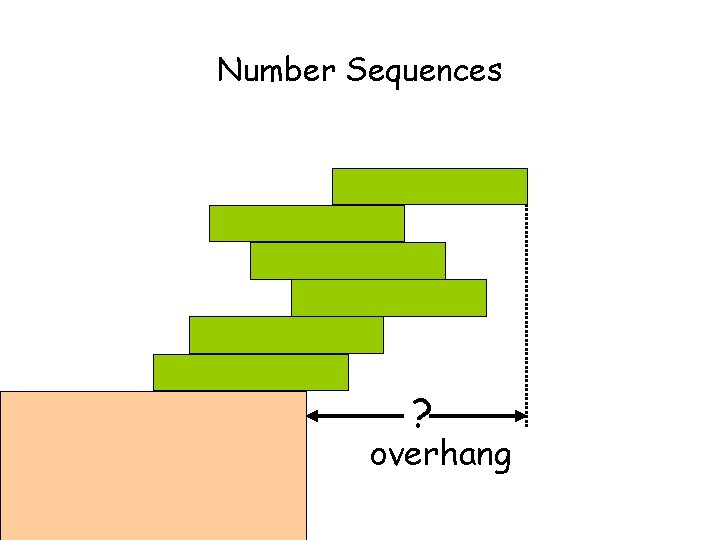
Number Sequences ? overhang
This Lecture We will study some simple number sequences and their properties. The topics include: • Representation of a sequence • Sum of a sequence • Arithmetic sequence • Geometric sequence • Applications • Harmonic sequence • Product of a sequence • Factorial
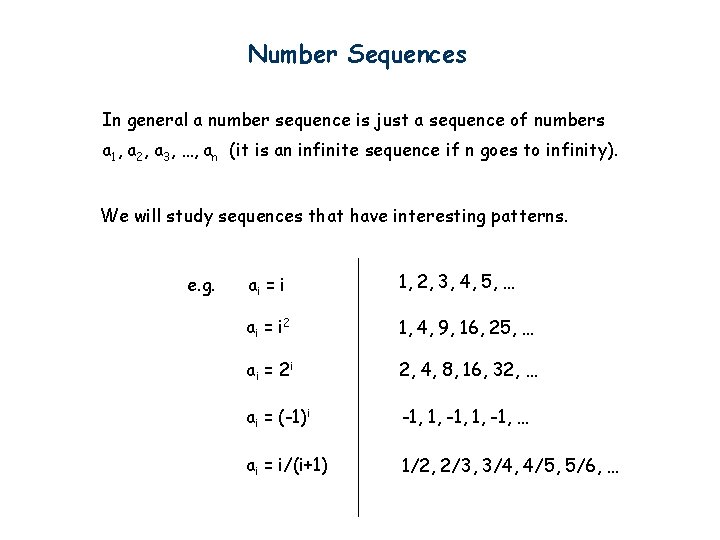
Number Sequences In general a number sequence is just a sequence of numbers a 1, a 2, a 3, …, an (it is an infinite sequence if n goes to infinity). We will study sequences that have interesting patterns. e. g. ai = i 1, 2, 3, 4, 5, … ai = i 2 1, 4, 9, 16, 25, … ai = 2 i 2, 4, 8, 16, 32, … ai = (-1)i -1, 1, -1, … ai = i/(i+1) 1/2, 2/3, 3/4, 4/5, 5/6, …
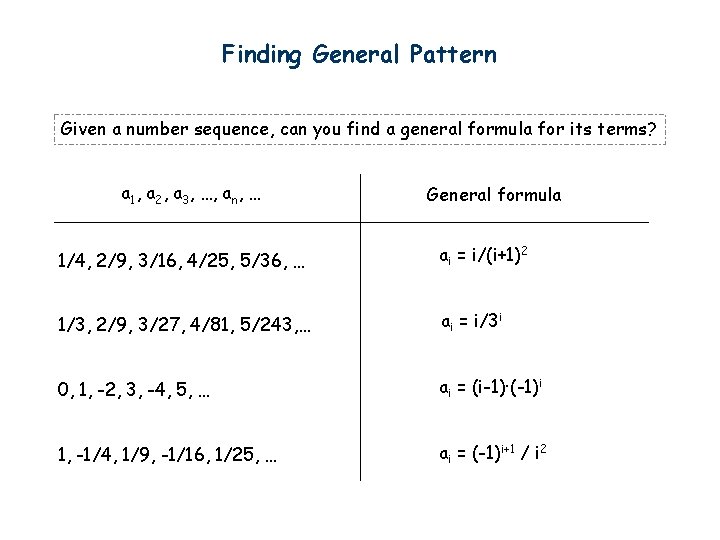
Finding General Pattern Given a number sequence, can you find a general formula for its terms? a 1, a 2, a 3, …, an, … General formula 1/4, 2/9, 3/16, 4/25, 5/36, … ai = i/(i+1)2 1/3, 2/9, 3/27, 4/81, 5/243, … ai = i/3 i 0, 1, -2, 3, -4, 5, … ai = (i-1)·(-1)i 1, -1/4, 1/9, -1/16, 1/25, … ai = (-1)i+1 / i 2
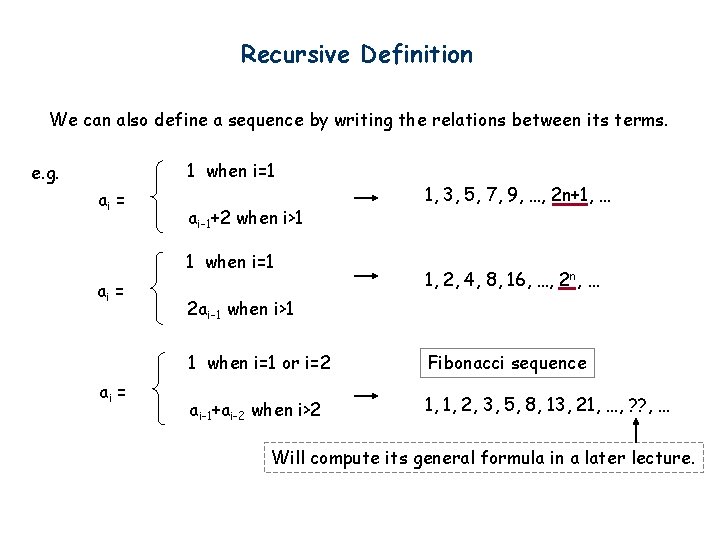
Recursive Definition We can also define a sequence by writing the relations between its terms. 1 when i=1 e. g. ai = ai-1+2 when i>1 1 when i=1 ai = 1, 3, 5, 7, 9, …, 2 n+1, … 1, 2, 4, 8, 16, …, 2 n, … 2 ai-1 when i>1 1 when i=1 or i=2 Fibonacci sequence ai-1+ai-2 when i>2 1, 1, 2, 3, 5, 8, 13, 21, …, ? ? , … Will compute its general formula in a later lecture.
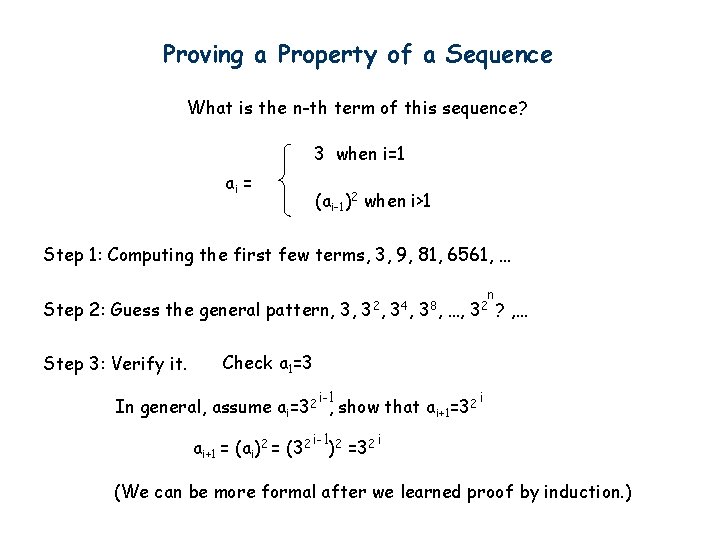
Proving a Property of a Sequence What is the n-th term of this sequence? 3 when i=1 ai = (ai-1)2 when i>1 Step 1: Computing the first few terms, 3, 9, 81, 6561, … Step 2: Guess the general pattern, 3, Step 3: Verify it. 3 2, 3 4, 3 8, …, n 32 ? , … Check a 1=3 i-1 In general, assume ai=32 , show that ai+1=32 i-1 ai+1 = (ai)2 = (32 )2 =32 i i (We can be more formal after we learned proof by induction. )
This Lecture • Representation of a sequence • Sum of a sequence • Arithmetic sequence • Geometric sequence • Applications • Harmonic sequence • (Optional) The integral method • Product of a sequence • Factorial
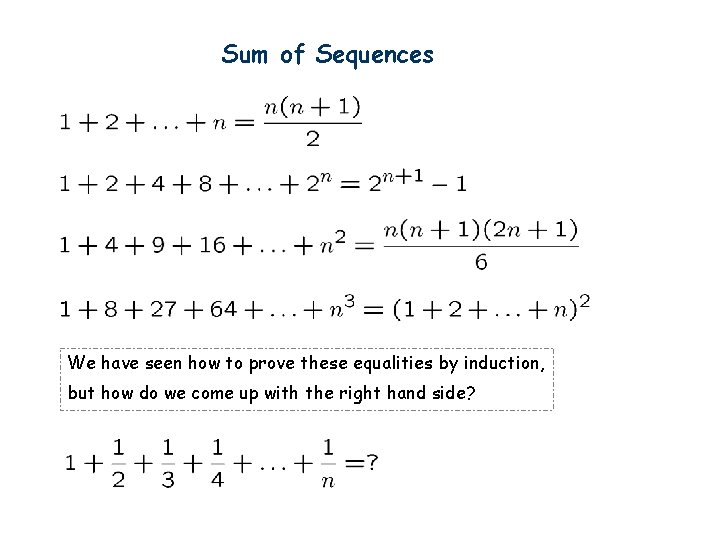
Sum of Sequences We have seen how to prove these equalities by induction, but how do we come up with the right hand side?
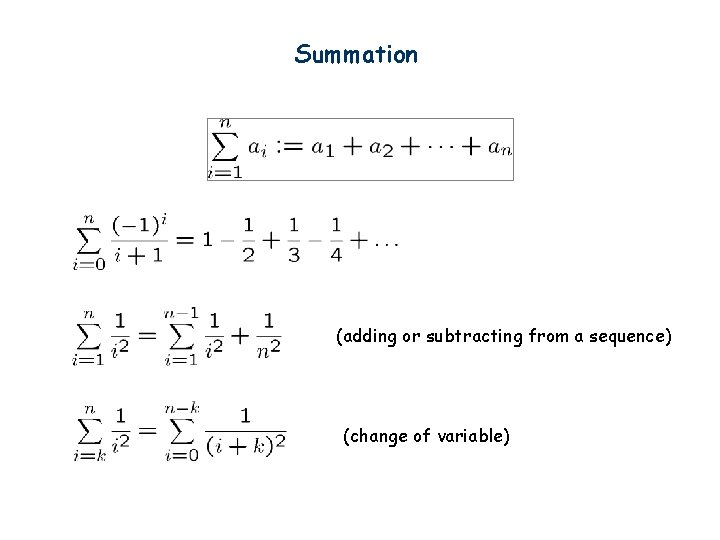
Summation (adding or subtracting from a sequence) (change of variable)
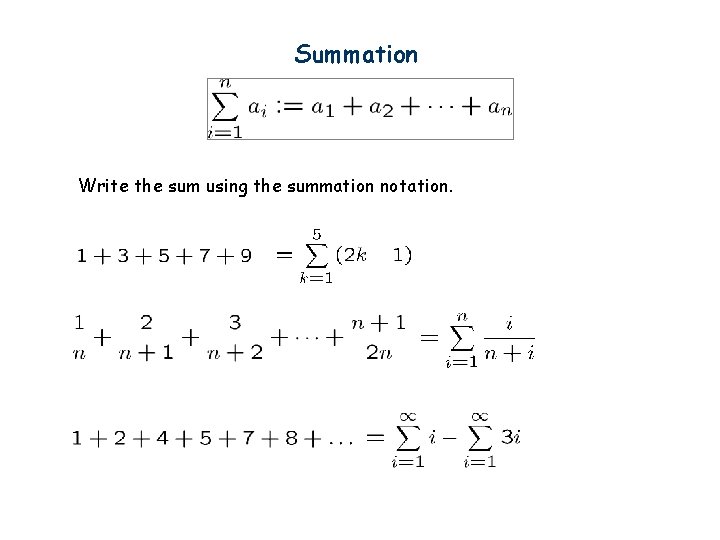
Summation Write the sum using the summation notation.
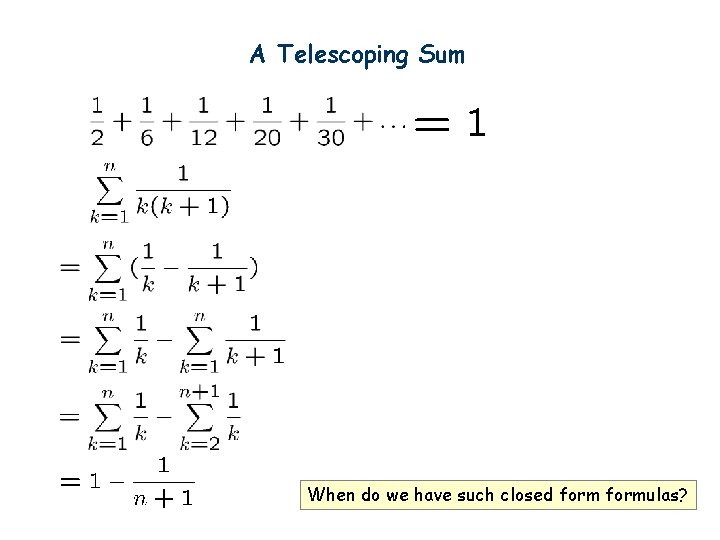
A Telescoping Sum When do we have such closed formulas?
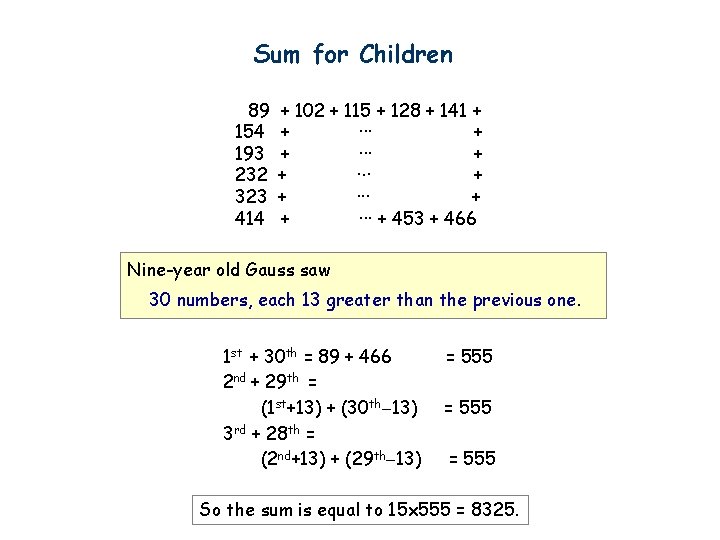
Sum for Children 89 154 193 232 323 414 + 102 + 115 + 128 + 141 + + ··· + + ··· + 453 + 466 Nine-year old Gauss saw 30 numbers, each 13 greater than the previous one. 1 st + 30 th = 89 + 466 2 nd + 29 th = (1 st+13) + (30 th 13) 3 rd + 28 th = (2 nd+13) + (29 th 13) = 555 So the sum is equal to 15 x 555 = 8325.
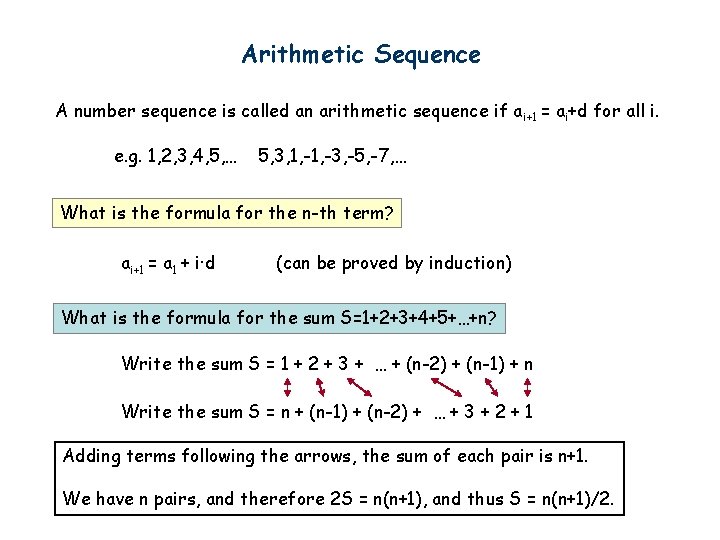
Arithmetic Sequence A number sequence is called an arithmetic sequence if a i+1 = ai+d for all i. e. g. 1, 2, 3, 4, 5, … 5, 3, 1, -3, -5, -7, … What is the formula for the n-th term? ai+1 = a 1 + i·d (can be proved by induction) What is the formula for the sum S=1+2+3+4+5+…+n? Write the sum S = 1 + 2 + 3 + … + (n-2) + (n-1) + n Write the sum S = n + (n-1) + (n-2) + … + 3 + 2 + 1 Adding terms following the arrows, the sum of each pair is n+1. We have n pairs, and therefore 2 S = n(n+1), and thus S = n(n+1)/2.
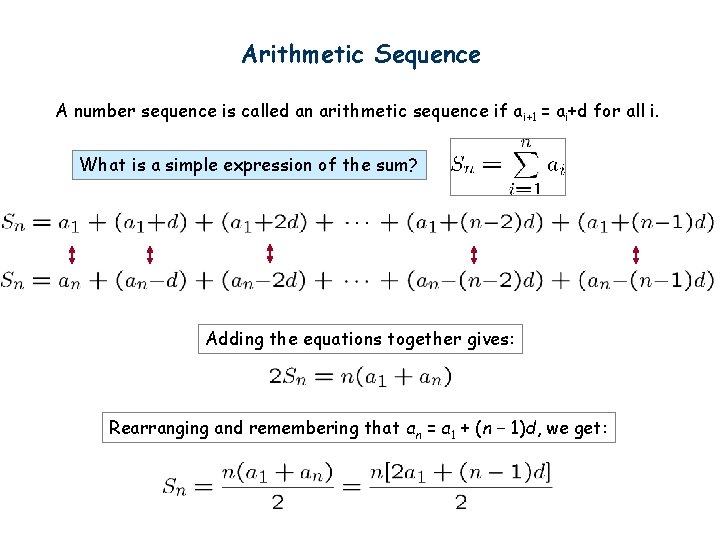
Arithmetic Sequence A number sequence is called an arithmetic sequence if a i+1 = ai+d for all i. What is a simple expression of the sum? Adding the equations together gives: Rearranging and remembering that an = a 1 + (n − 1)d, we get:
This Lecture • Representation of a sequence • Sum of a sequence • Arithmetic sequence • Geometric sequence • Applications • Harmonic sequence • (Optional) The integral method • Product of a sequence • Factorial
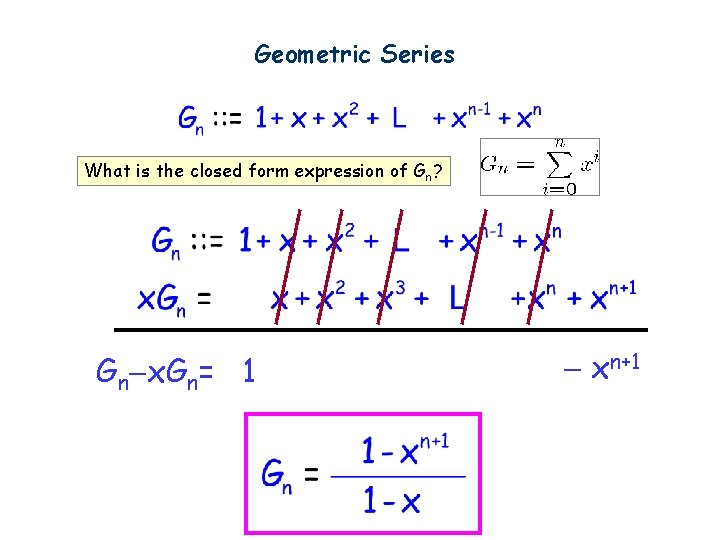
Geometric Series What is the closed form expression of Gn? Gn x. Gn= 1 xn+1
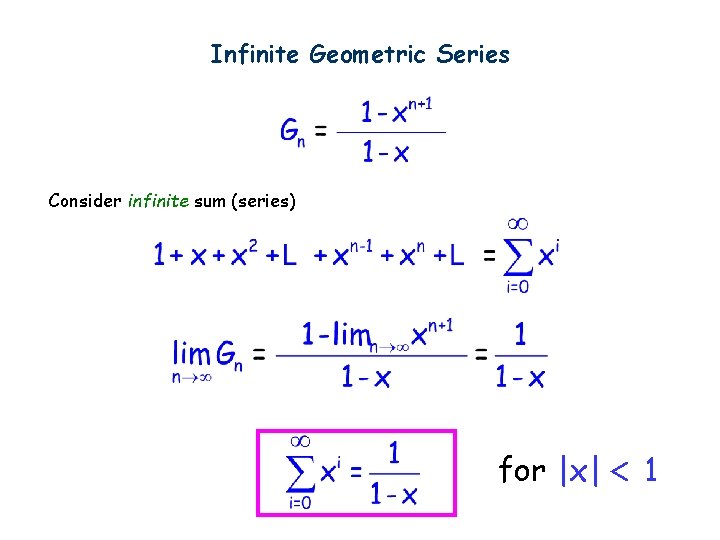
Infinite Geometric Series Consider infinite sum (series) for |x| < 1
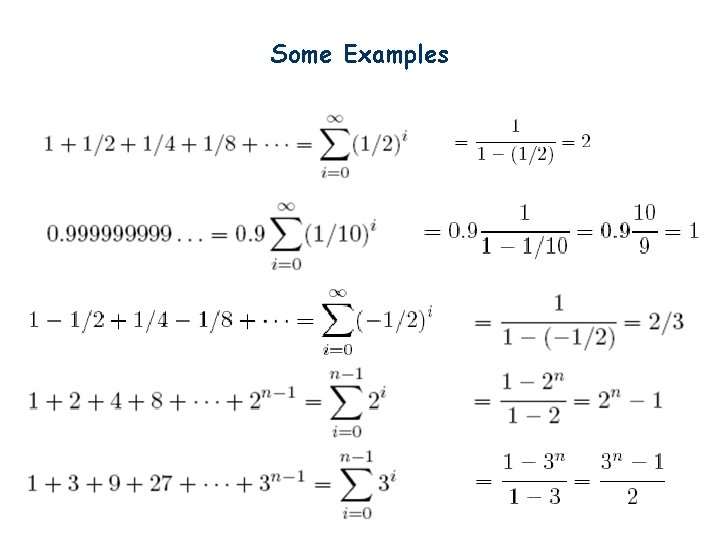
Some Examples
This Lecture • Representation of a sequence • Sum of a sequence • Arithmetic sequence • Geometric sequence • Applications • Harmonic sequence • (Optional) The integral method • Product of a sequence • Factorial

The Value of an Annuity Would you prefer a million dollars today or $50, 000 a year for the rest of your life? An annuity is a financial instrument that pays out a fixed amount of money at the beginning of every year for some specified number of years. Examples: lottery payouts, student loans, home mortgages. A key question is: what is an annuity worth? In order to answer such questions, we need to know what a dollar paid out in the future is worth today.
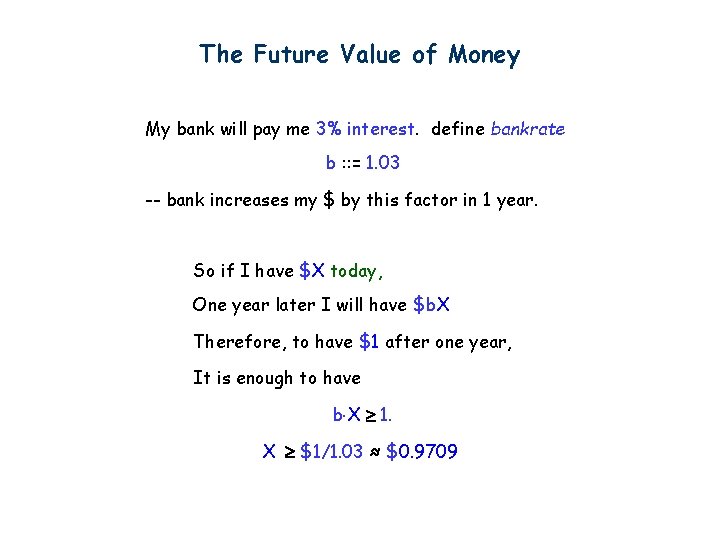
The Future Value of Money My bank will pay me 3% interest. define bankrate b : : = 1. 03 -- bank increases my $ by this factor in 1 year. So if I have $X today, One year later I will have $b. X Therefore, to have $1 after one year, It is enough to have b X 1. X $1/1. 03 ≈ $0. 9709
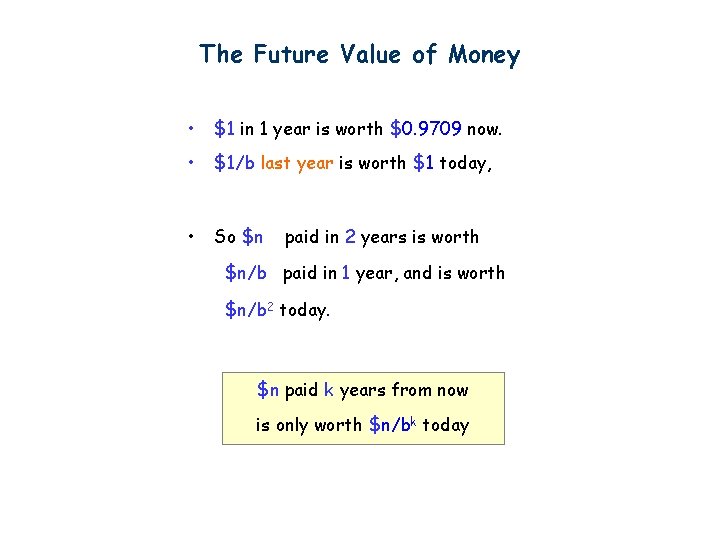
The Future Value of Money • $1 in 1 year is worth $0. 9709 now. • $1/b last year is worth $1 today, • So $n paid in 2 years is worth $n/b paid in 1 year, and is worth $n/b 2 today. $n paid k years from now is only worth $n/bk today
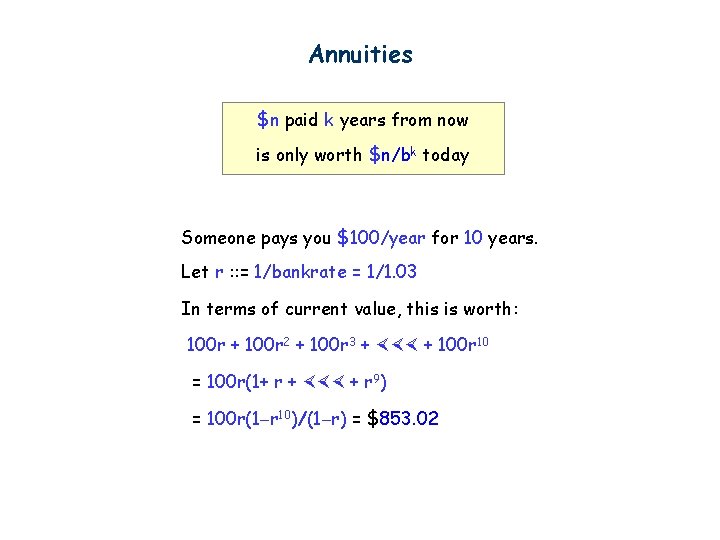
Annuities $n paid k years from now is only worth $n/bk today Someone pays you $100/year for 10 years. Let r : : = 1/bankrate = 1/1. 03 In terms of current value, this is worth: 100 r + 100 r 2 + 100 r 3 + + 100 r 10 = 100 r(1+ r + + r 9) = 100 r(1 r 10)/(1 r) = $853. 02
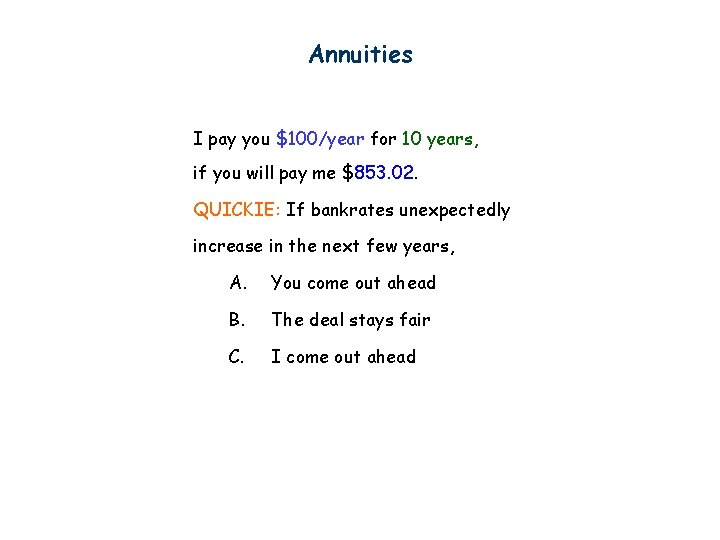
Annuities I pay you $100/year for 10 years, if you will pay me $853. 02. QUICKIE: If bankrates unexpectedly increase in the next few years, A. You come out ahead B. The deal stays fair C. I come out ahead
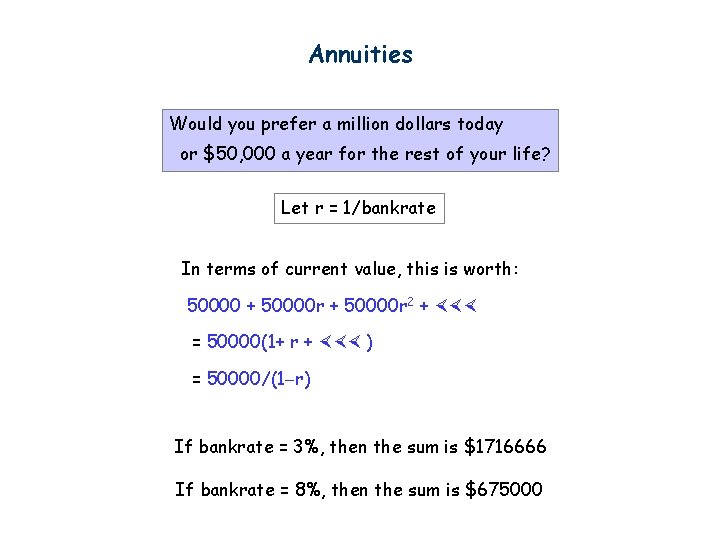
Annuities Would you prefer a million dollars today or $50, 000 a year for the rest of your life? Let r = 1/bankrate In terms of current value, this is worth: 50000 + 50000 r 2 + = 50000(1+ r + ) = 50000/(1 r) If bankrate = 3%, then the sum is $1716666 If bankrate = 8%, then the sum is $675000
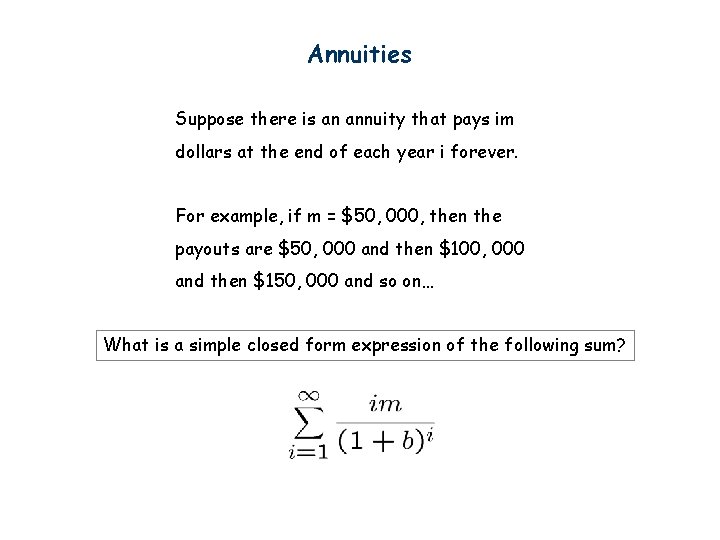
Annuities Suppose there is an annuity that pays im dollars at the end of each year i forever. For example, if m = $50, 000, then the payouts are $50, 000 and then $100, 000 and then $150, 000 and so on… What is a simple closed form expression of the following sum?
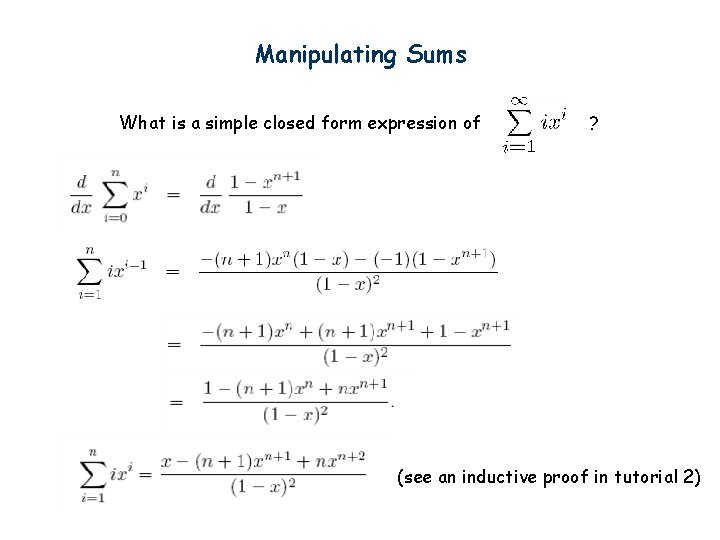
Manipulating Sums What is a simple closed form expression of ? (see an inductive proof in tutorial 2)
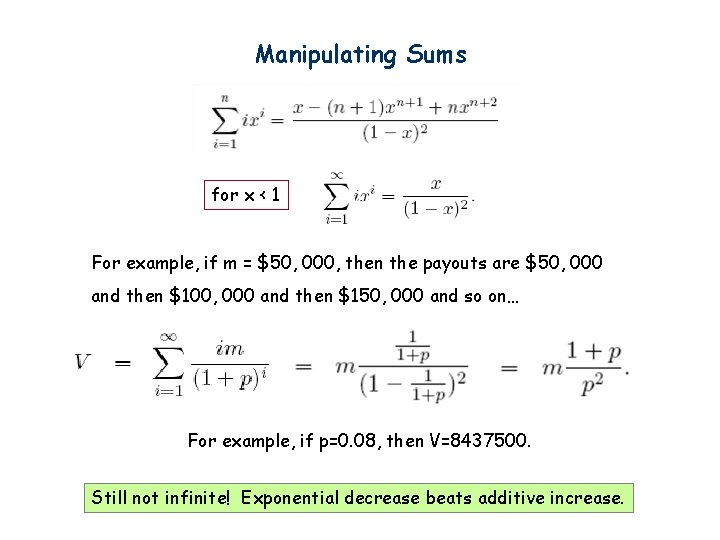
Manipulating Sums for x < 1 For example, if m = $50, 000, then the payouts are $50, 000 and then $100, 000 and then $150, 000 and so on… For example, if p=0. 08, then V=8437500. Still not infinite! Exponential decrease beats additive increase.
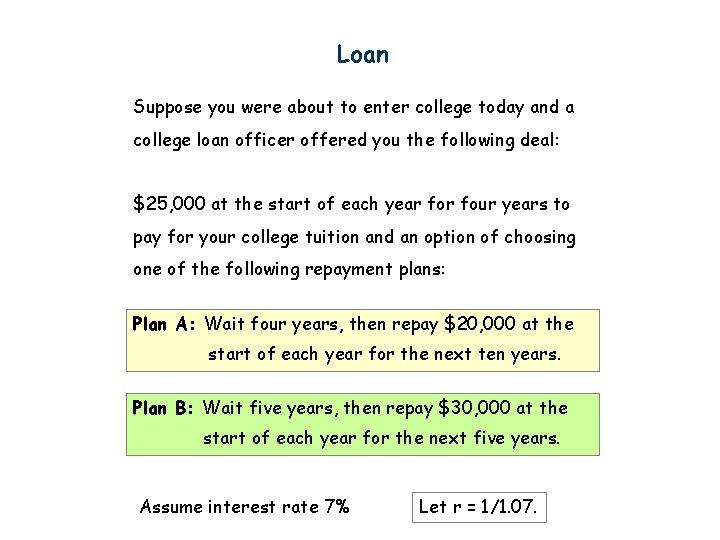
Loan Suppose you were about to enter college today and a college loan officer offered you the following deal: $25, 000 at the start of each year four years to pay for your college tuition and an option of choosing one of the following repayment plans: Plan A: Wait four years, then repay $20, 000 at the start of each year for the next ten years. Plan B: Wait five years, then repay $30, 000 at the start of each year for the next five years. Assume interest rate 7% Let r = 1/1. 07.
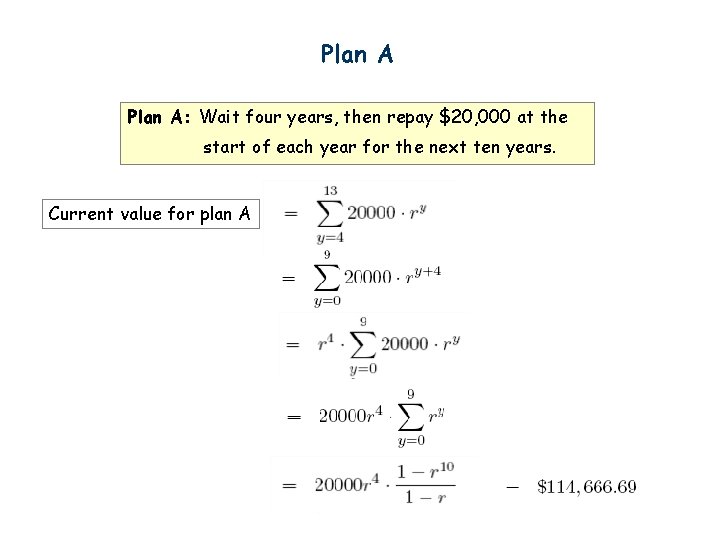
Plan A: Wait four years, then repay $20, 000 at the start of each year for the next ten years. Current value for plan A
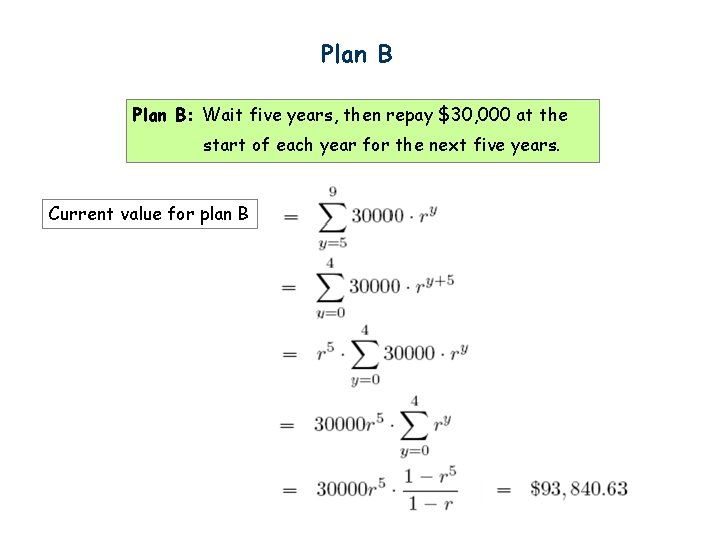
Plan B: Wait five years, then repay $30, 000 at the start of each year for the next five years. Current value for plan B
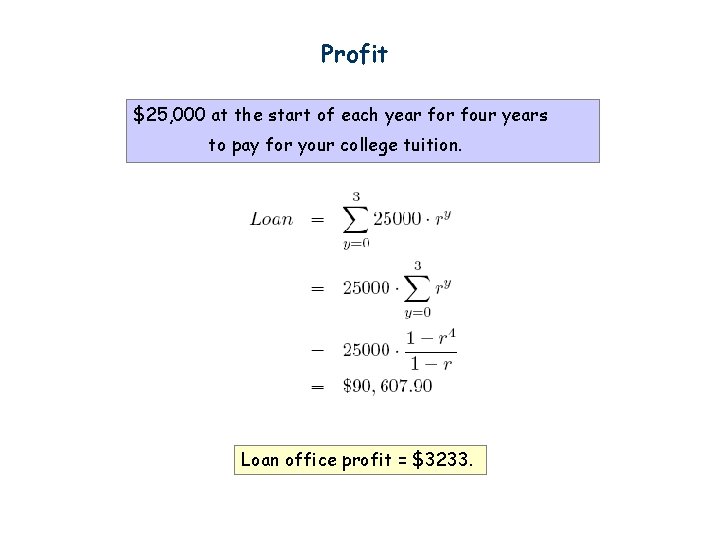
Profit $25, 000 at the start of each year four years to pay for your college tuition. Loan office profit = $3233.
This Lecture • Representation of a sequence • Sum of a sequence • Arithmetic sequence • Geometric sequence • Applications • Harmonic sequence • (Optional) The integral method • Product of a sequence • Factorial
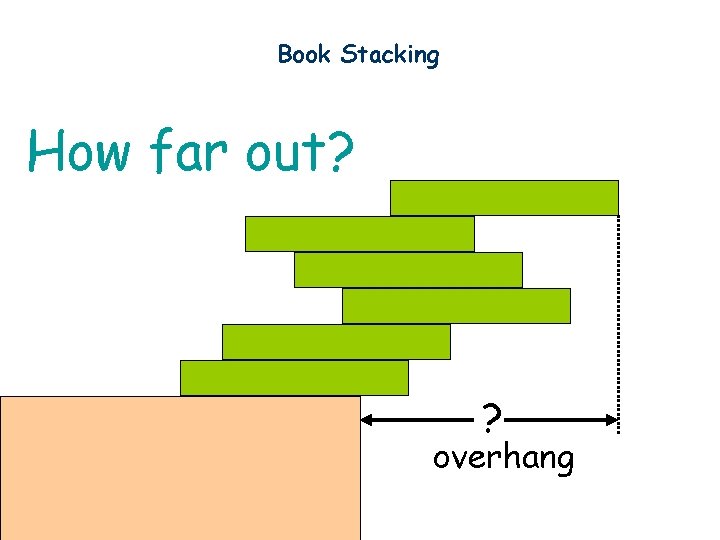
Book Stacking How far out? ? overhang
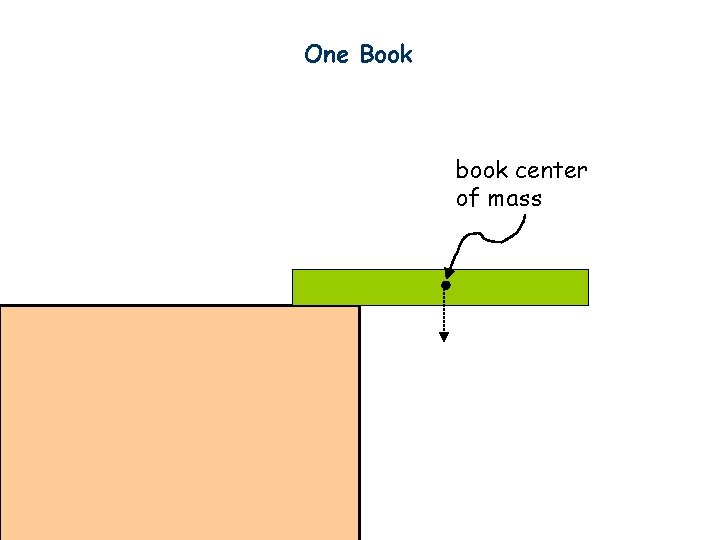
One Book book center of mass
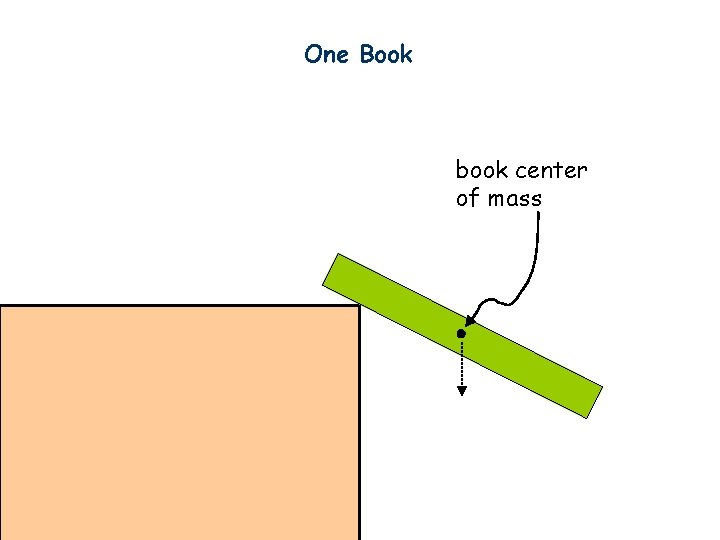
One Book book center of mass
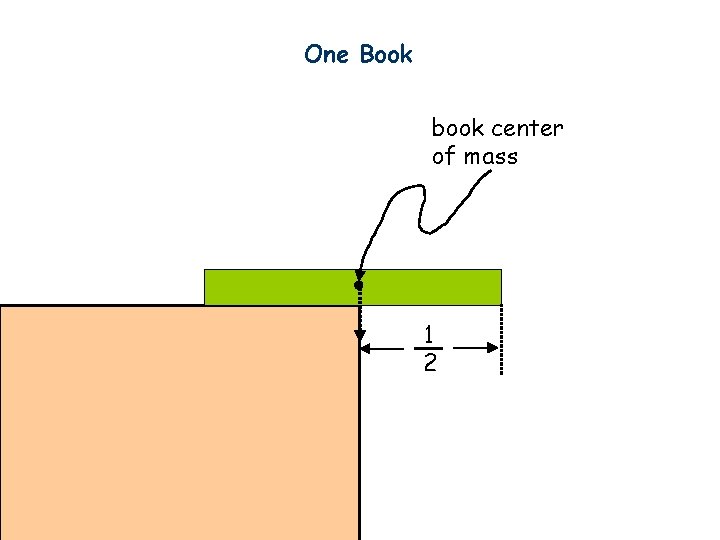
One Book book center of mass 1 2
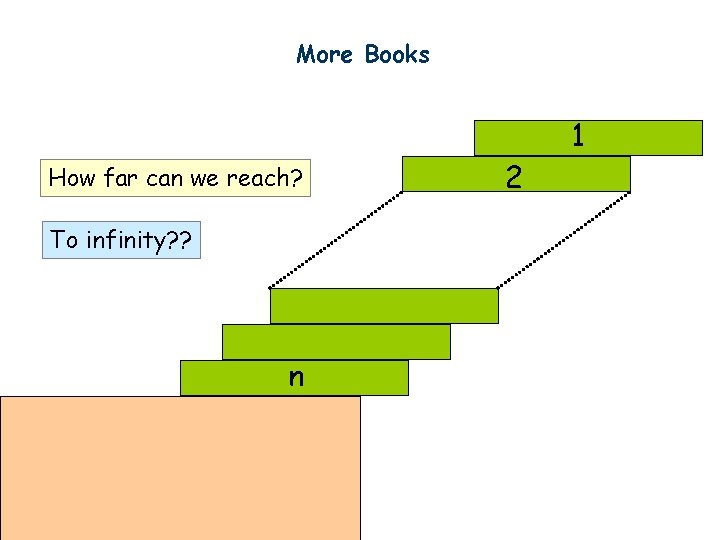
More Books 1 How far can we reach? To infinity? ? n 2

More Books 1 2 n center of mass
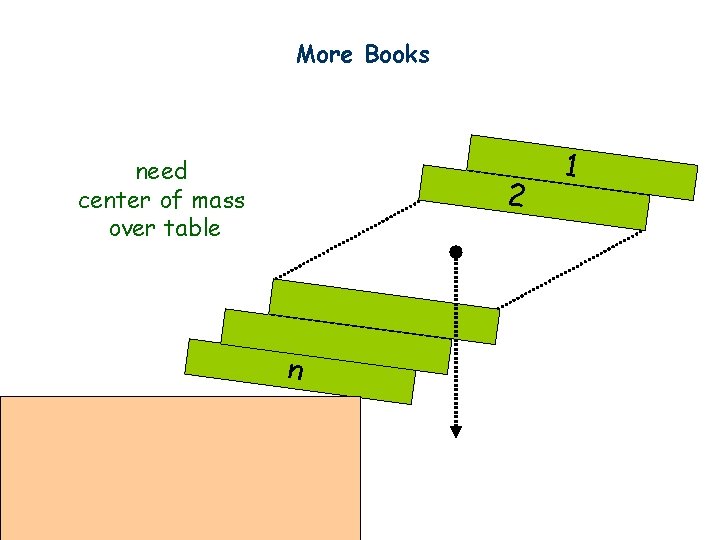
More Books need center of mass over table 2 n 1
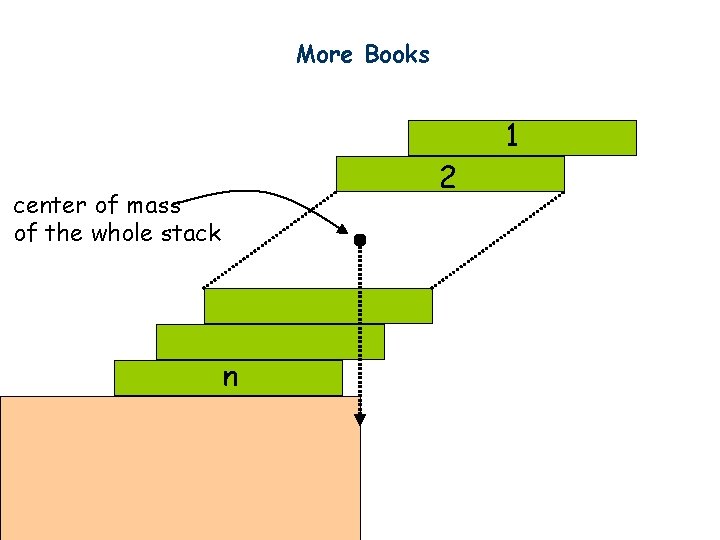
More Books 1 2 center of mass of the whole stack n
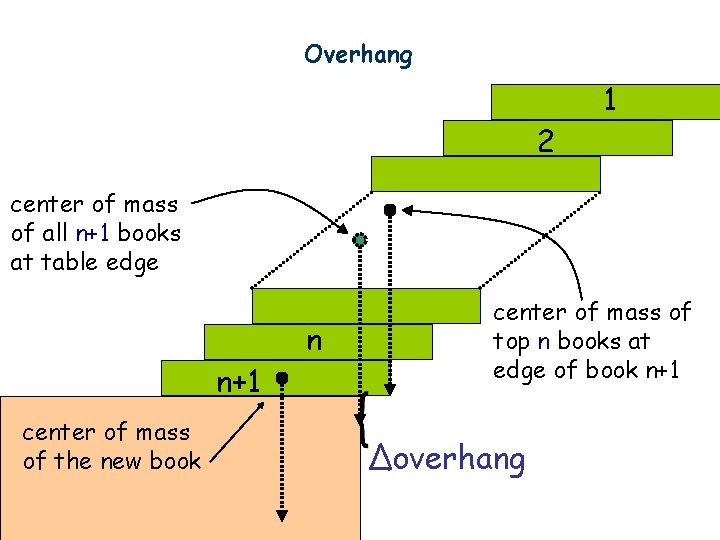
Overhang 1 2 center of mass of all n+1 books at table edge n n+1 center of mass of the new book center of mass of top n books at edge of book n+1 ∆overhang
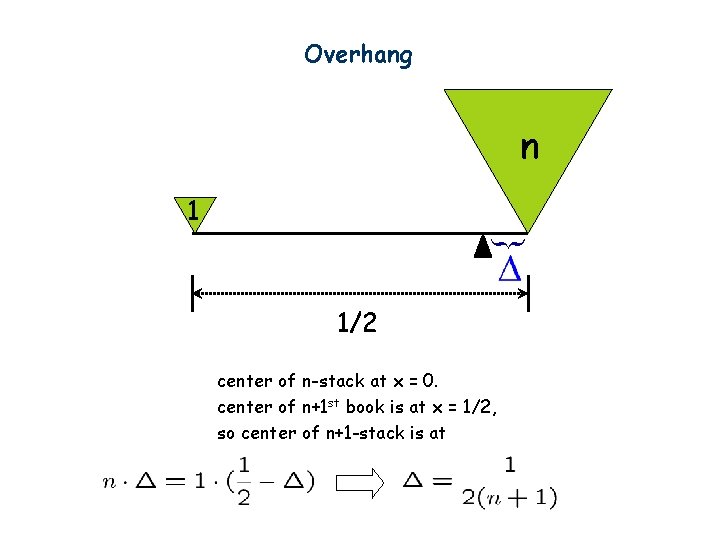
Overhang n 1 1/2 center of n-stack at x = 0. center of n+1 st book is at x = 1/2, so center of n+1 -stack is at
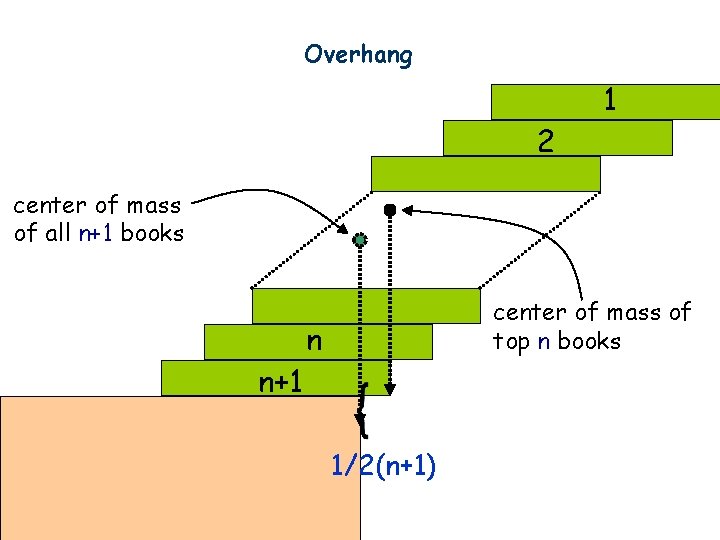
Overhang 1 2 center of mass of all n+1 books center of mass of top n books n n+1 1/2(n+1)
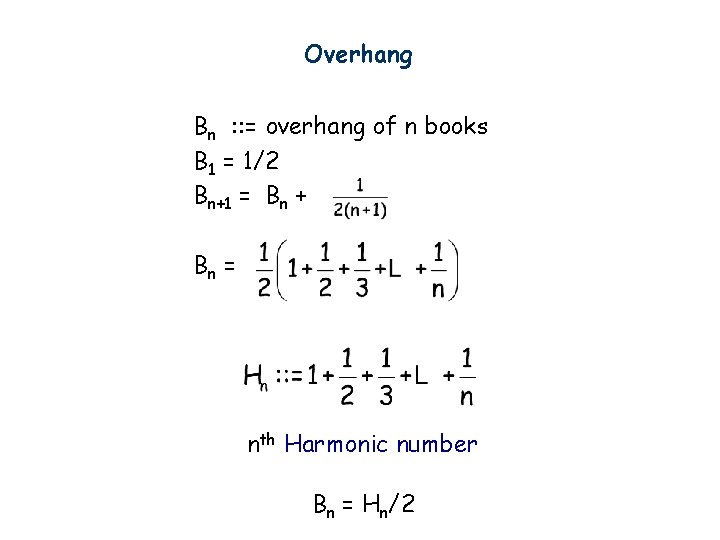
Overhang Bn : : = overhang of n books B 1 = 1/2 Bn+1 = Bn + Bn = nth Harmonic number Bn = Hn/2
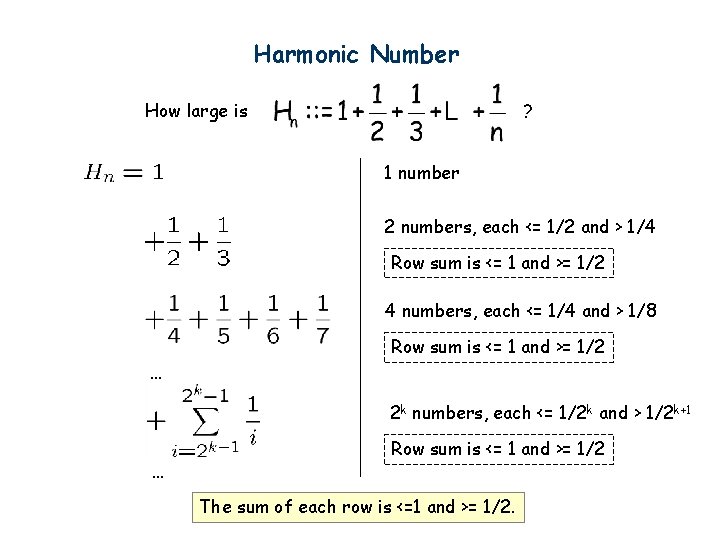
Harmonic Number How large is ? 1 number 2 numbers, each <= 1/2 and > 1/4 Row sum is <= 1 and >= 1/2 4 numbers, each <= 1/4 and > 1/8 … Row sum is <= 1 and >= 1/2 2 k numbers, each <= 1/2 k and > 1/2 k+1 … Row sum is <= 1 and >= 1/2 The sum of each row is <=1 and >= 1/2.
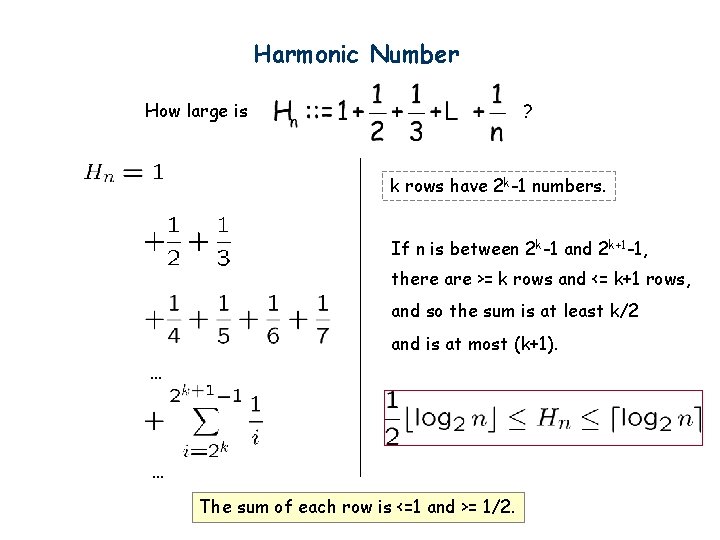
Harmonic Number How large is ? k rows have 2 k-1 numbers. If n is between 2 k-1 and 2 k+1 -1, there are >= k rows and <= k+1 rows, and so the sum is at least k/2 and is at most (k+1). … … The sum of each row is <=1 and >= 1/2.
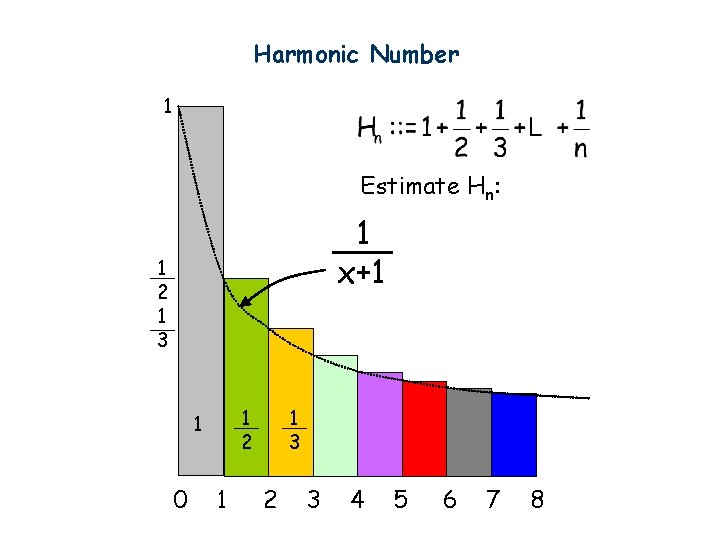
Harmonic Number 1 Estimate Hn: 1 x+1 1 2 1 3 1 2 1 0 1 1 3 2 3 4 5 6 7 8
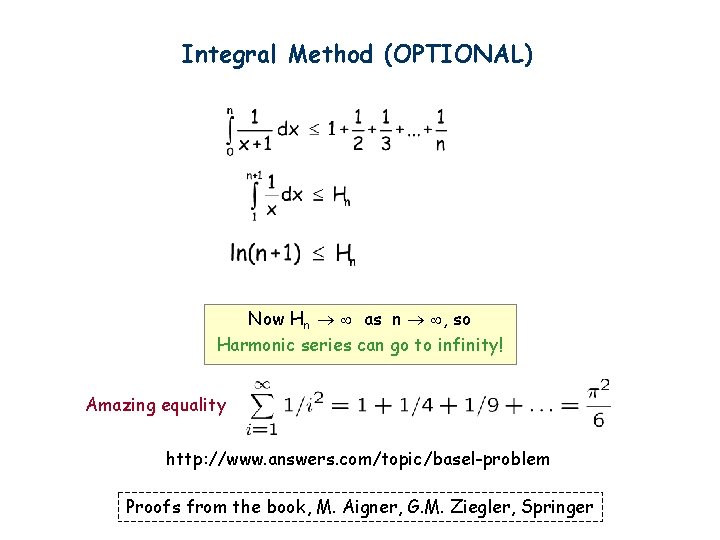
Integral Method (OPTIONAL) Now Hn as n , so Harmonic series can go to infinity! Amazing equality http: //www. answers. com/topic/basel-problem Proofs from the book, M. Aigner, G. M. Ziegler, Springer
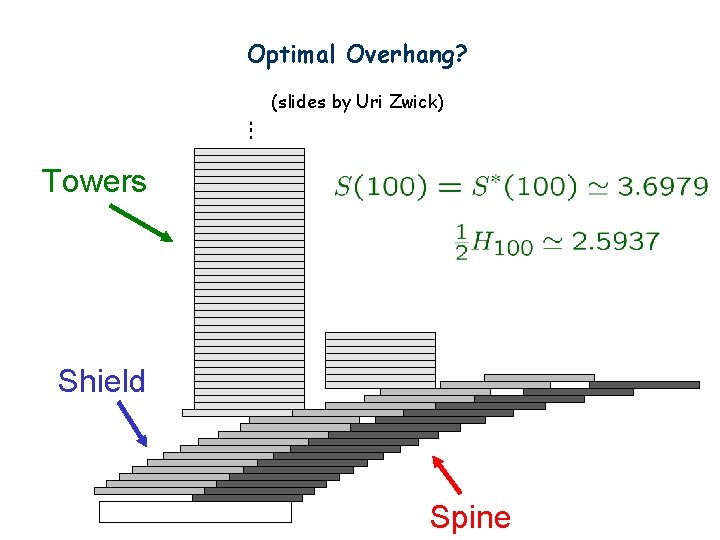
Optimal Overhang? (slides by Uri Zwick) Towers Shield Spine
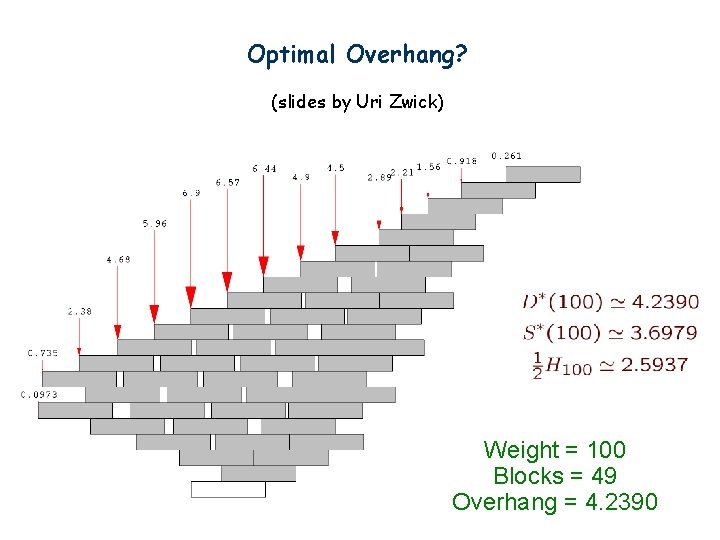
Optimal Overhang? (slides by Uri Zwick) Weight = 100 Blocks = 49 Overhang = 4. 2390
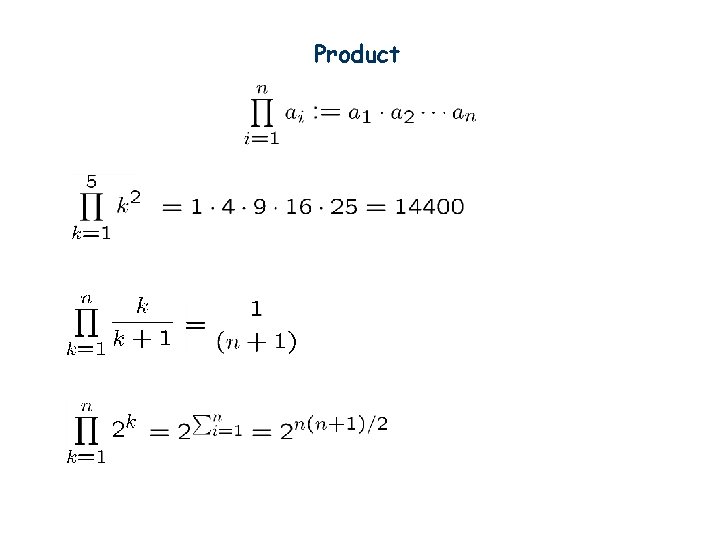
Product
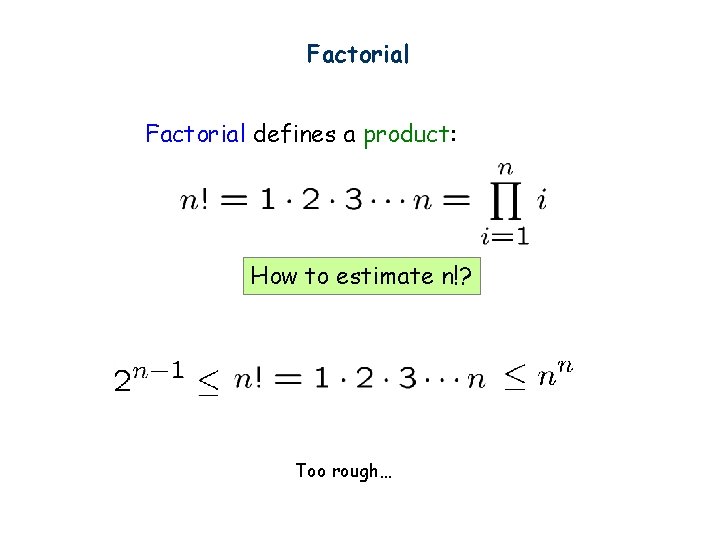
Factorial defines a product: How to estimate n!? Too rough…
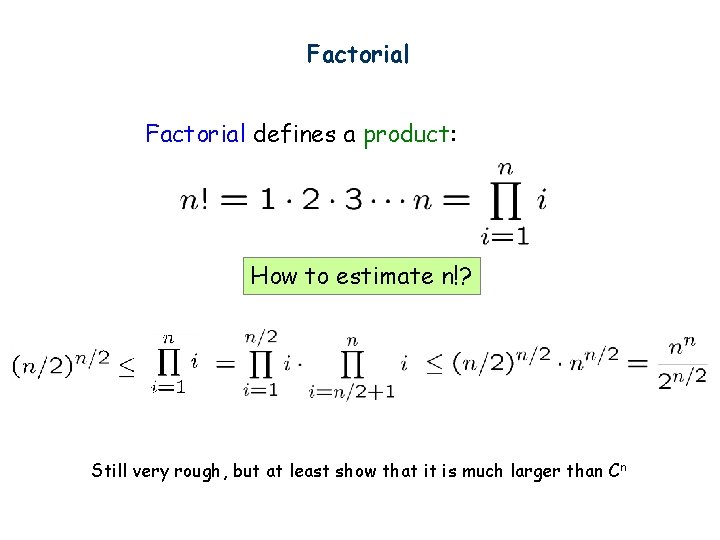
Factorial defines a product: How to estimate n!? Still very rough, but at least show that it is much larger than C n
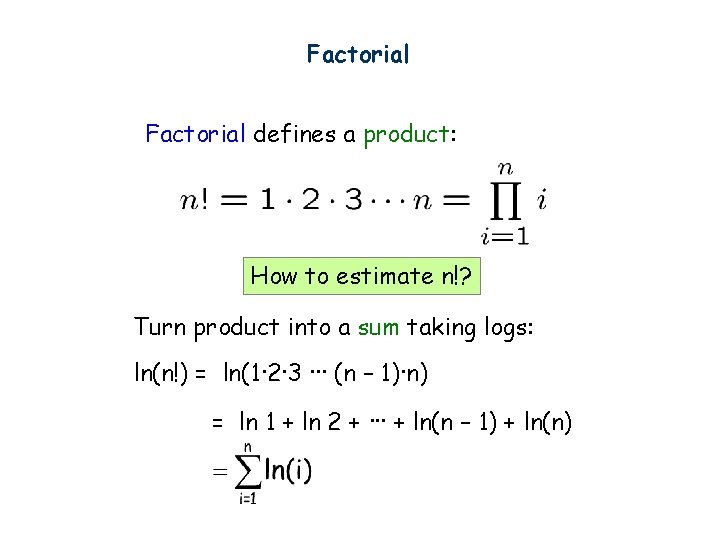
Factorial defines a product: How to estimate n!? Turn product into a sum taking logs: ln(n!) = ln(1· 2· 3 ··· (n – 1)·n) = ln 1 + ln 2 + ··· + ln(n – 1) + ln(n)
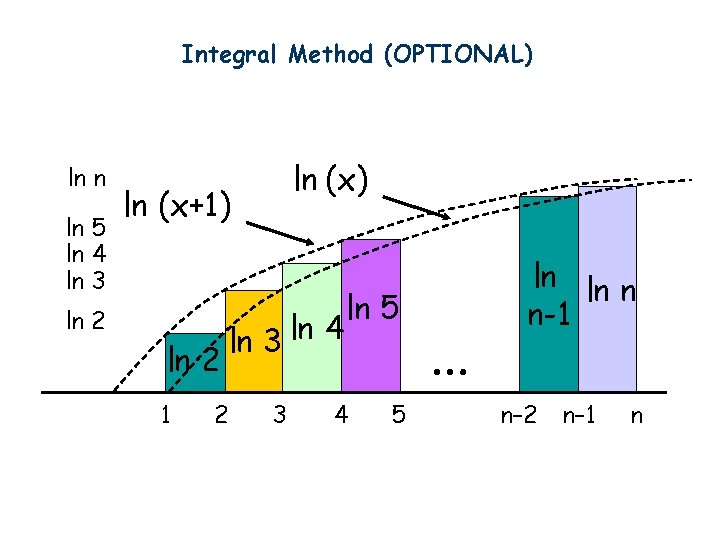
Integral Method (OPTIONAL) ln n ln 5 ln 4 ln 3 ln 2 ln (x) ln (x+1) ln 2 1 ln 3 ln 4 2 3 ln 5 4 5 … ln ln n n-1 n– 2 n– 1 n
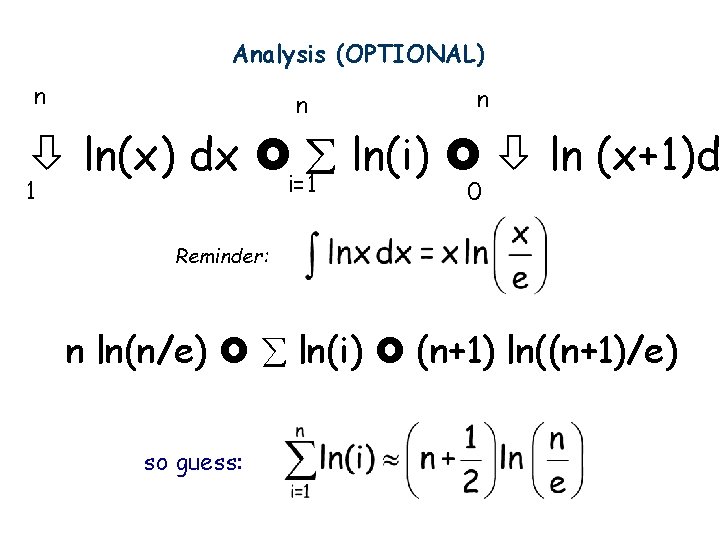
Analysis (OPTIONAL) n n n ln(x) dx i=1 ln(i) ln (x+1)d 1 0 Reminder: n ln(n/e) ln(i) (n+1) ln((n+1)/e) so guess:
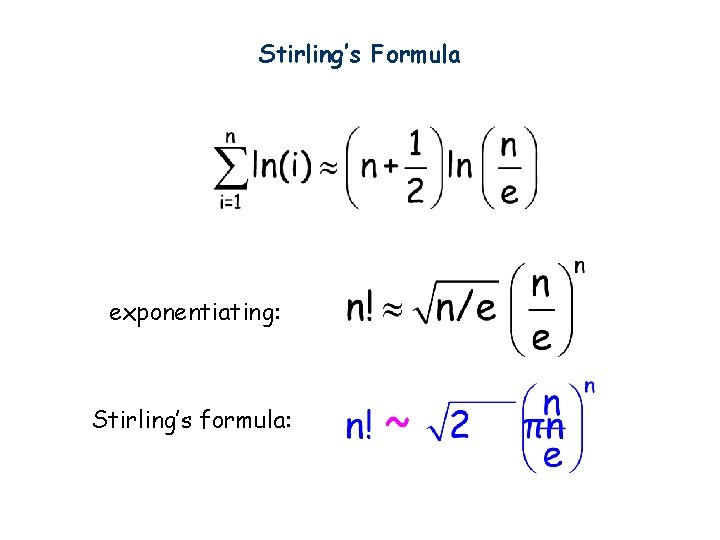
Stirling’s Formula exponentiating: Stirling’s formula:

More Integral Method What is a simple closed form expressions of Idea: use integral method. So we guess that Make a hypothesis ?
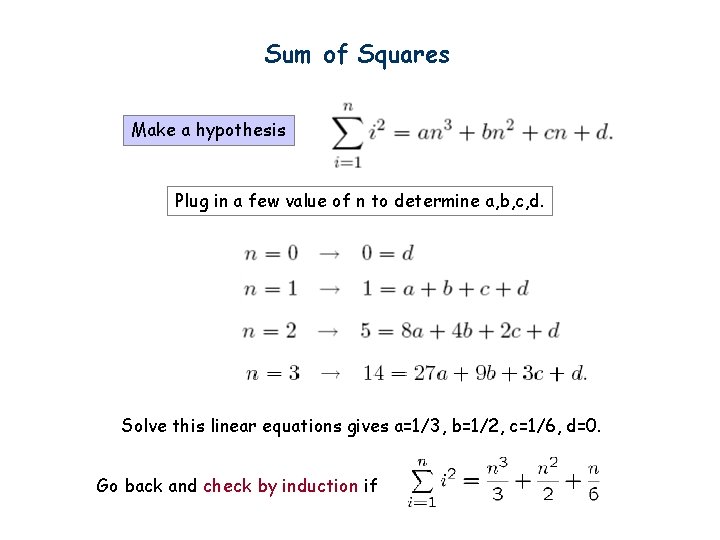
Sum of Squares Make a hypothesis Plug in a few value of n to determine a, b, c, d. Solve this linear equations gives a=1/3, b=1/2, c=1/6, d=0. Go back and check by induction if
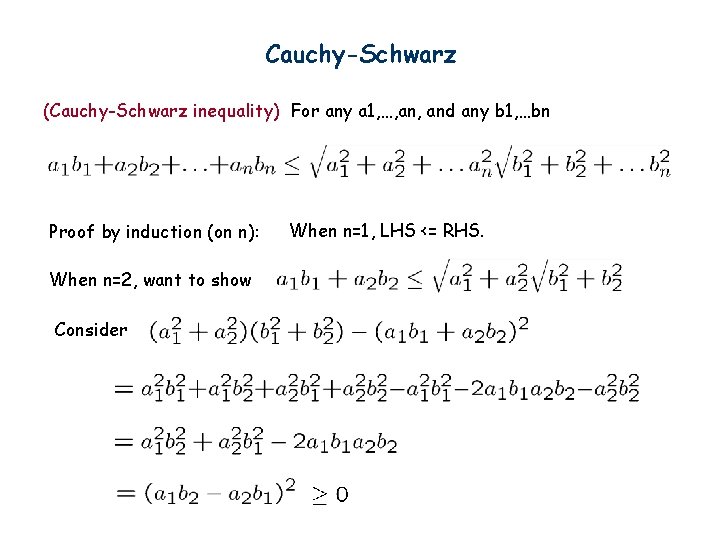
Cauchy-Schwarz (Cauchy-Schwarz inequality) For any a 1, …, and any b 1, …bn Proof by induction (on n): When n=2, want to show Consider When n=1, LHS <= RHS.
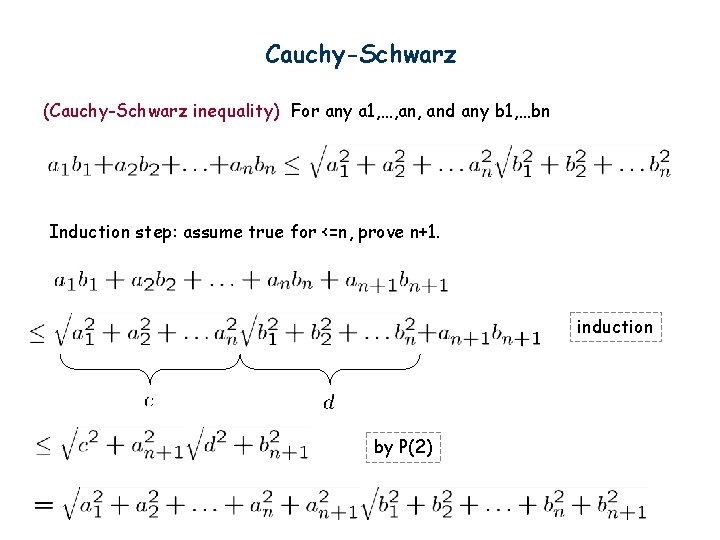
Cauchy-Schwarz (Cauchy-Schwarz inequality) For any a 1, …, and any b 1, …bn Induction step: assume true for <=n, prove n+1. induction by P(2)
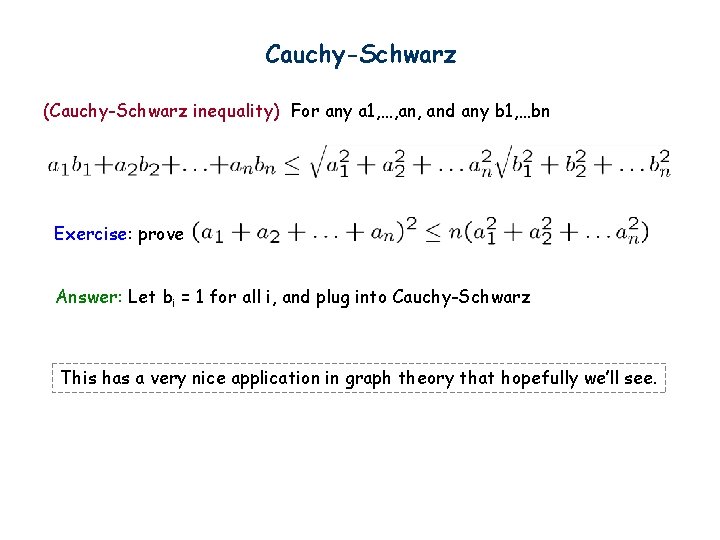
Cauchy-Schwarz (Cauchy-Schwarz inequality) For any a 1, …, and any b 1, …bn Exercise: prove Answer: Let bi = 1 for all i, and plug into Cauchy-Schwarz This has a very nice application in graph theory that hopefully we’ll see.
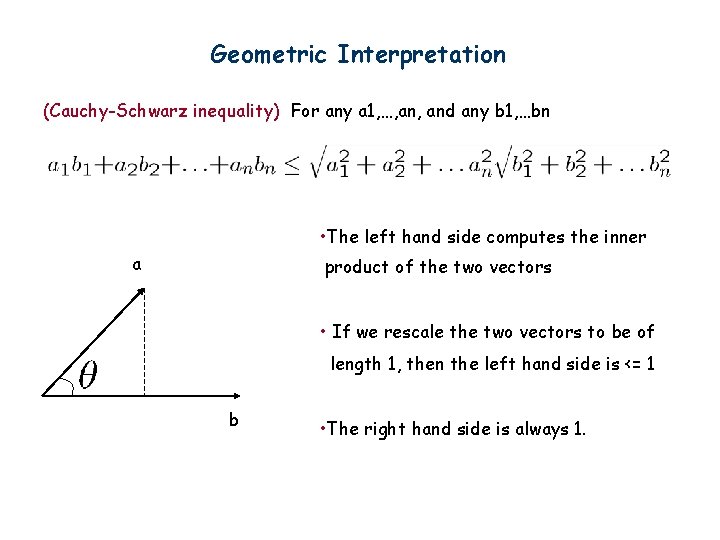
Geometric Interpretation (Cauchy-Schwarz inequality) For any a 1, …, and any b 1, …bn • The left hand side computes the inner a product of the two vectors • If we rescale the two vectors to be of length 1, then the left hand side is <= 1 b • The right hand side is always 1.
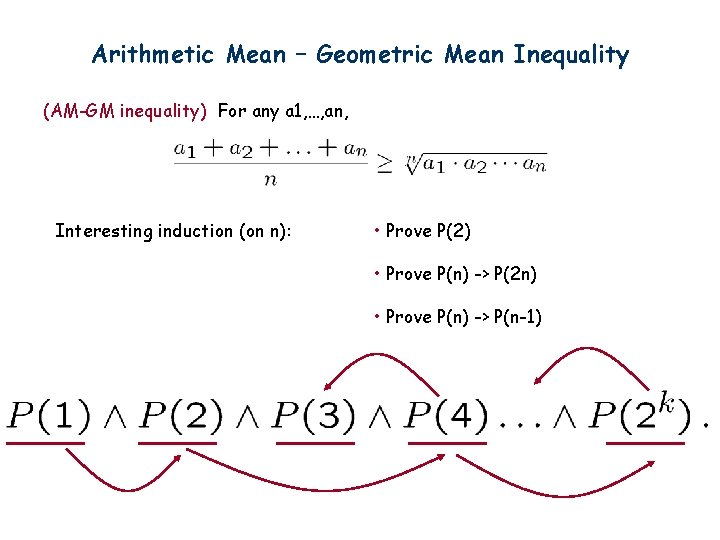
Arithmetic Mean – Geometric Mean Inequality (AM-GM inequality) For any a 1, …, an, Interesting induction (on n): • Prove P(2) • Prove P(n) -> P(2 n) • Prove P(n) -> P(n-1)
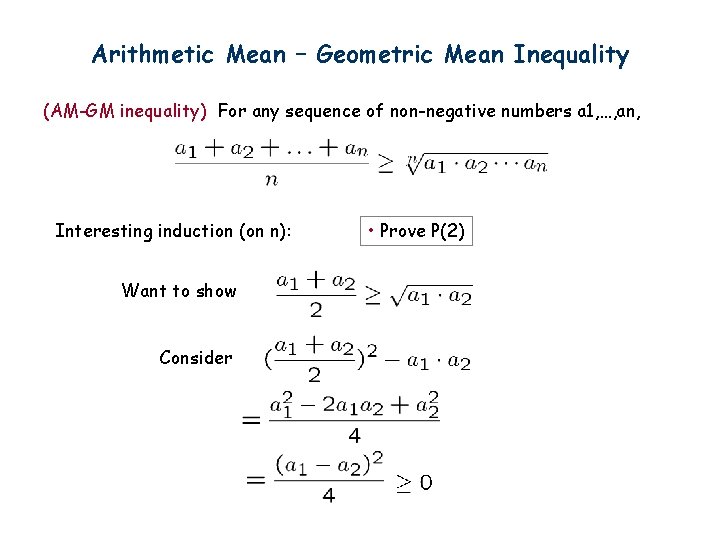
Arithmetic Mean – Geometric Mean Inequality (AM-GM inequality) For any sequence of non-negative numbers a 1, …, an, Interesting induction (on n): Want to show Consider • Prove P(2)
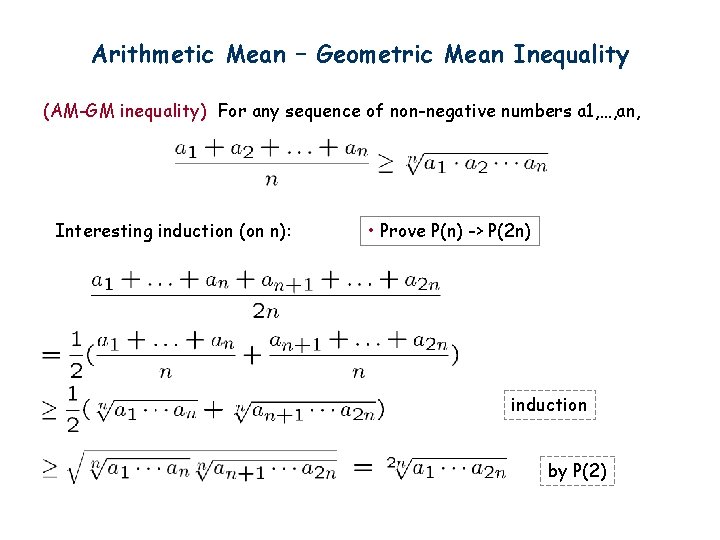
Arithmetic Mean – Geometric Mean Inequality (AM-GM inequality) For any sequence of non-negative numbers a 1, …, an, Interesting induction (on n): • Prove P(n) -> P(2 n) induction by P(2)
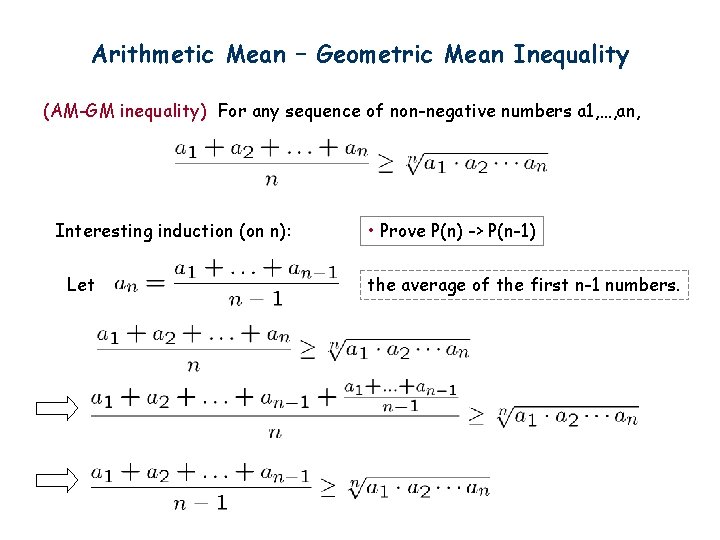
Arithmetic Mean – Geometric Mean Inequality (AM-GM inequality) For any sequence of non-negative numbers a 1, …, an, Interesting induction (on n): Let • Prove P(n) -> P(n-1) the average of the first n-1 numbers.
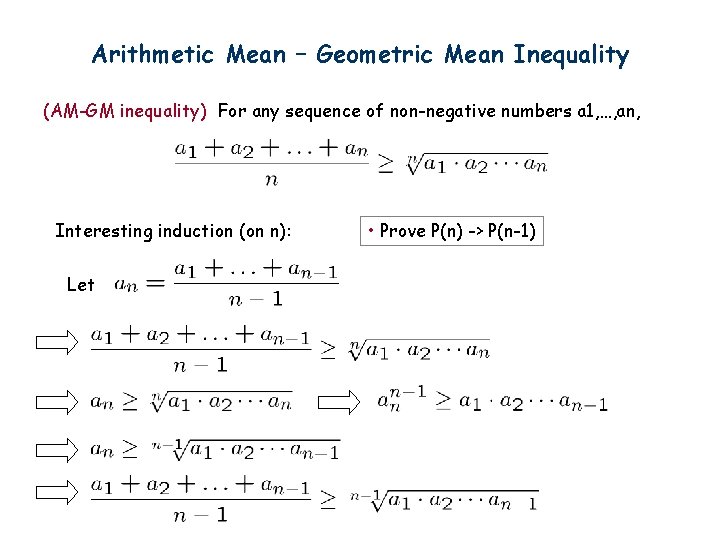
Arithmetic Mean – Geometric Mean Inequality (AM-GM inequality) For any sequence of non-negative numbers a 1, …, an, Interesting induction (on n): Let • Prove P(n) -> P(n-1)
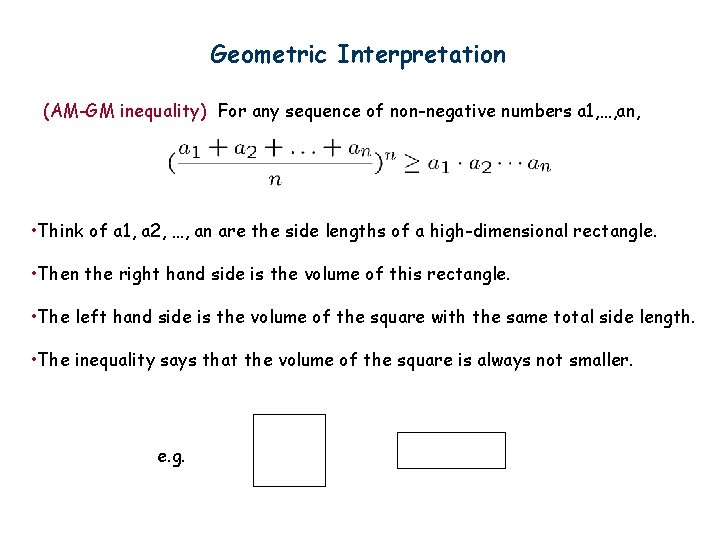
Geometric Interpretation (AM-GM inequality) For any sequence of non-negative numbers a 1, …, an, • Think of a 1, a 2, …, an are the side lengths of a high-dimensional rectangle. • Then the right hand side is the volume of this rectangle. • The left hand side is the volume of the square with the same total side length. • The inequality says that the volume of the square is always not smaller. e. g.
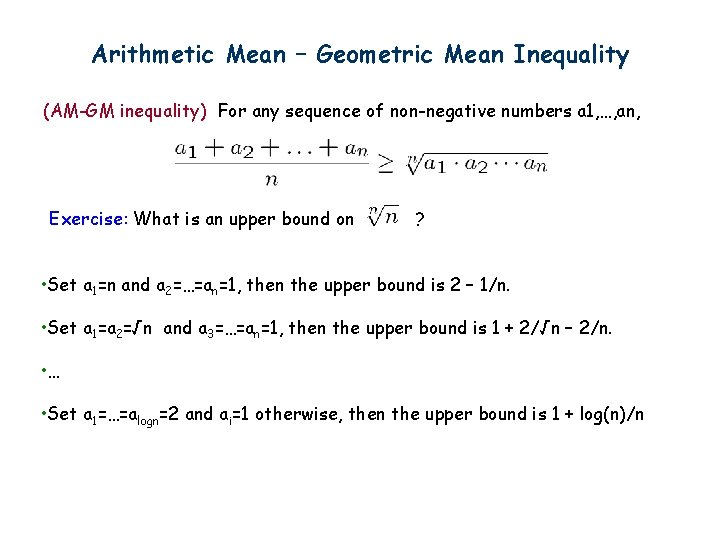
Arithmetic Mean – Geometric Mean Inequality (AM-GM inequality) For any sequence of non-negative numbers a 1, …, an, Exercise: What is an upper bound on ? • Set a 1=n and a 2=…=an=1, then the upper bound is 2 – 1/n. • Set a 1=a 2=√n and a 3=…=an=1, then the upper bound is 1 + 2/√n – 2/n. • … • Set a 1=…=alogn=2 and ai=1 otherwise, then the upper bound is 1 + log(n)/n
- Slides: 71