
Number Relationships Fractions Chapter 2 prime Words To
Number Relationships & Fractions Chapter 2

prime Words To Know number composite number prime factorization factor tree common factor equivalent fractions simplest form multiple least common denominator improper fraction mixed number

Overview 2. 1 Prime Factorization 2. 2 Greatest Common Factor 2. 3 Fundamental Fraction Concepts 2. 4 Fractions in Simplest Form 2. 5 Least Common Multiple 2. 6 Comparing and Ordering Fractions 2. 7 Mixed Numbers and Improper Fractions
Prime Factorization 2. 1
What is a factor? A nonzero whole number that divides another nonzero whole number evenly Or A number that divides another without remainders 1) What would the factors of 14 be?

Define: Prime Number A number whose only whole number factors are 1 and itself Or A number whose factors are only 1 and itself 1) What would the factors of 3 be? 2) What would the factors of 2 be?
Define: Composite Number A number that has factors other than 1 and itself 1) What would the factors of 10 be? 2) What would the factors of 20 be?
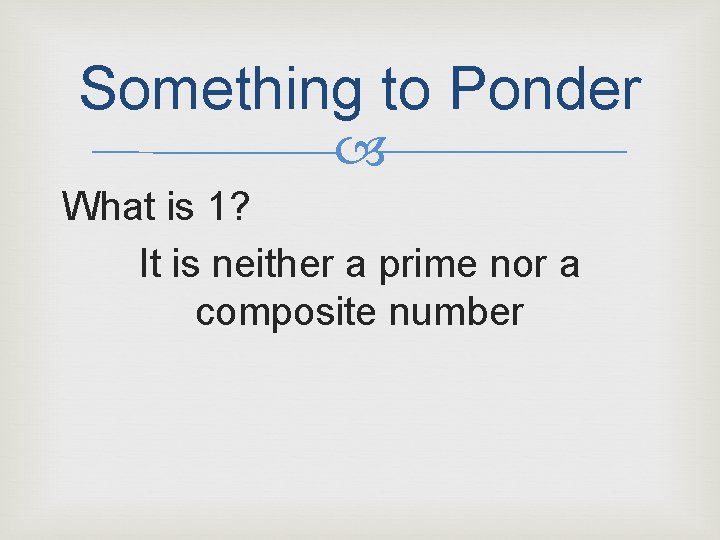
Something to Ponder What is 1? It is neither a prime nor a composite number
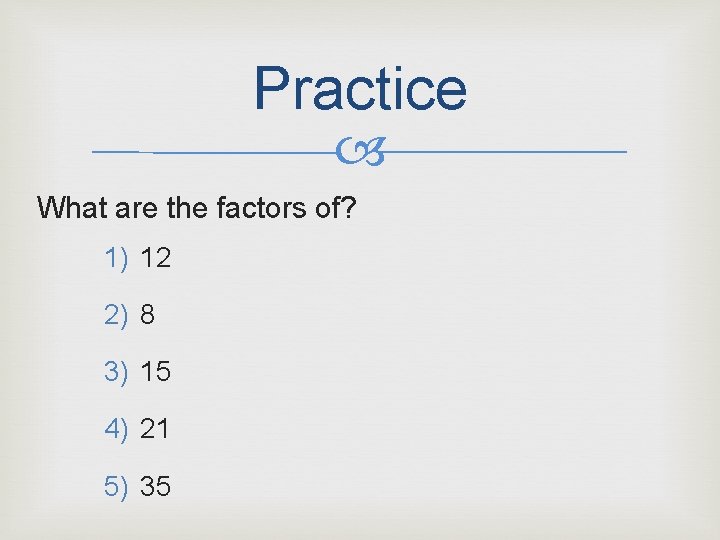
Practice What are the factors of? 1) 12 2) 8 3) 15 4) 21 5) 35
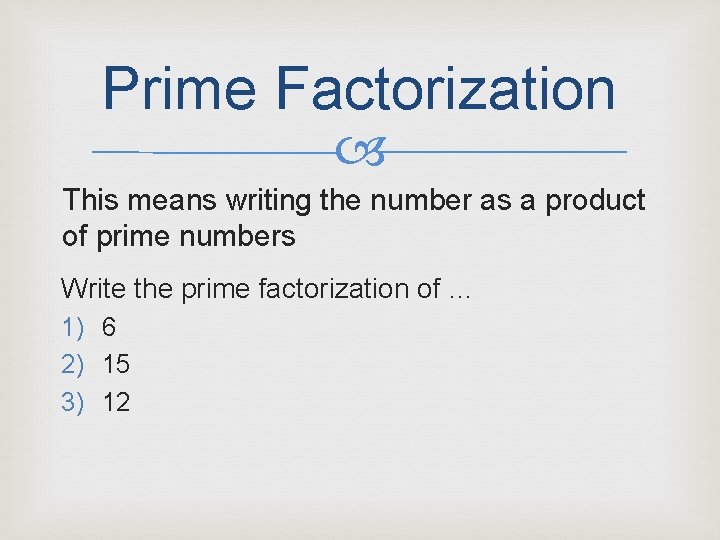
Prime Factorization This means writing the number as a product of prime numbers Write the prime factorization of … 1) 6 2) 15 3) 12
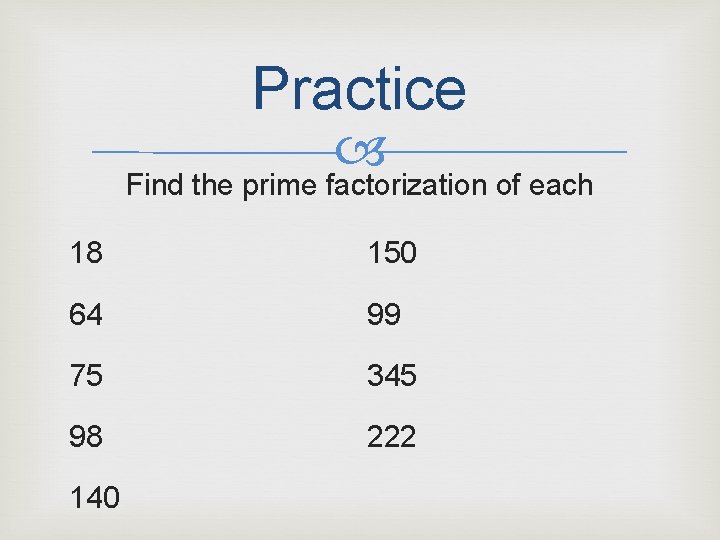
Practice Find the prime factorization of each 18 150 64 99 75 345 98 222 140
Greatest Common Factor 2. 2

Greatest Common Factor The largest number that is a factor of two or more nonzero whole numbers. (GCF)[also can be called greatest common divisor(GCD)] This will be helpful to know how to do when simplifying fractions.

Practice Find the Greatest Common Factor by listing all the factors of the numbers. 1. 14, 21 2. 72, 84 3. 18, 27, 45 4. 12, 35 5. 66, 96
Fundamental Fraction Concepts 2. 3
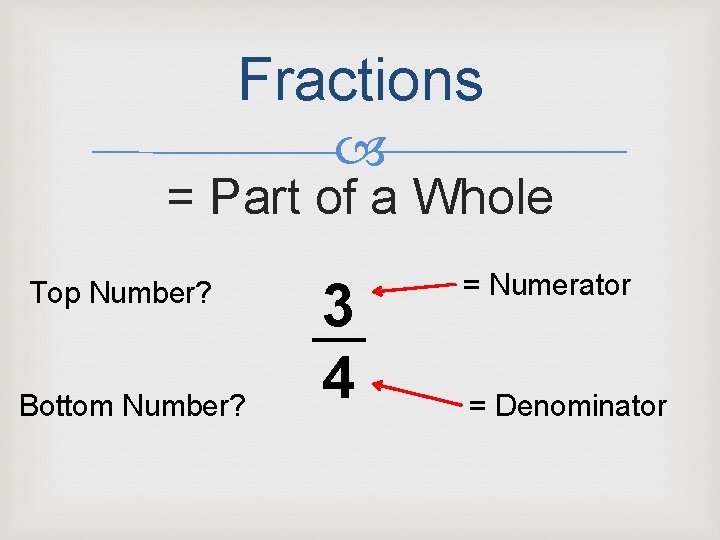
Fractions = Part of a Whole Top Number? Bottom Number? 3 4 = Numerator = Denominator
What do they mean? Numerator = number of objects that are being looked at Denominator = number of total equal parts that make up the Whole Note: the fraction bar means to divide the numerator by the denominator
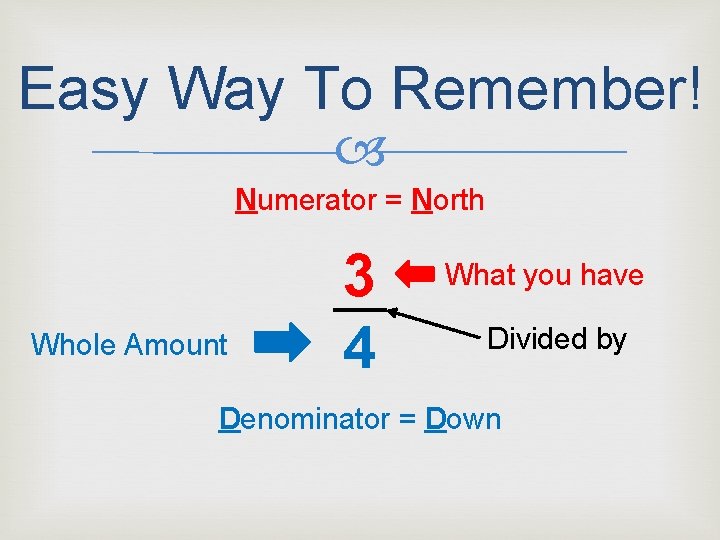
Easy Way To Remember! Numerator = North Whole Amount 3 4 What you have Divided by Denominator = Down
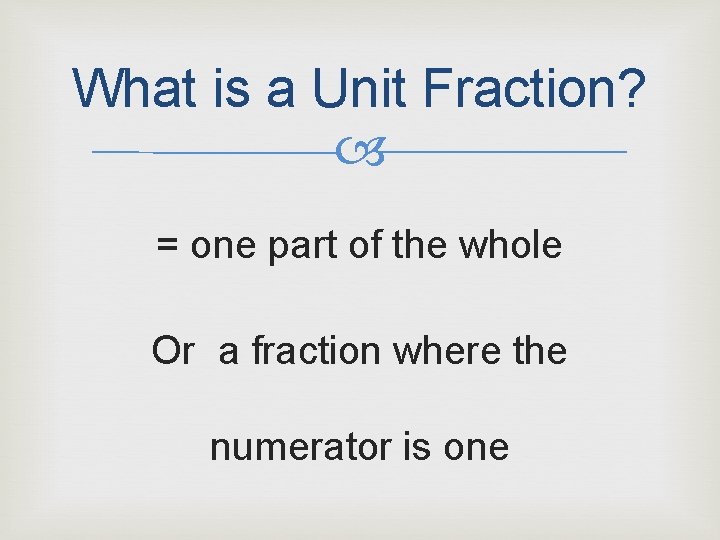
What is a Unit Fraction? = one part of the whole Or a fraction where the numerator is one
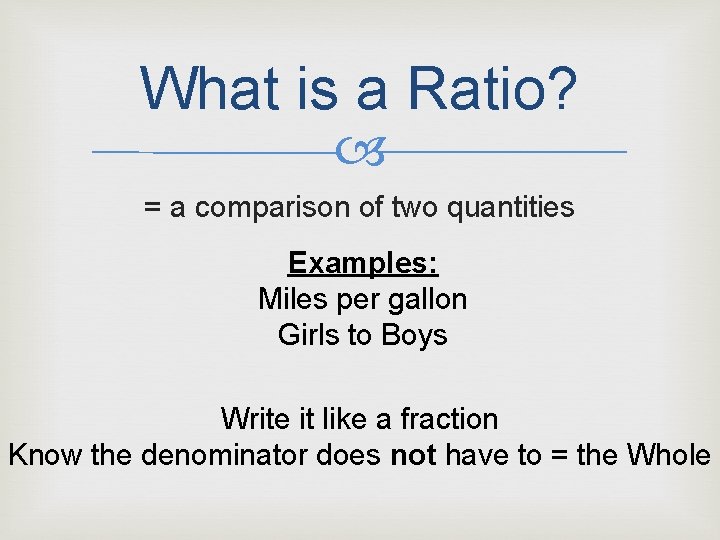
What is a Ratio? = a comparison of two quantities Examples: Miles per gallon Girls to Boys Write it like a fraction Know the denominator does not have to = the Whole
Fractions in Simplest Form 2. 4
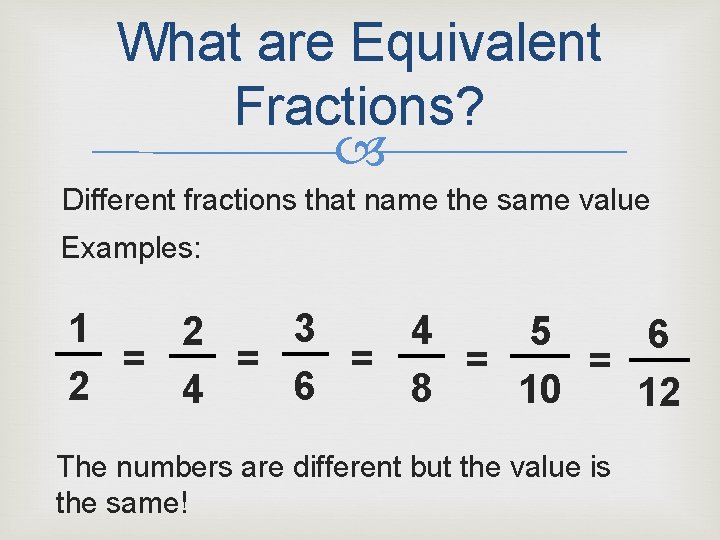
What are Equivalent Fractions? Different fractions that name the same value Examples: 1 3 4 2 5 6 = = = 2 6 8 4 10 12 The numbers are different but the value is the same!
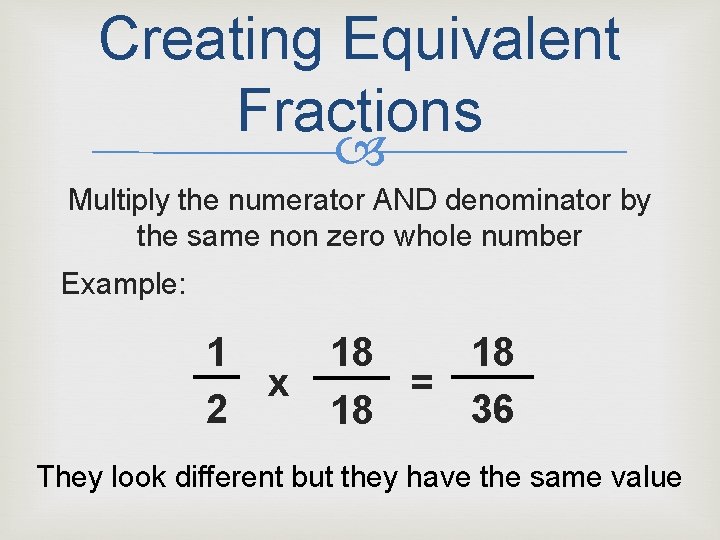
Creating Equivalent Fractions Multiply the numerator AND denominator by the same non zero whole number Example: 1 18 18 x = 2 36 18 They look different but they have the same value
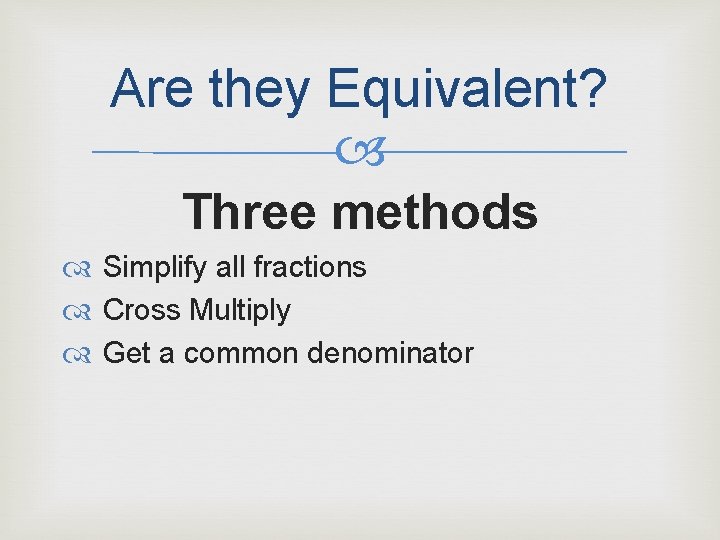
Are they Equivalent? Three methods Simplify all fractions Cross Multiply Get a common denominator
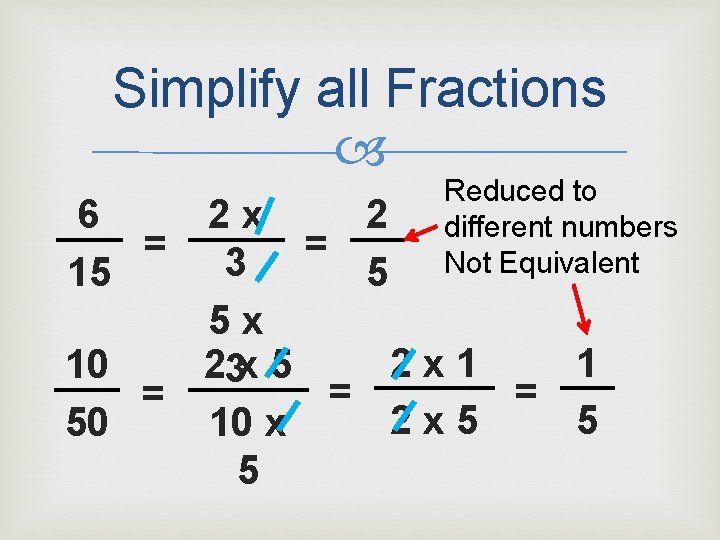
Simplify all Fractions 6 = 15 Reduced to different numbers Not Equivalent 2 x 2 = 3 5 5 x 2 x 1 1 10 23 x 5 = = = 2 x 5 5 50 10 x 5
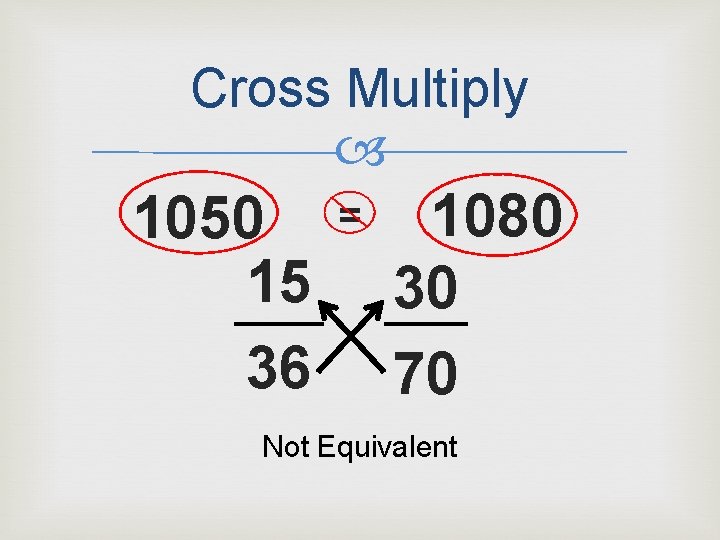
Cross Multiply 1050 15 36 = 1080 30 70 Not Equivalent
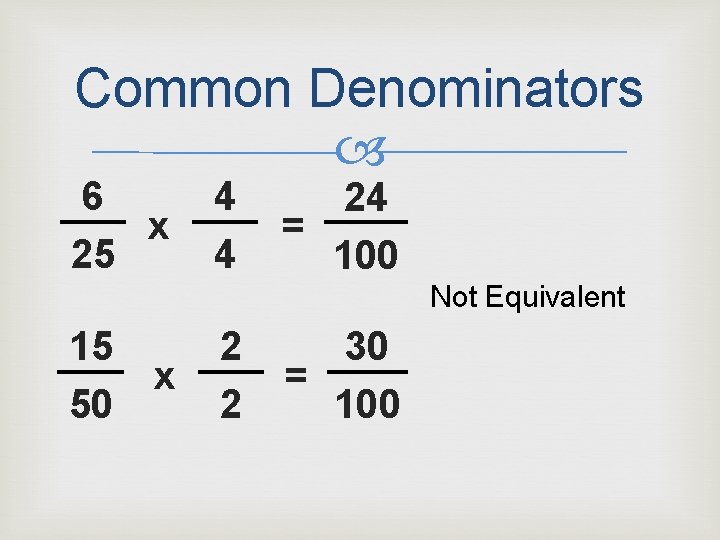
Common Denominators 6 x 25 4 4 24 = 100 Not Equivalent 15 50 x 2 2 30 = 100
How do you know if … A fraction is in its simplest form? The numerator and denominator have a greatest common factor of 1.
Simplifying Fractions Can it be reduced by 2? Can it be reduced by 3? Can it be reduced by 5? Can it be reduced by 7, 11 etc. ?
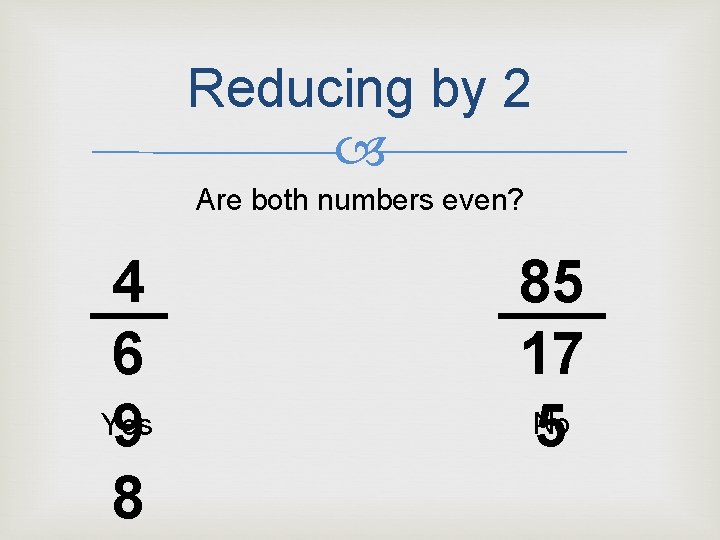
Reducing by 2 Are both numbers even? 4 6 Yes 9 8 85 17 No 5
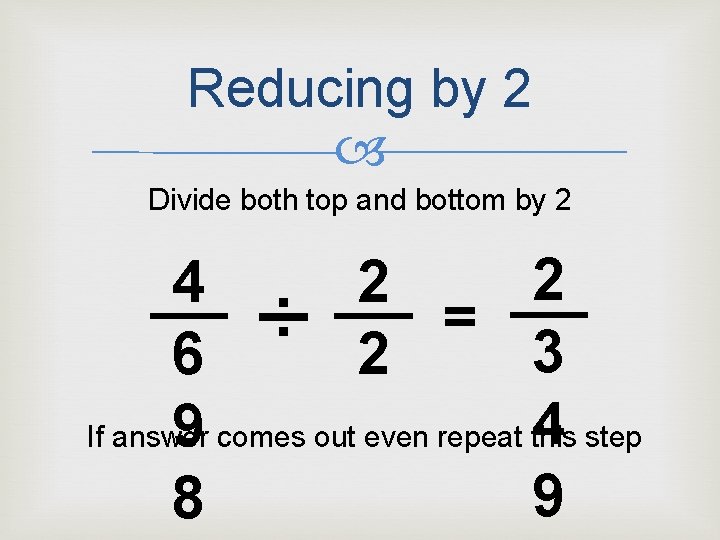
Reducing by 2 Divide both top and bottom by 2 2 2 4 = 3 2 6 4 step 9 comes out even repeat this If answer 9 8 ÷
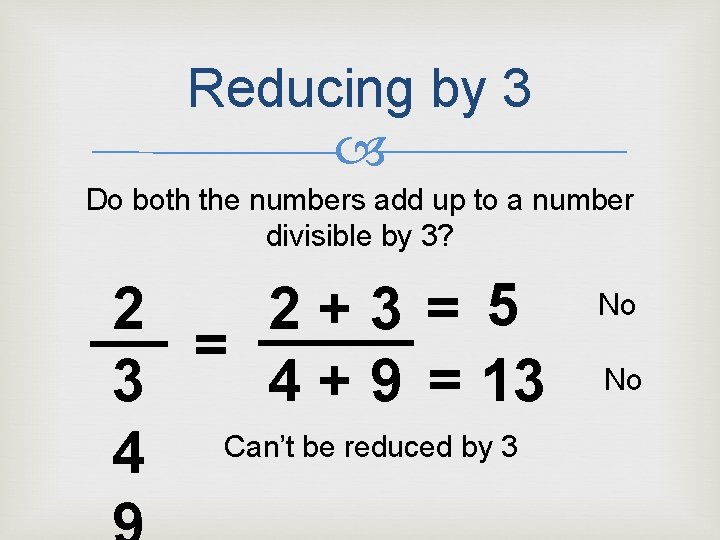
Reducing by 3 Do both the numbers add up to a number divisible by 3? 2+3 = 5 2 = 4 + 9 = 13 3 Can’t be reduced by 3 4 No No
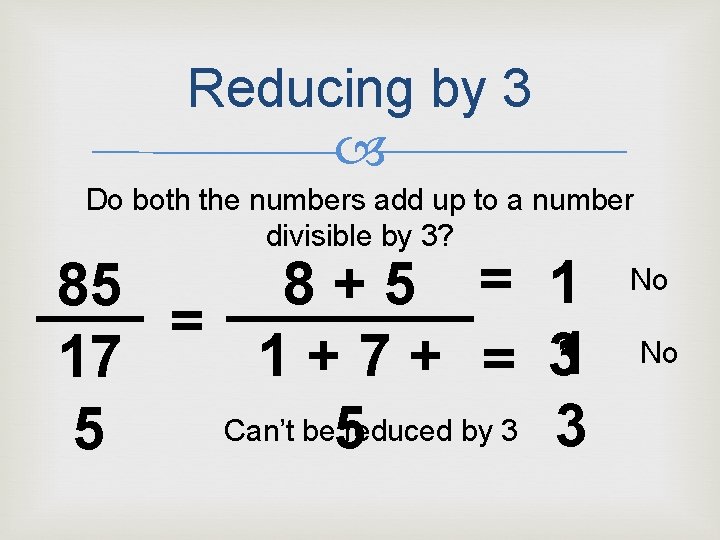
Reducing by 3 Do both the numbers add up to a number divisible by 3? No 8+5 = 1 85 = 1 + 7 + = 31 17 Can’t be 5 reduced by 3 3 5 No
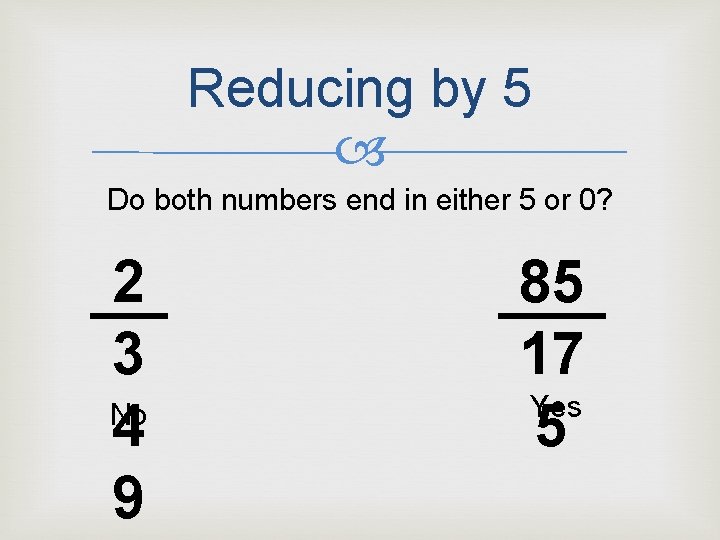
Reducing by 5 Do both numbers end in either 5 or 0? 2 3 No 4 9 85 17 Yes 5
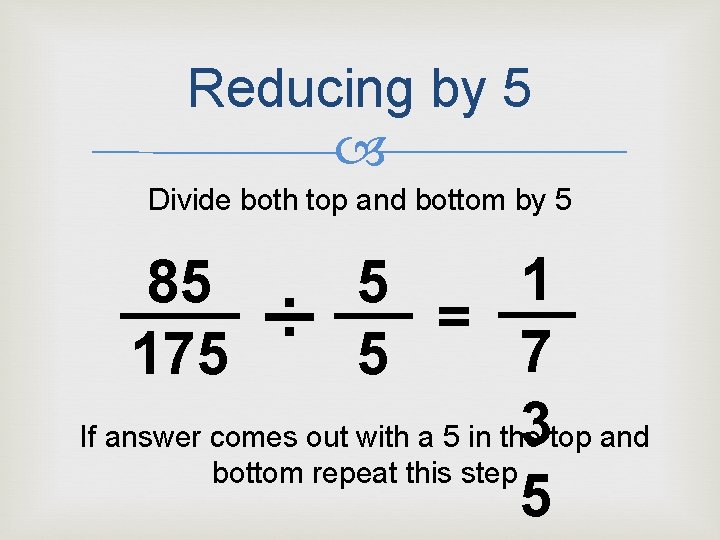
Reducing by 5 Divide both top and bottom by 5 1 5 = 7 5 3 top and If answer comes out with a 5 in the bottom repeat this step 5 85 175 ÷
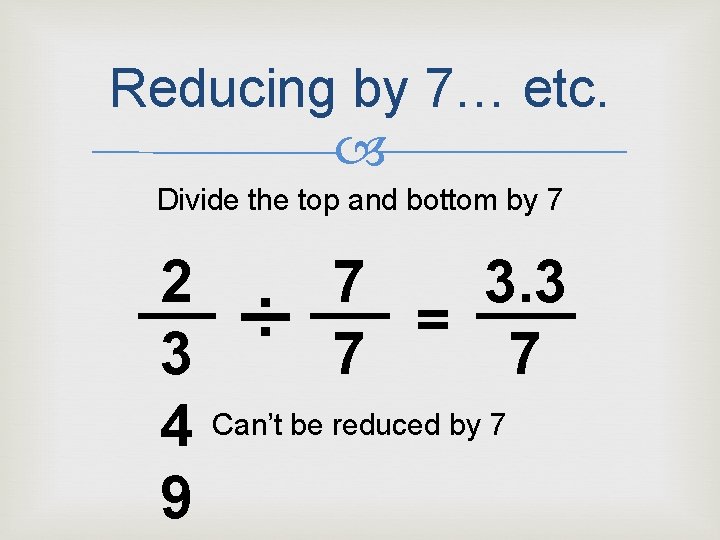
Reducing by 7… etc. Divide the top and bottom by 7 2 3 4 9 ÷ 3. 3 7 = 7 7 Can’t be reduced by 7
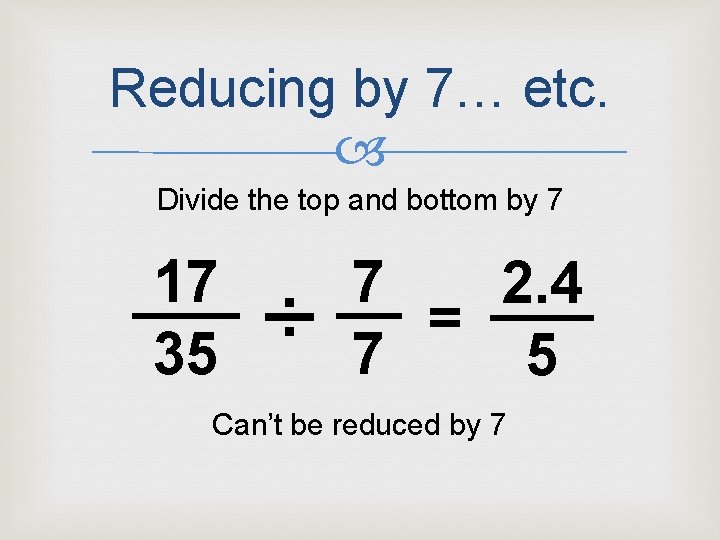
Reducing by 7… etc. Divide the top and bottom by 7 17 35 ÷ 7 2. 4 = 7 5 Can’t be reduced by 7
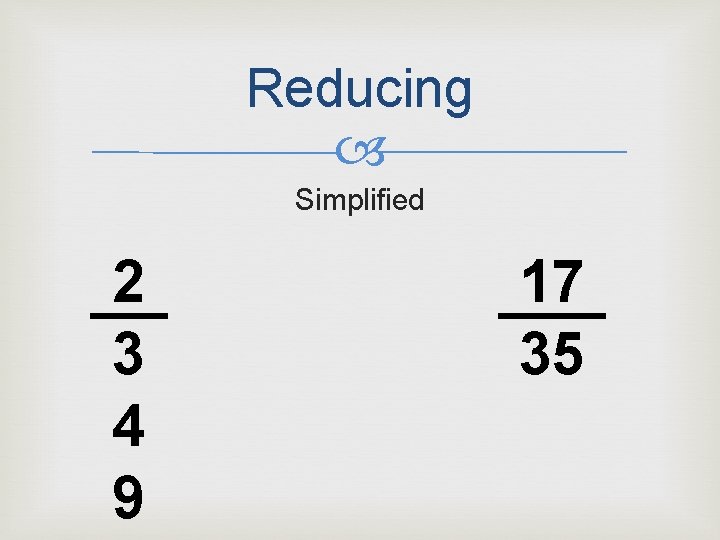
Reducing Simplified 2 3 4 9 17 35
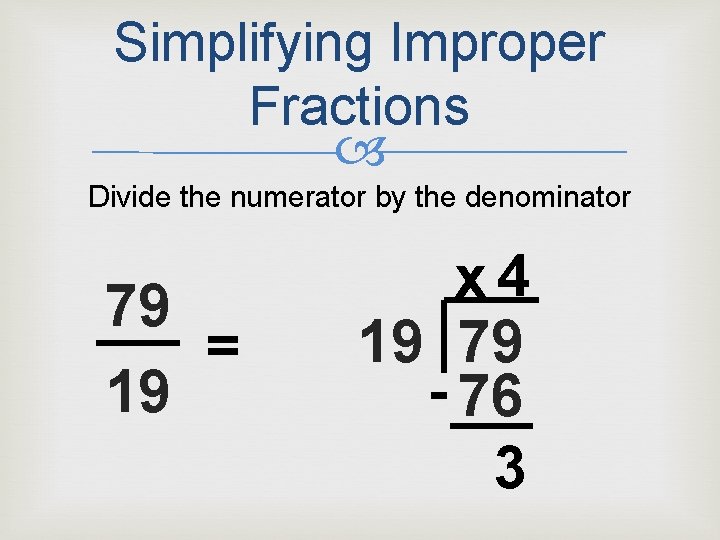
Simplifying Improper Fractions Divide the numerator by the denominator 79 = 19 x 4 19 79 - 76 3
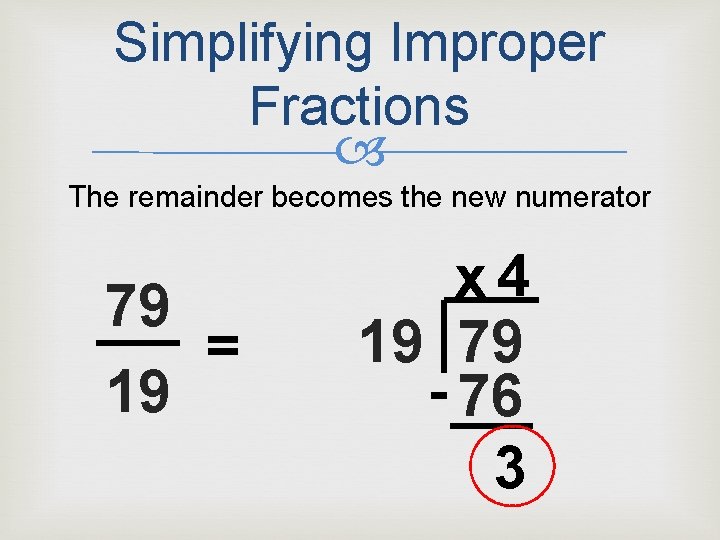
Simplifying Improper Fractions The remainder becomes the new numerator 79 = 19 x 4 19 79 - 76 3
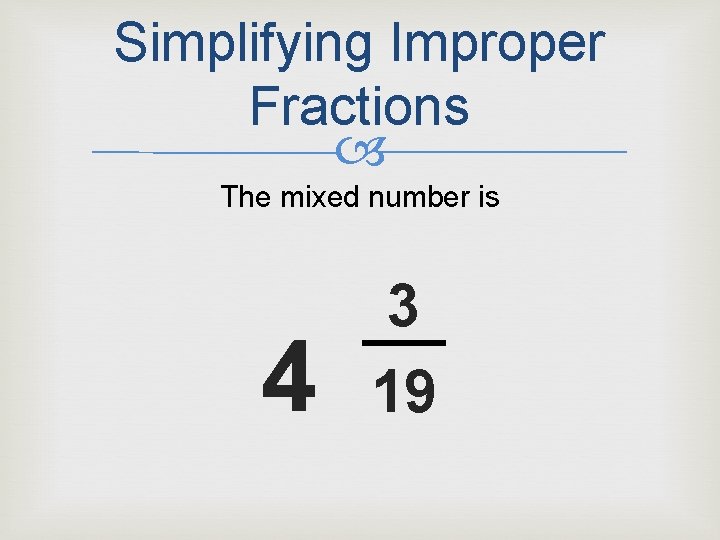
Simplifying Improper Fractions The mixed number is 4 3 19
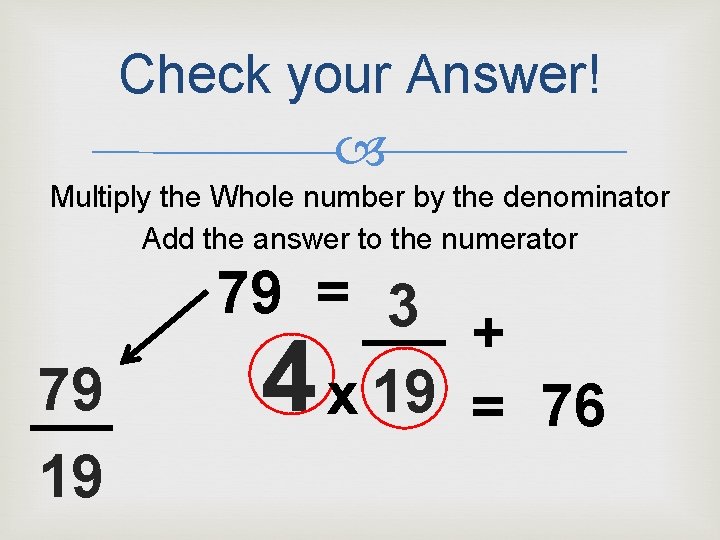
Check your Answer! Multiply the Whole number by the denominator Add the answer to the numerator 79 19 79 = 3 + x 19 = 76 4
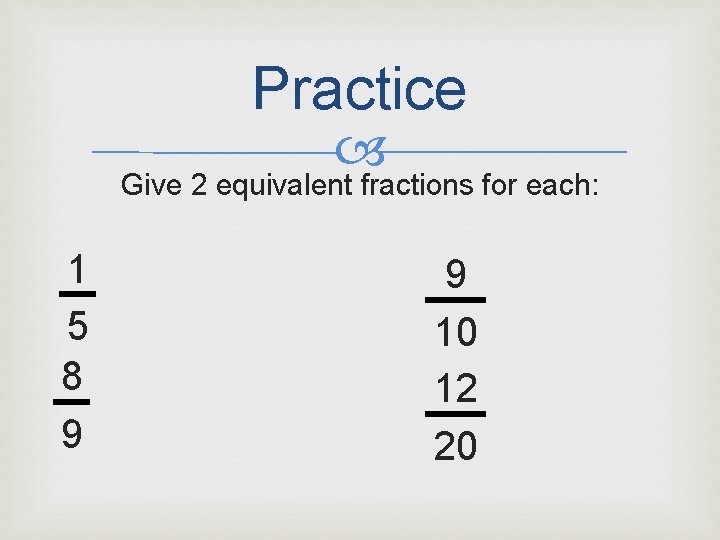
Practice Give 2 equivalent fractions for each: 1 5 8 9 9 10 12 20
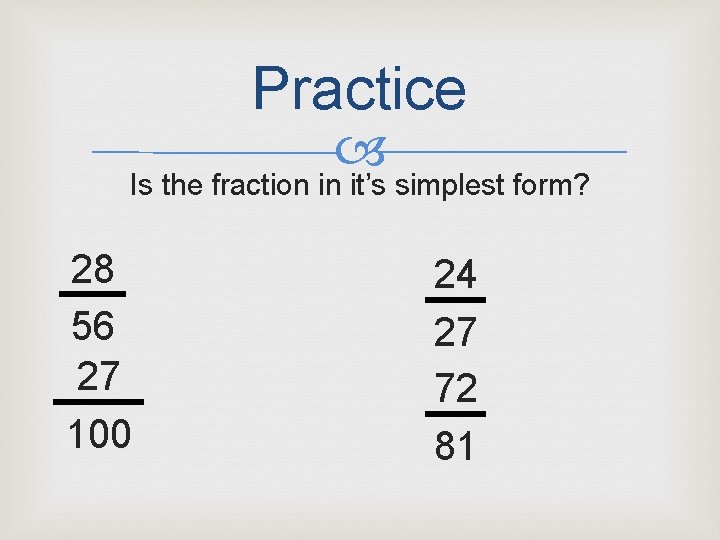
Practice Is the fraction in it’s simplest form? 28 56 27 100 24 27 72 81
Least Common Multiple 2. 5
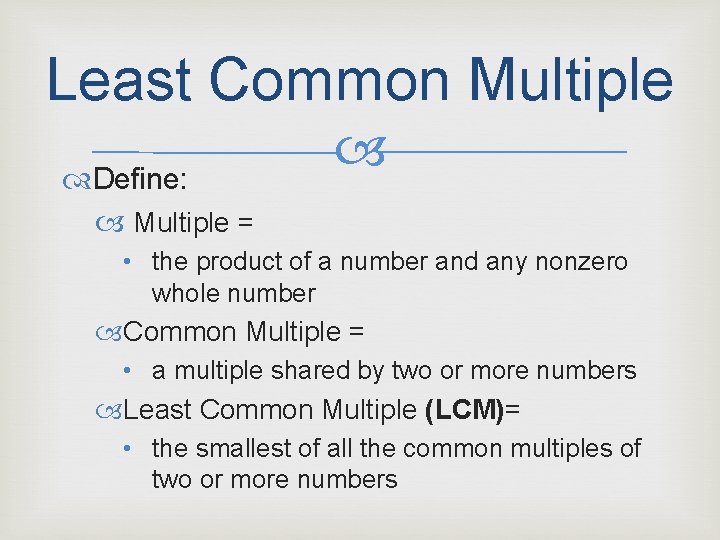
Least Common Multiple Define: Multiple = • the product of a number and any nonzero whole number Common Multiple = • a multiple shared by two or more numbers Least Common Multiple (LCM)= • the smallest of all the common multiples of two or more numbers
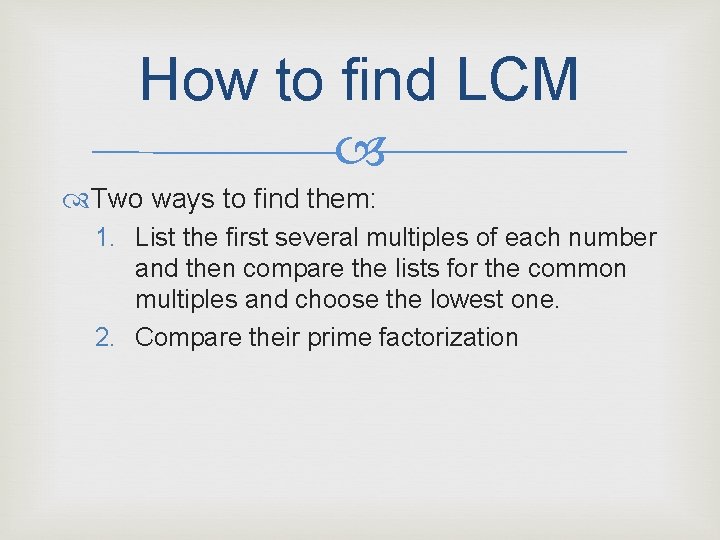
How to find LCM Two ways to find them: 1. List the first several multiples of each number and then compare the lists for the common multiples and choose the lowest one. 2. Compare their prime factorization

LCM Listing Find the LCM of 1. 8, 10 8 = 16, 24, 32, 40, 48, 56, 64, 72, 80 10 = 20, 30, 40, 50, 60, 70, 80 Answer: 40
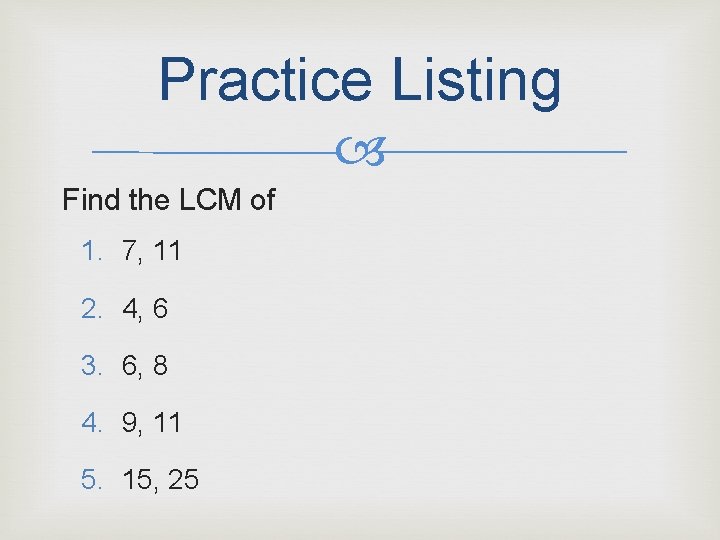
Practice Listing Find the LCM of 1. 7, 11 2. 4, 6 3. 6, 8 4. 9, 11 5. 15, 25
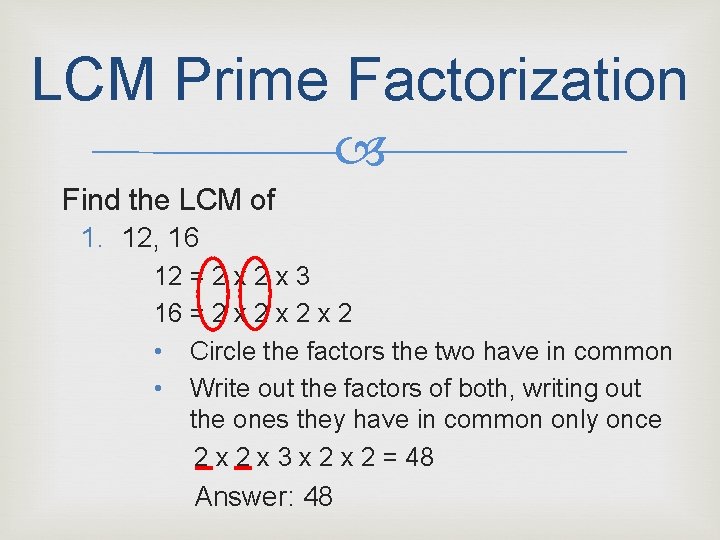
LCM Prime Factorization Find the LCM of 1. 12, 16 12 = 2 x 3 16 = 2 x 2 x 2 • Circle the factors the two have in common • Write out the factors of both, writing out the ones they have in common only once 2 x 3 x 2 = 48 Answer: 48
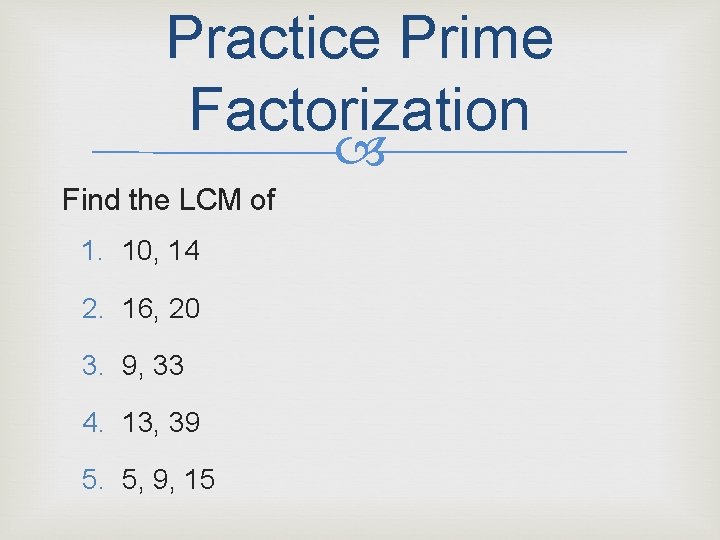
Practice Prime Factorization Find the LCM of 1. 10, 14 2. 16, 20 3. 9, 33 4. 13, 39 5. 5, 9, 15
Comparing and Ordering Fractions 2. 6
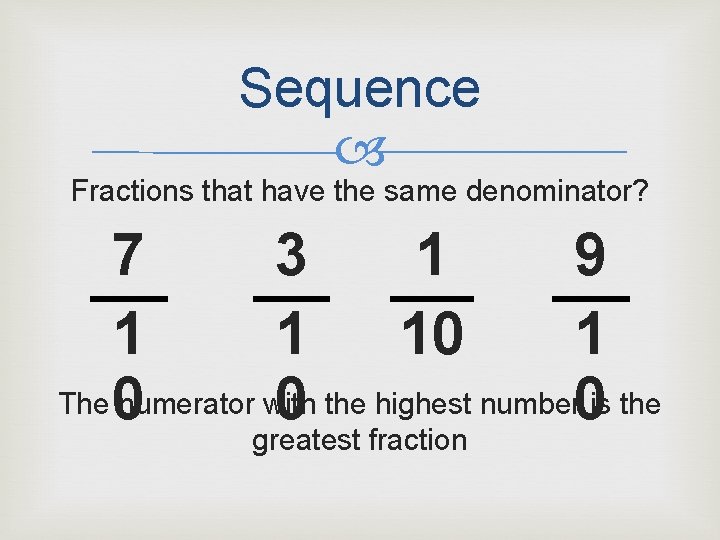
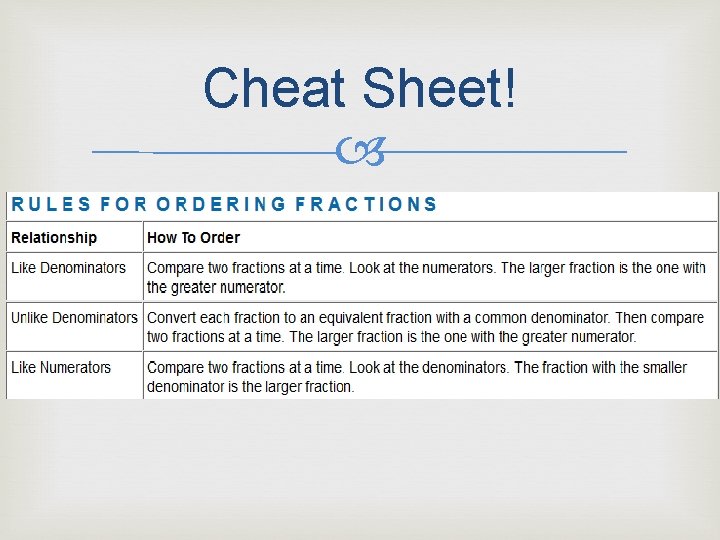
Sequence Fractions that have the same denominator? 7 3 1 9 1 1 10 1 The 0 numerator with 0 the highest number 0 is the greatest fraction
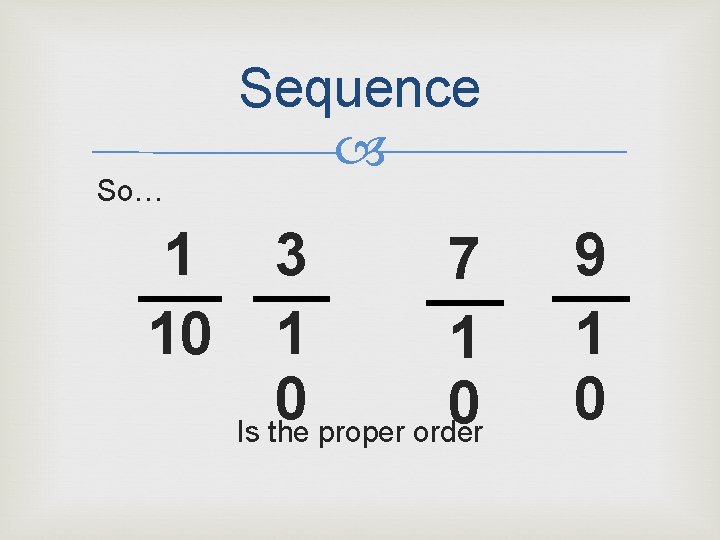
So… 1 10 Sequence 3 7 1 1 0 0 Is the proper order 9 1 0
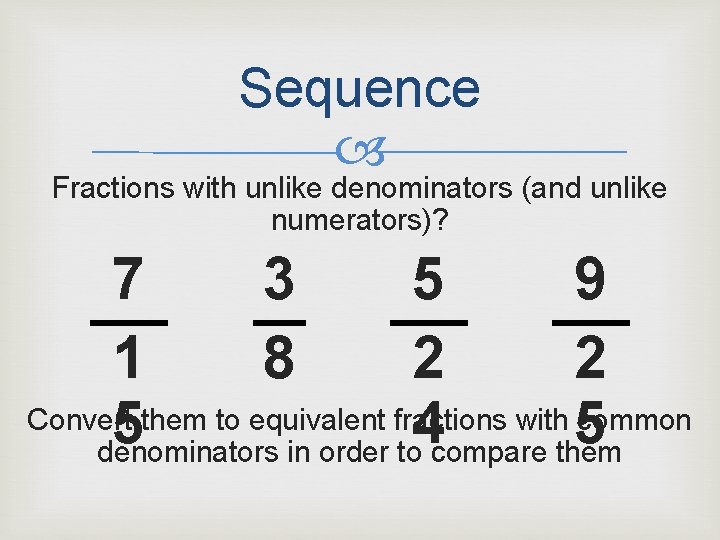
Sequence Fractions with unlike denominators (and unlike numerators)? 7 3 5 9 1 8 2 2 Convert them to equivalent fractions with 5 common 5 4 denominators in order to compare them
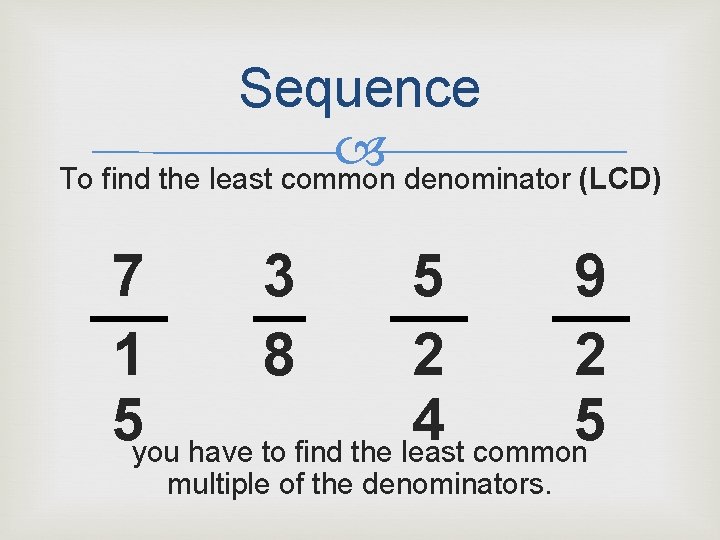
Sequence To find the least common denominator (LCD) 7 3 5 9 1 8 2 2 5 you have to find the least 4 common 5 multiple of the denominators.
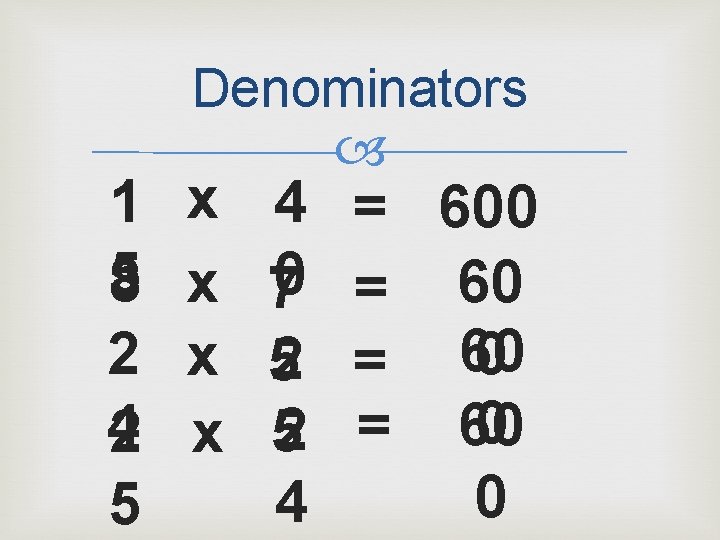
1 5 8 2 4 2 5 Denominators x x 4 70 2 5 52 4 = 600 = 60 0
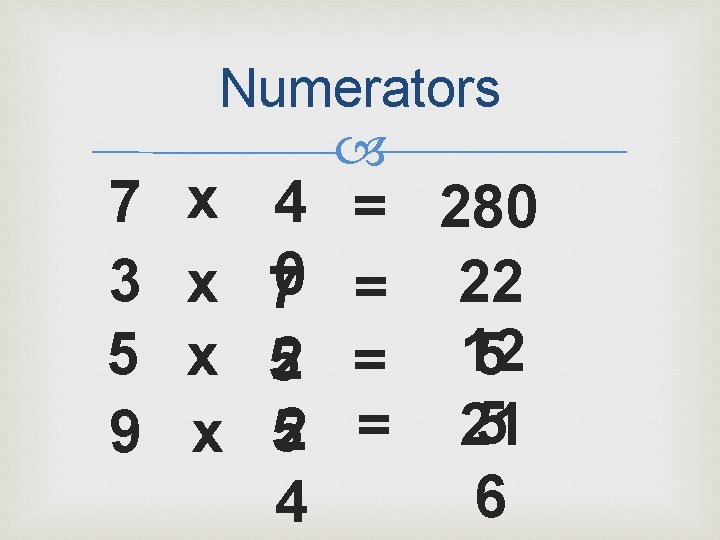
7 3 5 9 Numerators x x 4 70 2 5 52 4 = 280 = 22 5 = 12 5 = 21 6
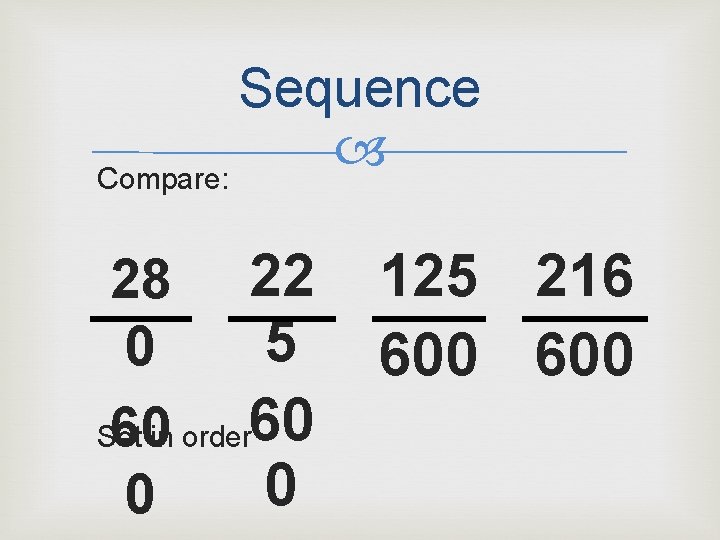
Sequence Compare: 28 22 5 0 60 in order 60 Set 0 0 125 216 600
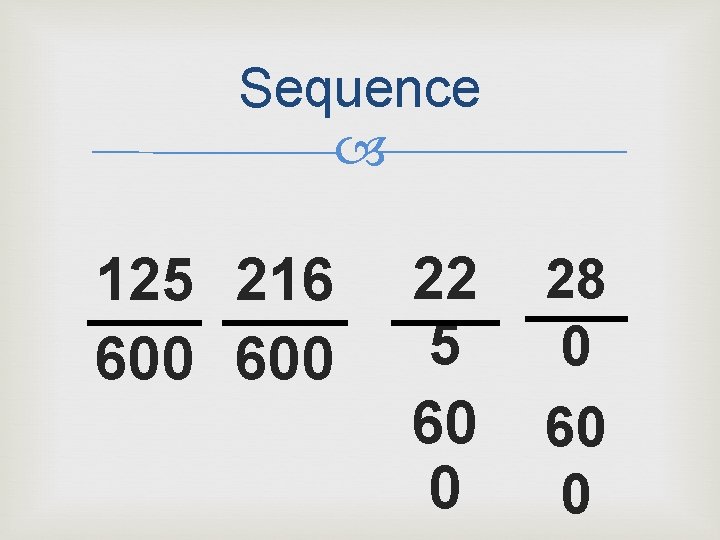
Sequence 125 216 600 22 5 60 0 28 0 60 0
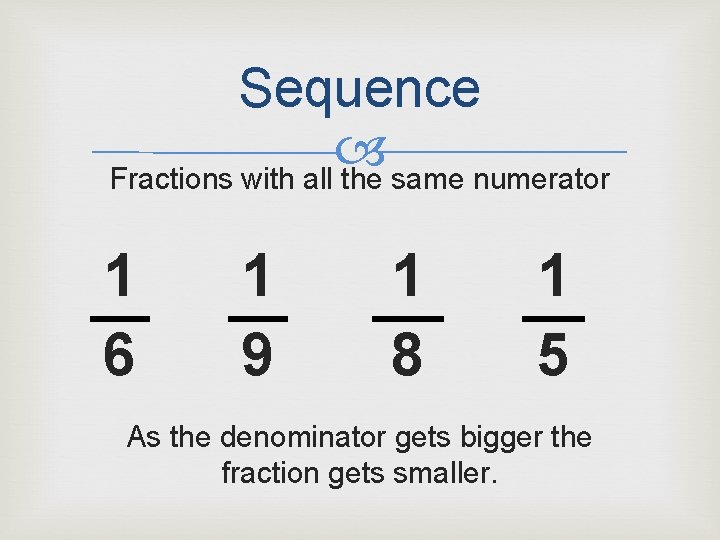
Sequence Fractions with all the same numerator 1 6 1 9 1 8 1 5 As the denominator gets bigger the fraction gets smaller.
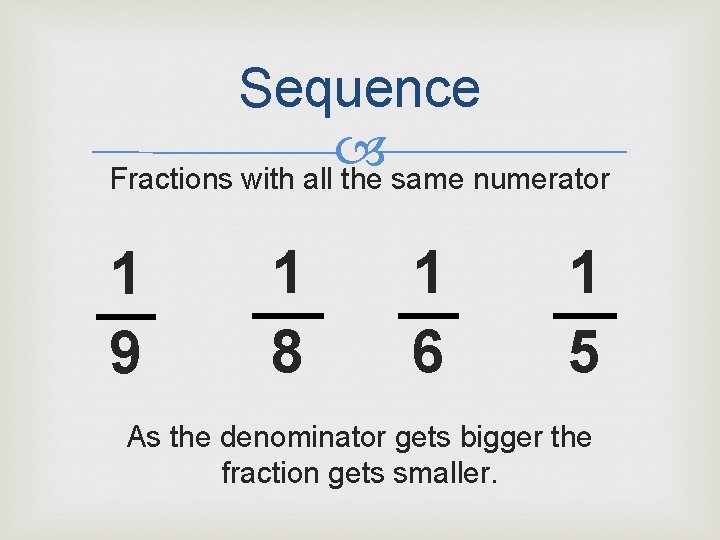
Sequence Fractions with all the same numerator 1 9 1 8 1 6 1 5 As the denominator gets bigger the fraction gets smaller.
Cheat Sheet!
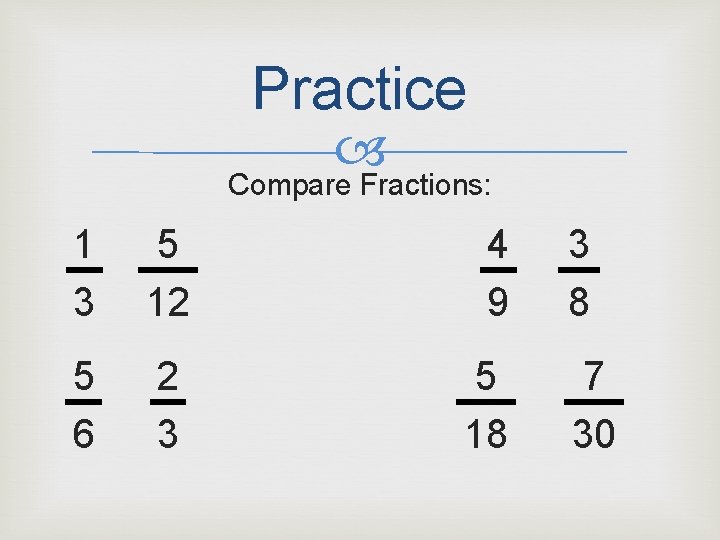
Practice Compare Fractions: 1 3 5 12 4 9 5 6 2 3 5 18 3 8 7 30
Mixed Numbers & Improper Fractions 2. 7
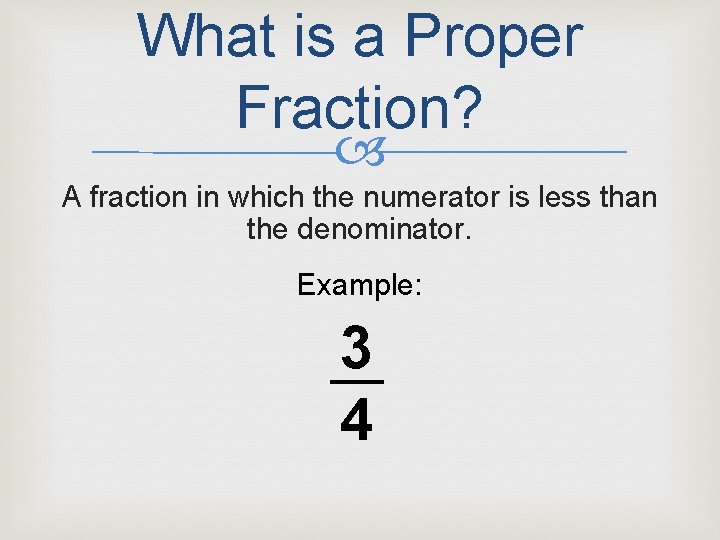
What is a Proper Fraction? A fraction in which the numerator is less than the denominator. Example: 3 4
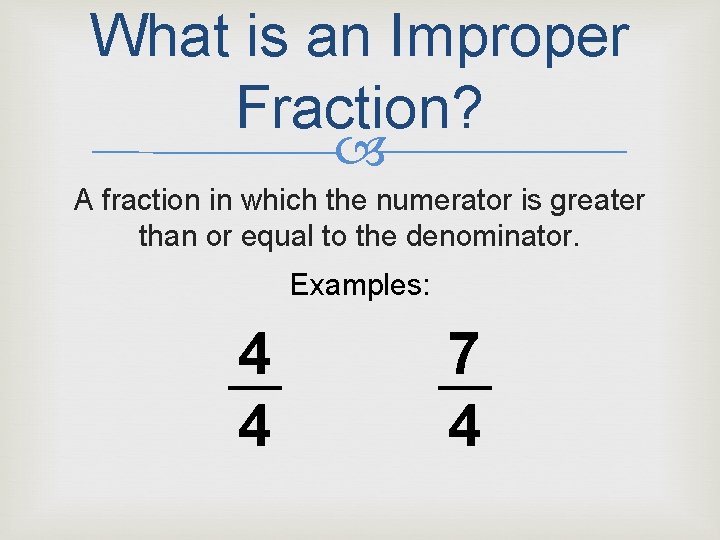
What is an Improper Fraction? A fraction in which the numerator is greater than or equal to the denominator. Examples: 4 4 7 4
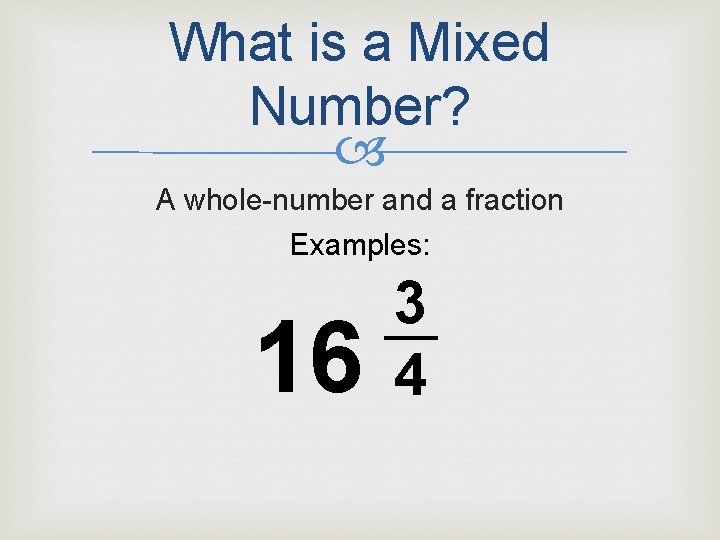
What is a Mixed Number? A whole-number and a fraction Examples: 16 3 4

Cheat Sheet!
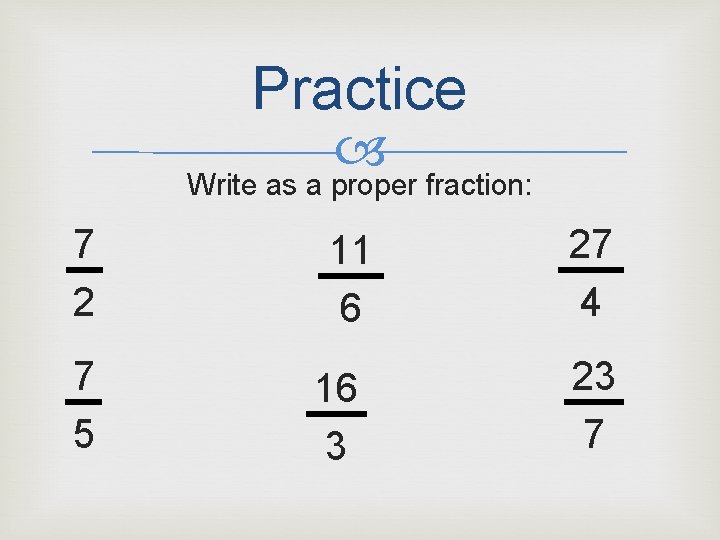
Practice Write as a proper fraction: 7 2 7 5 11 6 16 3 27 4 23 7
Connecting Decimals to Fractions 2. 8
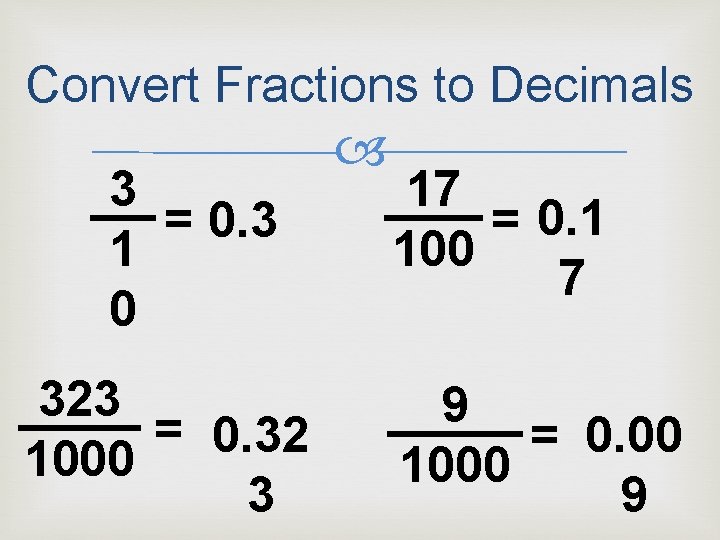
Convert Fractions to Decimals 3 = 0. 3 1 0 323 = 0. 32 1000 3 17 = 0. 1 100 7 9 = 0. 00 1000 9
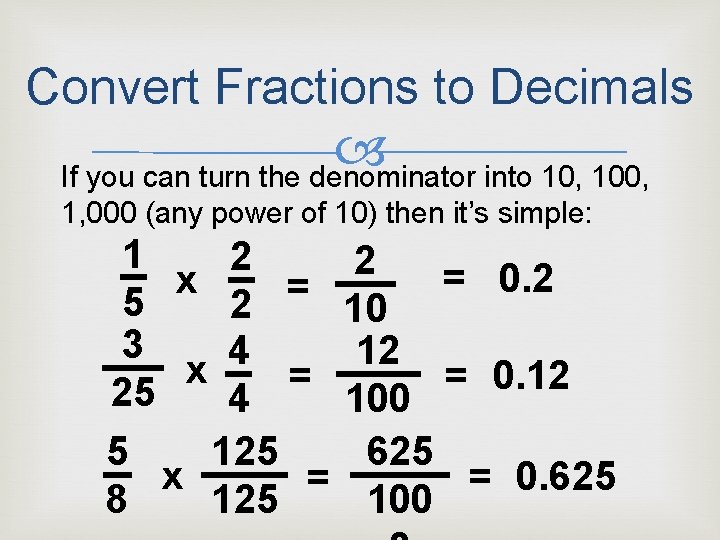
Convert Fractions to Decimals If you can turn the denominator into 10, 100, 1, 000 (any power of 10) then it’s simple: 1 2 x = 5 2 3 4 x = 25 4 125 5 x = 125 8 2 = 0. 2 10 12 = 0. 12 100 625 = 0. 625 100
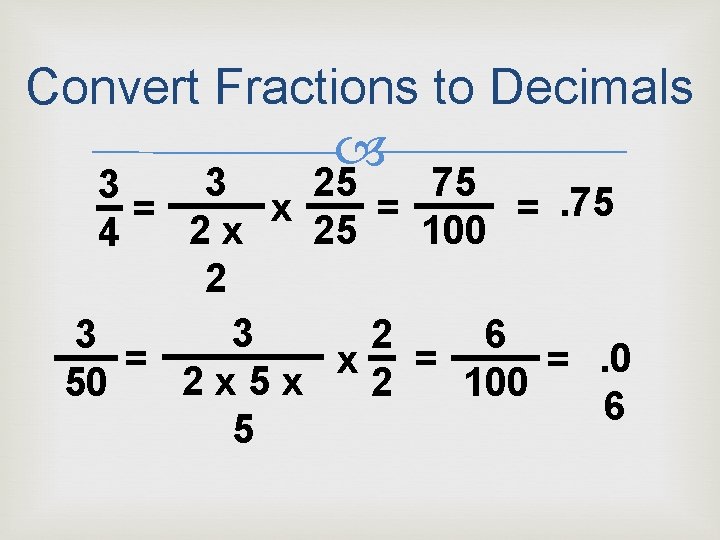
Convert Fractions to Decimals 3 25 75 3 x = =. 75 = 2 x 25 100 4 2 3 6 = x = =. 0 2 x 5 x 2 50 100 6 5
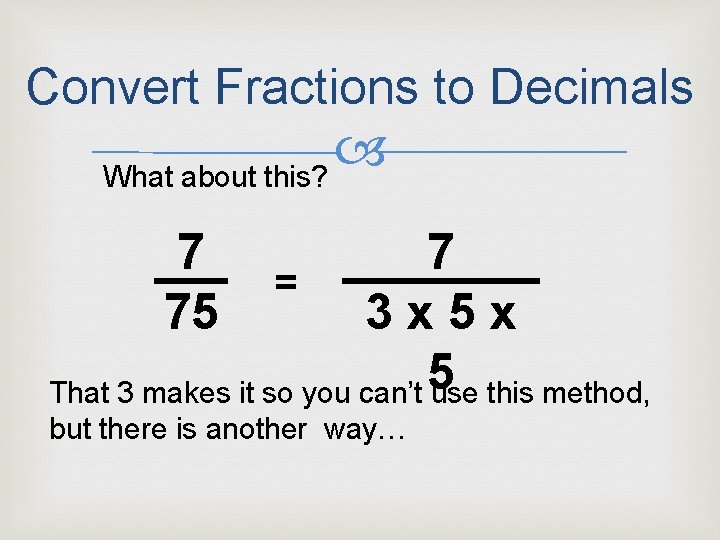
Convert Fractions to Decimals What about this? 7 = 3 x 5 x That 3 makes it so you can’t 5 use this method, 7 75 but there is another way…
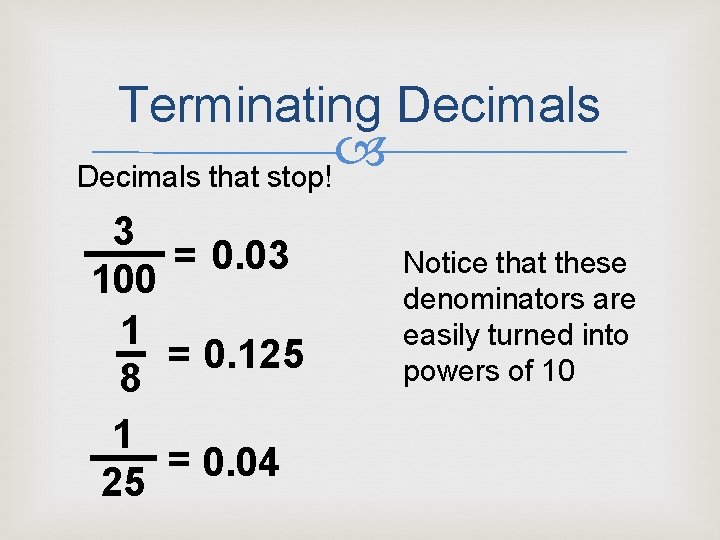
Terminating Decimals that stop! 3 = 0. 03 100 1 = 0. 125 8 1 = 0. 04 25 Notice that these denominators are easily turned into powers of 10
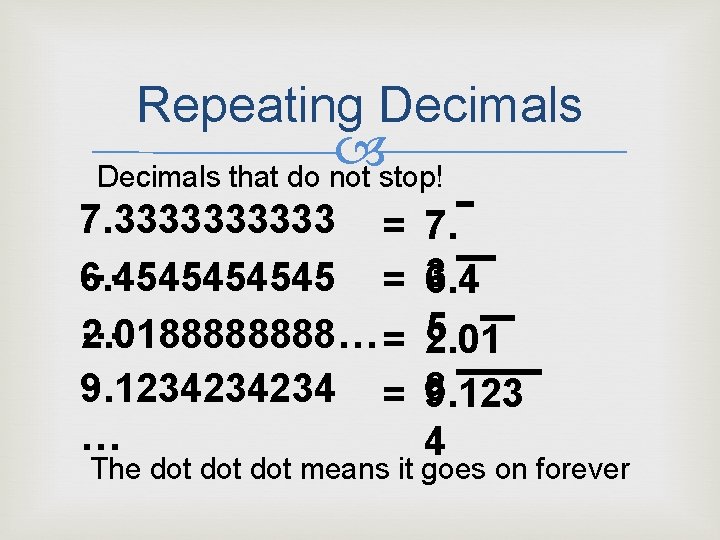
Repeating Decimals that do not stop! 7. 33333 = … 6. 454545 = … 2. 018888… = 9. 1234234234 = … 7. 3 6. 4 5 2. 01 8. 123 9 4 The dot dot means it goes on forever
Converting Repeating Decimals into Fractions https: //www. khanacademy. org/math/algeb ra/solving-linear-equations-andinequalities/conv_rep_decimals/v/covertin g-repeating-decimals-to-fractions-1
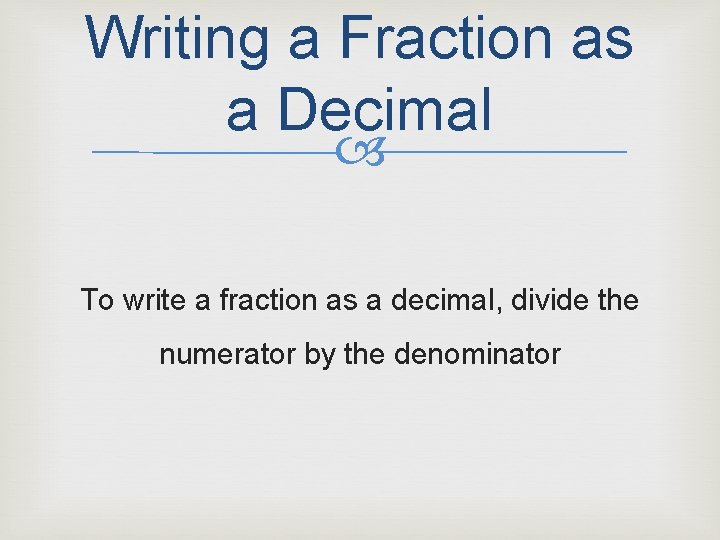
Writing a Fraction as a Decimal To write a fraction as a decimal, divide the numerator by the denominator
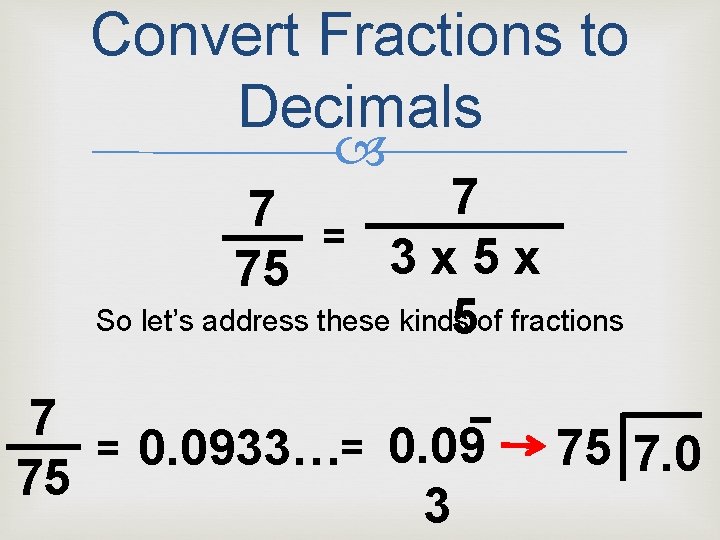
Convert Fractions to Decimals 7 = 3 x 5 x So let’s address these kinds 5 of fractions 7 75 = 0. 0933…= 0. 09 3 75 7. 0
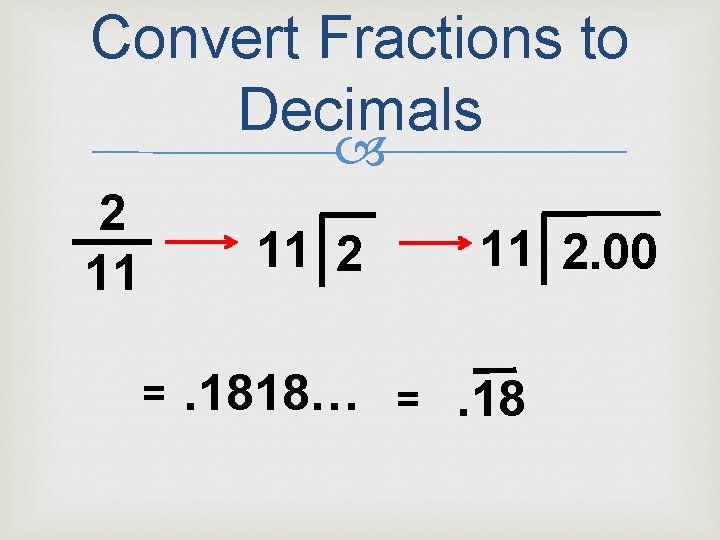
Convert Fractions to Decimals 2 11 11 2. 00 11 2 = . 1818… = . 18
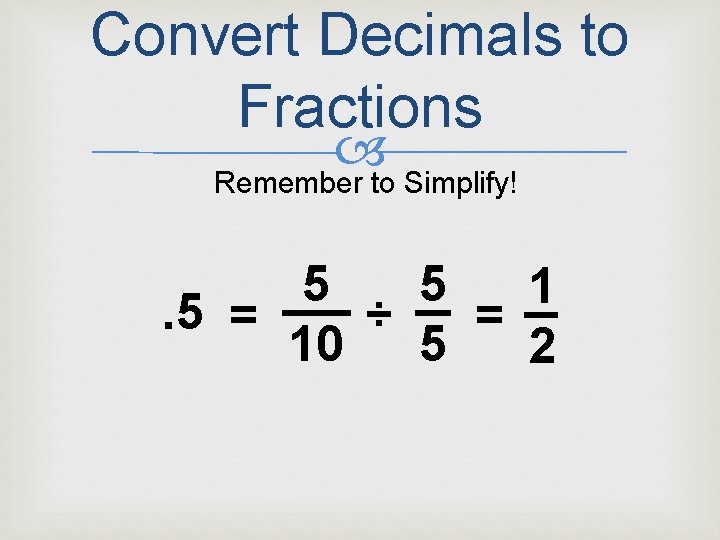
Convert Decimals to Fractions Remember to Simplify! 5 5 1. 5 = ÷ = 10 5 2
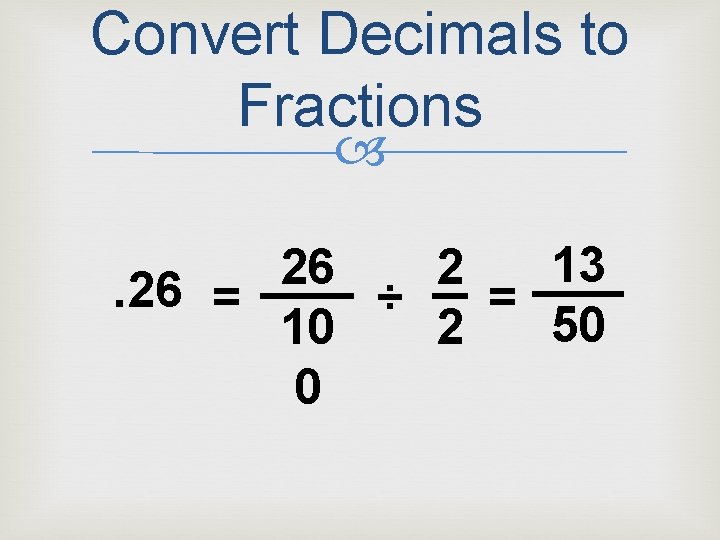
Convert Decimals to Fractions 13 26 2. 26 = ÷ = 50 10 2 0
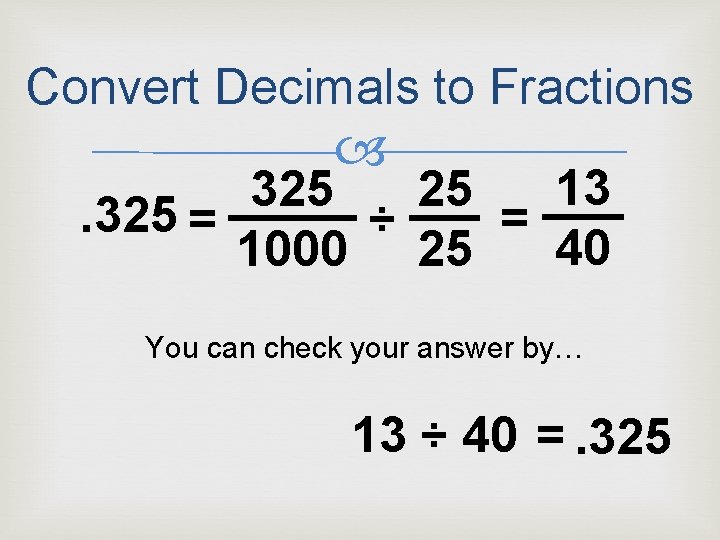
Convert Decimals to Fractions 13 325 25. 325 = = ÷ 40 1000 25 You can check your answer by… 13 ÷ 40 =. 325
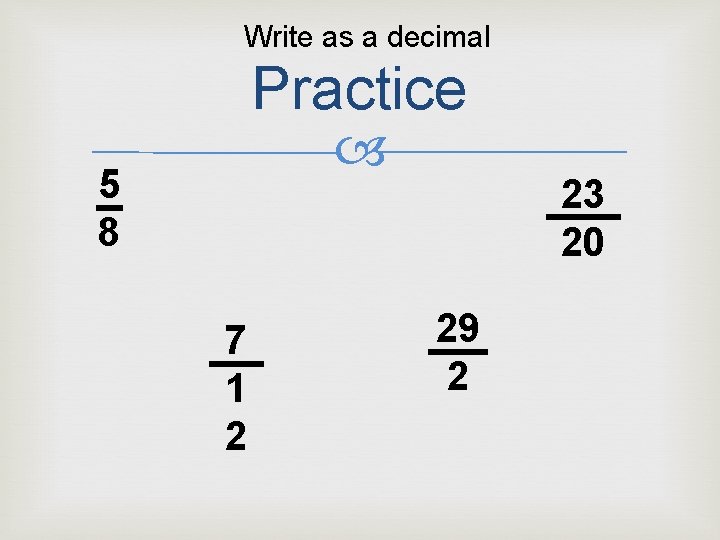
Write as a decimal Practice 5 8 7 1 2 23 20 29 2
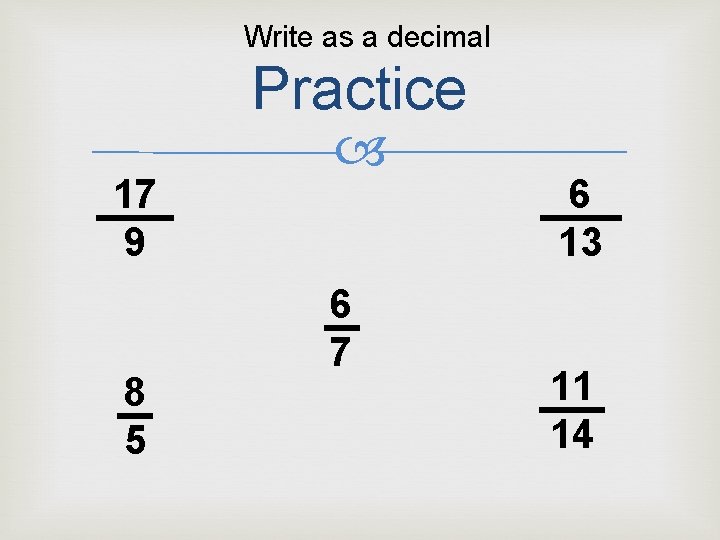
Write as a decimal Practice 17 9 8 5 6 7 6 13 11 14
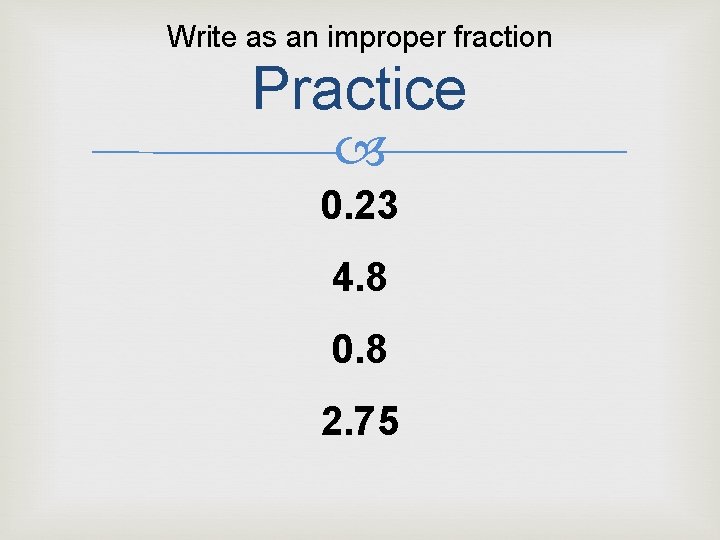
Write as an improper fraction Practice 0. 23 4. 8 0. 8 2. 75
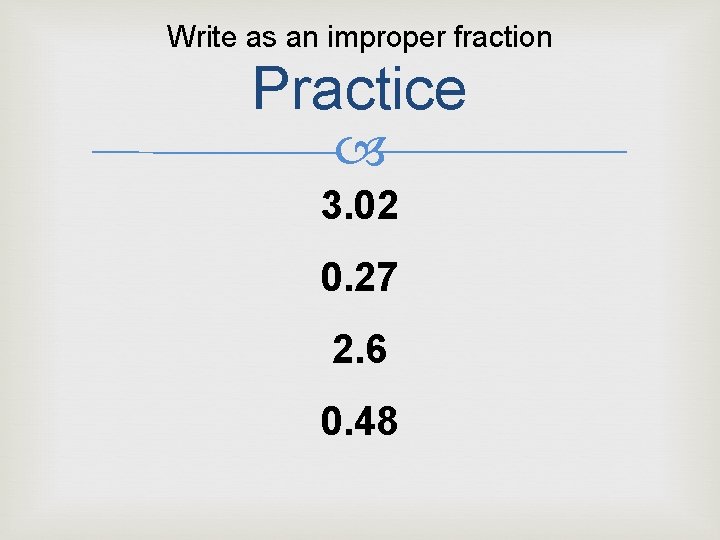
Write as an improper fraction Practice 3. 02 0. 27 2. 6 0. 48
- Slides: 88