
Number Relations Chapter 1 Squares Grab a whiteboard

Number Relations Chapter 1
Squares! Grab a whiteboard, marker and an eraser. On the whiteboard describe what a square is…. What do squares look like? How are squares related to math?

Square Scavenger Hunt Find the Squares! Objective: Go around the room and find as many squares as you can. ◎ Draw/Trace them onto a sheet of paper. *Find at least 5 Squares
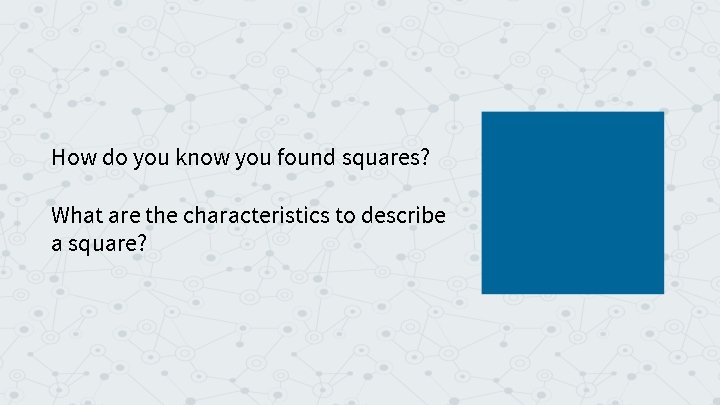
How do you know you found squares? What are the characteristics to describe a square?
Review What is the formula for the area of a rectangle or square? What units do we measure area in?
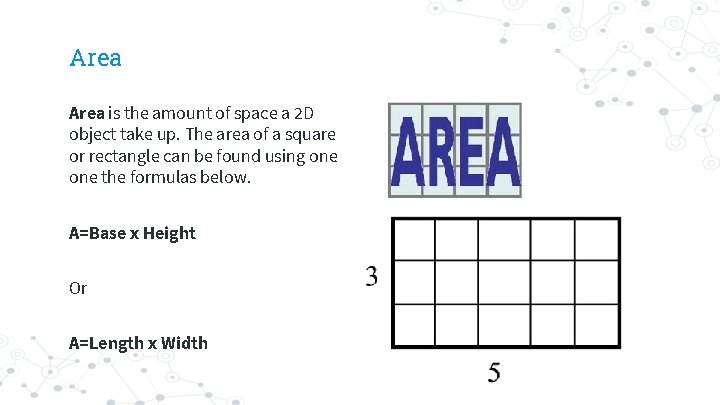
Area is the amount of space a 2 D object take up. The area of a square or rectangle can be found using one the formulas below. A=Base x Height Or A=Length x Width
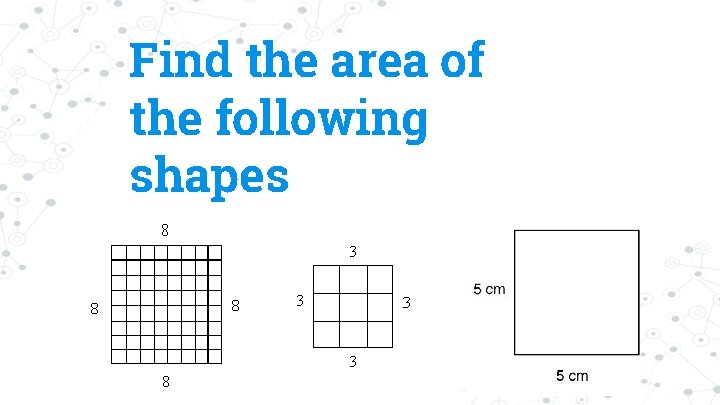
Find the area of the following shapes
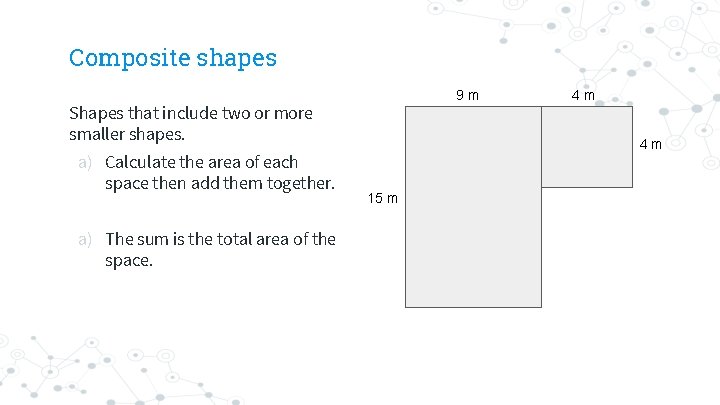
Composite shapes 9 m Shapes that include two or more smaller shapes. a) Calculate the area of each space then add them together. a) The sum is the total area of the space. 4 m 4 m 15 m
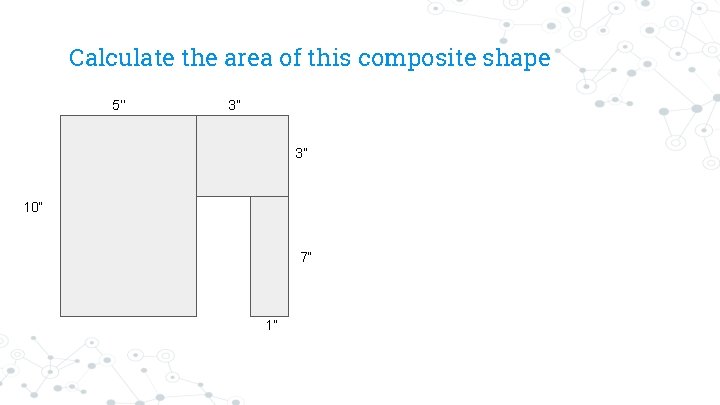
Calculate the area of this composite shape 5’’ 3” 3” 10” 7” 1”
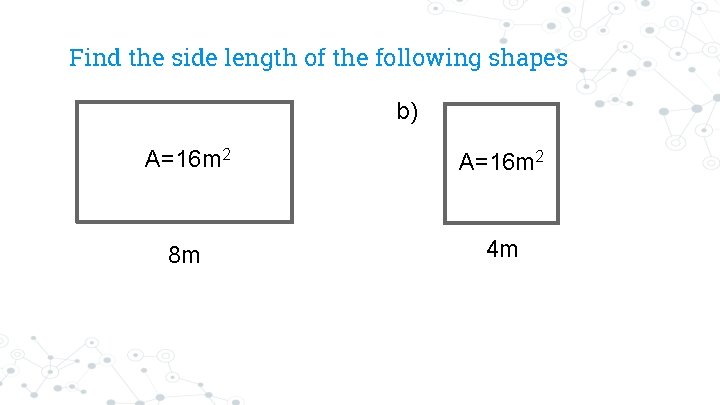
Find the side length of the following shapes b) A=16 m 2 8 m 4 m
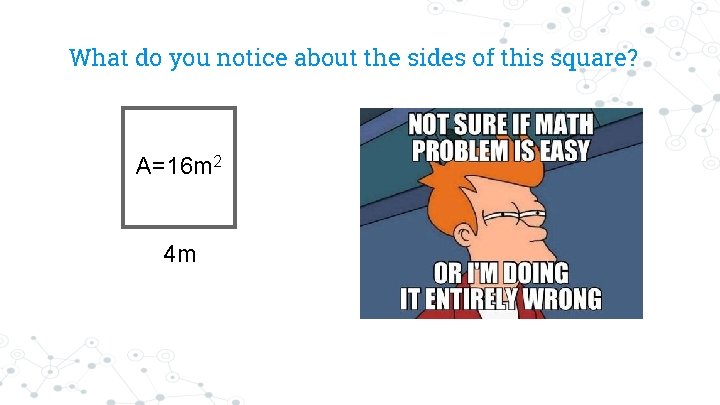
What do you notice about the sides of this square? A=16 m 2 4 m
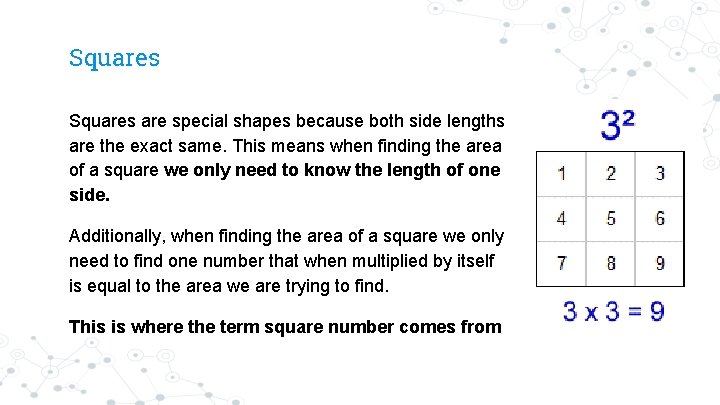
Squares are special shapes because both side lengths are the exact same. This means when finding the area of a square we only need to know the length of one side. Additionally, when finding the area of a square we only need to find one number that when multiplied by itself is equal to the area we are trying to find. This is where the term square number comes from

What is a Square Number? The number we get after multiplying an integer (not a fraction) by itself. 4 x 4 = 16 16 is a square number

Review What is the formula for area of a rectangle or square? What is so special about a square? What is a square number

Discovering Squares 1) With a partner grab one sheet of paper and one pencil 2) With the manipulatives you are given, create as many squares as possible 3) Write down the area of the squares you create as well as the side length of each.

What did you find?
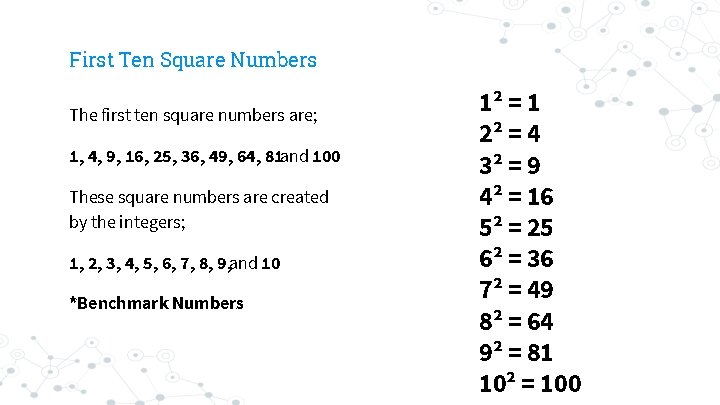
First Ten Square Numbers The first ten square numbers are; 1, 4, 9, 16, 25, 36, 49, 64, 81 and 100 These square numbers are created by the integers; 1, 2, 3, 4, 5, 6, 7, 8, 9, and 10 *Benchmark Numbers 1² = 1 2² = 4 3² = 9 4² = 16 5² = 25 6² = 36 7² = 49 8² = 64 9² = 81 10² = 100
Fun Fact! Perfect square numbers only end in 0, 1, 4, 5, 6 or 9. If a number does not end in one of these digits it is not a perfect square. However, just because a number ends in 0, 1, 4, 5, 6 or 9 does not mean it is a perfect square.
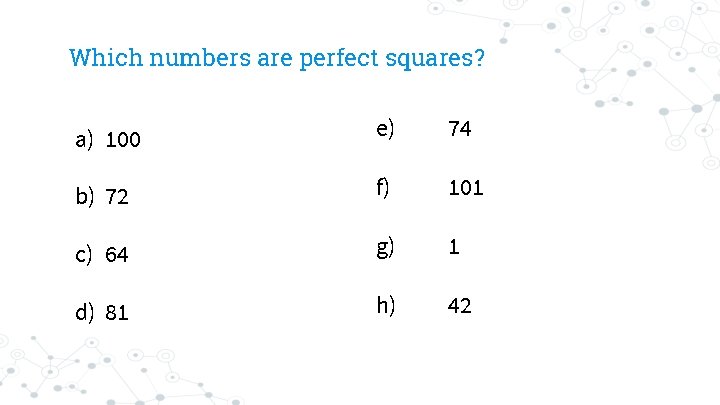
Which numbers are perfect squares? a) 100 e) 74 b) 72 f) 101 c) 64 g) 1 d) 81 h) 42
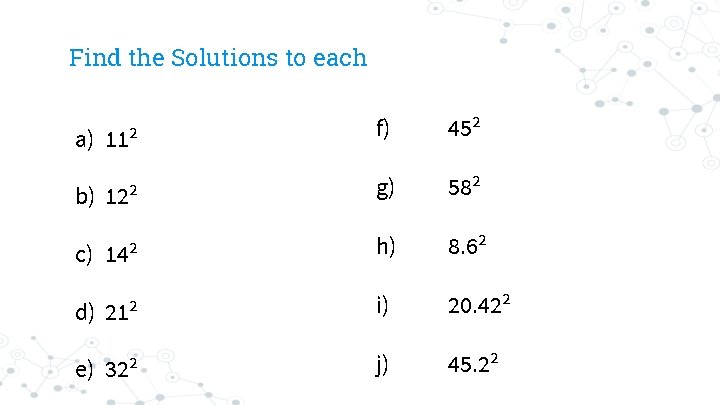
Find the Solutions to each a) 11² f) 45² b) 12² g) 58² c) 14² h) 8. 6² d) 21² i) 20. 42² e) 32² j) 45. 2²
Review What is a square number? What makes that number a square? Can you square any number?
Identifying Perfect Squares There are two methods we will use to identify if a number is a perfect square; 1) Identify using the square root 2) Prime factorization
Square Roots The square root of a number is a value that, when multiplied by itself, gives the number. Example: 4 × 4 = 16, so a square root of 16 is 4. Note that (− 4) × (− 4) = 16 too, so − 4 is also a square root of 16, but because we will be using the square roots for measurement we will disregard the negative answers.
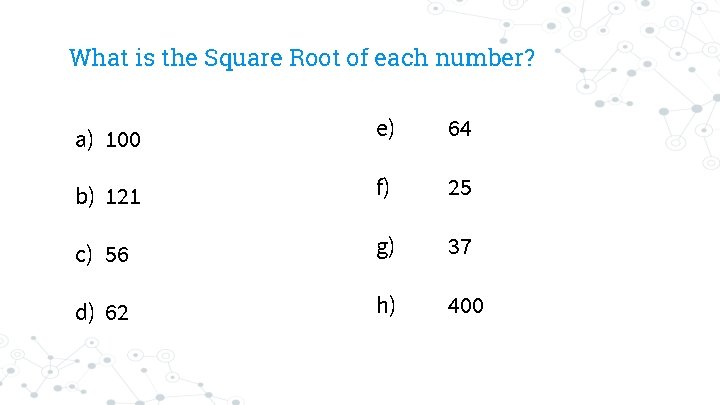
What is the Square Root of each number? a) 100 e) 64 b) 121 f) 25 c) 56 g) 37 d) 62 h) 400
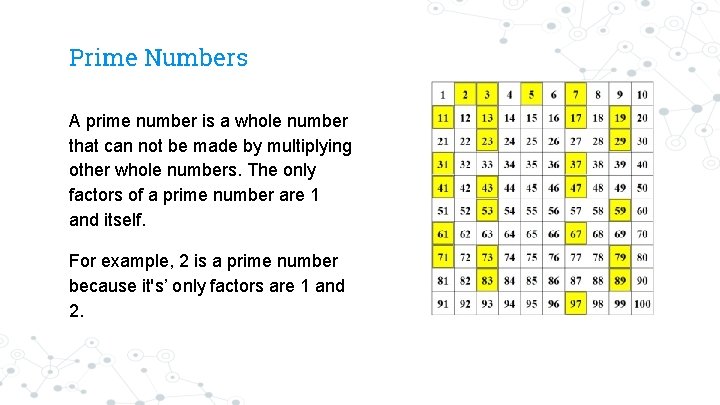
Prime Numbers A prime number is a whole number that can not be made by multiplying other whole numbers. The only factors of a prime number are 1 and itself. For example, 2 is a prime number because it's’ only factors are 1 and 2.
Prime Factorization Prime factorization is finding the factors of a number that are all prime. Each of these prime numbers can be multiplied to create the original number. A number is considered square if it has an even amount of the same prime factor. To complete prime factorization; 1) Find two factors of your number. 2) Look at your two factors and determine if one or both of them is not prime. 3) If it is not a prime factor it. 4) Repeat this process until all your factors are prime.
Find the Prime Factorization of 24 1) Find two factors of your number. 2) Look at your two factors and determine if one or both of them is not prime. 3) If it is not a prime factor it. 4) Repeat this process until all your factors are prime. 24
Find the Prime Factorization of 81 1) Find two factors of your number. 2) Look at your two factors and determine if one or both of them is not prime. 3) If it is not a prime factor it. 4) Repeat this process until all your factors are prime. 81
Find the Prime Factorization of 36 1) Find two factors of your number. 2) Look at your two factors and determine if one or both of them is not prime. 3) If it is not a prime factor it. 4) Repeat this process until all your factors are prime. 36

Find the Prime Factorization of 400
Review a) What are two ways to tell if a number is a perfect square? a) How many answers does the square root of a number give? c) What is the prime factorization of 42?
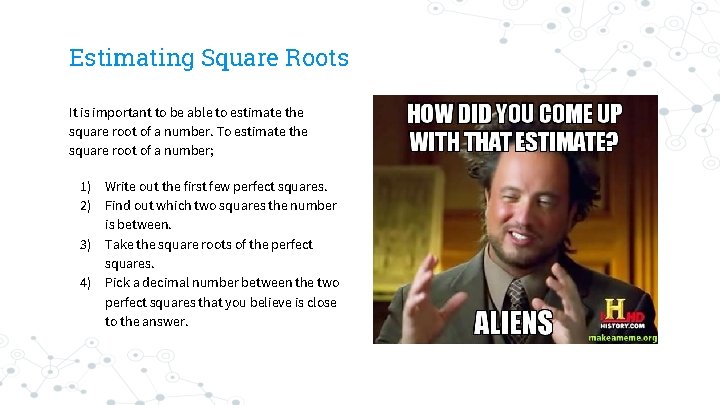
Estimating Square Roots It is important to be able to estimate the square root of a number. To estimate the square root of a number; 1) Write out the first few perfect squares. 2) Find out which two squares the number is between. 3) Take the square roots of the perfect squares. 4) Pick a decimal number between the two perfect squares that you believe is close to the answer.
What is √ 55 when estimating? 1) Write out the first few perfect squares. 2) Find out which two squares the number is between. 3) Take the square roots of the perfect squares. 4) Pick a decimal number between the two perfect squares that you believe is close to the answer.
What is √ 76 when estimating? 1) Write out the first few perfect squares. 2) Find out which two squares the number is between. 3) Take the square roots of the perfect squares. 4) Pick a decimal number between the two perfect squares that you believe is close to the answer.
What is √ 34 when estimating? 1) Write out the first few perfect squares. 2) Find out which two squares the number is between. 3) Take the square roots of the perfect squares. 4) Pick a decimal number between the two perfect squares that you believe is close to the answer.

Practice! Page 18 #1, 2, 4, 5, 13, 14
Review a) What is a square root? a) What is a perfect square? c) What makes a square so special?
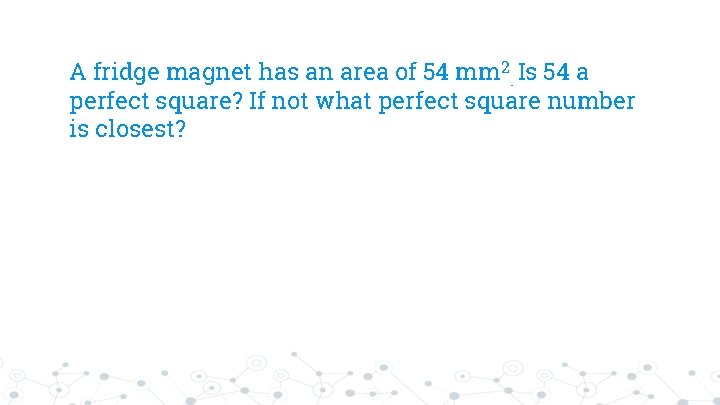
A fridge magnet has an area of 54 mm 2. Is 54 a perfect square? If not what perfect square number is closest?
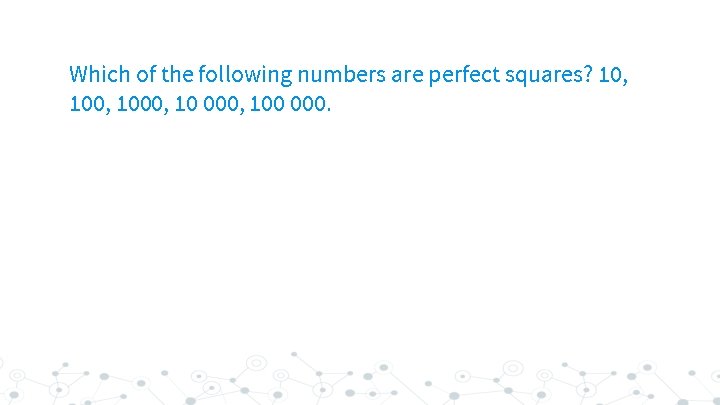
Which of the following numbers are perfect squares? 10, 1000, 100 000.
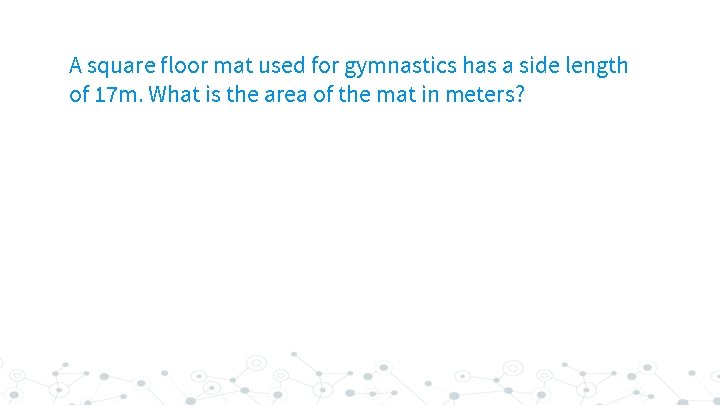
A square floor mat used for gymnastics has a side length of 17 m. What is the area of the mat in meters?
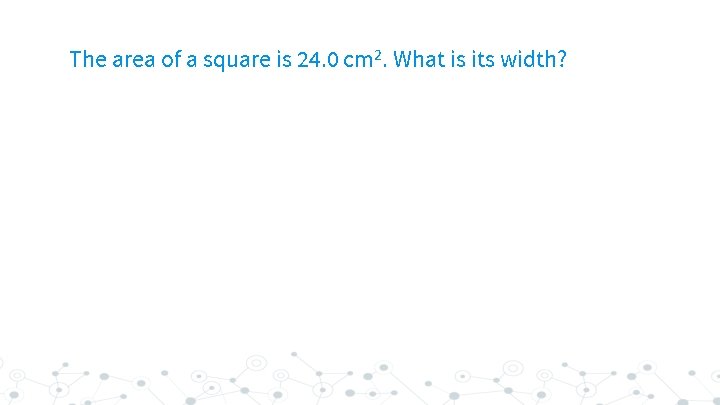
The area of a square is 24. 0 cm 2. What is its width?

A square grid contains 400 cells. What is its width?
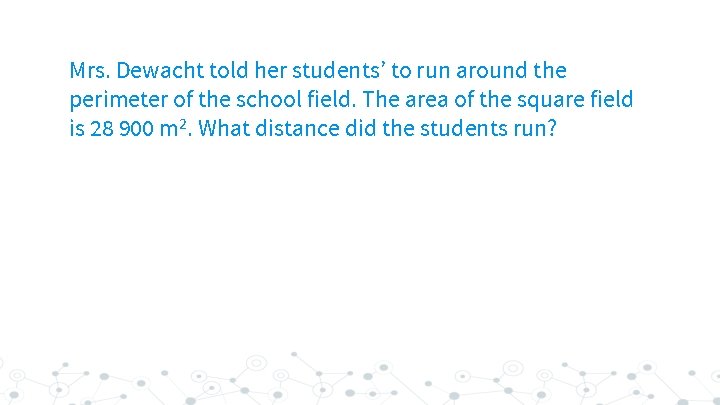
Mrs. Dewacht told her students’ to run around the perimeter of the school field. The area of the square field is 28 900 m 2. What distance did the students run?

Practice! Pages 8 -9 Questions #1, 2, 6, 7, 10, 15 Pages 13 -14 Questions # 2, 4, 7, 8, 9, 10, 11 Page 23 Questions # 1 - 9
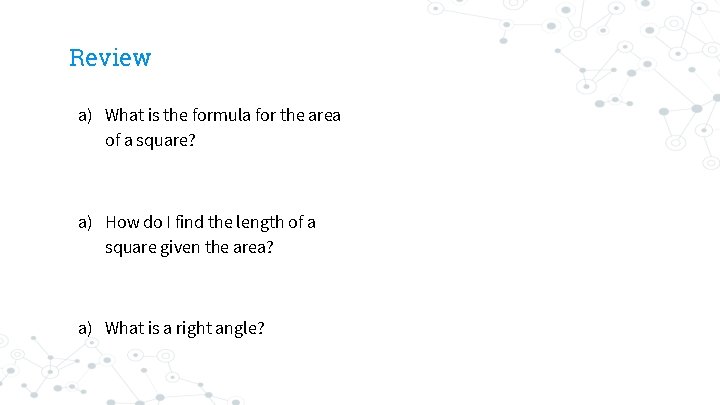
Review a) What is the formula for the area of a square? a) How do I find the length of a square given the area? a) What is a right angle?

Story Time
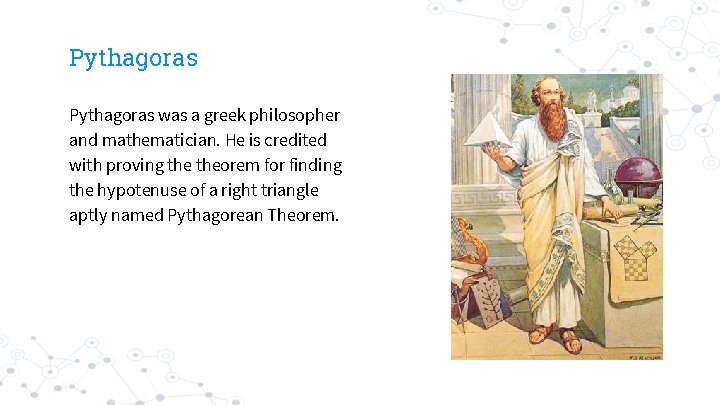
Pythagoras was a greek philosopher and mathematician. He is credited with proving theorem for finding the hypotenuse of a right triangle aptly named Pythagorean Theorem.
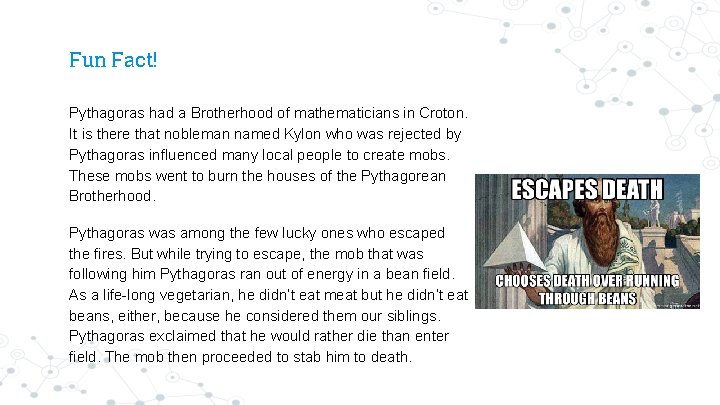
Fun Fact! Pythagoras had a Brotherhood of mathematicians in Croton. It is there that nobleman named Kylon who was rejected by Pythagoras influenced many local people to create mobs. These mobs went to burn the houses of the Pythagorean Brotherhood. Pythagoras was among the few lucky ones who escaped the fires. But while trying to escape, the mob that was following him Pythagoras ran out of energy in a bean field. As a life-long vegetarian, he didn’t eat meat but he didn’t eat beans, either, because he considered them our siblings. Pythagoras exclaimed that he would rather die than enter field. The mob then proceeded to stab him to death.
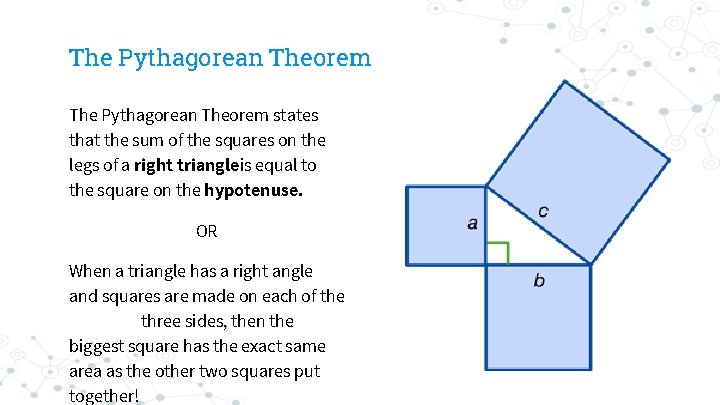
The Pythagorean Theorem states that the sum of the squares on the legs of a right triangleis equal to the square on the hypotenuse. OR When a triangle has a right angle and squares are made on each of the three sides, then the biggest square has the exact same area as the other two squares put together!
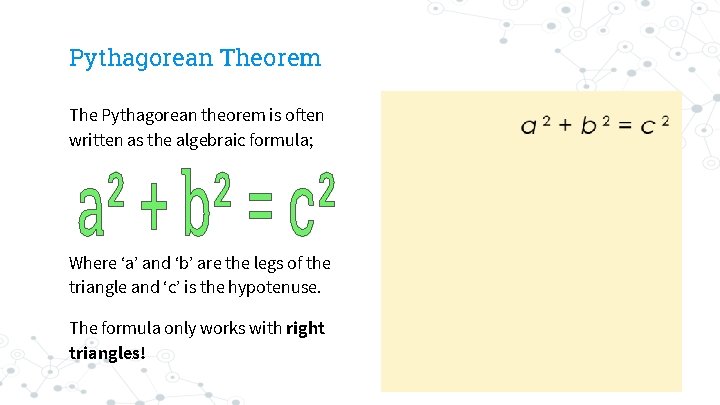
Pythagorean Theorem The Pythagorean theorem is often written as the algebraic formula; Where ‘a’ and ‘b’ are the legs of the triangle and ‘c’ is the hypotenuse. The formula only works with right triangles!
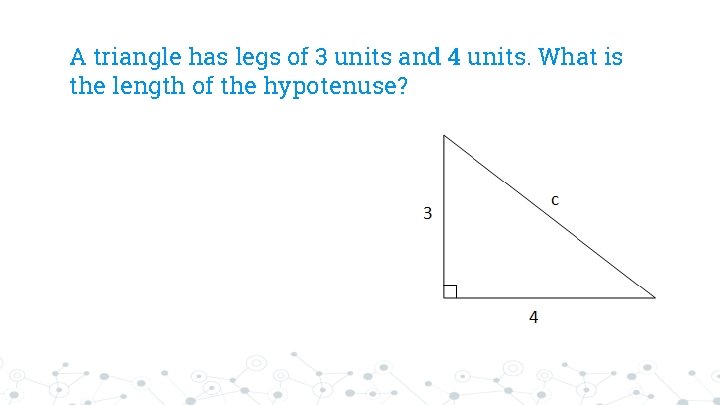
A triangle has legs of 3 units and 4 units. What is the length of the hypotenuse?
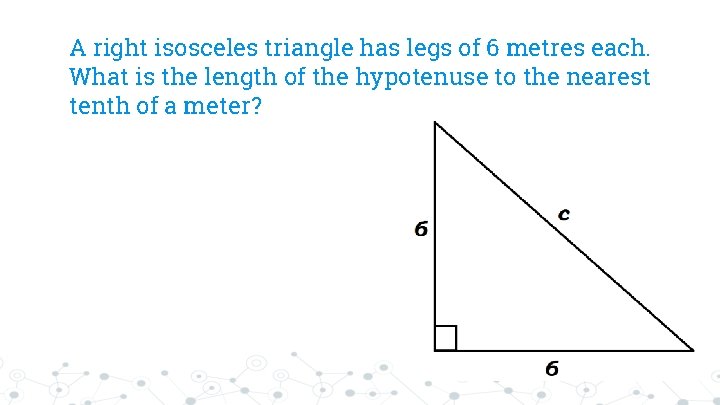
A right isosceles triangle has legs of 6 metres each. What is the length of the hypotenuse to the nearest tenth of a meter?
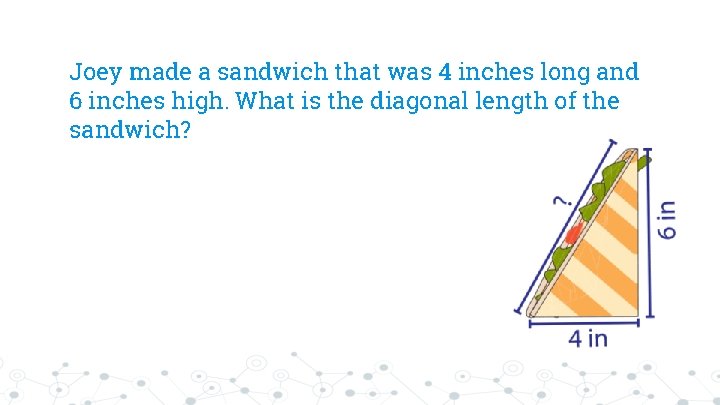
Joey made a sandwich that was 4 inches long and 6 inches high. What is the diagonal length of the sandwich?
Review a) What is a hypotenuse? a) What is the Pythagorean Theorem? a) What kind of triangles does the Pythagorean Theorem work for?
Review The Pythagorean Theorem is not only used to find the hypotenuse of a right angled triangle. It can also be used to find the legs of the same triangle as long as one of the legs and hypotenuse is known. Or in other terms you can use the Theorem to find ‘a’ as long as you know ‘b’ and ‘c’.
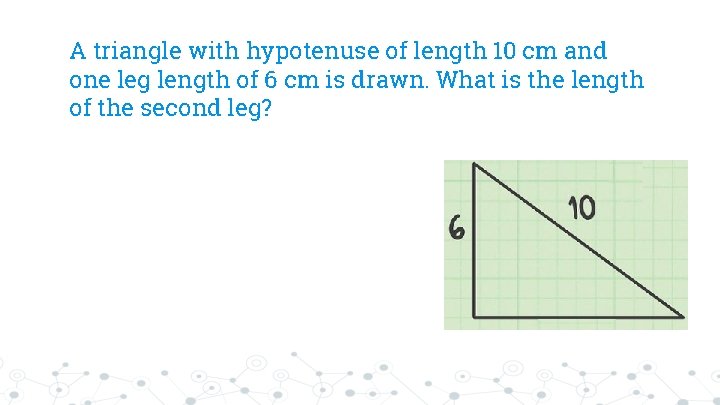
A triangle with hypotenuse of length 10 cm and one leg length of 6 cm is drawn. What is the length of the second leg?
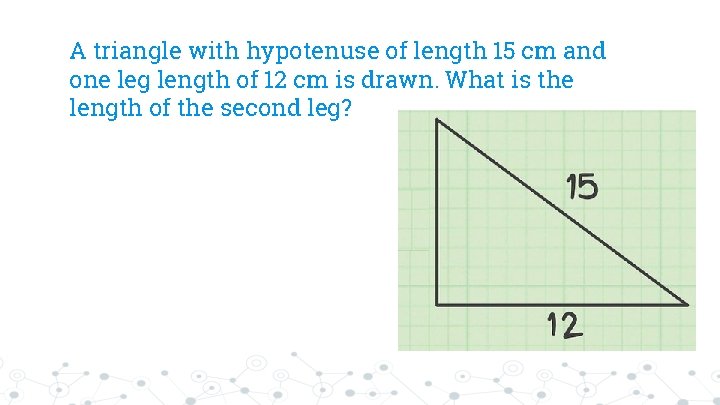
A triangle with hypotenuse of length 15 cm and one leg length of 12 cm is drawn. What is the length of the second leg?
A triangle with hypotenuse of length 13 ft and one leg length of 8 ft is drawn. What is the length of the second leg to the nearest tenth?
Pythagorean Theorem One of the best parts of the Pythagorean Theorem is that it works both ways! This means that if a triangle is a right triangle a² + b² = c², and if a² + b² = c² then the triangle is a right triangle.
A triangle has measures of 8 cm, 10 cm and 16 cm. Is it a right triangle?

Review a) What is the Pythagorean Theorem? a) What kind of triangles does the Pythagorean Theorem work for? a) Can the Theorem also help to find right angle triangles?
The height of a triangle is 4 cm and the base of the same triangle is 10 cm. What is the length of the hypotenuse to the nearest tenth?
The hypotenuse of a right triangle is 14. 0 cm and the base of the triangle is 8. 0 cm. What is the height of the triangle to the nearest hundredth?
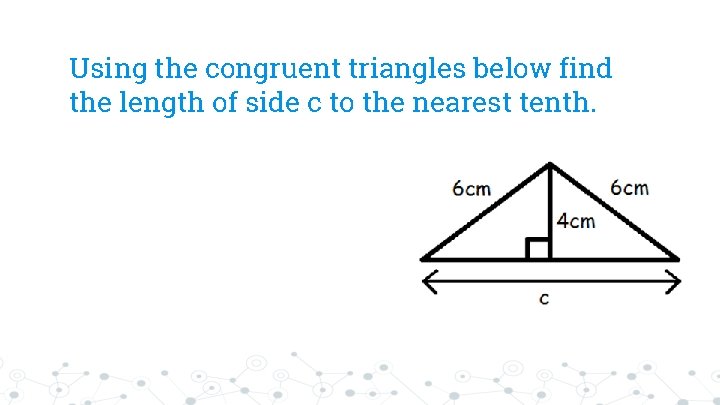
Using the congruent triangles below find the length of side c to the nearest tenth.

A cruise ship travels from Port Cassett north at a speed of 34 km/h for 2. 5 hours. The it turns 90⁰ and travels west at 30 km/h for 7. 3 hours. When it reaches Green Sea Island, how far is the ship from Port Cassett. Express your answer to the nearest kilometer.
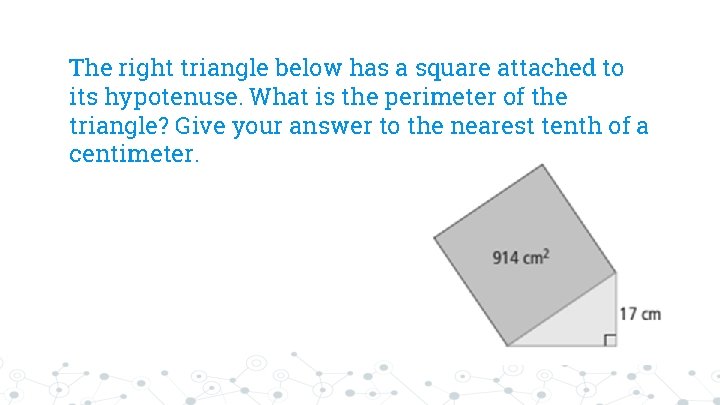
The right triangle below has a square attached to its hypotenuse. What is the perimeter of the triangle? Give your answer to the nearest tenth of a centimeter.
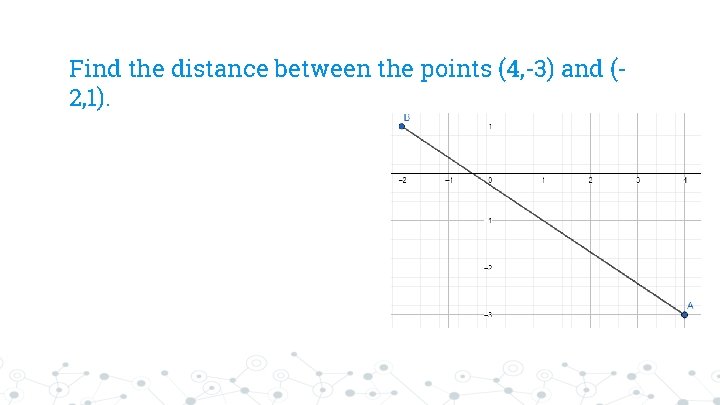
Find the distance between the points (4, -3) and (2, 1).

Mr. Hirsche challenges Mr. Turnbull to a race across the Wilson soccer field measuring 100 yards long and 50 yards wide. Mr. Hirsche runs down the perimeter of the field to the opposite corner, and Mr. Turnbull runs diagonally straight across. Who should win the race?

Practice Pages 29 -31 Questions #1, 2, 5, 7, 9, 10 Page 35 all questions Chapter Self Test and Chapter Review
- Slides: 69