
Number Dividing to Give Decimal Answers Learning Objective
Number Dividing to Give Decimal Answers
Learning Objective • To be able to divide with integers to give decimal answers. Success Criteria • To recognise that when a division results in a remainder, the answer can also be given in decimal form. • To be able to divide integers by integers to give decimal answers. • To be able to solve problems involving division of whole numbers to give decimals.
Starter: Remainder or Decimal? When we divide a number by something that is not a factor of the original number, we have a choice about how we present our answer. For example, 13 ÷ 2 = 6 remainder 1 or 13 ÷ 2 = 6. 5 How we present it can depend on the problem we are using the division to solve. 1. There are 13 dogs in a shelter. Dog beds can fit 2 dogs. How many beds will be required for all the dogs to sleep on? Working out 13 ÷ 2 would help us to find the answer, but what does each solution, 6 remainder 1 and 6. 5, tell us? 6 remainder 1 tells us that if we had 6 beds, 1 dog would be left without a bed. 6. 5 tells us that we would need 6 and a half beds to accommodate all of the dogs; this only makes sense if the beds can be cut in half. If the beds cannot be cut in half, you’d need 7 beds to make sure that each dog had a bed.
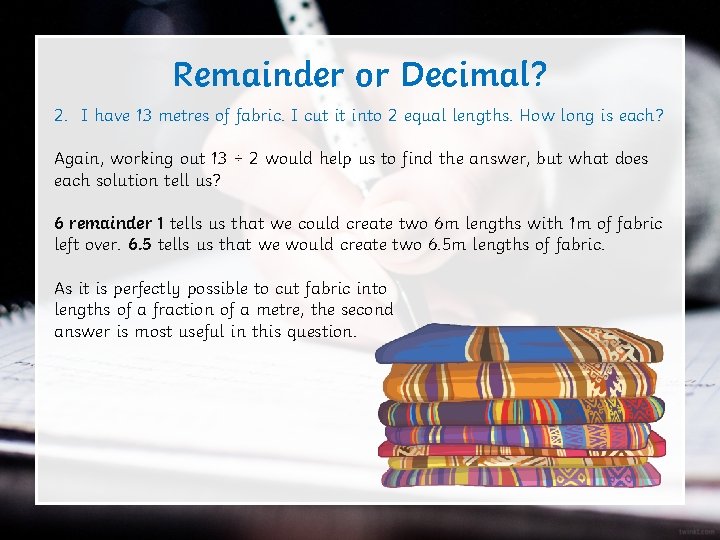
Remainder or Decimal? 2. I have 13 metres of fabric. I cut it into 2 equal lengths. How long is each? Again, working out 13 ÷ 2 would help us to find the answer, but what does each solution tell us? 6 remainder 1 tells us that we could create two 6 m lengths with 1 m of fabric left over. 6. 5 tells us that we would create two 6. 5 m lengths of fabric. As it is perfectly possible to cut fabric into lengths of a fraction of a metre, the second answer is most useful in this question.
Remainder or Decimal? 3. 13 fizzy bonbons are shared between 2 children. How many fizzy bonbons does each get? Again, 13 ÷ 2 helps us find the answer. What does each solution tell us? 6 remainder 1 tells us that each child could have 6 bonbons and 1 would be left over. 6. 5 tells us that each child could have 6 and a half bonbons. The best answer to this question depends upon whether the children can cut the last bonbon in half.
Remainder or Decimal? 4. 13 children need to split up into two equal teams for a game of football. How many will be on each team? 13 ÷ 2 helps us find the answer. What does each solution tell us? 6 remainder 1 tells us that each team would have 6 children and 1 would be left over. 6. 5 tells us that each team could have 6 and a half children. Since children should not be cut in half, the first answer is the most useful. The question says that the teams have to be equal, so 1 child will be left out.
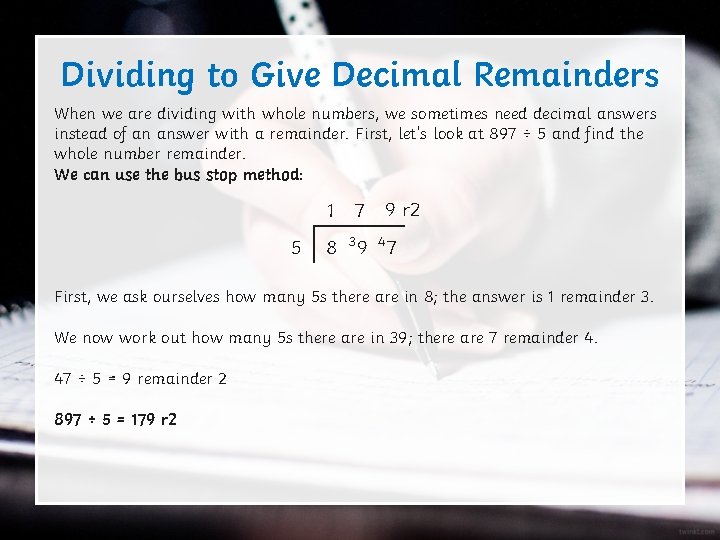
Dividing to Give Decimal Remainders When we are dividing with whole numbers, we sometimes need decimal answers instead of an answer with a remainder. First, let’s look at 897 ÷ 5 and find the whole number remainder. We can use the bus stop method: 1 5 7 9 r 2 8 39 4 7 First, we ask ourselves how many 5 s there are in 8; the answer is 1 remainder 3. We now work out how many 5 s there are in 39; there are 7 remainder 4. 47 ÷ 5 = 9 remainder 2 897 ÷ 5 = 179 r 2
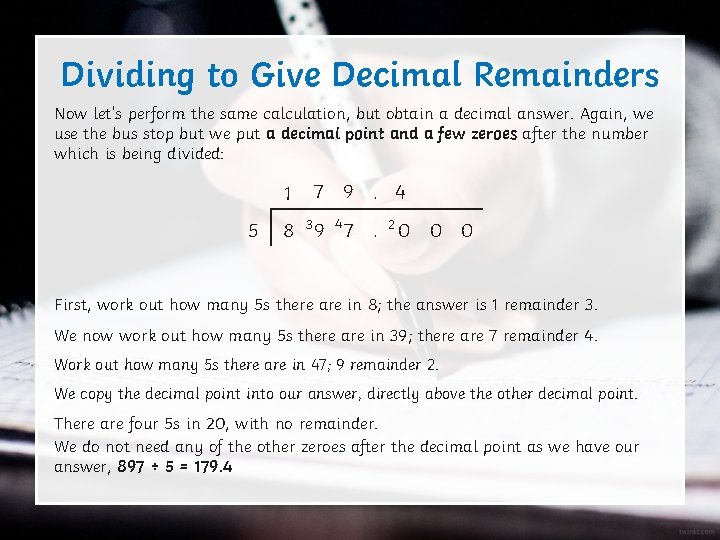
Dividing to Give Decimal Remainders Now let’s perform the same calculation, but obtain a decimal answer. Again, we use the bus stop but we put a decimal point and a few zeroes after the number which is being divided: 1 5 7 9. 4 8 39 4 7. 2 0 0 0 First, work out how many 5 s there are in 8; the answer is 1 remainder 3. We now work out how many 5 s there are in 39; there are 7 remainder 4. Work out how many 5 s there are in 47; 9 remainder 2. We copy the decimal point into our answer, directly above the other decimal point. There are four 5 s in 20, with no remainder. We do not need any of the other zeroes after the decimal point as we have our answer, 897 ÷ 5 = 179. 4
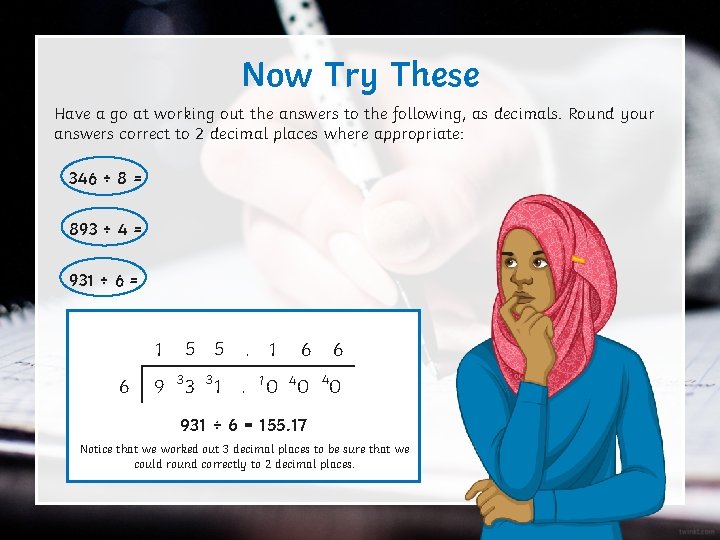
Now Try These Have a go at working out the answers to the following, as decimals. Round your answers correct to 2 decimal places where appropriate: 346 ÷ 8 = 893 ÷ 4 = 931 ÷ 6 = 4 2 5 3 2 5 10 6 8 4 . 12 5 6 6 9 38 34 39 321 163. . 1200 44200 400 931 ÷ 6 = 155. 17 893 346 out÷÷ 348 decimal == 223. 25 43. 25 Notice that we worked places to be sure that we could round correctly to 2 decimal places.
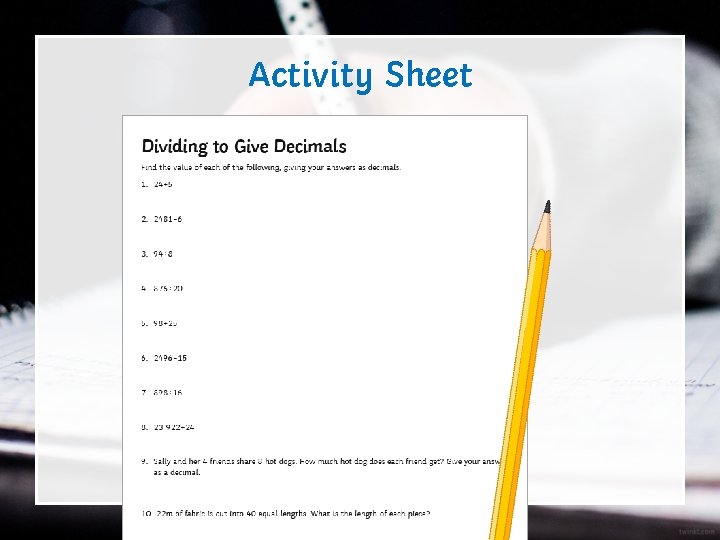
Activity Sheet
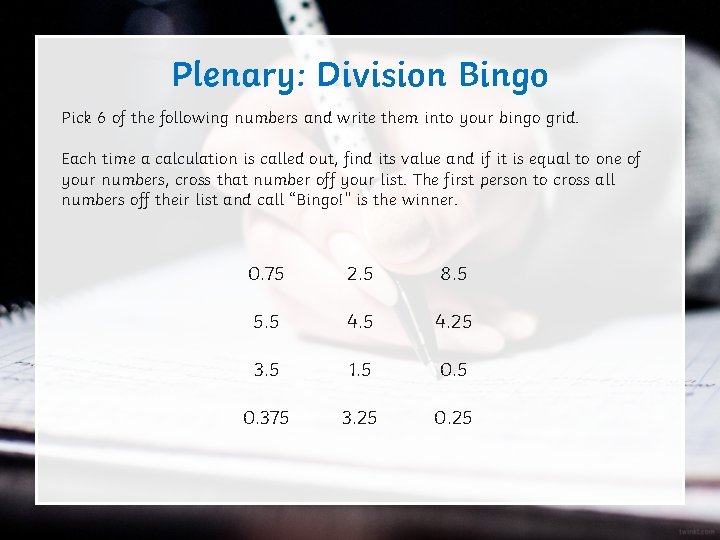
Plenary: Division Bingo Pick 6 of the following numbers and write them into your bingo grid. Each time a calculation is called out, find its value and if it is equal to one of your numbers, cross that number off your list. The first person to cross all numbers off their list and call “Bingo!” is the winner. 0. 75 2. 5 8. 5 5. 5 4. 25 3. 5 1. 5 0. 375 3. 25 0. 25

- Slides: 12