
Number and density of quarkgluon strings and collective
Number and density of quark-gluon strings and collective effects in hadron collisions Grigory Feofilov (St. Petersburg State University, RF) XXII Quark Confinement and the Hadron Spectrum Thessaloniki (Greece) from 29 th August to 3 rd September 2016, ROOM, Clio, (Makedonia Palace), 16: 40 – 17: 00, Friday 02/09/2016 https: //indico. cern. ch/event/353906/ The author of this report acknowledges the support by the Russian Science Foundation research grant 16 -12 -10176
Outline 1) Introduction (motivation) 2) Estimates of: Ø Number of MPIs from PYTHIA Ø Constraints on number of strings in percolation approach basing on the onset of ridge in Au+Au collisions at RHIC Ø The multipomeron exchange model with string fusion phenomenon 3) Conclusions 2
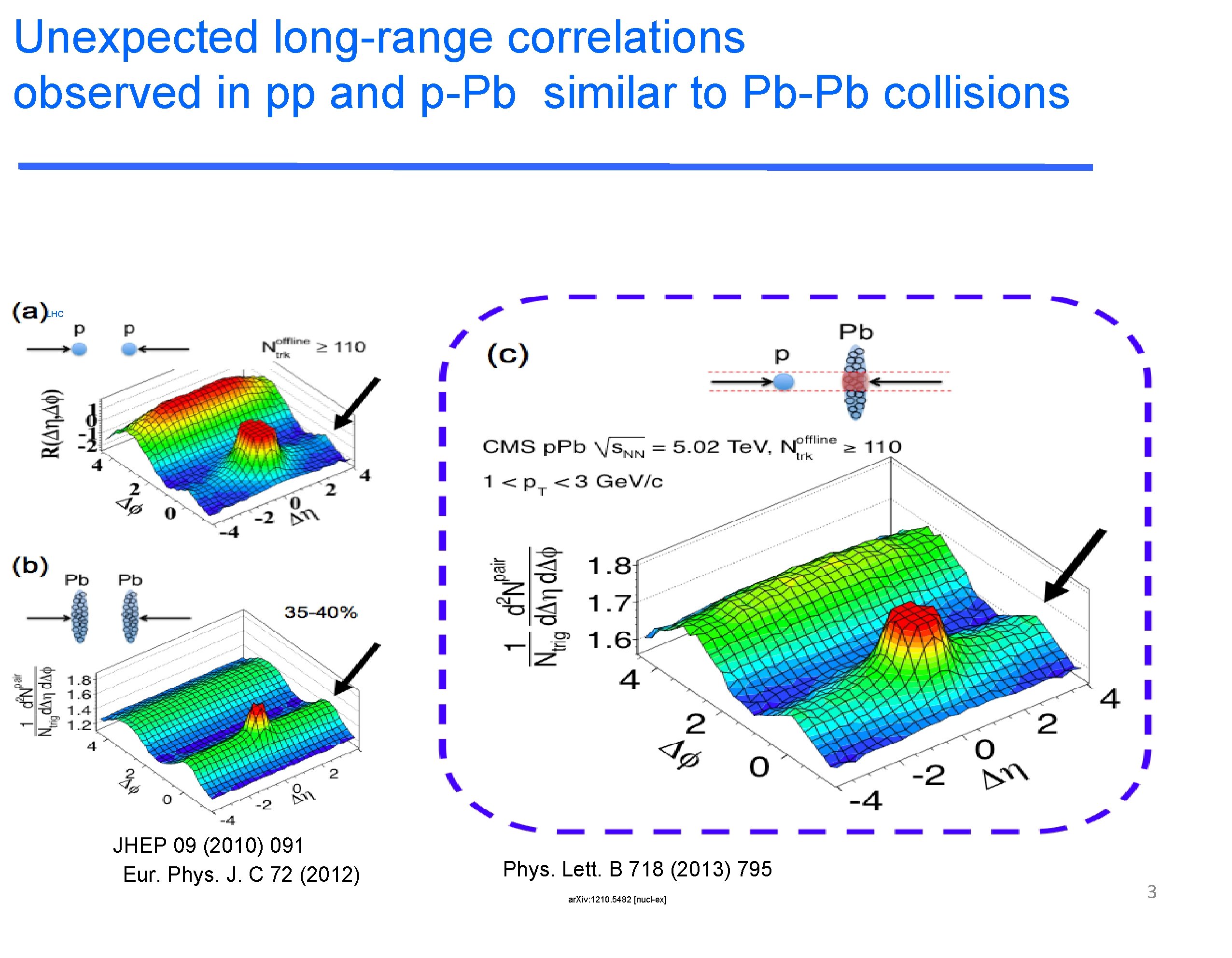
Unexpected long-range correlations observed in pp and p-Pb similar to Pb-Pb collisions LHC JHEP 09 (2010) 091 Eur. Phys. J. C 72 (2012) Phys. Lett. B 718 (2013) 795 ar. Xiv: 1210. 5482 [nucl-ex] 3
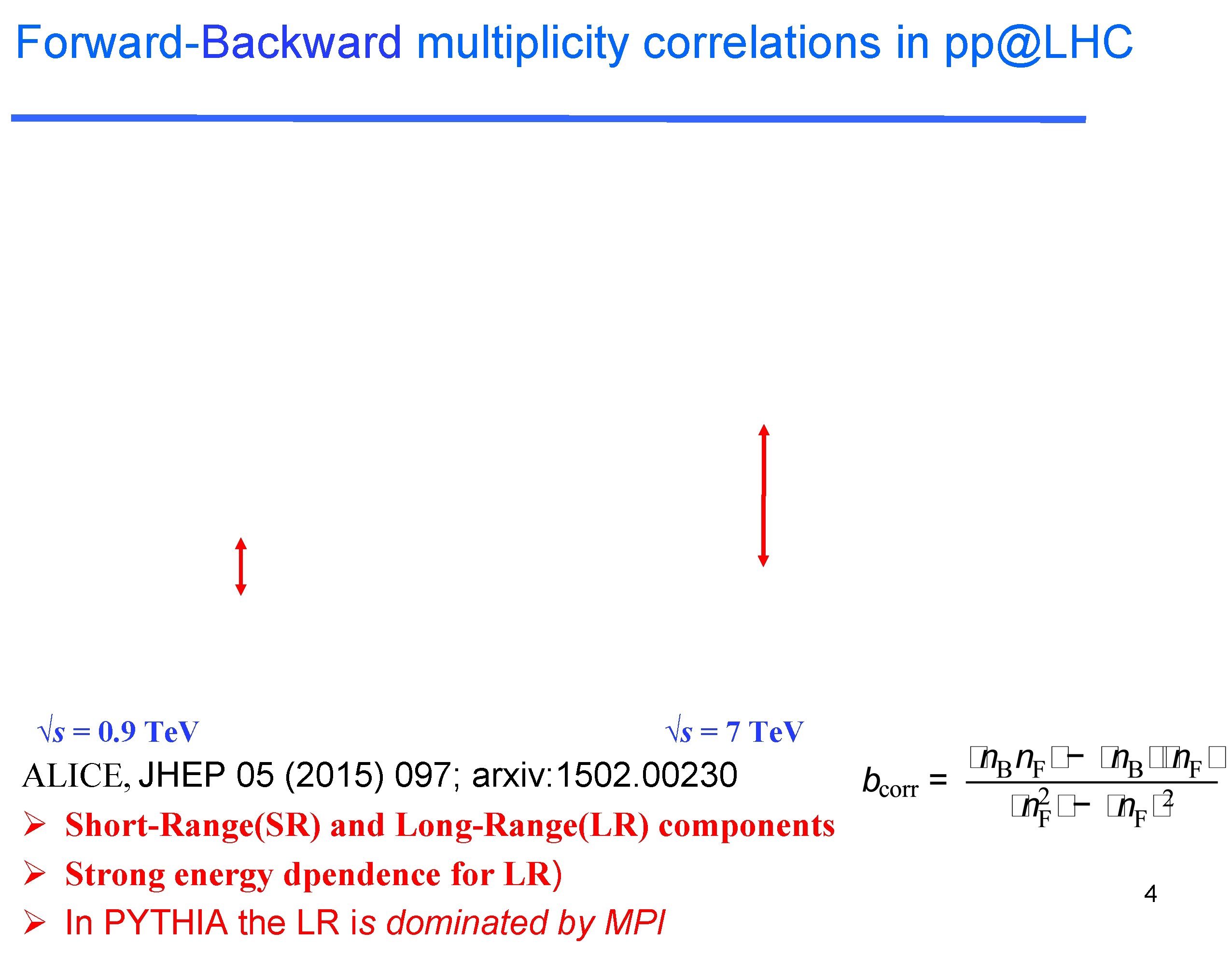
Forward-Backward multiplicity correlations in pp@LHC √s = 0. 9 Te. V √s = 7 Te. V ALICE, JHEP 05 (2015) 097; arxiv: 1502. 00230 Ø Short-Range(SR) and Long-Range(LR) components Ø Strong energy dpendence for LR) Ø In PYTHIA the LR is dominated by MPI 4
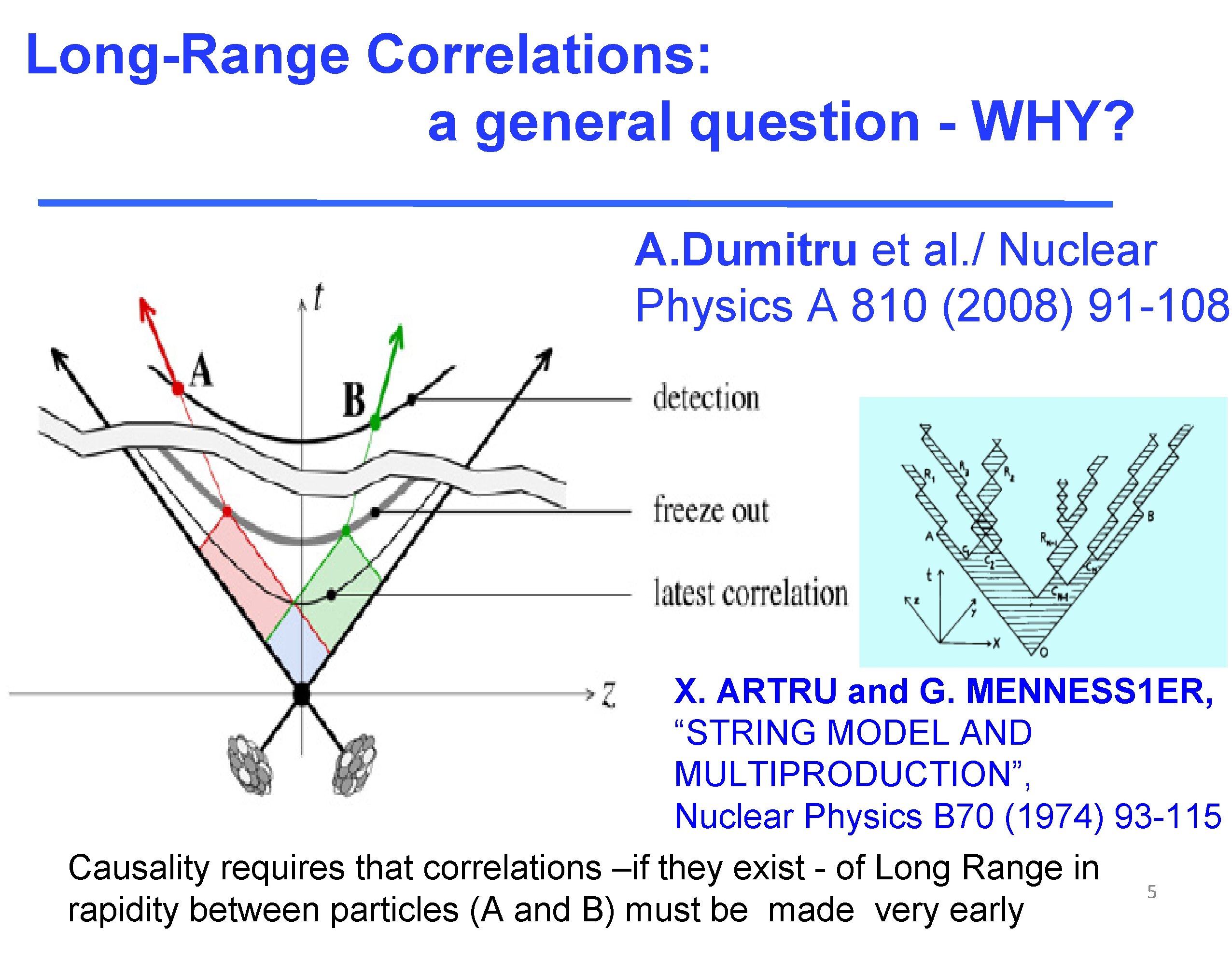
Long-Range Correlations: a general question - WHY? A. Dumitru et al. / Nuclear Physics A 810 (2008) 91 -108 X. ARTRU and G. MENNESS 1 ER, “STRING MODEL AND MULTIPRODUCTION”, Nuclear Physics B 70 (1974) 93 -115 Causality requires that correlations –if they exist - of Long Range in 5 rapidity between particles (A and B) must be made very early
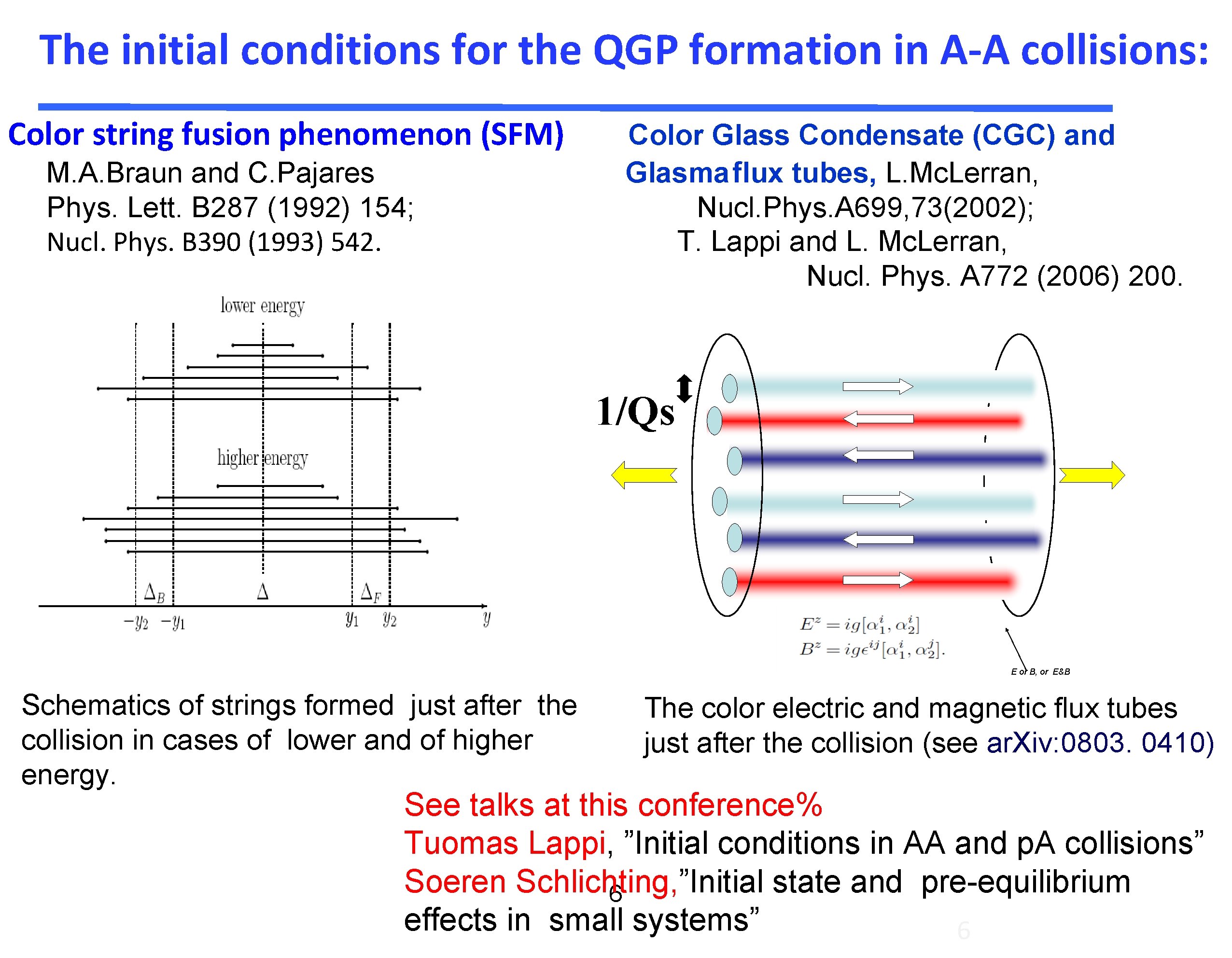
The initial conditions for the QGP formation in A-A collisions: Color string fusion phenomenon (SFM) M. A. Braun and C. Pajares Phys. Lett. B 287 (1992) 154; Nucl. Phys. B 390 (1993) 542. Color Glass Condensate (CGC) and Glasma flux tubes, L. Mc. Lerran, Nucl. Phys. A 699, 73(2002); T. Lappi and L. Mc. Lerran, Nucl. Phys. A 772 (2006) 200. 1/Qs E or B, or E&B Schematics of strings formed just after the collision in cases of lower and of higher energy. The color electric and magnetic flux tubes just after the collision (see ar. Xiv: 0803. 0410) See talks at this conference% Tuomas Lappi, ”Initial conditions in AA and p. A collisions” Soeren Schlichting, ”Initial state and pre-equilibrium 6 effects in small systems” 6
Color-flux tubes as particle emitting sources: quark-gluon strings 2 -stage scenario : • A. Capella, U. P. Sukhatme, C. -I. Tan and J. Tran Thanh Van, Phys. Lett. B 81 (1979) 68; Phys. Rep. , 236(1994) 225. • A. B. Kaidalov and K. A. Ter-Martirosyan , Phys. Lett. , 117 B(1982)247. • See in: Andy Buckley et al. , General-purpose event generators for LHC physics ar. Xiv: 1101. 2599, 2011
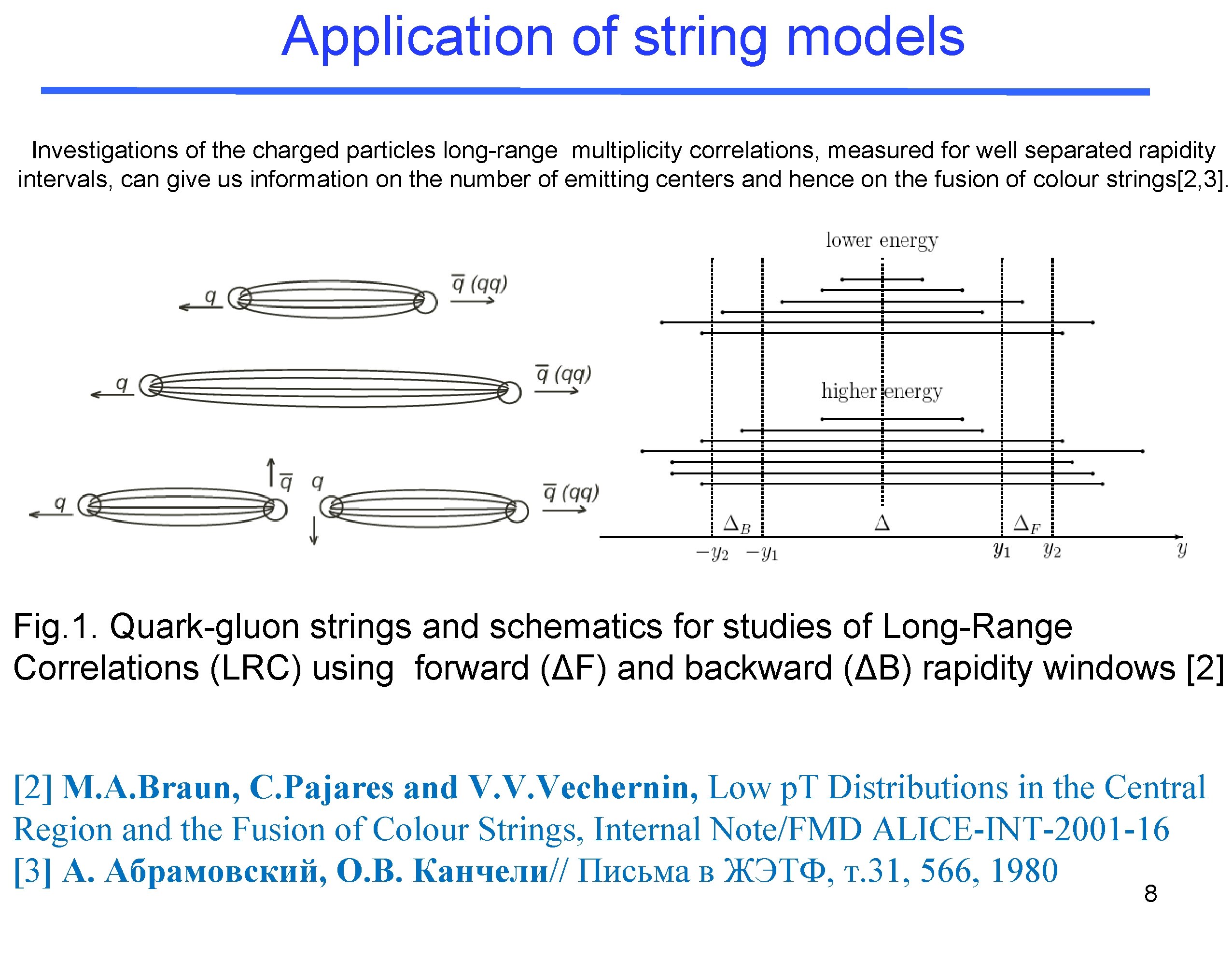
Application of string models Investigations of the charged particles long-range multiplicity correlations, measured for well separated rapidity intervals, can give us information on the number of emitting centers and hence on the fusion of colour strings[2, 3]. Fig. 1. Quark-gluon strings and schematics for studies of Long-Range Correlations (LRC) using forward (ΔF) and backward (ΔB) rapidity windows [2] M. A. Braun, C. Pajares and V. V. Vechernin, Low p. T Distributions in the Central Region and the Fusion of Colour Strings, Internal Note/FMD ALICE-INT-2001 -16 [3] А. Абрамовский, О. В. Канчели// Письма в ЖЭТФ, т. 31, 566, 1980 8
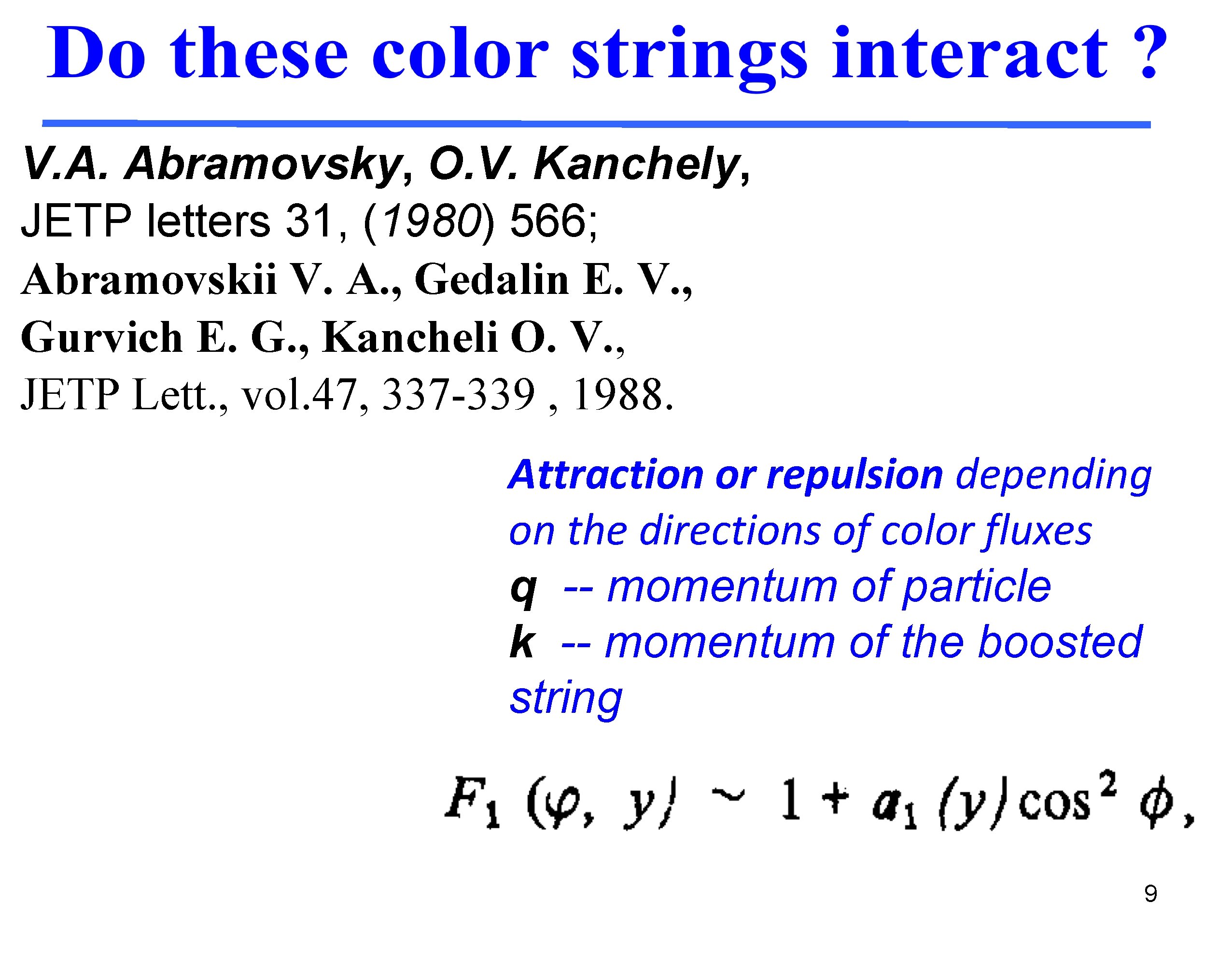
V. A. Abramovsky, O. V. Kanchely, JETP letters 31, (1980) 566; Abramovskii V. A. , Gedalin E. V. , Gurvich E. G. , Kancheli O. V. , JETP Lett. , vol. 47, 337 -339 , 1988. Attraction or repulsion depending on the directions of color fluxes q -- momentum of particle k -- momentum of the boosted string 9
Color string fusion phenomenon SFM: M. A. Braun and C. Pajares, Phys. Lett. B 287(1992) 154; Nucl. Phys. B 390} (1993) 542, 549 • • • Colour rope model Biro, T. S. et al. Nucl. Phys. B 245 (1984) 449 -468 C. Bierlich et al. , ar. Xiv: 1412. 6259 [hep-ph] (The DIPSY model) N. S. Amelin, M. A. Braun and C. Pajares, Phys. Lett. {bf B 306} (1993) 312; \ Z. Phys. {bf C 63} (1994) 507. N. S. Amelin, N. Armesto, M. A. Braun, E. G. Ferreiro and C. Pajares, Phys. Rev. Lett. {bf 73} (1994) 2813. N. Armesto, M. A. Braun, E. G. Ferreiro and C. Pajares, \Phys. Rev. Lett. {bf 77} (1996) 3736. M. Nardi and H. Satz, Phys. Lett. {bf B 442} (1998) 14; \H. Satz, Nucl. Phys. {bf A 661} (2000) 104 c. M. A. Braun, C. Pajares and J. Ranft. \Int. J. of Mod. Phys. {bf A 14} (1999) 2689. M. A. Braun and C. Pajares, Eur. Phys. J. {bf C 16} (2000) 349. M. A. Braun, R. S. Kolevatov, C. Pajares. V. V. Vechernin, Eur. Phys. J. C. 32. 535546(2004) N/Armesto, M. A. Braun. E. C. Fereiro. C. Pajares, 'Z. Phys. C. , 67, 489 -493, (1995), M. A. Braun, C. Pajares. Phys. Rev. Let, v. 85. no. 23, 4864 -4867, 2000 M. A. Braun, C. Pajares. Eur. Phys. J. C 16, 349 -359(2000) See the talk on string fusion by V. Kovalenko at this conference • 11
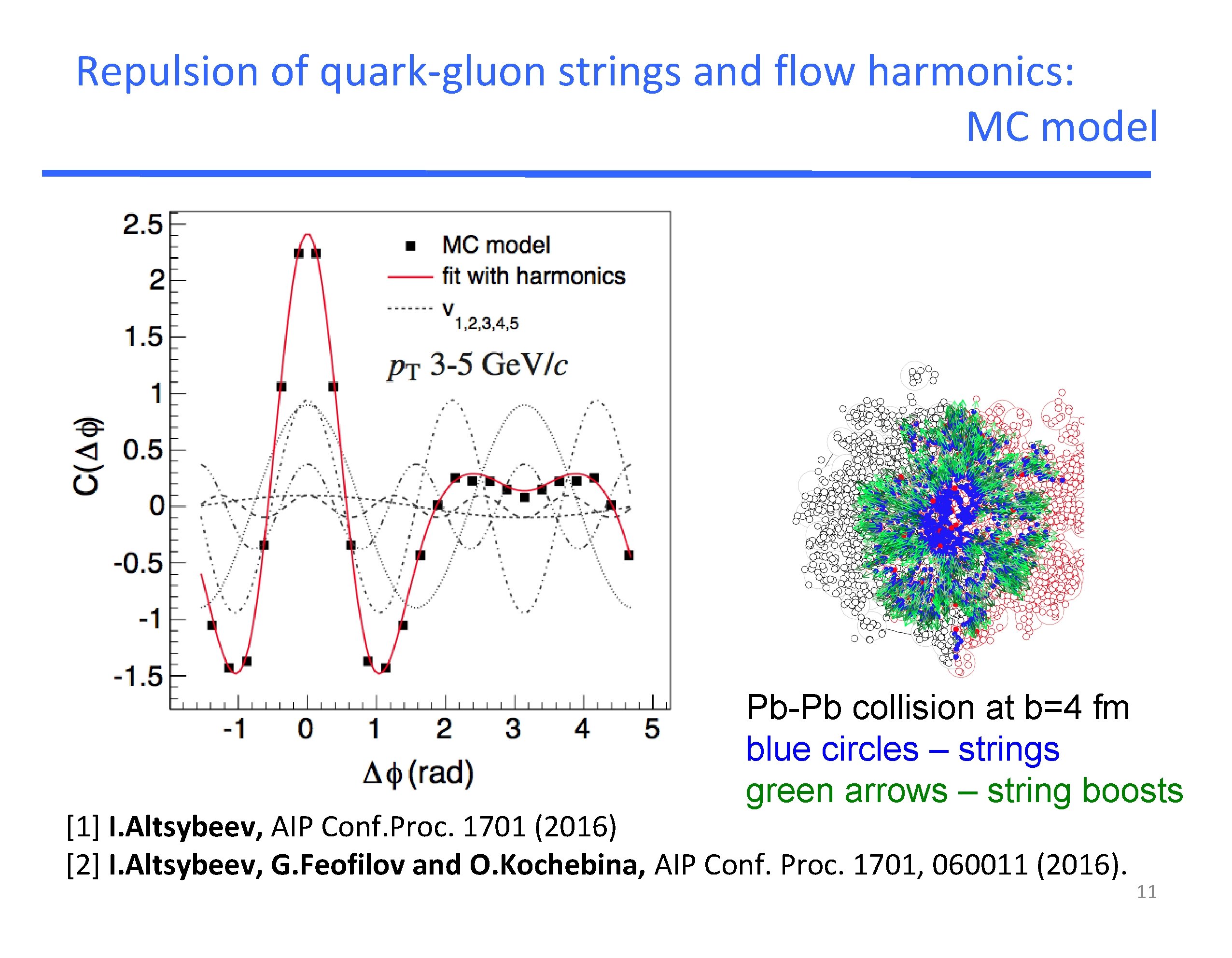
Repulsion of quark-gluon strings and flow harmonics: MC model Pb-Pb collision at b=4 fm blue circles – strings green arrows – string boosts [1] I. Altsybeev, AIP Conf. Proc. 1701 (2016) [2] I. Altsybeev, G. Feofilov and O. Kochebina, AIP Conf. Proc. 1701, 060011 (2016). 11
![QCD string-string interactions and “Spaghetti implosion” T. Kalaydzhyan, E. Shuryak [1 -4] Attraction between](http://slidetodoc.com/presentation_image_h2/e7a78a789fe9a819685a4ab06bc57f4f/image-12.jpg "QCD string-string interactions and “Spaghetti implosion” T. Kalaydzhyan, E. Shuryak [1 -4] Attraction between")
QCD string-string interactions and “Spaghetti implosion” T. Kalaydzhyan, E. Shuryak [1 -4] Attraction between strings due to σ-meson exchange and concept of σ-meson cloud[3] Small sigma-string coupling [1] E. Shuryak, Ar. Xiv: 1412. 8393, 29 Dec. 2014 [2] T. Kalaydzhyan and E. Shuryak, ar. Xiv: 1402. 7363, [3] T. Kalaydzhyan and E. Shuryak, , ar. Xiv: 1404. 1888. [4] T. Kalaydzhyan and E. Shuryak, Phys. Rev. C 91, 054913 (2015) , ar. Xiv: 1503. 05213 [hep-ph] is compensated by large number of strings [3] flows [3] 12
QUESTIONS: 1) What is the number of these sources extended in rapidity and produced in case of small systems, in particular, in pp collisions? 2) Is the density of these sources suffients to start overlap and to interact producing new kinds of particle production sources? 13
ESTIMATE-1 MPI in pp 14
![Collectivity in PYTHIA: Color Reconnection and Long-Range correlations (LRC) [1] A. Asryan, G. Feofilov,](http://slidetodoc.com/presentation_image_h2/e7a78a789fe9a819685a4ab06bc57f4f/image-15.jpg "Collectivity in PYTHIA: Color Reconnection and Long-Range correlations (LRC) [1] A. Asryan, G. Feofilov,")
Collectivity in PYTHIA: Color Reconnection and Long-Range correlations (LRC) [1] A. Asryan, G. Feofilov, Studies of p. T-Nch correlation in pp collisions in the framework of PSM and PYTHIA generators, ALICE Week, Physics Forum, CERN, 11 October 2006. [2] A. Asryan, D. Derkach, G. Feofilov “Correlation pt-Nch and collective effects in pp and ppbar collisions from ISR up to Tevatron and LHC”, Vestnik SPb. SU, ser. 4 , v. 2, 2008, 3 -16, accepted 18 Dec. 2007. Ø LRC in PYTHIA due to fluctuating, from event to event, number of strings. 15 Ø p. T-Nch correlation – due to Color Reconnection
Collectivity in PYTHIA: MPI in pp collisions 2 assumptions: ----the number of MPIs is proportional to the hard collisions cross section -- soft particle multiplicity scales with the number of MPIs Andreas Morsch, for the ALICE Collaboration Journal of Physics: Conf Seri. 535 (2014) 012012 ar. Xiv: 1407. 3628 <Nuncor. seeds> -- up to ~ 15 in pp@7 Te. V 16 for p. T trig >0. 7 Ge. V/c
ESTIMATE-2 based on the onset of ridge in Au -Au@RHIC O. Kochebina, G. Feofilov, Arxiv: 1012. 0173 17
![Threshold phenomena in AA collisions observed by STAR [1] Variation of low-p. T “ridge”](http://slidetodoc.com/presentation_image_h2/e7a78a789fe9a819685a4ab06bc57f4f/image-18.jpg "Threshold phenomena in AA collisions observed by STAR [1] Variation of low-p. T “ridge”")
Threshold phenomena in AA collisions observed by STAR [1] Variation of low-p. T “ridge” with centrality (Npart). (pt> 0. 15 Ge. V/c ) 55 -65% 83 -94% STA y r a in m i l e r P R ηΔ h t d wi Shape changes little from peripheral to the transition R A T S y r a n i m i l e r P 46 -55% ST e r P AR y r a il min Large change within ~10% centrality 0 -5% y r a n limi e r P R A T S Smaller change from transition to most central Low-p. T manifestation of the “ridge” The data showed a sharp transition at some definite energy-dependent centrality: growing of peak amplitude and pseudorapidity stretching of width. [1]Anomalous centrality variation of minijet angular correlations in Au-Au collisions at 62 and 200 Ge. V from STAR. M. Daugherity. QM 2008. 18
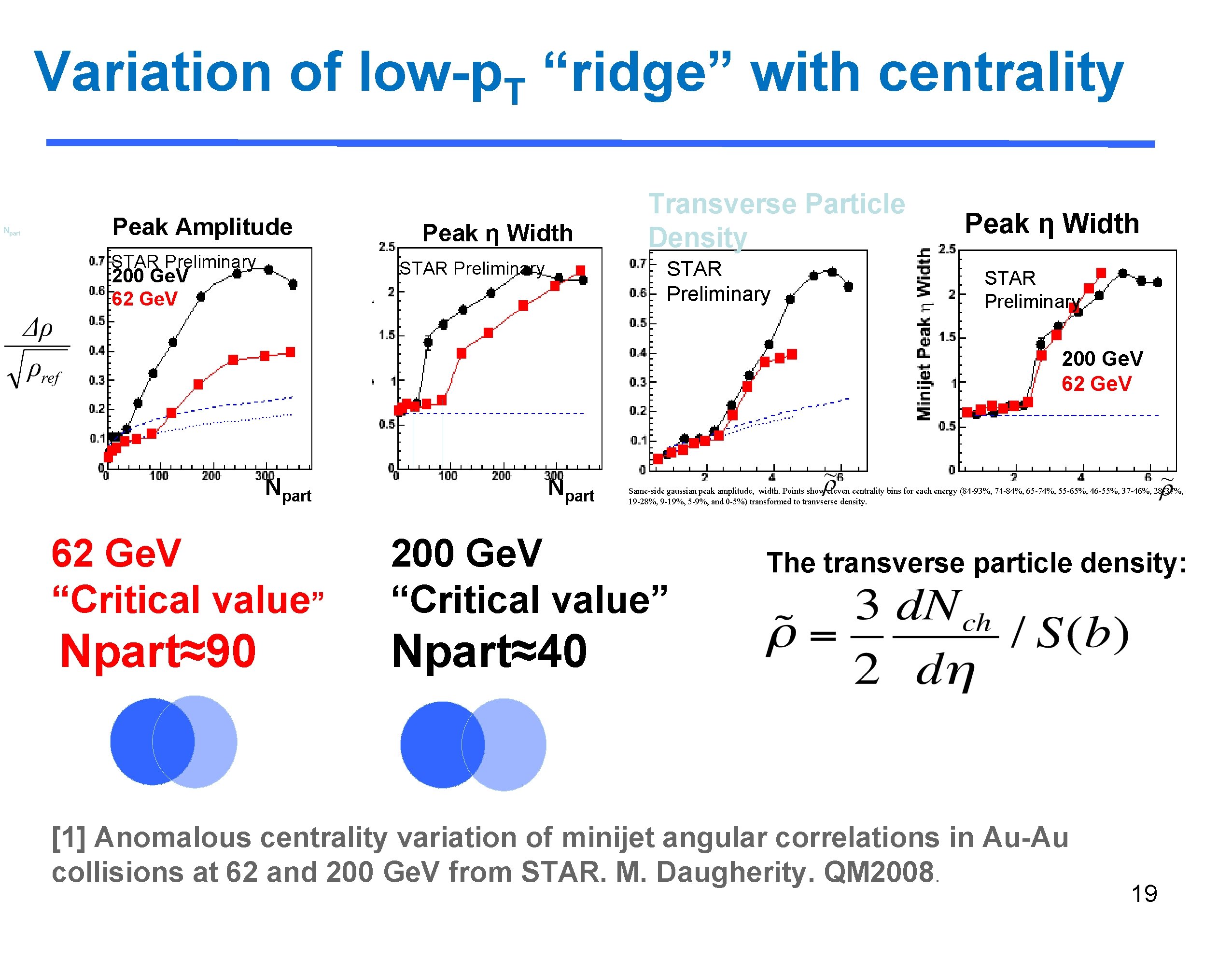
Variation of low-p. T “ridge” with centrality Npart Peak Amplitude STAR Preliminary Peak η Width STAR Preliminary 200 Ge. V 62 Ge. V Transverse Particle Density Peak η Width STAR Preliminary 200 Ge. V 62 Ge. V Npart Same-side gaussian peak amplitude, width. Points show eleven centrality bins for each energy (84 -93%, 74 -84%, 65 -74%, 55 -65%, 46 -55%, 37 -46%, 28 -37%, 19 -28%, 9 -19%, 5 -9%, and 0 -5%) transformed to tranvserse density. 62 Ge. V “Critical value” 200 Ge. V “Critical value” Npart≈90 Npart≈40 The transverse particle density: S [1] Anomalous centrality variation of minijet angular correlations in Au-Au collisions at 62 and 200 Ge. V from STAR. M. Daugherity. QM 2008. 19
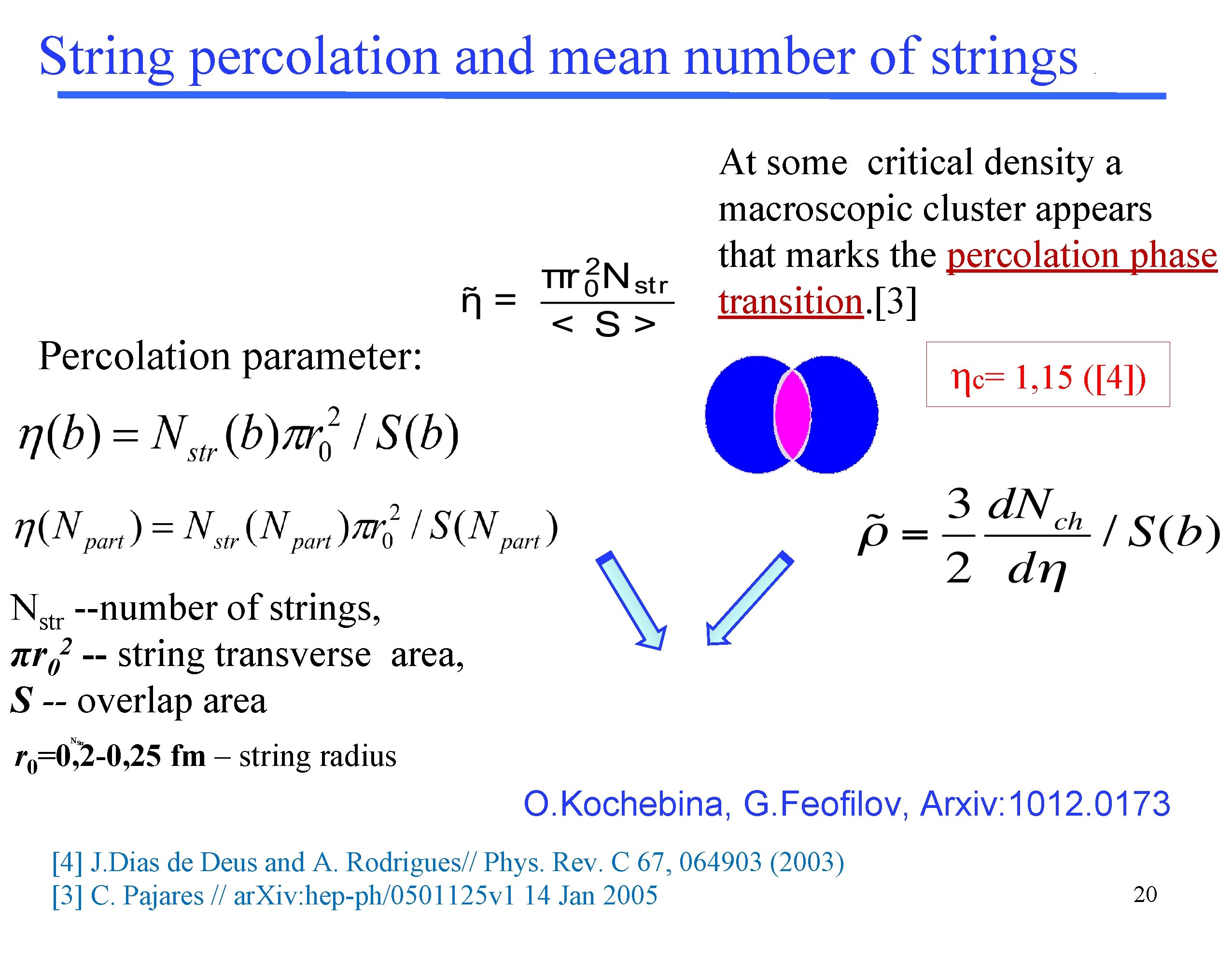
String percolation and mean number of strings . At some critical density a macroscopic cluster appears that marks the percolation phase transition. [3] Percolation parameter: ηс= 1, 15 ([4]) S Nstr --number of strings, 2 πr 0 -- string transverse area, S -- overlap area NStr r 0=0, 2 -0, 25 fm – string radius O. Kochebina, G. Feofilov, Arxiv: 1012. 0173 [4] J. Dias de Deus and A. Rodrigues// Phys. Rev. C 67, 064903 (2003) [3] C. Pajares // ar. Xiv: hep-ph/0501125 v 1 14 Jan 2005 20
String percolation and number of strings: from A-A colllisions to pp The transverse particle density vs. string density O. Kochebina, G. Feofilov, Arxiv: 1012. 0173 21
From A-A colllisions to pp: mean number of strings Table 1: The total number of strings, the number of sea strings and parameter a obtained in the ”critical” points for Au. Au collisions at 62 Ge. V and 200 Ge. V collision energies and for P b collisions at 17. 3 Ge. V. The calculations are done for r = 0. 25 fm. [1]. 0 ± Table 2: The transverse particle density, the string density and number of strings estimated for pp collisions for energies from 17. 3 Ge. V to 7000 Ge. V. [1] O. Kochebina, G. Feofilov, Arxiv: 1012. 0173 for pp@7 Te. V: <Nsrings> ~ 30 +- 12 22
![ESTIMATE-3 Multi-pomeron exchange model with effective account of interaction between strings (EPEM) [1] Armesto,](http://slidetodoc.com/presentation_image_h2/e7a78a789fe9a819685a4ab06bc57f4f/image-23.jpg "ESTIMATE-3 Multi-pomeron exchange model with effective account of interaction between strings (EPEM) [1] Armesto,")
ESTIMATE-3 Multi-pomeron exchange model with effective account of interaction between strings (EPEM) [1] Armesto, N. , Derkach, D. , and Feofilov, G. , Phys. At. Nucl. , 2008, vol. 71, p. 2087. [2] Bodnia, E. , Derkach, D. , Feofilov, G. , Kovalenko, V. , and Puchkov, A. , Proc. QFTHEP 2013, St. Petersburg, 2013. http: //arxiv. org/abs/1310. 1627. [3] Bodnia, E. O. , Kovalenko, V. N. , Puchkov, A. M. , and Feofilov, G. A. , AIP Conf. Proc. , 2014, vol. 1606, p. 273. 23
Motivation: Experimentally Observed pt-Nch correlations in pp and ppbar collisions: . Compilation of experimental data in: [1] Armesto, N. , Derkach, D. , and Feofilov, G. , Phys. At. Nucl. , 2008, vol. 71, p. 2087. : pt-Nch correlations @LHC 24
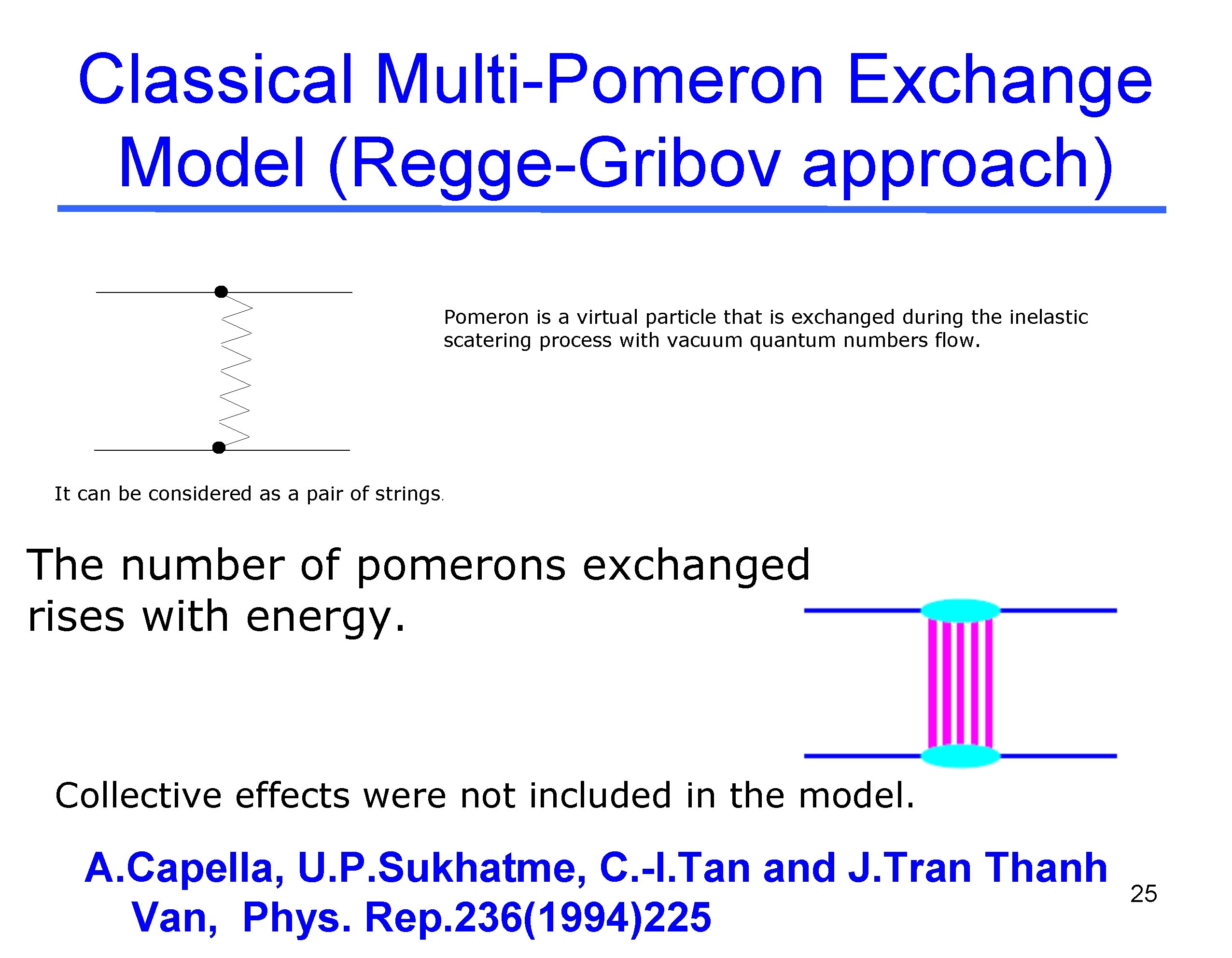
Classical Multi-Pomeron Exchange Model (Regge-Gribov approach) Pomeron is a virtual particle that is exchanged during the inelastic scatering process with vacuum quantum numbers flow. It can be considered as a pair of strings. The number of pomerons exchanged rises with energy. Collective effects were not included in the model. A. Capella, U. P. Sukhatme, C. -I. Tan and J. Tran Thanh Van, Phys. Rep. 236(1994)225 25
![EPEM[1] Modifications[2] t – average string tension k – mean number of particles produced](http://slidetodoc.com/presentation_image_h2/e7a78a789fe9a819685a4ab06bc57f4f/image-26.jpg "EPEM[1] Modifications[2] t – average string tension k – mean number of particles produced")
EPEM[1] Modifications[2] t – average string tension k – mean number of particles produced per unit rapidity by one string β-- efficient string fusion collective coefficient [1] Armesto, N. , Derkach, D. , and Feofilov, G. , Phys. At. Nucl. , 2008, vol. 71, p. 2087 26 [2] Bodnia, E. , Derkach, D. , Feofilov, G. , Kovalenko, V. , and Puchkov, A. , Proc. QFTHEP 2013, St. Petersburg, 2013. http: //arxiv. org/abs/1310. 162
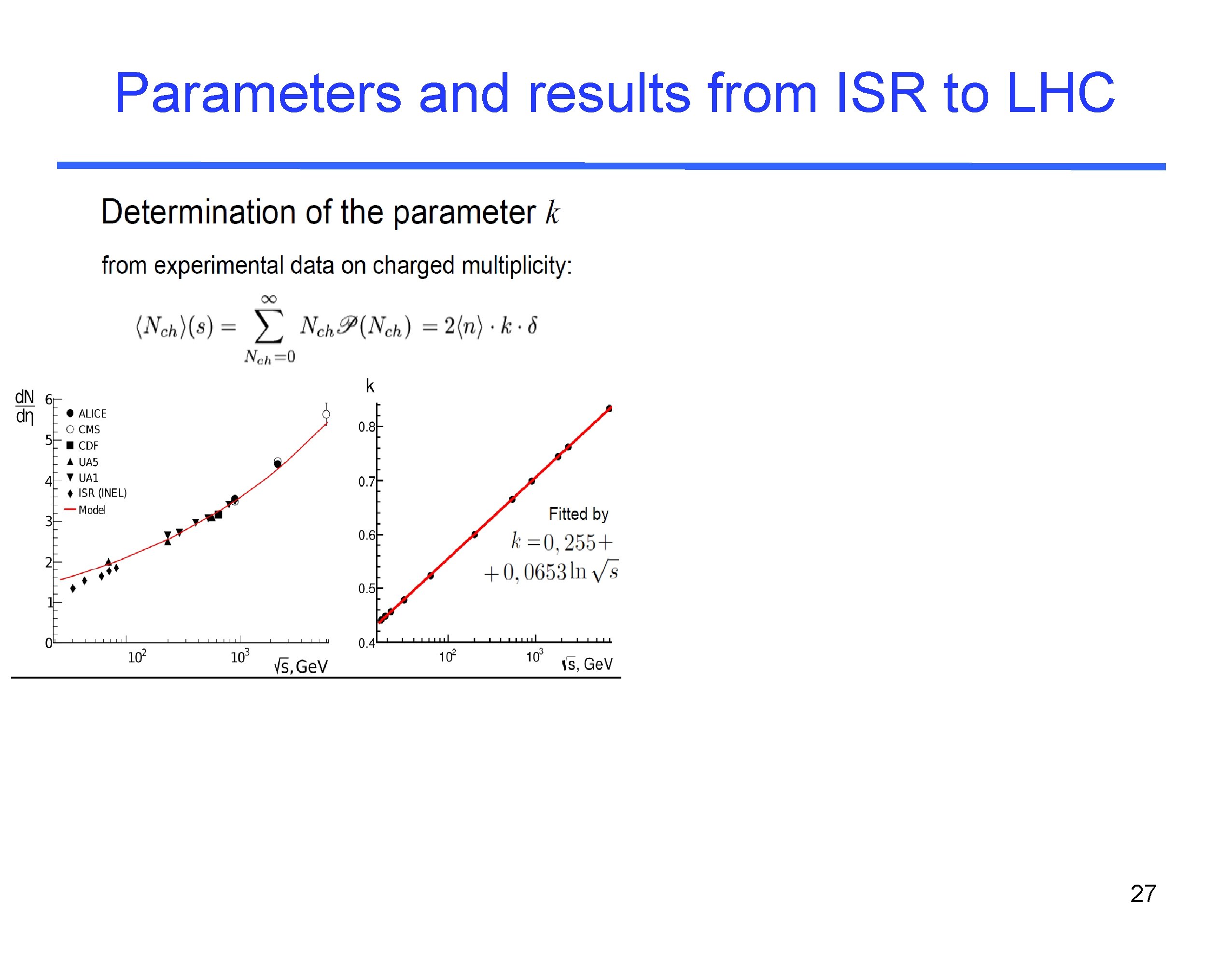
Parameters and results from ISR to LHC 27
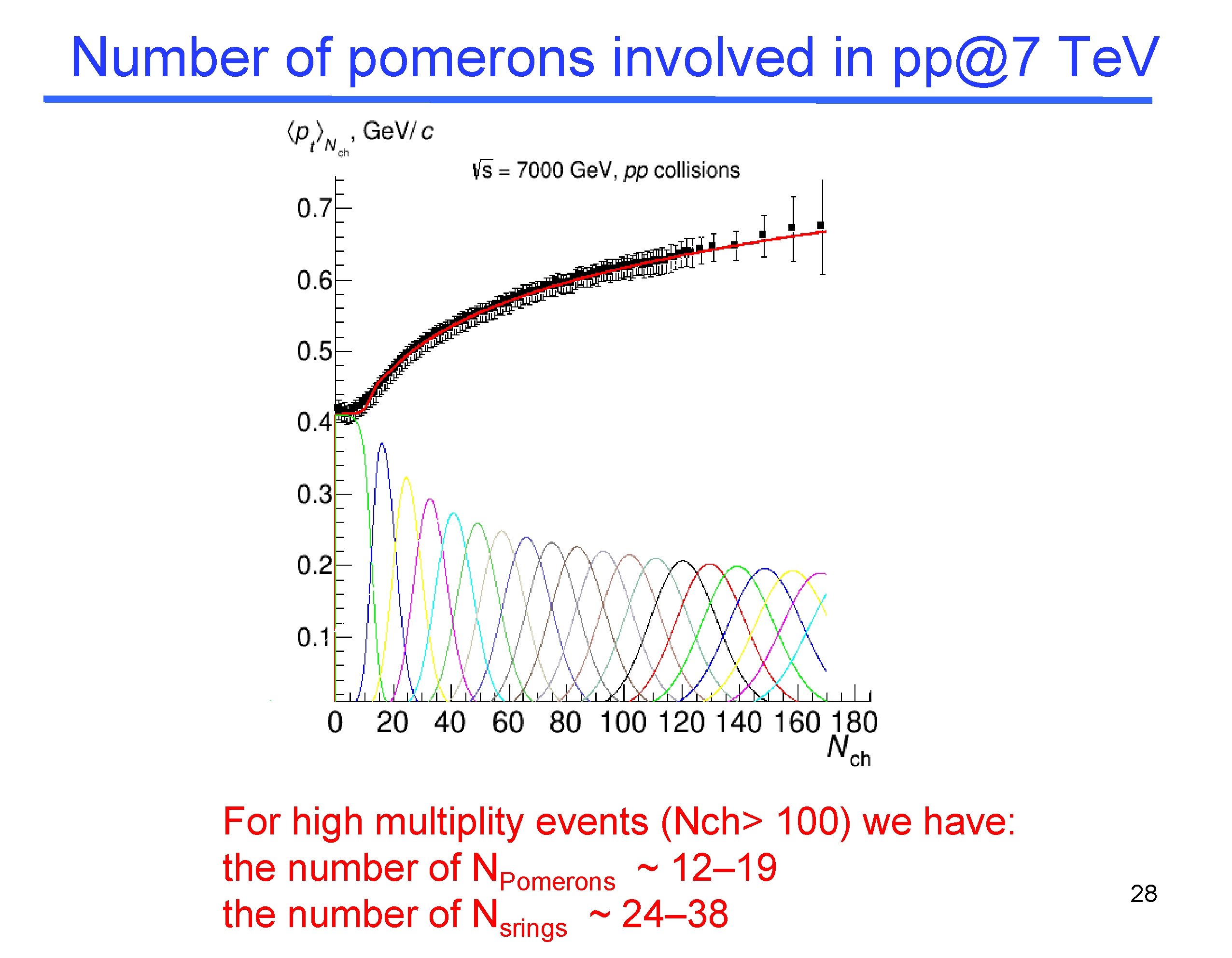
Number of pomerons involved in pp@7 Te. V For high multiplity events (Nch> 100) we have: the number of NPomerons ~ 12– 19 the number of Nsrings ~ 24– 38 28
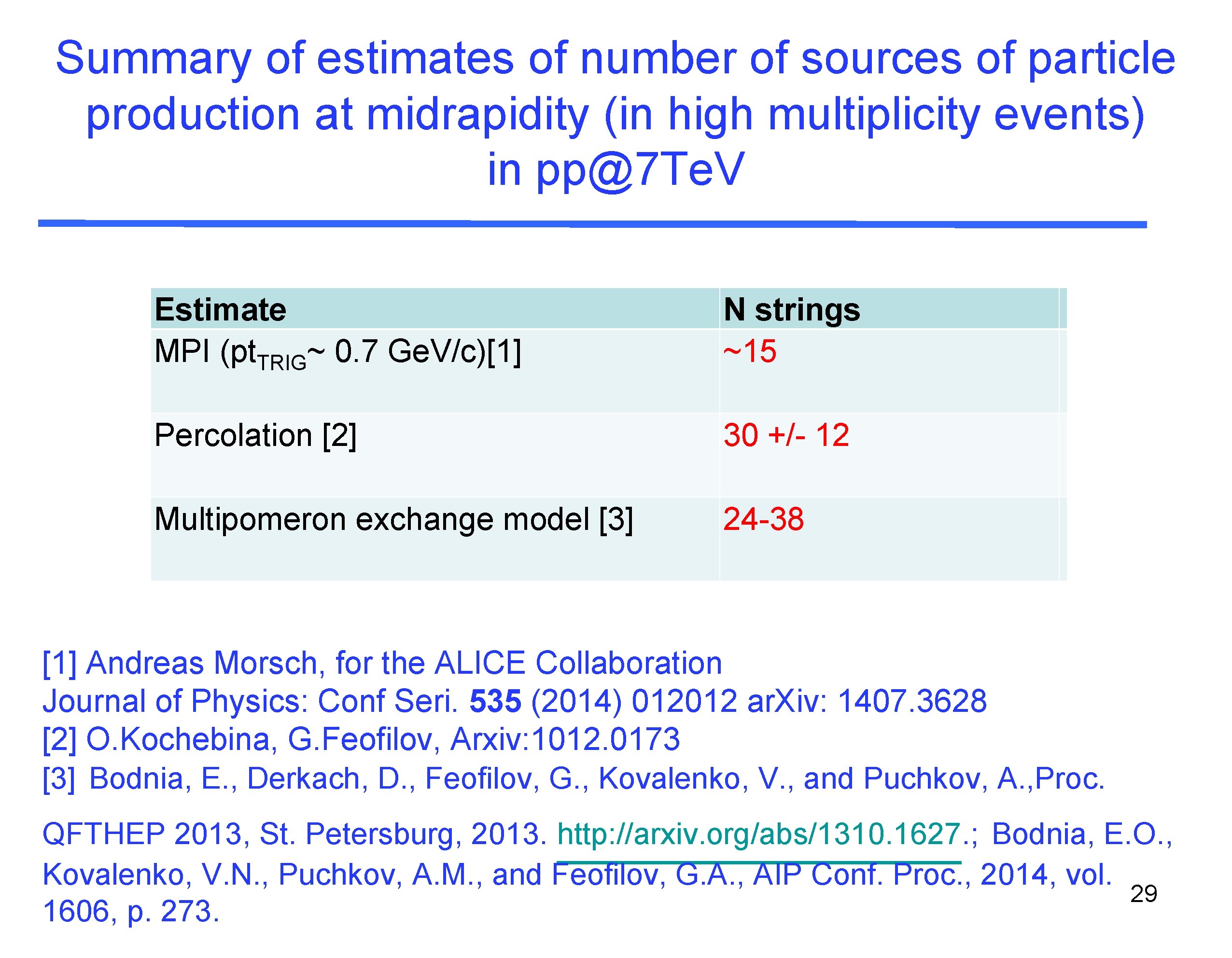
Summary of estimates of number of sources of particle production at midrapidity (in high multiplicity events) in pp@7 Te. V Estimate MPI (pt. TRIG~ 0. 7 Ge. V/c)[1] N strings ~15 Percolation [2] 30 +/- 12 Multipomeron exchange model [3] 24 -38 [1] Andreas Morsch, for the ALICE Collaboration Journal of Physics: Conf Seri. 535 (2014) 012012 ar. Xiv: 1407. 3628 [2] O. Kochebina, G. Feofilov, Arxiv: 1012. 0173 [3] Bodnia, E. , Derkach, D. , Feofilov, G. , Kovalenko, V. , and Puchkov, A. , Proc. QFTHEP 2013, St. Petersburg, 2013. http: //arxiv. org/abs/1310. 1627. ; Bodnia, E. O. , Kovalenko, V. N. , Puchkov, A. M. , and Feofilov, G. A. , AIP Conf. Proc. , 2014, vol. 29 1606, p. 273.
Conclusions Ø Concept of color flux tubes (quark-gluon strings) as particle production sources is implemented in a number of event generators, phenomenology is tuned and looks feasible for the majority of experimental phenomena at the LHC. It contains some collectivity, manifested in long-range correlations, colorreconnection, flows… Ø Independent estimates of number of these sources show that one may expect formation of ~ 20 -40 strings in high multipliicty pp collisions at the LHC. Ø String-string interaction between these sources in case of high density is an important factor of investigations of new effects like string fusion, “spaghetti” implosion and /or string repulsion, that are responsible for shaping the initial conditions of systems collisions leading to the QGP formation. 30
- Slides: 30