
Nulling Interferometry Basic Approach Motivation Implementation An ExoEarth

Nulling Interferometry Basic Approach Motivation Implementation An Exo-Earth Mission using Nulling
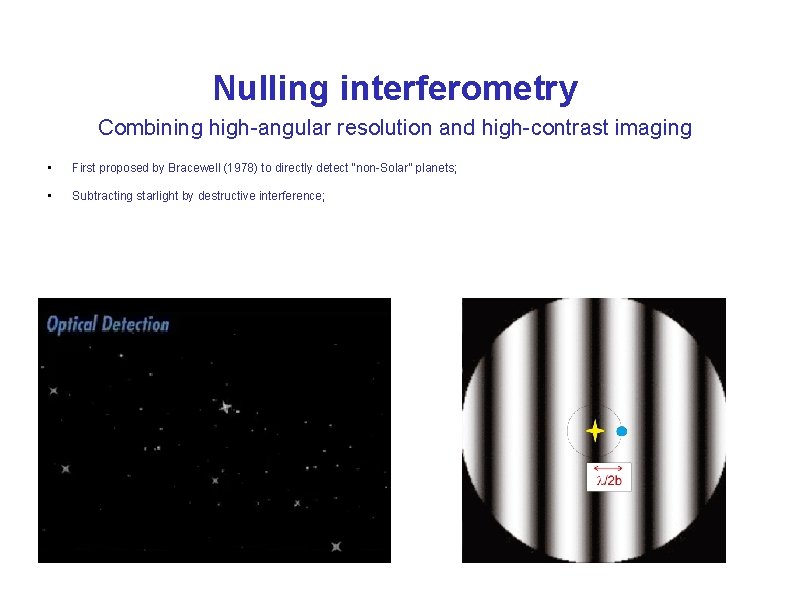
Nulling interferometry Combining high-angular resolution and high-contrast imaging • First proposed by Bracewell (1978) to directly detect “non-Solar” planets; • Subtracting starlight by destructive interference;
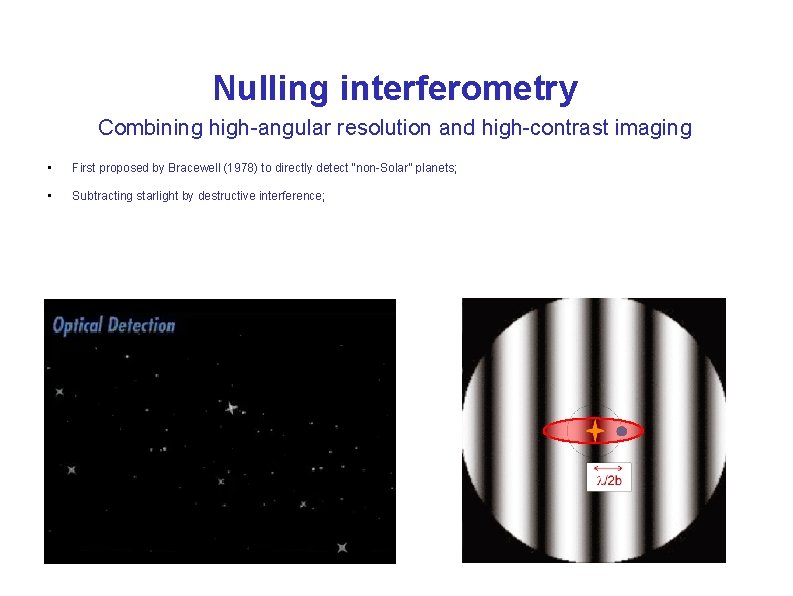
Nulling interferometry Combining high-angular resolution and high-contrast imaging • First proposed by Bracewell (1978) to directly detect “non-Solar” planets; • Subtracting starlight by destructive interference;
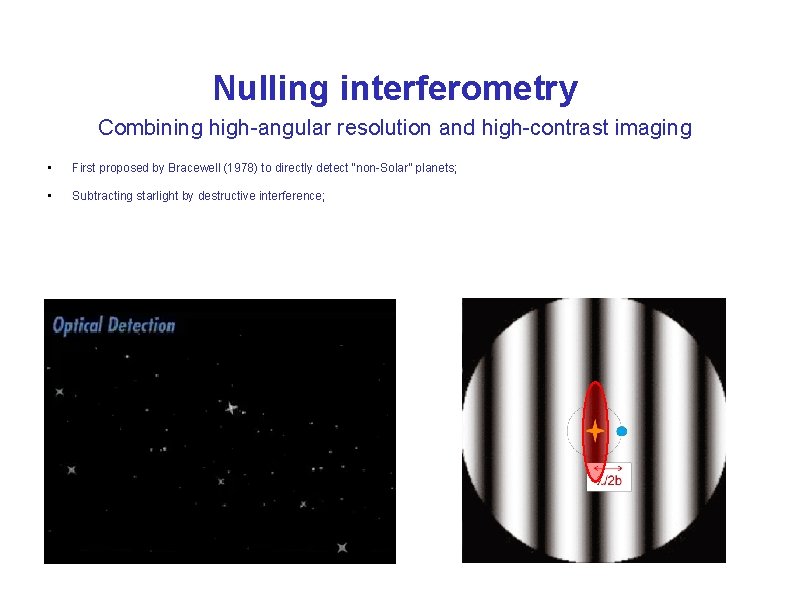
Nulling interferometry Combining high-angular resolution and high-contrast imaging • First proposed by Bracewell (1978) to directly detect “non-Solar” planets; • Subtracting starlight by destructive interference;
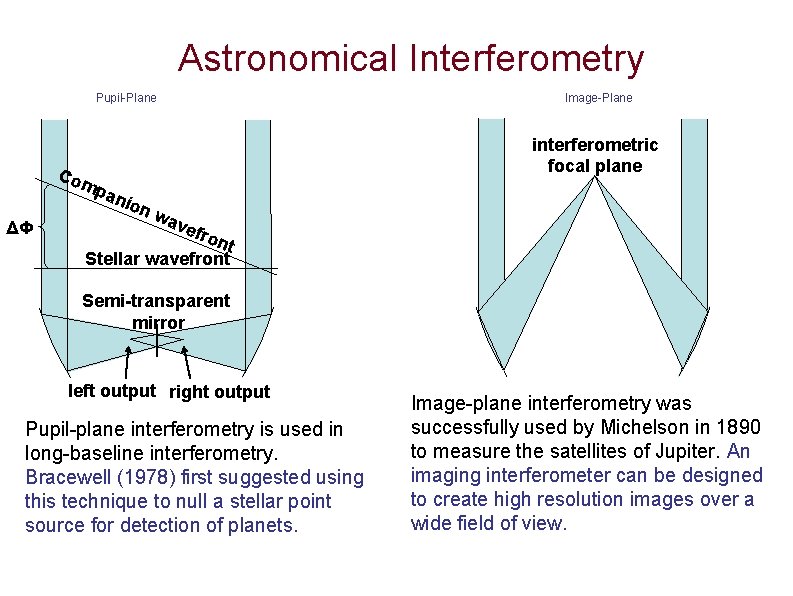
Astronomical Interferometry Pupil-Plane interferometric focal plane Co mp ani ΔΦ Image-Plane on wa vef ron t Stellar wavefront Semi-transparent mirror left output right output Pupil-plane interferometry is used in long-baseline interferometry. Bracewell (1978) first suggested using this technique to null a stellar point source for detection of planets. Image-plane interferometry was successfully used by Michelson in 1890 to measure the satellites of Jupiter. An imaging interferometer can be designed to create high resolution images over a wide field of view.
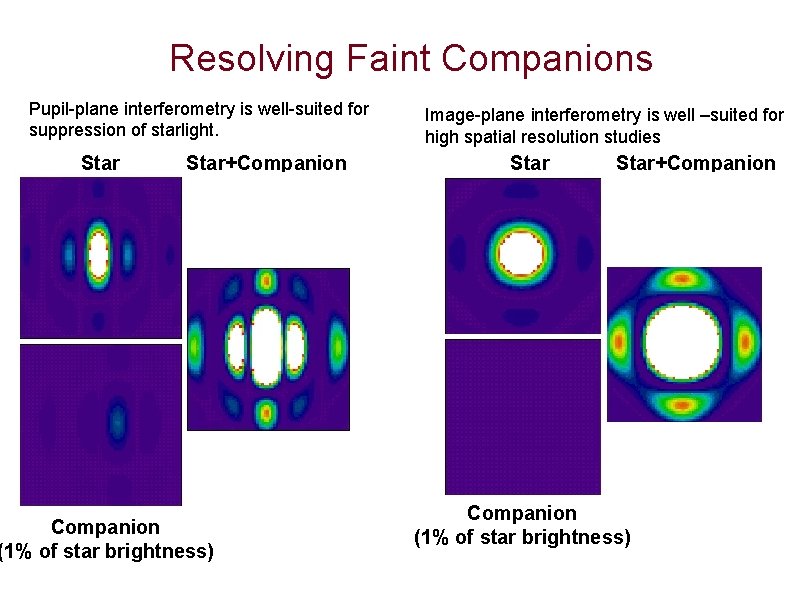
Resolving Faint Companions Pupil-plane interferometry is well-suited for suppression of starlight. Star+Companion (1% of star brightness) Image-plane interferometry is well –suited for high spatial resolution studies Star+Companion (1% of star brightness)

First Telescope Demonstration of Nulling at the MMT Nature 1998; 395, 251. Ambient Temperature Optics
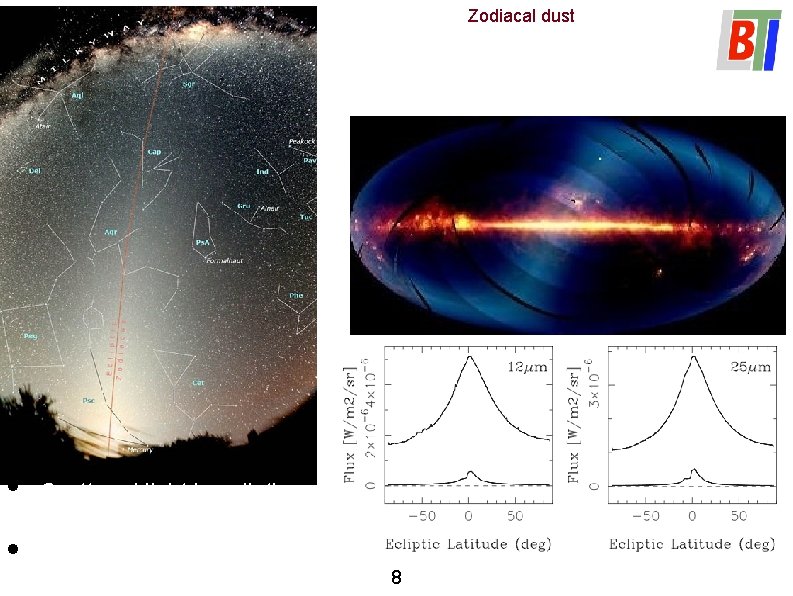
Zodiacal dust • • Scattered light in ecliptic plane. Infrared emission first seen by IRAS. 8 from Nesvorney et al. 2010
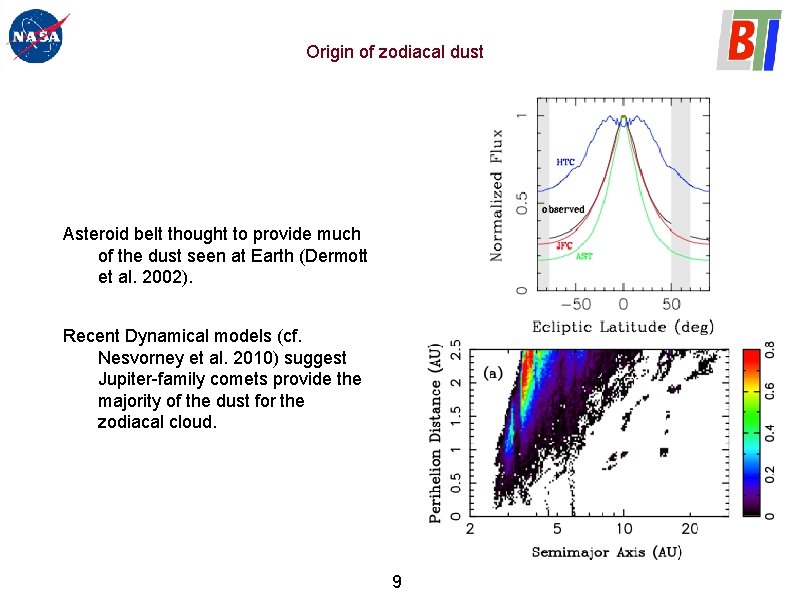
Origin of zodiacal dust Asteroid belt thought to provide much of the dust seen at Earth (Dermott et al. 2002). Recent Dynamical models (cf. Nesvorney et al. 2010) suggest Jupiter-family comets provide the majority of the dust for the zodiacal cloud. 9 from Nesvorney et al. 2010
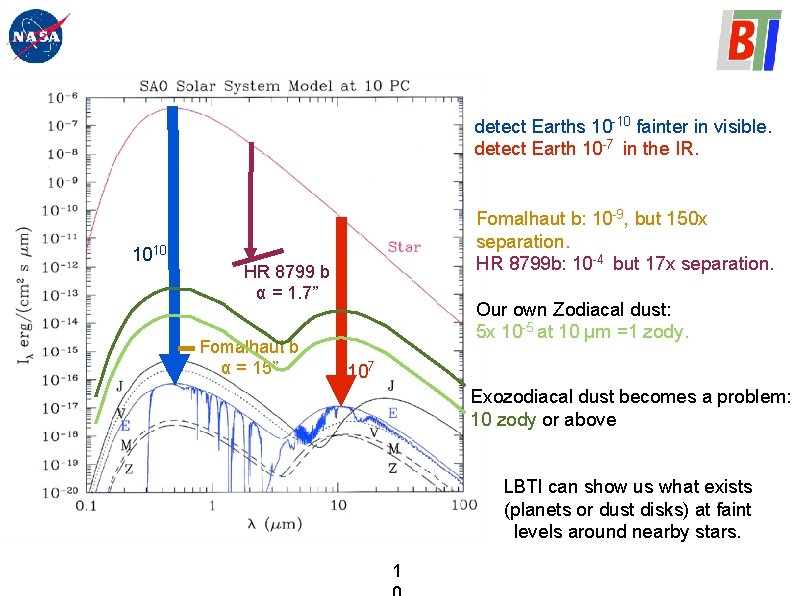
The Contrast Problem Planet Finding missions aim to: detect Earths 10 -10 fainter in visible. detect Earth 10 -7 in the IR. 1010 Current state of the art: Fomalhaut b: 10 -9, but 150 x separation. HR 8799 b: 10 -4 but 17 x separation. HR 8799 b α = 1. 7” Fomalhaut b α = 15” Our own Zodiacal dust: 5 x 10 -5 at 10 µm =1 zody. 107 Exozodiacal dust becomes a problem: 10 zody or above. LBTI can show us what exists (planets or dust disks) at faint levels around nearby stars. 1
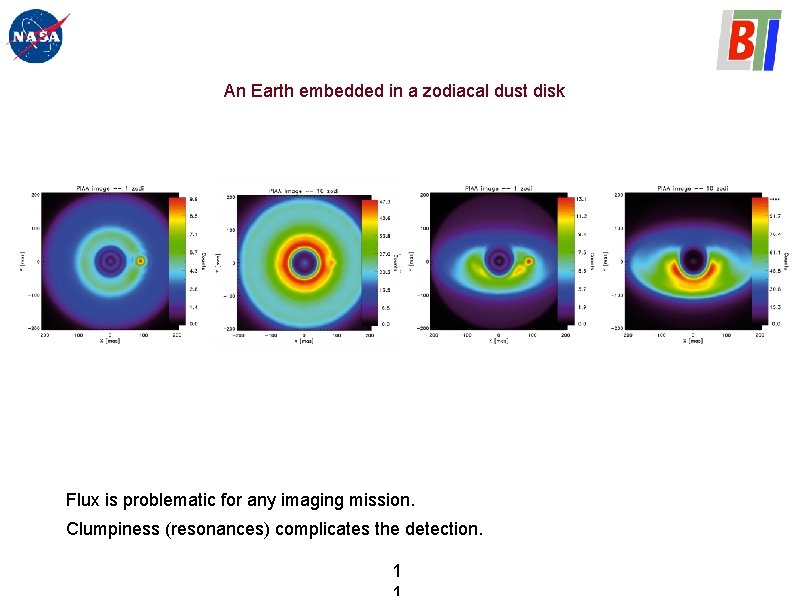
An Earth embedded in a zodiacal dust disk from Defrere et al. 2012 Flux is problematic for any imaging mission. Clumpiness (resonances) complicates the detection. 1
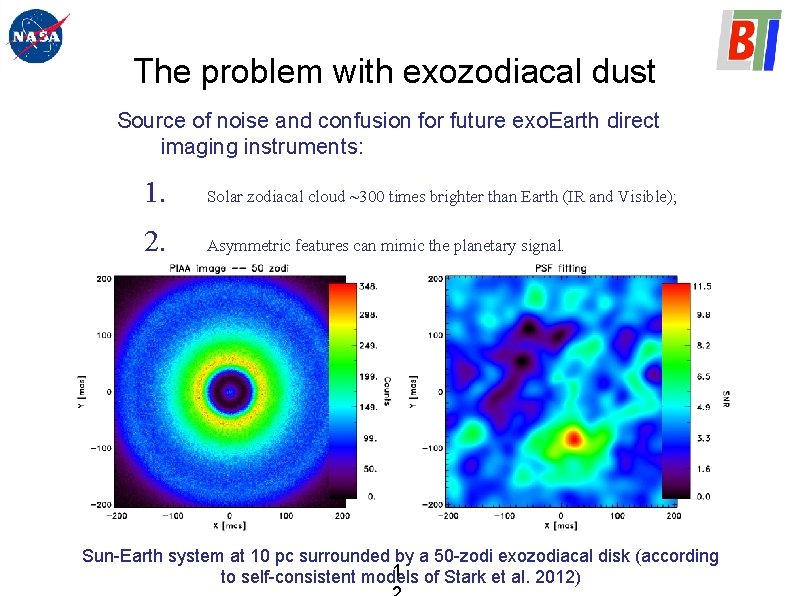
The problem with exozodiacal dust Source of noise and confusion for future exo. Earth direct imaging instruments: 1. Solar zodiacal cloud ~300 times brighter than Earth (IR and Visible); 2. Asymmetric features can mimic the planetary signal. Sun-Earth system at 10 pc surrounded by a 50 -zodi exozodiacal disk (according 1 of Stark et al. 2012) to self-consistent models
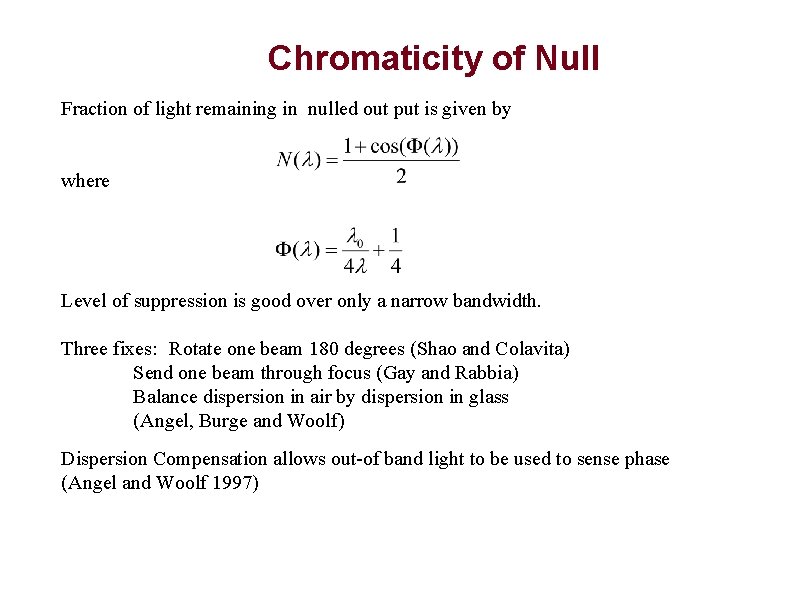
Chromaticity of Null Fraction of light remaining in nulled out put is given by where Level of suppression is good over only a narrow bandwidth. Three fixes: Rotate one beam 180 degrees (Shao and Colavita) Send one beam through focus (Gay and Rabbia) Balance dispersion in air by dispersion in glass (Angel, Burge and Woolf) Dispersion Compensation allows out-of band light to be used to sense phase (Angel and Woolf 1997)

Creating an Achromatic Null An null is created by introducing a 0. 5 wave path difference between the two beams. This phase shift can be made achromatic by balancing a slight difference in path with an Path difference: 51 μm difference in substrate thickness: 21 μm Zn. Se substrate Thin film coating stack
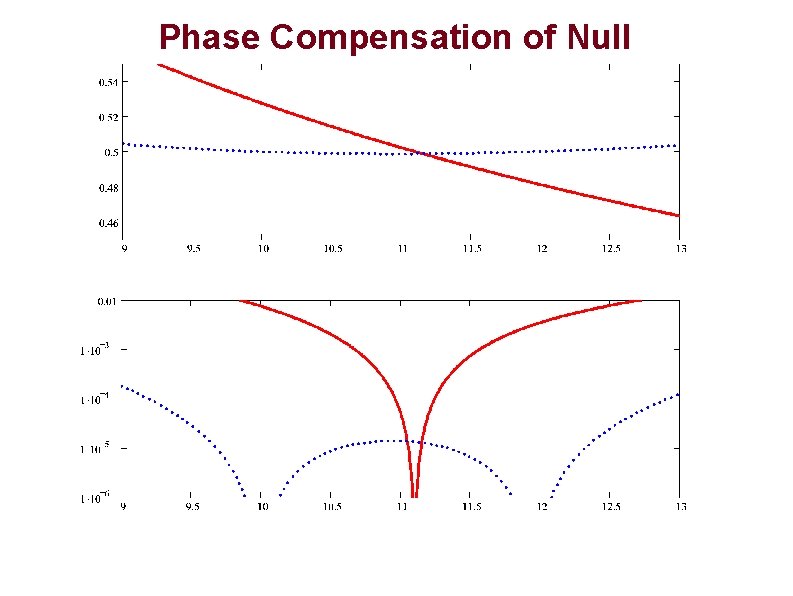
Phase (waves) Phase Compensation of Null Intensity Wavelength (μm)
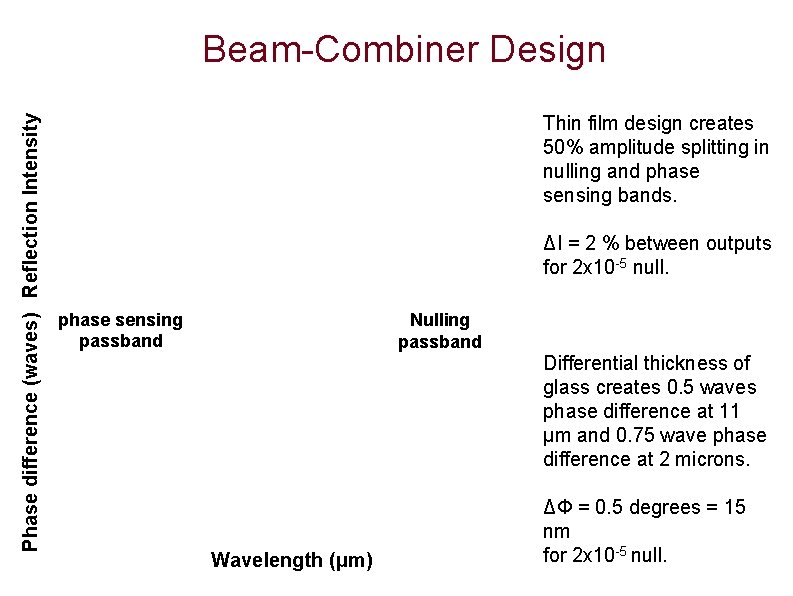
Phase difference (waves) Reflection Intensity Beam-Combiner Design Thin film design creates 50% amplitude splitting in nulling and phase sensing bands. ΔI = 2 % between outputs for 2 x 10 -5 null. phase sensing passband Nulling passband Wavelength (μm) Differential thickness of glass creates 0. 5 waves phase difference at 11 μm and 0. 75 wave phase difference at 2 microns. ΔΦ = 0. 5 degrees = 15 nm for 2 x 10 -5 null.
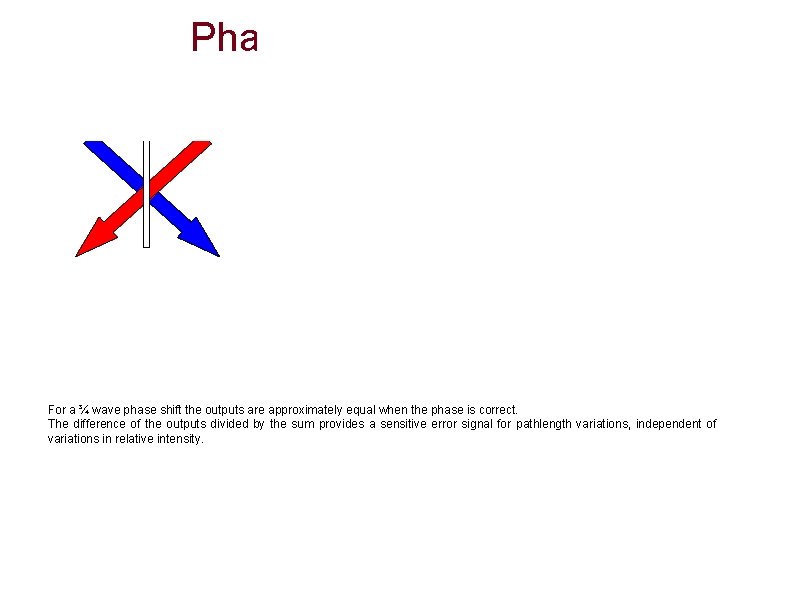
Phase Sensing Outputs beamsplitter left output right output For a ¾ wave phase shift the outputs are approximately equal when the phase is correct. The difference of the outputs divided by the sum provides a sensitive error signal for pathlength variations, independent of variations in relative intensity.
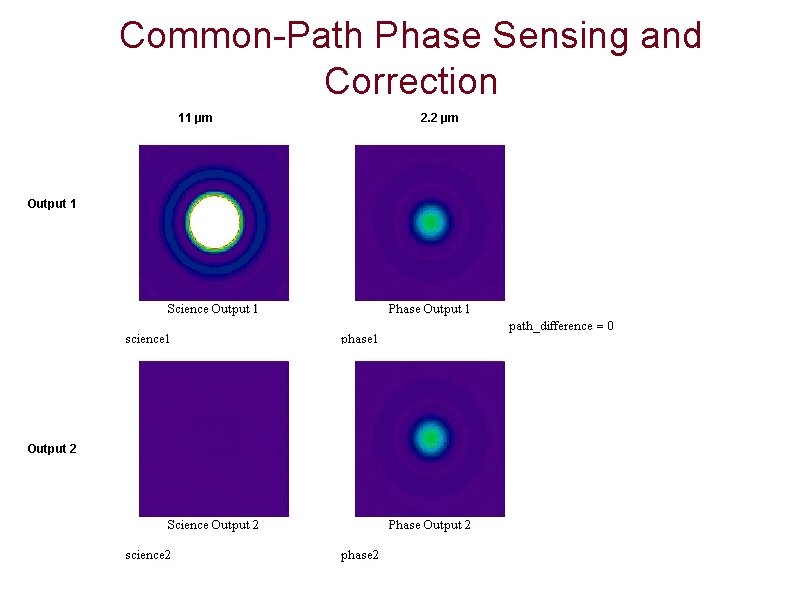
Common-Path Phase Sensing and Correction 11 μm Output 1 Output 2 2. 2 μm
Why Have the Phase-Sensing be Common-Path with the Nulling? By having the phase sensing light travel the exact same path as the nulling light, phase variations can be sensed no matter where they are in the beam train. The common-path approach provides a simplified approach to that of having a completely independent interferometer for phase sensing.
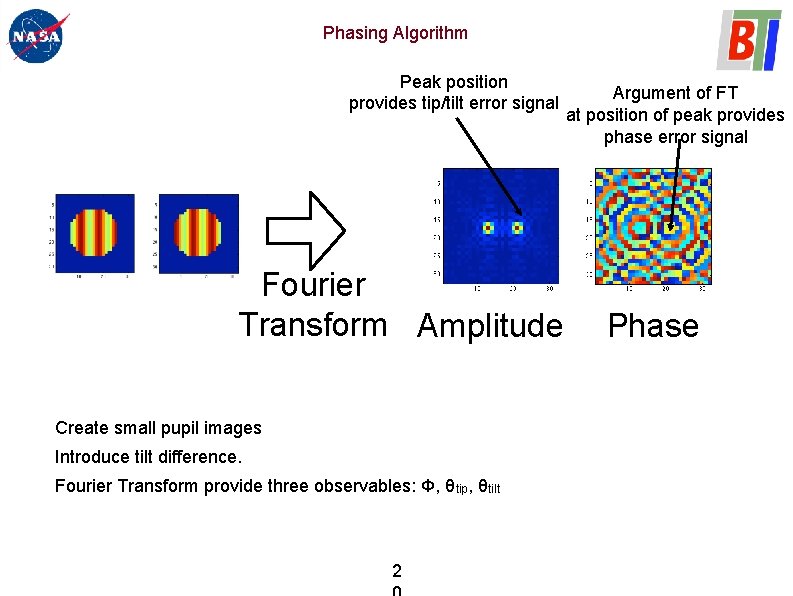
Phasing Algorithm Peak position provides tip/tilt error signal Fourier Transform Amplitude Create small pupil images Introduce tilt difference. Fourier Transform provide three observables: Φ, θtip, θtilt 2 Argument of FT at position of peak provides phase error signal Phase
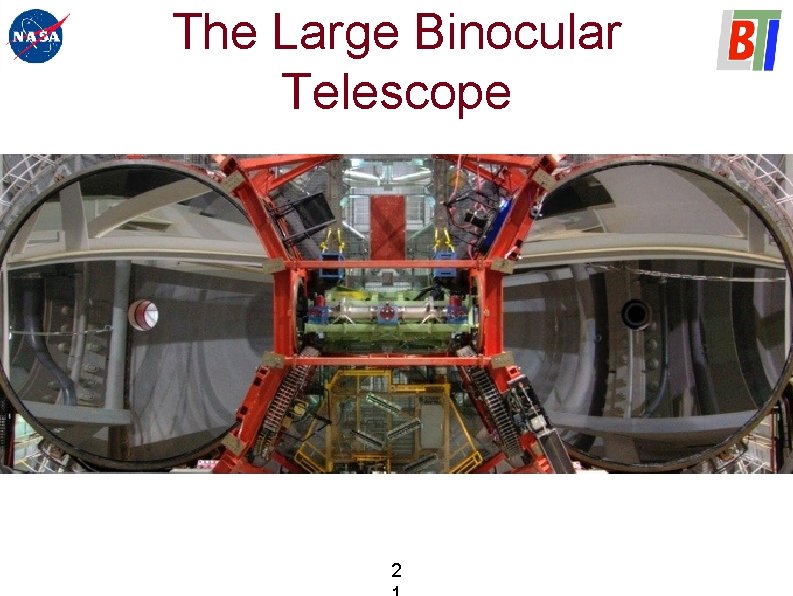
The Large Binocular Telescope 2
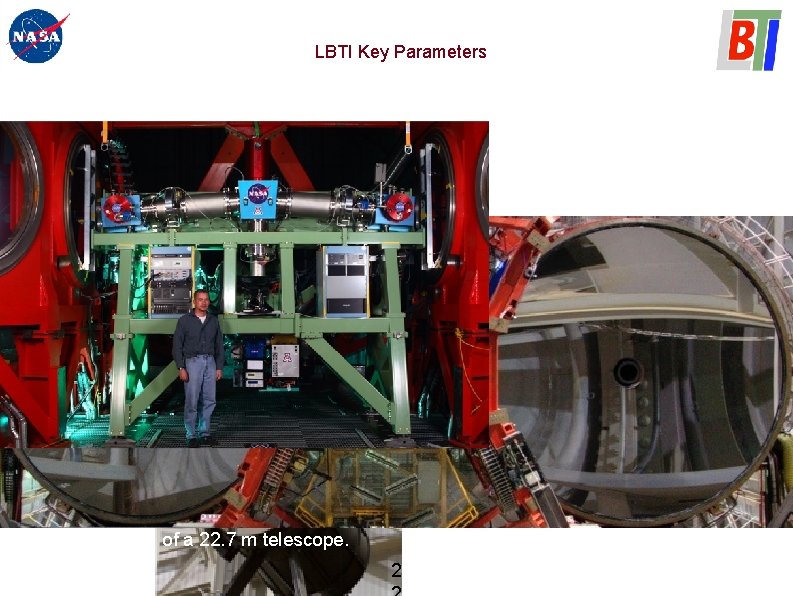
LBTI Key Parameters Sensitivity LBTI has two 8. 4 m mirrors mounted on a single structure. LBTI High Contrast The AO system creates an image with a Strehl of >95% at 3. 8 μm. LBT Deformable Secondary Mirror Resolution Beam combination provides the equivalent resolution of a 22. 7 m telescope. 2 LBTI installed on the telescope

LBTI Layout 2 3
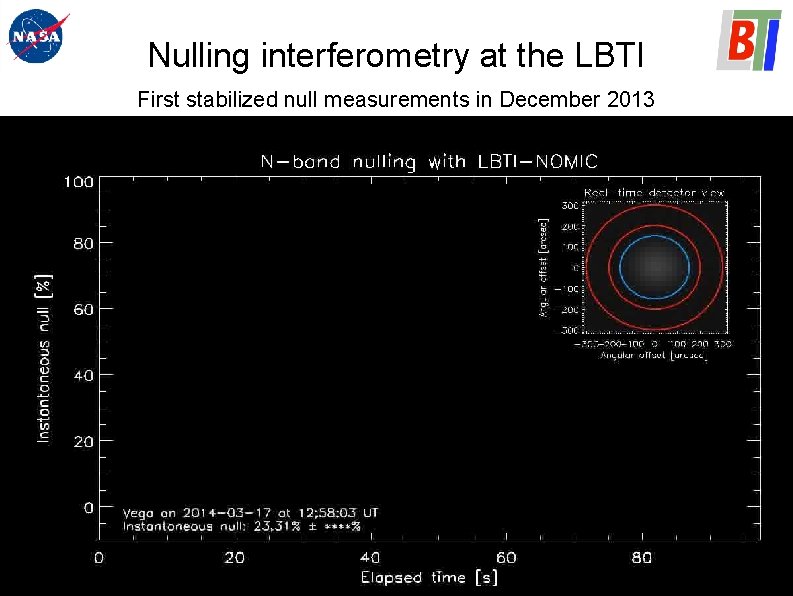
Nulling interferometry at the LBTI First stabilized null measurements in December 2013 2
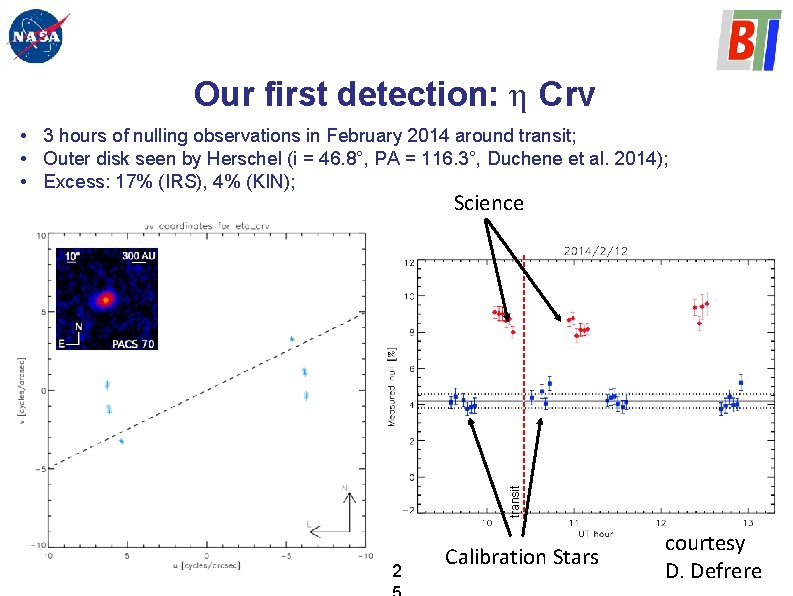
Our first detection: η Crv • 3 hours of nulling observations in February 2014 around transit; • Outer disk seen by Herschel (i = 46. 8°, PA = 116. 3°, Duchene et al. 2014); • Excess: 17% (IRS), 4% (KIN); Science isk tion nta of d ter ou p mid e lan transit ie Or 2 Calibration Stars courtesy D. Defrere
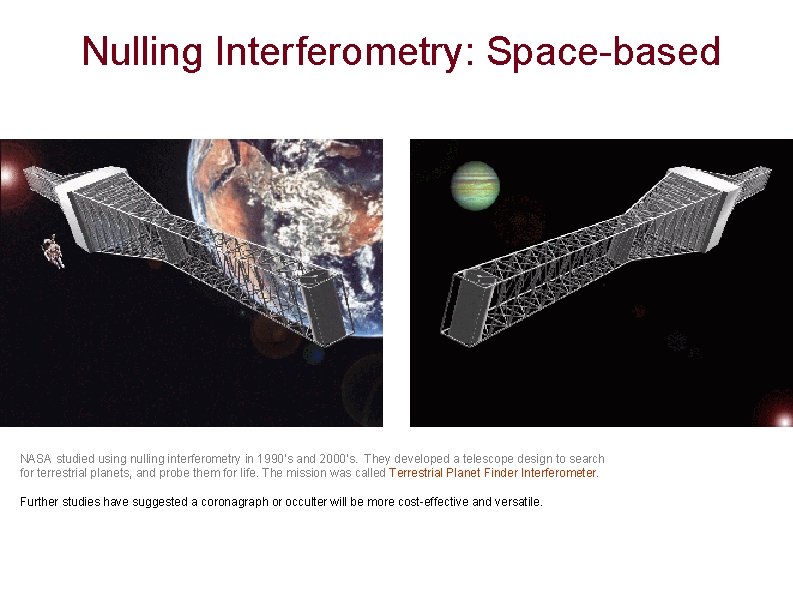
Nulling Interferometry: Space-based NASA studied using nulling interferometry in 1990’s and 2000’s. They developed a telescope design to search for terrestrial planets, and probe them for life. The mission was called Terrestrial Planet Finder Interferometer. Further studies have suggested a coronagraph or occulter will be more cost-effective and versatile.

Nulling Interferometry: Space-based
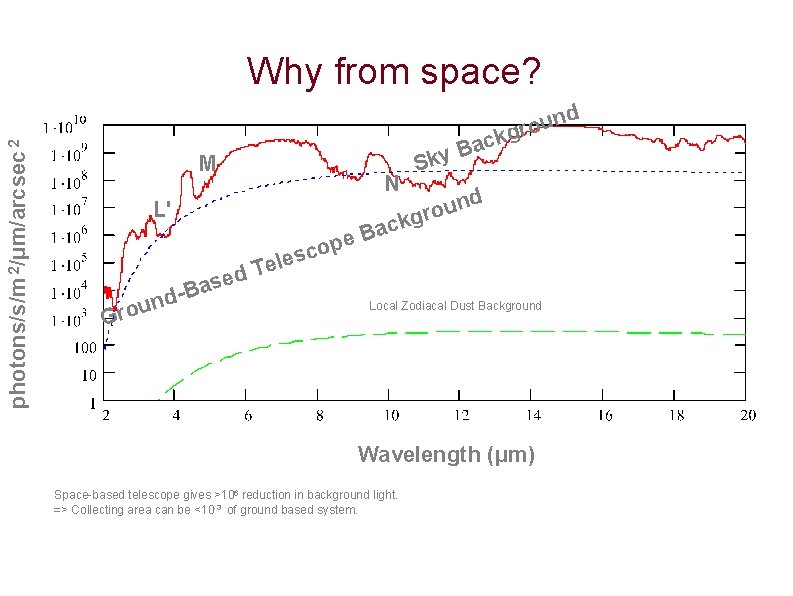
photons/s/m 2/μm/arcsec 2 Why from space? d n u o kgr M N L' pe o c s e l e d. T ac B y Sk d n u o r kg c a B e as B nd u Gro Local Zodiacal Dust Background Wavelength (μm) Space-based telescope gives >106 reduction in background light. => Collecting area can be <10 -3 of ground based system.
Why an interferometer? Need resolution < 0. 1 arcsec to spatially resolve a planetary system. (10 m at 10 μm) Only need a couple of meters 2 collecting area for cooled space-based system to get detectable flux from planet (1 photon/s/micron, in the presence of 100 photons/s of background).
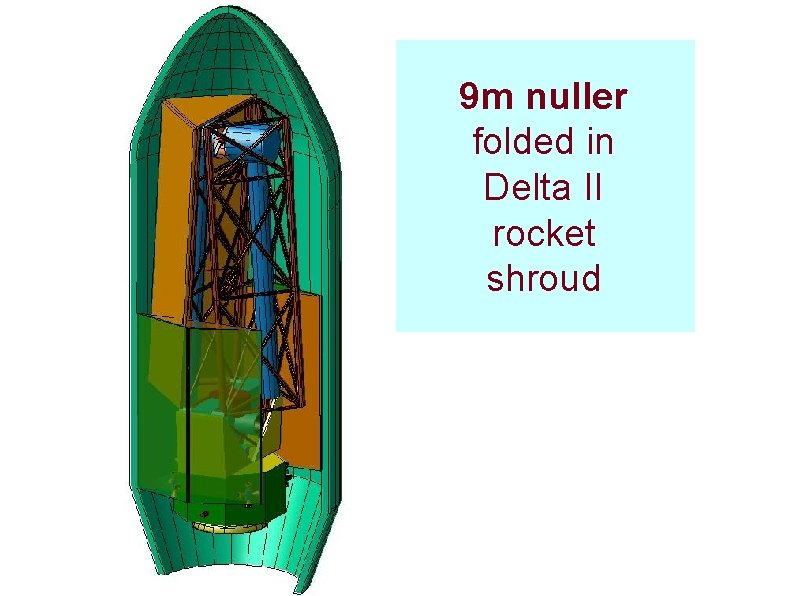
9 m nuller folded in Delta II rocket shroud
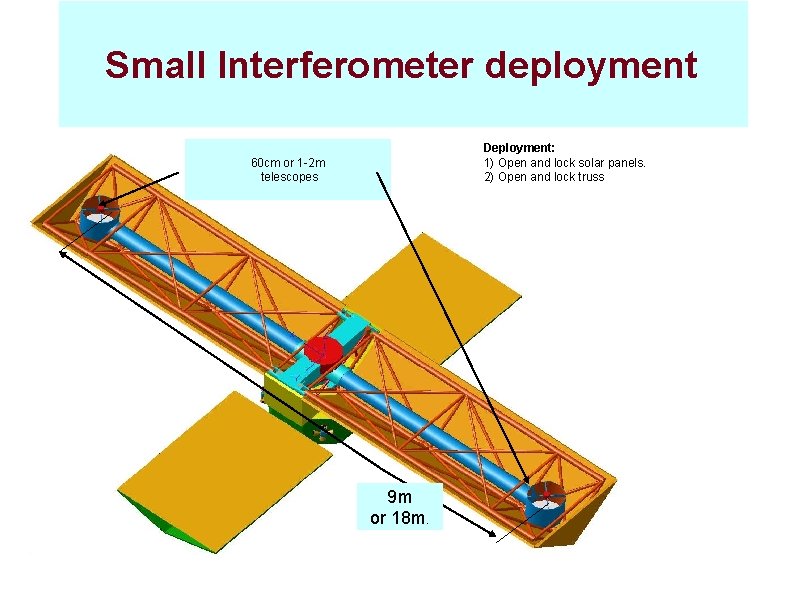
Small Interferometer deployment Deployment: 1) Open and lock solar panels. 2) Open and lock truss 60 cm or 1 -2 m telescopes 9 m or 18 m.
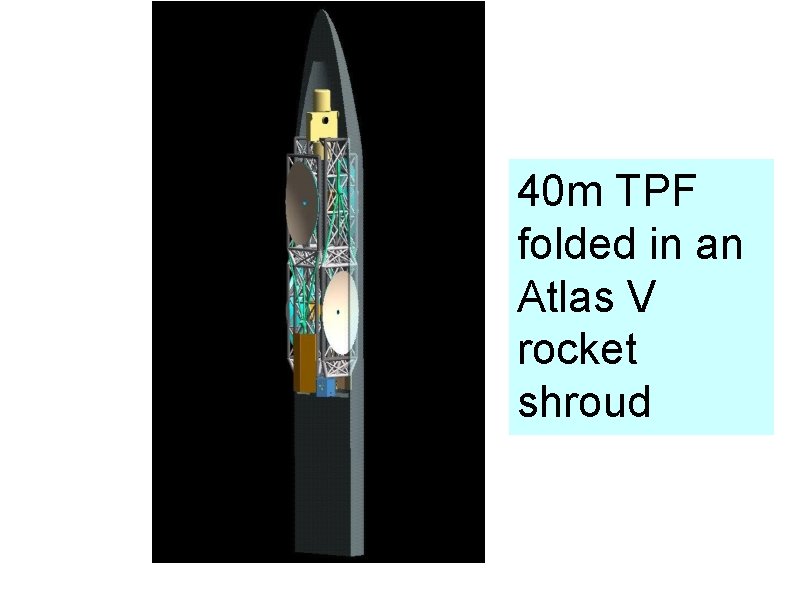
40 m TPF folded in an Atlas V rocket shroud

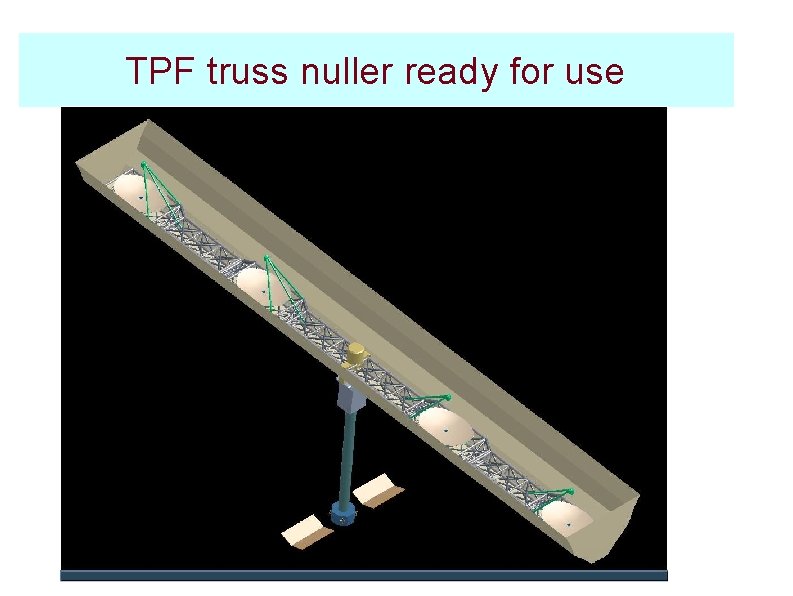
TPF truss nuller ready for use
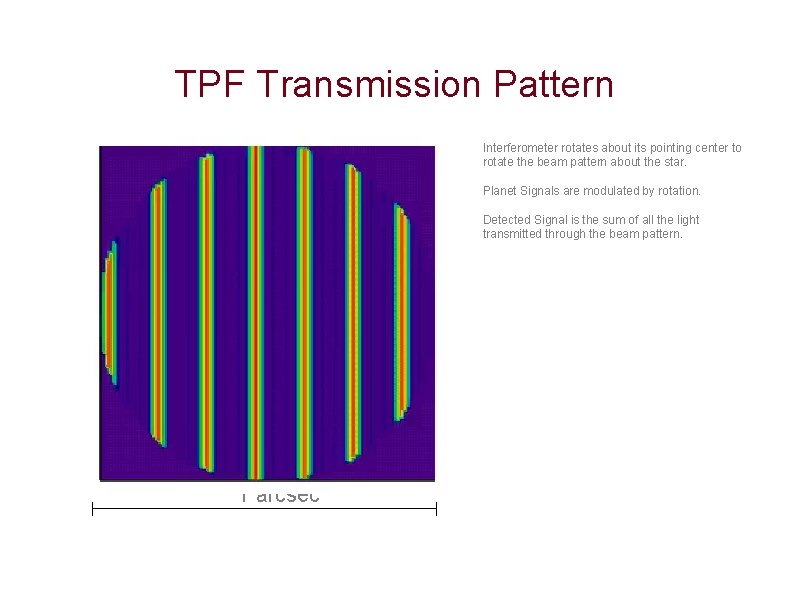
TPF Transmission Pattern Interferometer rotates about its pointing center to rotate the beam pattern about the star. Planet Signals are modulated by rotation. Detected Signal is the sum of all the light transmitted through the beam pattern. 1 arcsec
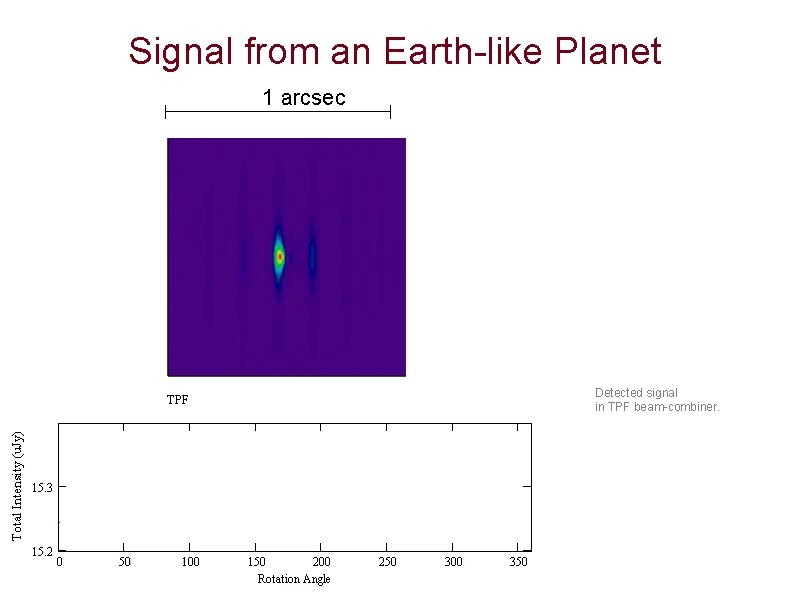
Signal from an Earth-like Planet 1 arcsec Detected signal in TPF beam-combiner.
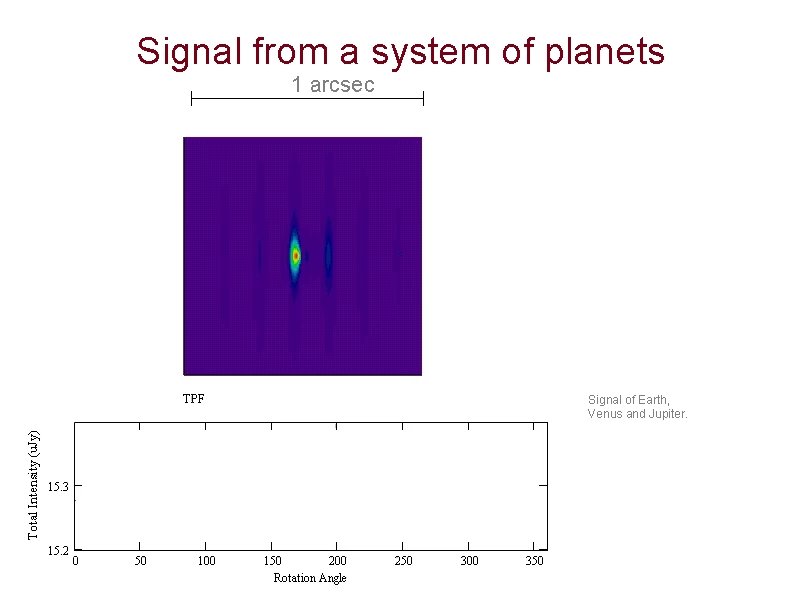
Signal from a system of planets 1 arcsec Signal of Earth, Venus and Jupiter.
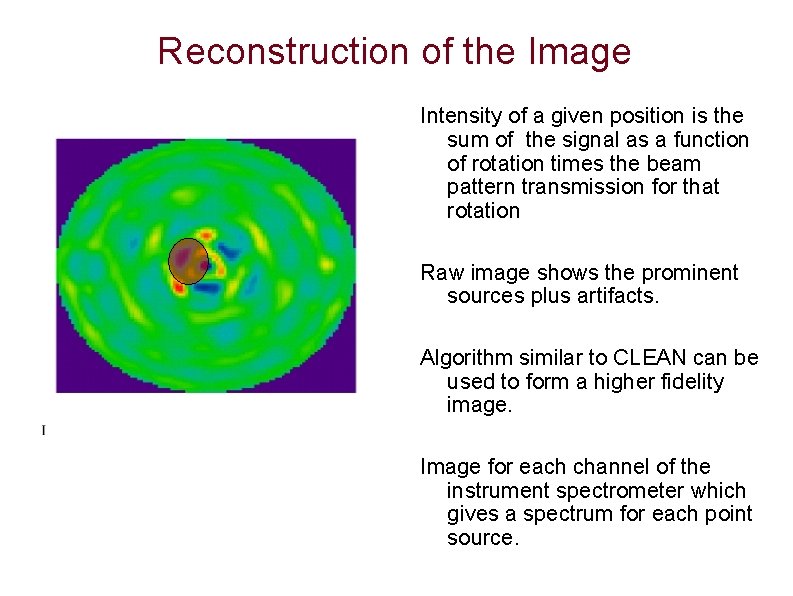
Reconstruction of the Image Intensity of a given position is the sum of the signal as a function of rotation times the beam pattern transmission for that rotation Raw image shows the prominent sources plus artifacts. Algorithm similar to CLEAN can be used to form a higher fidelity image. Image for each channel of the instrument spectrometer which gives a spectrum for each point source.
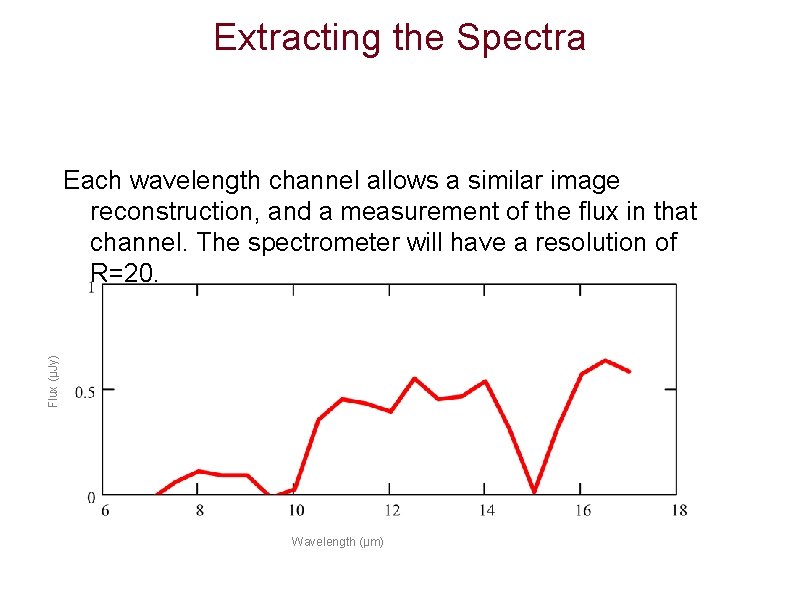
Extracting the Spectra Flux (μJy) Each wavelength channel allows a similar image reconstruction, and a measurement of the flux in that channel. The spectrometer will have a resolution of R=20. Wavelength (μm)
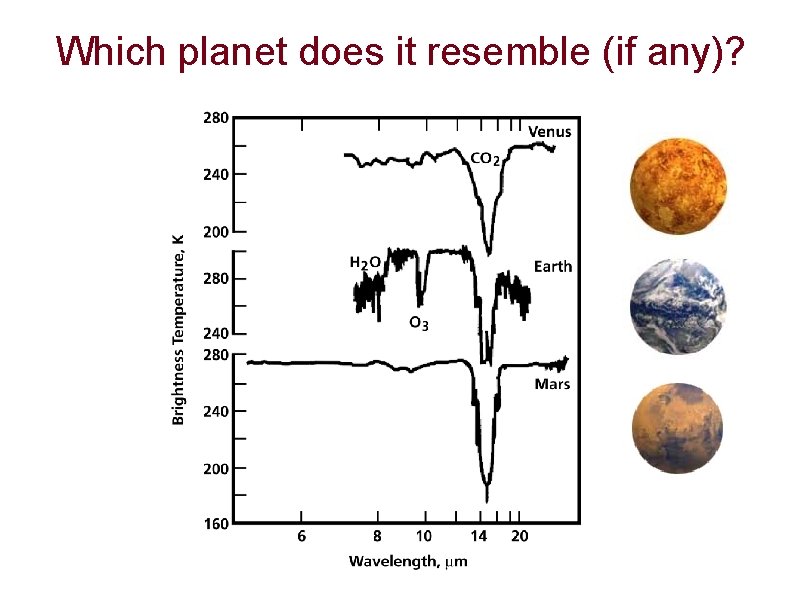
Which planet does it resemble (if any)?
- Slides: 40