
Nuffield FreeStanding Mathematics Activity Solve friction problems Nuffield
Nuffield Free-Standing Mathematics Activity Solve friction problems © Nuffield Foundation 2011
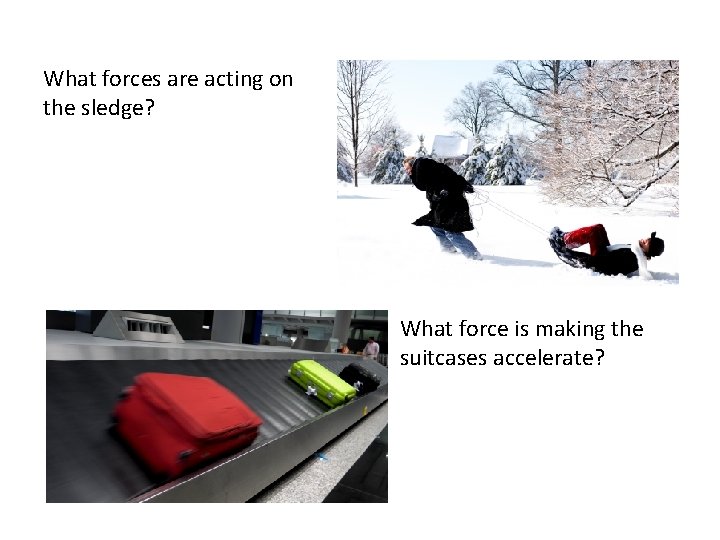
What forces are acting on the sledge? What force is making the suitcases accelerate?
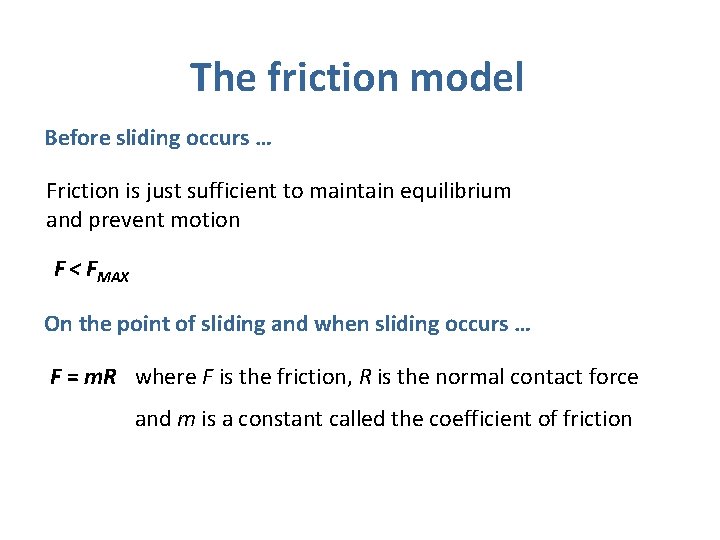
The friction model Before sliding occurs … Friction is just sufficient to maintain equilibrium and prevent motion F < FMAX On the point of sliding and when sliding occurs … F = m. R where F is the friction, R is the normal contact force and m is a constant called the coefficient of friction
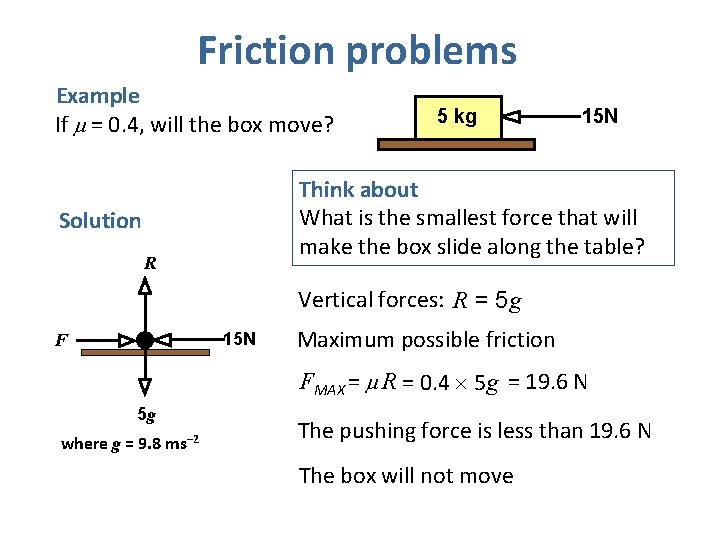
Friction problems Example If m = 0. 4, will the box move? 5 kg 15 N Think about What is the smallest force that will make the box slide along the table? Solution R Vertical forces: R = 5 g 15 N F Maximum possible friction FMAX = m R = 0. 4 5 g = 19. 6 N 5 g where g = 9. 8 ms– 2 The pushing force is less than 19. 6 N The box will not move
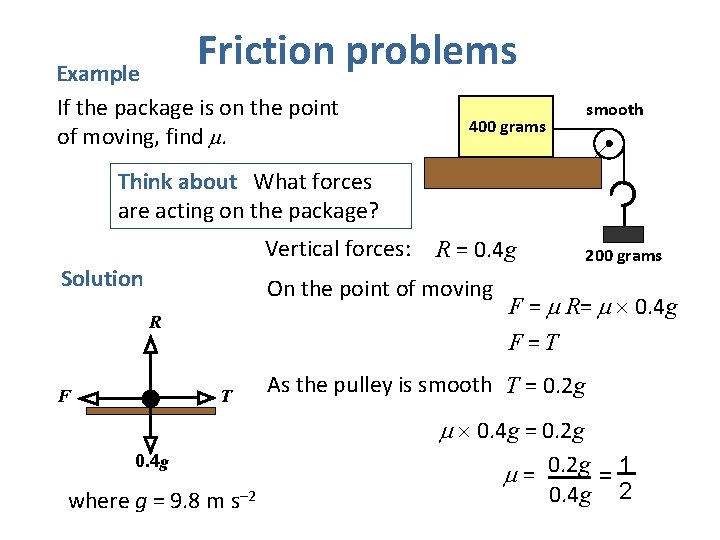
Friction problems Example If the package is on the point of moving, find m. smooth 400 grams Think about What forces are acting on the package? Vertical forces: Solution R = 0. 4 g On the point of moving R F = m R= m 0. 4 g F=T T F 200 grams As the pulley is smooth T = 0. 2 g m 0. 4 g = 0. 2 g 0. 4 g where g = 9. 8 m s– 2 m = 0. 2 g = 1 0. 4 g 2
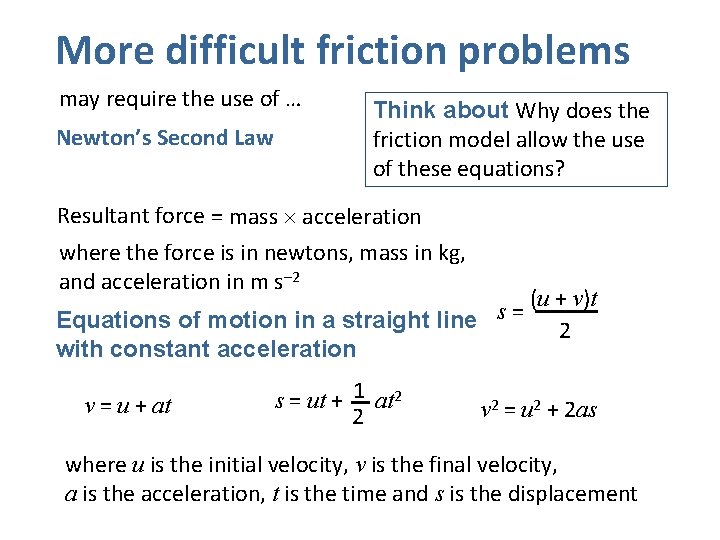
More difficult friction problems may require the use of … Newton’s Second Law Think about Why does the friction model allow the use of these equations? Resultant force = mass acceleration where the force is in newtons, mass in kg, and acceleration in m s– 2 Equations of motion in a straight line s = with constant acceleration v = u + at s = ut + 1 at 2 2 (u + v)t 2 v 2 = u 2 + 2 as where u is the initial velocity, v is the final velocity, a is the acceleration, t is the time and s is the displacement
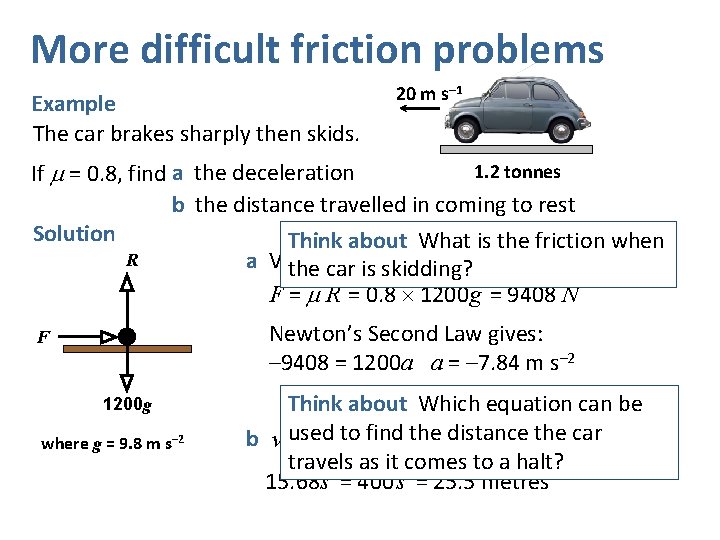
More difficult friction problems Example The car brakes sharply then skids. 20 m s– 1 1. 2 tonnes If m = 0. 8, find a the deceleration b the distance travelled in coming to rest Solution Think about What is the friction when R a Vertical R = 1200 g the carforces: is skidding? F = m R = 0. 8 1200 g = 9408 N Newton’s Second Law gives: – 9408 = 1200 a a = – 7. 84 m s– 2 F 1200 g where g = 9. 8 m s– 2 Think about Which equation can be 2 = distance find 0 the car b v 2 used 202 - 2 the 7. 84 s = u 2 +to 2 as travels as it comes to a halt? 15. 68 s = 400 s = 25. 5 metres
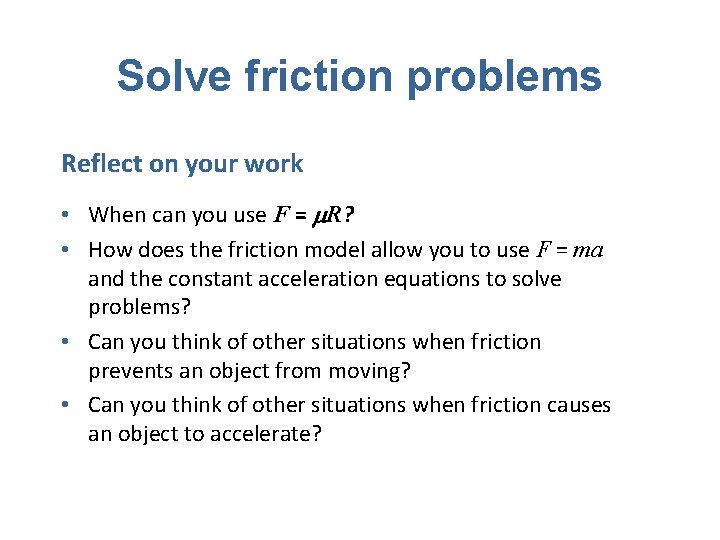
Solve friction problems Reflect on your work • When can you use F = m. R? • How does the friction model allow you to use F = ma and the constant acceleration equations to solve problems? • Can you think of other situations when friction prevents an object from moving? • Can you think of other situations when friction causes an object to accelerate?
- Slides: 8