
Nucleus as an Open System Continuum Shell Model
![Predictive power of theory Continuum Shell Model prediction 2003 -2006 Measured 2009 -2013 [1]](https://slidetodoc.com/presentation_image_h/b02dde269e62e23c8c6ee8ac26f02648/image-28.jpg "Predictive power of theory Continuum Shell Model prediction 2003 -2006 Measured 2009 -2013 [1]")
![[2] A. Volya and V. Z. Phys. Rev. C 74 (2006) 064314, [3] G.](https://slidetodoc.com/presentation_image_h/b02dde269e62e23c8c6ee8ac26f02648/image-29.jpg "[2] A. Volya and V. Z. Phys. Rev. C 74 (2006) 064314, [3] G.")




![Quantum Decay: exponential versus non-exponential * [Kubo] - exponential decay corresponds to the condition](https://slidetodoc.com/presentation_image_h/b02dde269e62e23c8c6ee8ac26f02648/image-60.jpg "Quantum Decay: exponential versus non-exponential * [Kubo] - exponential decay corresponds to the condition")
- Slides: 70
Nucleus as an Open System: Continuum Shell Model and New Challenges Vladimir Zelevinsky NSCL/ Michigan State University Supported by NSF Caen, GANIL May 30, 2014
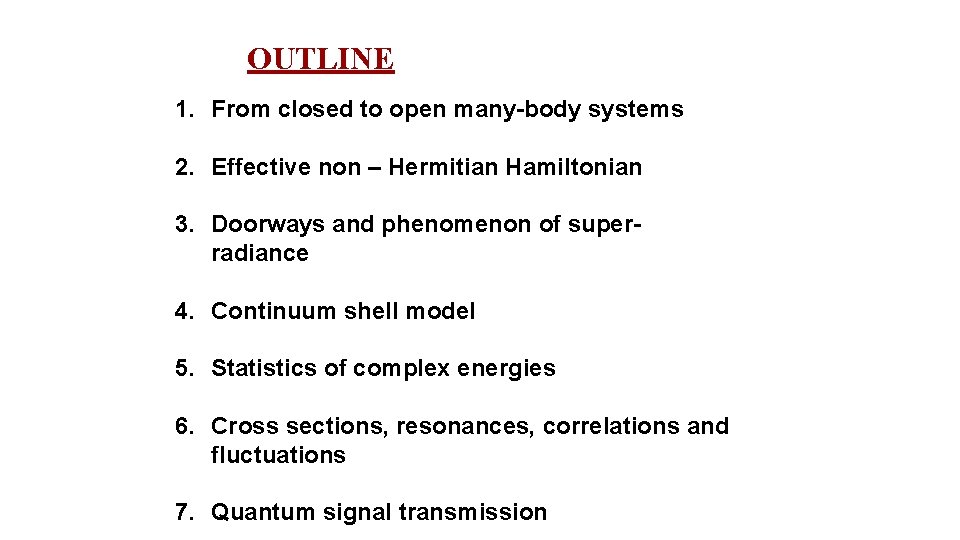
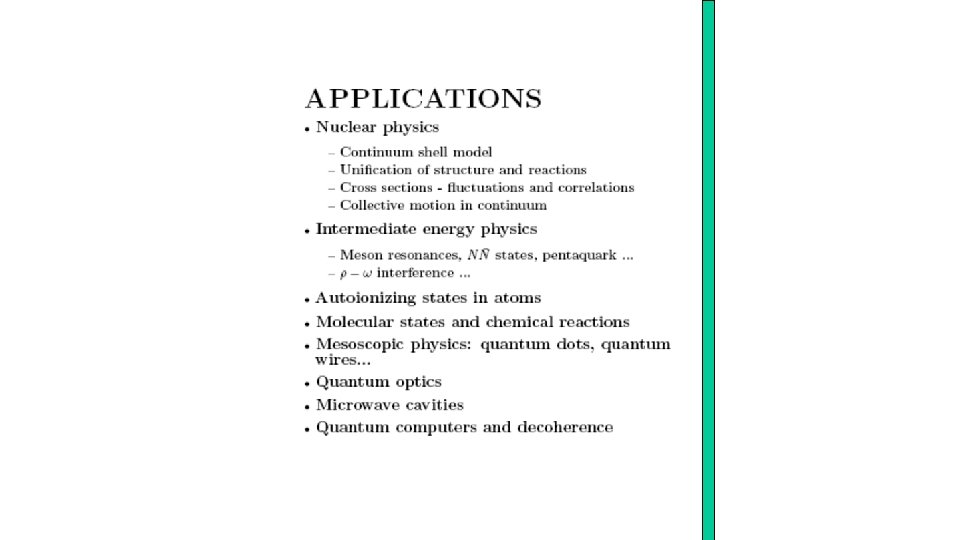
OUTLINE 1. From closed to open many-body systems 2. Effective non – Hermitian Hamiltonian 3. Doorways and phenomenon of superradiance 4. Continuum shell model 5. Statistics of complex energies 6. Cross sections, resonances, correlations and fluctuations 7. Quantum signal transmission
THANKS • • Naftali Auerbach (Tel Aviv University) Luca Celardo (University of Breschia) Felix Izrailev (University of Puebla) Lev Kaplan (Tulane University) Gavriil Shchedrin (MSU, TAMU) Valentin Sokolov (Budker Instutute) Suren Sorathia (University of Puebla) Alexander Volya (Florida State University)
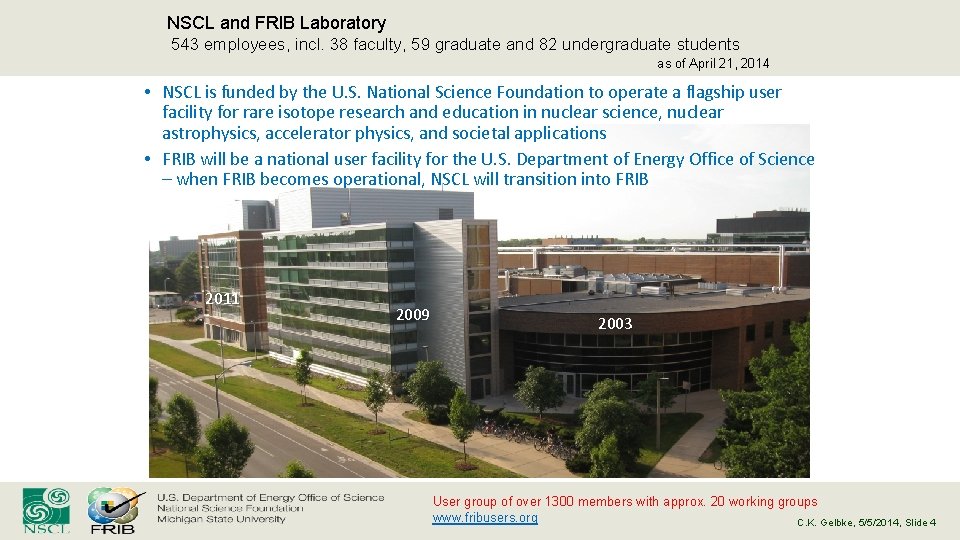
NSCL and FRIB Laboratory 543 employees, incl. 38 faculty, 59 graduate and 82 undergraduate students as of April 21, 2014 • NSCL is funded by the U. S. National Science Foundation to operate a flagship user facility for rare isotope research and education in nuclear science, nuclear astrophysics, accelerator physics, and societal applications • FRIB will be a national user facility for the U. S. Department of Energy Office of Science – when FRIB becomes operational, NSCL will transition into FRIB 2011 2009 2003 User group of over 1300 members with approx. 20 working groups www. fribusers. org C. K. Gelbke, 5/5/2014, Slide 4
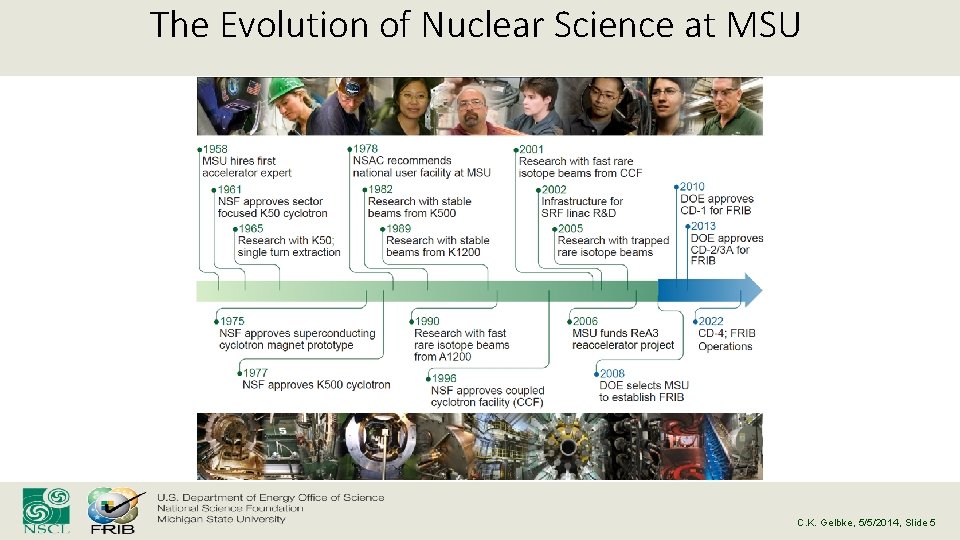
The Evolution of Nuclear Science at MSU C. K. Gelbke, 5/5/2014, Slide 5
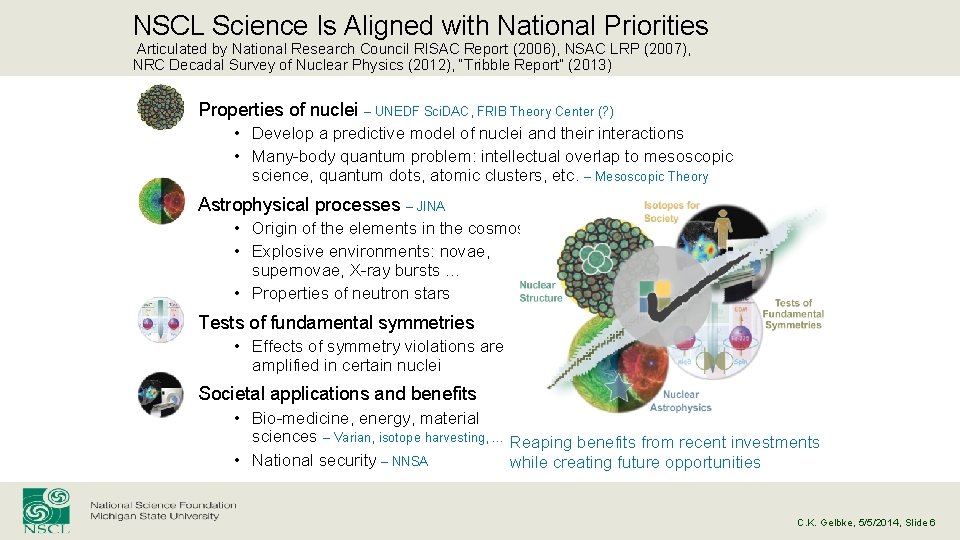
NSCL Science Is Aligned with National Priorities Articulated by National Research Council RISAC Report (2006), NSAC LRP (2007), NRC Decadal Survey of Nuclear Physics (2012), “Tribble Report” (2013) Properties of nuclei – UNEDF Sci. DAC, FRIB Theory Center (? ) • Develop a predictive model of nuclei and their interactions • Many-body quantum problem: intellectual overlap to mesoscopic science, quantum dots, atomic clusters, etc. – Mesoscopic Theory Astrophysical processes – JINA • Origin of the elements in the cosmos • Explosive environments: novae, supernovae, X-ray bursts … • Properties of neutron stars Tests of fundamental symmetries • Effects of symmetry violations are amplified in certain nuclei Societal applications and benefits • Bio-medicine, energy, material sciences – Varian, isotope harvesting, … Reaping benefits from recent investments • National security – NNSA while creating future opportunities C. K. Gelbke, 5/5/2014, Slide 6
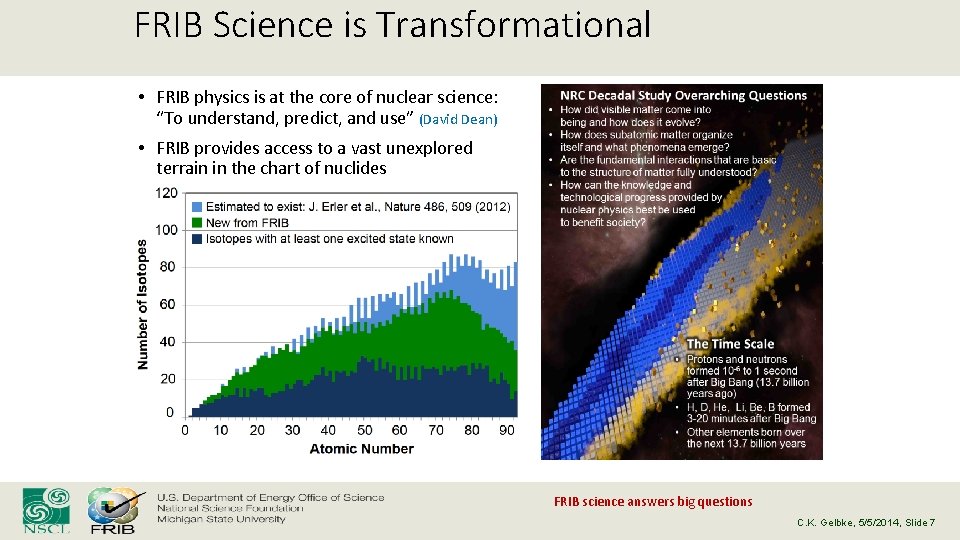
FRIB Science is Transformational • FRIB physics is at the core of nuclear science: “To understand, predict, and use” (David Dean) • FRIB provides access to a vast unexplored terrain in the chart of nuclides FRIB science answers big questions C. K. Gelbke, 5/5/2014, Slide 7
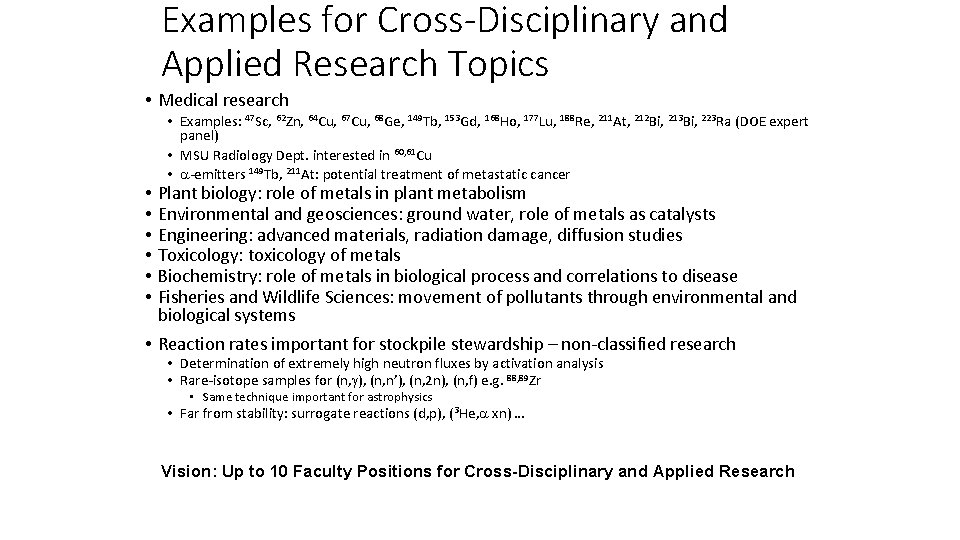
Examples for Cross-Disciplinary and Applied Research Topics • Medical research • • Examples: 47 Sc, 62 Zn, 64 Cu, 67 Cu, 68 Ge, 149 Tb, 153 Gd, 168 Ho, 177 Lu, 188 Re, 211 At, 212 Bi, 213 Bi, 223 Ra (DOE expert panel) • MSU Radiology Dept. interested in 60, 61 Cu • -emitters 149 Tb, 211 At: potential treatment of metastatic cancer Plant biology: role of metals in plant metabolism Environmental and geosciences: ground water, role of metals as catalysts Engineering: advanced materials, radiation damage, diffusion studies Toxicology: toxicology of metals Biochemistry: role of metals in biological process and correlations to disease Fisheries and Wildlife Sciences: movement of pollutants through environmental and biological systems • Reaction rates important for stockpile stewardship – non-classified research • Determination of extremely high neutron fluxes by activation analysis • Rare-isotope samples for (n, ), (n, n’), (n, 2 n), (n, f) e. g. 88, 89 Zr • Same technique important for astrophysics • Far from stability: surrogate reactions (d, p), (3 He, xn) … Vision: Up to 10 Faculty Positions for Cross-Disciplinary and Applied Research
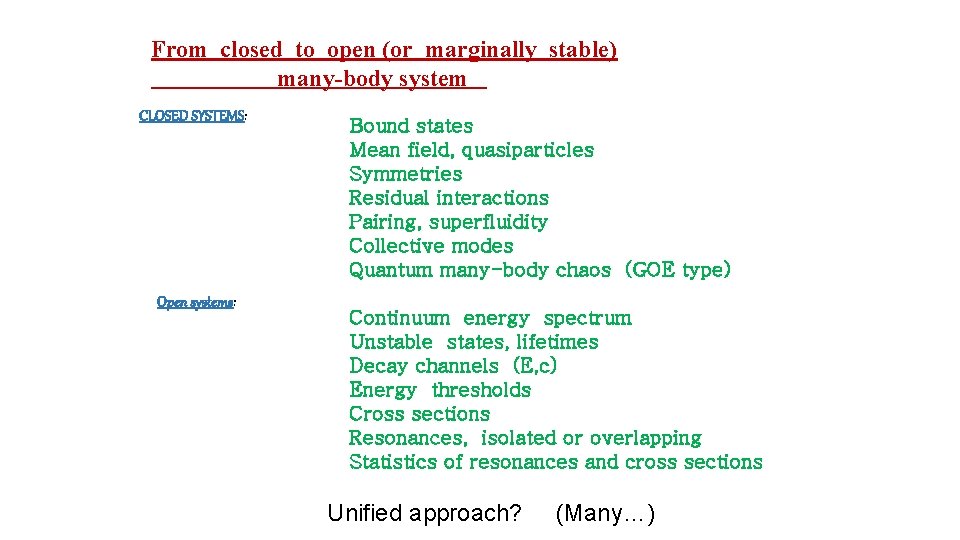
From closed to open (or marginally stable) many-body system CLOSED SYSTEMS: Open systems: Bound states Mean field, quasiparticles Symmetries Residual interactions Pairing, superfluidity Collective modes Quantum many-body chaos (GOE type) Continuum energy spectrum Unstable states, lifetimes Decay channels (E, c) Energy thresholds Cross sections Resonances, isolated or overlapping Statistics of resonances and cross sections Unified approach? (Many…)
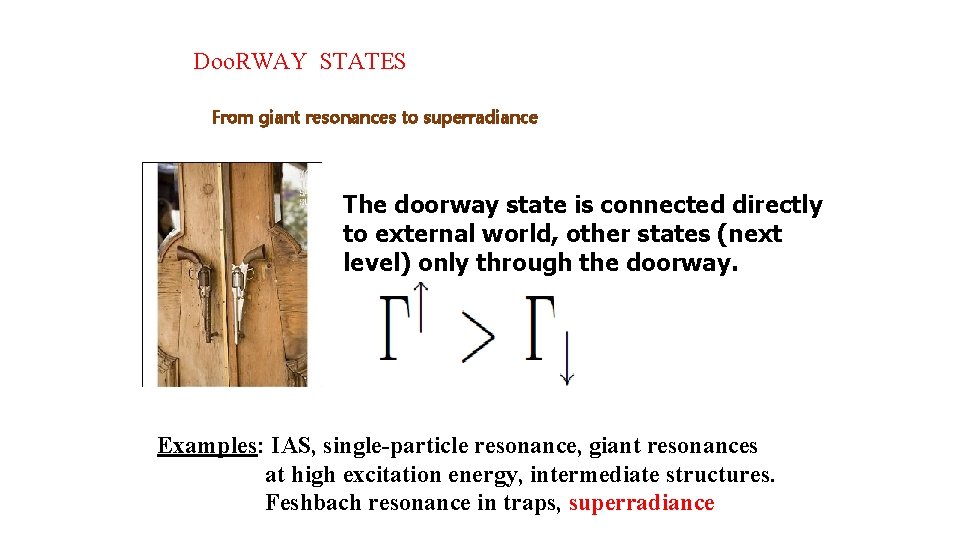
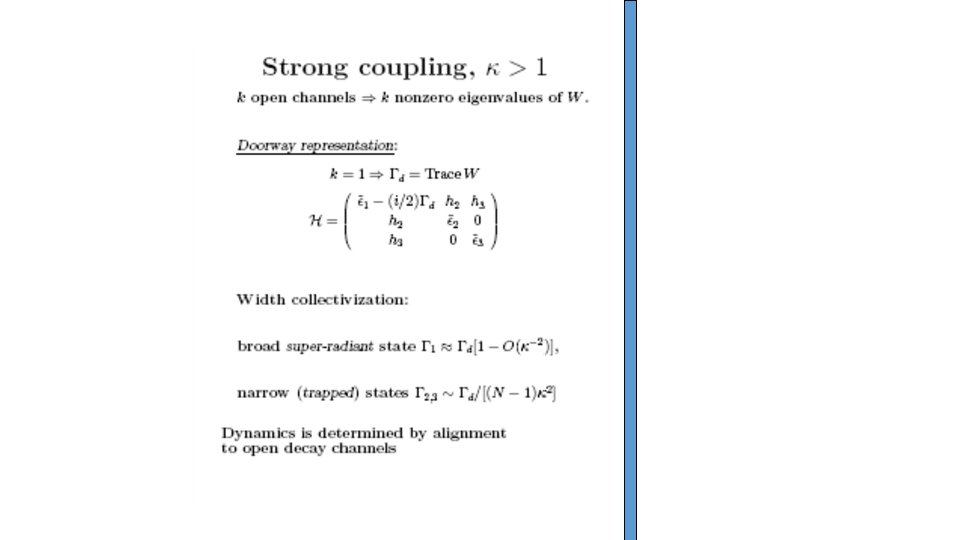
Doo. RWAY STATES From giant resonances to superradiance The doorway state is connected directly to external world, other states (next level) only through the doorway. Examples: IAS, single-particle resonance, giant resonances at high excitation energy, intermediate structures. Feshbach resonance in traps, superradiance
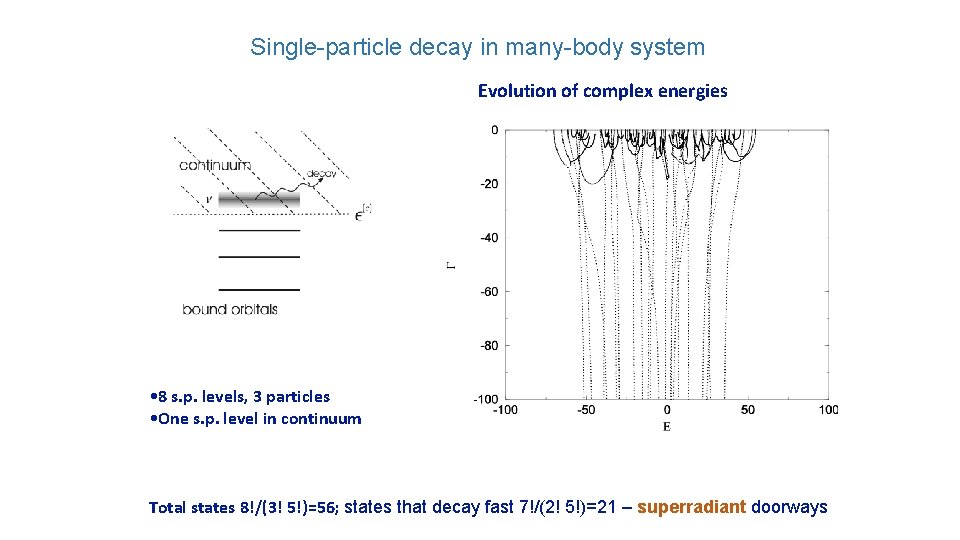
Single-particle decay in many-body system Evolution of complex energies • 8 s. p. levels, 3 particles • One s. p. level in continuum Total states 8!/(3! 5!)=56; states that decay fast 7!/(2! 5!)=21 – superradiant doorways
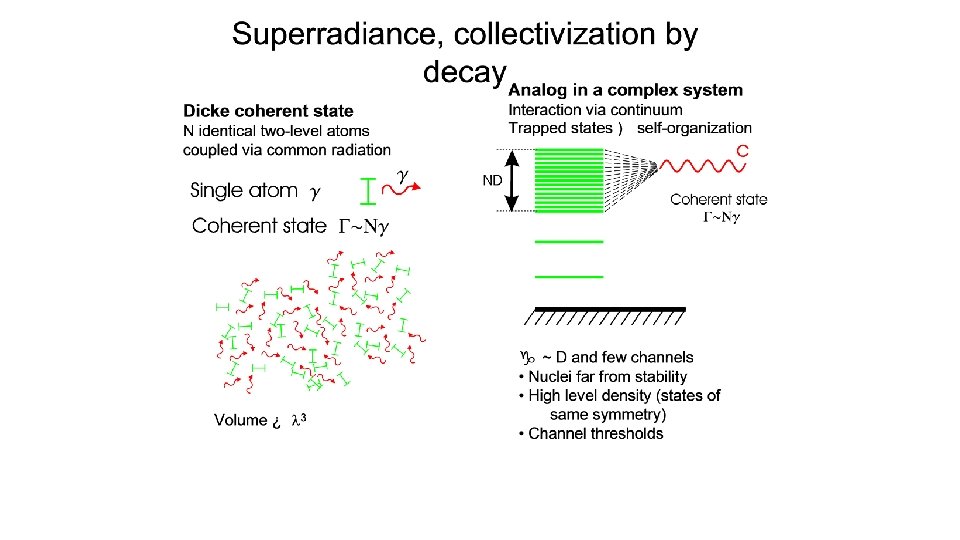
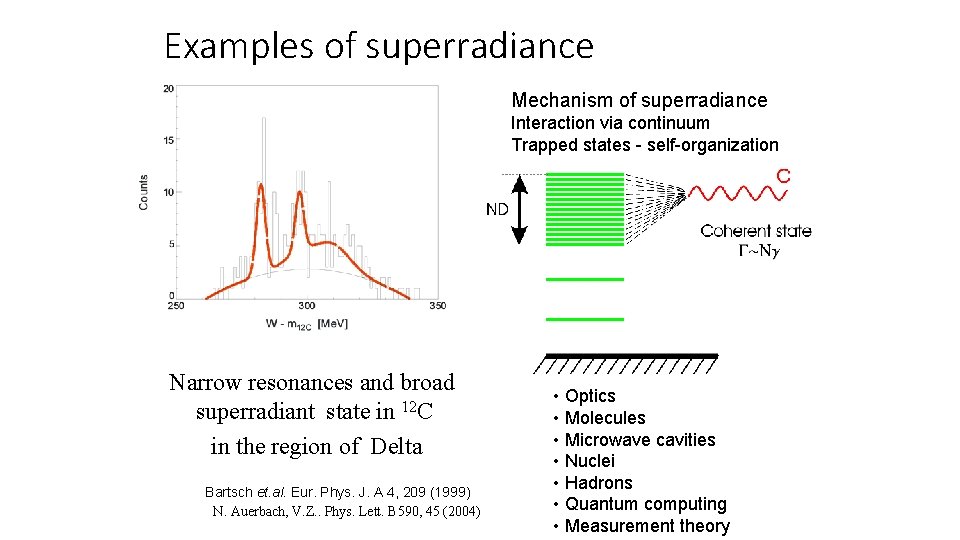
Examples of superradiance Mechanism of superradiance Interaction via continuum Trapped states - self-organization Narrow resonances and broad superradiant state in 12 C in the region of Delta Bartsch et. al. Eur. Phys. J. A 4, 209 (1999) N. Auerbach, V. Z. . Phys. Lett. B 590, 45 (2004) • Optics • Molecules • Microwave cavities • Nuclei • Hadrons • Quantum computing • Measurement theory
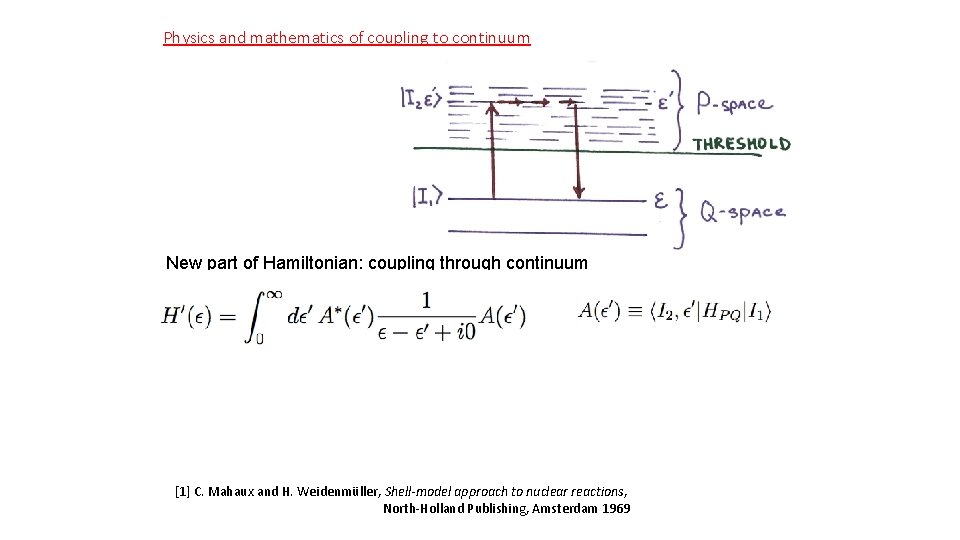
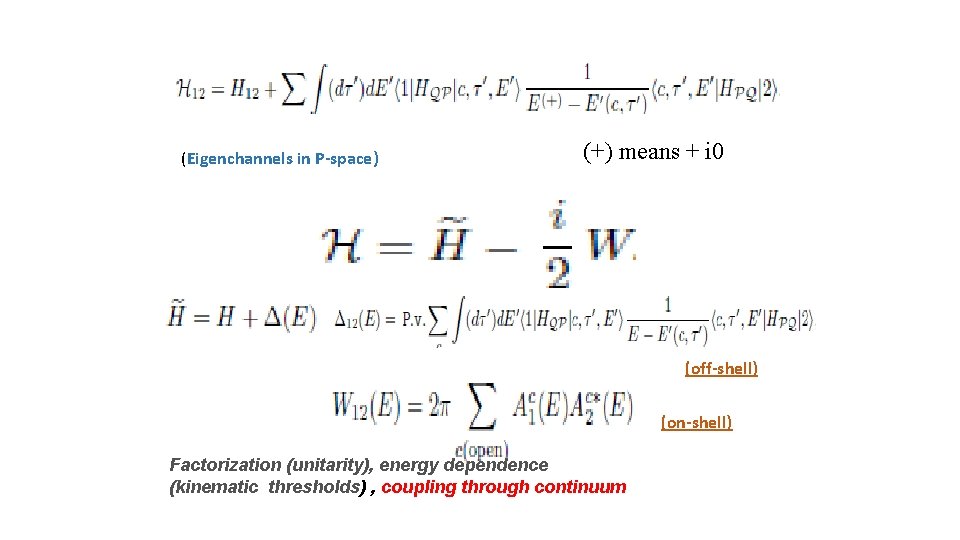
Physics and mathematics of coupling to continuum New part of Hamiltonian: coupling through continuum [1] C. Mahaux and H. Weidenmüller, Shell-model approach to nuclear reactions, North-Holland Publishing, Amsterdam 1969
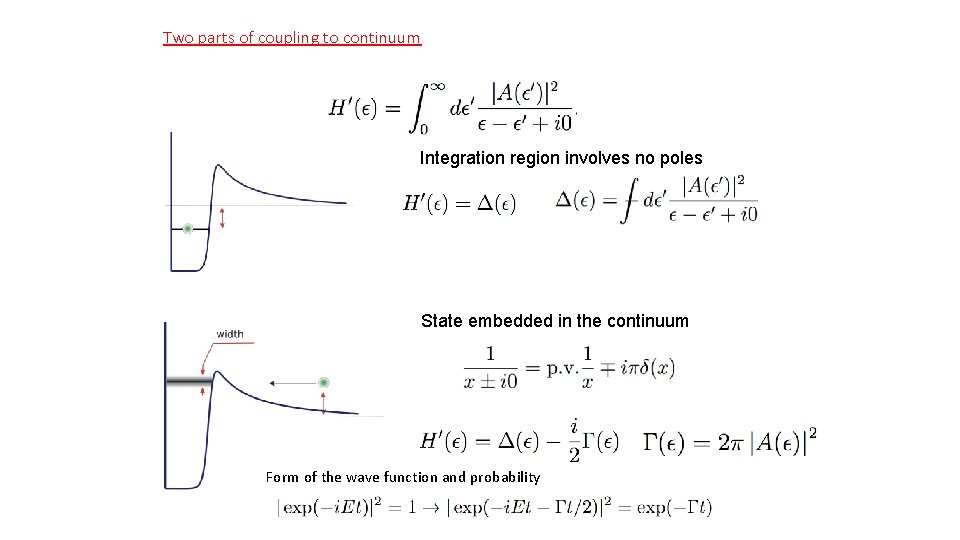
Two parts of coupling to continuum Integration region involves no poles State embedded in the continuum Form of the wave function and probability
(Eigenchannels in P-space) (+) means + i 0 (off-shell) (on-shell) Factorization (unitarity), energy dependence (kinematic thresholds) , coupling through continuum
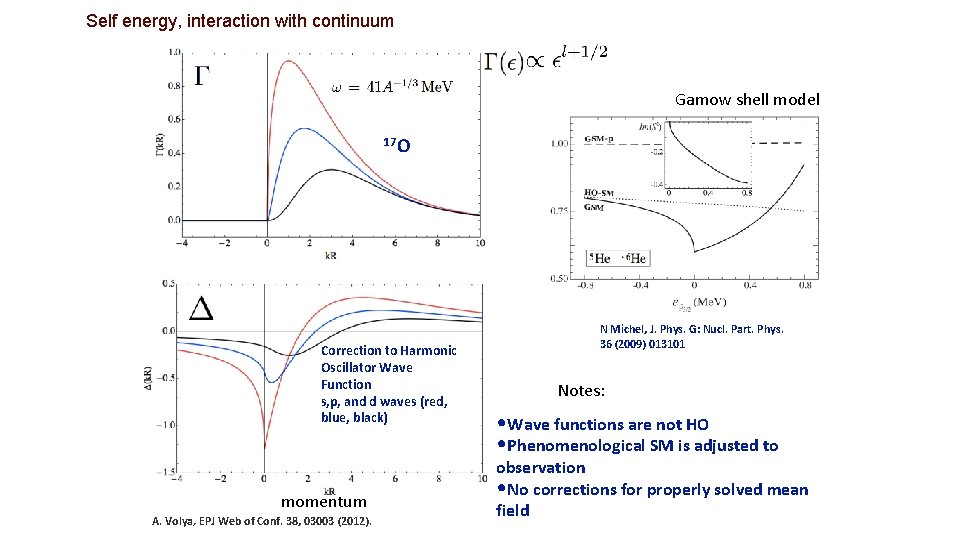
Self energy, interaction with continuum Gamow shell model 17 O Correction to Harmonic Oscillator Wave Function s, p, and d waves (red, blue, black) momentum A. Volya, EPJ Web of Conf. 38, 03003 (2012). N Michel, J. Phys. G: Nucl. Part. Phys. 36 (2009) 013101 Notes: • Wave functions are not HO • Phenomenological SM is adjusted to observation • No corrections for properly solved mean field
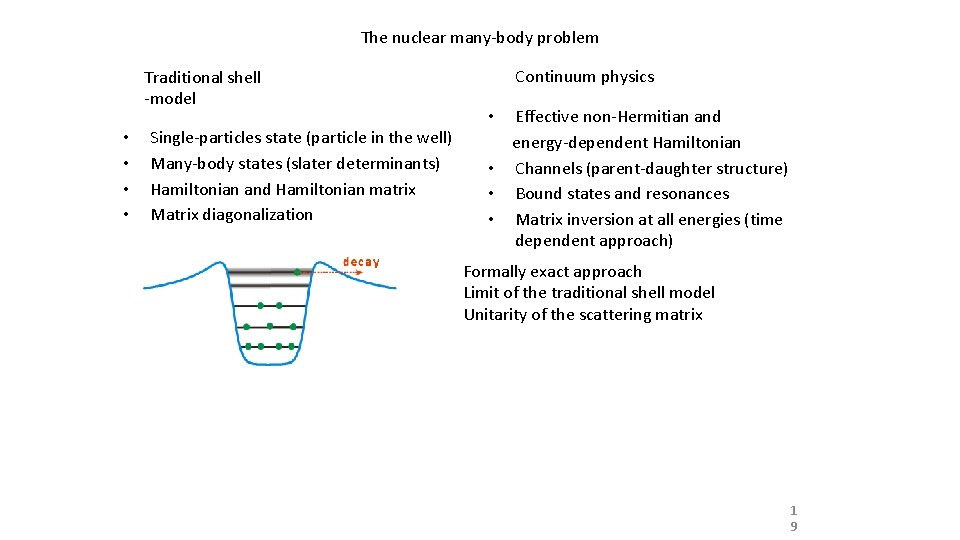
The nuclear many-body problem Traditional shell -model • • Single-particles state (particle in the well) Many-body states (slater determinants) Hamiltonian and Hamiltonian matrix Matrix diagonalization Continuum physics Effective non-Hermitian and energy-dependent Hamiltonian • Channels (parent-daughter structure) • Bound states and resonances • Matrix inversion at all energies (time dependent approach) • Formally exact approach Limit of the traditional shell model Unitarity of the scattering matrix 1 9
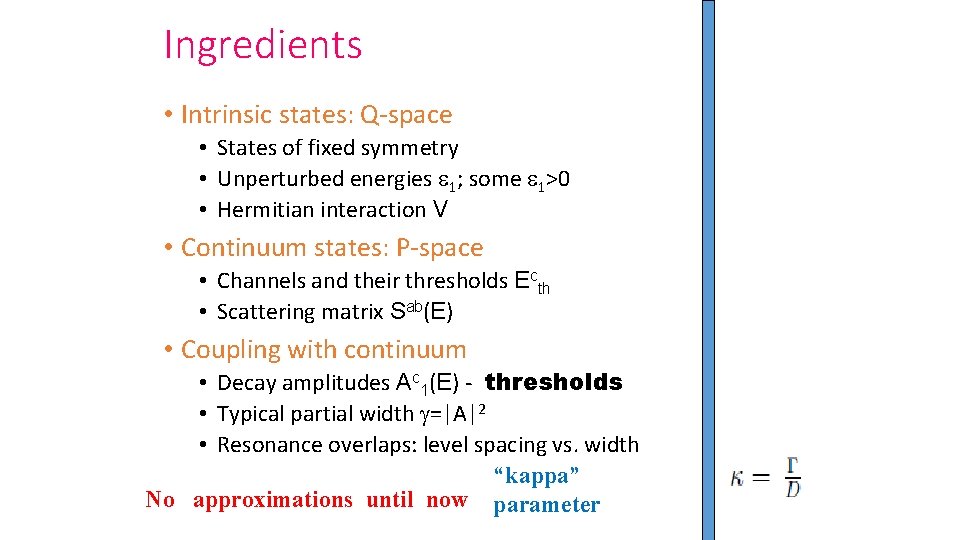
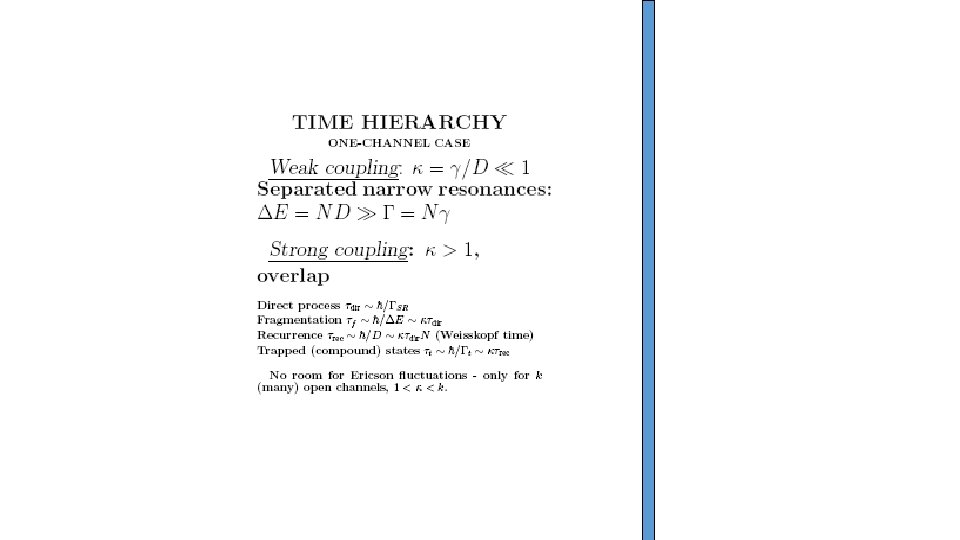
Ingredients • Intrinsic states: Q-space • States of fixed symmetry • Unperturbed energies 1; some 1>0 • Hermitian interaction V • Continuum states: P-space • Channels and their thresholds Ecth • Scattering matrix Sab(E) • Coupling with continuum • Decay amplitudes Ac 1(E) - thresholds • Typical partial width =|A|2 • Resonance overlaps: level spacing vs. width “kappa” No approximations until now parameter
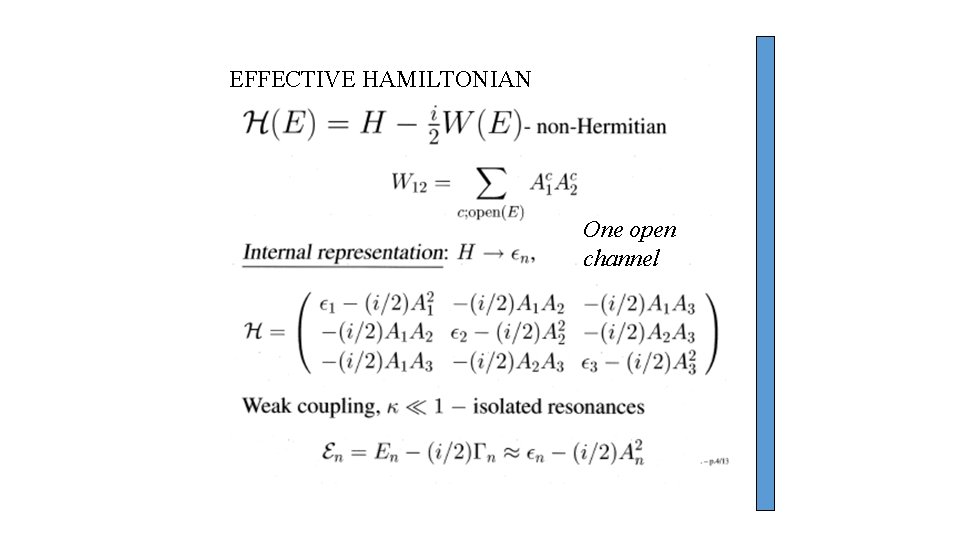
EFFECTIVE HAMILTONIAN One open channel
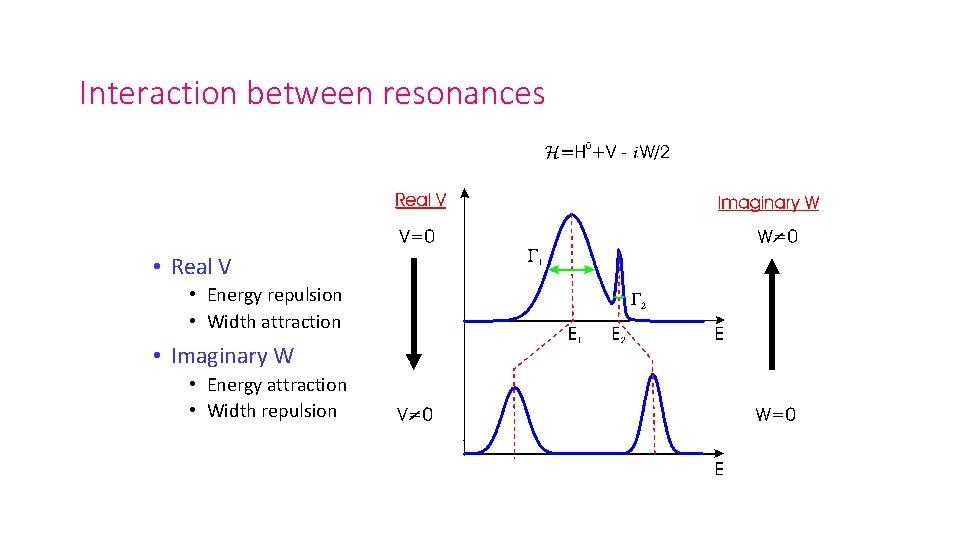
Interaction between resonances • Real V • Energy repulsion • Width attraction • Imaginary W • Energy attraction • Width repulsion
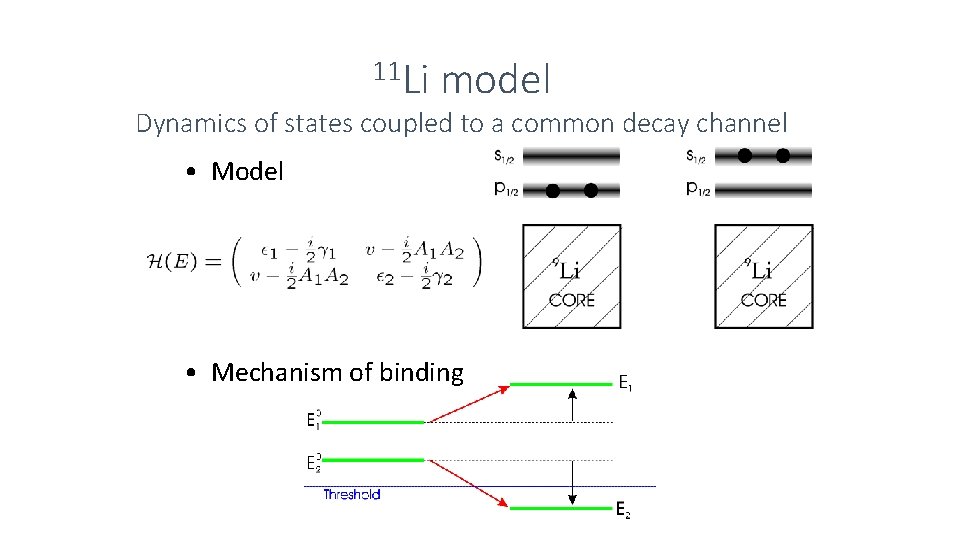
11 Li model Dynamics of states coupled to a common decay channel • Model • Mechanism of binding
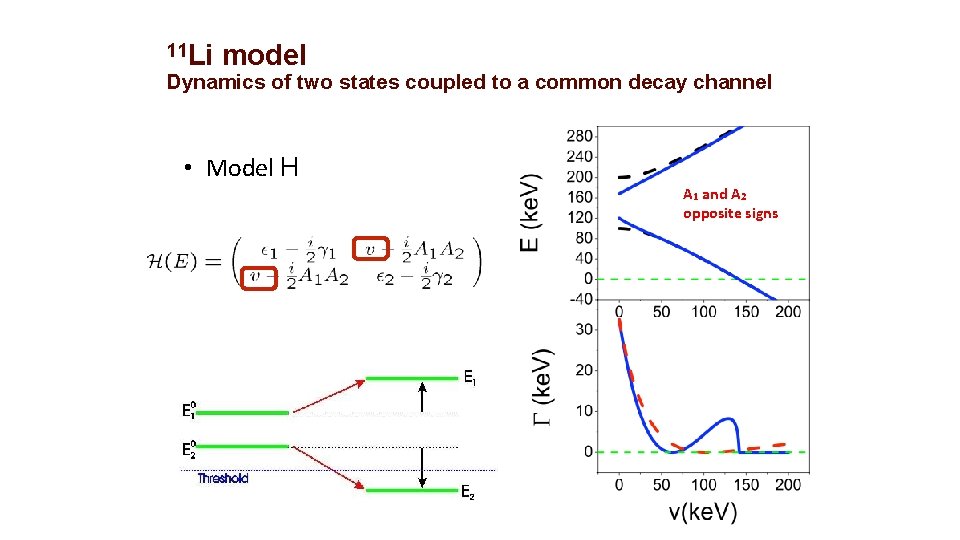
11 Li model Dynamics of two states coupled to a common decay channel • Model H A 1 and A 2 opposite signs
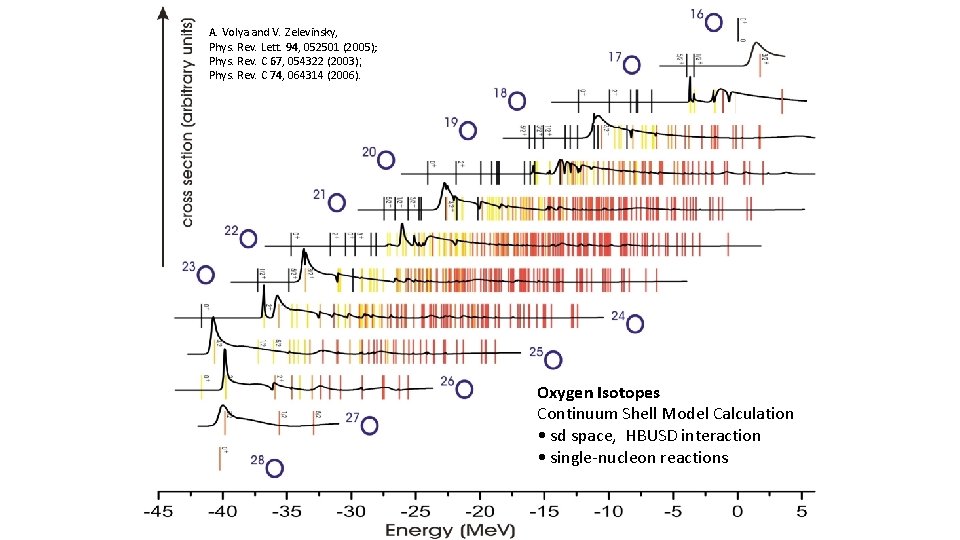
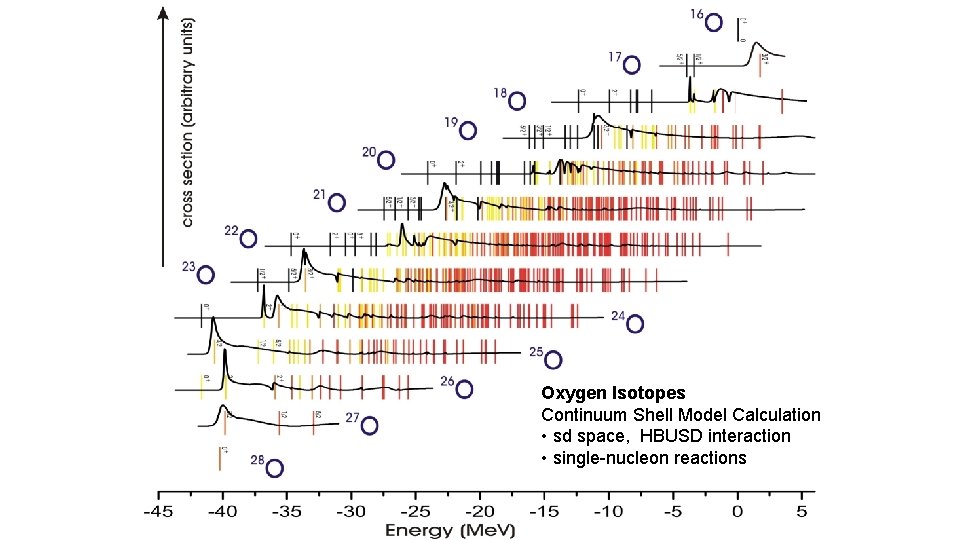
A. Volya and V. Zelevinsky, Phys. Rev. Lett. 94, 052501 (2005); Phys. Rev. C 67, 054322 (2003); Phys. Rev. C 74, 064314 (2006). Oxygen Isotopes Continuum Shell Model Calculation • sd space, HBUSD interaction • single-nucleon reactions
Predictive power of theory Continuum Shell Model prediction 2003 -2006 Measured 2009 -2013 [1] C. R. Hoffman et al. , Phys. Lett. B 672, 17 (2009); Phys. Rev. Lett. 102, 152501(2009); Phys. Rev. C 83, 031303(R)(2011); E. Lunderberg et al. , Phys. Rev. Lett. 108, 142503 (2012). [2] A. Volya and V. Zelevinsky, Phys. Rev. Lett. 94, 052501 (2005); Phys. Rev. C 67, 054322 (2003); 74, 064314 (2006). [3] G. Hagen et. al Phys. Rev. Lett. 108, 242501 (2012) http: //www. nscl. msu. edu/general-public/news/2012/O 26 2 8
[2] A. Volya and V. Z. Phys. Rev. C 74 (2006) 064314, [3] G. Hagen et al. Phys. Rev. Lett. 108 (2012) 242501
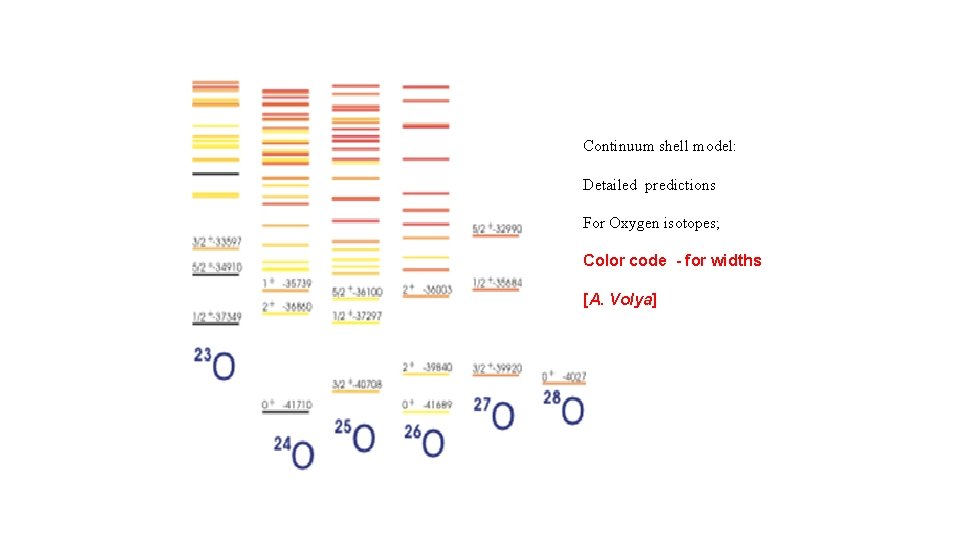
Continuum shell model: Detailed predictions For Oxygen isotopes; Color code - for widths [A. Volya]
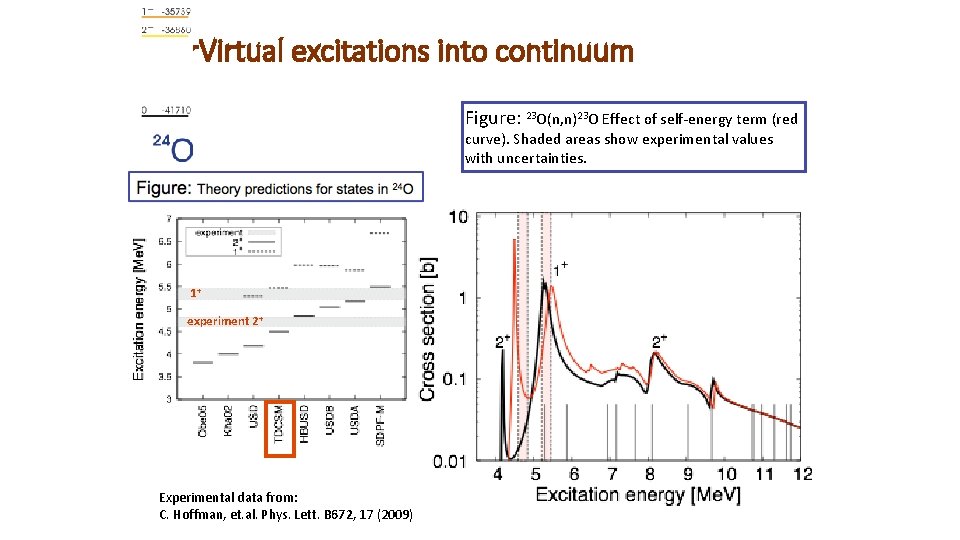
Vir. Virtual excitations into continuum Figure: 23 O(n, n)23 O Effect of self-energy term (red curve). Shaded areas show experimental values with uncertainties. 1+ experiment 2+ Experimental data from: C. Hoffman, et. al. Phys. Lett. B 672, 17 (2009)
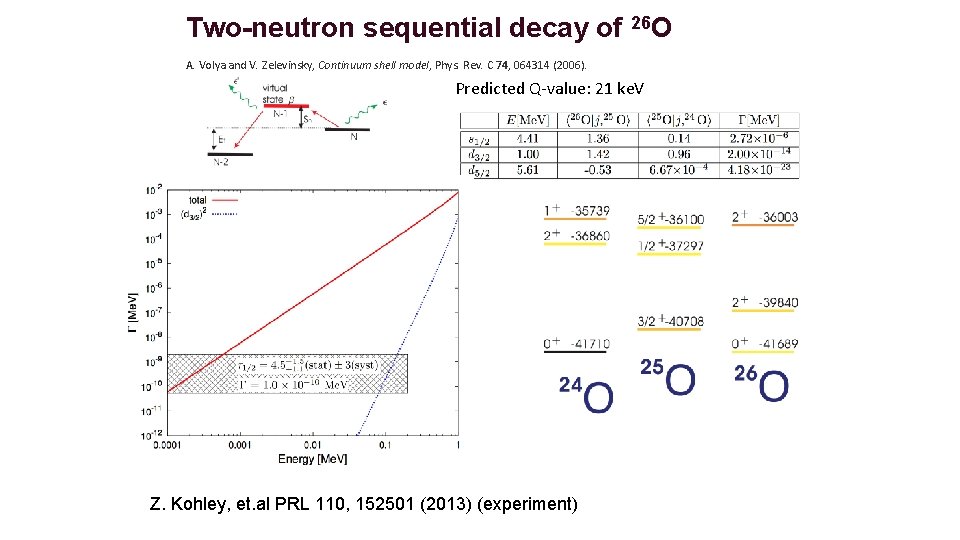
Two-neutron sequential decay of 26 O A. Volya and V. Zelevinsky, Continuum shell model, Phys. Rev. C 74, 064314 (2006). Predicted Q-value: 21 ke. V Z. Kohley, et. al PRL 110, 152501 (2013) (experiment)
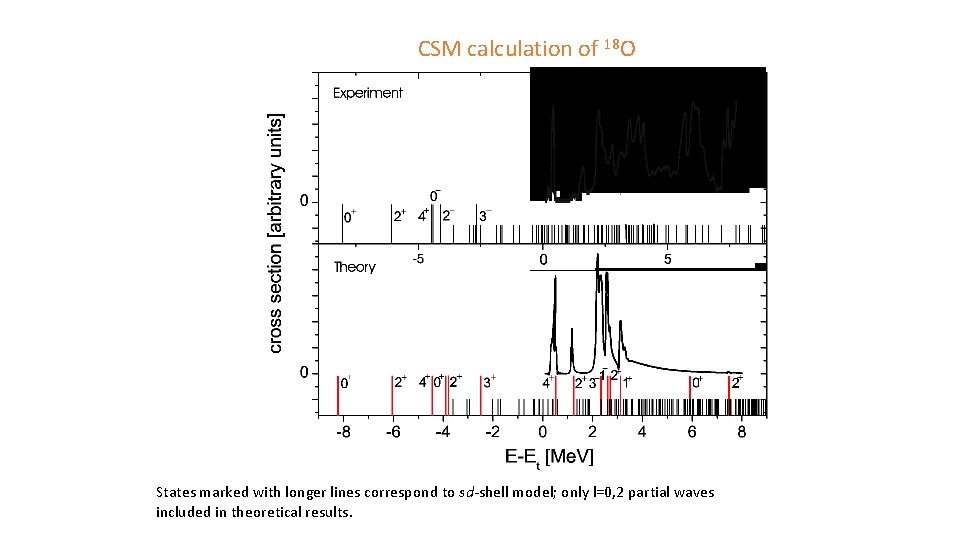
CSM calculation of 18 O States marked with longer lines correspond to sd-shell model; only l=0, 2 partial waves included in theoretical results.
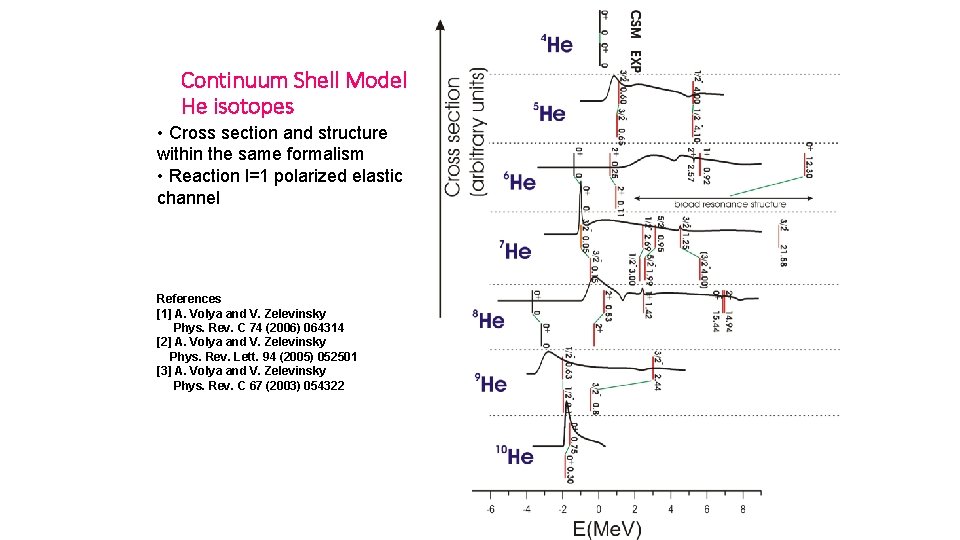
Continuum Shell Model He isotopes • Cross section and structure within the same formalism • Reaction l=1 polarized elastic channel References [1] A. Volya and V. Zelevinsky Phys. Rev. C 74 (2006) 064314 [2] A. Volya and V. Zelevinsky Phys. Rev. Lett. 94 (2005) 052501 [3] A. Volya and V. Zelevinsky Phys. Rev. C 67 (2003) 054322
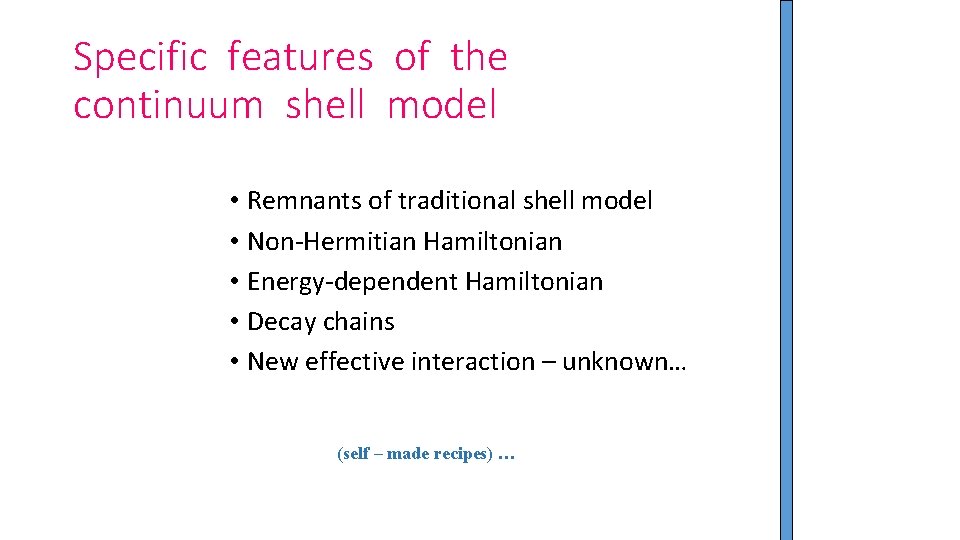
Specific features of the continuum shell model • Remnants of traditional shell model • Non-Hermitian Hamiltonian • Energy-dependent Hamiltonian • Decay chains • New effective interaction – unknown… (self – made recipes) …
Energy-dependent Hamiltonian • Form of energy-dependence • Consistency with thresholds • Appropriate near-threshold behavior • How to solve energy-dependent H • Consistency in solution • Determination of energies • Determination of open channels
Interpretation of complex energies • For isolated narrow resonances all definitions agree • Real Situation • Many-body complexity • High density of states • Large decay widths • Result: • Overlapping, interference, width redistribution • Resonance and width are definition dependent • Non-exponential decay • Solution: Cross section is a true observable (S-matrix )
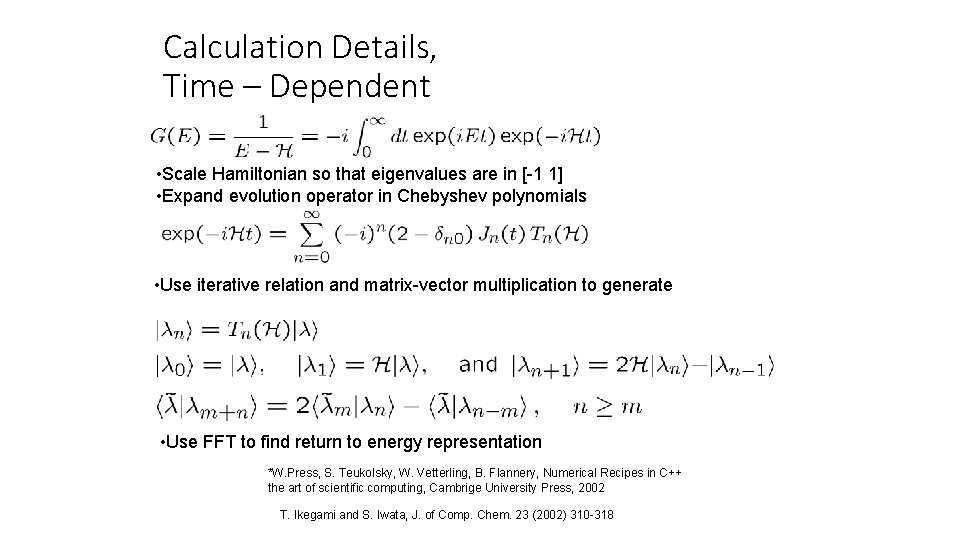
Calculation Details, Time – Dependent • Scale Hamiltonian so that eigenvalues are in [-1 1] • Expand evolution operator in Chebyshev polynomials • Use iterative relation and matrix-vector multiplication to generate • Use FFT to find return to energy representation *W. Press, S. Teukolsky, W. Vetterling, B. Flannery, Numerical Recipes in C++ the art of scientific computing, Cambrige University Press, 2002 T. Ikegami and S. Iwata, J. of Comp. Chem. 23 (2002) 310 -318
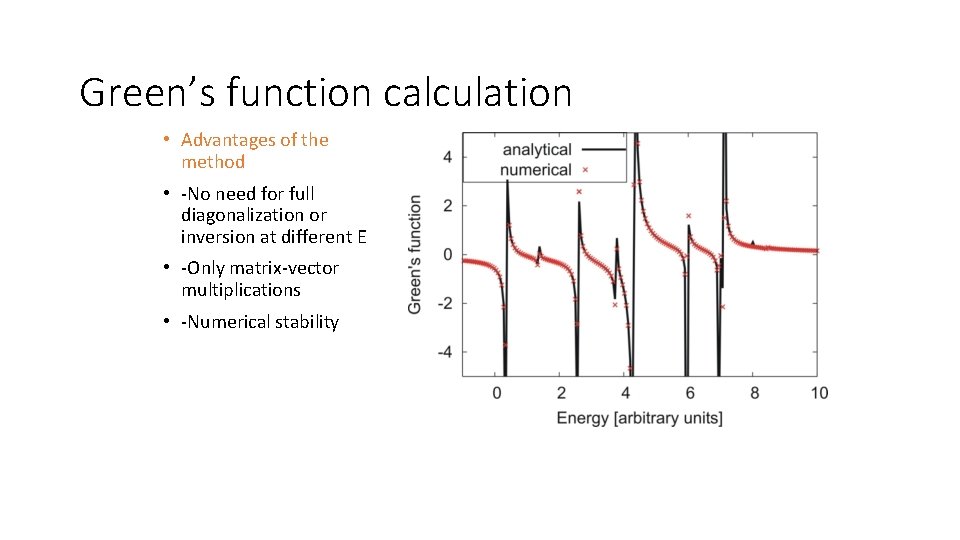
Green’s function calculation • Advantages of the method • -No need for full diagonalization or inversion at different E • -Only matrix-vector multiplications • -Numerical stability
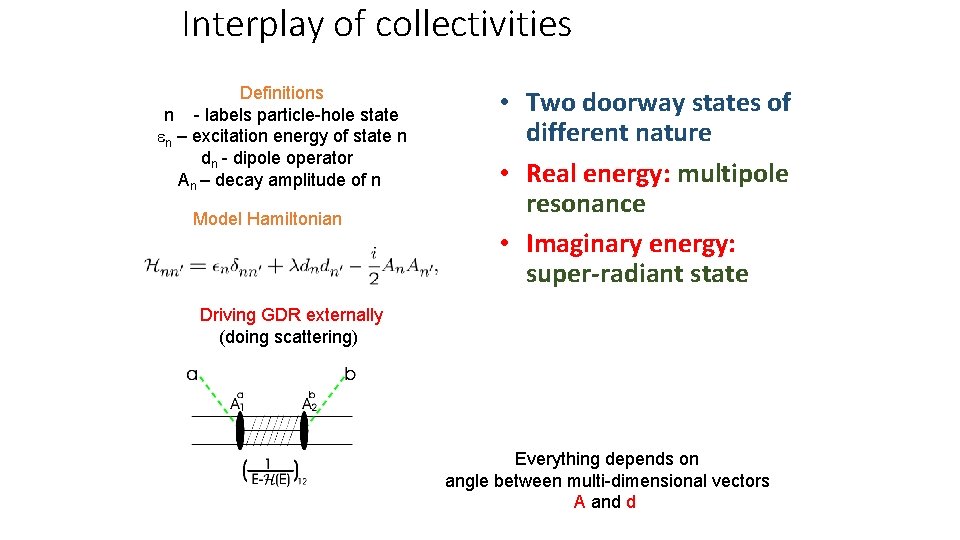
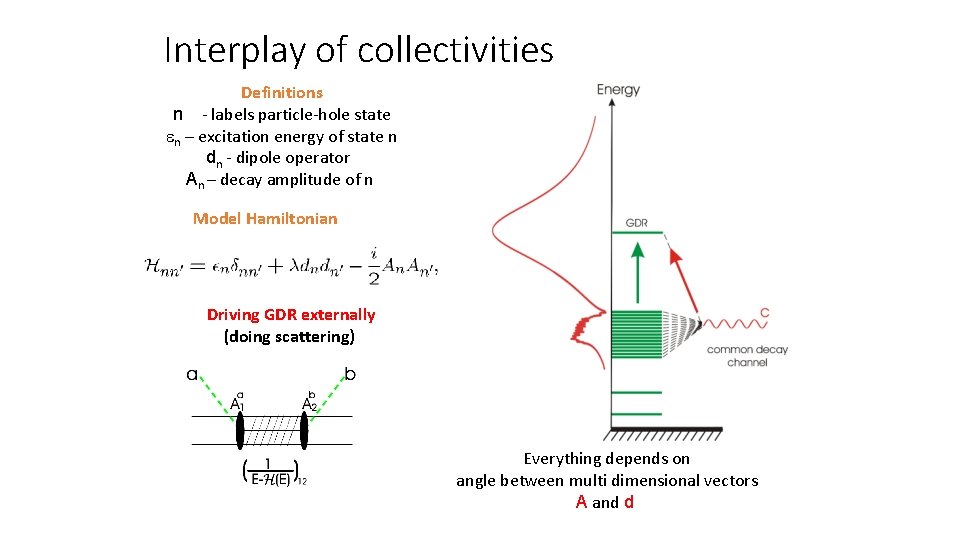
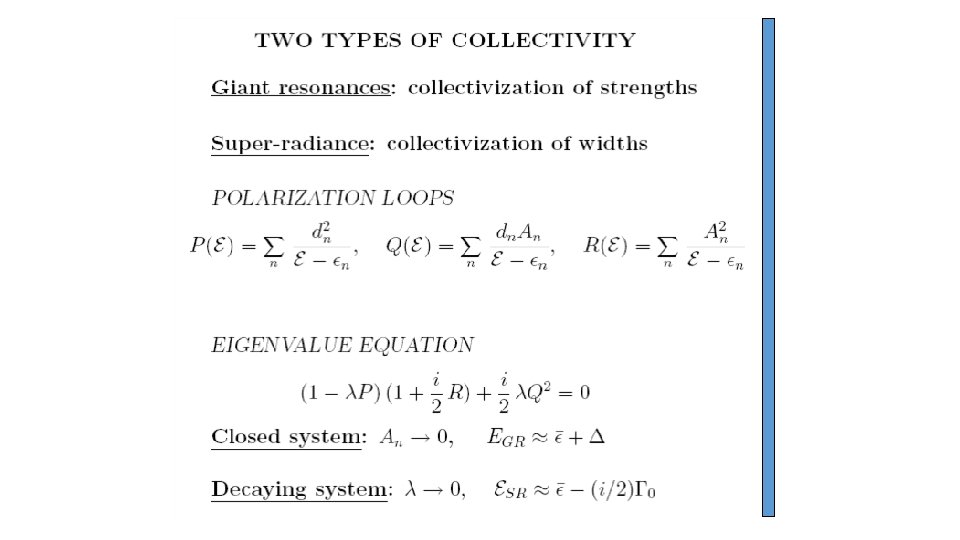
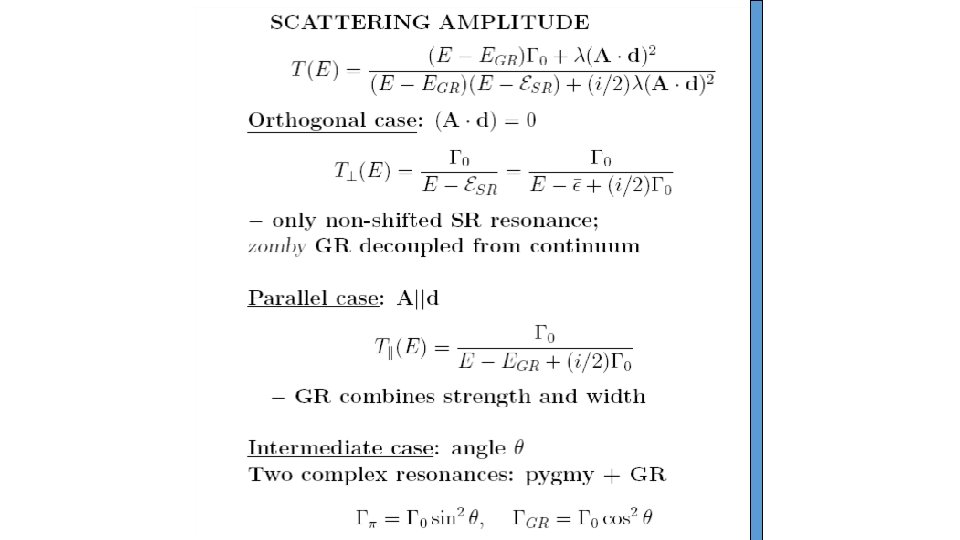
Interplay of collectivities Definitions n - labels particle-hole state n – excitation energy of state n dn - dipole operator An – decay amplitude of n Model Hamiltonian • Two doorway states of different nature • Real energy: multipole resonance • Imaginary energy: super-radiant state Driving GDR externally (doing scattering) Everything depends on angle between multi-dimensional vectors A and d
Interplay of collectivities Definitions n - labels particle-hole state n – excitation energy of state n dn - dipole operator An – decay amplitude of n Model Hamiltonian Driving GDR externally (doing scattering) Everything depends on angle between multi dimensional vectors A and d
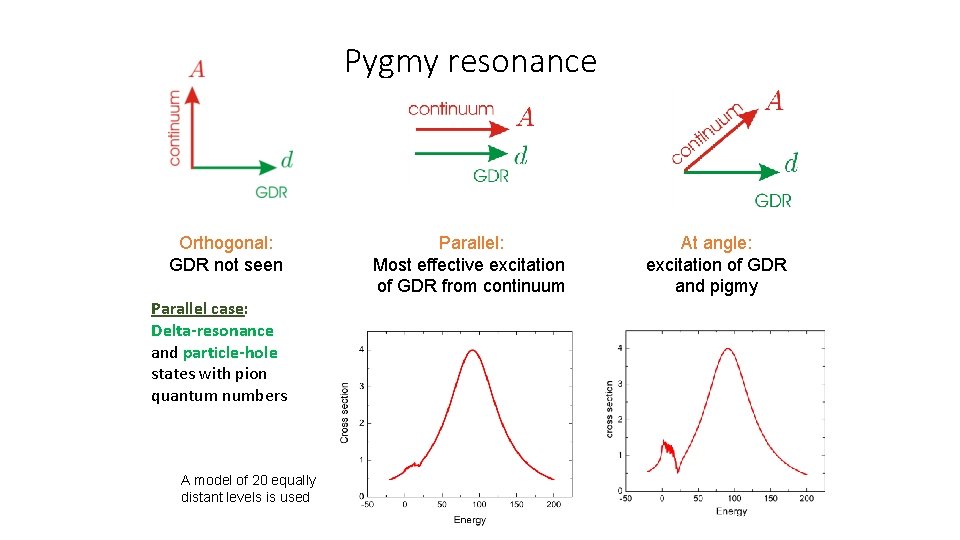
Pygmy resonance Orthogonal: GDR not seen Parallel case: Delta-resonance and particle-hole states with pion quantum numbers A model of 20 equally distant levels is used Parallel: Most effective excitation of GDR from continuum At angle: excitation of GDR and pigmy
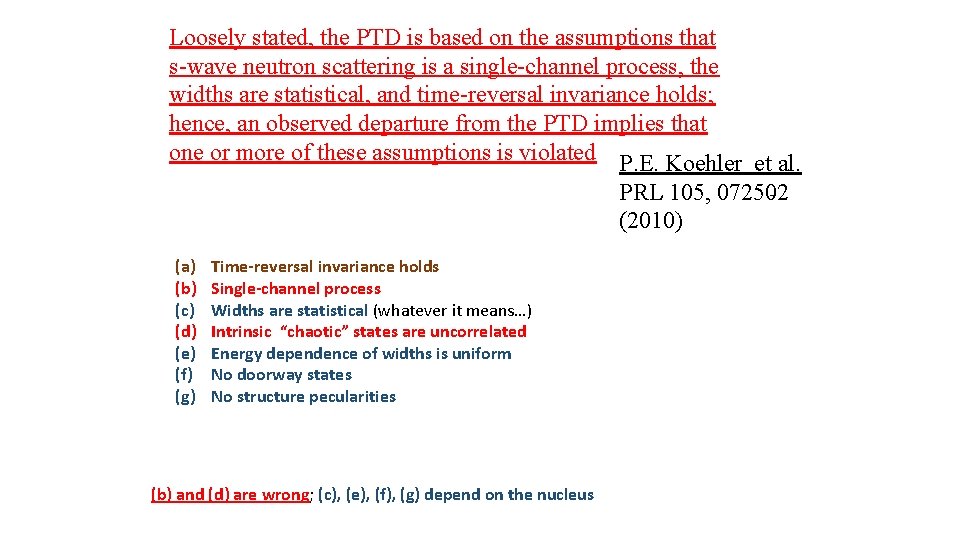
Loosely stated, the PTD is based on the assumptions that s-wave neutron scattering is a single-channel process, the widths are statistical, and time-reversal invariance holds; hence, an observed departure from the PTD implies that one or more of these assumptions is violated P. E. Koehler et al. PRL 105, 072502 (2010) (a) (b) (c) (d) (e) (f) (g) Time-reversal invariance holds Single-channel process Widths are statistical (whatever it means…) Intrinsic “chaotic” states are uncorrelated Energy dependence of widths is uniform No doorway states No structure pecularities (b) and (d) are wrong; (c), (e), (f), (g) depend on the nucleus
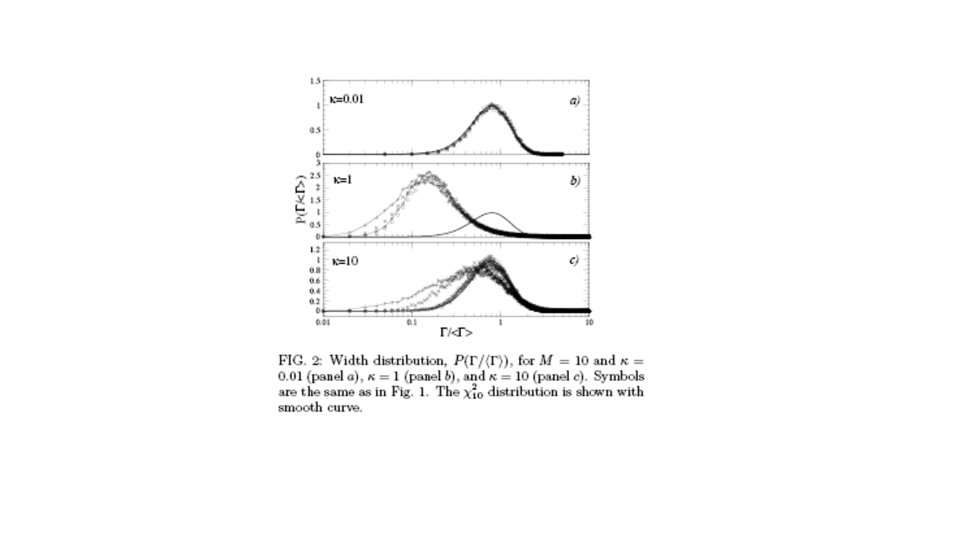
Resonance width distribution (chaotic closed system, single open channel) G. Shchedrin, V. Z. , PRC (2012)
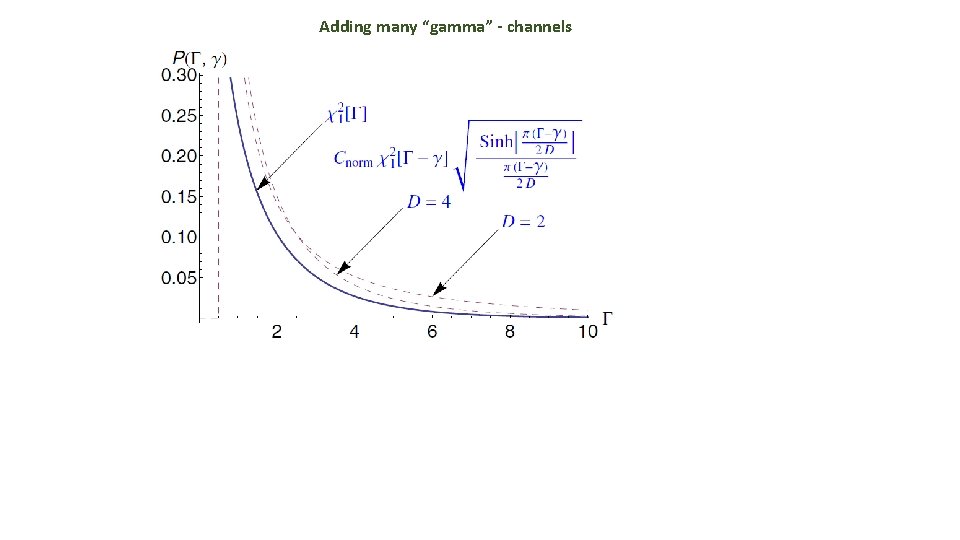
Adding many “gamma” - channels
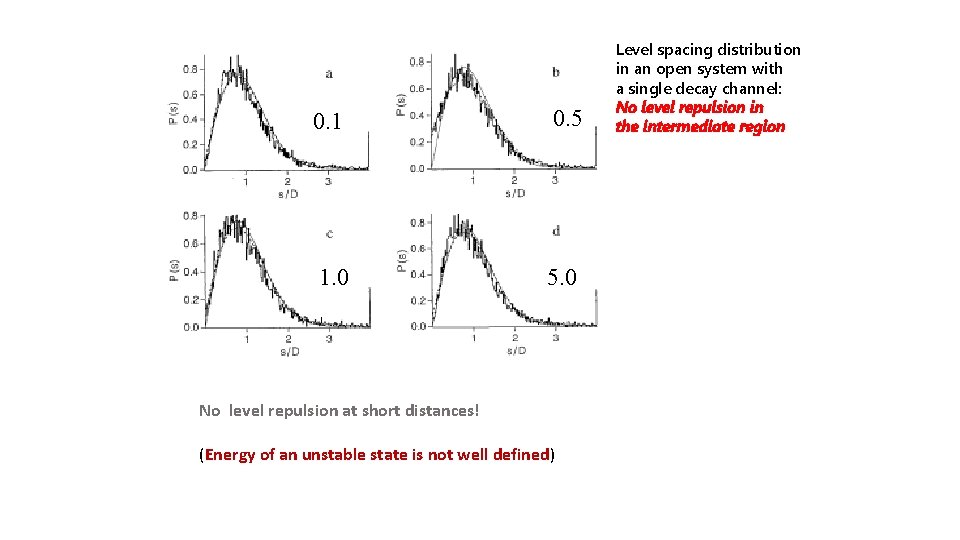
0. 1 0. 5 1. 0 5. 0 No level repulsion at short distances! (Energy of an unstable state is not well defined) Level spacing distribution in an open system with a single decay channel: No level repulsion in the intermediate region
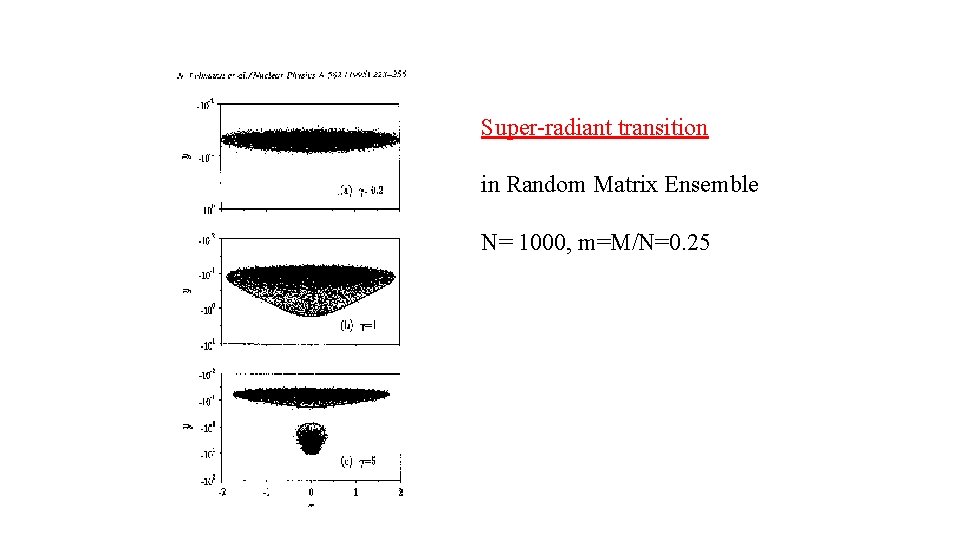
Super-radiant transition in Random Matrix Ensemble N= 1000, m=M/N=0. 25
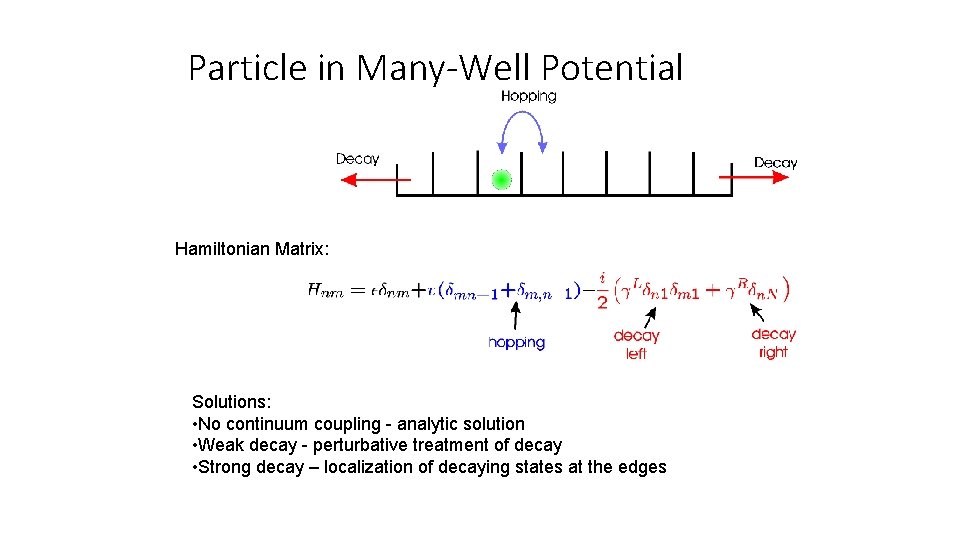
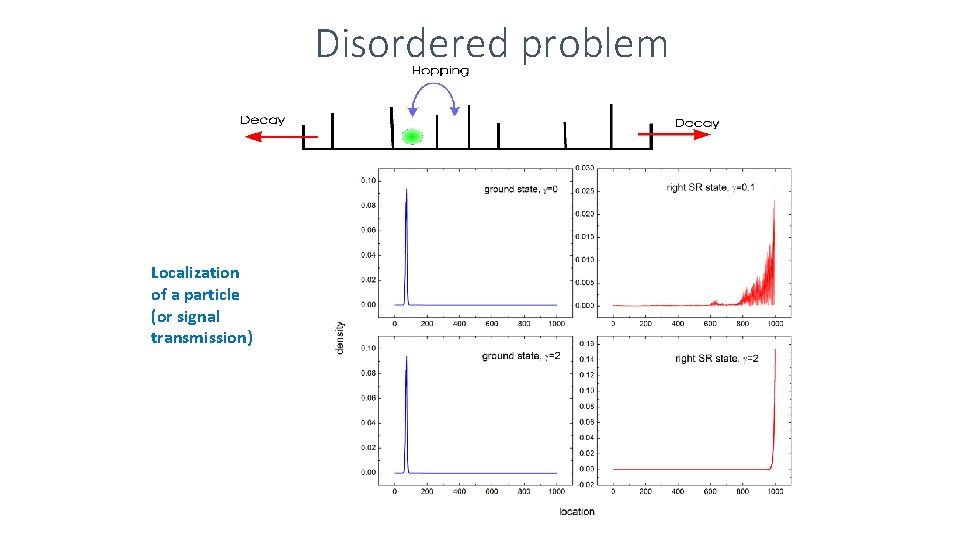
Particle in Many-Well Potential Hamiltonian Matrix: Solutions: • No continuum coupling - analytic solution • Weak decay - perturbative treatment of decay • Strong decay – localization of decaying states at the edges
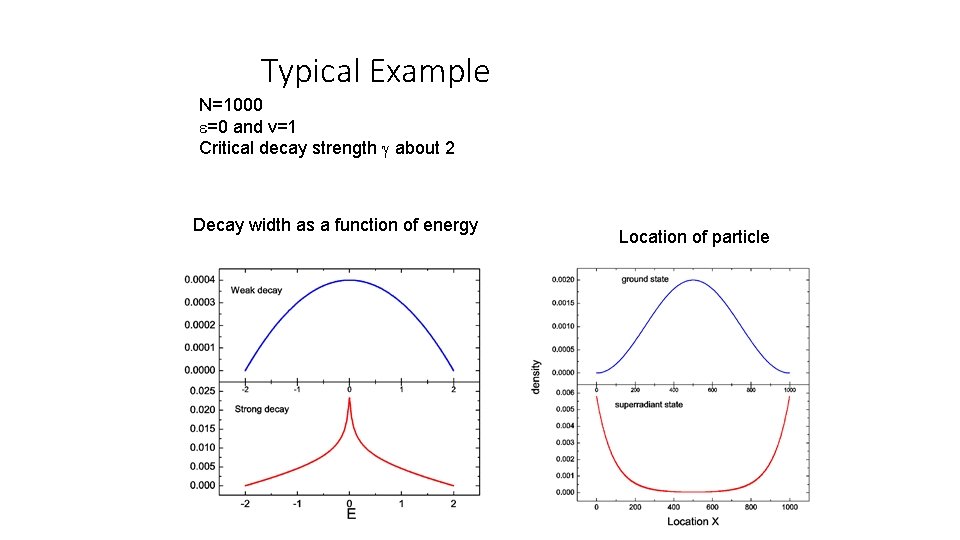
Typical Example N=1000 =0 and v=1 Critical decay strength about 2 Decay width as a function of energy Location of particle
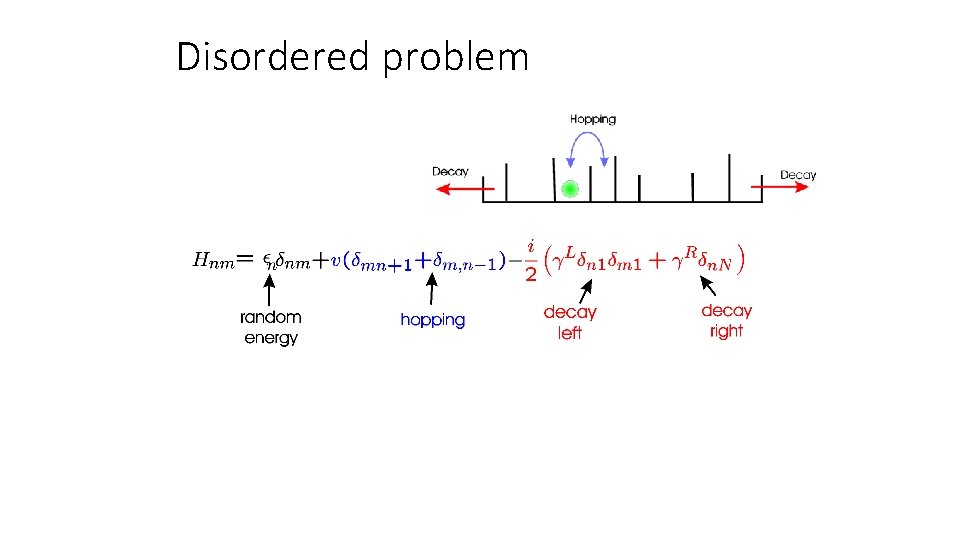
Disordered problem
Disordered problem Localization of a particle (or signal transmission)
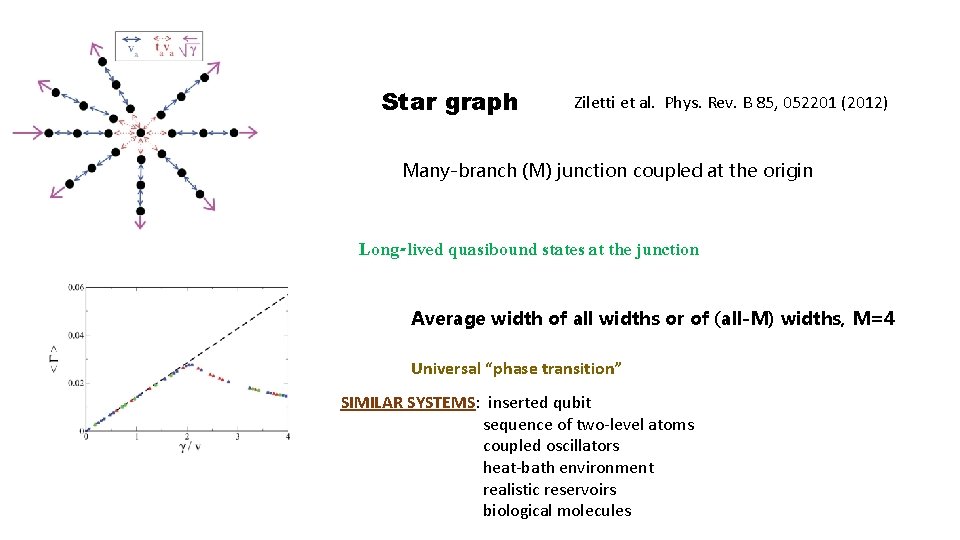
Star graph Ziletti et al. Phys. Rev. B 85, 052201 (2012) Many-branch (M) junction coupled at the origin Long-lived quasibound states at the junction Average width of all widths or of (all-M) widths, M=4 Universal “phase transition” SIMILAR SYSTEMS: inserted qubit sequence of two-level atoms coupled oscillators heat-bath environment realistic reservoirs biological molecules
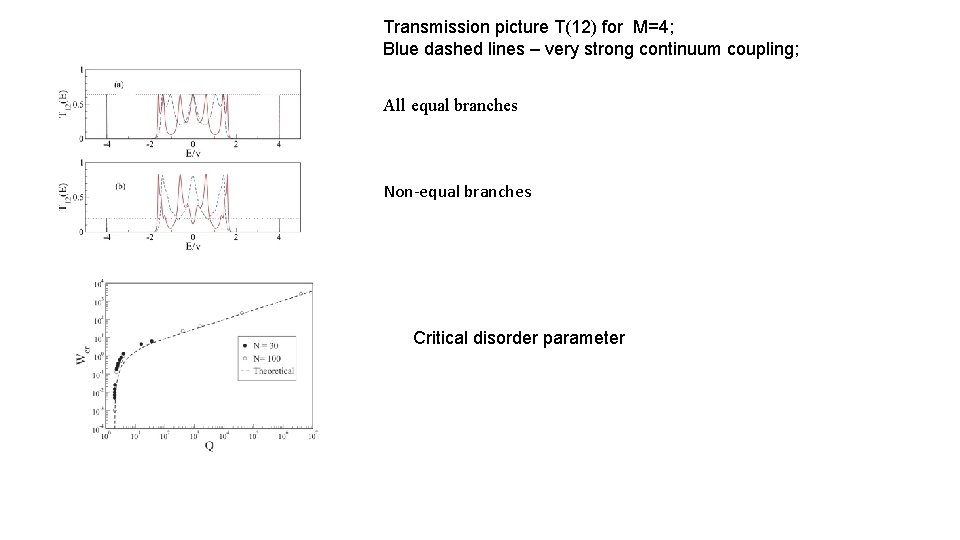
Transmission picture T(12) for M=4; Blue dashed lines – very strong continuum coupling; All equal branches Non-equal branches Critical disorder parameter
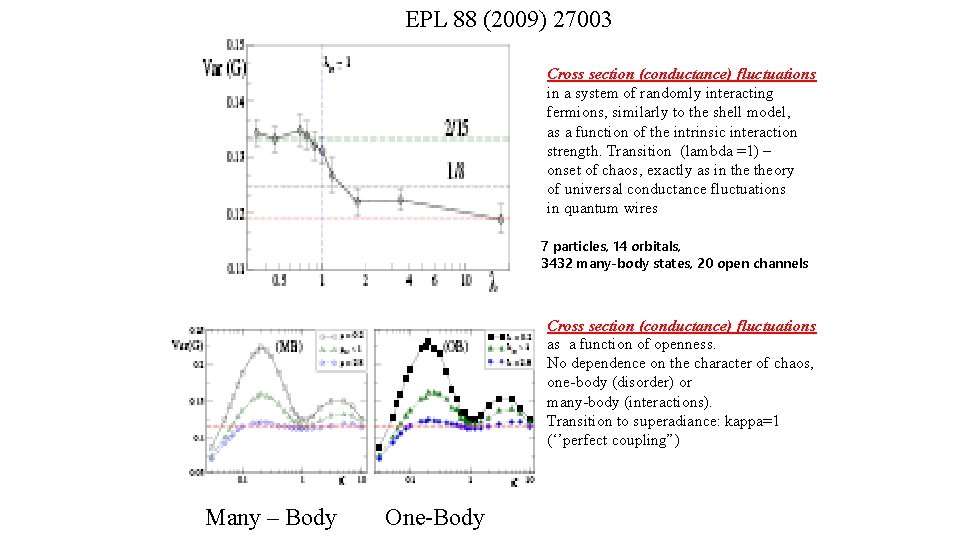
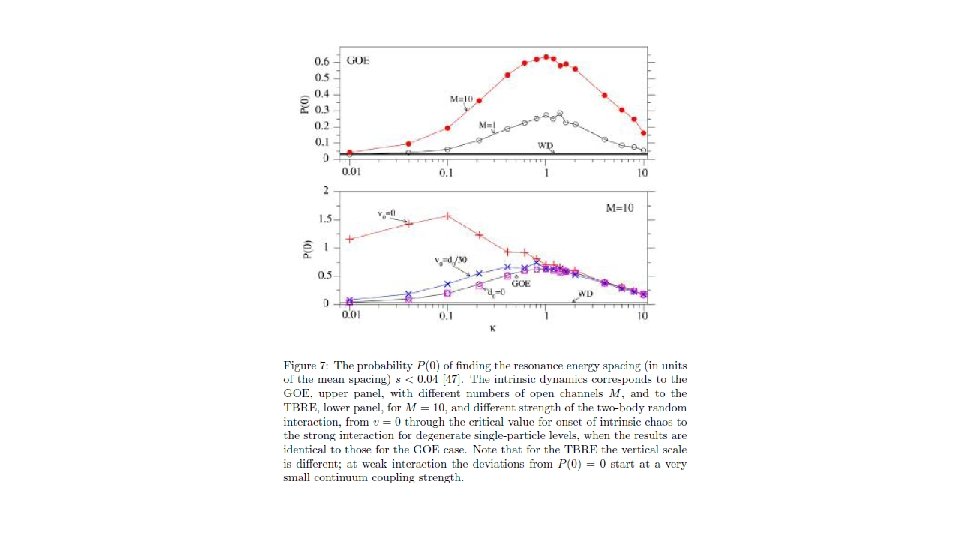
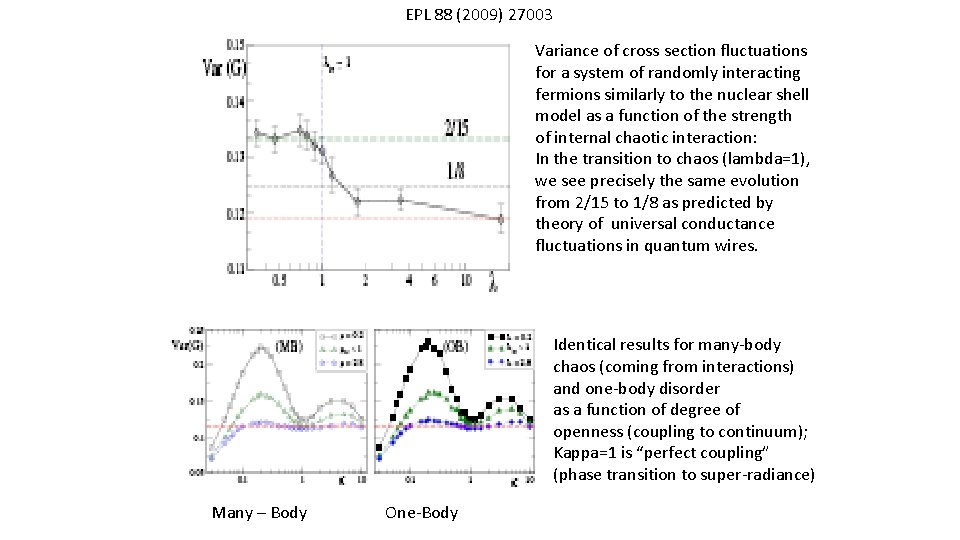
EPL 88 (2009) 27003 Cross section (conductance) fluctuations in a system of randomly interacting fermions, similarly to the shell model, as a function of the intrinsic interaction strength. Transition (lambda =1) – onset of chaos, exactly as in theory of universal conductance fluctuations in quantum wires 7 particles, 14 orbitals, 3432 many-body states, 20 open channels Cross section (conductance) fluctuations as a function of openness. No dependence on the character of chaos, one-body (disorder) or many-body (interactions). Transition to superadiance: kappa=1 (‘’perfect coupling”) Many – Body One-Body
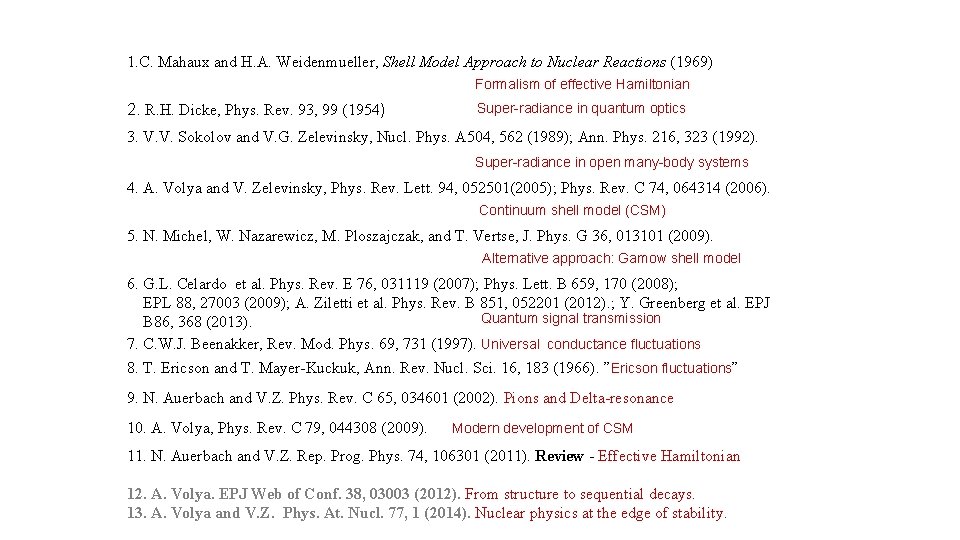
1. C. Mahaux and H. A. Weidenmueller, Shell Model Approach to Nuclear Reactions (1969) Formalism of effective Hamiltonian 2. R. H. Dicke, Phys. Rev. 93, 99 (1954) Super-radiance in quantum optics 3. V. V. Sokolov and V. G. Zelevinsky, Nucl. Phys. A 504, 562 (1989); Ann. Phys. 216, 323 (1992). Super-radiance in open many-body systems 4. A. Volya and V. Zelevinsky, Phys. Rev. Lett. 94, 052501(2005); Phys. Rev. C 74, 064314 (2006). Continuum shell model (CSM) 5. N. Michel, W. Nazarewicz, M. Ploszajczak, and T. Vertse, J. Phys. G 36, 013101 (2009). Alternative approach: Gamow shell model 6. G. L. Celardo et al. Phys. Rev. E 76, 031119 (2007); Phys. Lett. B 659, 170 (2008); EPL 88, 27003 (2009); A. Ziletti et al. Phys. Rev. B 851, 052201 (2012). ; Y. Greenberg et al. EPJ Quantum signal transmission B 86, 368 (2013). 7. C. W. J. Beenakker, Rev. Mod. Phys. 69, 731 (1997). Universal conductance fluctuations 8. T. Ericson and T. Mayer-Kuckuk, Ann. Rev. Nucl. Sci. 16, 183 (1966). ”Ericson fluctuations” 9. N. Auerbach and V. Z. Phys. Rev. C 65, 034601 (2002). Pions and Delta-resonance 10. A. Volya, Phys. Rev. C 79, 044308 (2009). Modern development of CSM 11. N. Auerbach and V. Z. Rep. Prog. Phys. 74, 106301 (2011). Review - Effective Hamiltonian 12. A. Volya. EPJ Web of Conf. 38, 03003 (2012). From structure to sequential decays. 13. A. Volya and V. Z. Phys. At. Nucl. 77, 1 (2014). Nuclear physics at the edge of stability.
CHALLENGES: • No harmonic oscillator • Correlated decays • Cluster decays • Transfer reactions • Microscopic derivation of the Hamiltonian • Collectivity in continuum • New applications • >>>>>>
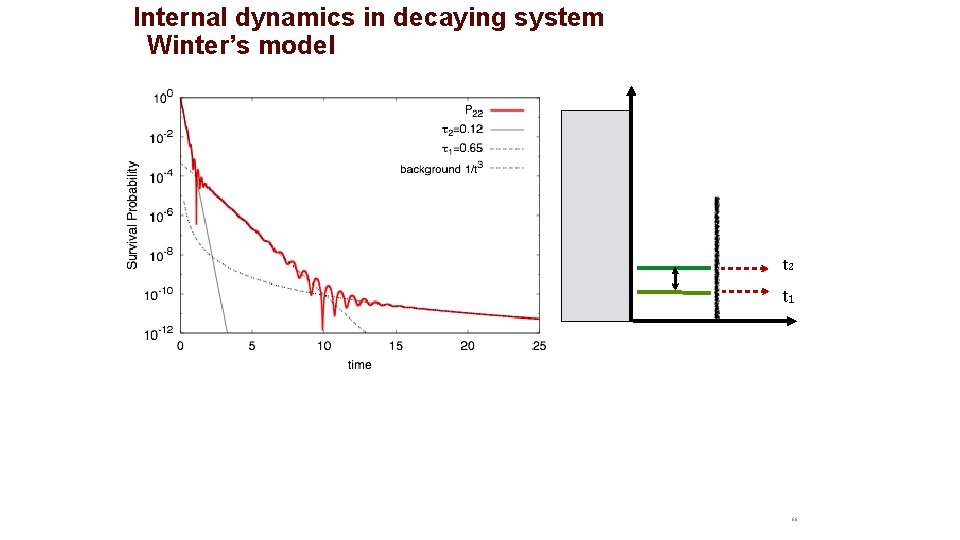
Quantum Decay: exponential versus non-exponential * [Kubo] - exponential decay corresponds to the condition for a physical process to be approximated as a Markovian process * [Silverman] - indeed a random process, no “cosmic force” * [Merzbacher] - result of “delicate” approximations Three stages: short-time main (exponential) Oscillations? long-time
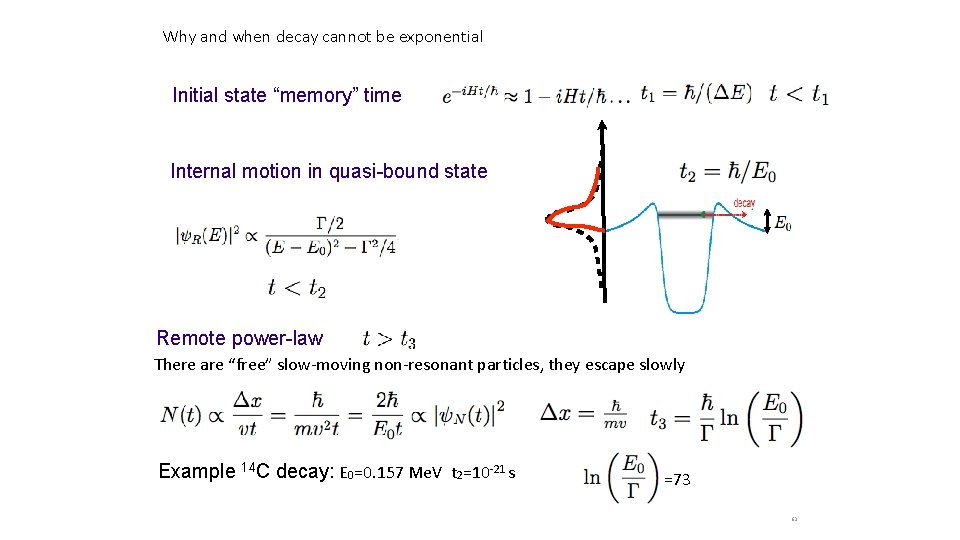
Why and when decay cannot be exponential Initial state “memory” time Internal motion in quasi-bound state Remote power-law There are “free” slow-moving non-resonant particles, they escape slowly Example 14 C decay: E 0=0. 157 Me. V t 2=10 -21 s =73 63
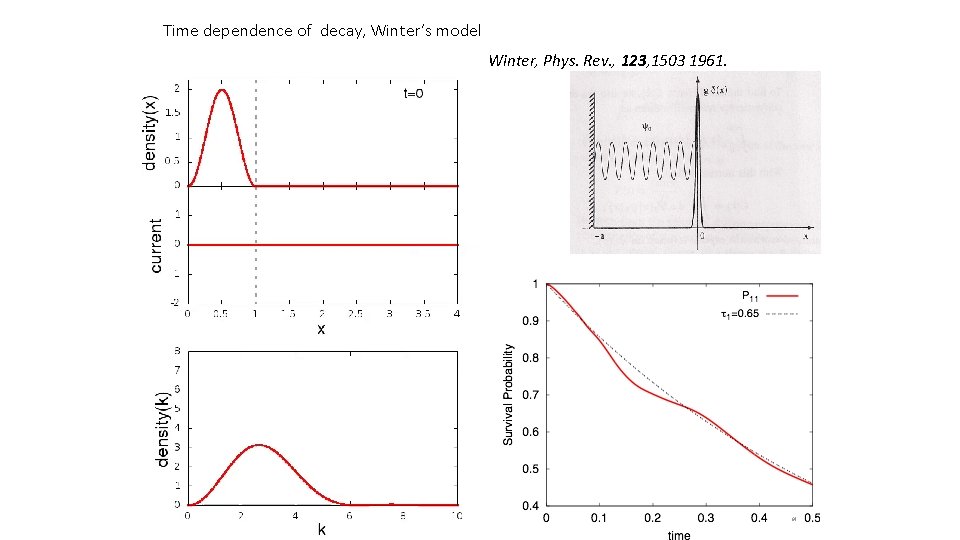
Time dependence of decay, Winter’s model Winter, Phys. Rev. , 123, 1503 1961. 64
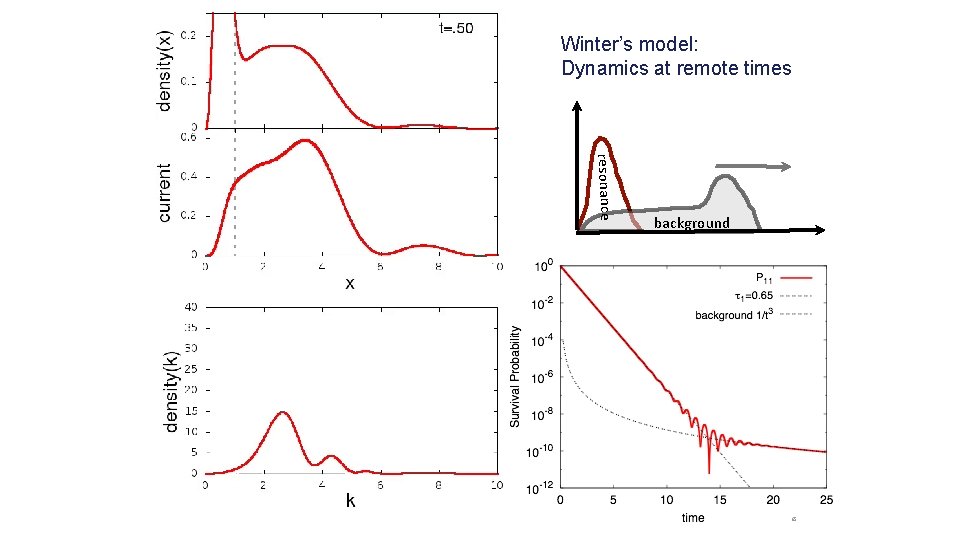
Winter’s model: Dynamics at remote times resonance background 65
Internal dynamics in decaying system Winter’s model t 2 t 1 66
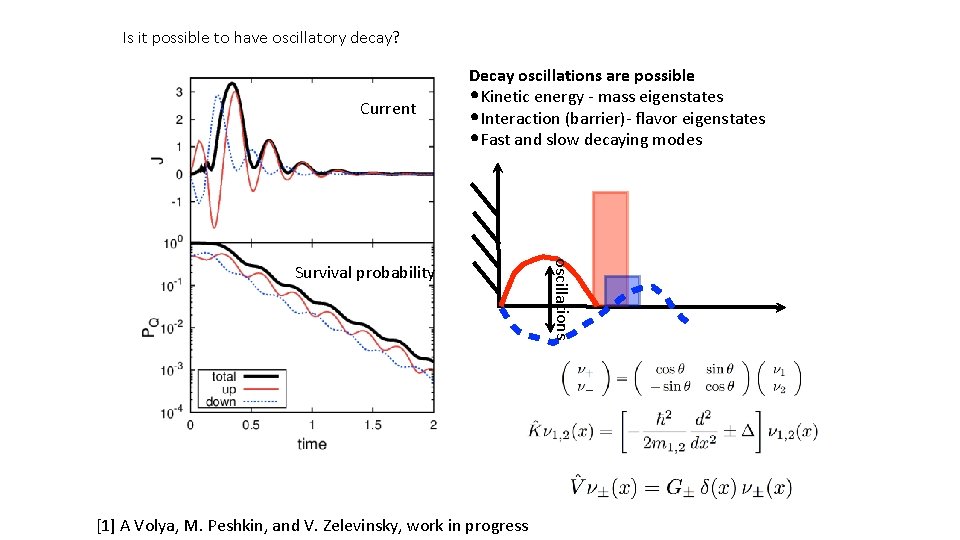
Is it possible to have oscillatory decay? Current Decay oscillations are possible • Kinetic energy - mass eigenstates • Interaction (barrier)- flavor eigenstates • Fast and slow decaying modes [1] A Volya, M. Peshkin, and V. Zelevinsky, work in progress oscillations Survival probability
Oxygen Isotopes Continuum Shell Model Calculation • sd space, HBUSD interaction • single-nucleon reactions
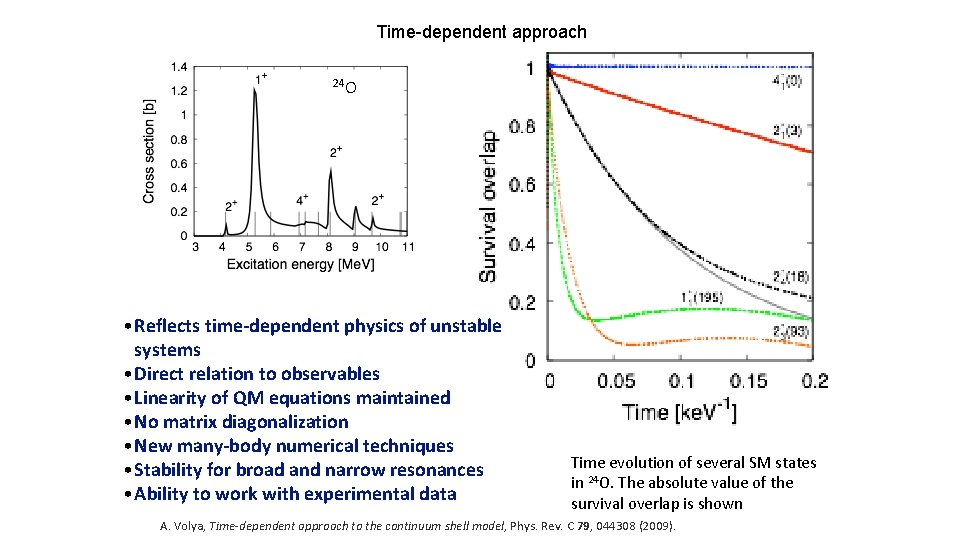
Time-dependent approach 24 O • Reflects time-dependent physics of unstable systems • Direct relation to observables • Linearity of QM equations maintained • No matrix diagonalization • New many-body numerical techniques • Stability for broad and narrow resonances • Ability to work with experimental data Time evolution of several SM states in 24 O. The absolute value of the survival overlap is shown A. Volya, Time-dependent approach to the continuum shell model, Phys. Rev. C 79, 044308 (2009).
EPL 88 (2009) 27003 Variance of cross section fluctuations for a system of randomly interacting fermions similarly to the nuclear shell model as a function of the strength of internal chaotic interaction: In the transition to chaos (lambda=1), we see precisely the same evolution from 2/15 to 1/8 as predicted by theory of universal conductance fluctuations in quantum wires. Identical results for many-body chaos (coming from interactions) and one-body disorder as a function of degree of openness (coupling to continuum); Kappa=1 is “perfect coupling” (phase transition to super-radiance) Many – Body One-Body
Nucleus as an Open System: Continuum Shell Model and New Challenges Vladimir Zelevinsky NSCL/ Michigan State University Supported by NSF Bruyères-le-Châtel, May 2014