
Nucleosome Position Can Be Mapped Nucleosome position can
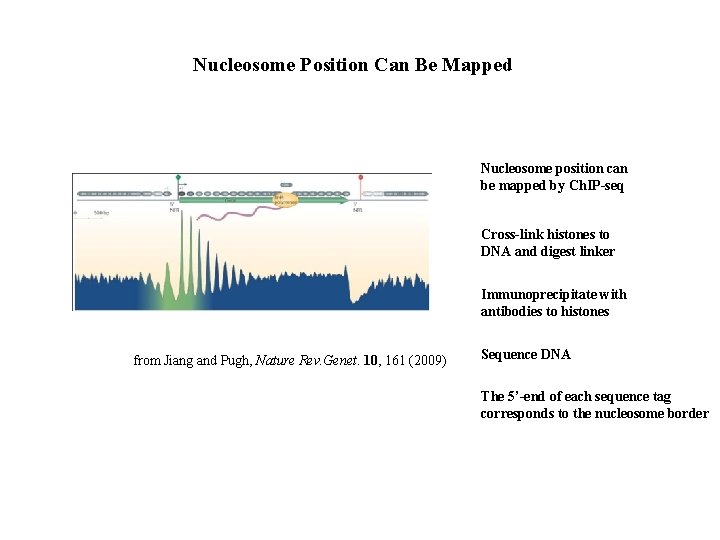
Nucleosome Position Can Be Mapped Nucleosome position can be mapped by Ch. IP-seq Cross-link histones to DNA and digest linker Immunoprecipitate with antibodies to histones from Jiang and Pugh, Nature Rev. Genet. 10, 161 (2009) Sequence DNA The 5’-end of each sequence tag corresponds to the nucleosome border
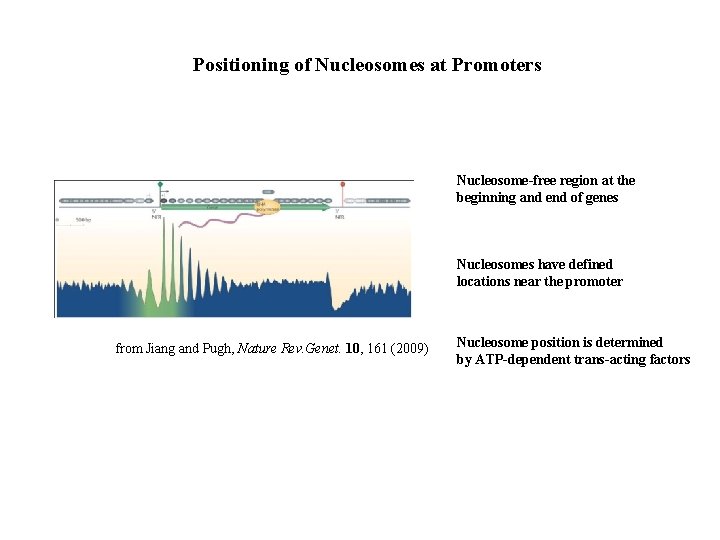
Positioning of Nucleosomes at Promoters Nucleosome-free region at the beginning and end of genes Nucleosomes have defined locations near the promoter from Jiang and Pugh, Nature Rev. Genet. 10, 161 (2009) Nucleosome position is determined by ATP-dependent trans-acting factors
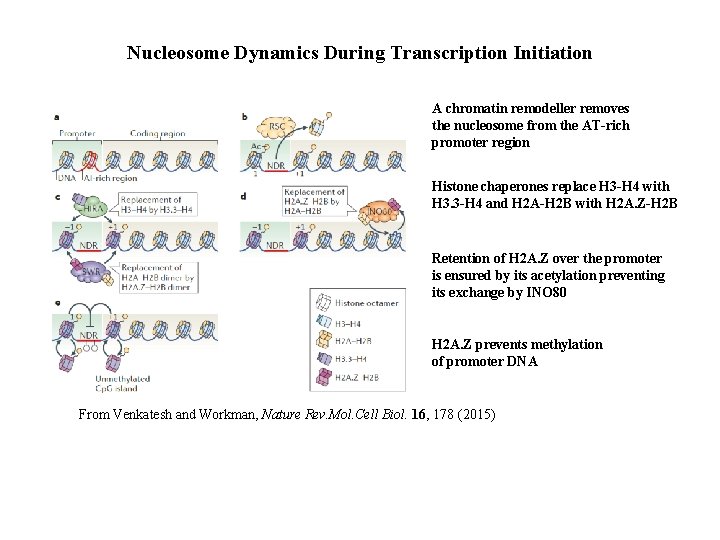
Nucleosome Dynamics During Transcription Initiation A chromatin remodeller removes the nucleosome from the AT-rich promoter region Histone chaperones replace H 3 -H 4 with H 3. 3 -H 4 and H 2 A-H 2 B with H 2 A. Z-H 2 B Retention of H 2 A. Z over the promoter is ensured by its acetylation preventing its exchange by INO 80 H 2 A. Z prevents methylation of promoter DNA From Venkatesh and Workman, Nature Rev. Mol. Cell Biol. 16, 178 (2015)
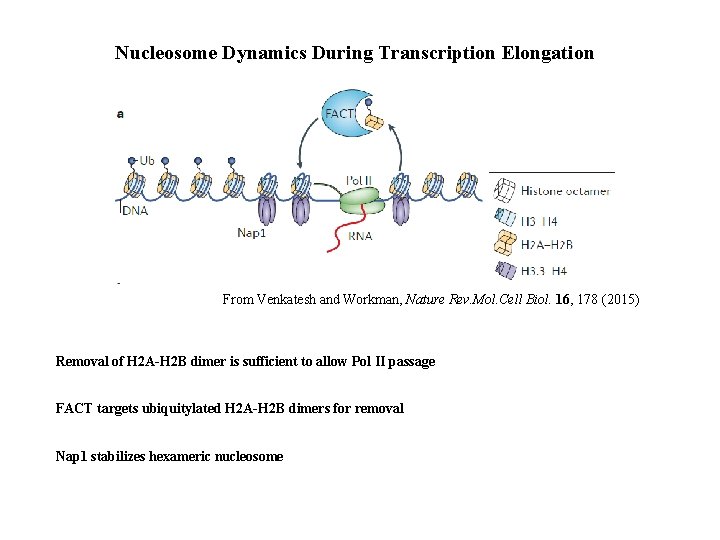
Nucleosome Dynamics During Transcription Elongation From Venkatesh and Workman, Nature Rev. Mol. Cell Biol. 16, 178 (2015) Removal of H 2 A-H 2 B dimer is sufficient to allow Pol II passage FACT targets ubiquitylated H 2 A-H 2 B dimers for removal Nap 1 stabilizes hexameric nucleosome
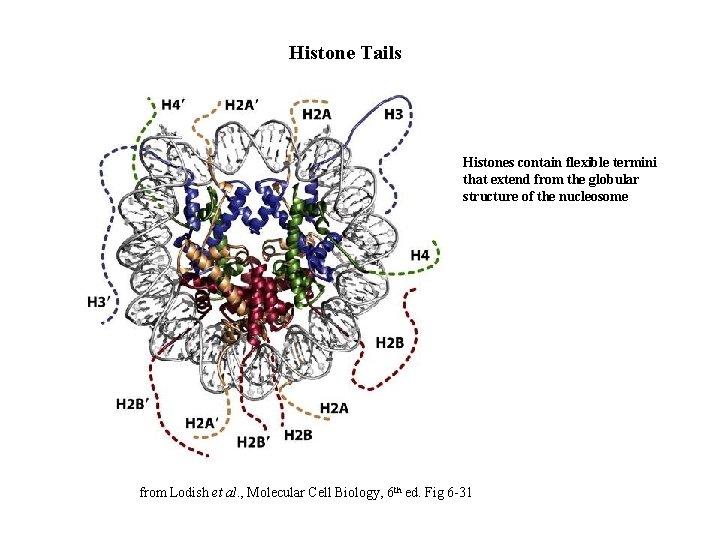
Histone Tails Histones contain flexible termini that extend from the globular structure of the nucleosome from Lodish et al. , Molecular Cell Biology, 6 th ed. Fig 6 -31
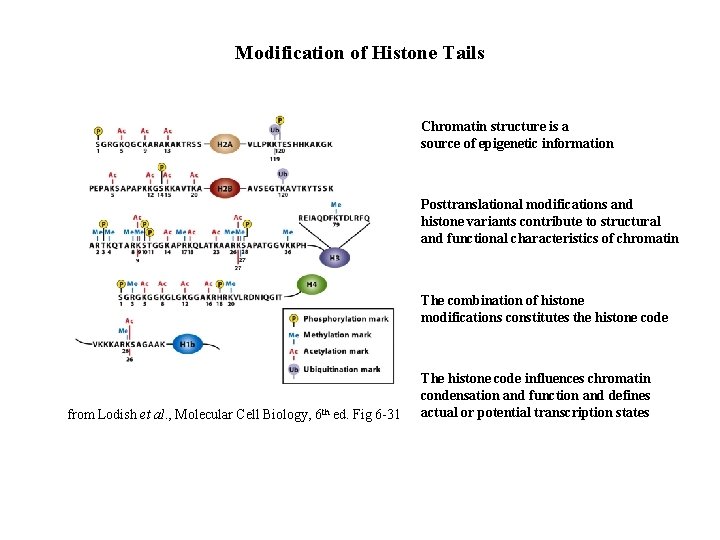
Modification of Histone Tails Chromatin structure is a source of epigenetic information Posttranslational modifications and histone variants contribute to structural and functional characteristics of chromatin The combination of histone modifications constitutes the histone code from Lodish et al. , Molecular Cell Biology, 6 th ed. Fig 6 -31 The histone code influences chromatin condensation and function and defines actual or potential transcription states
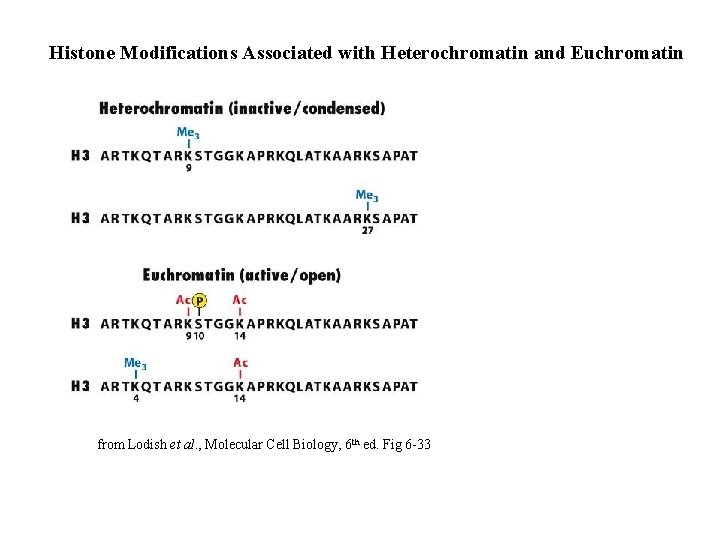
Histone Modifications Associated with Heterochromatin and Euchromatin from Lodish et al. , Molecular Cell Biology, 6 th ed. Fig 6 -33
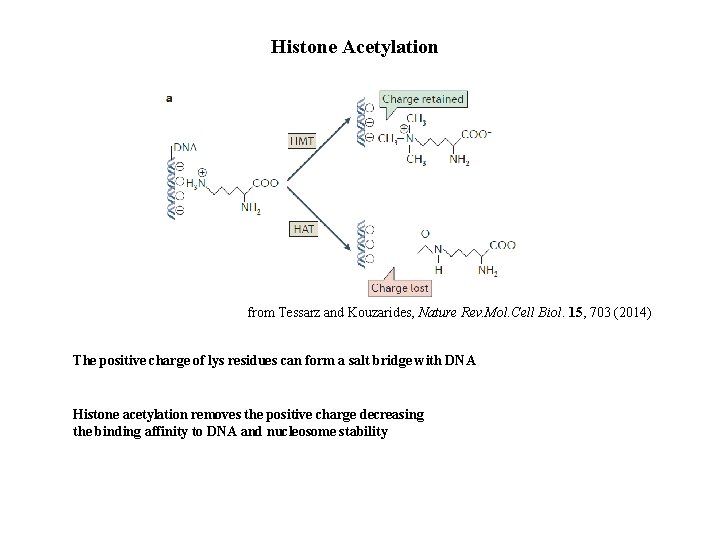
Histone Acetylation from Tessarz and Kouzarides, Nature Rev. Mol. Cell Biol. 15, 703 (2014) The positive charge of lys residues can form a salt bridge with DNA Histone acetylation removes the positive charge decreasing the binding affinity to DNA and nucleosome stability
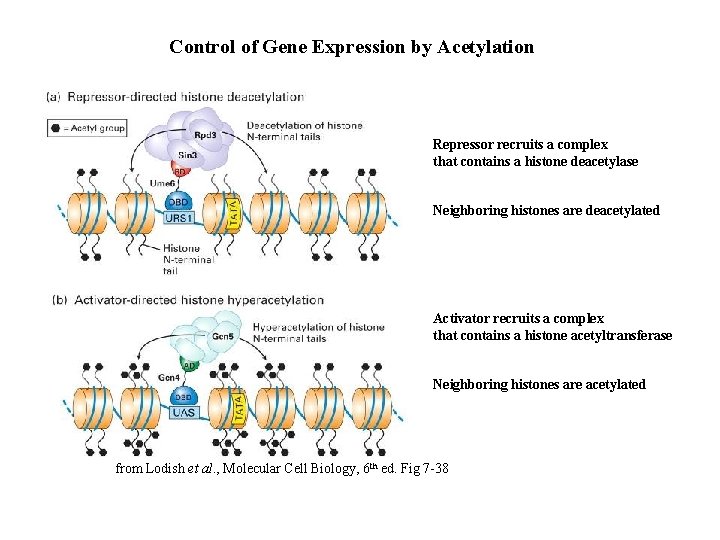
Control of Gene Expression by Acetylation Repressor recruits a complex that contains a histone deacetylase Neighboring histones are deacetylated Activator recruits a complex that contains a histone acetyltransferase Neighboring histones are acetylated from Lodish et al. , Molecular Cell Biology, 6 th ed. Fig 7 -38
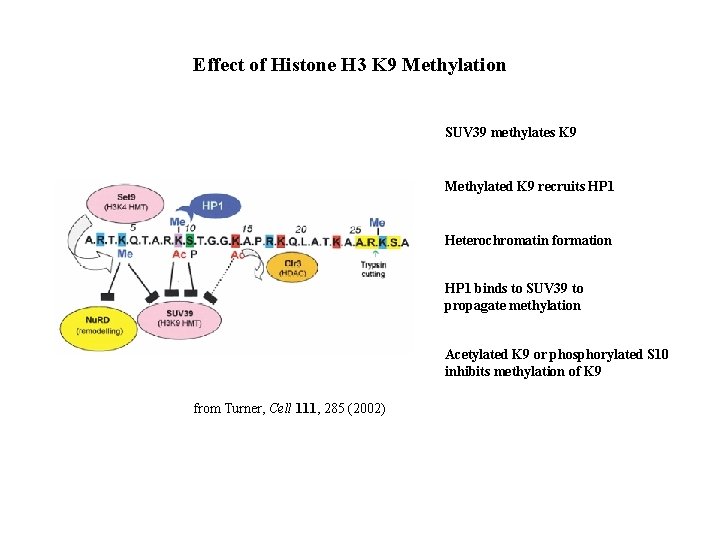
Effect of Histone H 3 K 9 Methylation SUV 39 methylates K 9 Methylated K 9 recruits HP 1 Heterochromatin formation HP 1 binds to SUV 39 to propagate methylation Acetylated K 9 or phosphorylated S 10 inhibits methylation of K 9 from Turner, Cell 111, 285 (2002)
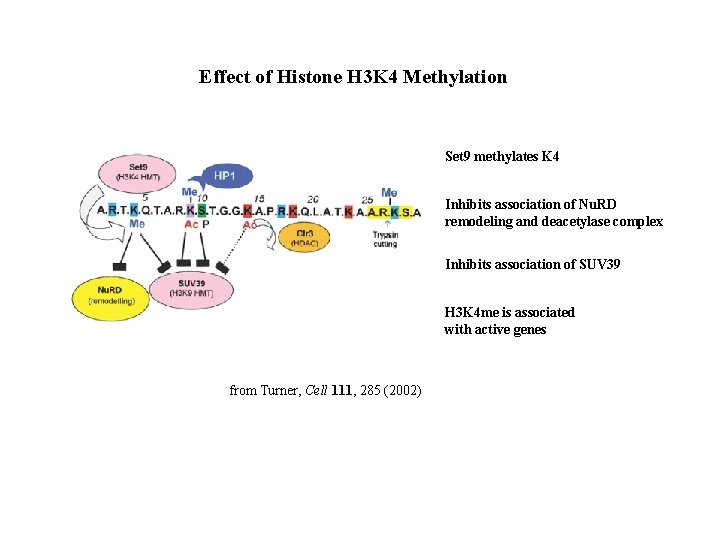
Effect of Histone H 3 K 4 Methylation Set 9 methylates K 4 Inhibits association of Nu. RD remodeling and deacetylase complex Inhibits association of SUV 39 H 3 K 4 me is associated with active genes from Turner, Cell 111, 285 (2002)
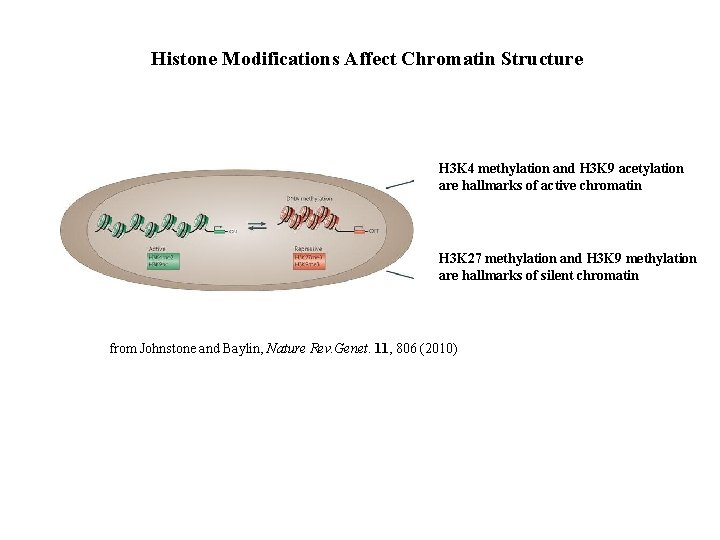
Histone Modifications Affect Chromatin Structure H 3 K 4 methylation and H 3 K 9 acetylation are hallmarks of active chromatin H 3 K 27 methylation and H 3 K 9 methylation are hallmarks of silent chromatin from Johnstone and Baylin, Nature Rev. Genet. 11, 806 (2010)
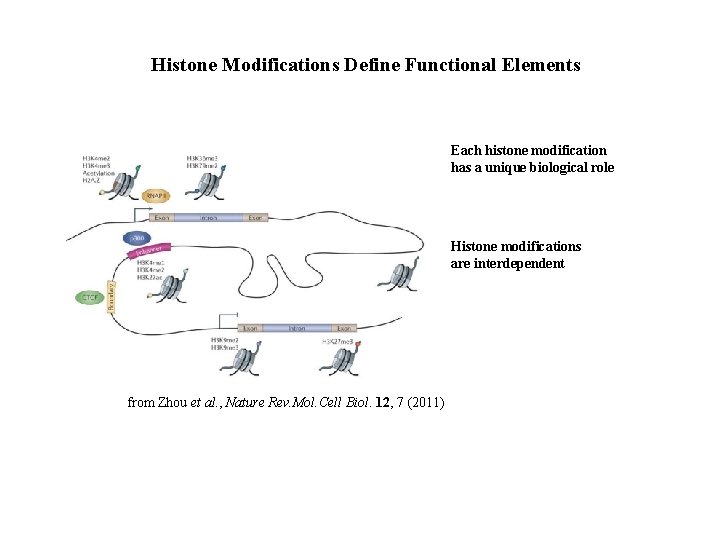
Histone Modifications Define Functional Elements Each histone modification has a unique biological role Histone modifications are interdependent from Zhou et al. , Nature Rev. Mol. Cell Biol. 12, 7 (2011)
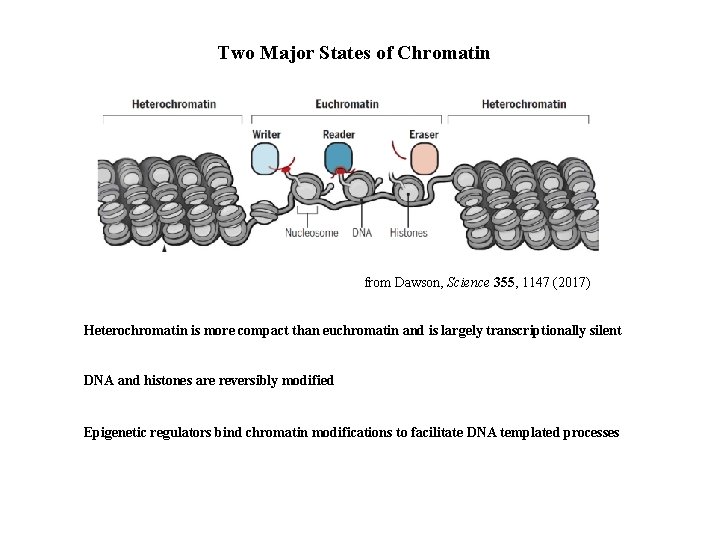
Two Major States of Chromatin from Dawson, Science 355, 1147 (2017) Heterochromatin is more compact than euchromatin and is largely transcriptionally silent DNA and histones are reversibly modified Epigenetic regulators bind chromatin modifications to facilitate DNA templated processes
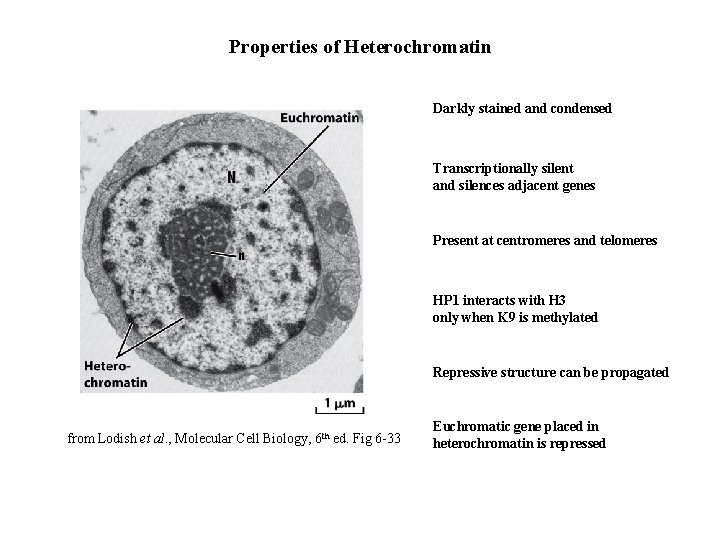
Properties of Heterochromatin Darkly stained and condensed Transcriptionally silent and silences adjacent genes Present at centromeres and telomeres HP 1 interacts with H 3 only when K 9 is methylated Repressive structure can be propagated from Lodish et al. , Molecular Cell Biology, 6 th ed. Fig 6 -33 Euchromatic gene placed in heterochromatin is repressed
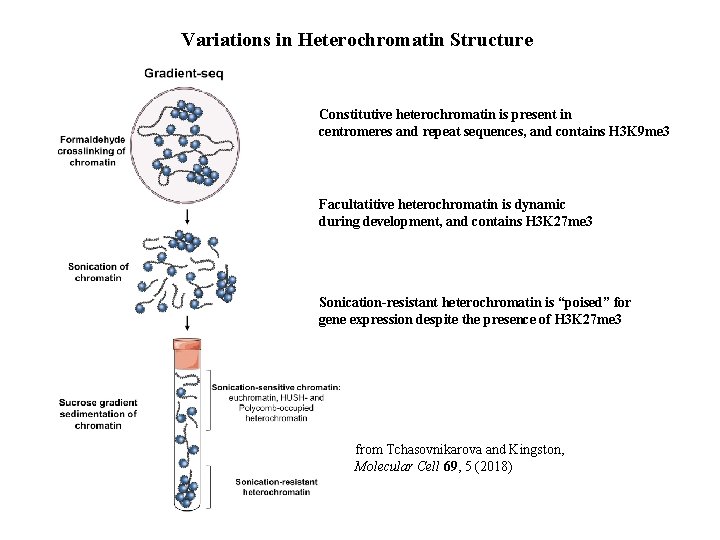
Variations in Heterochromatin Structure Constitutive heterochromatin is present in centromeres and repeat sequences, and contains H 3 K 9 me 3 Facultatitive heterochromatin is dynamic during development, and contains H 3 K 27 me 3 Sonication-resistant heterochromatin is “poised” for gene expression despite the presence of H 3 K 27 me 3 from Tchasovnikarova and Kingston, Molecular Cell 69, 5 (2018)
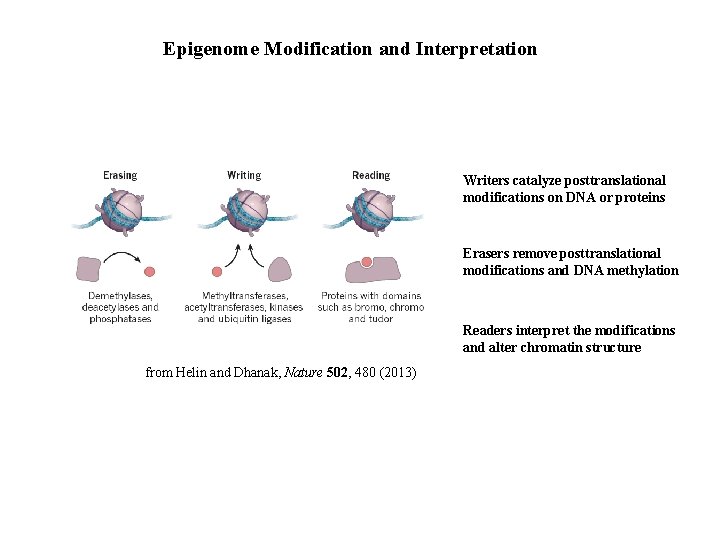
Epigenome Modification and Interpretation Writers catalyze posttranslational modifications on DNA or proteins Erasers remove posttranslational modifications and DNA methylation Readers interpret the modifications and alter chromatin structure from Helin and Dhanak, Nature 502, 480 (2013)
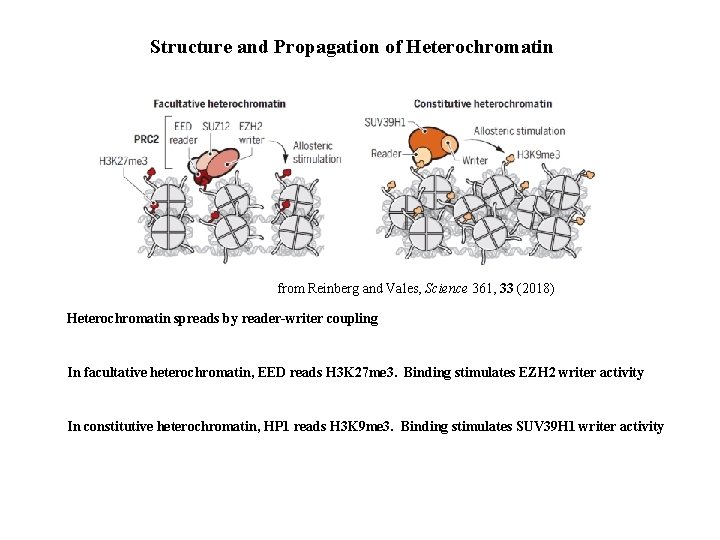
Structure and Propagation of Heterochromatin from Reinberg and Vales, Science 361, 33 (2018) Heterochromatin spreads by reader-writer coupling In facultative heterochromatin, EED reads H 3 K 27 me 3. Binding stimulates EZH 2 writer activity In constitutive heterochromatin, HP 1 reads H 3 K 9 me 3. Binding stimulates SUV 39 H 1 writer activity
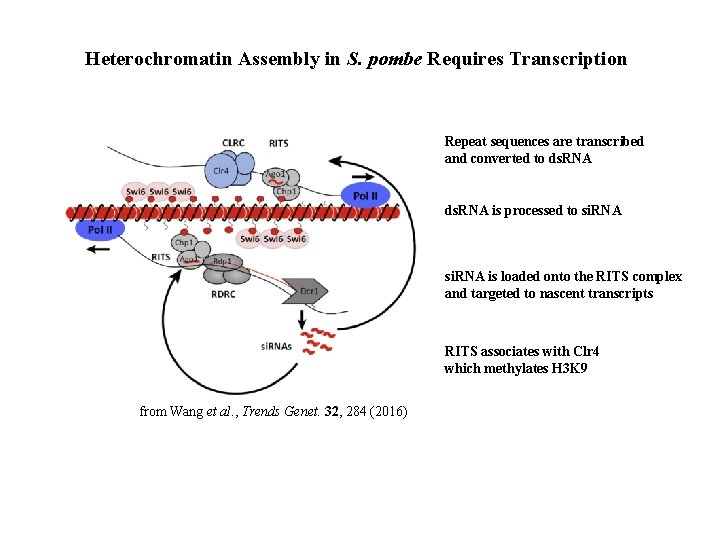
Heterochromatin Assembly in S. pombe Requires Transcription Repeat sequences are transcribed and converted to ds. RNA is processed to si. RNA is loaded onto the RITS complex and targeted to nascent transcripts RITS associates with Clr 4 which methylates H 3 K 9 from Wang et al. , Trends Genet. 32, 284 (2016)
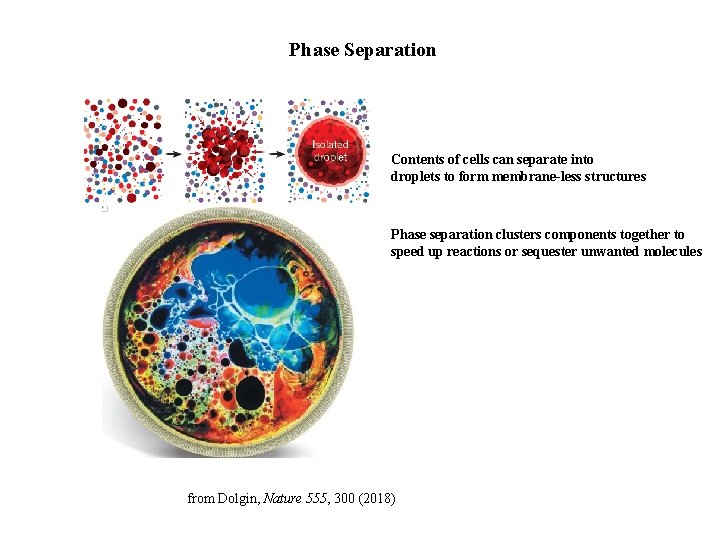
Phase Separation Contents of cells can separate into droplets to form membrane-less structures Phase separation clusters components together to speed up reactions or sequester unwanted molecules from Dolgin, Nature 555, 300 (2018)
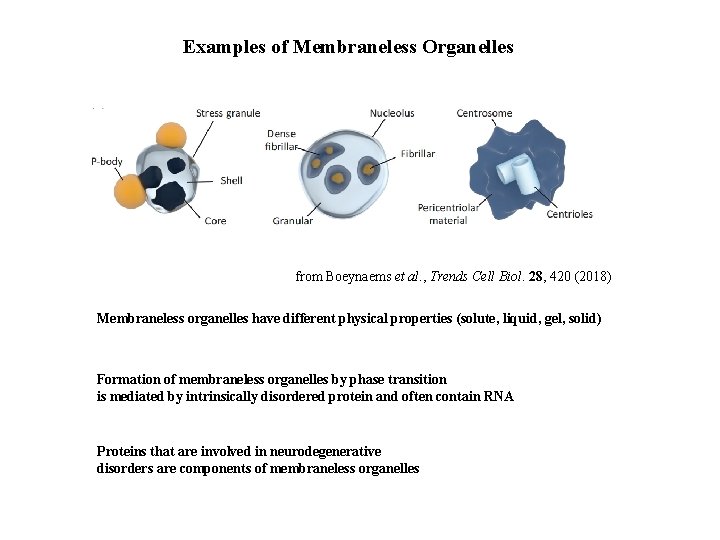
Examples of Membraneless Organelles from Boeynaems et al. , Trends Cell Biol. 28, 420 (2018) Membraneless organelles have different physical properties (solute, liquid, gel, solid) Formation of membraneless organelles by phase transition is mediated by intrinsically disordered protein and often contain RNA Proteins that are involved in neurodegenerative disorders are components of membraneless organelles
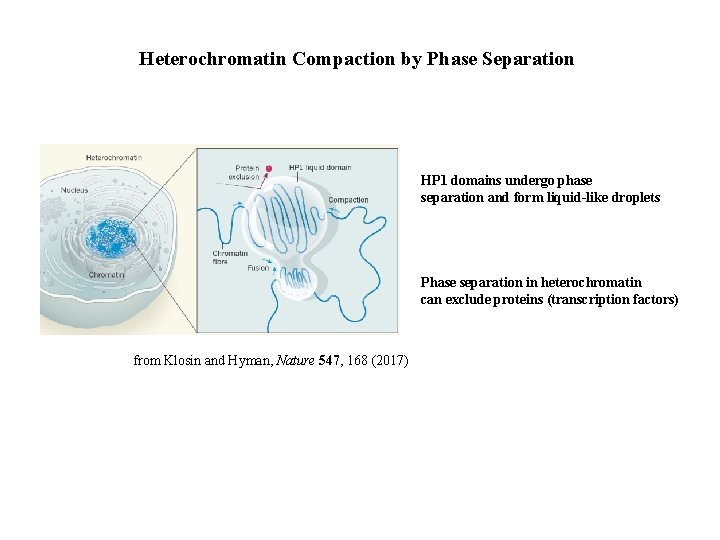
Heterochromatin Compaction by Phase Separation HP 1 domains undergo phase separation and form liquid-like droplets Phase separation in heterochromatin can exclude proteins (transcription factors) from Klosin and Hyman, Nature 547, 168 (2017)
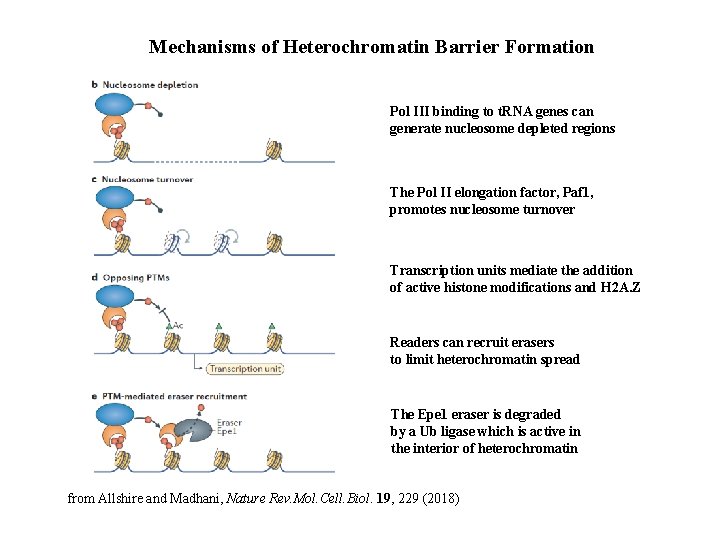
Mechanisms of Heterochromatin Barrier Formation Pol III binding to t. RNA genes can generate nucleosome depleted regions The Pol II elongation factor, Paf 1, promotes nucleosome turnover Transcription units mediate the addition of active histone modifications and H 2 A. Z Readers can recruit erasers to limit heterochromatin spread The Epe 1 eraser is degraded by a Ub ligase which is active in the interior of heterochromatin from Allshire and Madhani, Nature Rev. Mol. Cell. Biol. 19, 229 (2018)
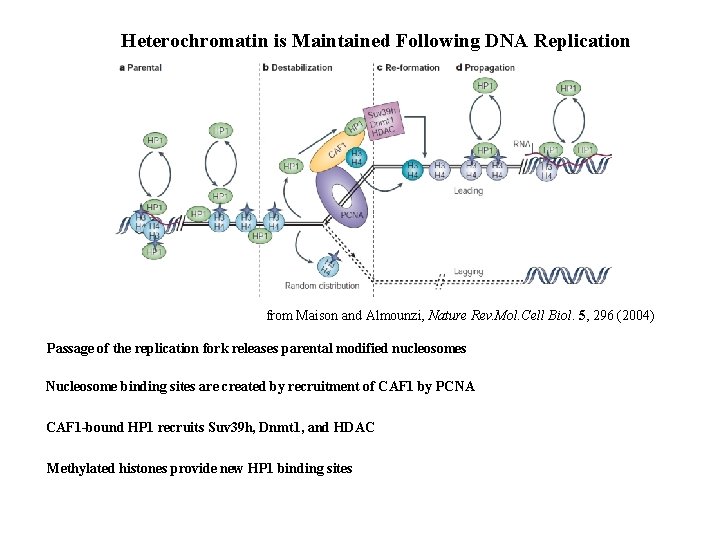
Heterochromatin is Maintained Following DNA Replication from Maison and Almounzi, Nature Rev. Mol. Cell Biol. 5, 296 (2004) Passage of the replication fork releases parental modified nucleosomes Nucleosome binding sites are created by recruitment of CAF 1 by PCNA CAF 1 -bound HP 1 recruits Suv 39 h, Dnmt 1, and HDAC Methylated histones provide new HP 1 binding sites
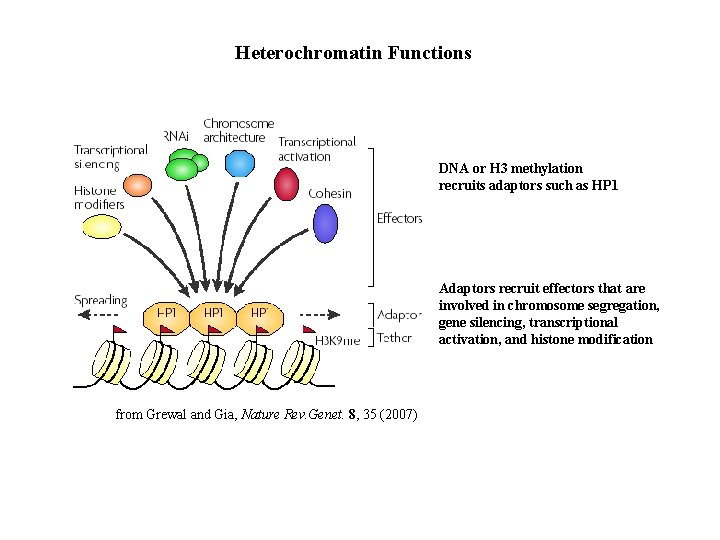
Heterochromatin Functions DNA or H 3 methylation recruits adaptors such as HP 1 Adaptors recruit effectors that are involved in chromosome segregation, gene silencing, transcriptional activation, and histone modification from Grewal and Gia, Nature Rev. Genet. 8, 35 (2007)
Epigenetics Heritable changes in gene function that cannot be explained by changes in gene sequences DNA methylation Histone variants and modifications Nucleosome positioning Cells retain a memory of past states Epigenetic information is involved in cell fate determination and stability
Epigenetic Modifications During Development Epigenetically imposed restrictions to plasticity are erased in the germ line Early mammalian development is characterized by progressive restriction of cellular plasticity accompanied by acquisition of epigenetic modifications Epigenetic modifications impose a cellular memory that accompanies and enables stable differentiation
DNA Methylation at Cp. G residues correlates with gene repression 5 me. C is involved in stable epigenetic repression Sites of methylation Inactive X Imprinted loci Transposon-derived sequences Cp. G islands are Cp. G-rich regions usually found at promoters Methylation patterns are reproduced at each round of cell division Organisms that lack DNA methylation have cellular memory
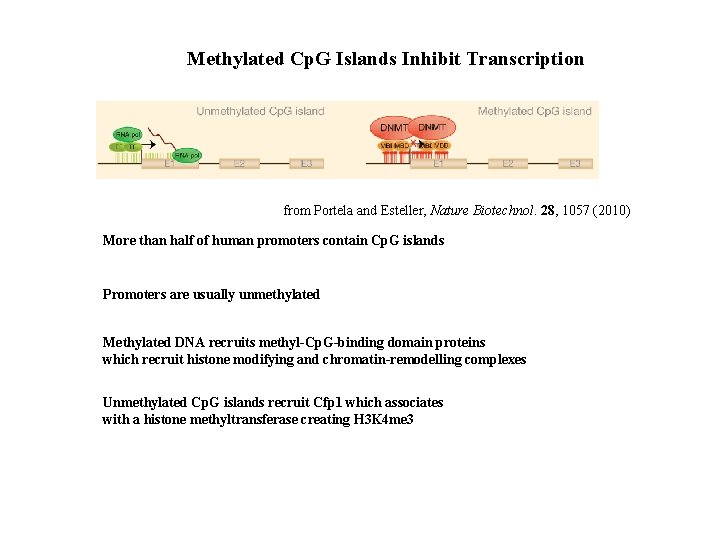
Methylated Cp. G Islands Inhibit Transcription from Portela and Esteller, Nature Biotechnol. 28, 1057 (2010) More than half of human promoters contain Cp. G islands Promoters are usually unmethylated Methylated DNA recruits methyl-Cp. G-binding domain proteins which recruit histone modifying and chromatin-remodelling complexes Unmethylated Cp. G islands recruit Cfp 1 which associates with a histone methyltransferase creating H 3 K 4 me 3
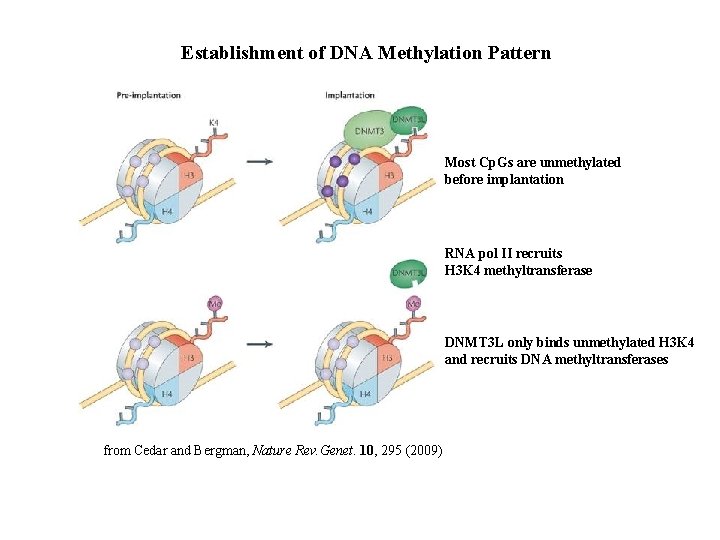
Establishment of DNA Methylation Pattern Most Cp. Gs are unmethylated before implantation RNA pol II recruits H 3 K 4 methyltransferase DNMT 3 L only binds unmethylated H 3 K 4 and recruits DNA methyltransferases from Cedar and Bergman, Nature Rev. Genet. 10, 295 (2009)
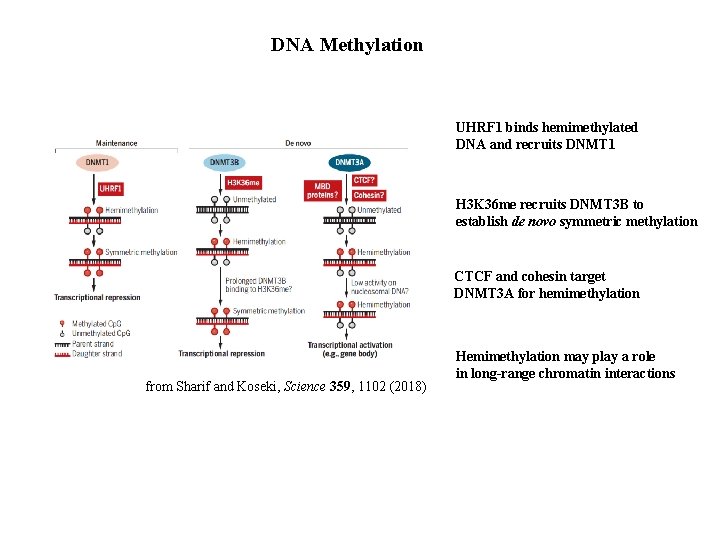
DNA Methylation UHRF 1 binds hemimethylated DNA and recruits DNMT 1 H 3 K 36 me recruits DNMT 3 B to establish de novo symmetric methylation CTCF and cohesin target DNMT 3 A for hemimethylation from Sharif and Koseki, Science 359, 1102 (2018) Hemimethylation may play a role in long-range chromatin interactions
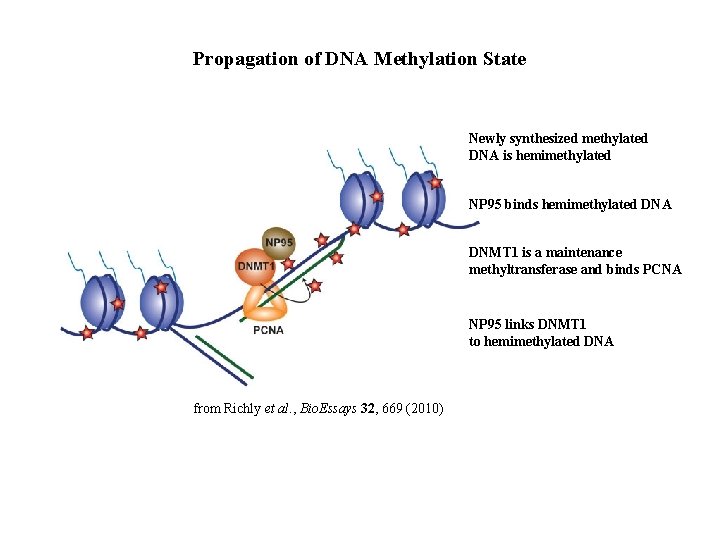
Propagation of DNA Methylation State Newly synthesized methylated DNA is hemimethylated NP 95 binds hemimethylated DNA DNMT 1 is a maintenance methyltransferase and binds PCNA NP 95 links DNMT 1 to hemimethylated DNA from Richly et al. , Bio. Essays 32, 669 (2010)
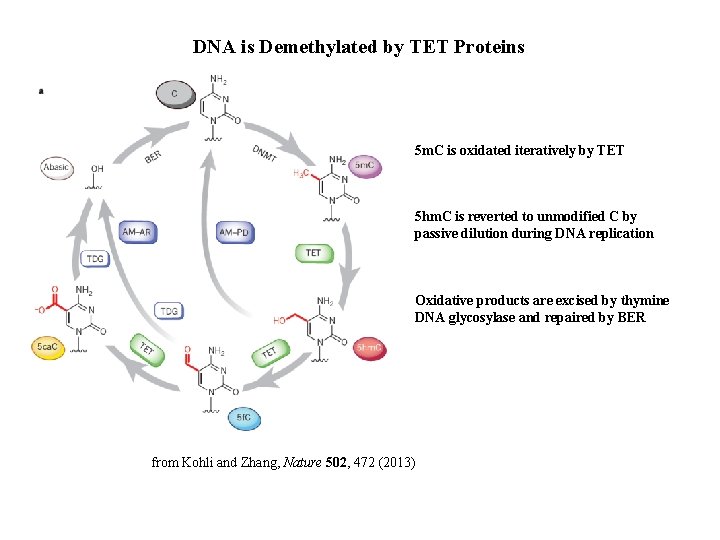
DNA is Demethylated by TET Proteins 5 m. C is oxidated iteratively by TET 5 hm. C is reverted to unmodified C by passive dilution during DNA replication Oxidative products are excised by thymine DNA glycosylase and repaired by BER from Kohli and Zhang, Nature 502, 472 (2013)
Rett Syndrome Onset of symptoms in females is 6 -12 months of age Rett syndrome is a severe neurological disorder Abnormal head growth Decrease in speech function Breathing disturbances Repetitive hand movements Caused by mutation in the Me. CP 2 gene on the X chromosome Severity of symptoms varies with the proportion of cells expressing the mutant copy of Me. CP 2
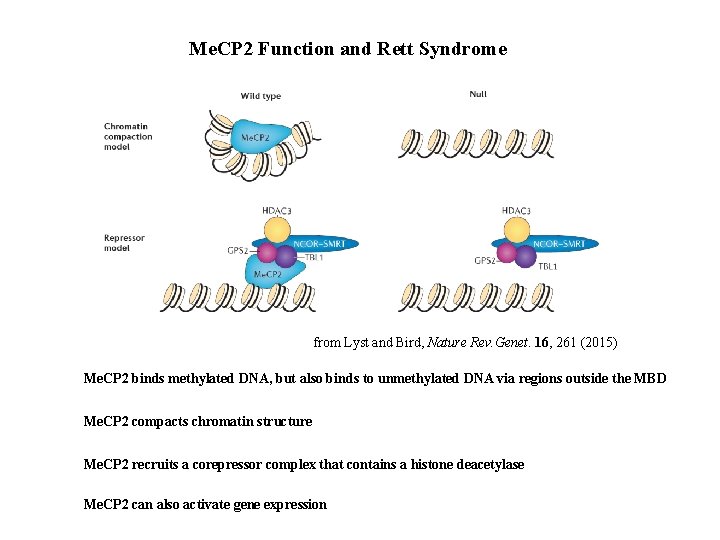
Me. CP 2 Function and Rett Syndrome from Lyst and Bird, Nature Rev. Genet. 16, 261 (2015) Me. CP 2 binds methylated DNA, but also binds to unmethylated DNA via regions outside the MBD Me. CP 2 compacts chromatin structure Me. CP 2 recruits a corepressor complex that contains a histone deacetylase Me. CP 2 can also activate gene expression
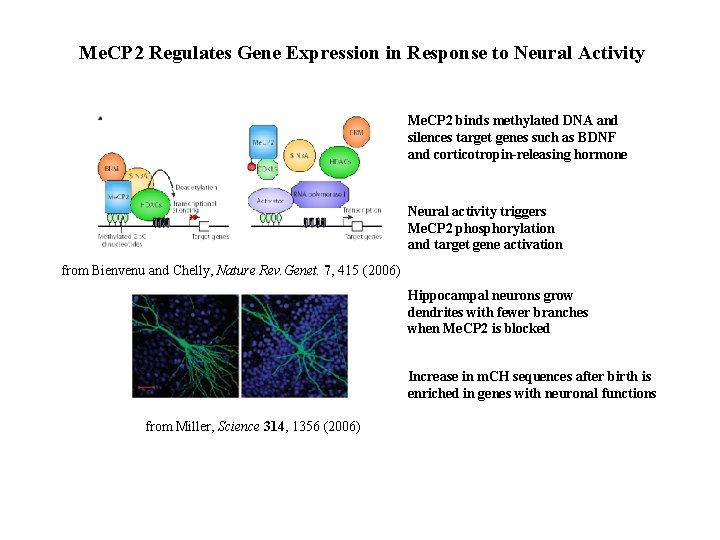
Me. CP 2 Regulates Gene Expression in Response to Neural Activity Me. CP 2 binds methylated DNA and silences target genes such as BDNF and corticotropin-releasing hormone Neural activity triggers Me. CP 2 phosphorylation and target gene activation from Bienvenu and Chelly, Nature Rev. Genet. 7, 415 (2006) Hippocampal neurons grow dendrites with fewer branches when Me. CP 2 is blocked Increase in m. CH sequences after birth is enriched in genes with neuronal functions from Miller, Science 314, 1356 (2006)
Many Me. CP 2 -Repressed Genes Encode Proteins That Modulate Neuronal Physiology Me. CP 2 binds m. CA Density of m. CA is higher in long genes Frequency of m. CA increases with age Long genes are selectively expressed in the brain Length- and m. CA-dependent increase in gene expression in Me. CP 2 mutants Increased binding of Me. CP 2 at the BDNF locus in adult brains from Gabel et al. , Nature 522, 89 (2015) from Luo and Ecker, Science 348, 1094 (2015)
- Slides: 37