
Nucleons Nuclei a quick guide to the real




- Slides: 27
Nucleons & Nuclei a quick guide to the real essentials in the subject which particle and nuclear physicists won’t tell you
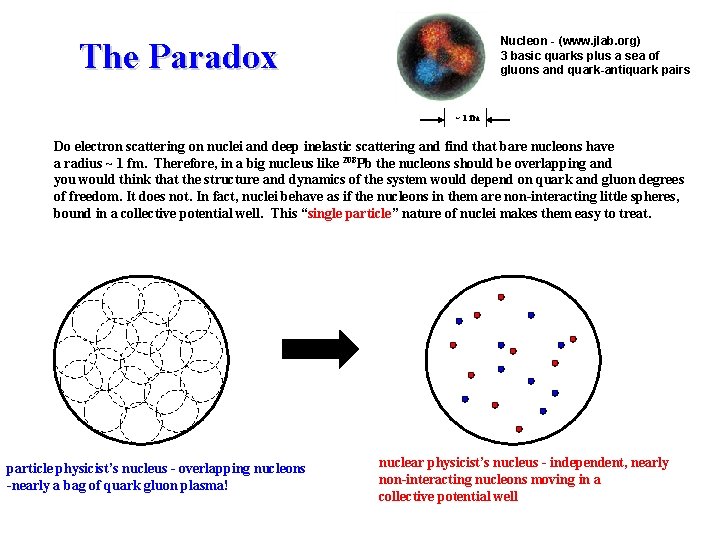
Nucleon - (www. jlab. org) 3 basic quarks plus a sea of gluons and quark-antiquark pairs The Paradox ~ 1 fm Do electron scattering on nuclei and deep inelastic scattering and find that bare nucleons have a radius ~ 1 fm. Therefore, in a big nucleus like 208 Pb the nucleons should be overlapping and you would think that the structure and dynamics of the system would depend on quark and gluon degrees of freedom. It does not. In fact, nuclei behave as if the nucleons in them are non-interacting little spheres, bound in a collective potential well. This “single particle” nature of nuclei makes them easy to treat. particle physicist’s nucleus - overlapping nucleons -nearly a bag of quark gluon plasma! nuclear physicist’s nucleus - independent, nearly non-interacting nucleons moving in a collective potential well
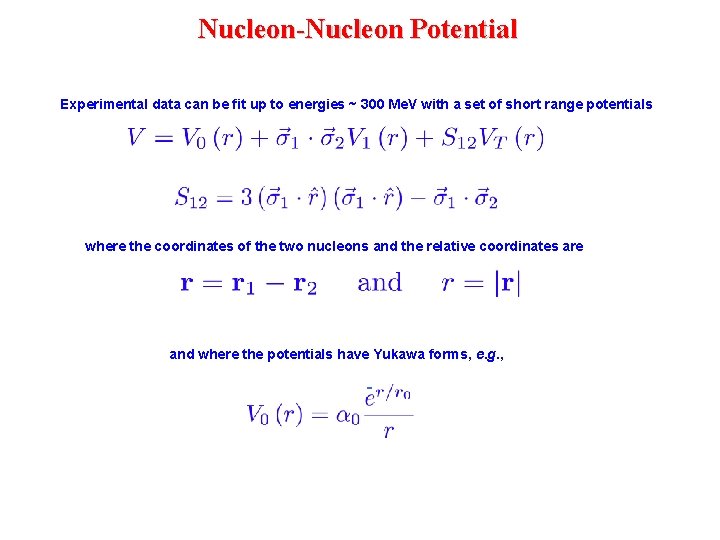
Nucleon-Nucleon Potential Experimental data can be fit up to energies ~ 300 Me. V with a set of short range potentials where the coordinates of the two nucleons and the relative coordinates are and where the potentials have Yukawa forms, e. g. , -
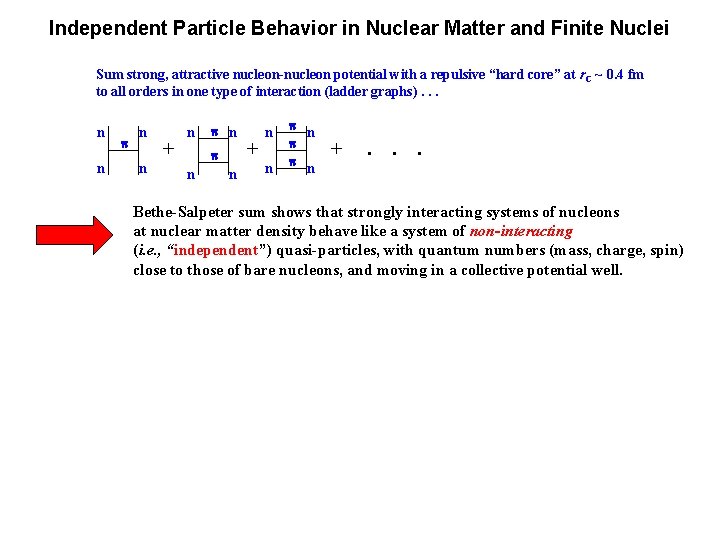
Independent Particle Behavior in Nuclear Matter and Finite Nuclei Sum strong, attractive nucleon-nucleon potential with a repulsive “hard core” at r. C ~ 0. 4 fm to all orders in one type of interaction (ladder graphs). . . n n + n n n n + n n n + . . . n Bethe-Salpeter sum shows that strongly interacting systems of nucleons at nuclear matter density behave like a system of non-interacting (i. e. , “independent”) quasi-particles, with quantum numbers (mass, charge, spin) close to those of bare nucleons, and moving in a collective potential well.
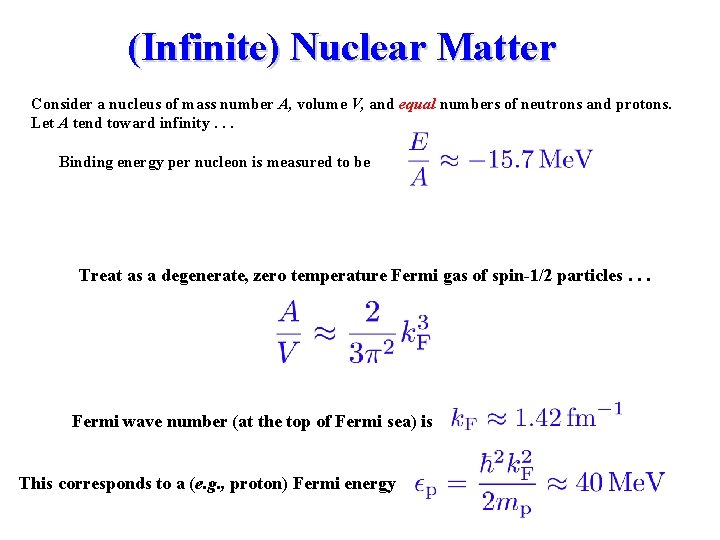
(Infinite) Nuclear Matter Consider a nucleus of mass number A, volume V, and equal numbers of neutrons and protons. Let A tend toward infinity. . . Binding energy per nucleon is measured to be Treat as a degenerate, zero temperature Fermi gas of spin-1/2 particles. . . Fermi wave number (at the top of Fermi sea) is This corresponds to a (e. g. , proton) Fermi energy
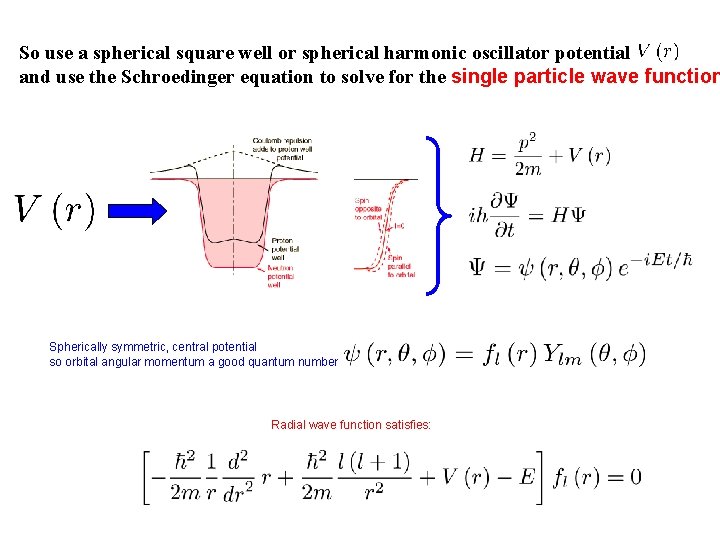
So use a spherical square well or spherical harmonic oscillator potential and use the Schroedinger equation to solve for the single particle wave function Spherically symmetric, central potential so orbital angular momentum a good quantum number Radial wave function satisfies:
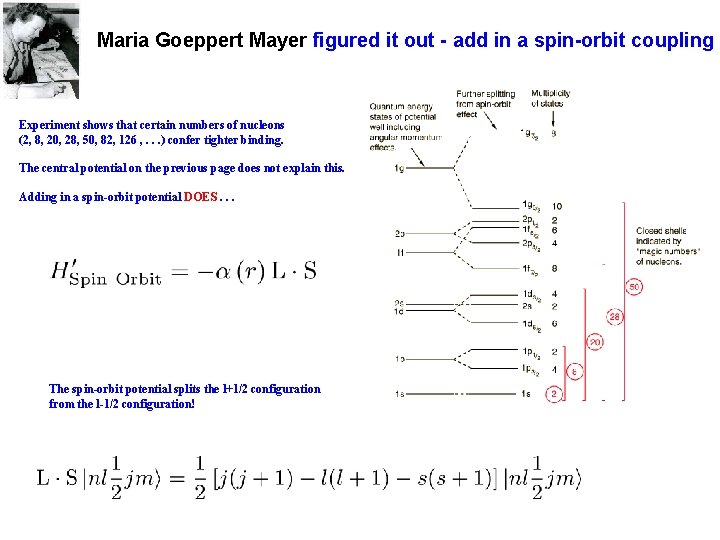
Maria Goeppert Mayer figured it out - add in a spin-orbit coupling Experiment shows that certain numbers of nucleons (2, 8, 20, 28, 50, 82, 126 , . . . ) confer tighter binding. The central potential on the previous page does not explain this. Adding in a spin-orbit potential DOES. . . The spin-orbit potential splits the l+1/2 configuration from the l-1/2 configuration!
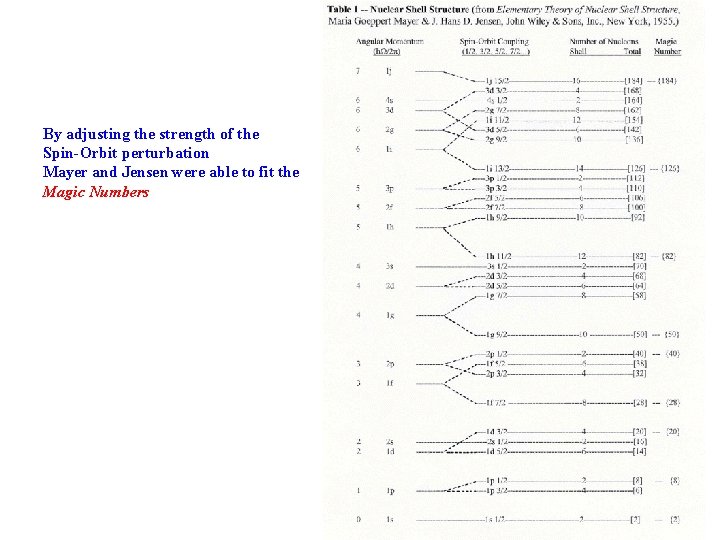
By adjusting the strength of the Spin-Orbit perturbation Mayer and Jensen were able to fit the Magic Numbers
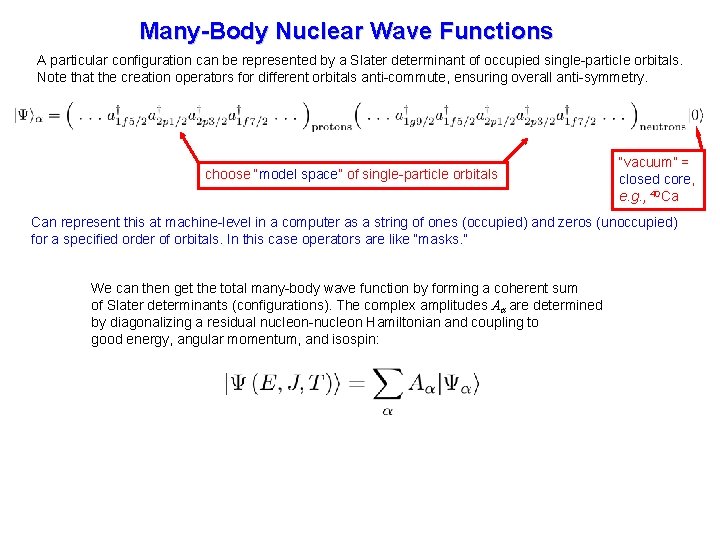
Many-Body Nuclear Wave Functions A particular configuration can be represented by a Slater determinant of occupied single-particle orbitals. Note that the creation operators for different orbitals anti-commute, ensuring overall anti-symmetry. choose “model space” of single-particle orbitals “vacuum” = closed core, e. g. , 40 Ca Can represent this at machine-level in a computer as a string of ones (occupied) and zeros (unoccupied) for a specified order of orbitals. In this case operators are like “masks. ” We can then get the total many-body wave function by forming a coherent sum of Slater determinants (configurations). The complex amplitudes A are determined by diagonalizing a residual nucleon-nucleon Hamiltonian and coupling to good energy, angular momentum, and isospin:
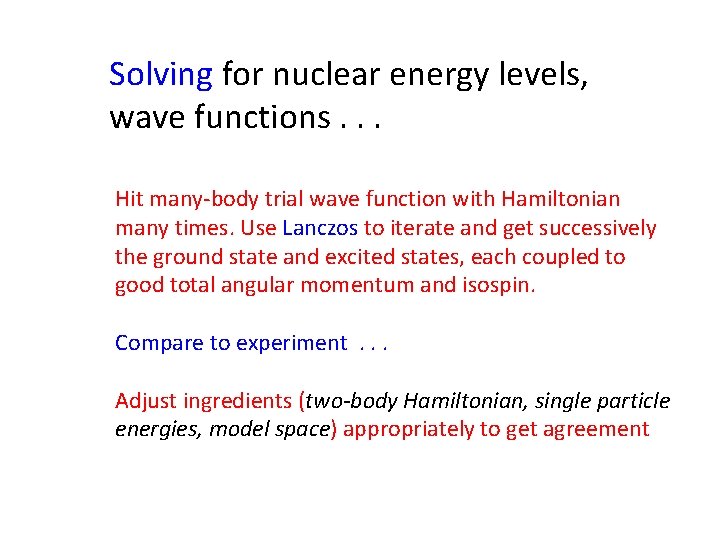
Solving for nuclear energy levels, wave functions. . . Hit many-body trial wave function with Hamiltonian many times. Use Lanczos to iterate and get successively the ground state and excited states, each coupled to good total angular momentum and isospin. Compare to experiment. . . Adjust ingredients (two-body Hamiltonian, single particle energies, model space) appropriately to get agreement
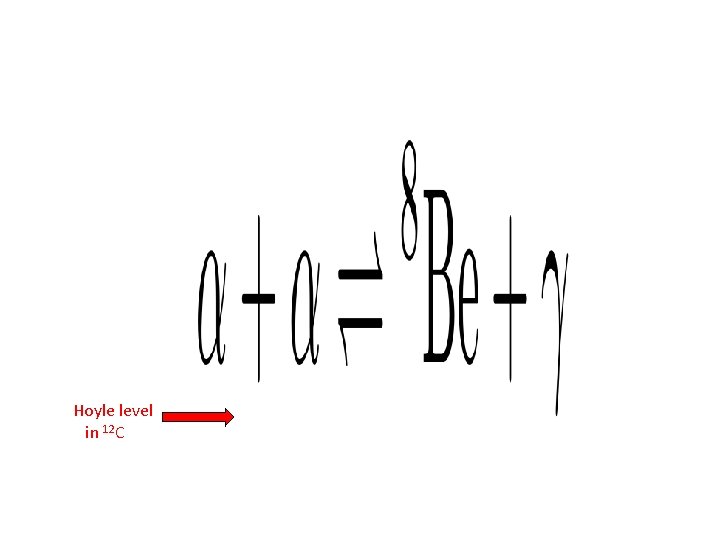
Hoyle level in 12 C
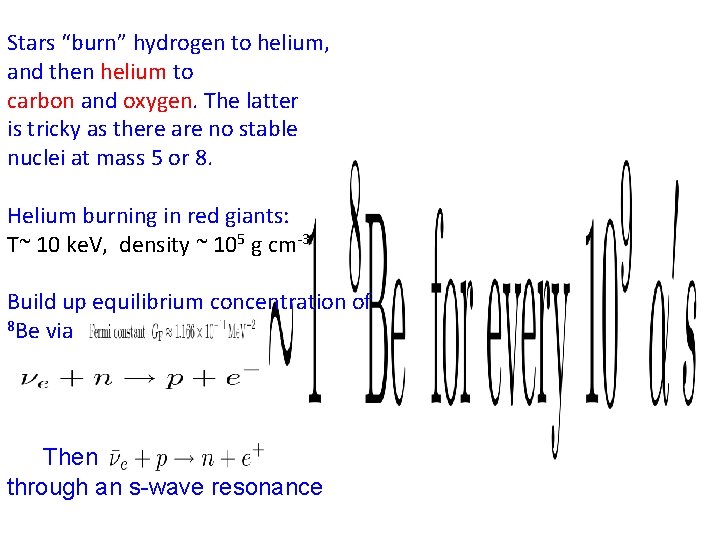
Stars “burn” hydrogen to helium, and then helium to carbon and oxygen. The latter is tricky as there are no stable nuclei at mass 5 or 8. Helium burning in red giants: T~ 10 ke. V, density ~ 105 g cm-3 Build up equilibrium concentration of 8 Be via Then through an s-wave resonance
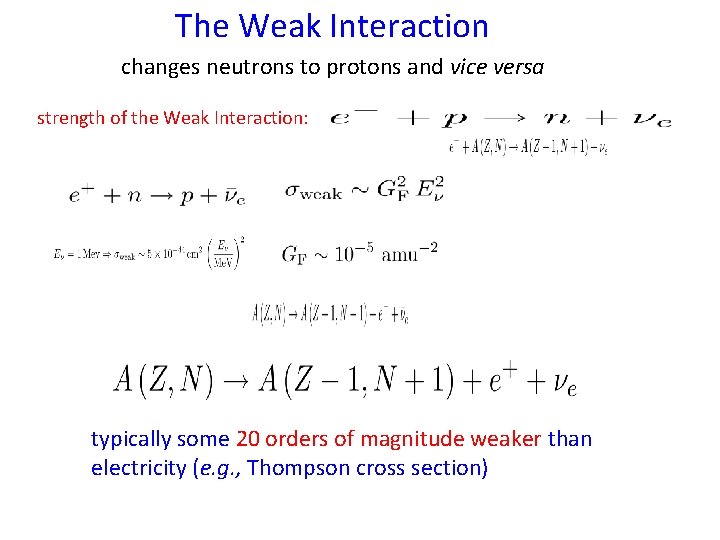
The Weak Interaction changes neutrons to protons and vice versa strength of the Weak Interaction: typically some 20 orders of magnitude weaker than electricity (e. g. , Thompson cross section)
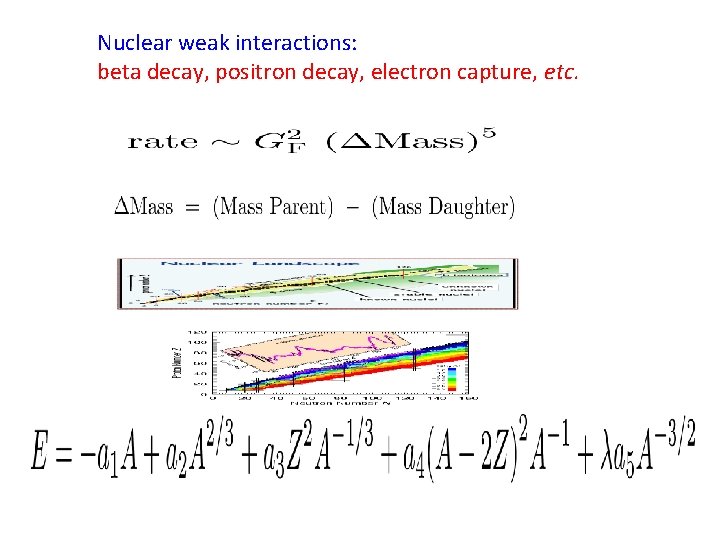
Nuclear weak interactions: beta decay, positron decay, electron capture, etc.
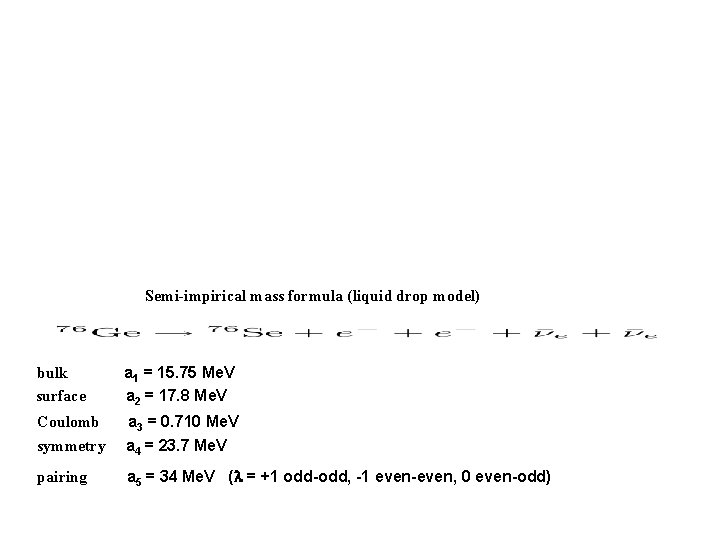
How could you predict nuclear (ground state) masses?
Semi-impirical mass formula (liquid drop model) bulk surface a 1 = 15. 75 Me. V a 2 = 17. 8 Me. V Coulomb symmetry a 3 = 0. 710 Me. V a 4 = 23. 7 Me. V pairing a 5 = 34 Me. V ( = +1 odd-odd, -1 even-even, 0 even-odd)
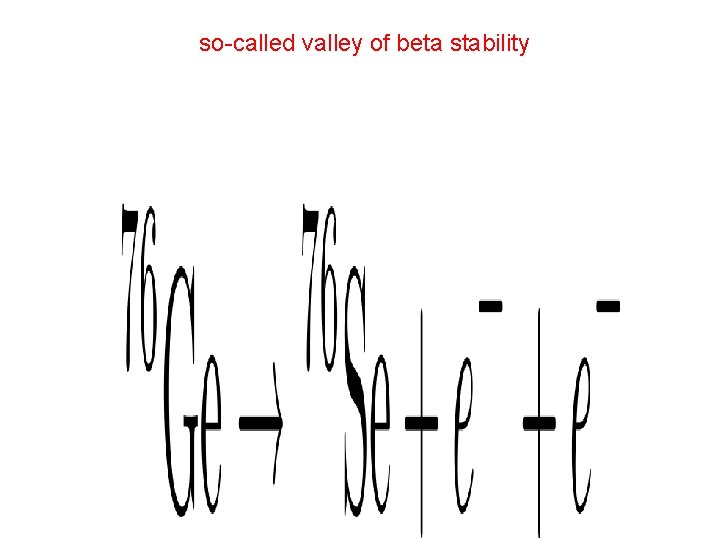
so-called valley of beta stability
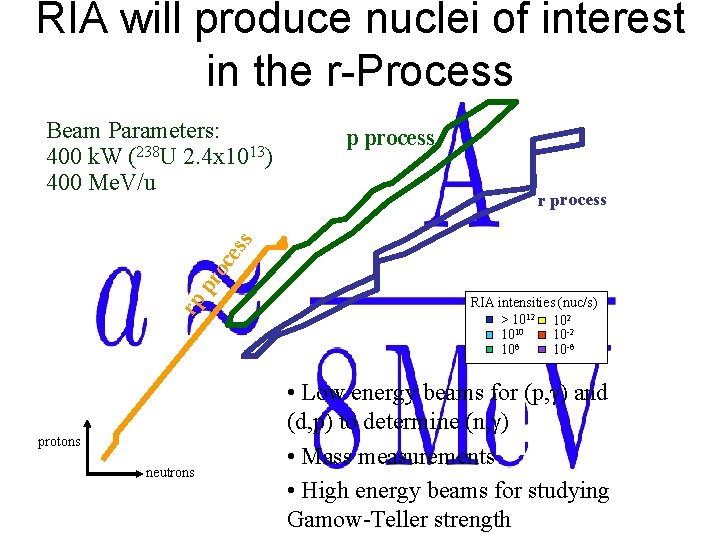
RIA will produce nuclei of interest in the r-Process p process rp pr oc e ss Beam Parameters: 400 k. W (238 U 2. 4 x 10¹³) 400 Me. V/u protons neutrons RIA intensities (nuc/s) > 1012 1010 10 -2 10 -6 106 • Low energy beams for (p, g) and (d, p) to determine (n, g) • Mass measurements • High energy beams for studying Gamow-Teller strength
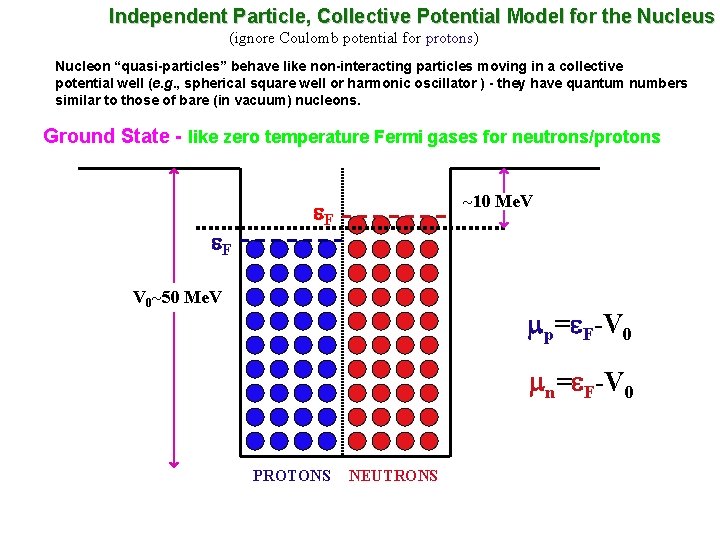
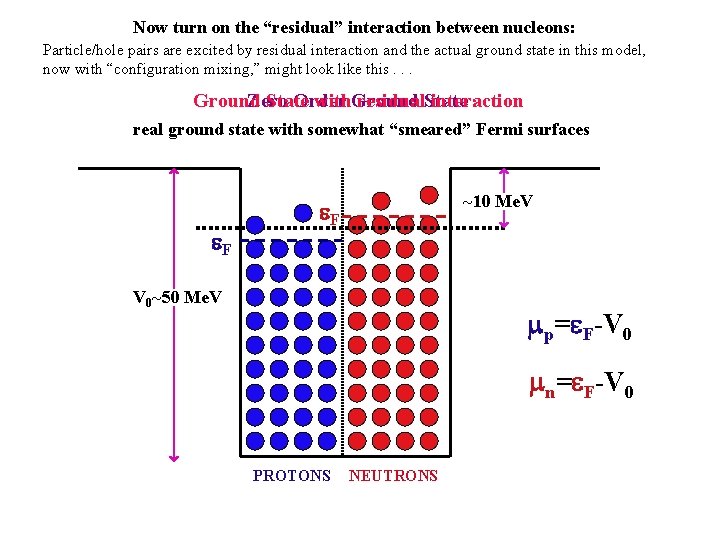
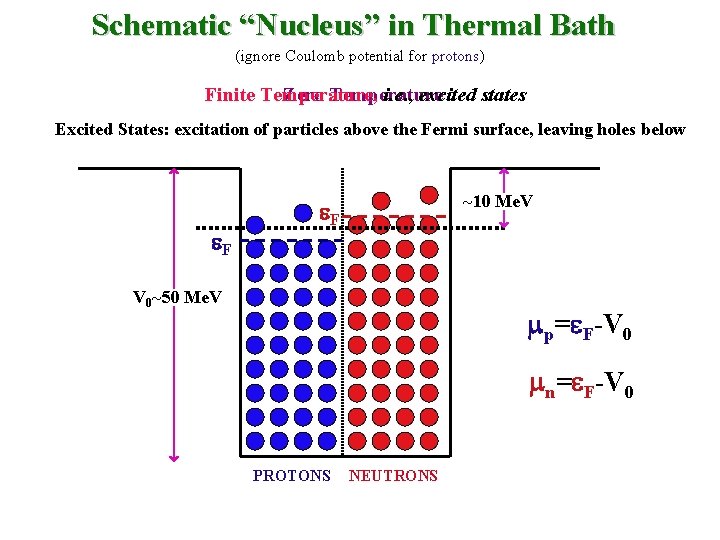
Independent Particle, Collective Potential Model for the Nucleus (ignore Coulomb potential for protons) Nucleon “quasi-particles” behave like non-interacting particles moving in a collective potential well (e. g. , spherical square well or harmonic oscillator ) - they have quantum numbers similar to those of bare (in vacuum) nucleons. Ground State - like zero temperature Fermi gases for neutrons/protons e. F ~10 Me. V e. F V 0~50 Me. V mp=e. F-V 0 mn=e. F-V 0 PROTONS NEUTRONS
Now turn on the “residual” interaction between nucleons: Particle/hole pairs are excited by residual interaction and the actual ground state in this model, now with “configuration mixing, ” might look like this. . . Ground Zero State Order with. Ground residual. State interaction real ground state with somewhat “smeared” Fermi surfaces e. F ~10 Me. V e. F V 0~50 Me. V mp=e. F-V 0 mn=e. F-V 0 PROTONS NEUTRONS
Schematic “Nucleus” in Thermal Bath (ignore Coulomb potential for protons) Finite Temperature, Zero Temperature i. e. , excited states Excited States: excitation of particles above the Fermi surface, leaving holes below e. F ~10 Me. V e. F V 0~50 Me. V mp=e. F-V 0 mn=e. F-V 0 PROTONS NEUTRONS
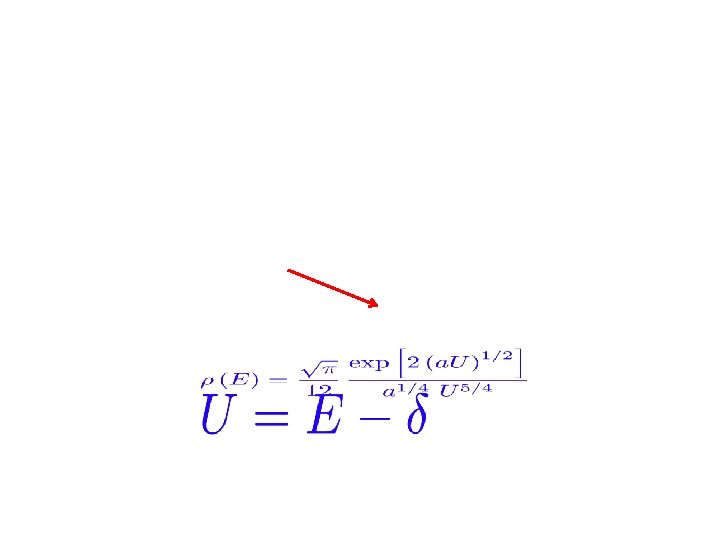
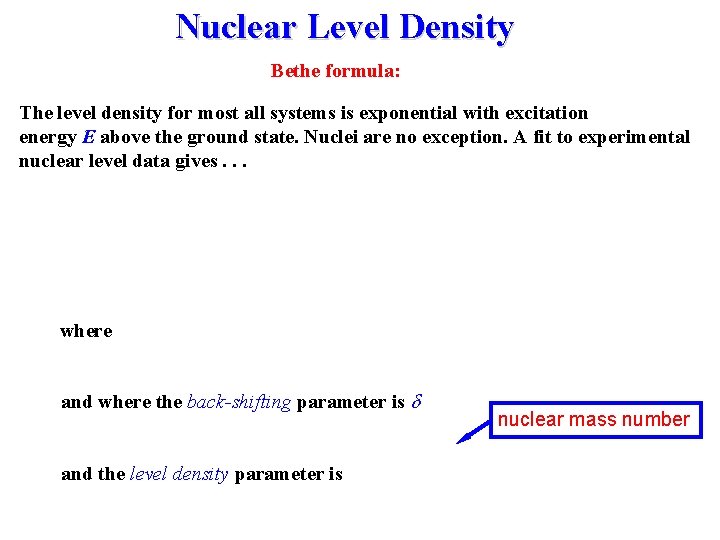
Nuclear Level Density Bethe formula: The level density for most all systems is exponential with excitation energy E above the ground state. Nuclei are no exception. A fit to experimental nuclear level data gives. . . where and where the back-shifting parameter is and the level density parameter is nuclear mass number