
Nucleic Acids Objectives Draw formulas representing the general
Nucleic Acids
Objectives • Draw formulas representing the general structures of nucleic acids; • Define and illustrate the terms nucleotide, nucleoside, base and sugar. • Explain how DNA differs from RNA.
Objectives (cont’d) • Describe the geometric shape of DNA molecules and explain why this shape is important. • Describe how chemical energy is carried in the cell. • Explain the role of nucleic acids in cell metabolism.
Nucleic Acids Huge polymers of nucleotides with very specific cellular functions in cells.
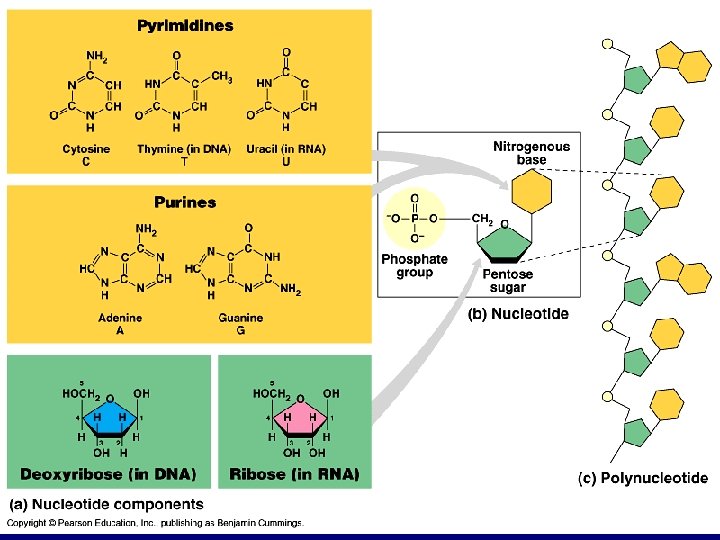
Nucleotides Monomers of nucleic acids • • • Phosphate molecule Pentose sugar Nitrogen containing base
Nucleic Acids and Functions DNA (deoxyribonucleic acid) Stores genetic code for its own replication and for the sequence of amino acids in proteins.

DNA Codons & Genetic Code Universal Triplets Code for amino acids Degenerate Unambiguous Has start & stop
Nucleic Acids and Functions RNA (ribonucleic acid) Single-stranded nucleic acid that translates the genetic code of DNA into the amino acid sequence of proteins.
Other Nucleotide Functions Metabolic Coenzymes are molecules which facilitate enzymatic reactions. ATP (adenosine triphosphate) is a nucleotide used to supply energy. Nucleic acid monomers.
DNA & RNA Structure Molecular complexes consisting of: phosphate (phosphoric acid) pentose sugar nitrogen-containing base.
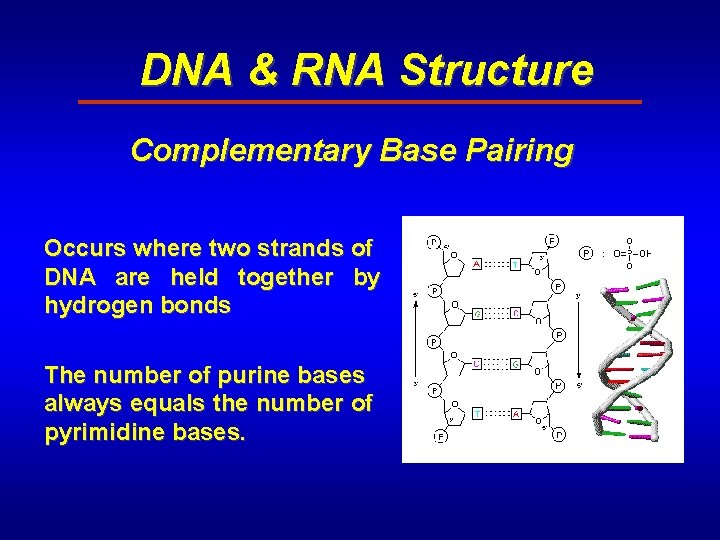
DNA & RNA Structure Complementary Base Pairing Occurs where two strands of DNA are held together by hydrogen bonds The number of purine bases always equals the number of pyrimidine bases.
DNA & RNA Differences DNA - deoxyribose sugar RNA - ribose sugar DNA – bases adenine, guanine, thymine & cytosine RNA - uracil occurs instead thymine. DNA - double-stranded with complementary base pairing RNA - single-stranded. DNA - double helix RNA - does not form helices.
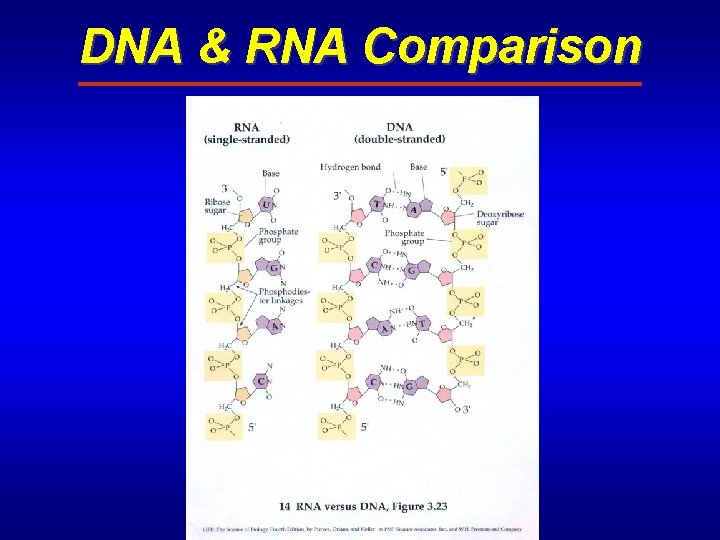
DNA & RNA Comparison
Some Individually Important Nucleotides
ATP (Adenosine triphosphate) * * * Nucleotide of adenosine Composed of ribose and adenine. Name derived from 3 phosphates attached to the five-carbon portion of the molecule. * Last two unstable phosphate bonds easily broken. * High-energy molecule.
ATP (cont’d) * * * Terminal phosphate bond hydrolyzed, leaving ADP (adenosine diphosphate) Supplies energy for energyrequiring processes (e. g. synthetic reactions(energy currency). Not stored!
NAD+ Nicotinamide adenine dinucleotide * Electron carrier involved in glycolysis
NADP+ Nicotinamide adenine dinucleotide phosphate * Electron carrier involved in photosynthesis
Review • Explain the general structures of nucleic acids; • Define the terms nucleotide, nucleoside, base and sugar. • How does DNA differs from RNA?
Review (cont’d) • Describe the geometric shape of DNA molecules and explain why this shape is important. • How is chemical energy is carried in the cell. • What is the role of nucleic acids in cell metabolism.
- Slides: 21