
Nucleic Acids DNA Structure Function and Technical Applications
- Slides: 36
Nucleic Acids • DNA Structure, Function and Technical Applications
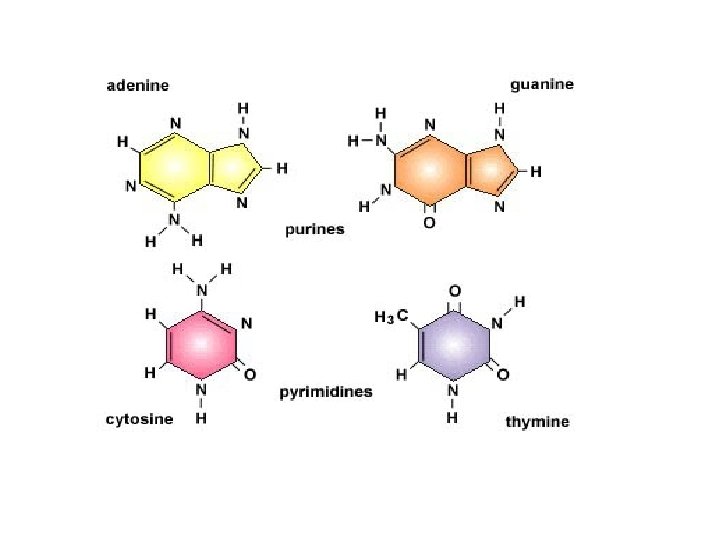
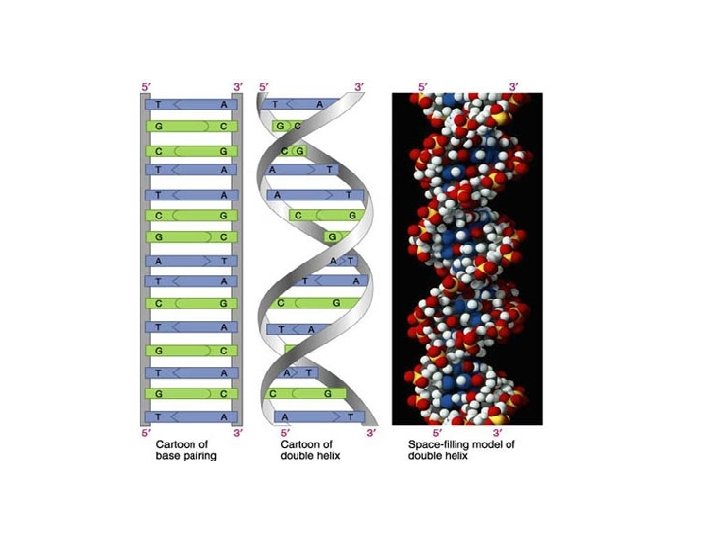
DNA • Monomers-nucleotides (phosphate, sugar, base). Be able to id structure • 4 different nucleotides, because 4 different bases (A, T, C, G) • Nucleoside- Just sugar + base • Purines vs. Pyrimidines
History • Chargaff-found that %A = % T and % G= %C; also found different base composition between them • Watson and Crick-1953 -determined the double helical structure of DNA
DNA Replication • Semiconservative • Your cells have 3 billion base pairs in a cell to replicate • 900 of your biochem books—and it only takes a few hours • Total DNA in your body would go to moon and back 1500 times • Very few errors—about 1 per 1 billion nucleotides
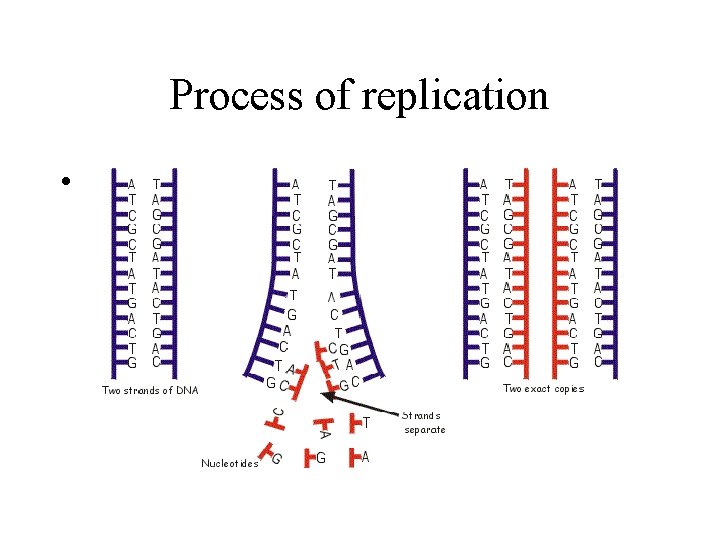
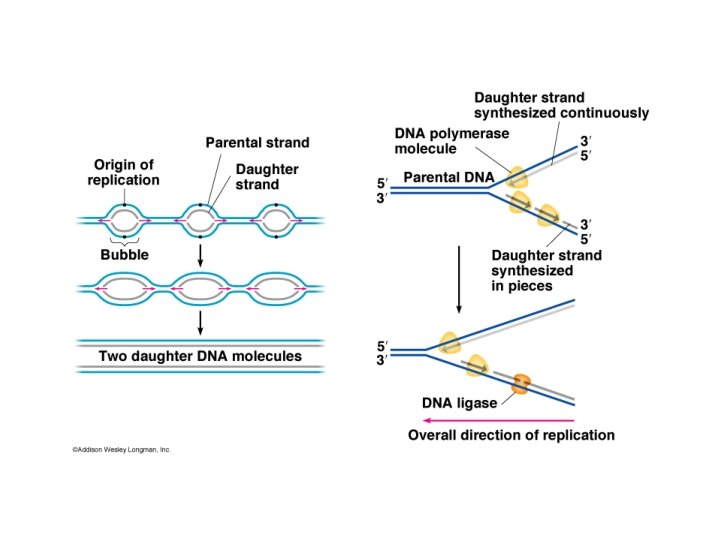
Process of replication •
More DNA replication • Begins at sites called “origins of replication” • Proteins (enzyme-helicase) pulls apart the double helix, forming a replication bubble. Proteins called SSB’s keep the strands from H bonding back together (‘hold’ them apart) • DNA polymerase begins adding nucleotides to the 3’end of the growing strand of DNA
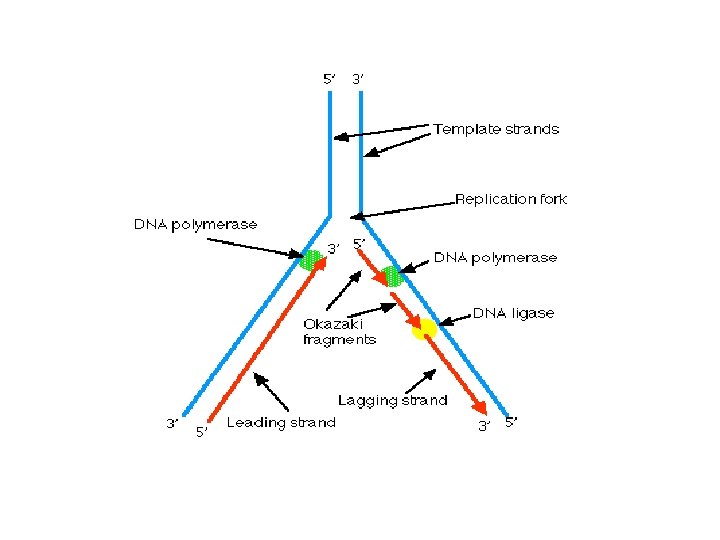
More replication • Because the 2 strands are antiparallel, one strand is synthesized continuously (leading strand) and the other is synthesized in little pieces called Okazaki fragments (lagging strands) • Okazaki fragments are ‘glued’ together with DNA ligase
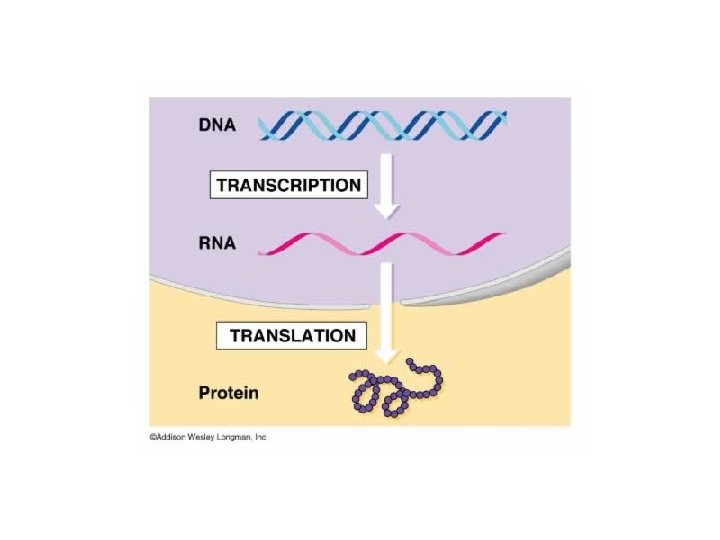
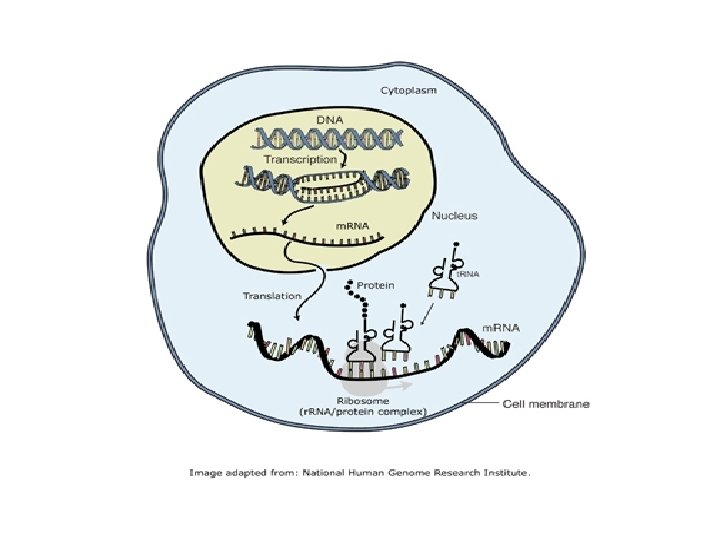
The Flow of Genetic info from DNA to RNA to Protein • Overview – Transcription: DNA transcribes code to m. RNA in nucleus – Translation: t. RNA transports amino acids to m. RNA on ribosome – Protein Synthesis-assembly of amino acids to polypeptides and, ultimately, proteins
Genetic Information • Written as codons, which are 3 -nucleotide m. RNA sequences that specify an amino acid: aka known as the triplet code • So, let’s take the DNA sequence: – TACGGT – m. RNA sequence? – Amino acid sequence? • *see chart in book
More Genetic Code • Genetic information is encoded as a sequence base triplets, or codons, each of which is translated into a specific amino acid during protein synthesis
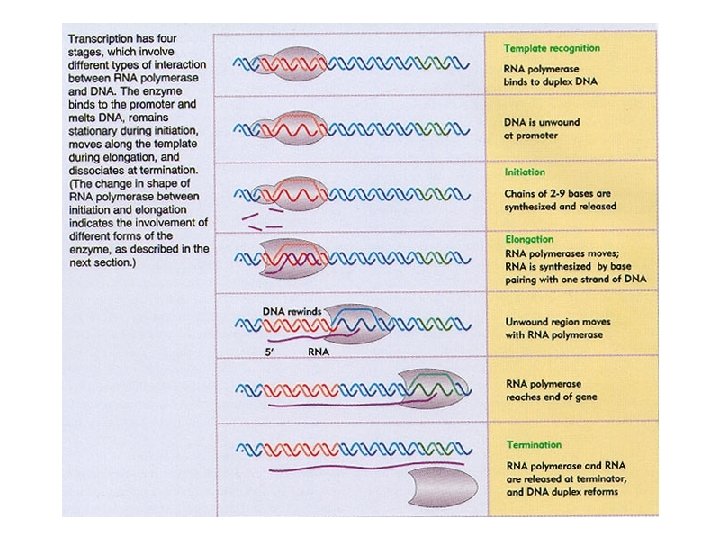
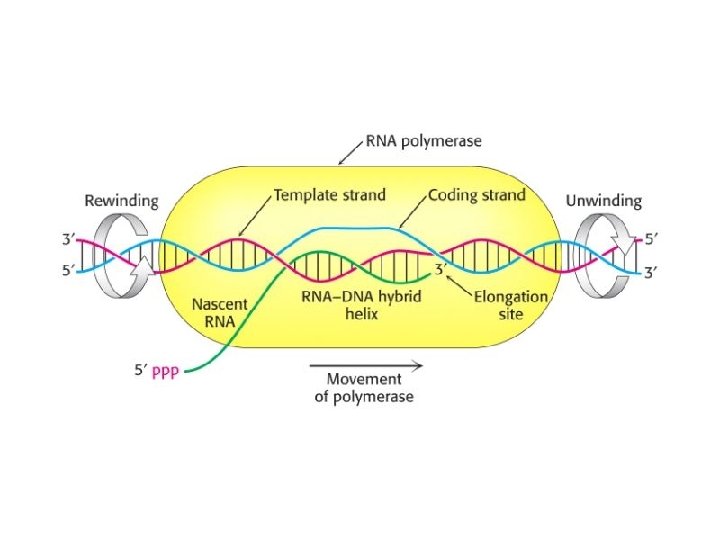
Transcription • Transfer of genetic information from DNA to RNA (m. RNA) • Just like replication, the DNA strands must separate. Unlike replication, only one m. RNA strand is “read”. • Carried out by RNA polymerase • 3 stages: initiation, elongation, termination
More Transcription • Promoter- region where RNA polymerase attaches and initiates transcription (TATA box) • Terminator- DNA sequence that signals the end of transcription
Stages of transcription •
Splicing • Before m. RNA leave the nucleus, introns are spliced out ( these are regions that do not carry any info for the coding of proteins) and the exons (coding regions) are spliced back together. • Cap (G) and tail (AAA) added to prevent degradation in the cytoplasm (*they have methyl groups which keep them less reactive. *Recall alkanes are basically unreactive, except for combustion and substitution)
Translation • • Transfer of info from m. RNA to protein Takes place on ribosome in cytoplasm m. RNA travels from nucleus to ribosome t. RNA ‘meets’ (by H bonding) m. RNA at ribosome, bringing amino acids to the site of polypeptide and ultimately protein synthesis
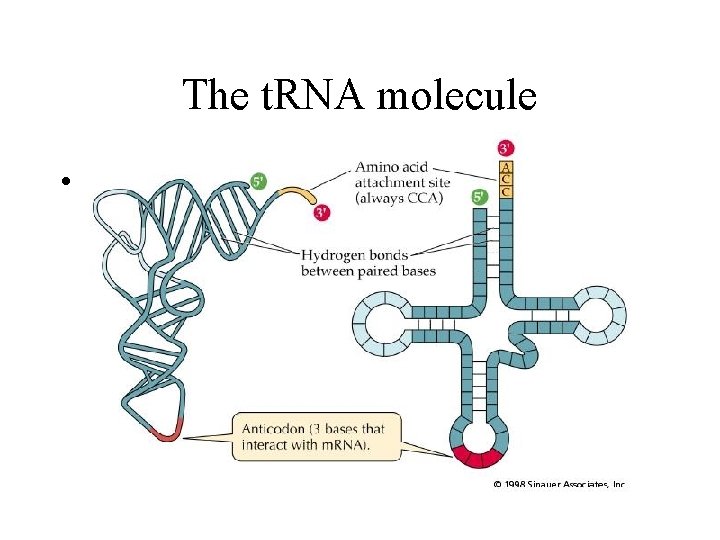
The t. RNA molecule •
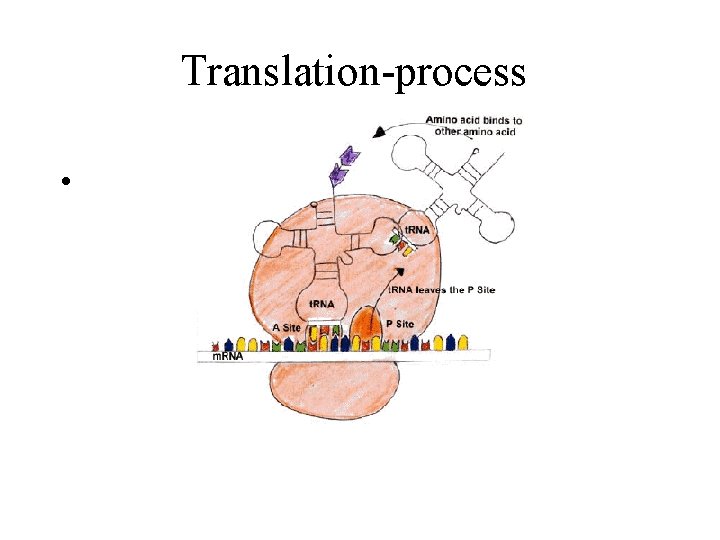
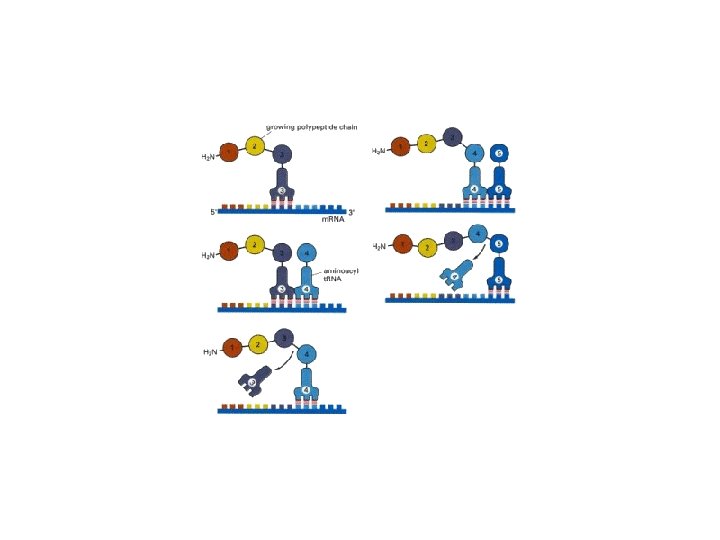
Translation-process •
3 Stages of translation • 1) Initiation – Brings together m. RNA, t. RNA and ribosome – Begins at the start code, AUG 2) Elongation -codon of m. RNA and anticodon of t. RNA complementary bond to one another -peptide bond fromation -translocation-ribosome moves to next codon 3)Termination-m. RNA stop codons-UAA, UAG, UGA
Mutations • Point mutations-one base pair is changed – Substitutions – Frameshift (Insertions and Deletions) • Mutagens-physical and chemical agents that interact DNA to cause mutations—exp. : xrays
Human Genome Project • June 27, 2000 - Announced that over 90% of DNA had been sequenced
Other info • Human genome carries ~25, 000 genes; Eukaryotic replication occurs at about 50 bases/sec • Over 95% of DNA is noncoding. Some of this DNA involved in regulation mechanisms (promoter regions, etc). We have some noncoding DNA between genes where the sequences repeat over and over. These are called short tandem repeats and vary from individual to individual. These STR’s become very important in DNA fingerprinting (forensics unit)
Telomeric DNA • Telomere- The ends of chromosomes; in humans contain long series of repeating groups of nucleotides. Prevent fragmentation and keep DNA from binding to other DNA in other chromosomes. New cells have thousand (or more) of repeating groups. Enzyme called telomerase sees to this. However, with each cell division, some nucleotides are lost. Old cells have very little, which eventually results in cell instability and cell death. Telomere shortening though to be related to aging
DNA Technology and Genetic Engineering • Bacteria can transfer information in 3 ways: – Transformation-the taking up of DNA from fluid surrounding the cell – Transduction-transfer of bacterial DNA via a phage – Conjugation-transfer of plasmids(tiny circular pieces of DNA) from one bacterium to another via pili
Plasmids • Small circular extra chromosomal pieces of DNA • Often carry beneficial (but not necessary)genes---like antibiotic resistance • Scientists use plasmids to customize bacteria – Insert genes of interest into plasmids – Get the bacteria to take up the plasmids
Restriction Enzymes • Discovered in bacteria– uses them to destroy viruses (phages) • In order to insert a gene into a plasmid, you first have to cut it out of its source • Restriction enzymes are like little molecular scissors. They “cut” at very specific sequences using “sticky ends’ • Once cut, DNA is glued together with DNA ligase producing recombinant DNA. You can then clone the gene
Recombinant DNA • Definition- DNA that contains two or more DNA segments not found together in nature • Once you cut and paste the gene, Bacteria reproduce so fast that you can usually get millions of copies of the gene in several hours! This is cloning!
Electrophoresis • Sorts DNA molecules by size • DNA samples have to be cut in pieces with restriction enzymes and loaded into wells of an agarose gel • Gel is porous, so DNA molecules can move thru it • An electrical charge is applied to the gel and DNA moves toward the positive electrode. Why? • Smaller pieces move faster than bigger ones • DNA fingerprinting- use electrophoresis to identify possible criminals in forensics. Only identical twins have the same DNA fingerprint
Polymerase Chain Reaction (PCR) • Technique by which any segment of DNA can be amplified (cloned) without using living cells such as bacterial or yeast plasmids (Can be done in vitro) • DNA mixed with heat resistant polymerase, primers and DNA monomers. DNA will keep replicating as long as monomers are available • PCR can generate 100 billion similar molecules in a few hours! • Used in forensics