
Nuclear Structure II Collective models P Van Isacker



- Slides: 47
Nuclear Structure (II) Collective models P. Van Isacker, GANIL, France NSDD Workshop, Trieste, February 2006
Overview of collective models • • • (Rigid) rotor model (Harmonic quadrupole) vibrator model Liquid-drop model of vibrations and rotations Interacting boson model Particle-core coupling model Nilsson model NSDD Workshop, Trieste, February 2006
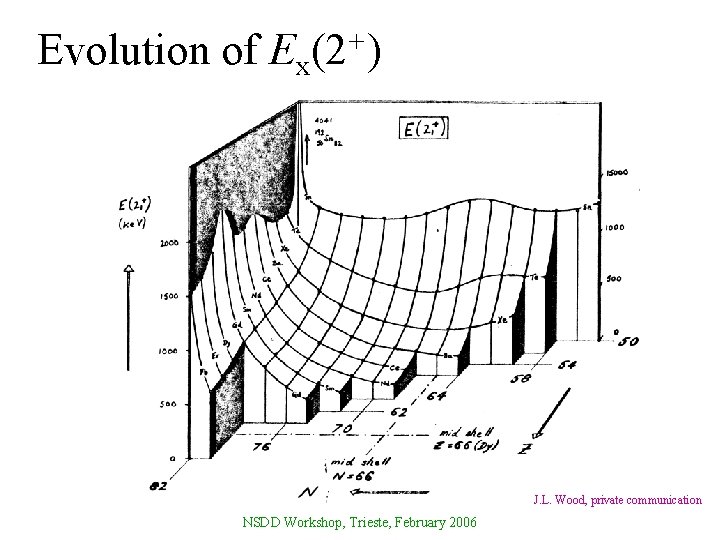
Evolution of + Ex(2 ) J. L. Wood, private communication NSDD Workshop, Trieste, February 2006
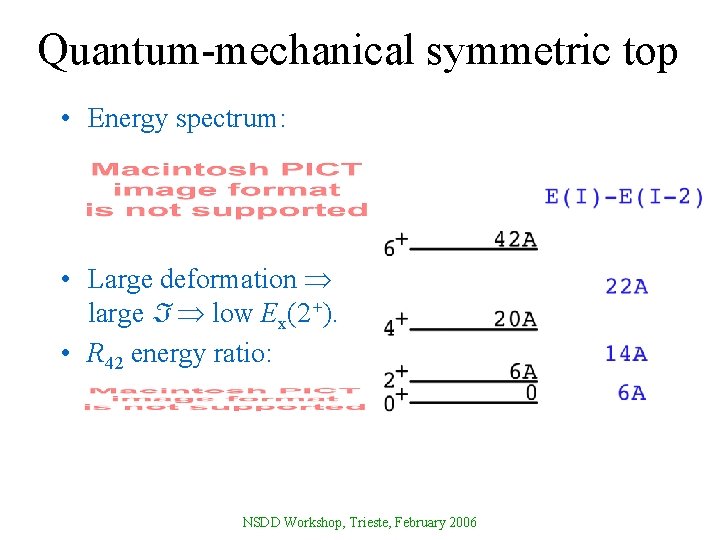
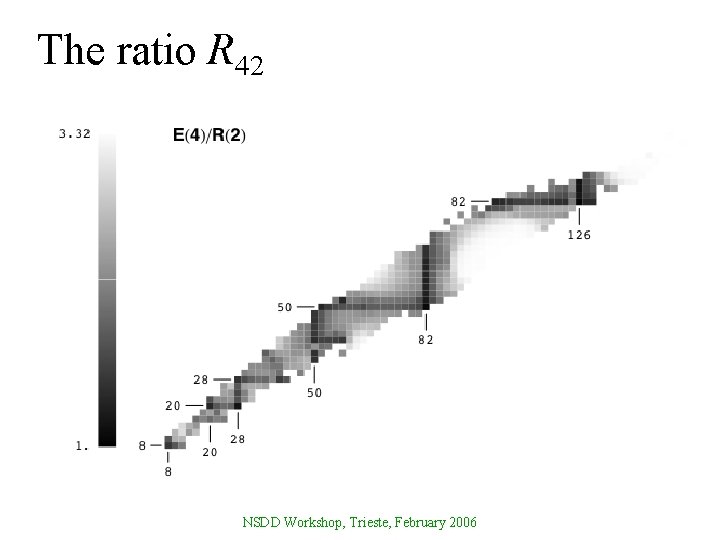
Quantum-mechanical symmetric top • Energy spectrum: • Large deformation large low Ex(2+). • R 42 energy ratio: NSDD Workshop, Trieste, February 2006
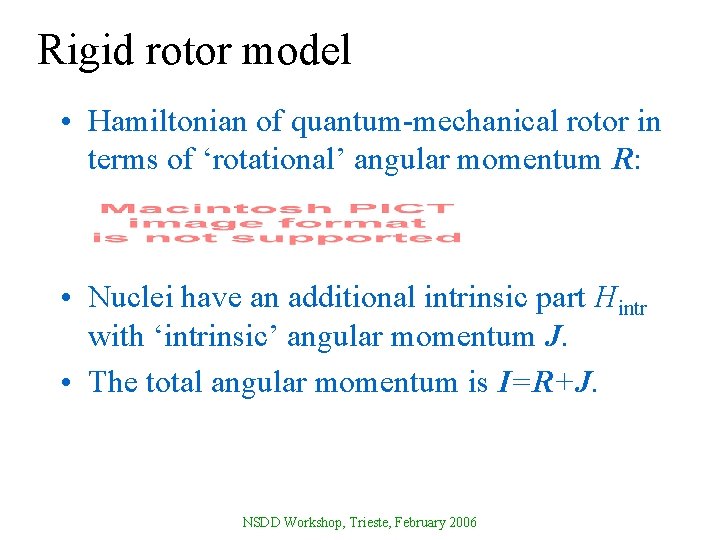
Rigid rotor model • Hamiltonian of quantum-mechanical rotor in terms of ‘rotational’ angular momentum R: • Nuclei have an additional intrinsic part Hintr with ‘intrinsic’ angular momentum J. • The total angular momentum is I=R+J. NSDD Workshop, Trieste, February 2006
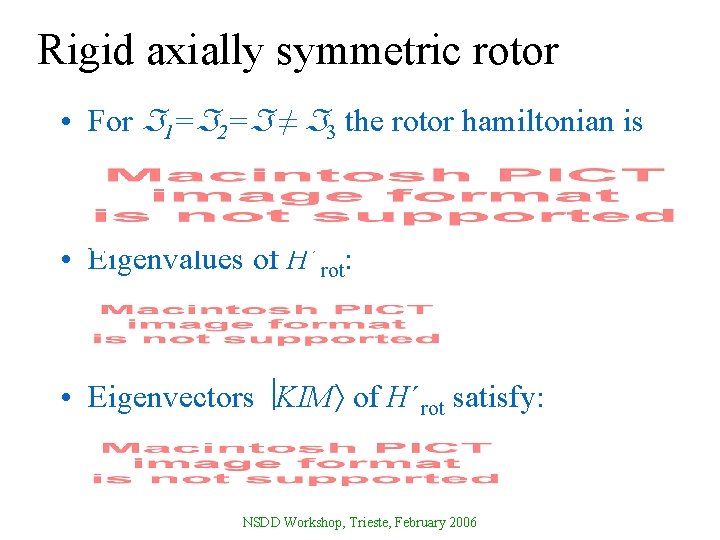
Rigid axially symmetric rotor • For 1= 2= ≠ 3 the rotor hamiltonian is • Eigenvalues of H´rot: • Eigenvectors KIM of H´rot satisfy: NSDD Workshop, Trieste, February 2006
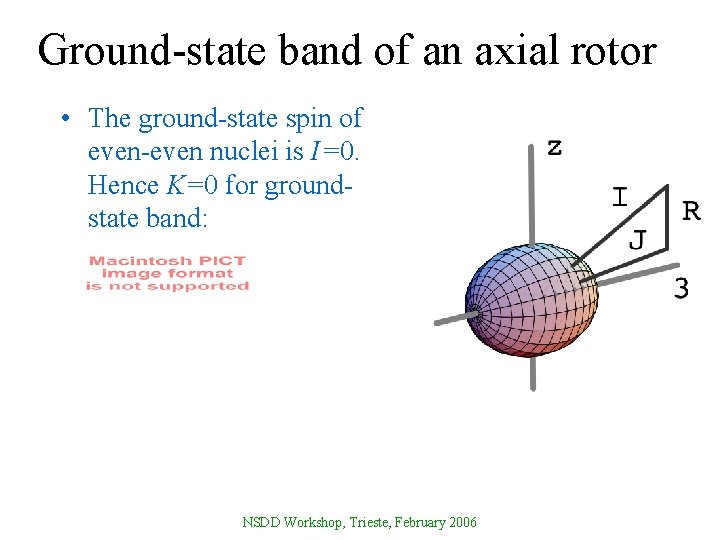
Ground-state band of an axial rotor • The ground-state spin of even-even nuclei is I=0. Hence K=0 for groundstate band: NSDD Workshop, Trieste, February 2006
The ratio R 42 NSDD Workshop, Trieste, February 2006
Electric (quadrupole) properties • Partial -ray half-life: • Electric quadrupole transitions: • Electric quadrupole moments: NSDD Workshop, Trieste, February 2006
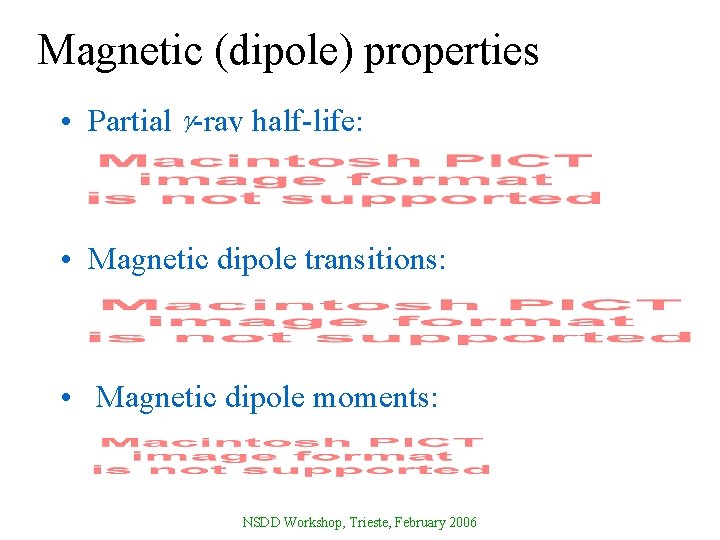
Magnetic (dipole) properties • Partial -ray half-life: • Magnetic dipole transitions: • Magnetic dipole moments: NSDD Workshop, Trieste, February 2006
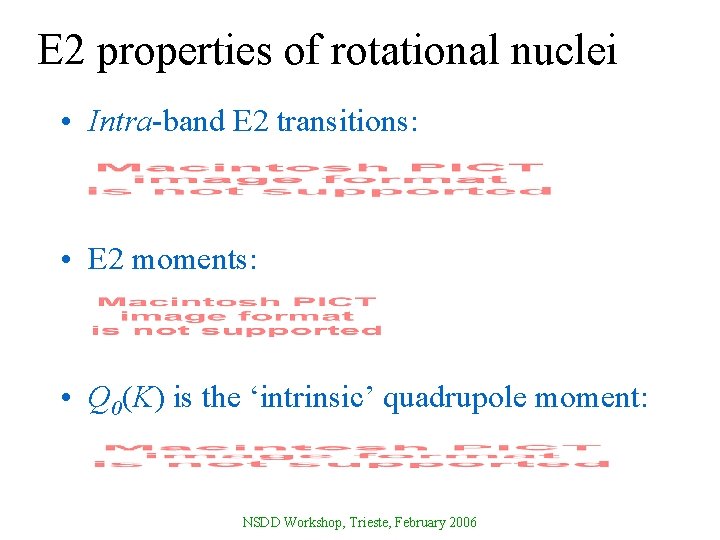
E 2 properties of rotational nuclei • Intra-band E 2 transitions: • E 2 moments: • Q 0(K) is the ‘intrinsic’ quadrupole moment: NSDD Workshop, Trieste, February 2006
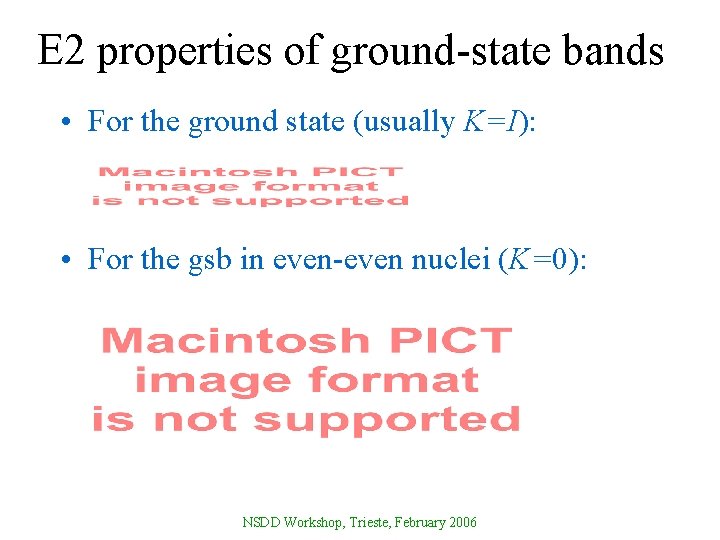
E 2 properties of ground-state bands • For the ground state (usually K=I): • For the gsb in even-even nuclei (K=0): NSDD Workshop, Trieste, February 2006
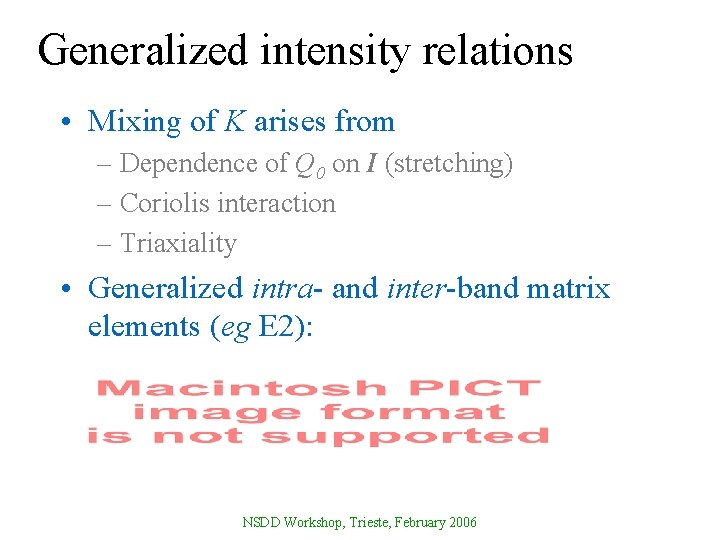
Generalized intensity relations • Mixing of K arises from – Dependence of Q 0 on I (stretching) – Coriolis interaction – Triaxiality • Generalized intra- and inter-band matrix elements (eg E 2): NSDD Workshop, Trieste, February 2006
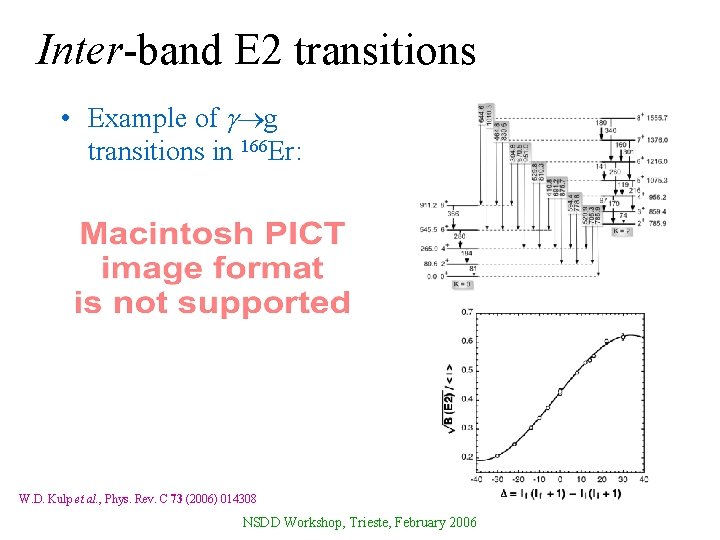
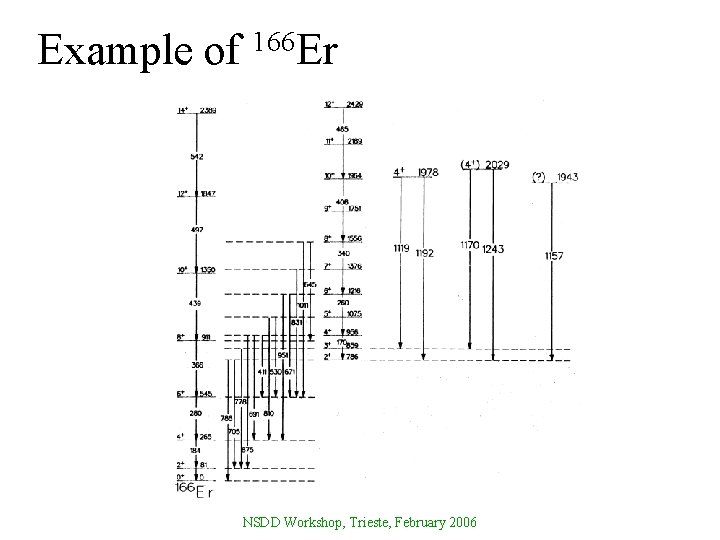
Inter-band E 2 transitions • Example of g transitions in 166 Er: W. D. Kulp et al. , Phys. Rev. C 73 (2006) 014308 NSDD Workshop, Trieste, February 2006
Modes of nuclear vibration • Nucleus is considered as a droplet of nuclear matter with an equilibrium shape. Vibrations are modes of excitation around that shape. • Character of vibrations depends on symmetry of equilibrium shape. Two important cases in nuclei: – Spherical equilibrium shape – Spheroidal equilibrium shape NSDD Workshop, Trieste, February 2006
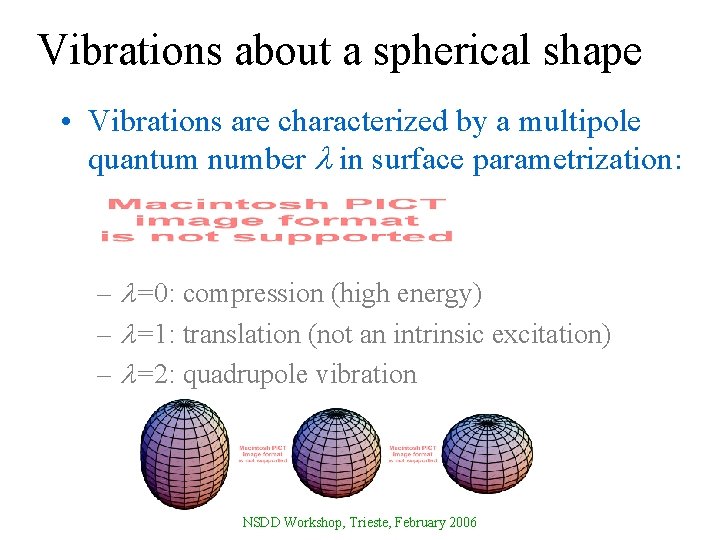
Vibrations about a spherical shape • Vibrations are characterized by a multipole quantum number in surface parametrization: – =0: compression (high energy) – =1: translation (not an intrinsic excitation) – =2: quadrupole vibration NSDD Workshop, Trieste, February 2006
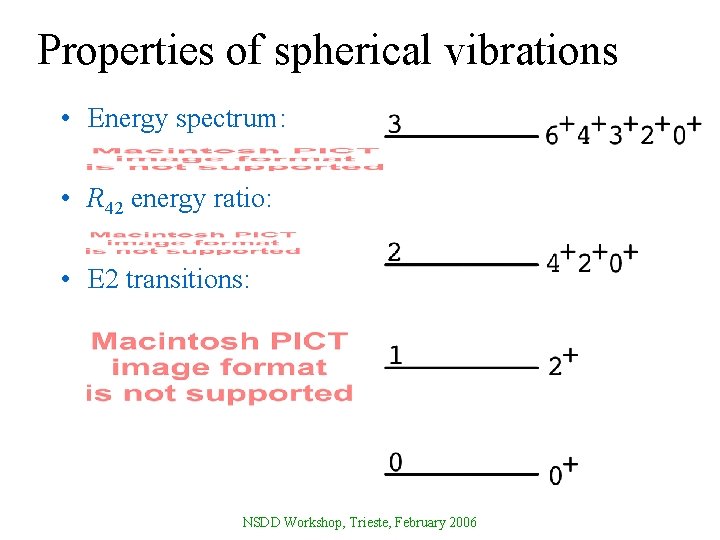
Properties of spherical vibrations • Energy spectrum: • R 42 energy ratio: • E 2 transitions: NSDD Workshop, Trieste, February 2006
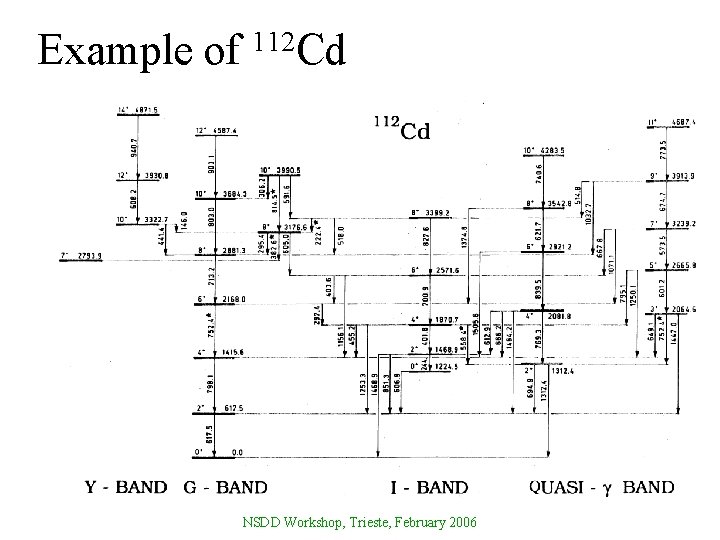
Example of 112 Cd NSDD Workshop, Trieste, February 2006
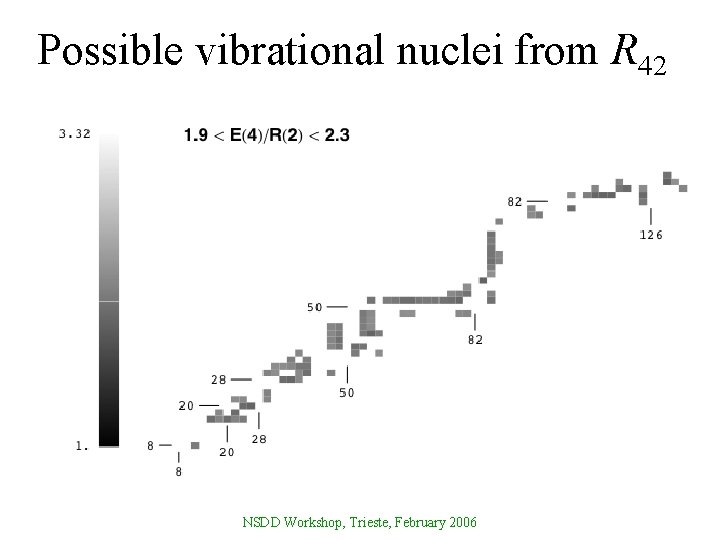
Possible vibrational nuclei from R 42 NSDD Workshop, Trieste, February 2006
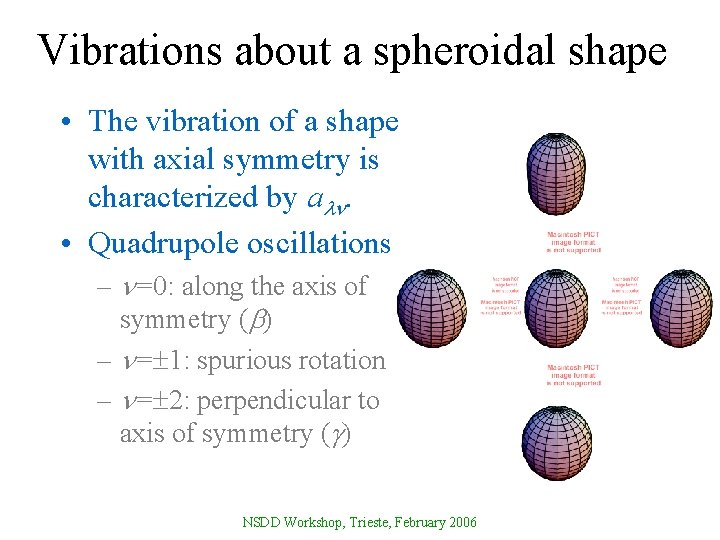
Vibrations about a spheroidal shape • The vibration of a shape with axial symmetry is characterized by a . • Quadrupole oscillations: – =0: along the axis of symmetry ( ) – = 1: spurious rotation – = 2: perpendicular to axis of symmetry ( ) NSDD Workshop, Trieste, February 2006
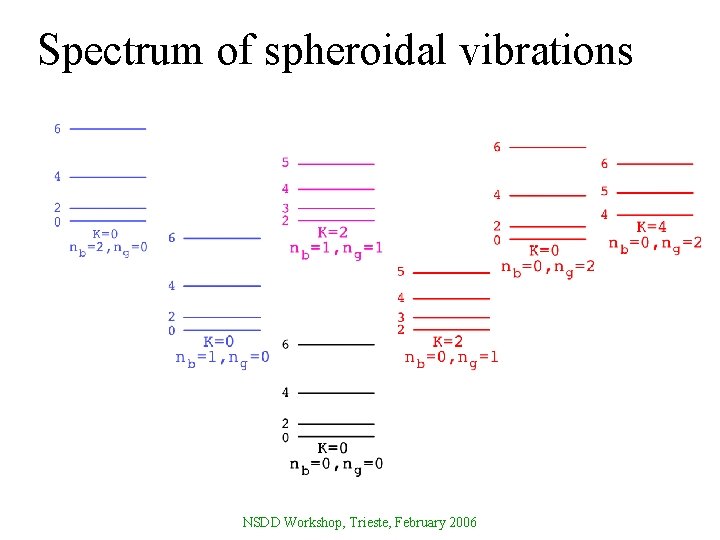
Spectrum of spheroidal vibrations NSDD Workshop, Trieste, February 2006
Example of 166 Er NSDD Workshop, Trieste, February 2006
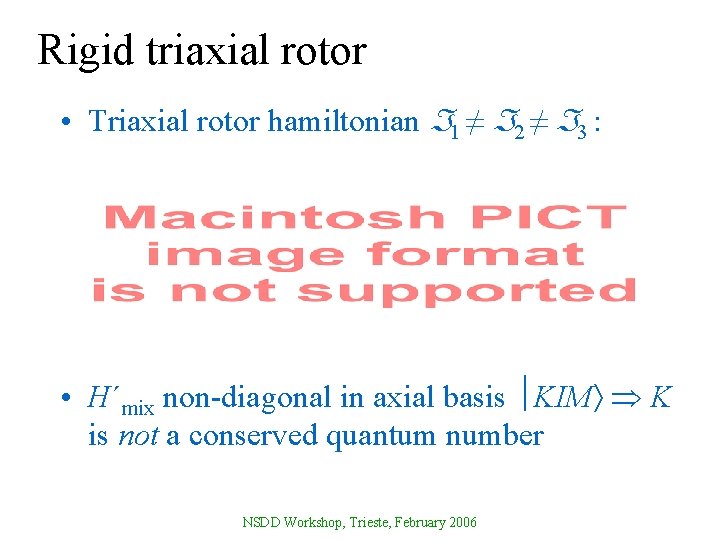
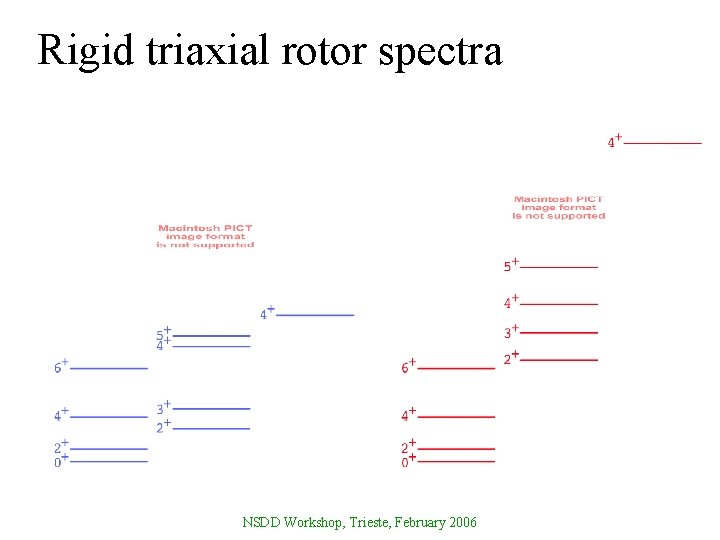
Rigid triaxial rotor • Triaxial rotor hamiltonian 1 ≠ 2 ≠ 3 : • H´mix non-diagonal in axial basis KIM K is not a conserved quantum number NSDD Workshop, Trieste, February 2006
Rigid triaxial rotor spectra NSDD Workshop, Trieste, February 2006
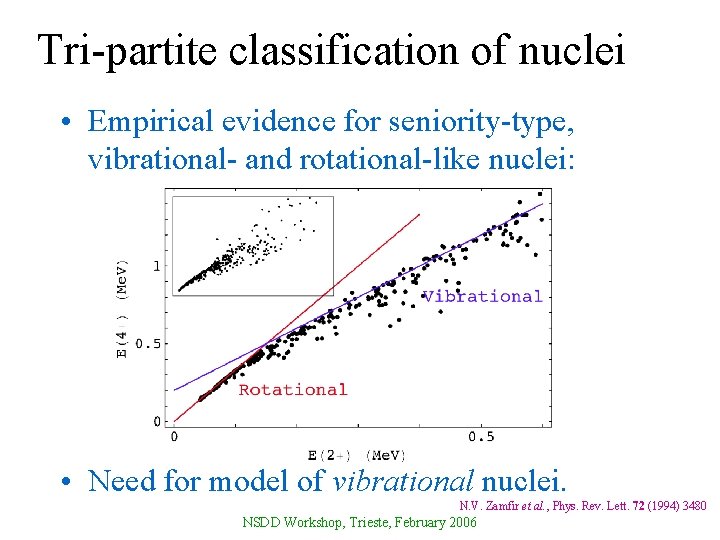
Tri-partite classification of nuclei • Empirical evidence for seniority-type, vibrational- and rotational-like nuclei: • Need for model of vibrational nuclei. N. V. Zamfir et al. , Phys. Rev. Lett. 72 (1994) 3480 NSDD Workshop, Trieste, February 2006
Interacting boson model • Describe the nucleus as a system of N interacting s and d bosons. Hamiltonian: • Justification from – Shell model: s and d bosons are associated with S and D fermion (Cooper) pairs. – Geometric model: for large boson number the IBM reduces to a liquid-drop hamiltonian. NSDD Workshop, Trieste, February 2006
Dimensions • Assume available 1 -fermion states. Number of n-fermion states is • Assume available 1 -boson states. Number of n-boson states is • Example: 162 Dy 96 with 14 neutrons ( =44) and 16 protons ( =32) (132 Sn 82 inert core). – SM dimension: ~7· 1019 – IBM dimension: 15504 NSDD Workshop, Trieste, February 2006
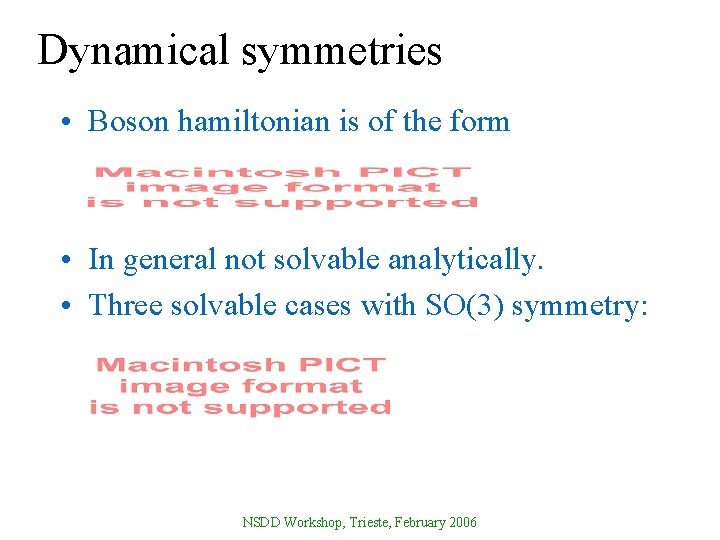
Dynamical symmetries • Boson hamiltonian is of the form • In general not solvable analytically. • Three solvable cases with SO(3) symmetry: NSDD Workshop, Trieste, February 2006
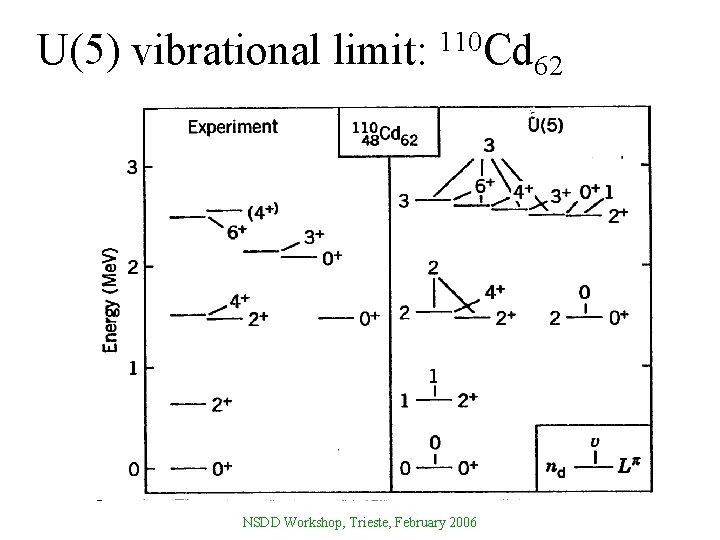
U(5) vibrational limit: 110 Cd NSDD Workshop, Trieste, February 2006 62
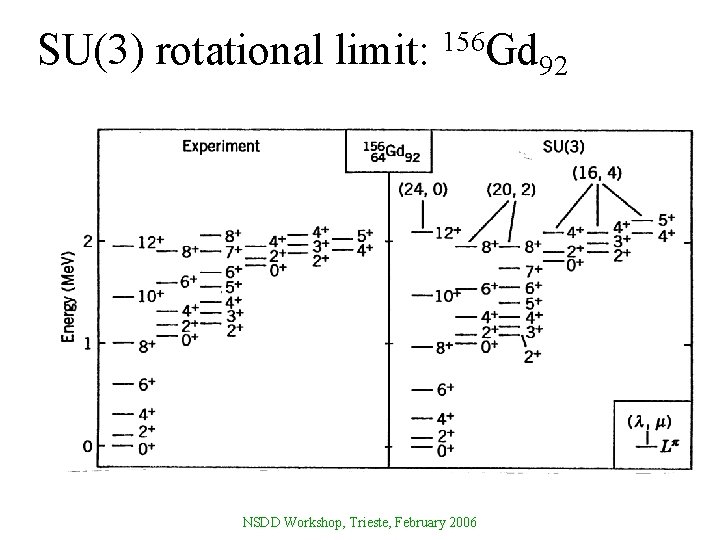
SU(3) rotational limit: 156 Gd NSDD Workshop, Trieste, February 2006 92
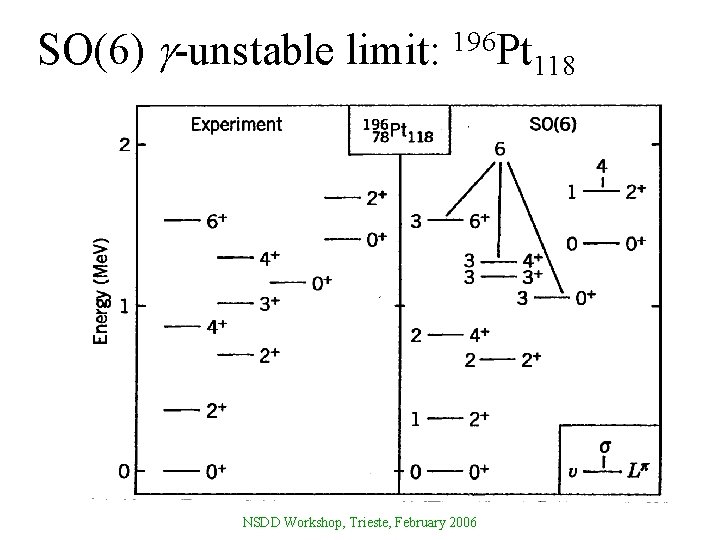
SO(6) -unstable limit: 196 Pt NSDD Workshop, Trieste, February 2006 118
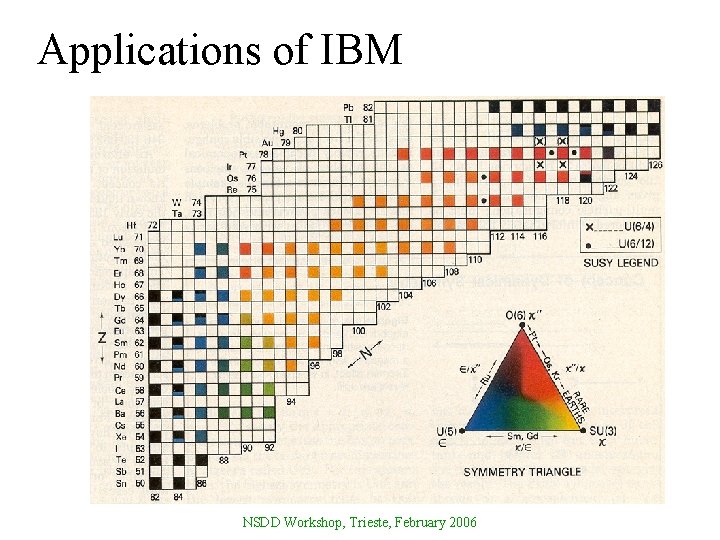
Applications of IBM NSDD Workshop, Trieste, February 2006
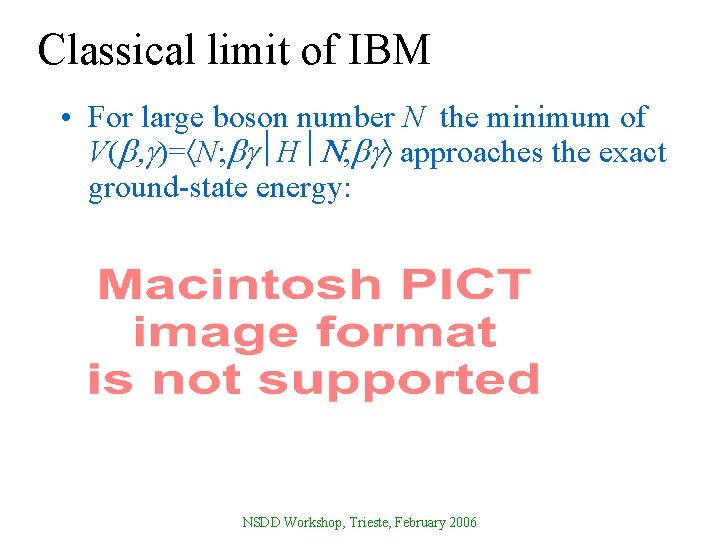
Classical limit of IBM • For large boson number N the minimum of V( )= N; H approaches the exact ground-state energy: NSDD Workshop, Trieste, February 2006
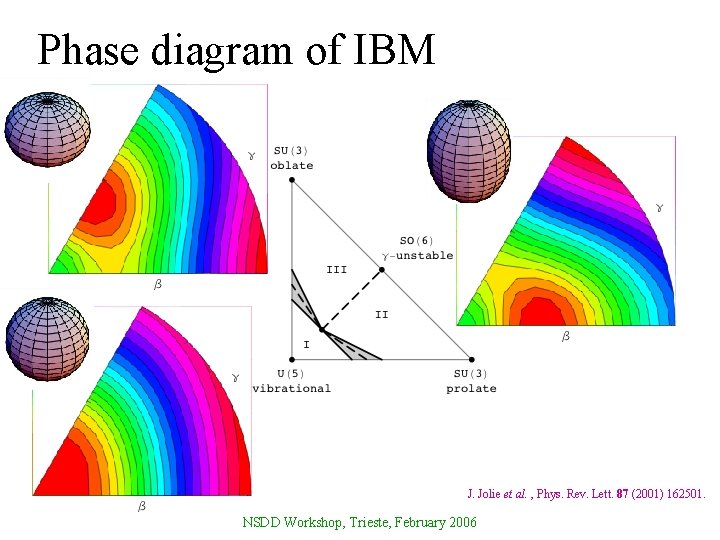
Phase diagram of IBM J. Jolie et al. , Phys. Rev. Lett. 87 (2001) 162501. NSDD Workshop, Trieste, February 2006
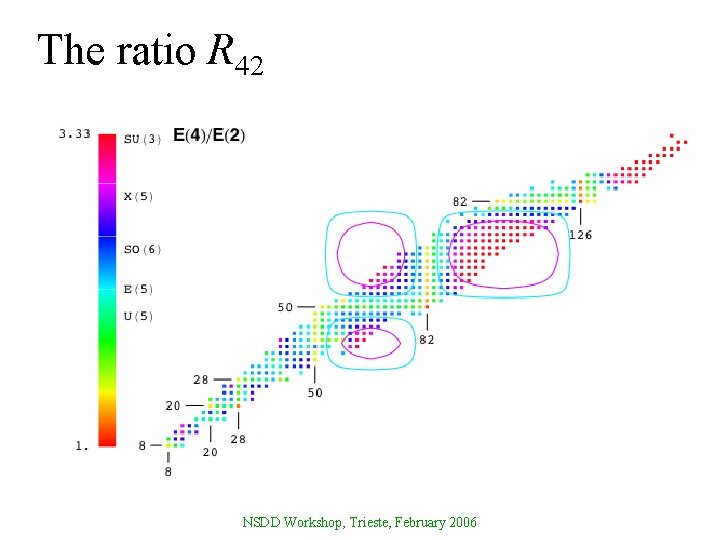
The ratio R 42 NSDD Workshop, Trieste, February 2006
Extensions of IBM • Neutron and proton degrees freedom (IBM-2): – F-spin multiplets (N +N =constant) – Scissors excitations • Fermion degrees of freedom (IBFM): – Odd-mass nuclei – Supersymmetry (doublets & quartets) • Other boson degrees of freedom: – Isospin T=0 & T=1 pairs (IBM-3 & IBM-4) – Higher multipole (g, …) pairs NSDD Workshop, Trieste, February 2006
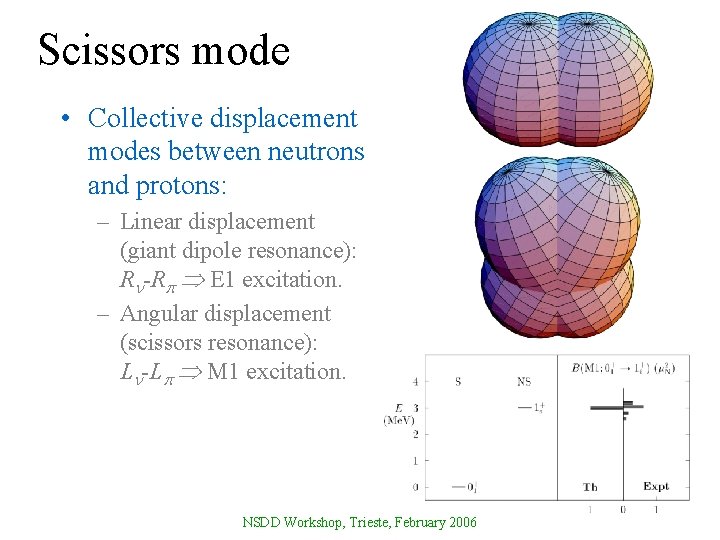
Scissors mode • Collective displacement modes between neutrons and protons: – Linear displacement (giant dipole resonance): R -R E 1 excitation. – Angular displacement (scissors resonance): L -L M 1 excitation. NSDD Workshop, Trieste, February 2006
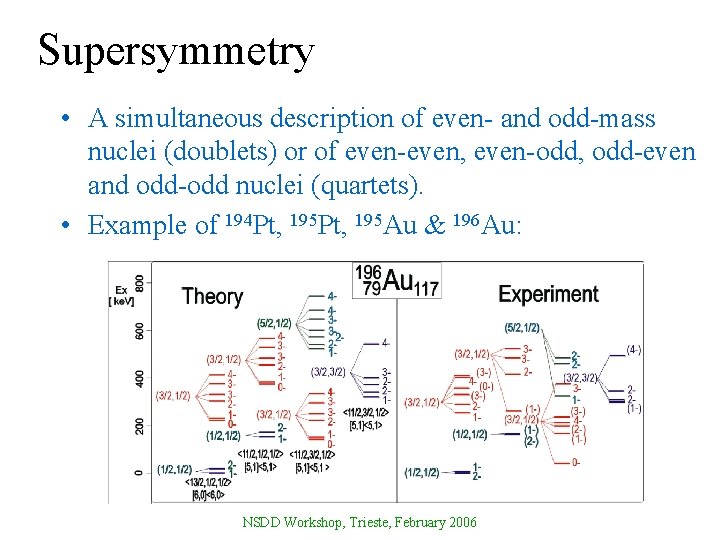
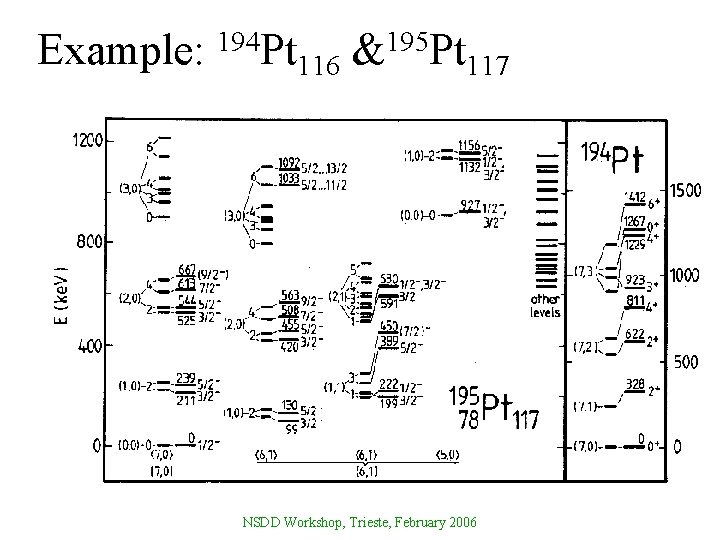
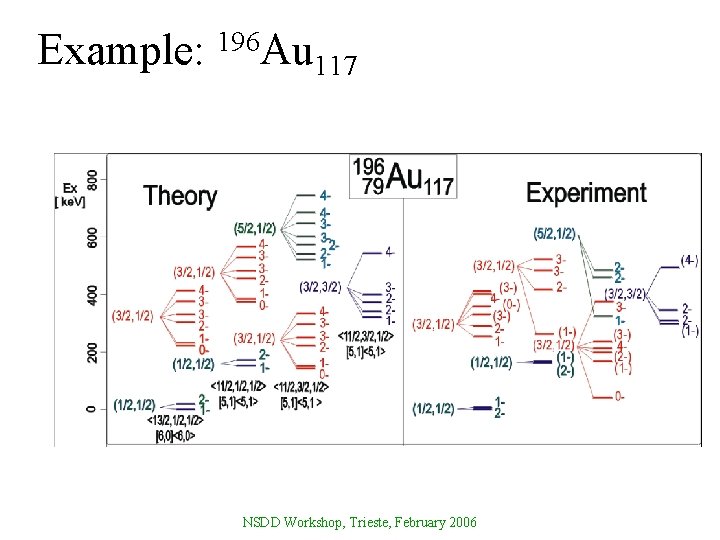
Supersymmetry • A simultaneous description of even- and odd-mass nuclei (doublets) or of even-even, even-odd, odd-even and odd-odd nuclei (quartets). • Example of 194 Pt, 195 Au & 196 Au: NSDD Workshop, Trieste, February 2006
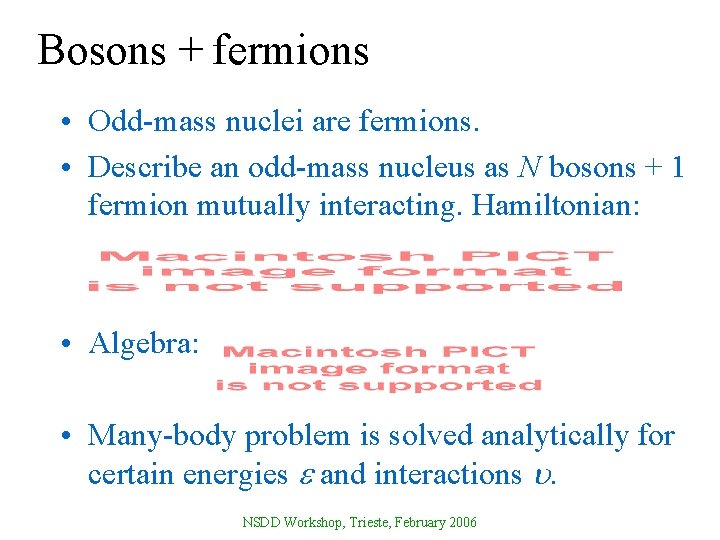
Bosons + fermions • Odd-mass nuclei are fermions. • Describe an odd-mass nucleus as N bosons + 1 fermion mutually interacting. Hamiltonian: • Algebra: • Many-body problem is solved analytically for certain energies and interactions . NSDD Workshop, Trieste, February 2006
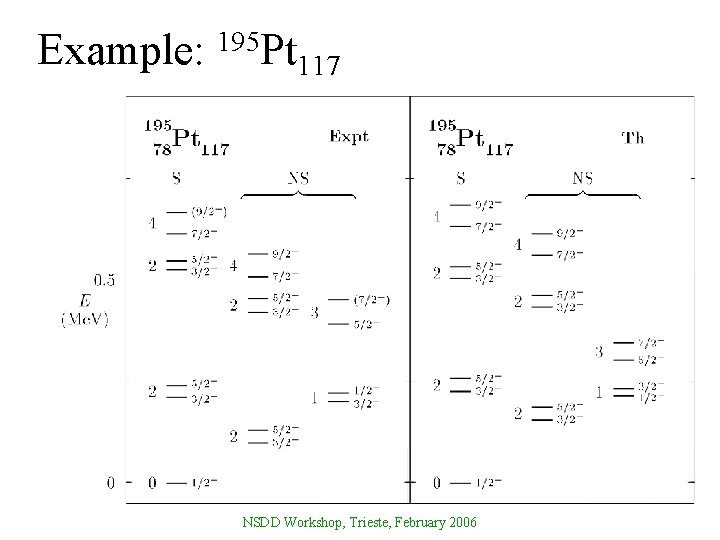
Example: 195 Pt 117 NSDD Workshop, Trieste, February 2006
Example: 195 Pt 117 (new data) NSDD Workshop, Trieste, February 2006
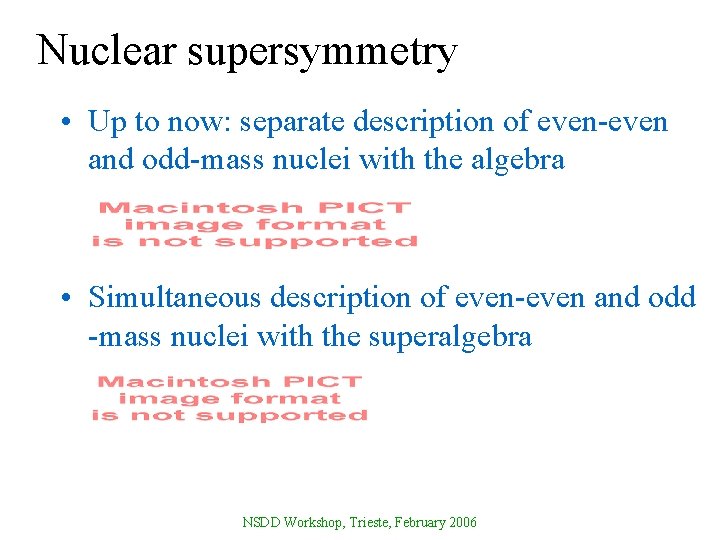
Nuclear supersymmetry • Up to now: separate description of even-even and odd-mass nuclei with the algebra • Simultaneous description of even-even and odd -mass nuclei with the superalgebra NSDD Workshop, Trieste, February 2006
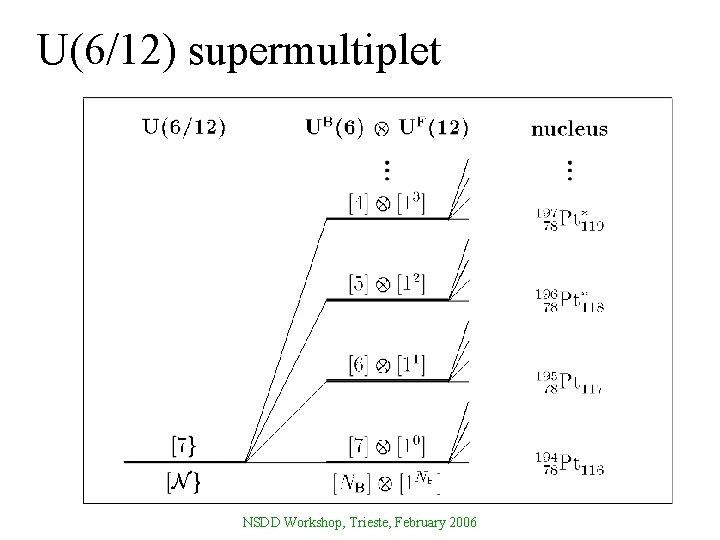
U(6/12) supermultiplet NSDD Workshop, Trieste, February 2006
Example: 194 Pt 116 195 & Pt 117 NSDD Workshop, Trieste, February 2006
Example: 196 Au 117 NSDD Workshop, Trieste, February 2006
Bibliography • A. Bohr and B. R. Mottelson, Nuclear Structure. I Single-Particle Motion (Benjamin, 1969). • A. Bohr and B. R. Mottelson, Nuclear Structure. II Nuclear Deformations (Benjamin, 1975). • R. D. Lawson, Theory of the Nuclear Shell Model (Oxford UP, 1980). • K. L. G. Heyde, The Nuclear Shell Model (Springer. Verlag, 1990). • I. Talmi, Simple Models of Complex Nuclei (Harwood, 1993). NSDD Workshop, Trieste, February 2006
Bibliography (continued) • P. Ring and P. Schuck, The Nuclear Many-Body Problem (Springer, 1980). • D. J. Rowe, Nuclear Collective Motion (Methuen, 1970). • D. J. Rowe and J. L. Wood, Fundamentals of Nuclear Collective Models, to appear. • F. Iachello and A. Arima, The Interacting Boson Model (Cambridge UP, 1987). NSDD Workshop, Trieste, February 2006