
Nuclear Spectroscopic Telescope Array What can Nu STAR
- Slides: 1
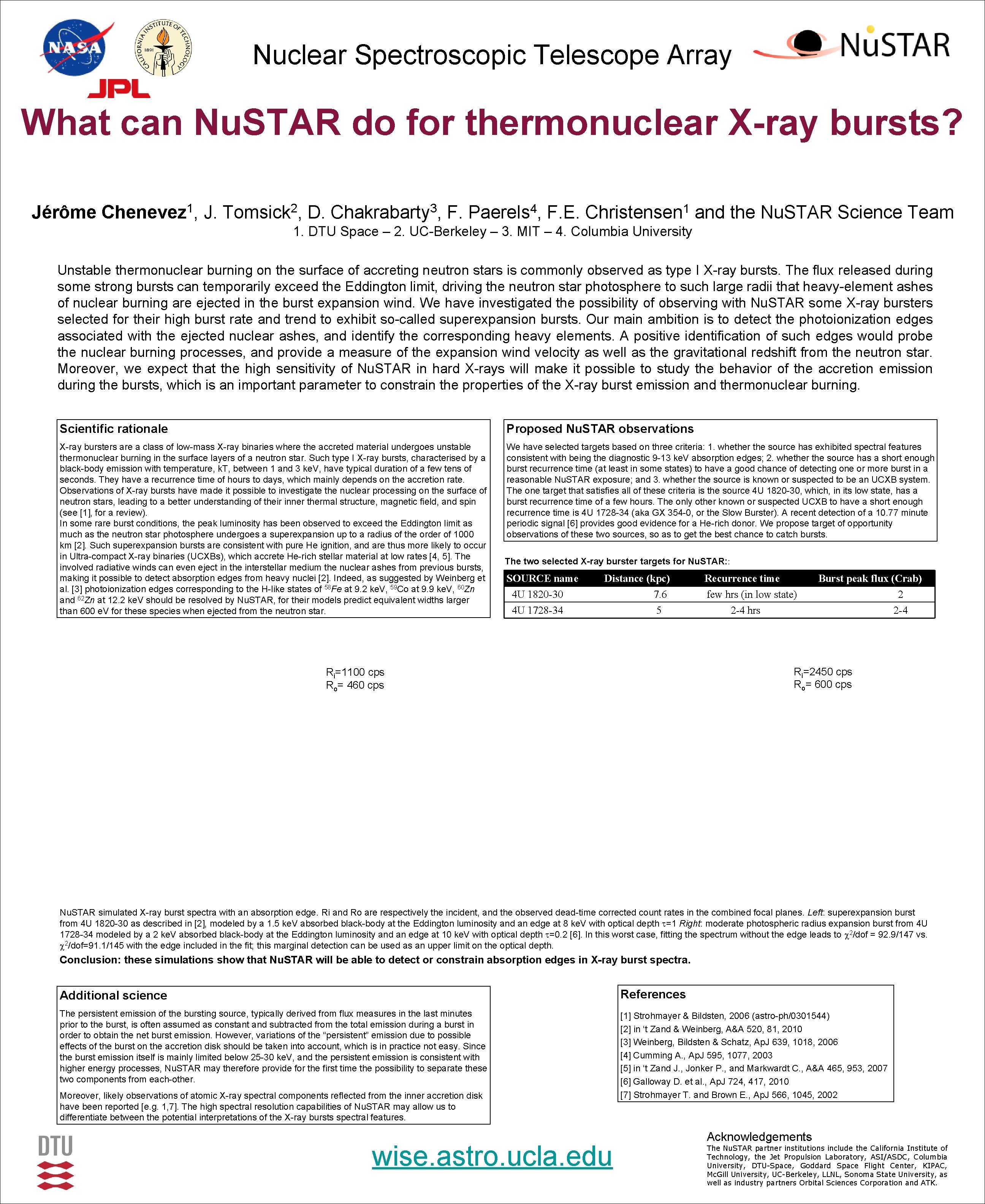
Nuclear Spectroscopic Telescope Array What can Nu. STAR do for thermonuclear X-ray bursts? Jérôme 1 Chenevez , J. 2 Tomsick , D. 3 Chakrabarty , F. Paerels 4, F. E. Christensen 1 and the Nu. STAR Science Team 1. DTU Space – 2. UC-Berkeley – 3. MIT – 4. Columbia University Unstable thermonuclear burning on the surface of accreting neutron stars is commonly observed as type I X-ray bursts. The flux released during some strong bursts can temporarily exceed the Eddington limit, driving the neutron star photosphere to such large radii that heavy-element ashes of nuclear burning are ejected in the burst expansion wind. We have investigated the possibility of observing with Nu. STAR some X-ray bursters selected for their high burst rate and trend to exhibit so-called superexpansion bursts. Our main ambition is to detect the photoionization edges associated with the ejected nuclear ashes, and identify the corresponding heavy elements. A positive identification of such edges would probe the nuclear burning processes, and provide a measure of the expansion wind velocity as well as the gravitational redshift from the neutron star. Moreover, we expect that the high sensitivity of Nu. STAR in hard X-rays will make it possible to study the behavior of the accretion emission during the bursts, which is an important parameter to constrain the properties of the X-ray burst emission and thermonuclear burning. Scientific rationale Proposed Nu. STAR observations X-ray bursters are a class of low-mass X-ray binaries where the accreted material undergoes unstable thermonuclear burning in the surface layers of a neutron star. Such type I X-ray bursts, characterised by a black-body emission with temperature, k. T, between 1 and 3 ke. V, have typical duration of a few tens of seconds. They have a recurrence time of hours to days, which mainly depends on the accretion rate. Observations of X-ray bursts have made it possible to investigate the nuclear processing on the surface of neutron stars, leading to a better understanding of their inner thermal structure, magnetic field, and spin (see [1], for a review). In some rare burst conditions, the peak luminosity has been observed to exceed the Eddington limit as much as the neutron star photosphere undergoes a superexpansion up to a radius of the order of 1000 km [2]. Such superexpansion bursts are consistent with pure He ignition, and are thus more likely to occur in Ultra-compact X-ray binaries (UCXBs), which accrete He-rich stellar material at low rates [4, 5]. The involved radiative winds can even eject in the interstellar medium the nuclear ashes from previous bursts, making it possible to detect absorption edges from heavy nuclei [2]. Indeed, as suggested by Weinberg et al. [3] photoionization edges corresponding to the H-like states of 58 Fe at 9. 2 ke. V, 59 Co at 9. 9 ke. V, 60 Zn and 62 Zn at 12. 2 ke. V should be resolved by Nu. STAR, for their models predict equivalent widths larger than 600 e. V for these species when ejected from the neutron star. We have selected targets based on three criteria: 1. whether the source has exhibited spectral features consistent with being the diagnostic 9 -13 ke. V absorption edges; 2. whether the source has a short enough burst recurrence time (at least in some states) to have a good chance of detecting one or more burst in a reasonable Nu. STAR exposure; and 3. whether the source is known or suspected to be an UCXB system. The one target that satisfies all of these criteria is the source 4 U 1820 -30, which, in its low state, has a burst recurrence time of a few hours. The only other known or suspected UCXB to have a short enough recurrence time is 4 U 1728 -34 (aka GX 354 -0, or the Slow Burster). A recent detection of a 10. 77 minute periodic signal [6] provides good evidence for a He-rich donor. We propose target of opportunity observations of these two sources, so as to get the best chance to catch bursts. The two selected X-ray burster targets for Nu. STAR: : SOURCE name Distance (kpc) 4 U 1820 -30 4 U 1728 -34 7. 6 5 Recurrence time Burst peak flux (Crab) few hrs (in low state) 2 -4 hrs 2 2 -4 Ri=2450 cps Ro= 600 cps Ri=1100 cps Ro= 460 cps Nu. STAR simulated X-ray burst spectra with an absorption edge. Ri and Ro are respectively the incident, and the observed dead-time corrected count rates in the combined focal planes. Left: superexpansion burst from 4 U 1820 -30 as described in [2], modeled by a 1. 5 ke. V absorbed black-body at the Eddington luminosity and an edge at 8 ke. V with optical depth =1 Right: moderate photospheric radius expansion burst from 4 U 1728 -34 modeled by a 2 ke. V absorbed black-body at the Eddington luminosity and an edge at 10 ke. V with optical depth =0. 2 [6]. In this worst case, fitting the spectrum without the edge leads to 2/dof = 92. 9/147 vs. 2/dof=91. 1/145 with the edge included in the fit; this marginal detection can be used as an upper limit on the optical depth. Conclusion: these simulations show that Nu. STAR will be able to detect or constrain absorption edges in X-ray burst spectra. Additional science References The persistent emission of the bursting source, typically derived from flux measures in the last minutes prior to the burst, is often assumed as constant and subtracted from the total emission during a burst in order to obtain the net burst emission. However, variations of the “persistent” emission due to possible effects of the burst on the accretion disk should be taken into account, which is in practice not easy. Since the burst emission itself is mainly limited below 25 -30 ke. V, and the persistent emission is consistent with higher energy processes, Nu. STAR may therefore provide for the first time the possibility to separate these two components from each-other. [1] Strohmayer & Bildsten, 2006 (astro-ph/0301544) [2] in ‘t Zand & Weinberg, A&A 520, 81, 2010 [3] Weinberg, Bildsten & Schatz, Ap. J 639, 1018, 2006 [4] Cumming A. , Ap. J 595, 1077, 2003 [5] in ‘t Zand J. , Jonker P. , and Markwardt C. , A&A 465, 953, 2007 [6] Galloway D. et al. , Ap. J 724, 417, 2010 [7] Strohmayer T. and Brown E. , Ap. J 566, 1045, 2002 Moreover, likely observations of atomic X-ray spectral components reflected from the inner accretion disk have been reported [e. g. 1, 7]. The high spectral resolution capabilities of Nu. STAR may allow us to differentiate between the potential interpretations of the X-ray bursts spectral features. wise. astro. ucla. edu Acknowledgements The Nu. STAR partner institutions include the California Institute of Technology, the Jet Propulsion Laboratory, ASI/ASDC, Columbia University, DTU-Space, Goddard Space Flight Center, KIPAC, Mc. Gill University, UC-Berkeley, LLNL, Sonoma State University, as well as industry partners Orbital Sciences Corporation and ATK.