
Nuclear Research Reactors Seminar on Nuclear Science and
- Slides: 34
Nuclear Research Reactors Seminar on Nuclear Science and Technology for Diplomats P. Adelfang(+), N. Ramamoorthy(*) (+)Division of Nuclear Fuel Cycle and Waste Technology (NEFW) Dept. of Nuclear Energy (NE) (*)Division of Physical and Chemical Sciences (NAPC) Dept. of Nuclear Sciences and Applications (NA) IAEA, Vienna, February 6 -8, 2007
Nuclear Research Reactors (RR) Outline of Presentation • • • Introduction to RR principles, components RR types and features RR utilization: Techniques and Applications RR issues & needs: perceptions and concerns Agency assistance on RRs Some Stories of Success
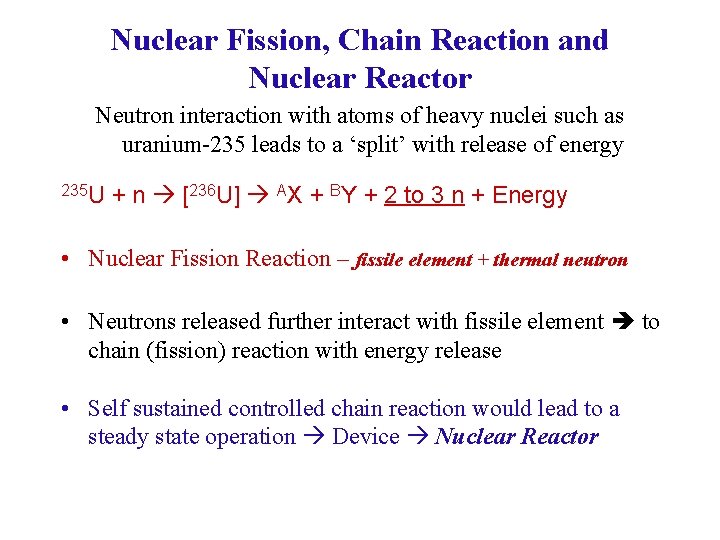
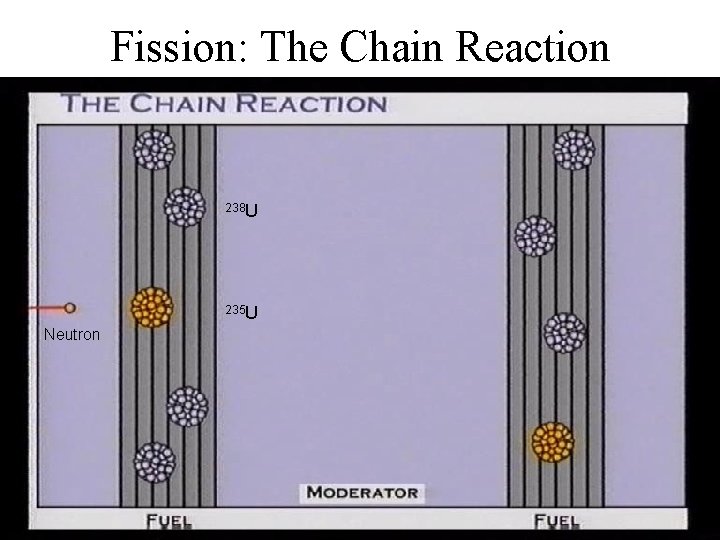
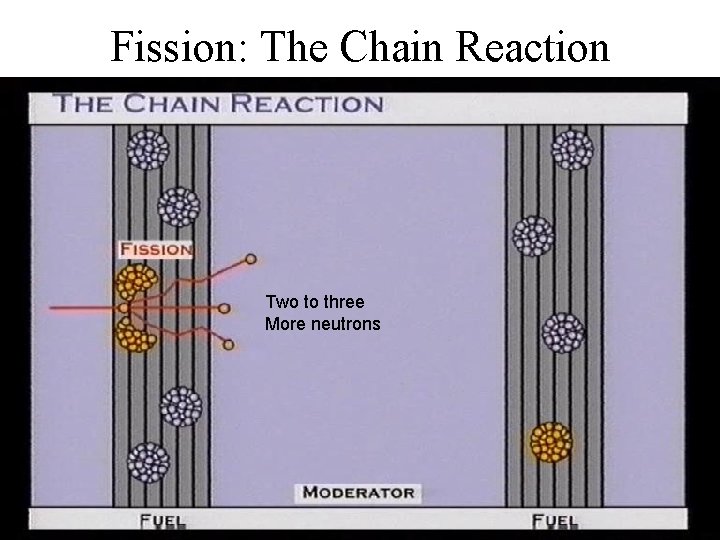
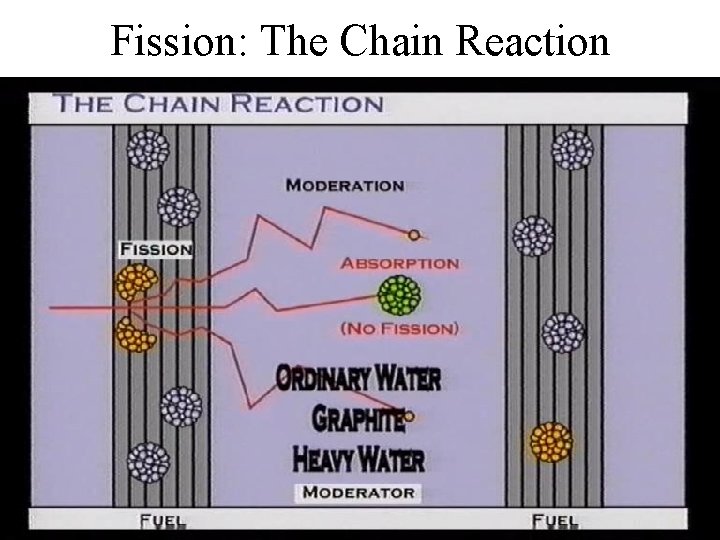
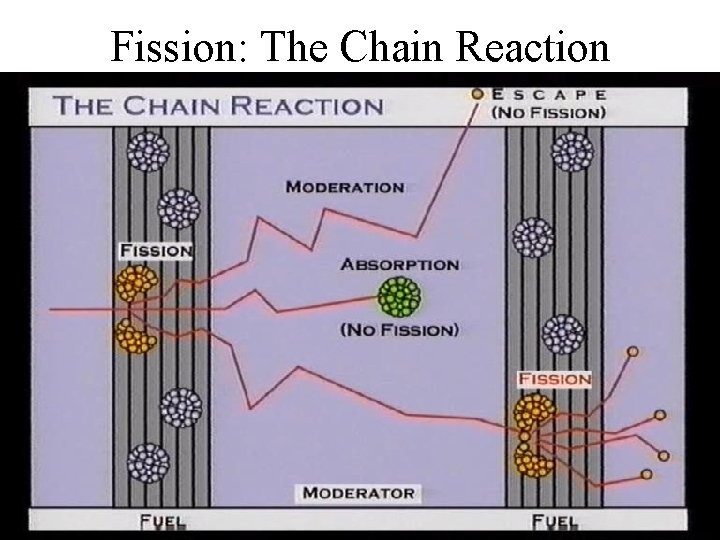
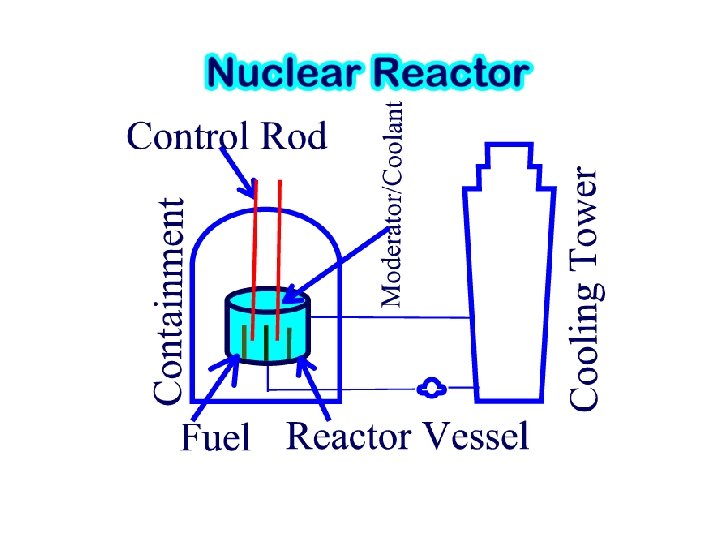
Nuclear Fission, Chain Reaction and Nuclear Reactor Neutron interaction with atoms of heavy nuclei such as uranium-235 leads to a ‘split’ with release of energy 235 U + n [236 U] AX + BY + 2 to 3 n + Energy • Nuclear Fission Reaction – fissile element + thermal neutron • Neutrons released further interact with fissile element to chain (fission) reaction with energy release • Self sustained controlled chain reaction would lead to a steady state operation Device Nuclear Reactor
Fission: The Chain Reaction 238 U 235 U Neutron
Fission: The Chain Reaction Two to three More neutrons
Fission: The Chain Reaction
Fission: The Chain Reaction
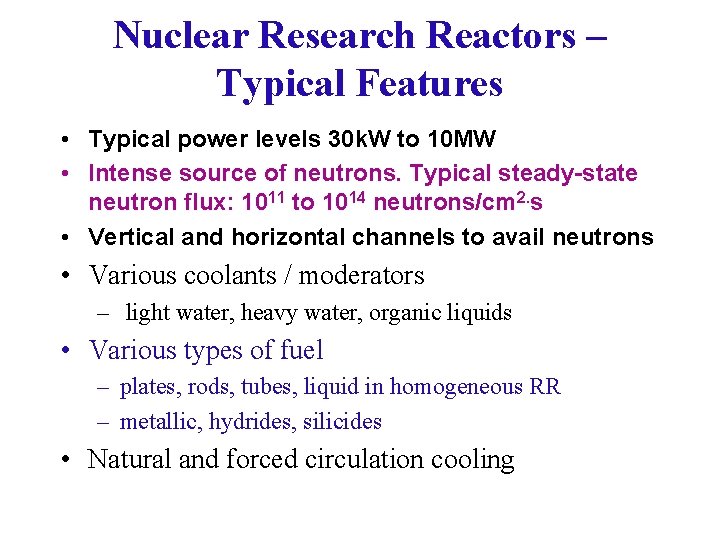
Nuclear Research Reactors – Typical Features • Typical power levels 30 k. W to 10 MW • Intense source of neutrons. Typical steady-state neutron flux: 1011 to 1014 neutrons/cm 2. s • Vertical and horizontal channels to avail neutrons • Various coolants / moderators – light water, heavy water, organic liquids • Various types of fuel – plates, rods, tubes, liquid in homogeneous RR – metallic, hydrides, silicides • Natural and forced circulation cooling
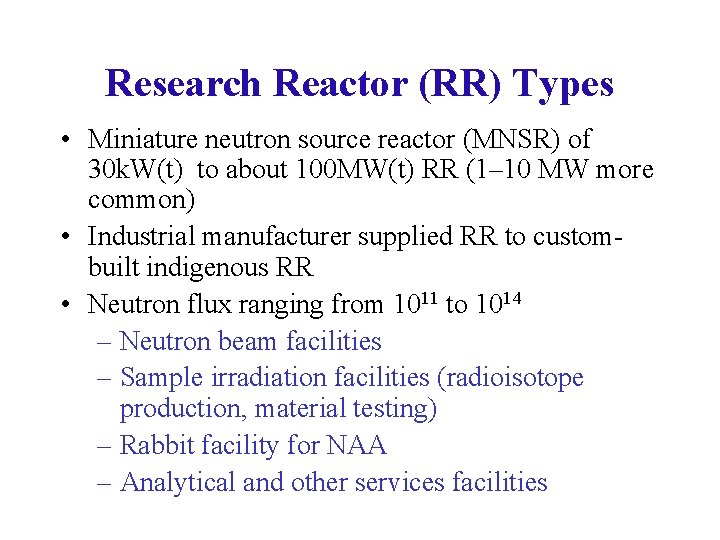
Research Reactor (RR) Types • Miniature neutron source reactor (MNSR) of 30 k. W(t) to about 100 MW(t) RR (1– 10 MW more common) • Industrial manufacturer supplied RR to custombuilt indigenous RR • Neutron flux ranging from 1011 to 1014 – Neutron beam facilities – Sample irradiation facilities (radioisotope production, material testing) – Rabbit facility for NAA – Analytical and other services facilities
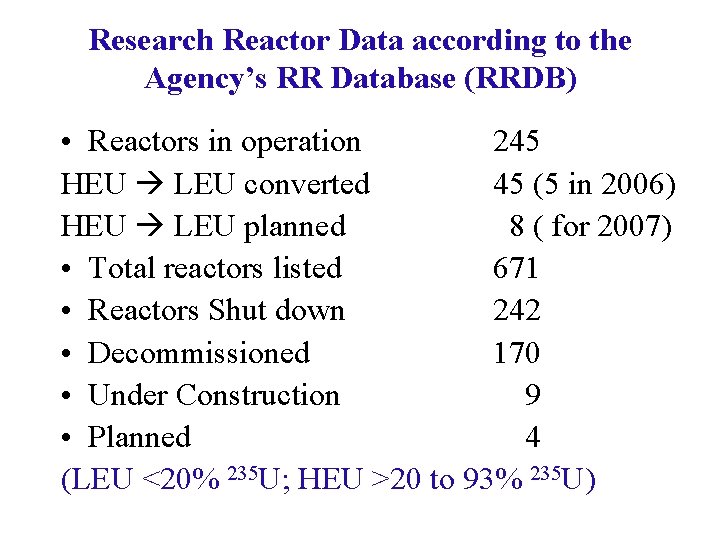
Research Reactor Data according to the Agency’s RR Database (RRDB) • Reactors in operation 245 HEU LEU converted 45 (5 in 2006) HEU LEU planned 8 ( for 2007) • Total reactors listed 671 • Reactors Shut down 242 • Decommissioned 170 • Under Construction 9 • Planned 4 (LEU <20% 235 U; HEU >20 to 93% 235 U)
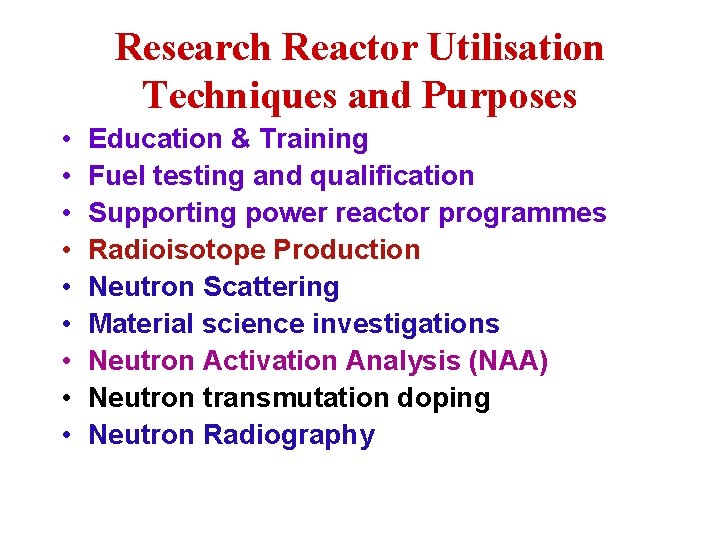
Research Reactor Utilisation Techniques and Purposes • • • Education & Training Fuel testing and qualification Supporting power reactor programmes Radioisotope Production Neutron Scattering Material science investigations Neutron Activation Analysis (NAA) Neutron transmutation doping Neutron Radiography
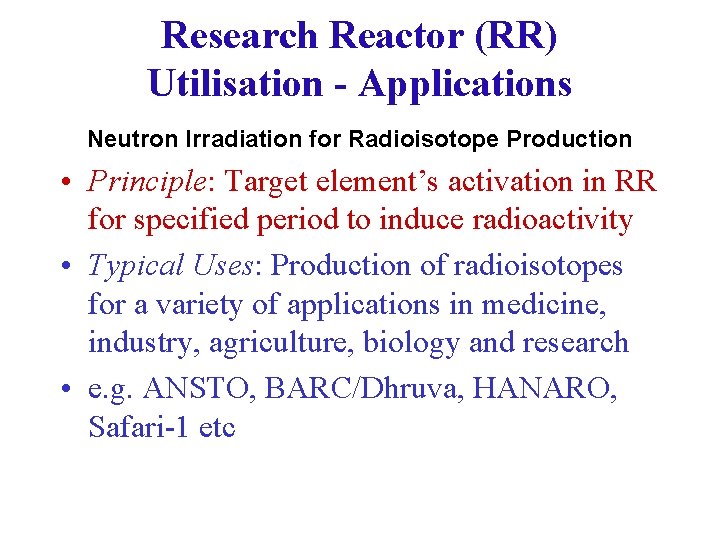
Research Reactor (RR) Utilisation - Applications Neutron Irradiation for Radioisotope Production • Principle: Target element’s activation in RR for specified period to induce radioactivity • Typical Uses: Production of radioisotopes for a variety of applications in medicine, industry, agriculture, biology and research • e. g. ANSTO, BARC/Dhruva, HANARO, Safari-1 etc
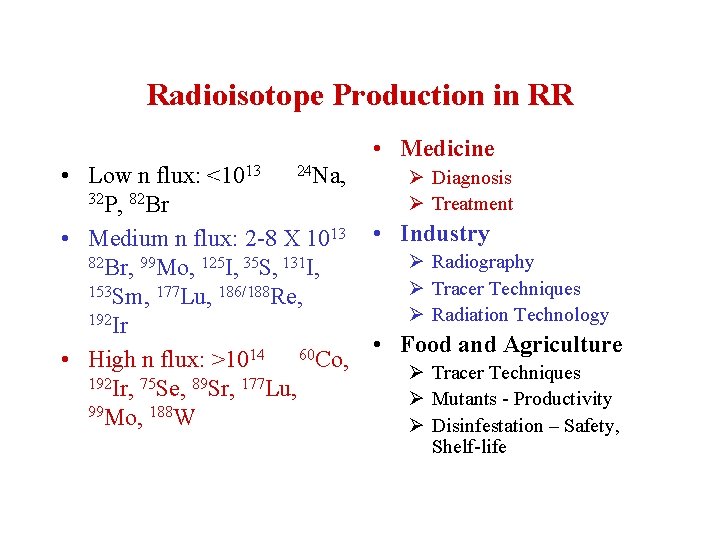
Radioisotope Production in RR • Low n flux: <1013 24 Na, 32 P, 82 Br • Medium n flux: 2 -8 X 10¹³ 82 Br, 99 Mo, 125 I, 35 S, 131 I, 153 Sm, 177 Lu, 186/188 Re, 192 Ir • High n flux: >1014 60 Co, 192 Ir, 75 Se, 89 Sr, 177 Lu, 99 Mo, 188 W • Medicine Ø Diagnosis Ø Treatment • Industry Ø Radiography Ø Tracer Techniques Ø Radiation Technology • Food and Agriculture Ø Tracer Techniques Ø Mutants - Productivity Ø Disinfestation – Safety, Shelf-life
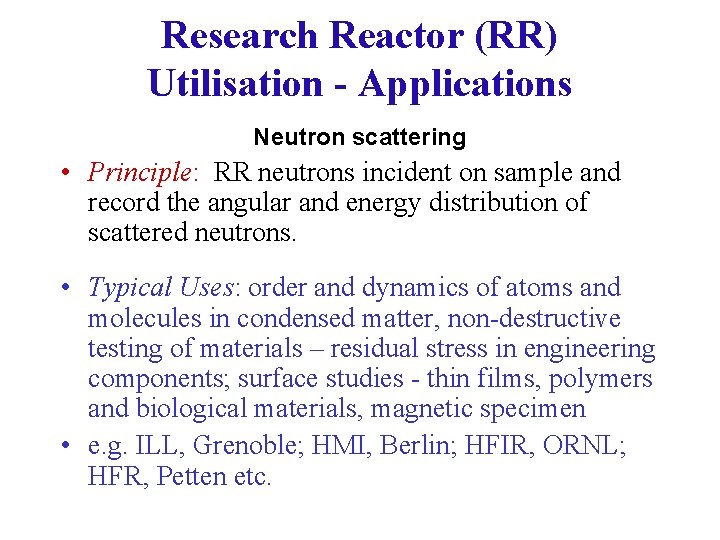
Research Reactor (RR) Utilisation - Applications Neutron scattering • Principle: RR neutrons incident on sample and record the angular and energy distribution of scattered neutrons. • Typical Uses: order and dynamics of atoms and molecules in condensed matter, non-destructive testing of materials – residual stress in engineering components; surface studies - thin films, polymers and biological materials, magnetic specimen • e. g. ILL, Grenoble; HMI, Berlin; HFIR, ORNL; HFR, Petten etc.
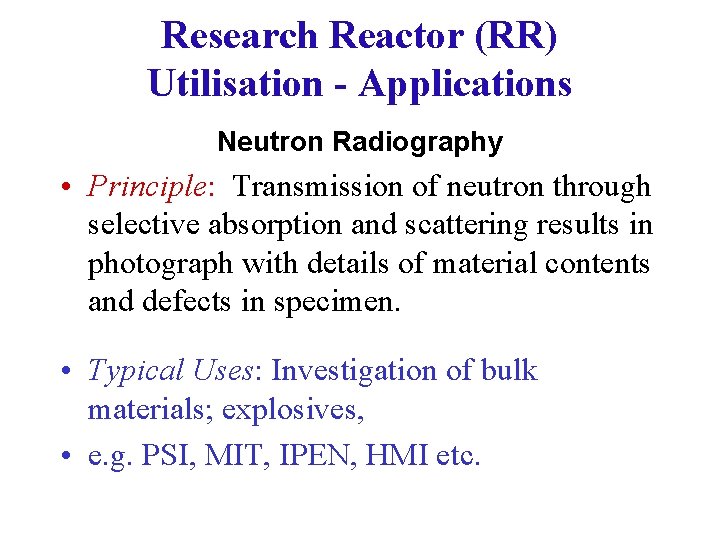
Research Reactor (RR) Utilisation - Applications Neutron Radiography • Principle: Transmission of neutron through selective absorption and scattering results in photograph with details of material contents and defects in specimen. • Typical Uses: Investigation of bulk materials; explosives, • e. g. PSI, MIT, IPEN, HMI etc.
NDT-Neutron Radiography
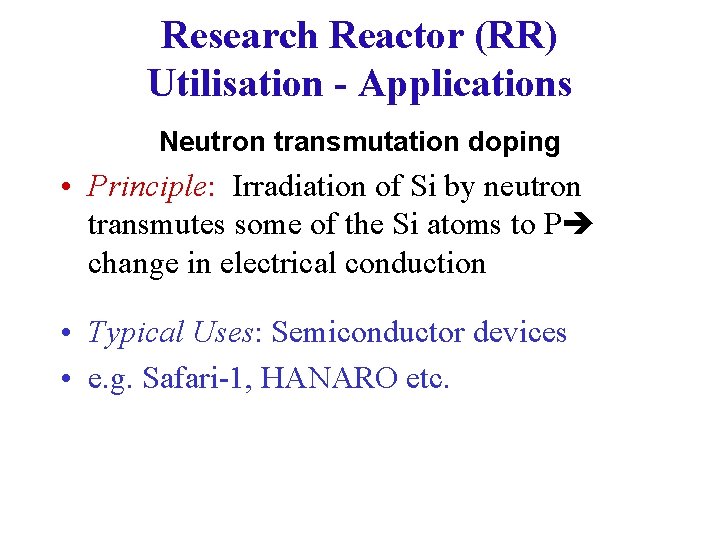
Research Reactor (RR) Utilisation - Applications Neutron transmutation doping • Principle: Irradiation of Si by neutron transmutes some of the Si atoms to P change in electrical conduction • Typical Uses: Semiconductor devices • e. g. Safari-1, HANARO etc.
Neutron Transmutation Doping
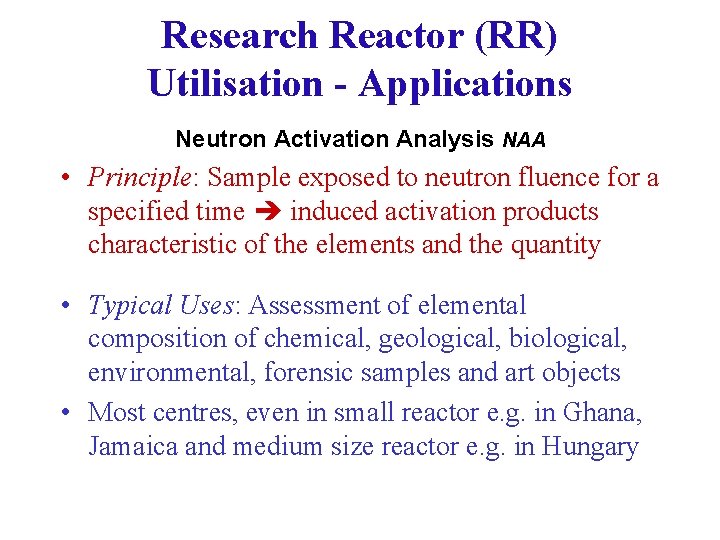
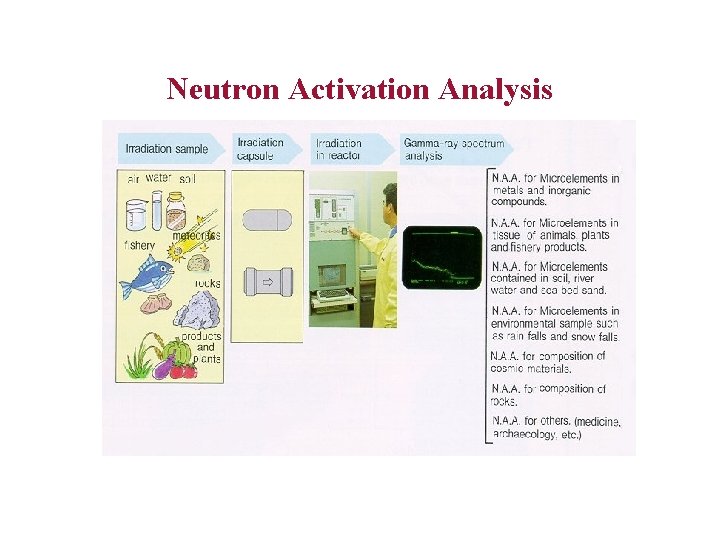
Research Reactor (RR) Utilisation - Applications Neutron Activation Analysis NAA • Principle: Sample exposed to neutron fluence for a specified time induced activation products characteristic of the elements and the quantity • Typical Uses: Assessment of elemental composition of chemical, geological, biological, environmental, forensic samples and art objects • Most centres, even in small reactor e. g. in Ghana, Jamaica and medium size reactor e. g. in Hungary
Neutron Activation Analysis
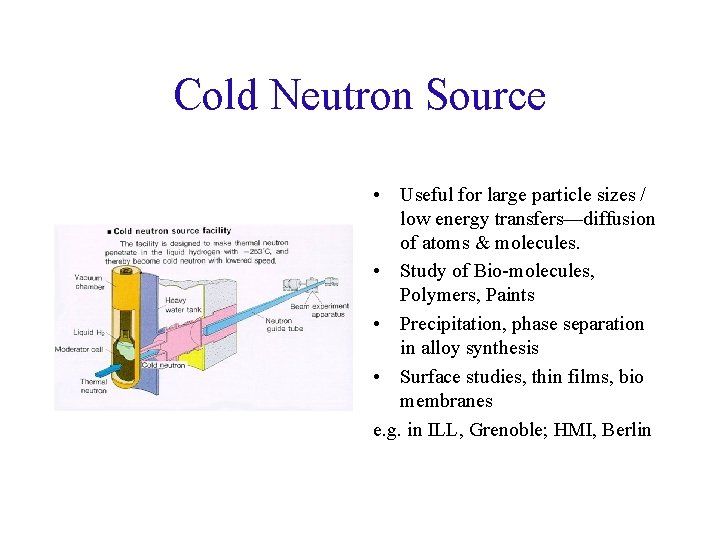
Cold Neutron Source • Useful for large particle sizes / low energy transfers—diffusion of atoms & molecules. • Study of Bio-molecules, Polymers, Paints • Precipitation, phase separation in alloy synthesis • Surface studies, thin films, bio membranes e. g. in ILL, Grenoble; HMI, Berlin
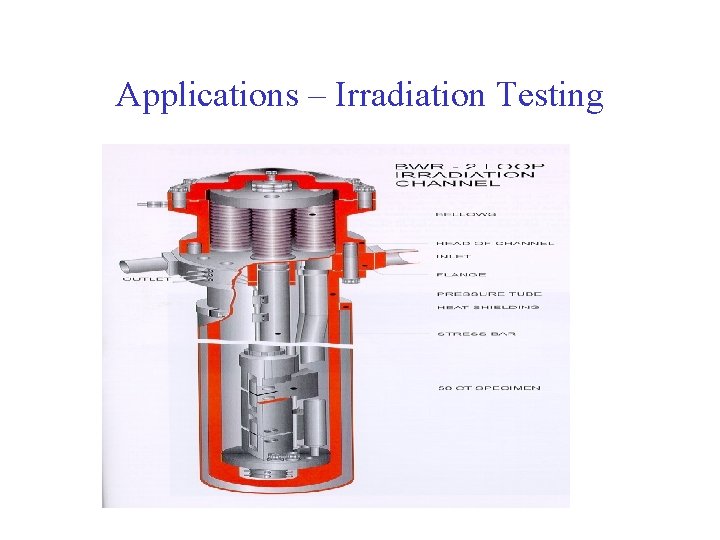
Research Reactor (RR) Utilisation - Applications Neutron irradiation for materials testing • Principle: Target material’s irradiation by neutrons and exposure to radiation field in RR for specified period leading to changes/damages • Typical Uses: Understanding and assessment of radiation induced damage • Modification to material characteristics, structure Utility for new reactor designs and concepts; Data for plant life-extension studies and decommissioning/disposal purposes
Applications – Irradiation Testing
Research Reactor (RR) Utilisation - Applications Post-irradiation examination (PIE) Principle: Fuel & related material’s exposure to RR ambience (radiation, temperature, pressure, neutron flux) for specified period • Typical Uses: Reactor fuel testing and development, validation/qualification, trouble-shooting. Understanding fuel behaviour in various conditions
Research Reactor (RR) Utilisation - Applications Education and Training for HRD • • • Science teachers & students Engineering teachers & students Nuclear power plant operator trainees Operational health physicists Regulators Public awareness
RR issues and needs: perceptions and concerns (1 of 2) • RR as the stepping stone to or symbol of nuclear science and technology • RR as the cradle of all development and availability of nuclear technology • RR utilisation needs and requirements for safety & security upgrades vis-à-vis resources availability and national support/ priorities/ policies
RR issues and needs: perceptions and concerns (2 of 2) • RR fuel issues – conversion of HEU fuel to LEU fuel; development & qualification of high density LEU fuels • Decommissioning of shut-down RR – Strategy and technology support needs RR type classification desirable to facilitate utilisation plans and address the above concerns. ‘Need exists for beneficial utilisation' to be the basis for operation & utilisation of RR in safe and secure manner. .
IAEA Assistance on Research Reactors • The Agency is ready to assist Member States in all RR related issues: • Utilization • Safety and Security • RR operation, maintenance, reliability and availability • RR nuclear fuel cycle issues • RR spent fuel management • RR refurbishment and modernization • RR ageing • RR decommissioning
Story of Success: Instrument development / Regional collaboration • Neutron beam applications: Small Angle Neutron scattering and Reflectometry are important for R & D and industrial applications. • IAEA-TC project for RR utilization • Greece installing instruments for neutron scattering and establish a Regional Centre. Expected to complete this year. • South Africa to establish a SANS centre in South Africa, which is expected to be used by researchers and industries. • Facilities expected to be installed/operational 2007.
Story of Success: Conversion of TRIGA 14 -MW (Romania) – TC project ROM/4/024 – Contract to supply LEU fuel between the IAEA, Romania and CERCA/TRIGA International (November 2003) – IAEA officials together with officials from CNCAN and the Institute for Nuclear Research (ICN), Pitesti, jointly carried out all the QA audits and acceptance inspections – Final lot of LEU delivered to Pitesti on March 30, 2006 – Mid-May 2006 full-core conversion to LEU completed – All irradiated HEU removed prior to May 12, 2006 will be shipped to the US
Story of Success: Development of National Capacity for RR fuel Fabrication (Chile) – TC Project CHI/4/021 – Development of domestic capacity to fabricate LEU silicide fuel with IAEA assistance – Chile qualified as a supplier of silicide fuel elements through an irradiation and post irradiation qualification programme – Chilean fabrication capacity used to fabricate LEU fuel to convert RECH-1 – RECH-1 fully converted to LEU in May 11 2006
IAEA Thank you for your attention …atoms for peace.