
Nuclear Reactor Nuclear reactor basic principles 1 Neutron
Nuclear Reactor
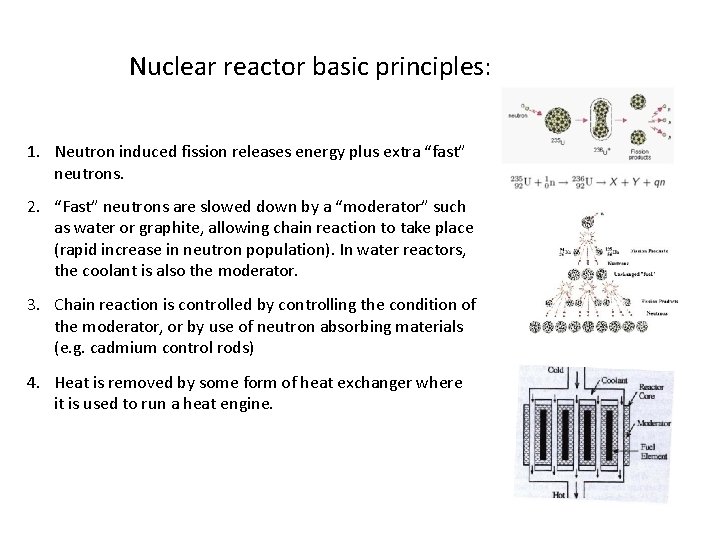
Nuclear reactor basic principles: 1. Neutron induced fission releases energy plus extra “fast” neutrons. 2. “Fast” neutrons are slowed down by a “moderator” such as water or graphite, allowing chain reaction to take place (rapid increase in neutron population). In water reactors, the coolant is also the moderator. 3. Chain reaction is controlled by controlling the condition of the moderator, or by use of neutron absorbing materials (e. g. cadmium control rods) 4. Heat is removed by some form of heat exchanger where it is used to run a heat engine.
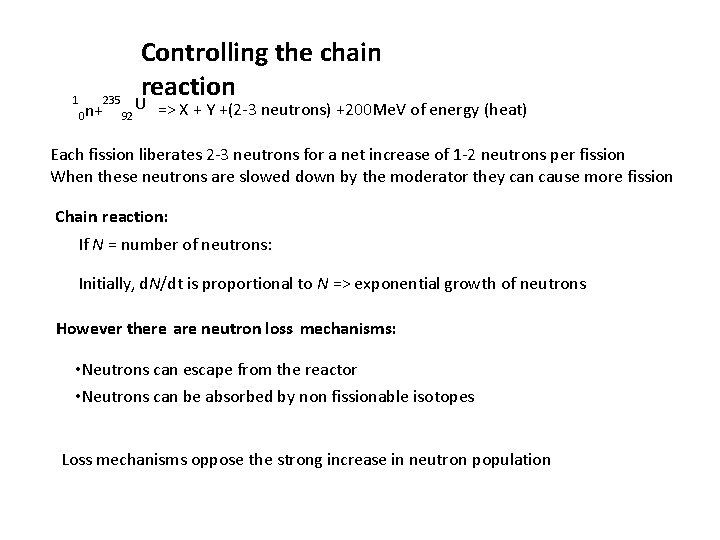
Controlling the chain reaction 1 235 U n+ 92 0 => X + Y +(2 -3 neutrons) +200 Me. V of energy (heat) Each fission liberates 2 -3 neutrons for a net increase of 1 -2 neutrons per fission When these neutrons are slowed down by the moderator they can cause more fission Chain reaction: If N = number of neutrons: Initially, d. N/dt is proportional to N => exponential growth of neutrons However there are neutron loss mechanisms: • Neutrons can escape from the reactor • Neutrons can be absorbed by non fissionable isotopes Loss mechanisms oppose the strong increase in neutron population
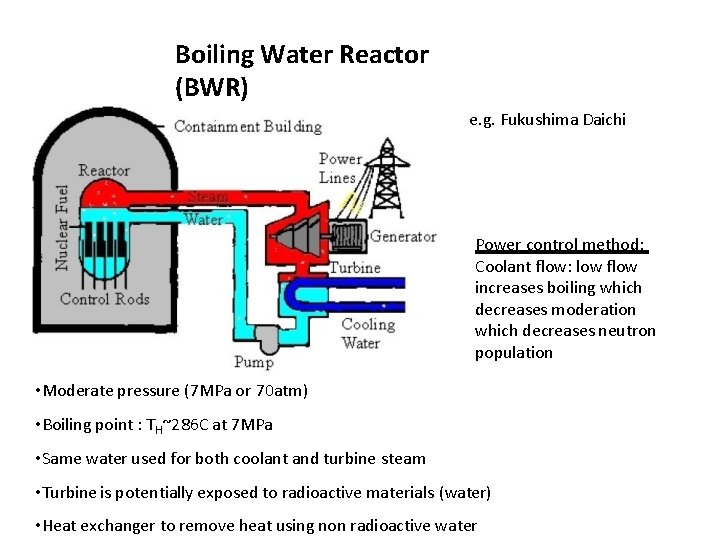
Boiling Water Reactor (BWR) e. g. Fukushima Daichi Power control method: Coolant flow: low flow increases boiling which decreases moderation which decreases neutron population • Moderate pressure (7 MPa or 70 atm) • Boiling point : TH~286 C at 7 MPa • Same water used for both coolant and turbine steam • Turbine is potentially exposed to radioactive materials (water) • Heat exchanger to remove heat using non radioactive water
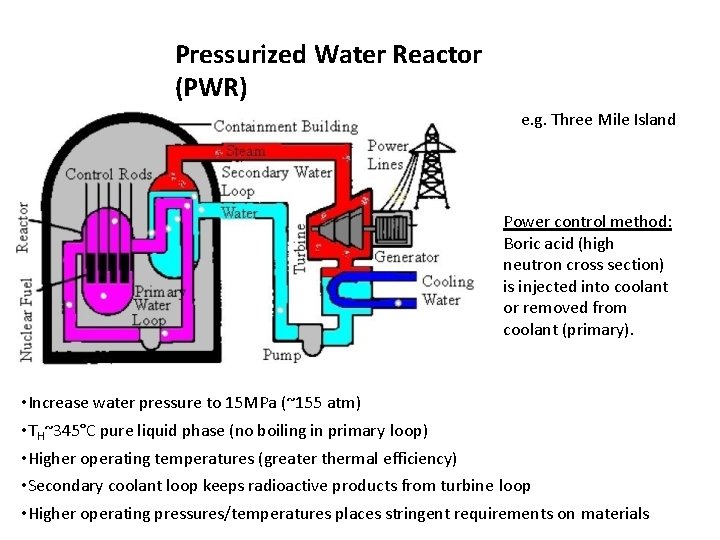
Pressurized Water Reactor (PWR) e. g. Three Mile Island Power control method: Boric acid (high neutron cross section) is injected into coolant or removed from coolant (primary). • Increase water pressure to 15 MPa (~155 atm) • TH~345°C pure liquid phase (no boiling in primary loop) • Higher operating temperatures (greater thermal efficiency) • Secondary coolant loop keeps radioactive products from turbine loop • Higher operating pressures/temperatures places stringent requirements on materials
Light water vs. Heavy water reactors Light water reactors, LWR (most reactors): • water moderator is effective at slowing neutrons, but also absorbs neutrons strongly (σ=0. 33 Barn), meaning fewer neutrons per fission • strong absorption of neutrons requires the use of enriched uranium: 3 -5% 235 U • countries with enrichment facilities can potentially produce weapons grade U (typically greater than 85% 235 U) Heavy water reactors, HWR (Candu) • D 2 O is less effective as a moderator but has much lower neutron cross section (σ =5. 2 x 10 -4) i. e. more neutrons are available for fission. • Weaker absorption of neutrons allows the use of natural uranium (0. 72% 235 U ) • D 2 O is expensive (~20% of cost of a reactor!) • But: D 2 O enrichment is only required once (as opposed to 235 U enrichment for LWR) • heavy water reactors breed higher levels of 239 Pu making them useful sources of this material for weapons manufacture.
Reactor Stability refers to the ability of the system to recover from the effect of a small change in power output H 2 O and D 2 O reactors tend be inherently self stabilizing: • Uncontrolled increase in fission rate leads to vaporization of coolant/ moderator • This results in a loss of moderation because of the sudden decrease in moderator density (liquid=> gas) • This tends to reduce the fission rate • This mechanism is not available in graphite reactors such as Chernobyl Liquid H 2 O and D 2 O based reactors are said to have a “negative void” coefficient Graphite reactors have a “positive void coefficient”, making these systems more susceptible to uncontrolled output situations like Chernobyl (more later)
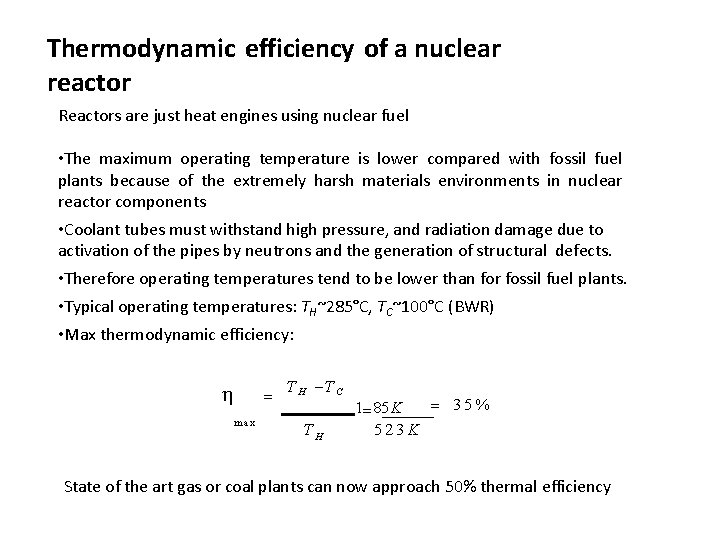
Thermodynamic efficiency of a nuclear reactor Reactors are just heat engines using nuclear fuel • The maximum operating temperature is lower compared with fossil fuel plants because of the extremely harsh materials environments in nuclear reactor components • Coolant tubes must withstand high pressure, and radiation damage due to activation of the pipes by neutrons and the generation of structural defects. • Therefore operating temperatures tend to be lower than for fossil fuel plants. • Typical operating temperatures: TH~285°C, TC~100°C (BWR) • Max thermodynamic efficiency: max T H T C TH 35% 1 85 K 523 K State of the art gas or coal plants can now approach 50% thermal efficiency
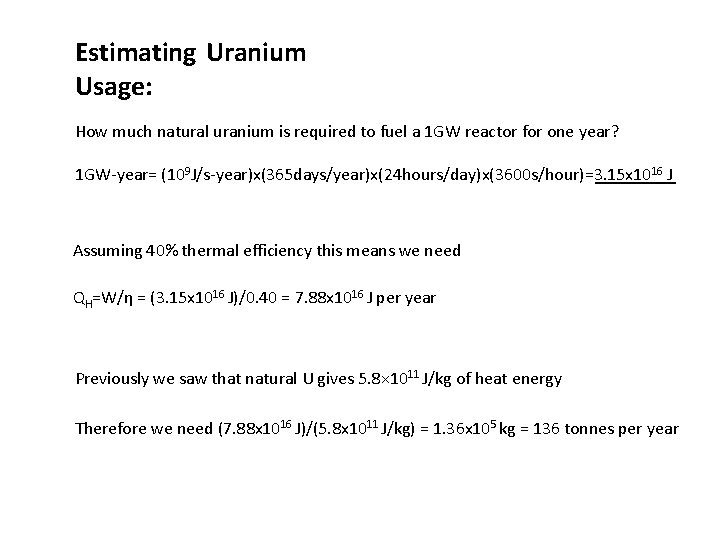
Estimating Uranium Usage: How much natural uranium is required to fuel a 1 GW reactor for one year? 1 GW-year= (109 J/s-year)x(365 days/year)x(24 hours/day)x(3600 s/hour)=3. 15 x 1016 J Assuming 40% thermal efficiency this means we need QH=W/η = (3. 15 x 1016 J)/0. 40 = 7. 88 x 1016 J per year Previously we saw that natural U gives 5. 8× 10¹¹ J/kg of heat energy Therefore we need (7. 88 x 1016 J)/(5. 8 x 10¹¹ J/kg) = 1. 36 x 105 kg = 136 tonnes per year
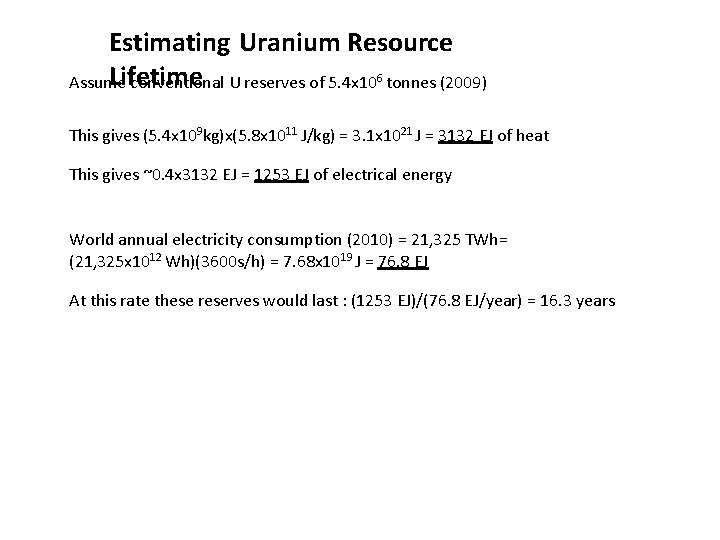
Estimating Uranium Resource Lifetime Assume conventional U reserves of 5. 4 x 10⁶ tonnes (2009) This gives (5. 4 x 10⁹ kg)x(5. 8 x 10¹¹ J/kg) = 3. 1 x 10²¹ J = 3132 EJ of heat This gives ~0. 4 x 3132 EJ = 1253 EJ of electrical energy World annual electricity consumption (2010) = 21, 325 TWh= (21, 325 x 1012 Wh)(3600 s/h) = 7. 68 x 1019 J = 76. 8 EJ At this rate these reserves would last : (1253 EJ)/(76. 8 EJ/year) = 16. 3 years

To be continued……………….
- Slides: 11