
NUCLEAR REACTOR MATERIALS 1 EFFECT OF RADIATION Radiation

- Slides: 31
NUCLEAR REACTOR MATERIALS 1. EFFECT OF RADIATION
Radiation Environment 1. The amount of radiation that a material encountered during their life cycle strongly depends on radiation environment and their operation conditions. 2. Different environment is characterized by its own spectrum of particles and energy distribution 3. The common radiation environments are: i. Space ii. High energy physics experiments iii. Natural environments iv. Processing induced radiation v. Nuclear
i) Space Environment - Heavy ion trapped in the magnetosphere - Cosmic ray protons and heavy ions - Proton and heavy ions from solar flares
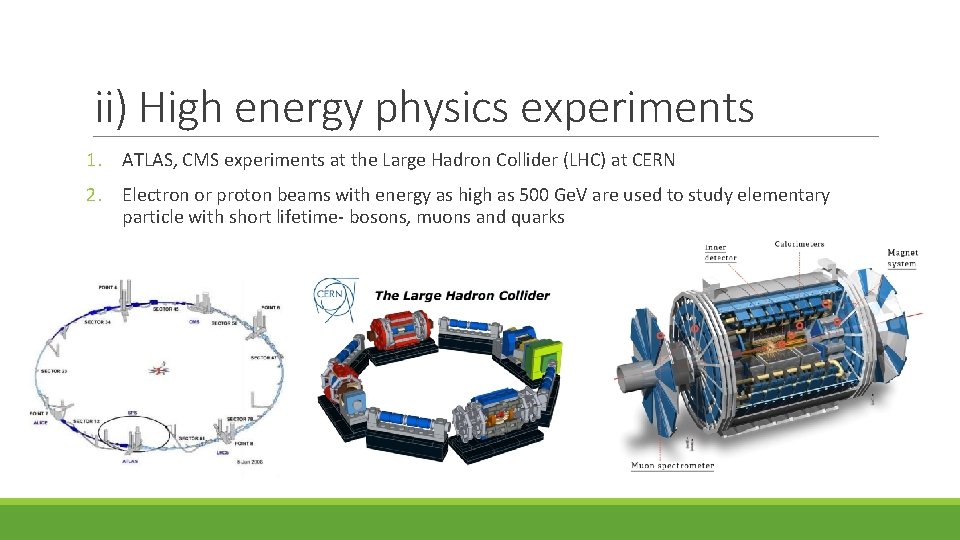
ii) High energy physics experiments 1. ATLAS, CMS experiments at the Large Hadron Collider (LHC) at CERN 2. Electron or proton beams with energy as high as 500 Ge. V are used to study elementary particle with short lifetime- bosons, muons and quarks
iii) Natural Environment Source of ionising radiation is due to alpha particles coming from the radioactive impurities, such as uranium and thorium or radioactive daughter products in the used materials Radioactive impurities can also be introduced by the reactants used during the devise processing steps. Example: Boron is used as p-type dopant for junction formation and to influence the stress and flow properties of silica layer-BPSG
iv) Processing-induced radiation The fabrication of modern semiconductor devices uses a great number of processing step to introduce radiation damage. Examples: ion implantation, x-ray lithography, plasma enhanced chemical vapour deposition The degree of introduced damage is much lower than the other radiation environment
Nuclear Environment 1. Nuclear power reactors are characterized by the existence of high radiation fields. 2. The radiation fields have a profound effect on the properties of many materials which, by design, must fulfill specific neutronic, structural and transport functions. 3. The appearance of these primary radiations and particles serve to initiate numerous and complex cascade effects in the materials. 4. For example: ◦ ◦ atoms can be dislodged from their positions by the fission fragments emitted gamma ray may cause ionization and induce the production of x-rays
Effects of radiation ◦ Microscopic ◦ Macroscopic ◦ Annealing What can we do? ◦ Detector and characterizations ◦ Material design and engineering
The development of truly predictive material is through the thorough understanding of the fundamental radiation damage mechanisms This requires the application of a wide range of instruments, particularly spectrometry and microscopy to understand the radiation-induced electrically active defects.
Spectroscopy in brief… Spectroscopy is the study of the interaction between matter and radiated energy. Is used to study the incident spectrums, emitted spectrums and absorbed spectrums of materials. Spectroscopic data is often represented by a spectrum, a plot of the response of interest as a function of wavelength or frequency
Decay Heat Measurement Understanding the β-decay properties of fission products is very important for nuclear reactor monitoring & safety. β-decay of fission products is a source of power during nuclear reactor operation and after, this activity is the main contributor to the decay-heat representing ~7 -8% of a reactor nominal power. In order to perform measurements of fission products β-decay properties-Total Absorption spectrometer (TAS) characterization is carried out.
1. Interaction of high energy radiation such as α, β and γ rays as well as particles such as electrons, protons, neutrons etc with crystal lattices give rise to defects/imperfections 2. The microscopic defects produced in materials due to irradiation are referred to as radiation damage. 3. The crystal defects thus produced modify the macroscopic properties of materials which are referred to as radiation effects. 4. The damage can be described by the following groupings: 5. ◦ ◦ ◦ Vacancies or Knock-ons Interstitials Ionization Thermal Spikes Impurity Atoms Although the above are effects produced on the atomic and nuclear level, a sufficient number of these processes contribute to important macroscopic changes in the material.
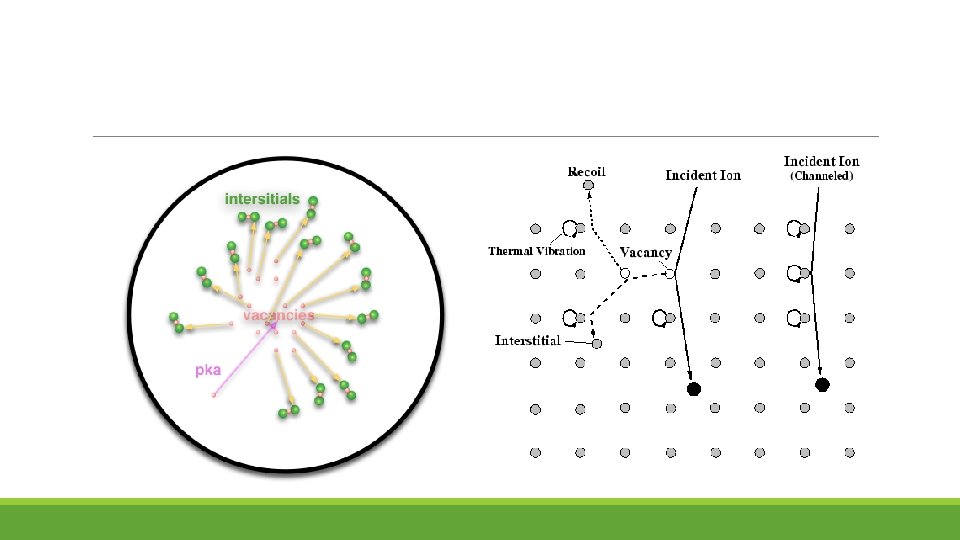
Vacancies or Knock-ons The removal of an atom from its position by the direct interaction of a high energy neutron or a fission fragment. Interstitials An interstitial is formed when an atom, which is knocked out from its position, comes to rest at some remote point. Ionization is caused by the removal of electrons from their electronic shells and has the effect of changing the chemical bonds of molecules.
Thermal Spikes This term identifies localized high temperature domains caused by the deposition of energy from neutrons and fission fragments. Impurity Atoms The capture of neutrons and nuclear reactions induced by various radiations has the effect of transmuting an atom into an element which is foreign to the material.
Primary Knock-on Atoms (PKA) 1. The first atom that an incident particle encounters in the target. 2. After it is displaced from its initial lattice site, the PKA: ◦ ◦ can induce the subsequent lattice site displacements of other atoms if it possesses sufficient energy, or come to rest in the lattice at an interstitial site if it does not. 3. A neutron with sufficient energy produces a number of these PKAs which in turn produce knock-ons leading to displacement/collision cascades. 4. The atoms displaced by PKAs are known as secondary knock-on atoms. 5. Thus a high energy neutron may produce a number of PKAs which lead to many secondary knock-ons resulting in a large number of atomic displacements.
Collision Models Upon bombardment, atoms can only be displaced if the energy they receive exceeds a threshold energy Ed. When a moving atom collides with a stationary atom, both atoms will have energy greater than Ed after the collision only if the original moving atom had an energy exceeding 2 Ed. Thus, only PKAs with an energy greater than 2 Ed can continue to displace more atoms and increase the total number of displaced atoms The majority of displaced atoms leave their lattice sites with energies no more than two or three times Ed.
Such an atom will collide with another atom approximately every mean interatomic distance traveled, losing half of its energy during the average collision. Assuming that an atom that has slowed down to a kinetic energy of 1 e. V becomes trapped in an interstitial site◦ displaced atoms will typically be trapped no more than a few interatomic distances away from the vacancies they leave behind. There are several possible scenarios for the energy of PKAs, and these lead to different forms of damage. In the case of electron or gamma ray bombardment, the PKA usually does not have sufficient energy to displace more atoms.
The resulting damage consists of a random distribution of Frenkel defects, usually with a distance no more than four or five interatomic distances between the interstitial and vacancy. When PKAs receive energy greater than Ed from bombarding electrons, they are able to displace more atoms, and some of the Frenkel defects become groups of interstitial atoms with corresponding vacancies, within a few interatomic distances of each other. In the case of bombardment by fast-moving atoms or ions, groups of vacancies and interstitial atoms widely separated along the track of the atom or ion are produced. As the atom slows down, the cross section for producing PKAs increases, resulting in groups of vacancies and interstitials concentrated at the end of the track
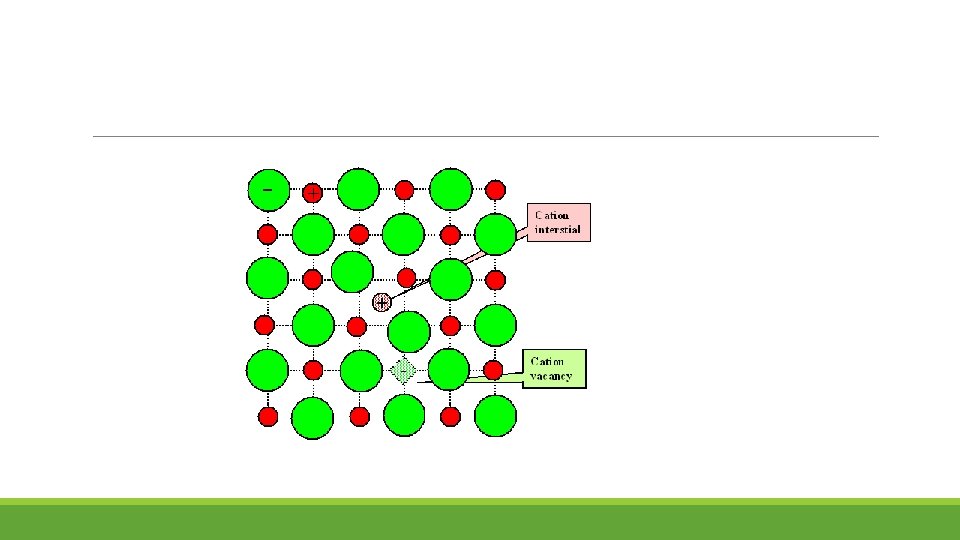
Frenkel Pair/Defect A Frenkel defect, Frenkel pair, or Frenkel disorder is a type of point defect in a crystal lattice The defect forms when an atom or smaller ion (usually cation) leaves its place in the lattice, creating a vacancy, and becomes an interstitial by lodging in a nearby location. Their prime mechanism of generation is by particle irradiation This defect does not have any impact on the density of the solid as it involves only the migration of the ions within the crystal, thus preserving both the volume as well as mass. In ionic crystals, charge neutrality requires (as we will see) that defects come in pairs with opposite charge, or at least the sum over the net charge of all charged point defects must be zero. One of the simple ways of maintaining charge neutrality with two different point defects is to always have a vacancy - interstitial pair
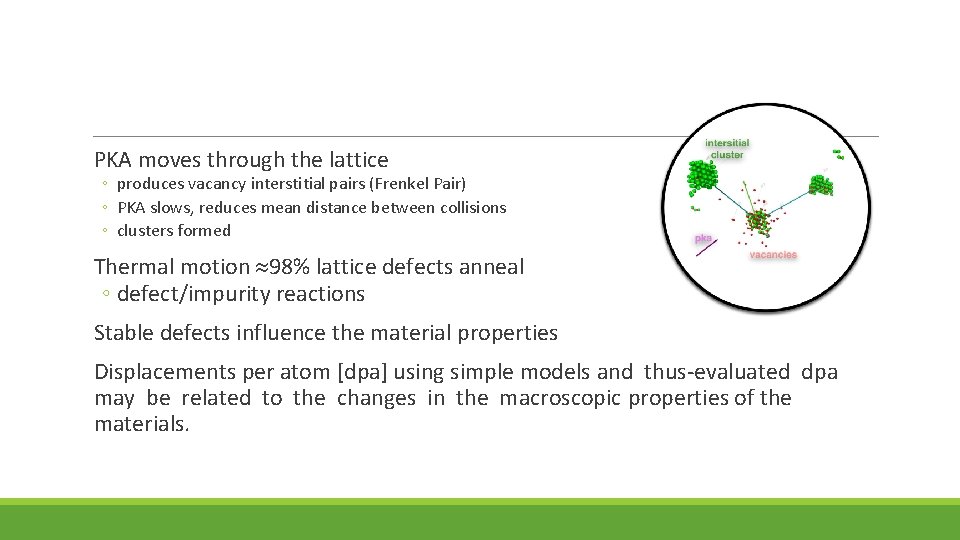
PKA moves through the lattice ◦ produces vacancy interstitial pairs (Frenkel Pair) ◦ PKA slows, reduces mean distance between collisions ◦ clusters formed Thermal motion 98% lattice defects anneal ◦ defect/impurity reactions Stable defects influence the material properties Displacements per atom [dpa] using simple models and thus-evaluated dpa may be related to the changes in the macroscopic properties of the materials.
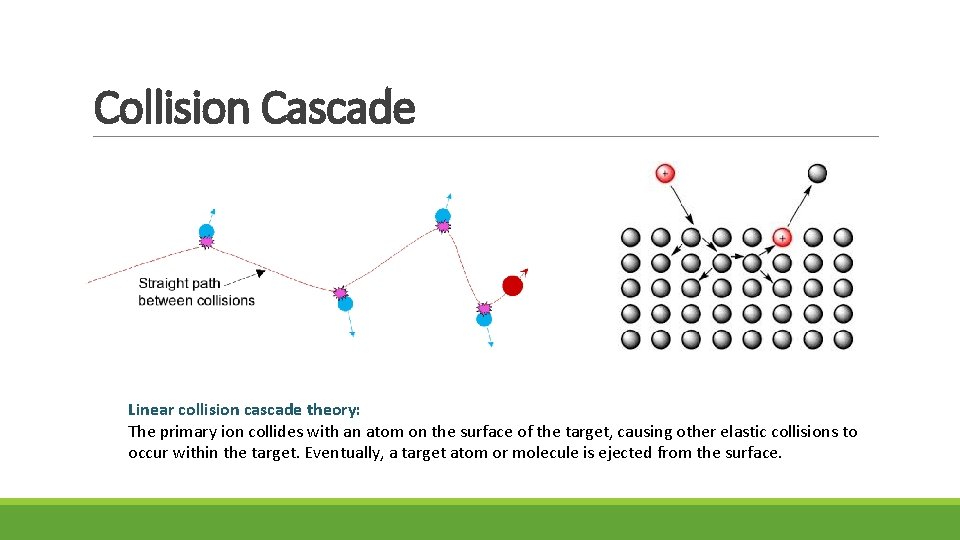
Collision Cascade Linear collision cascade theory: The primary ion collides with an atom on the surface of the target, causing other elastic collisions to occur within the target. Eventually, a target atom or molecule is ejected from the surface.
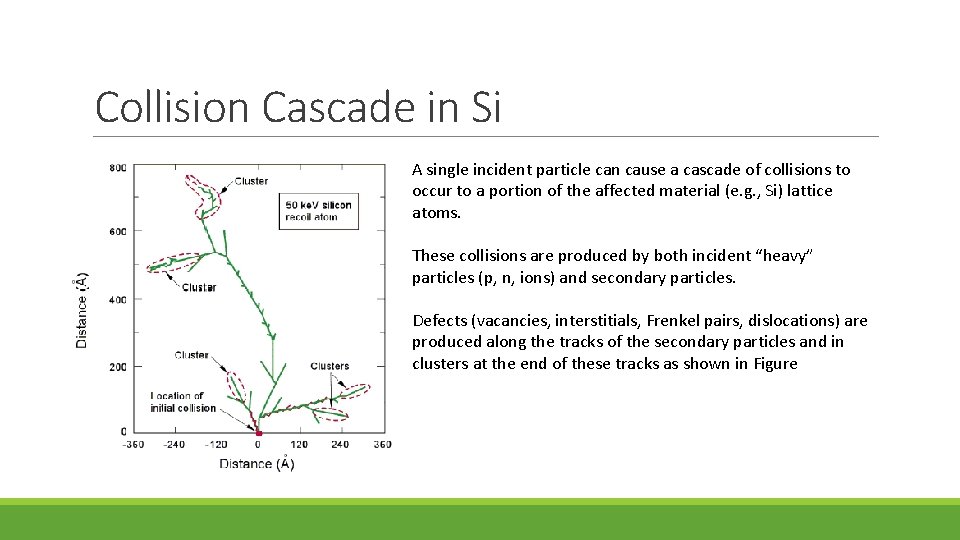
Collision Cascade in Si A single incident particle can cause a cascade of collisions to occur to a portion of the affected material (e. g. , Si) lattice atoms. These collisions are produced by both incident “heavy” particles (p, n, ions) and secondary particles. Defects (vacancies, interstitials, Frenkel pairs, dislocations) are produced along the tracks of the secondary particles and in clusters at the end of these tracks as shown in Figure
1. As the PKA slows to stop, it can collide with all atoms it encounters, impart kinetic energy to other atoms and initiate the ejections of atoms from their localized region 2. The size of the collision cascade is the primary function of the energy of the PKA. 3. The energy of PKA produced in a function of the irradiating species. 4. The nature of residual damage is the function of both PKA energy and the temperature of the material- at high temperature, the frenkel paairs have greater chance of spontaneously recombining to annihilate the damage 5. For metal like Zirconium, the displacement cascade results in the formation of damage zone/depleted zone- characterized by vacancy-rich core surrounded by the interstitial-rich shell
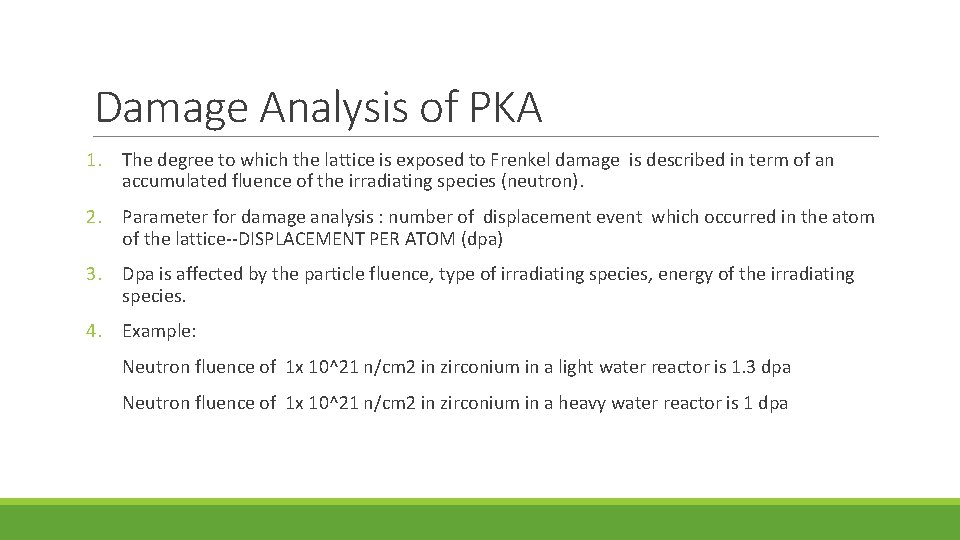
Damage Analysis of PKA 1. The degree to which the lattice is exposed to Frenkel damage is described in term of an accumulated fluence of the irradiating species (neutron). 2. Parameter for damage analysis : number of displacement event which occurred in the atom of the lattice--DISPLACEMENT PER ATOM (dpa) 3. Dpa is affected by the particle fluence, type of irradiating species, energy of the irradiating species. 4. Example: Neutron fluence of 1 x 10^21 n/cm 2 in zirconium in a light water reactor is 1. 3 dpa Neutron fluence of 1 x 10^21 n/cm 2 in zirconium in a heavy water reactor is 1 dpa
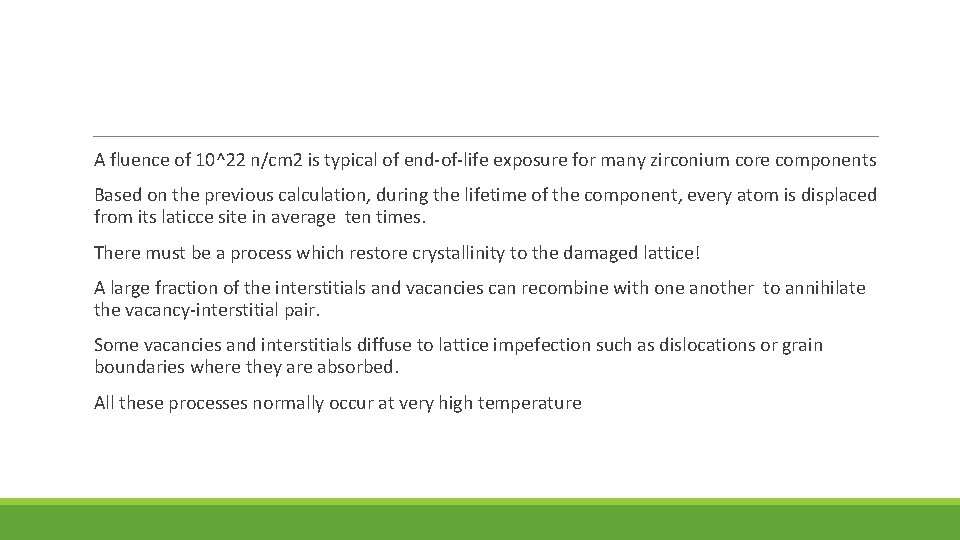
A fluence of 10^22 n/cm 2 is typical of end-of-life exposure for many zirconium core components Based on the previous calculation, during the lifetime of the component, every atom is displaced from its laticce site in average ten times. There must be a process which restore crystallinity to the damaged lattice! A large fraction of the interstitials and vacancies can recombine with one another to annihilate the vacancy-interstitial pair. Some vacancies and interstitials diffuse to lattice impefection such as dislocations or grain boundaries where they are absorbed. All these processes normally occur at very high temperature
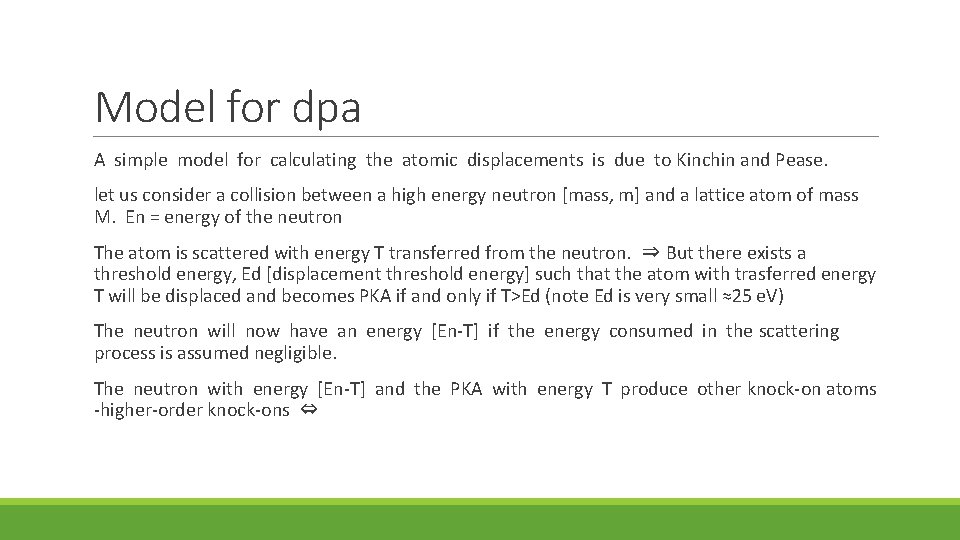
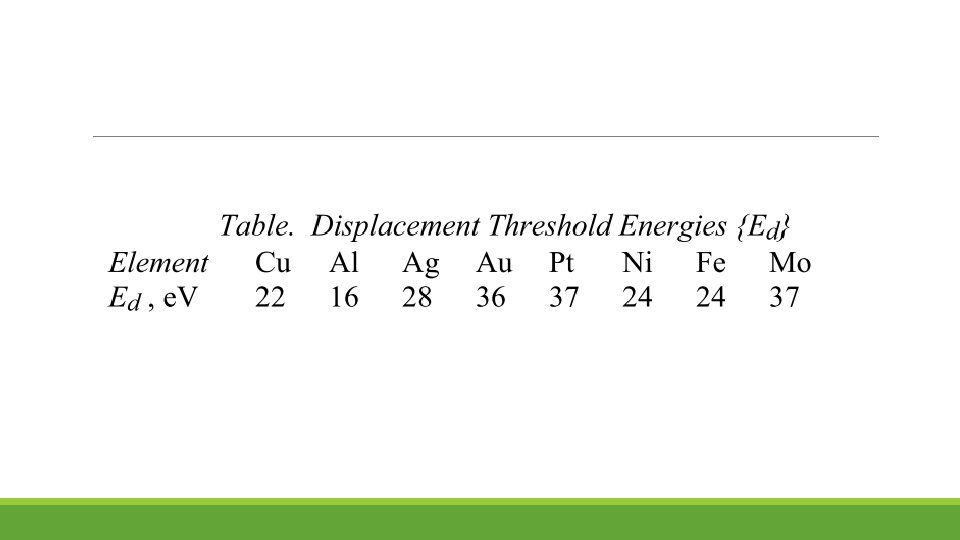
Model for dpa A simple model for calculating the atomic displacements is due to Kinchin and Pease. let us consider a collision between a high energy neutron [mass, m] and a lattice atom of mass M. En = energy of the neutron The atom is scattered with energy T transferred from the neutron. ⇒ But there exists a threshold energy, Ed [displacement threshold energy] such that the atom with trasferred energy T will be displaced and becomes PKA if and only if T>Ed (note Ed is very small ≈25 e. V) The neutron will now have an energy [En-T] if the energy consumed in the scattering process is assumed negligible. The neutron with energy [En-T] and the PKA with energy T produce other knock-on atoms -higher-order knock-ons ⇔
Model for dpa The Kinchin and Pease model is based on the following assumptions : • 2 -body elastic collisions • hard sphere model • atomic displacements occur only when T ≥Ed • no energy is consumed in displacing a lattice atom • atomic arrangement in the material is random [no crystallography] • no annihilation
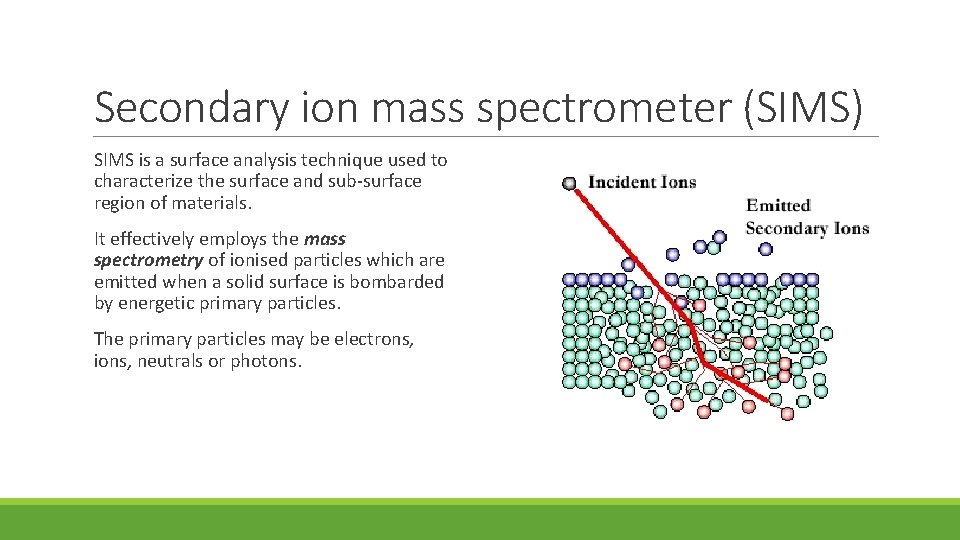
Secondary ion mass spectrometer (SIMS) SIMS is a surface analysis technique used to characterize the surface and sub-surface region of materials. It effectively employs the mass spectrometry of ionised particles which are emitted when a solid surface is bombarded by energetic primary particles. The primary particles may be electrons, ions, neutrals or photons.