
Nuclear Reactions Fission Fusion and Transmutation ATOMS NUCLEAR
- Slides: 14
Nuclear Reactions – Fission, Fusion and Transmutation ATOMS: NUCLEAR INTERACTIONS
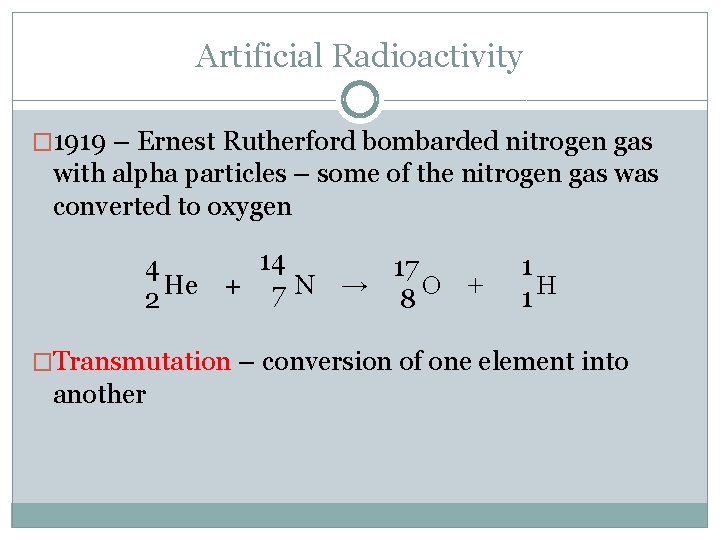
Artificial Radioactivity � 1919 – Ernest Rutherford bombarded nitrogen gas with alpha particles – some of the nitrogen gas was converted to oxygen 14 4 17 He + 7 N → O 2 8 + 1 H 1 �Transmutation – conversion of one element into another
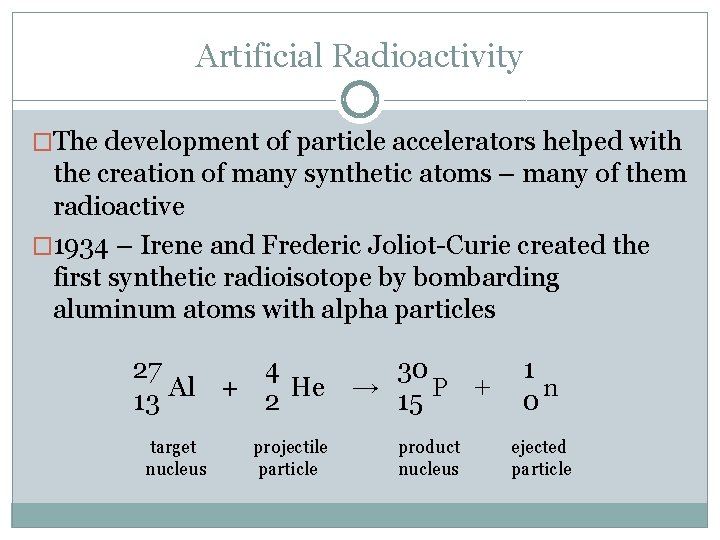
Artificial Radioactivity �The development of particle accelerators helped with the creation of many synthetic atoms – many of them radioactive � 1934 – Irene and Frederic Joliot-Curie created the first synthetic radioisotope by bombarding aluminum atoms with alpha particles 27 4 30 Al + He → P 13 2 15 target nucleus projectile particle product nucleus + 1 n 0 ejected particle
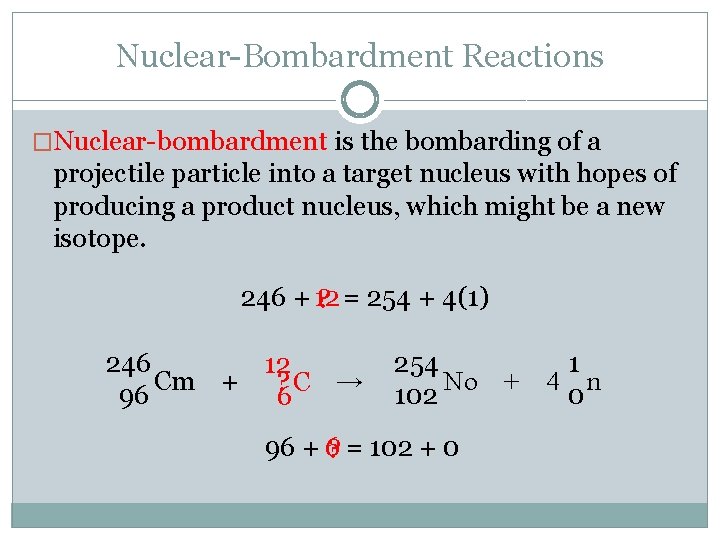
Nuclear-Bombardment Reactions �Nuclear-bombardment is the bombarding of a projectile particle into a target nucleus with hopes of producing a product nucleus, which might be a new isotope. 246 + 12 4(1) ? = 254 + 4 246 12 Cm + ? C → 96 6 254 No 102 96 + 6? = 102 + 0 + 1 4 n 0
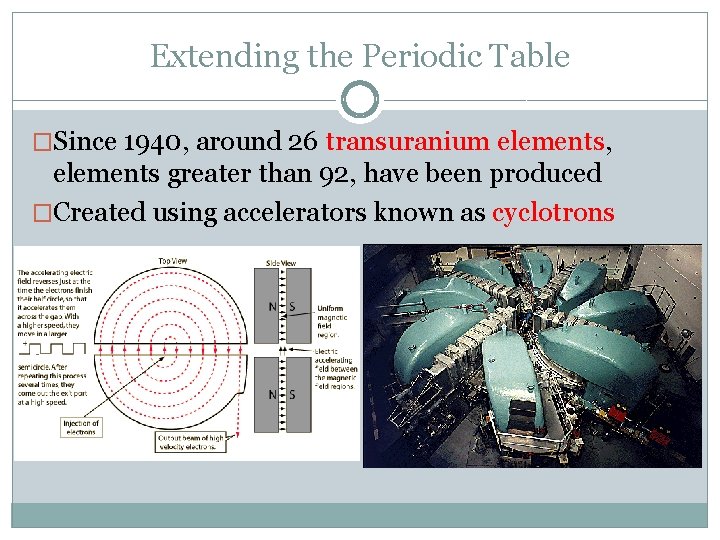
Extending the Periodic Table �Since 1940, around 26 transuranium elements, elements greater than 92, have been produced �Created using accelerators known as cyclotrons
Extending the Periodic Table � 1940 -1961, Glenn Seaborg, with help from his coworkers at UC-Berkeley, helped to create elements 94 -103 – none of these elements occur naturally �Examples of names: Americium, Berkelium, Californium �Naming of elements is now overseen by the IUPAC – International Union of Pure and Applied Chemistry �Names are now assigned by atomic number: element 115 is ununpentium, 118 is ununoctium, until given proper names
Nuclear Fission �Nuclear Fission involves the splitting of an atom either by bombardment or a spontaneous process � 1938 (Dec 22) – first discovered in Germany by Otto Hahn and Fritz Strassmann � 1939 (Jan 13) – explained by Lise Meitner (originally worked with Hahn and Strassmann on the fission reaction before fleeing to Sweden because she was Jewish) and her nephew Otto Frisch �Produces large amounts of energy
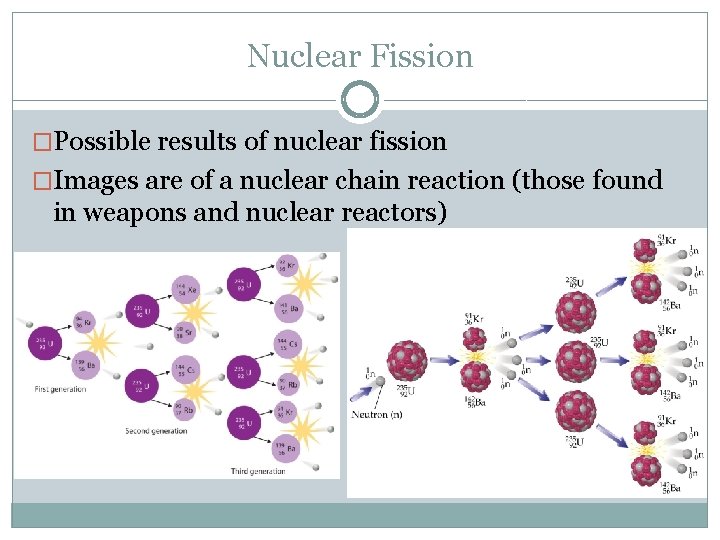
Nuclear Fission �Possible results of nuclear fission �Images are of a nuclear chain reaction (those found in weapons and nuclear reactors)
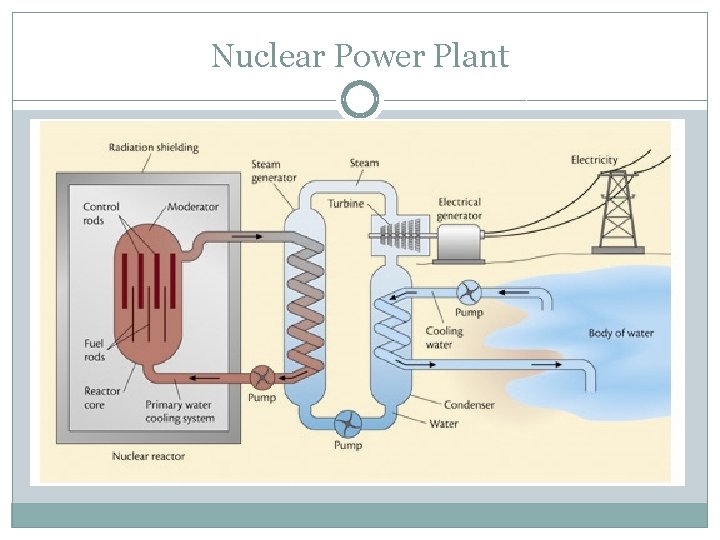
Nuclear Power Plant �The concept of nuclear fission being used for energy comes from the development of atomic weapons. �Nuclear Fission reactors and uranium enrichment (breeder) reactors showed proof that the energy from fission reactions could be converted to electricity. �The first nuclear reactor to produce electricity was the small experimental breeder reactor in Idaho in 1951 – it produced enough electricity to power 4 200 W light bulbs.
Nuclear Power Plant
Nuclear Power Plant
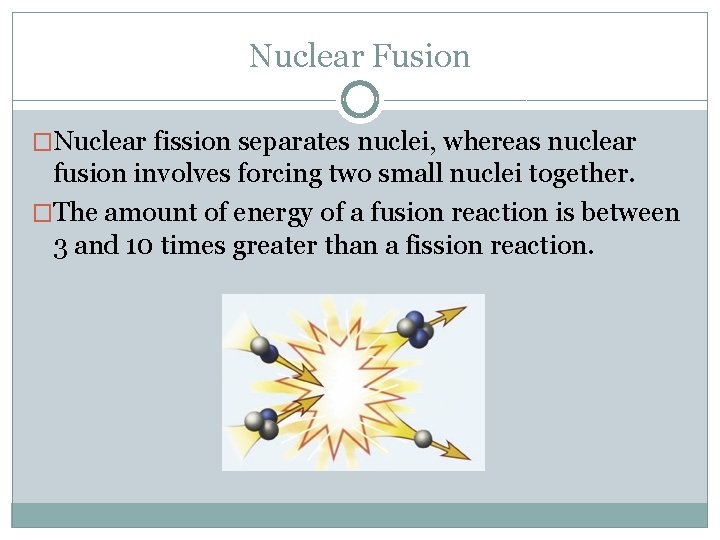
Nuclear Fusion �Nuclear fission separates nuclei, whereas nuclear fusion involves forcing two small nuclei together. �The amount of energy of a fusion reaction is between 3 and 10 times greater than a fission reaction.
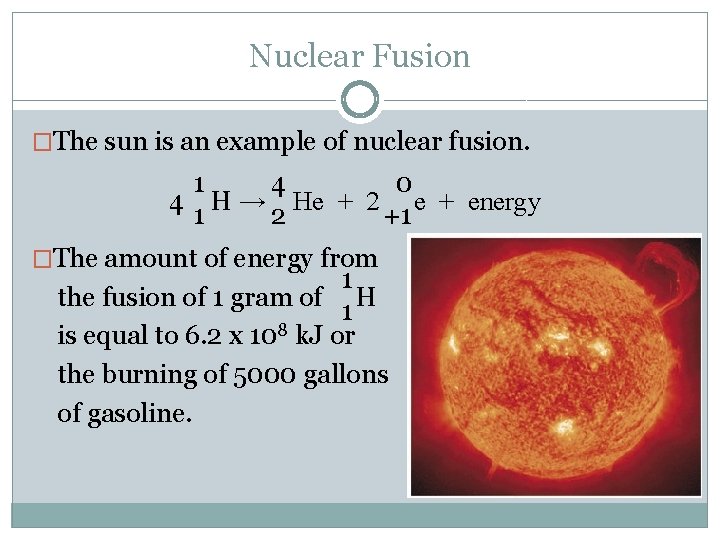
Nuclear Fusion �The sun is an example of nuclear fusion. 1 4 0 4 H → He + 2 e + energy 1 2 +1 �The amount of energy from 1 the fusion of 1 gram of H 1 is equal to 6. 2 x 10⁸ k. J or the burning of 5000 gallons of gasoline.
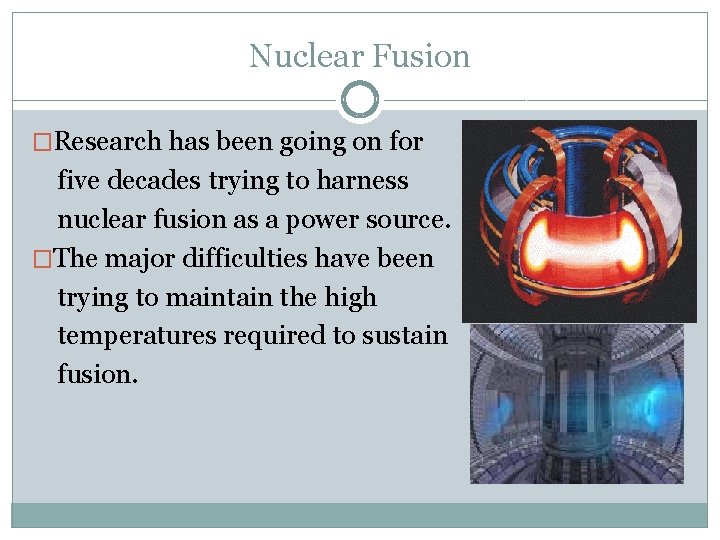
Nuclear Fusion �Research has been going on for five decades trying to harness nuclear fusion as a power source. �The major difficulties have been trying to maintain the high temperatures required to sustain fusion.