
Nuclear reactions experiment for nuclear structure reaction mechanisms
- Slides: 64
Nuclear reactions - experiment for nuclear structure, reaction mechanisms and nuclear astrophysics Livius Trache l-trache@tamu. edu Cyclotron Institute, Texas A&M University and Institute for Physics and Nuclear Engineering Bucharest, Romania Exotic Beam Summer School 2012 ANL Aug 5 -10, 2012 CYCLOTRON INSTITUTE
Summary 1. Introduction • 2. Rare Isotope Beams • • 3. RIB production RIB reaction specifics Types of reactions a) b) c) d) e) f) g) 4. 5. Nuclear reactions: vocabulary/definitions Elastic scattering Inelastic scattering Direct reactions: one nucleon transfer, few nucleons Breakup at intermediate energies Resonant elastic scattering – TTIK method In-flight decay spectroscopy multifragmentation Instrumentation Applications to Nuclear Astrophysics CYCLOTRON INSTITUTE
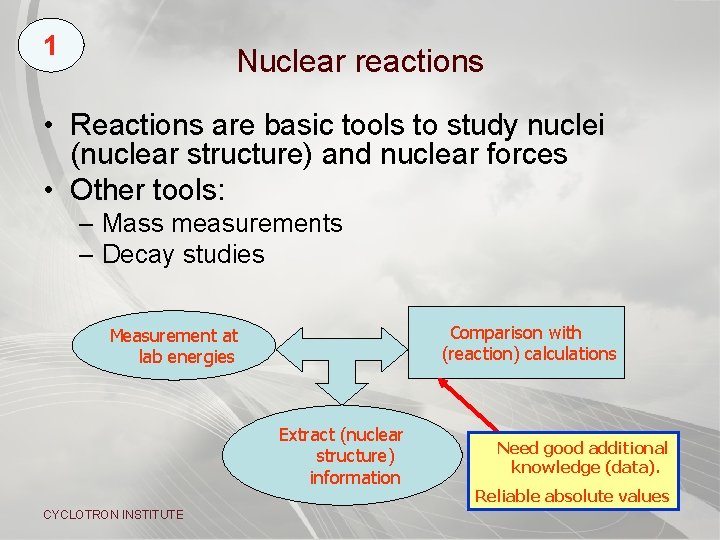
1 Nuclear reactions • Reactions are basic tools to study nuclei (nuclear structure) and nuclear forces • Other tools: – Mass measurements – Decay studies Comparison with (reaction) calculations Measurement at lab energies Extract (nuclear structure) information CYCLOTRON INSTITUTE Need good additional knowledge (data). Reliable absolute values
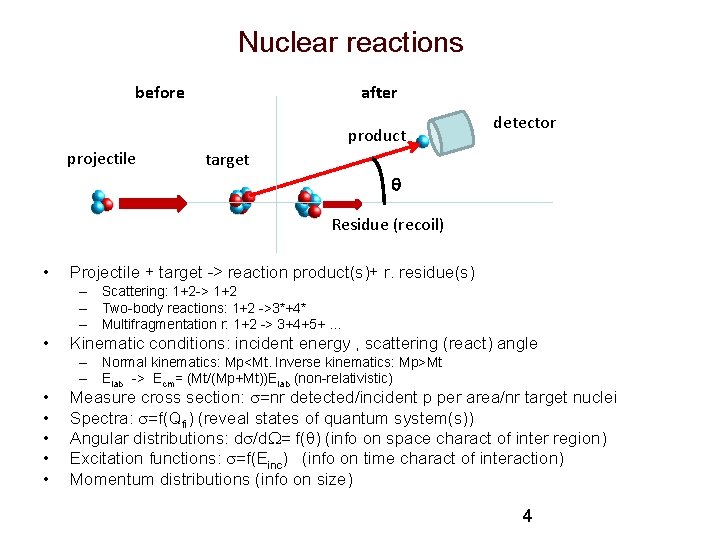
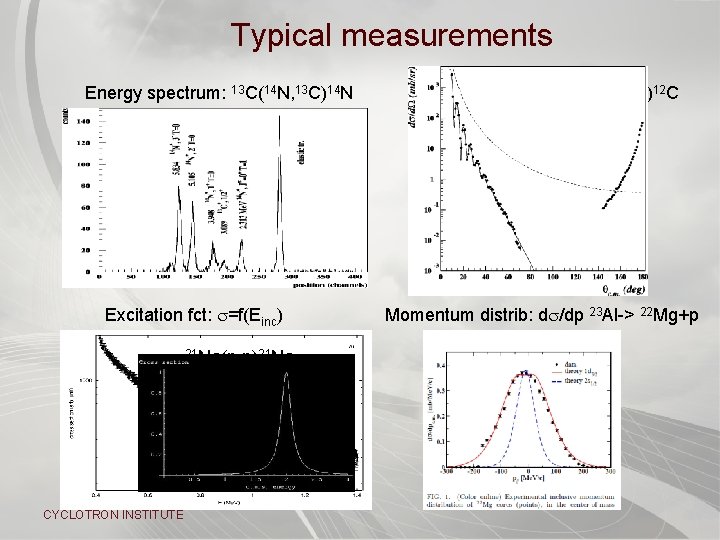
Nuclear reactions before after product projectile detector target + q Residue (recoil) • Projectile + target -> reaction product(s)+ r. residue(s) – Scattering: 1+2 -> 1+2 – Two-body reactions: 1+2 ->3*+4* – Multifragmentation r: 1+2 -> 3+4+5+ … • • • Kinematic conditions: incident energy , scattering (react) angle – Normal kinematics: Mp<Mt. Inverse kinematics: Mp>Mt – Elab -> Ecm= (Mt/(Mp+Mt))Elab (non-relativistic) Measure cross section: s=nr detected/incident p per area/nr target nuclei Spectra: s=f(Qfi) (reveal states of quantum system(s)) Angular distributions: ds/d. W= f(q) (info on space charact of inter region) Excitation functions: s=f(Einc) (info on time charact of interaction) Momentum distributions (info on size) 4
Typical measurements Energy spectrum: 13 C(14 N, 13 C)14 N Excitation fct: s=f(Einc) 21 Na(p, p)21 Na CYCLOTRON INSTITUTE Angular distribution 13 C(7 Li, 8 Li)12 C Momentum distrib: ds/dp 23 Al-> 22 Mg+p
2. Exotic nuclear Beams • EB or RIB (Rare Isotope Beams) • RIB production – ISOL technique: prod by reactions -> separation -> reacceleration – In-flight: reaction prod separated -> secondary beams • Fragmentation reactions (E/A> 25 -50 Me. V/u) • Reactions in inverse kinematics (fusion-evaporation, direct reactions) • RIB specifics – Lower intensities • Stable beams: 1 -100 pn. A => 109 – 1011 pps • RIB: 1 -107 pps – Lower resolutions: energy, angle – Large background • Imply: – – – Detectors w higher efficiency (4 p coverage? !) Clean data with coincidences (g-part, part-part, etc) Beam identification Full kinematics reconstruction New instruments, new experimental methods CYCLOTRON INSTITUTE 6
3 3. Types of reactions a) Elastic scattering b) Inelastic scattering c) Direct reactions: one nucleon transfer, few nucleons d) Breakup at intermediate energies e) Resonant elastic scattering – TTIK method f) In-flight decay spectroscopy g) Multifragmentation CYCLOTRON INSTITUTE
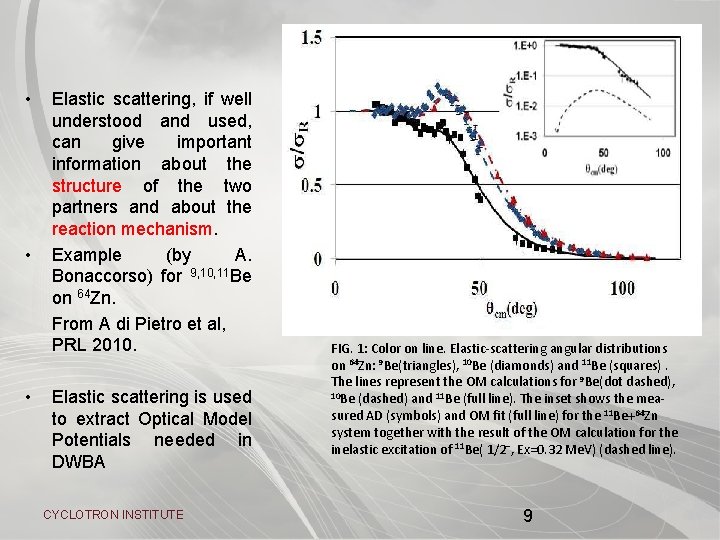
3 a) Elastic scattering • 1+2→ 1+2 • Elastic scattering: no energy transf to internal excit • good, sensitive probe of surface and (sometimes!) of interior of nuclei • Angular distributions measured on a large range: – small angles probe surface – Larger angles probe more toward interior • Described with Optical Model Potentials (OMP) – Phenomenological – Semi-microscopic: double folding • Figura Di Pietro here • Excitation function reveal resonances in CN 8
• • • Elastic scattering, if well understood and used, can give important information about the structure of the two partners and about the reaction mechanism. Example (by A. Bonaccorso) for 9, 10, 11 Be on 64 Zn. From A di Pietro et al, PRL 2010. Elastic scattering is used to extract Optical Model Potentials needed in DWBA CYCLOTRON INSTITUTE FIG. 1: Color on line. Elastic-scattering angular distributions on 64 Zn: 9 Be(triangles), 10 Be (diamonds) and 11 Be (squares). The lines represent the OM calculations for 9 Be(dot dashed), 10 Be (dashed) and 11 Be (full line). The inset shows the measured AD (symbols) and OM fit (full line) for the 11 Be+64 Zn system together with the result of the OM calculation for the inelastic excitation of 11 Be( 1/2−, Ex=0. 32 Me. V) (dashed line). 9
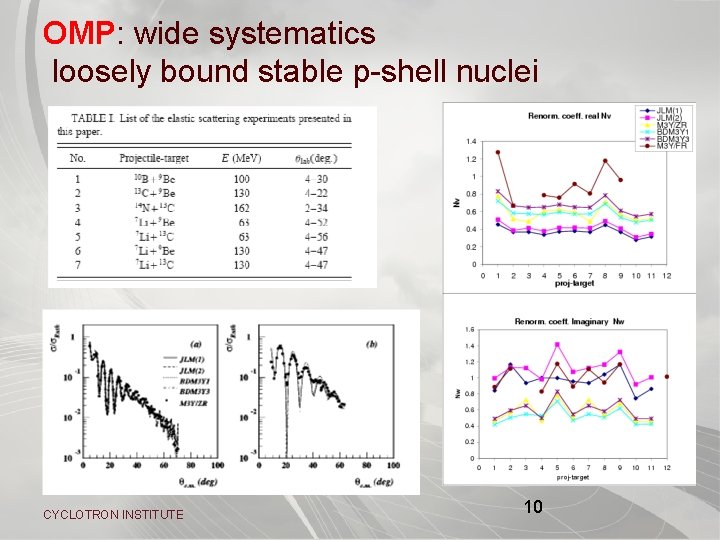
OMP: wide systematics loosely bound stable p-shell nuclei CYCLOTRON INSTITUTE 10
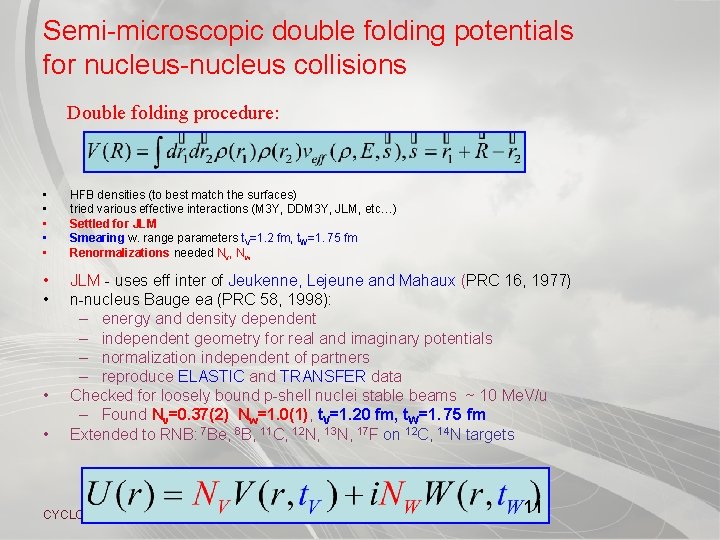
Semi-microscopic double folding potentials for nucleus-nucleus collisions Double folding procedure: • • • HFB densities (to best match the surfaces) tried various effective interactions (M 3 Y, DDM 3 Y, JLM, etc…) Settled for JLM Smearing w. range parameters t. V=1. 2 fm, t. W=1. 75 fm Renormalizations needed Nv, Nw • • JLM - uses eff inter of Jeukenne, Lejeune and Mahaux (PRC 16, 1977) n-nucleus Bauge ea (PRC 58, 1998): – energy and density dependent – independent geometry for real and imaginary potentials – normalization independent of partners – reproduce ELASTIC and TRANSFER data Checked for loosely bound p-shell nuclei stable beams ~ 10 Me. V/u – Found Nv=0. 37(2) Nw=1. 0(1), t. V=1. 20 fm, t. W=1. 75 fm Extended to RNB: 7 Be, 8 B, 11 C, 12 N, 13 N, 17 F on 12 C, 14 N targets • • CYCLOTRON INSTITUTE 11
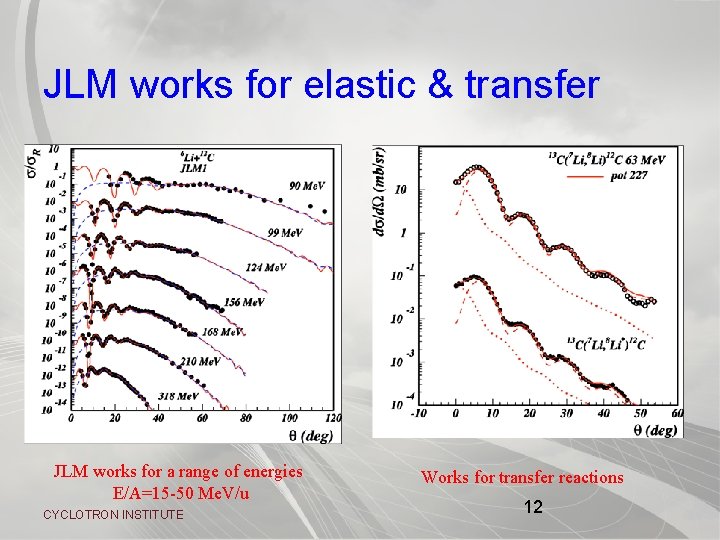
JLM works for elastic & transfer JLM works for a range of energies E/A=15 -50 Me. V/u CYCLOTRON INSTITUTE Works for transfer reactions 12
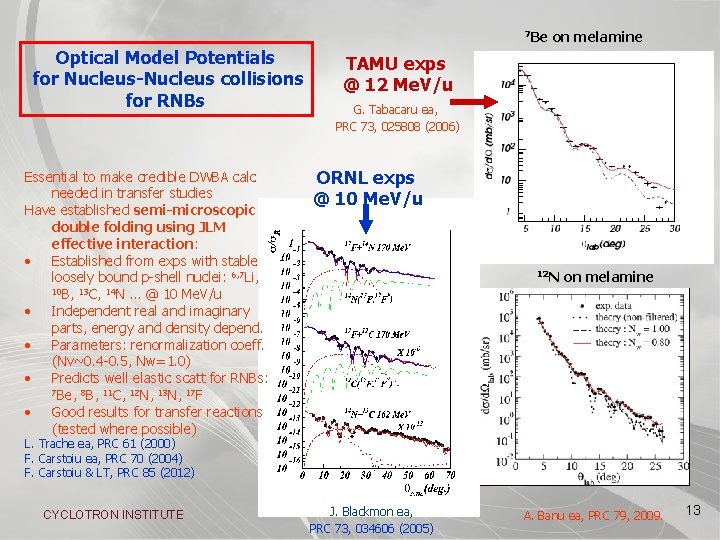
7 Be Optical Model Potentials for Nucleus-Nucleus collisions for RNBs Essential to make credible DWBA calc needed in transfer studies Have established semi-microscopic double folding using JLM effective interaction: • Established from exps with stable loosely bound p-shell nuclei: 6, 7 Li, 10 B, 13 C, 14 N … @ 10 Me. V/u • Independent real and imaginary parts, energy and density depend. • Parameters: renormalization coeff. (Nv~0. 4 -0. 5, Nw=1. 0) • Predicts well elastic scatt for RNBs: 7 Be, 8 B, 11 C, 12 N, 13 N, 17 F • Good results for transfer reactions (tested where possible) on melamine TAMU exps @ 12 Me. V/u G. Tabacaru ea, PRC 73, 025808 (2006) ORNL exps @ 10 Me. V/u 12 N on melamine L. Trache ea, PRC 61 (2000) F. Carstoiu ea, PRC 70 (2004) F. Carstoiu & LT, PRC 85 (2012) CYCLOTRON INSTITUTE J. Blackmon ea, PRC 73, 034606 (2005) A. Banu ea, PRC 79, 2009. 13
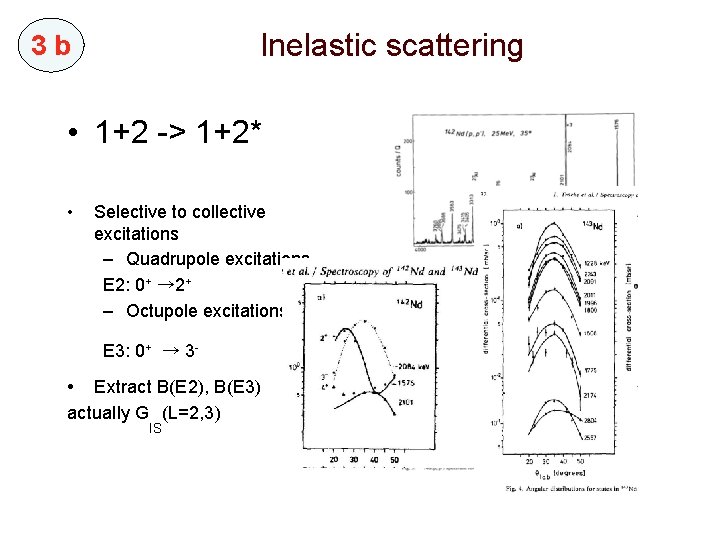
Inelastic scattering 3 b • 1+2 -> 1+2* • Selective to collective excitations – Quadrupole excitations E 2: 0+ → 2+ – Octupole excitations E 3: 0+ → 3 - • Extract B(E 2), B(E 3) actually G (L=2, 3) IS
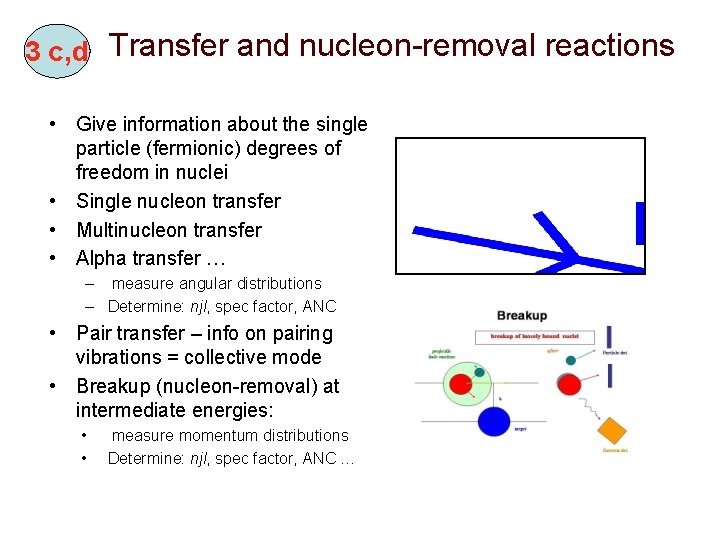
3 c, d Transfer and nucleon-removal reactions • Give information about the single particle (fermionic) degrees of freedom in nuclei • Single nucleon transfer • Multinucleon transfer • Alpha transfer … – measure angular distributions – Determine: njl, spec factor, ANC • Pair transfer – info on pairing vibrations = collective mode • Breakup (nucleon-removal) at intermediate energies: • • measure momentum distributions Determine: njl, spec factor, ANC …
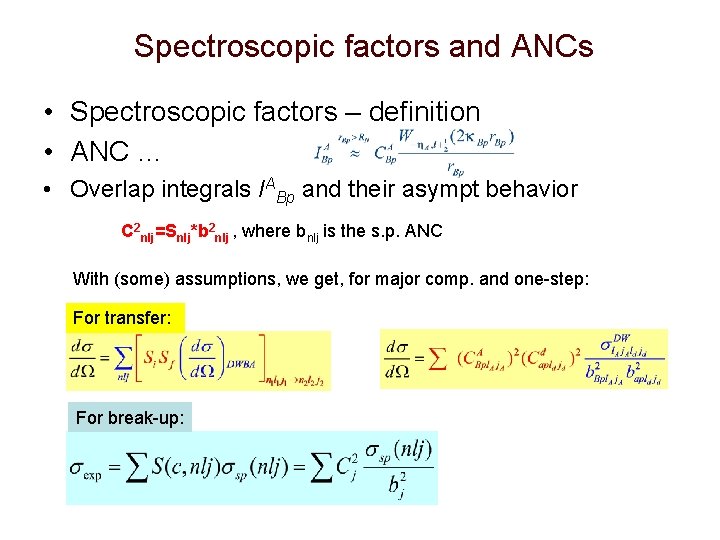
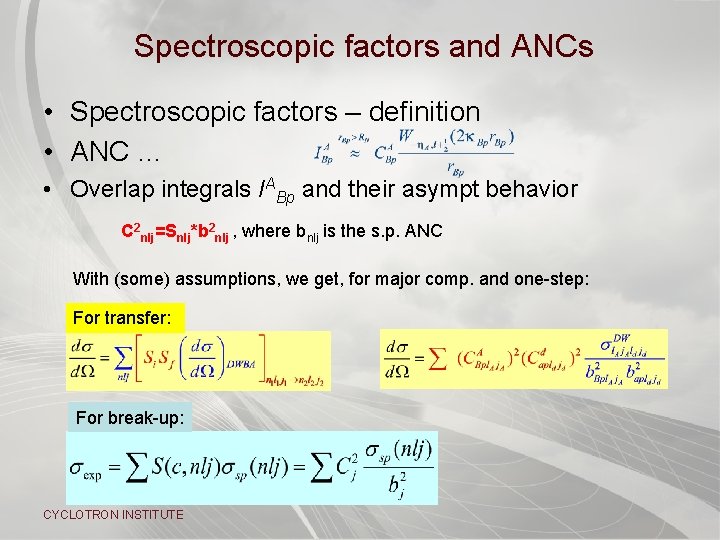
Spectroscopic factors and ANCs • Spectroscopic factors – definition • ANC … • Overlap integrals IABp and their asympt behavior C 2 nlj=Snlj*b 2 nlj , where bnlj is the s. p. ANC With (some) assumptions, we get, for major comp. and one-step: For transfer: For break-up:
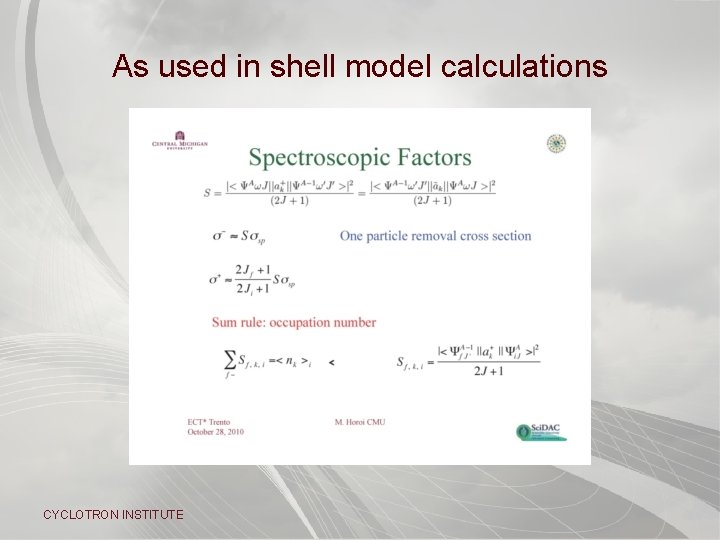
As used in shell model calculations CYCLOTRON INSTITUTE
Spectroscopic factors and ANCs • Spectroscopic factors – definition • ANC … • Overlap integrals IABp and their asympt behavior C 2 nlj=Snlj*b 2 nlj , where bnlj is the s. p. ANC With (some) assumptions, we get, for major comp. and one-step: For transfer: For break-up: CYCLOTRON INSTITUTE
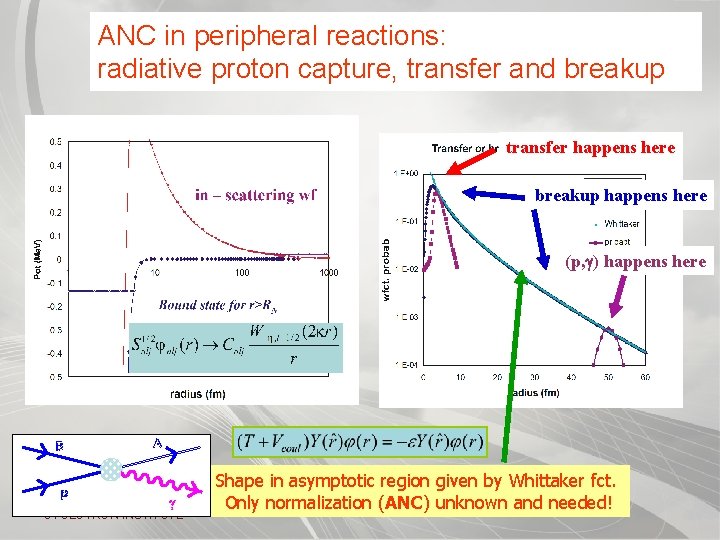
ANC in peripheral reactions: radiative proton capture, transfer and breakup transfer happens here breakup happens here (p, ) happens here CYCLOTRON INSTITUTE Shape in asymptotic region given by Whittaker fct. Only normalization (ANC) unknown and 19 needed!
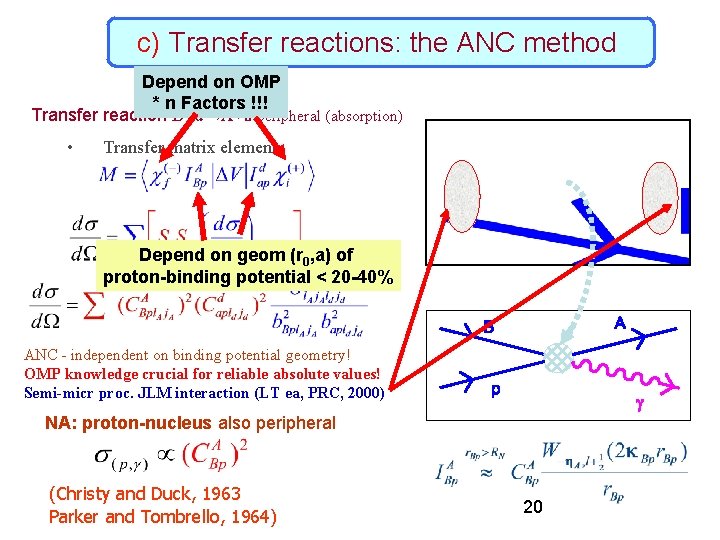
c) Transfer reactions: the ANC method Depend on OMP * n Factors !!! Transfer reaction B+d→A+a peripheral (absorption) • Transfer matrix element: Depend on geom (r 0, a) of proton-binding potential < 20 -40% ANC - independent on binding potential geometry! OMP knowledge crucial for reliable absolute values! Semi-micr proc. JLM interaction (LT ea, PRC, 2000) NA: proton-nucleus also peripheral (Christy and Duck, 1963 Parker and Tombrello, 1964) 20
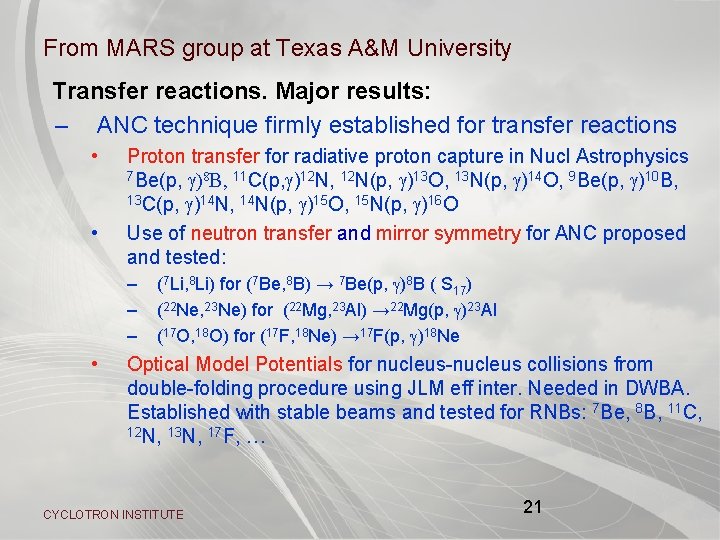
From MARS group at Texas A&M University Transfer reactions. Major results: – ANC technique firmly established for transfer reactions • • Proton transfer for radiative proton capture in Nucl Astrophysics 7 Be(p, g)8 B, 11 C(p, g)12 N, 12 N(p, g)13 O, 13 N(p, g)14 O, 9 Be(p, g)10 B, 13 C(p, g)14 N, 14 N(p, g)15 O, 15 N(p, g)16 O Use of neutron transfer and mirror symmetry for ANC proposed and tested: – – – • (7 Li, 8 Li) for (7 Be, 8 B) → 7 Be(p, g)8 B ( S 17) (22 Ne, 23 Ne) for (22 Mg, 23 Al) → 22 Mg(p, g)23 Al (17 O, 18 O) for (17 F, 18 Ne) → 17 F(p, g)18 Ne Optical Model Potentials for nucleus-nucleus collisions from double-folding procedure using JLM eff inter. Needed in DWBA. Established with stable beams and tested for RNBs: 7 Be, 8 B, 11 C, 12 N, 13 N, 17 F, … CYCLOTRON INSTITUTE 21
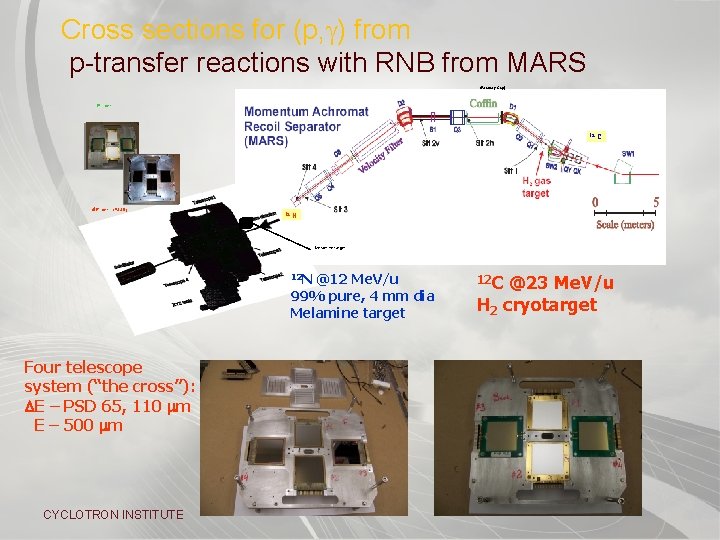
Cross sections for (p, g) from p-transfer reactions with RNB from MARS (Faraday Cup) Er - det. 12 D E - det. (PSSD) 12 C N Melamine target 12 N @12 Me. V/u 99% pure, 4 mm dia Melamine target 12 C @23 Me. V/u H 2 cryotarget Four telescope system (“the cross”): DE – PSD 65, 110 mm E – 500 mm CYCLOTRON INSTITUTE 22
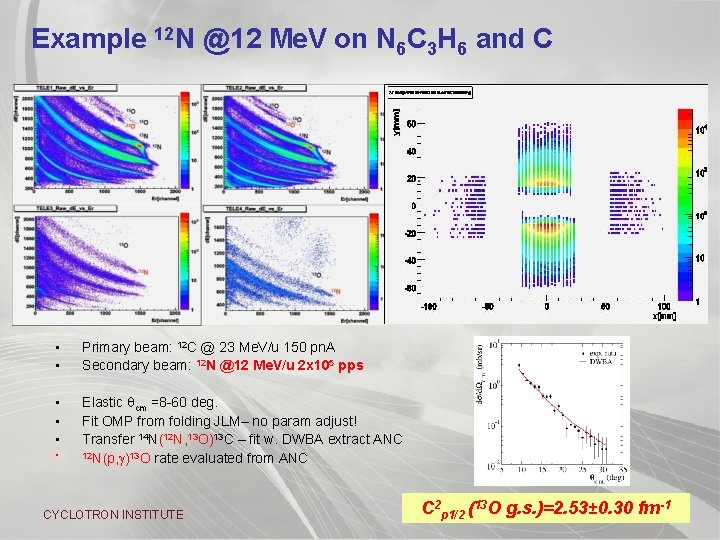
Example 12 N @12 Me. V on N 6 C 3 H 6 and C • • Primary beam: 12 C @ 23 Me. V/u 150 pn. A Secondary beam: 12 N @12 Me. V/u 2 x 10⁵ pps • • • Elastic qcm =8 -60 deg. Fit OMP from folding JLM– no param adjust! Transfer 14 N(12 N, 13 O)13 C – fit w. DWBA extract ANC 12 N(p, g)13 O rate evaluated from ANC • CYCLOTRON INSTITUTE 23 C 2 p 1/2 (13 O g. s. )=2. 53± 0. 30 fm-1
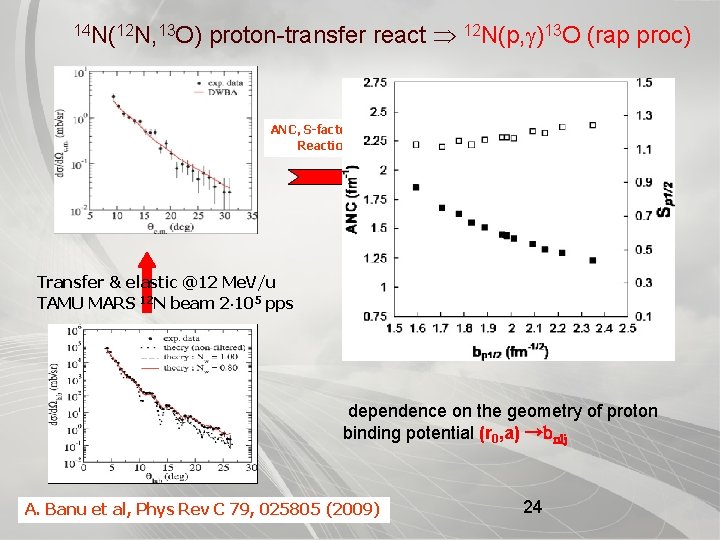
14 N(12 N, 13 O) proton-transfer react 12 N(p, g)13 O (rap proc) ANC, S-factor 0 -2 Me. V Reaction rate Transfer & elastic @12 Me. V/u TAMU MARS 12 N beam 2 105 pps dependence on the geometry of proton binding potential (r 0, a) →bnlj A. CYCLOTRON Banu et al, Phys Rev C 79, 025805 (2009) INSTITUTE 24
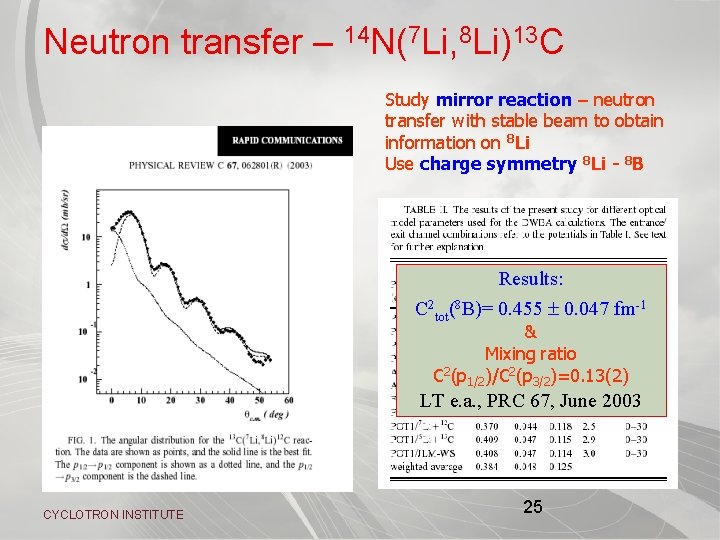
Neutron transfer – 14 N(7 Li, 8 Li)13 C Study mirror reaction – neutron transfer with stable beam to obtain information on 8 Li Use charge symmetry 8 Li - 8 B Results: C 2 tot(8 B)= 0. 455 0. 047 fm-1 & Mixing ratio C 2(p 1/2)/C 2(p 3/2)=0. 13(2) LT e. a. , PRC 67, June 2003 CYCLOTRON INSTITUTE 25
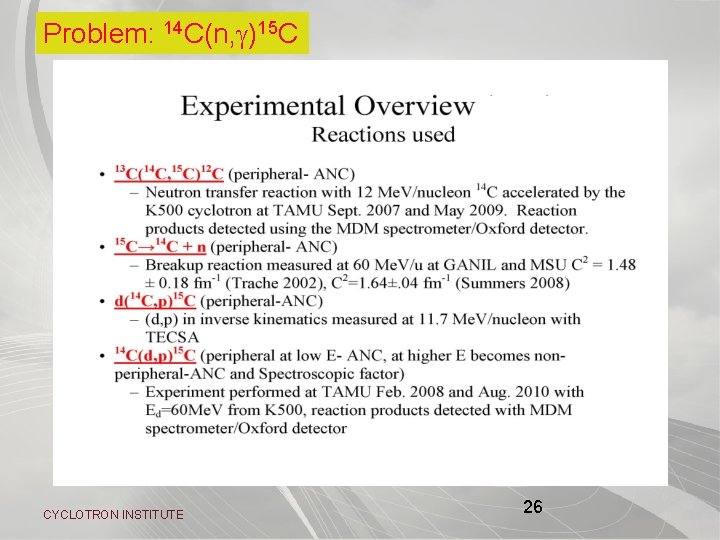
Problem: 14 C(n, g)15 C CYCLOTRON INSTITUTE 26
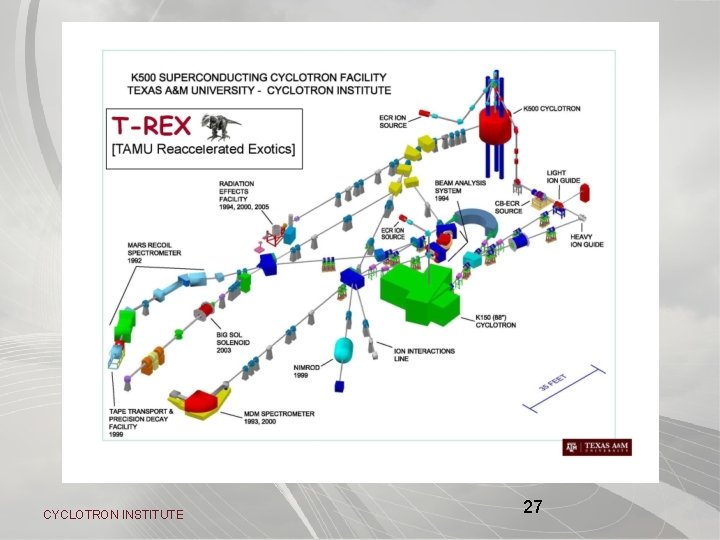
CYCLOTRON INSTITUTE 27
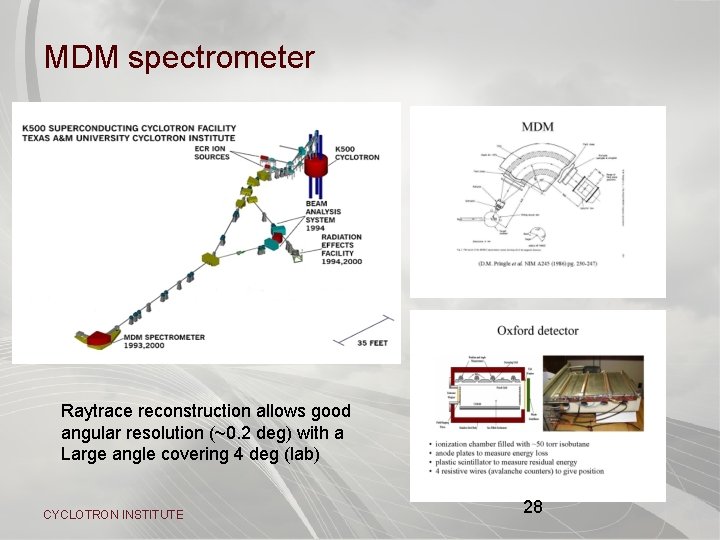
MDM spectrometer Raytrace reconstruction allows good angular resolution (~0. 2 deg) with a Large angle covering 4 deg (lab) CYCLOTRON INSTITUTE 28
CYCLOTRON INSTITUTE 29
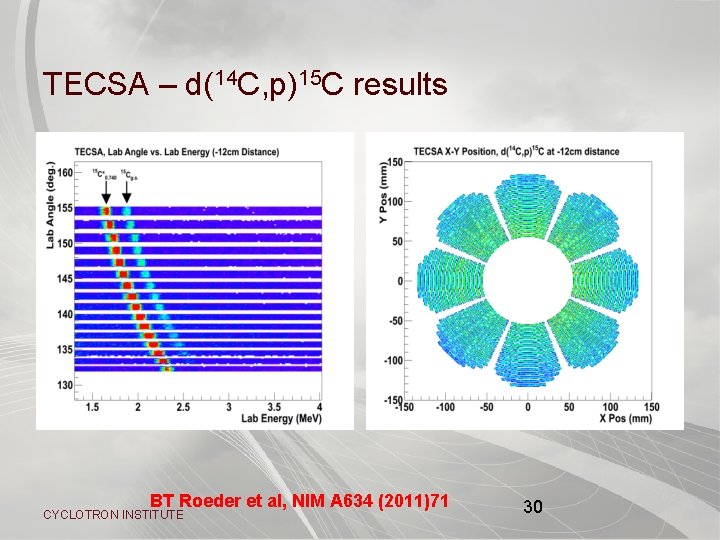
TECSA – d(14 C, p)15 C results BT Roeder et al, NIM A 634 (2011)71 CYCLOTRON INSTITUTE 30
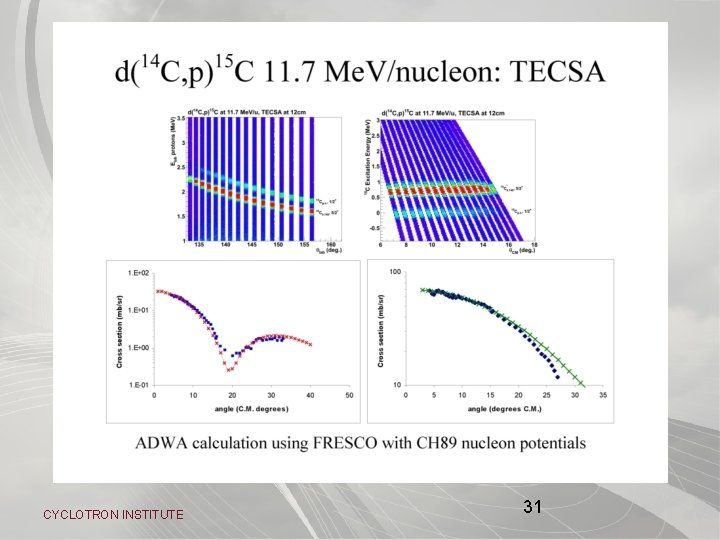
CYCLOTRON INSTITUTE 31
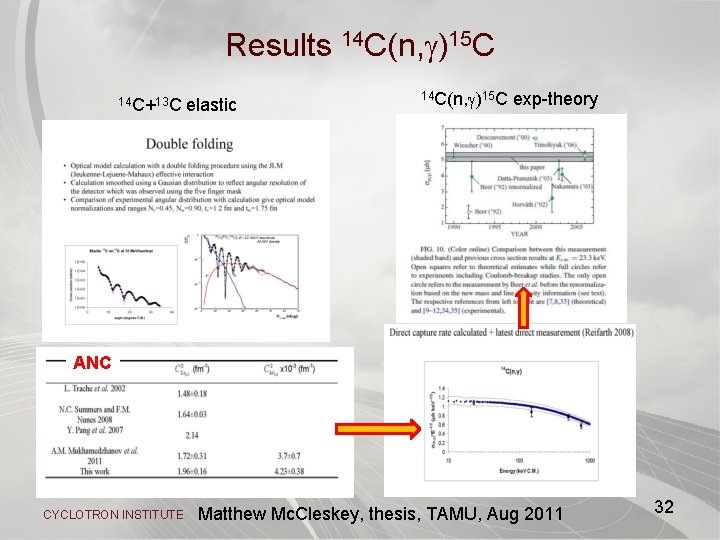
Results 14 C(n, g)15 C 14 C+13 C elastic 14 C(n, g)15 C exp-theory ANC CYCLOTRON INSTITUTE Matthew Mc. Cleskey, thesis, TAMU, Aug 2011 32
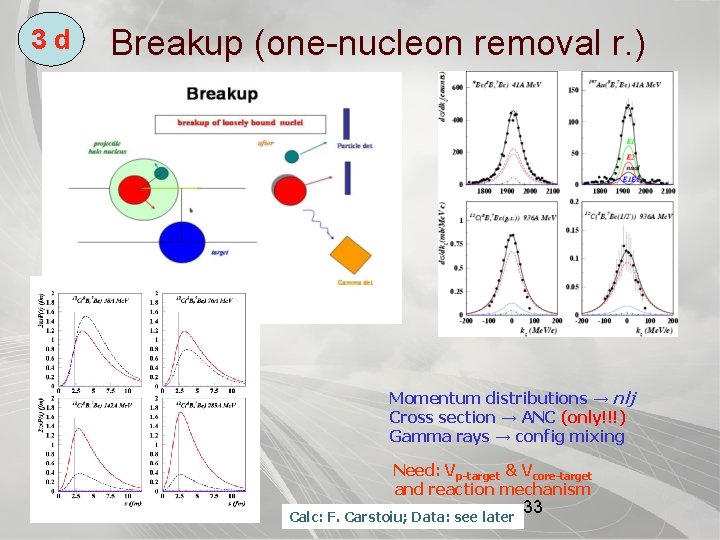
3 d Breakup (one-nucleon removal r. ) Momentum distributions → nlj Cross section → ANC (only!!!) Gamma rays → config mixing Need: Vp-target & Vcore-target and reaction mechanism CYCLOTRON INSTITUTE Calc: F. Carstoiu; Data: see later 33
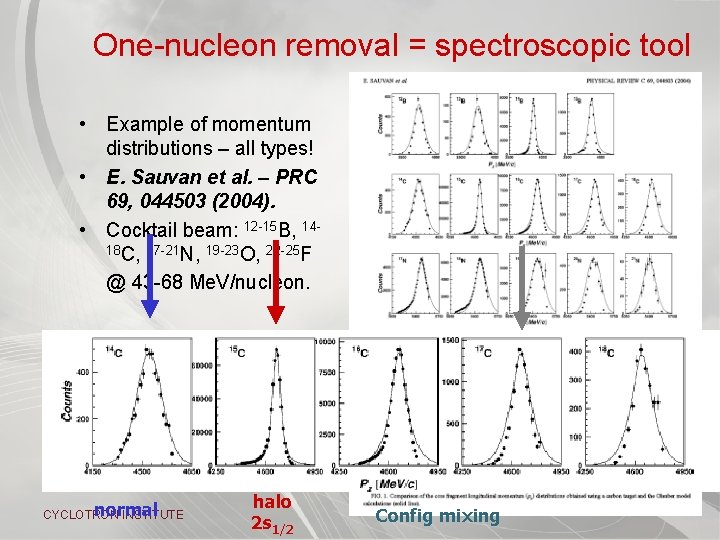
One-nucleon removal = spectroscopic tool • Example of momentum distributions – all types! • E. Sauvan et al. – PRC 69, 044503 (2004). • Cocktail beam: 12 -15 B, 1418 C, 17 -21 N, 19 -23 O, 22 -25 F @ 43 -68 Me. V/nucleon. normal CYCLOTRON INSTITUTE halo 2 s 1/2 Config mixing 34
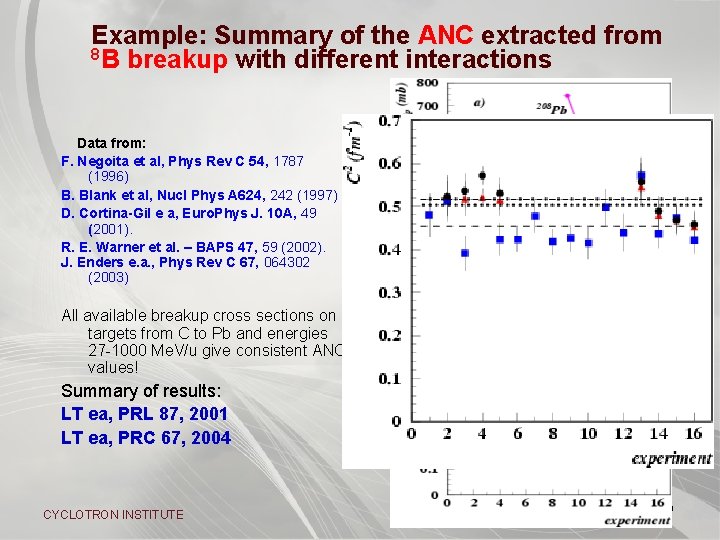
Example: Summary of the ANC extracted from 8 B breakup with different interactions Data from: F. Negoita et al, Phys Rev C 54, 1787 (1996) B. Blank et al, Nucl Phys A 624, 242 (1997) D. Cortina-Gil e a, Euro. Phys J. 10 A, 49 (2001). R. E. Warner et al. – BAPS 47, 59 (2002). J. Enders e. a. , Phys Rev C 67, 064302 (2003) All available breakup cross sections on targets from C to Pb and energies 27 -1000 Me. V/u give consistent ANC values! Summary of results: LT ea, PRL 87, 2001 LT ea, PRC 67, 2004 CYCLOTRON INSTITUTE 35
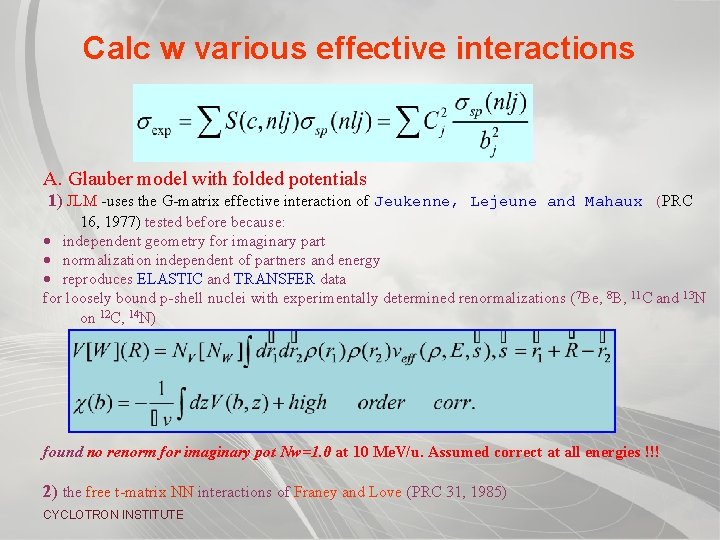
Calc w various effective interactions A. Glauber model with folded potentials 1) JLM -uses the G-matrix effective interaction of Jeukenne, Lejeune and Mahaux (PRC 16, 1977) tested before because: · independent geometry for imaginary part · normalization independent of partners and energy · reproduces ELASTIC and TRANSFER data for loosely bound p-shell nuclei with experimentally determined renormalizations ( 7 Be, 8 B, 11 C and 13 N on 12 C, 14 N) found no renorm for imaginary pot Nw=1. 0 at 10 Me. V/u. Assumed correct at all energies !!! 2) the free t-matrix NN interactions of Franey and Love (PRC 31, 1985) CYCLOTRON INSTITUTE
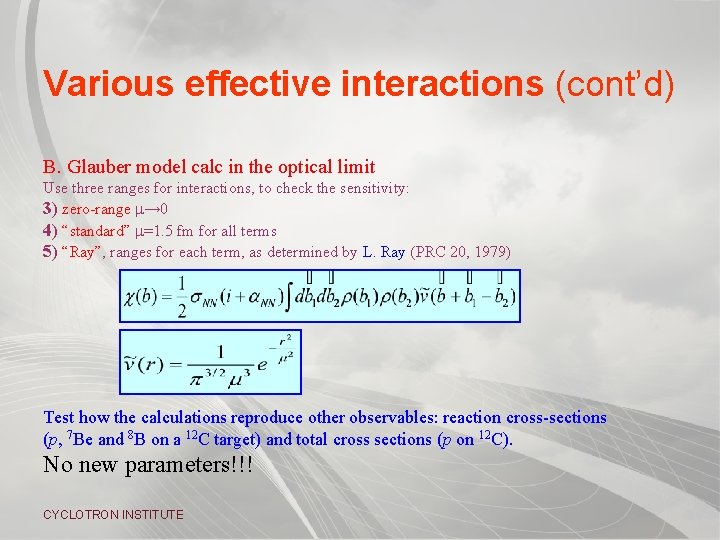
Various effective interactions (cont’d) B. Glauber model calc in the optical limit Use three ranges for interactions, to check the sensitivity: 3) zero-range → 0 4) “standard” =1. 5 fm for all terms 5) “Ray”, ranges for each term, as determined by L. Ray (PRC 20, 1979) Test how the calculations reproduce other observables: reaction cross-sections (p, 7 Be and 8 B on a 12 C target) and total cross sections (p on 12 C). No new parameters!!! CYCLOTRON INSTITUTE
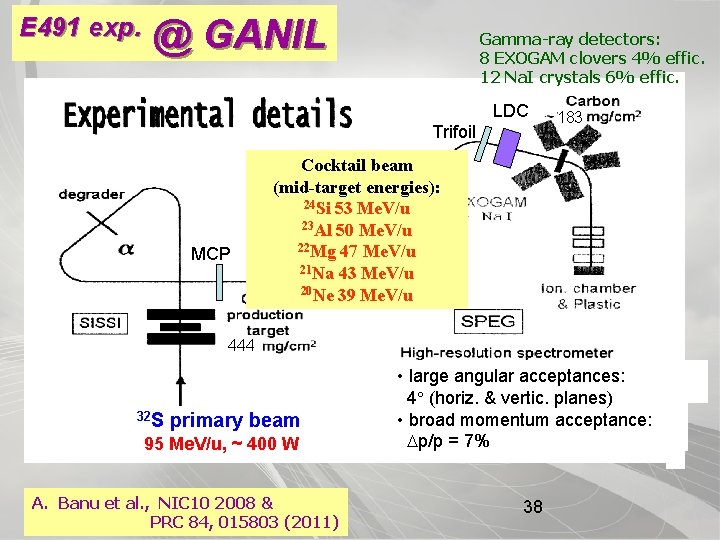
E 491 exp. @ GANIL Gamma-ray detectors: 8 EXOGAM clovers 4% effic. 12 Na. I crystals 6% effic. LDC Trifoil MCP 183 Cocktail beam (mid-target energies): 24 Si 53 Me. V/u 23 Al 50 Me. V/u 22 Mg 47 Me. V/u 21 Na 43 Me. V/u 20 Ne 39 Me. V/u 444 32 S primary beam 95 Me. V/u, ~ 400 W A. Banu et al. , NIC 10 2008 & CYCLOTRON INSTITUTE PRC 84, 015803 (2011) • large angular acceptances: 4 (horiz. & vertic. planes) • broad momentum acceptance: p/p = 7% 38
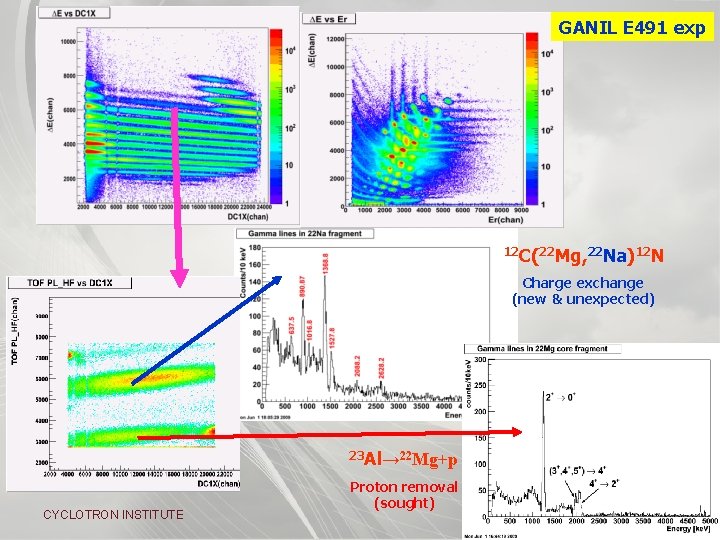
GANIL E 491 exp 12 C(22 Mg, 22 Na)12 N Charge exchange (new & unexpected) 23 Al→ 22 Mg+p CYCLOTRON INSTITUTE Proton removal (sought) 39
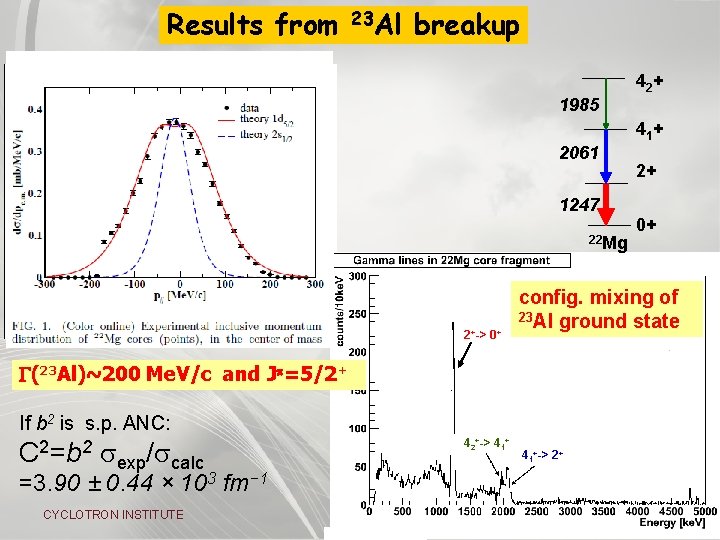
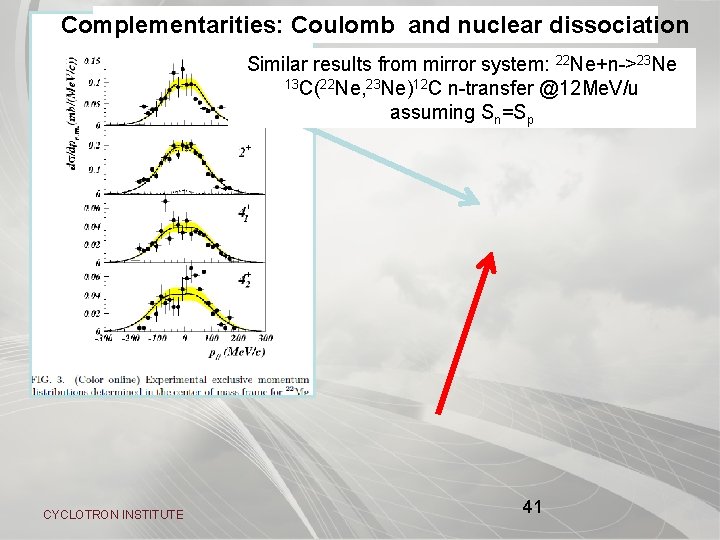
Results from 23 Al breakup 42 + 1985 41 + 2061 1247 22 Mg 2+-> 0+ If b 2 is s. p. ANC: sexp/scalc 42+-> 41+ 411+-> 2+ =3. 90 ± 0. 44 × 103 fm− 1 CYCLOTRON INSTITUTE 0+ config. mixing of 23 Al ground state G(23 Al)~200 Me. V/c and Jp=5/2+ C 2=b 2 2+ 40
Complementarities: Coulomb and nuclear dissociation Similar results from mirror system: 22 Ne+n->23 Ne 13 C(22 Ne, 23 Ne)12 C n-transfer @12 Me. V/u assuming Sn=Sp CYCLOTRON INSTITUTE 41
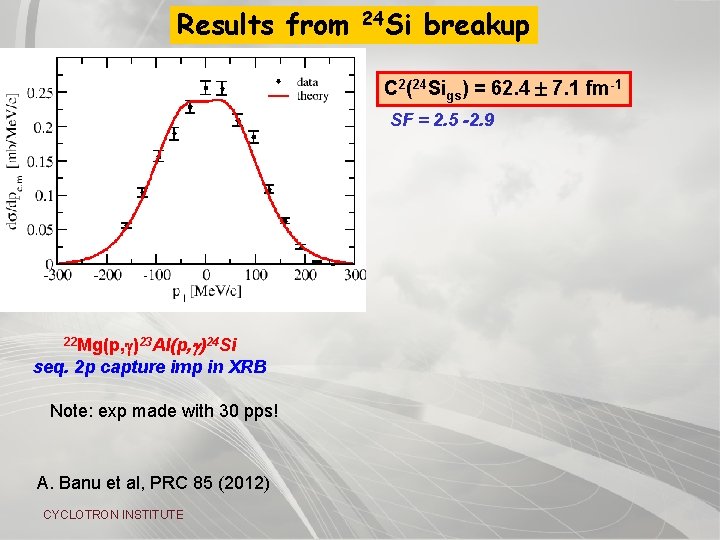
Results from 24 Si breakup C 2(24 Sigs) = 62. 4 7. 1 fm-1 SF = 2. 5 -2. 9 22 Mg(p, )23 Al(p, )24 Si seq. 2 p capture imp in XRB Note: exp made with 30 pps! A. Banu et al, PRC 85 (2012) CYCLOTRON INSTITUTE
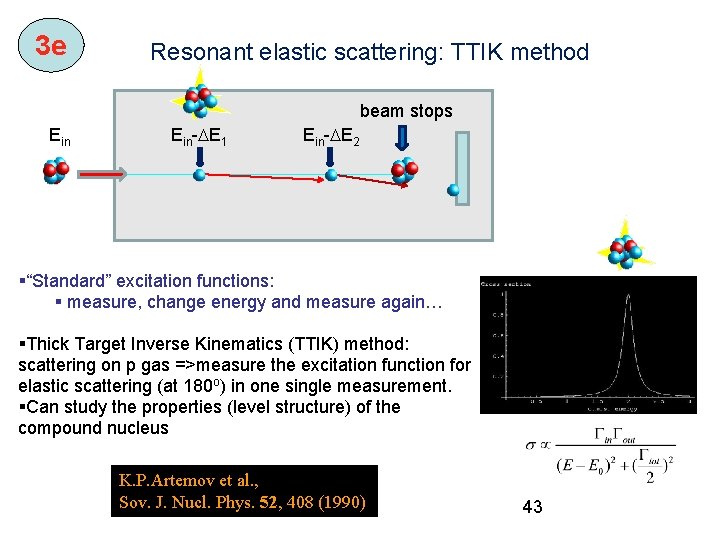
3 e Resonant elastic scattering: TTIK method beam stops Ein- E 1 Ein- E 2 §“Standard” excitation functions: § measure, change energy and measure again… §Thick Target Inverse Kinematics (TTIK) method: scattering on p gas =>measure the excitation function for elastic scattering (at 180 o) in one single measurement. §Can study the properties (level structure) of the compound nucleus 43 K. P. Artemov et al. , Sov. J. Nucl. Phys. 52, 408 (1990) 43
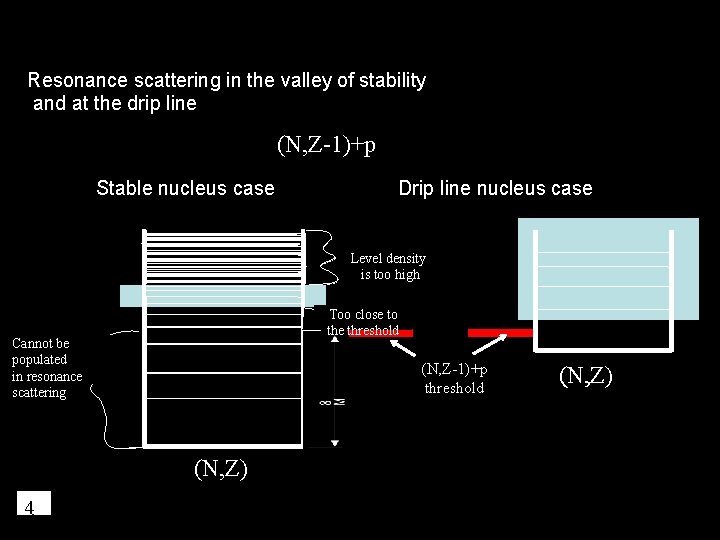
Resonance scattering in the valley of stability and at the drip line (N, Z-1)+p Stable nucleus case Drip line nucleus case Level density is too high Too close to the threshold Cannot be populated in resonance scattering (N, Z-1)+p threshold (N, Z) 4 44 44
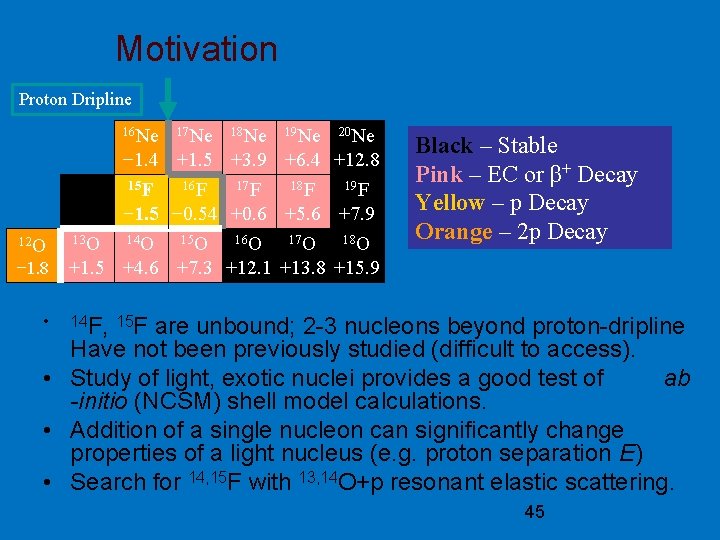
Motivation Proton Dripline 16 Ne 17 Ne 18 Ne 19 Ne 20 Ne − 1. 4 +1. 5 +3. 9 +6. 4 +12. 8 14 F ? 12 O − 1. 8 • 13 O 15 F 16 F 17 F 18 F 19 F − 1. 5 − 0. 54 +0. 6 +5. 6 +7. 9 14 O 15 O 16 O 17 O 18 O Black – Stable Pink – EC or β+ Decay Yellow – p Decay Orange – 2 p Decay +1. 5 +4. 6 +7. 3 +12. 1 +13. 8 +15. 9 14 F, 15 F are unbound; 2 -3 nucleons beyond proton-dripline Have not been previously studied (difficult to access). • Study of light, exotic nuclei provides a good test of ab -initio (NCSM) shell model calculations. • Addition of a single nucleon can significantly change properties of a light nucleus (e. g. proton separation E) • Search for 14, 15 F with 13, 14 O+p resonant elastic scattering. 45
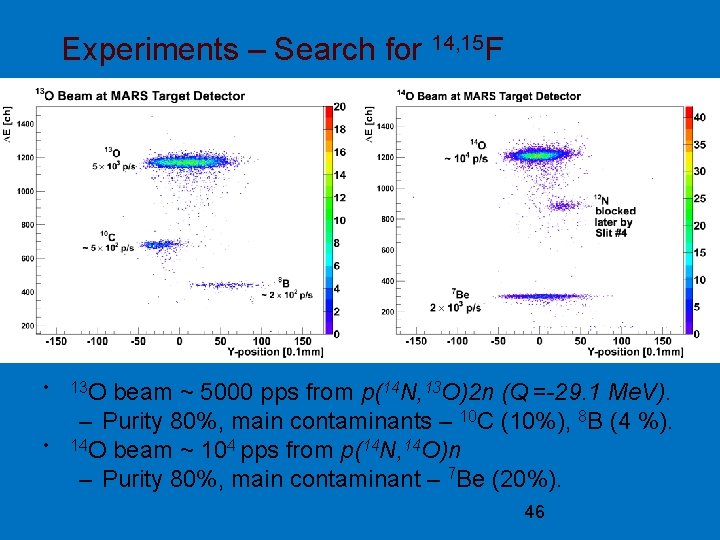
Experiments – Search for 14, 15 F 14 N Beam 38 Me. V/u 30 Me. V/u 13 O 80% pure • • 13 O beam ~ 5000 pps from p(14 N, 13 O)2 n (Q =-29. 1 Me. V). – Purity 80%, main contaminants – 10 C (10%), 8 B (4 %). 14 O beam ~ 104 pps from p(14 N, 14 O)n – Purity 80%, main contaminant – 7 Be (20%). 46
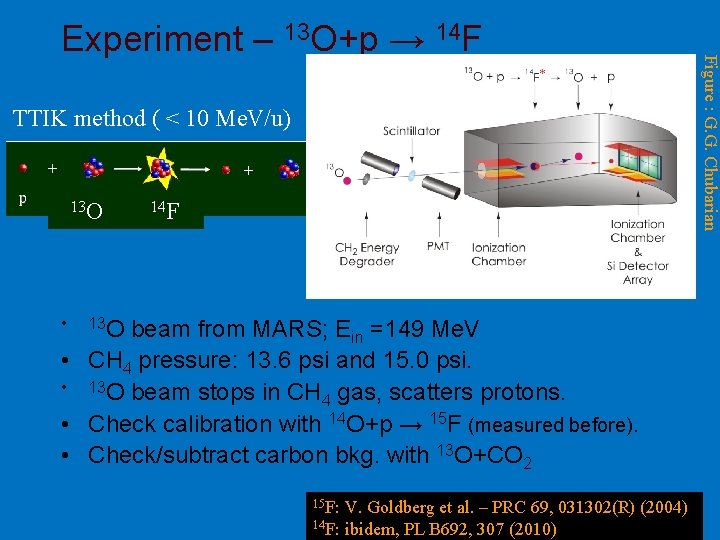
Figure : G. G. Chubarian Experiment – 13 O+p → 14 F TTIK method ( < 10 Me. V/u) 13 O • 14 F 13 O beam from MARS; Ein =149 Me. V • CH 4 pressure: 13. 6 psi and 15. 0 psi. • 13 O beam stops in CH gas, scatters protons. 4 • Check calibration with 14 O+p → 15 F (measured before). • Check/subtract carbon bkg. with 13 O+CO 2 15 F: V. Goldberg et al. – PRC 69, 031302(R) (2004) 47 14 F: ibidem, PL B 692, 307 (2010)
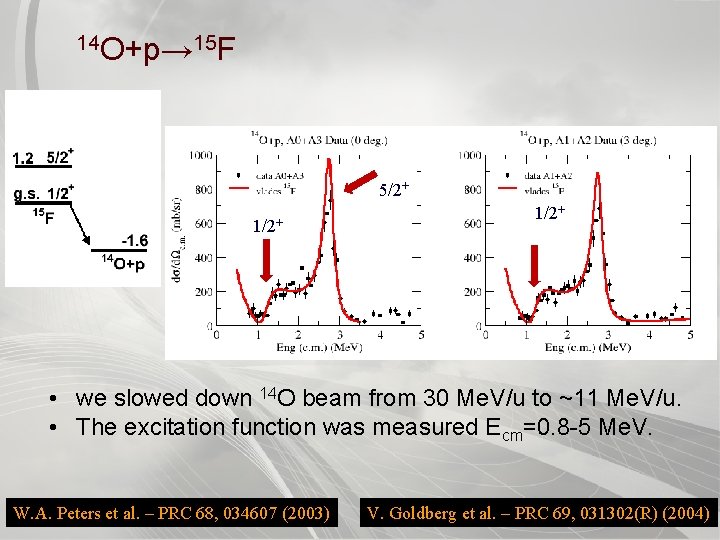
14 O+p→ 15 F 5/2+ 1/2+ • we slowed down 14 O beam from 30 Me. V/u to ~11 Me. V/u. • The excitation function was measured Ecm=0. 8 -5 Me. V. W. A. Peters et al. – PRC 68, 034607 (2003) CYCLOTRON INSTITUTE 48 V. Goldberg et al. – PRC 69, 031302(R) (2004)
3 3. Types of reactions a) Elastic scattering b) Inelastic scattering c) Direct reactions: one nucleon transfer, few nucleons d) Breakup at intermediate energies e) Resonant elastic scattering – TTIK method f) In-flight decay spectroscopy g) Multifragmentation CYCLOTRON INSTITUTE
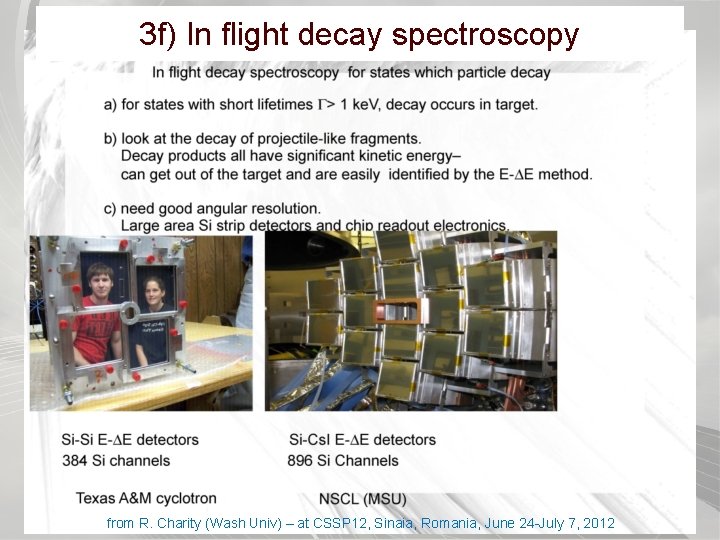
3 f) In flight decay spectroscopy CYCLOTRON INSTITUTE from R. Charity (Wash Univ) – at CSSP 12, Sinaia, Romania, June 24 -July 7, 2012
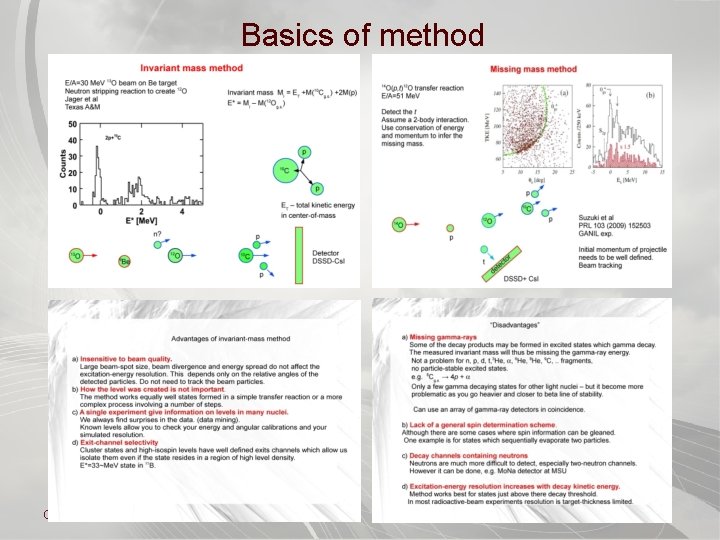
Basics of method CYCLOTRON INSTITUTE
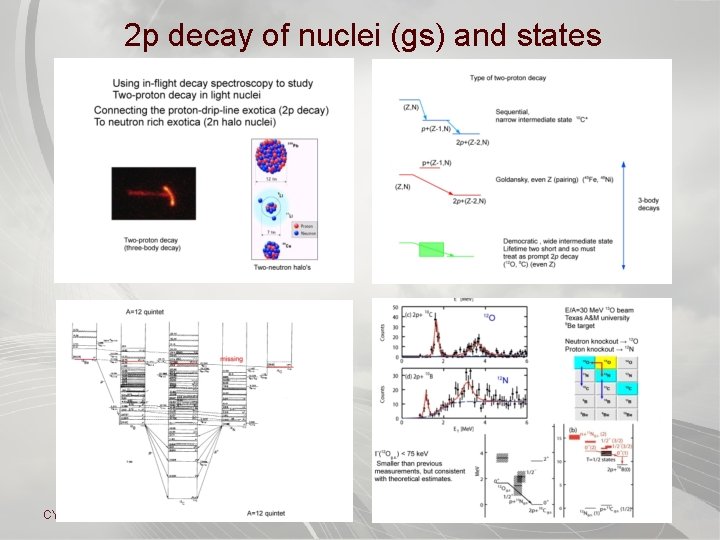
2 p decay of nuclei (gs) and states CYCLOTRON INSTITUTE
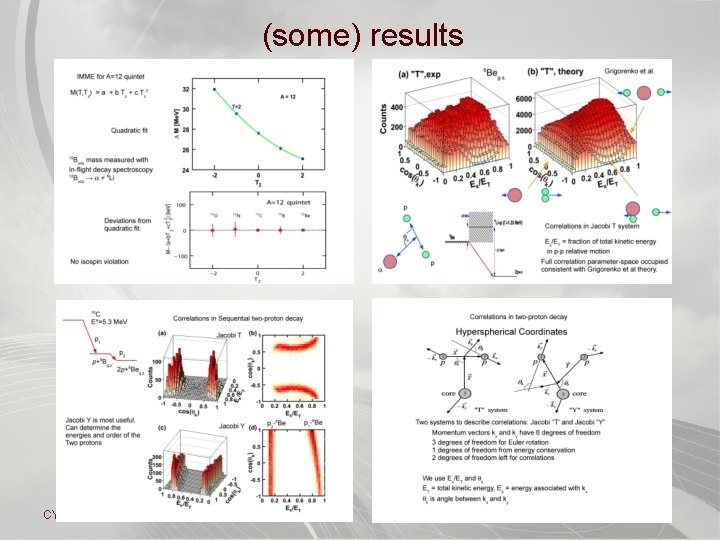
(some) results CYCLOTRON INSTITUTE
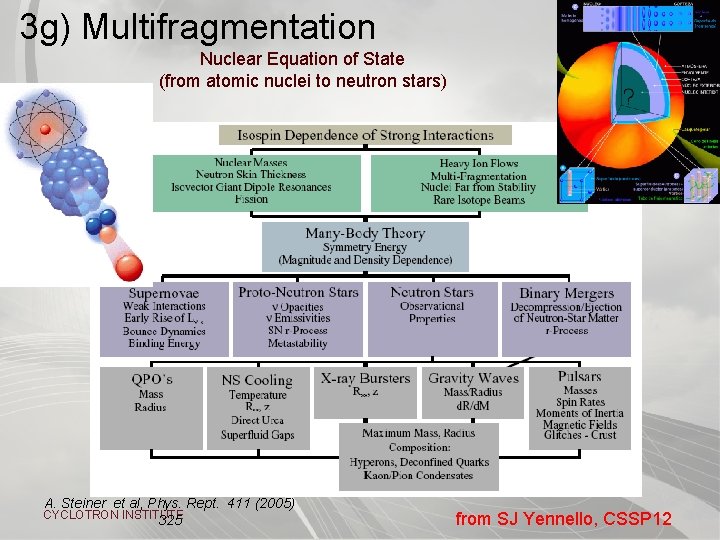
3 g) Multifragmentation Nuclear Equation of State (from atomic nuclei to neutron stars) A. Steiner et al, Phys. Rept. 411 (2005) CYCLOTRON INSTITUTE 325 from SJ Yennello, CSSP 12
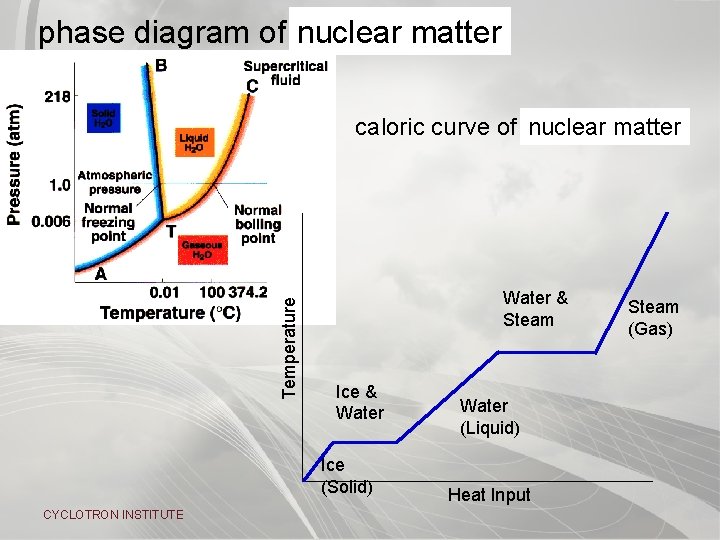
nuclear matter phase diagram of water Temperature nuclear matter caloric curve of water Water & Steam Ice & Water Ice (Solid) CYCLOTRON INSTITUTE Water (Liquid) Heat Input Steam (Gas)
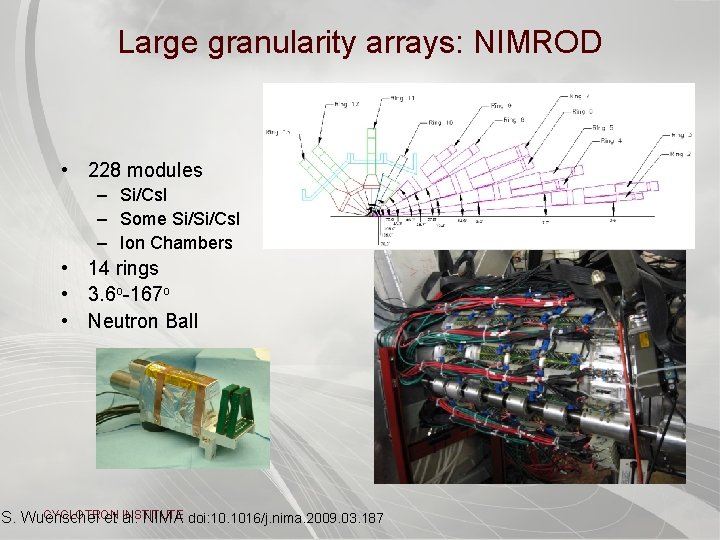
Large granularity arrays: NIMROD • 228 modules – Si/Cs. I – Some Si/Si/Cs. I – Ion Chambers • 14 rings • 3. 6 o-167 o • Neutron Ball CYCLOTRON S. Wuenschel et INSTITUTE al. NIMA doi: 10. 1016/j. nima. 2009. 03. 187
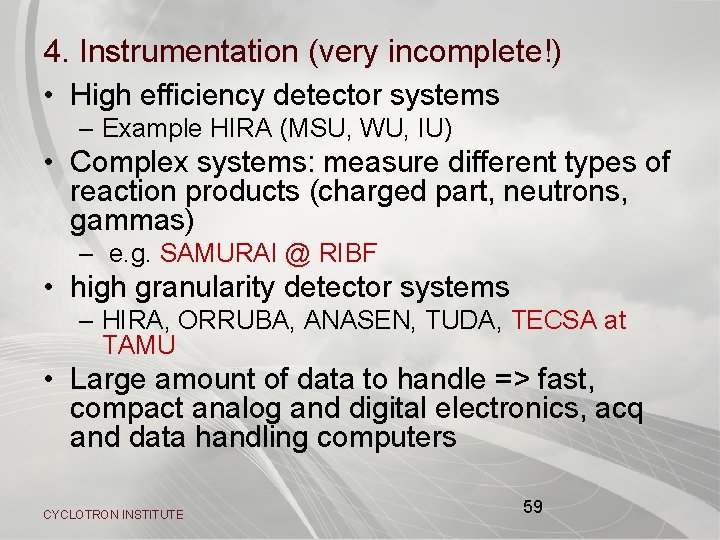
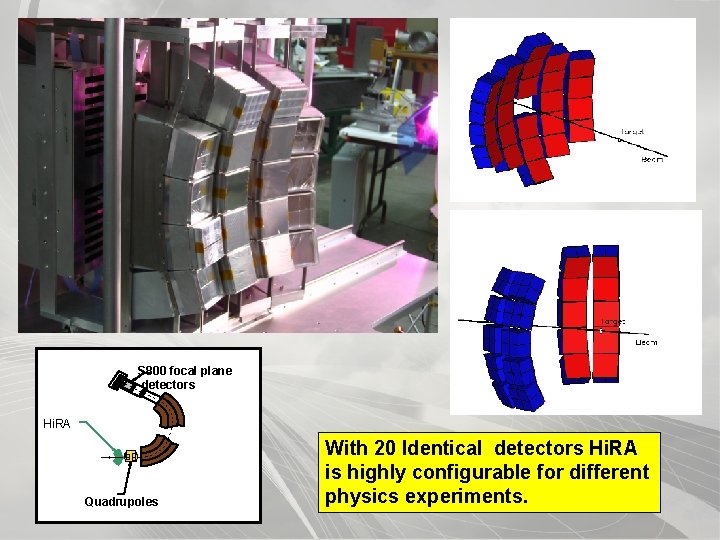
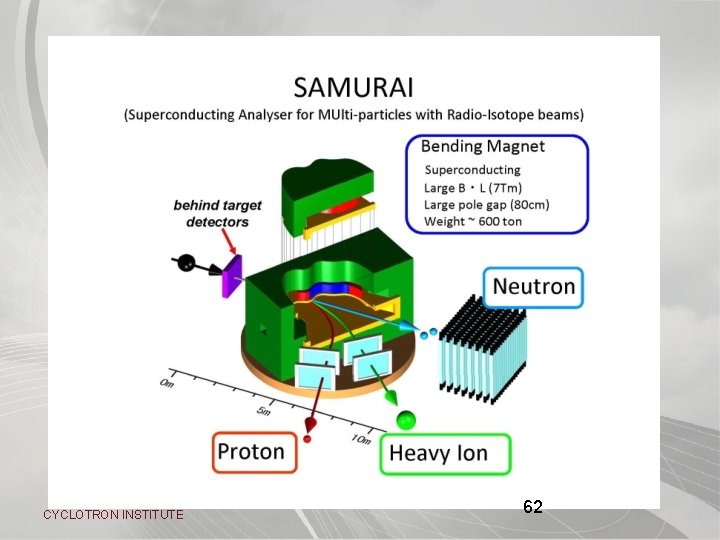
4. Instrumentation (very incomplete!) • High efficiency detector systems – Example HIRA (MSU, WU, IU) • Complex systems: measure different types of reaction products (charged part, neutrons, gammas) – e. g. SAMURAI @ RIBF • high granularity detector systems – HIRA, ORRUBA, ANASEN, TUDA, TECSA at TAMU • Large amount of data to handle => fast, compact analog and digital electronics, acq and data handling computers CYCLOTRON INSTITUTE 59
S 800 focal plane detectors Hi. RA Quadrupoles CYCLOTRON INSTITUTE With 20 Identical detectors Hi. RA is highly configurable for different physics experiments.
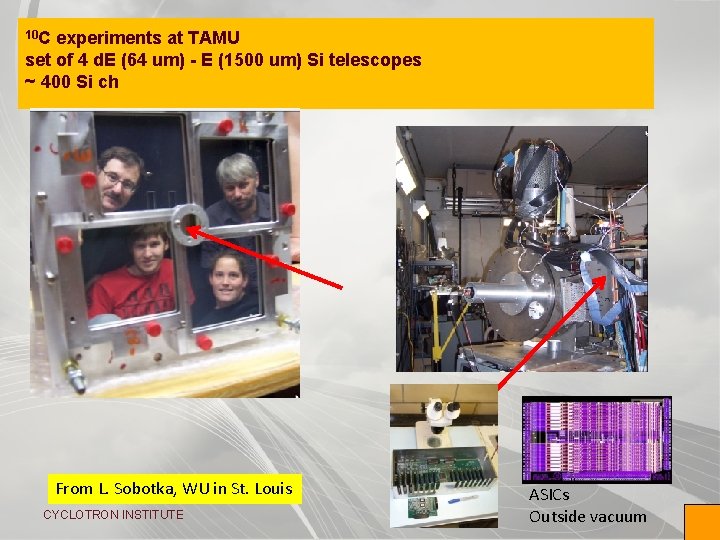
10 C experiments at TAMU set of 4 d. E (64 um) - E (1500 um) Si telescopes ~ 400 Si ch From L. Sobotka, WU in St. Louis CYCLOTRON INSTITUTE ASICs Outside vacuum
CYCLOTRON INSTITUTE 62
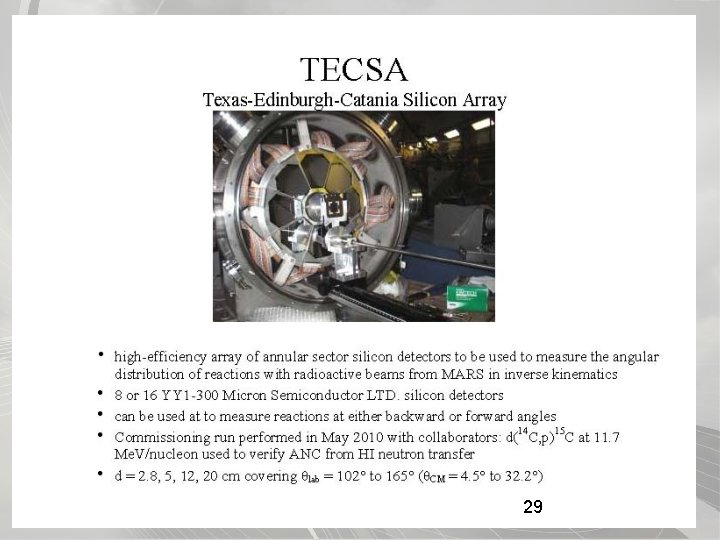
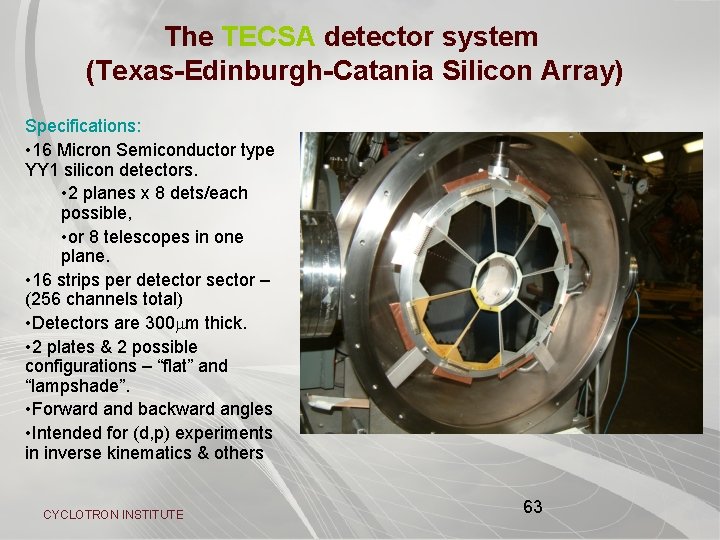
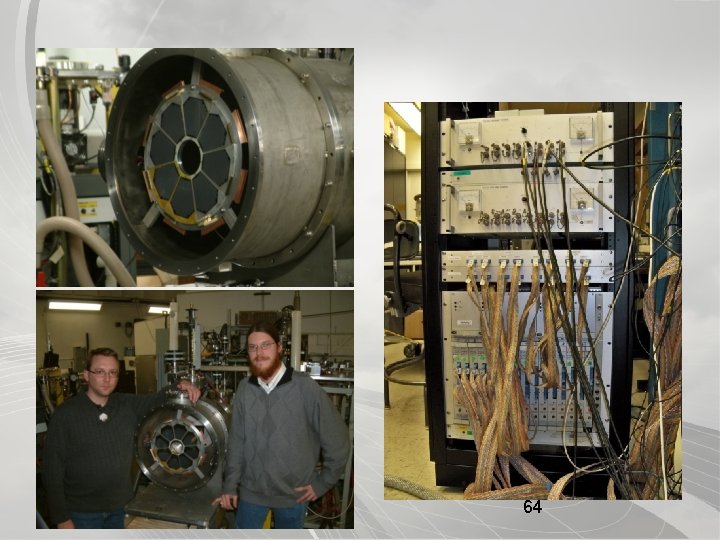
The TECSA detector system (Texas-Edinburgh-Catania Silicon Array) Specifications: • 16 Micron Semiconductor type YY 1 silicon detectors. • 2 planes x 8 dets/each possible, • or 8 telescopes in one plane. • 16 strips per detector sector – (256 channels total) • Detectors are 300 m thick. • 2 plates & 2 possible configurations – “flat” and “lampshade”. • Forward and backward angles • Intended for (d, p) experiments in inverse kinematics & others CYCLOTRON INSTITUTE 63
CYCLOTRON INSTITUTE 64
Conclusions • Reactions with RIBs are the future of nuclear physics studies • ISOL or in-flight production techniques • Specificities: • low rates and • relatively poor beam characteristics • large background • Need instrumentation efforts: • large facilities • complex detection systems • handling of large amount of data • Need new interpretation theories & approximations • Support data from experiments with stable beams CYCLOTRON INSTITUTE 65
Collaborators • R. E. Tribble, A. Banu*, CA Gagliardi, AM Mukhamedzhanov, M Mc. Cleskey, E Simmons, A. Spiridon, B. Roeder –Texas A&M University • F. Carstoiu – IFIN-HH Bucharest • E 491 exp: TAMU &: N. Orr et al. (LPC Caen), P. Chomaz et al. (GANIL Caen), W. Catford et al. (Univ of Surrey), M. Chartier et al. (Univ of Liverpool), R. Lemmon, M. Labiche (Daresbury), M. Freer et al. (Univ of Birmingham), F. Negoita (IFIN Bucharest) • L. Sobotka, R Charity et al (Washington Univ, St. Louis, MO) CYCLOTRON INSTITUTE 66