
Nuclear Reactions Chapter 18 Supernova 1999 gi in
- Slides: 28
Nuclear Reactions Chapter 18 Supernova 1999 gi in NGC 3184 Credit: Al Kelly (JSCAS/NASA & Arne Henden(Flagstaff/USNO)
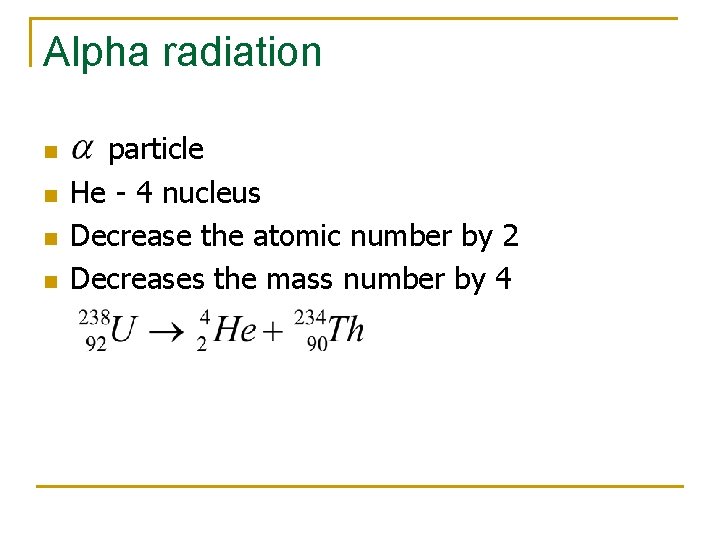
Alpha radiation n n particle He - 4 nucleus Decrease the atomic number by 2 Decreases the mass number by 4
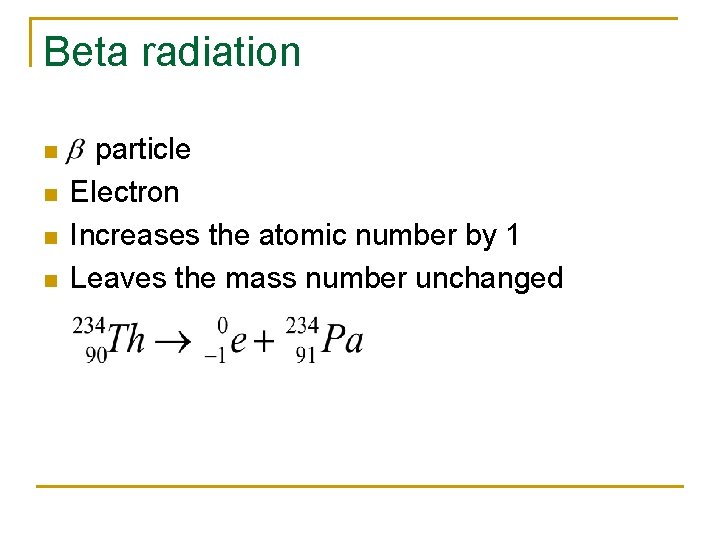
Beta radiation n n particle Electron Increases the atomic number by 1 Leaves the mass number unchanged
Gamma radiation emission n n radiation High energy photons Does not effect mass or atomic number Omitted in equations
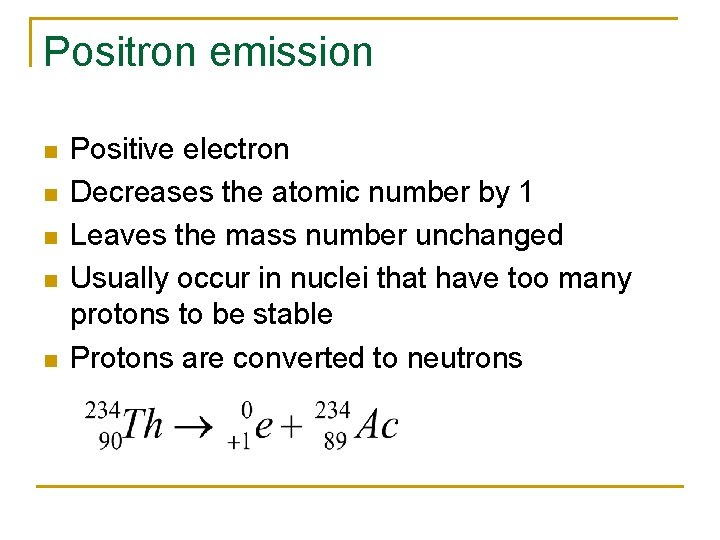
Positron emission n n Positive electron Decreases the atomic number by 1 Leaves the mass number unchanged Usually occur in nuclei that have too many protons to be stable Protons are converted to neutrons
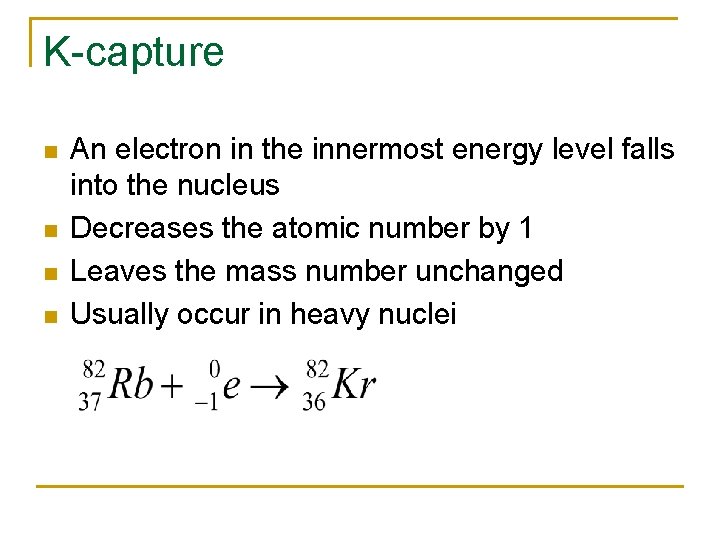
K-capture n n An electron in the innermost energy level falls into the nucleus Decreases the atomic number by 1 Leaves the mass number unchanged Usually occur in heavy nuclei
Write nuclear reactions for: Alpha emission by Th-230 K-capture of Ar-37 Beta emission by Pb-210
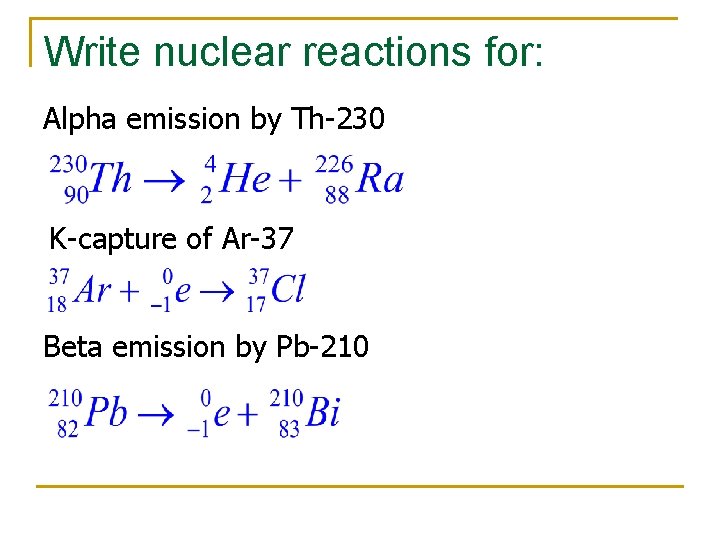
Write nuclear reactions for: Alpha emission by Th-230 K-capture of Ar-37 Beta emission by Pb-210
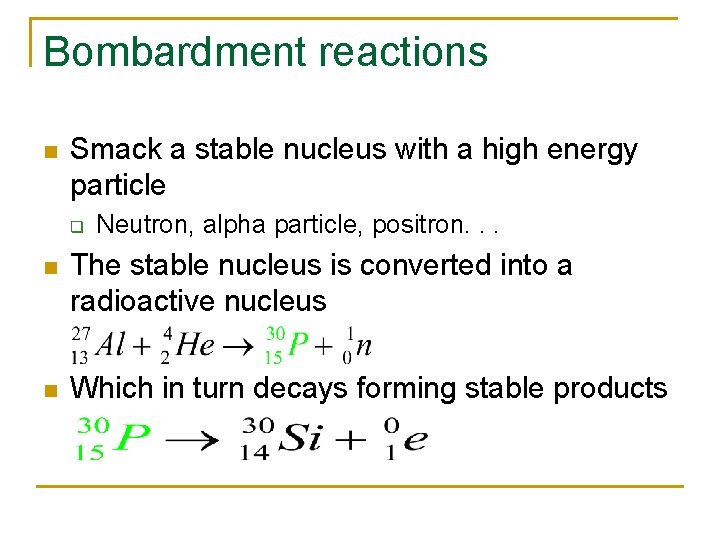
Bombardment reactions n Smack a stable nucleus with a high energy particle q Neutron, alpha particle, positron. . . n The stable nucleus is converted into a radioactive nucleus n Which in turn decays forming stable products
Uses n Medicine q q Co-60 is used to eliminate malignant cells left after tumor removal I-131 is used to treat thyroid cancer Glucose containing C-11, a positron emitter, is given to patients with brain disorders. A PET scanner is then used to see what’s going on Xe-133 is used for lung imaging
Neutron activation analysis n n Can be used to find trace amounts of elements Archaeology q q Determine dead thing’s diet Plants contain more Sr than animals so. . .
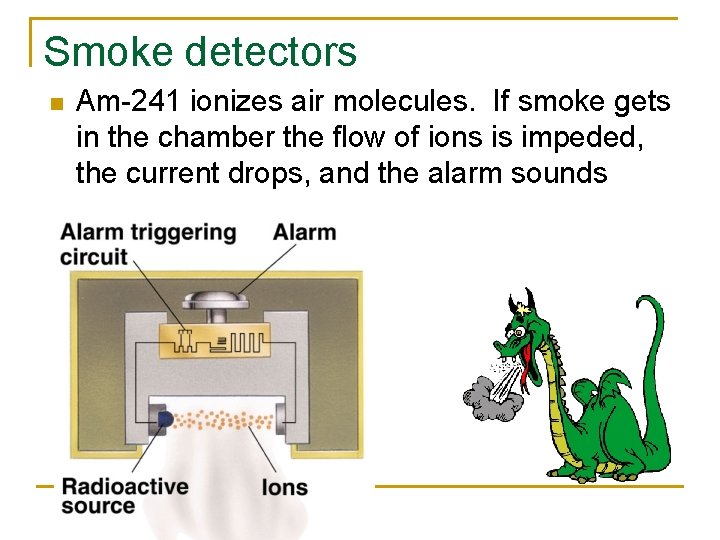
Smoke detectors n Am-241 ionizes air molecules. If smoke gets in the chamber the flow of ions is impeded, the current drops, and the alarm sounds
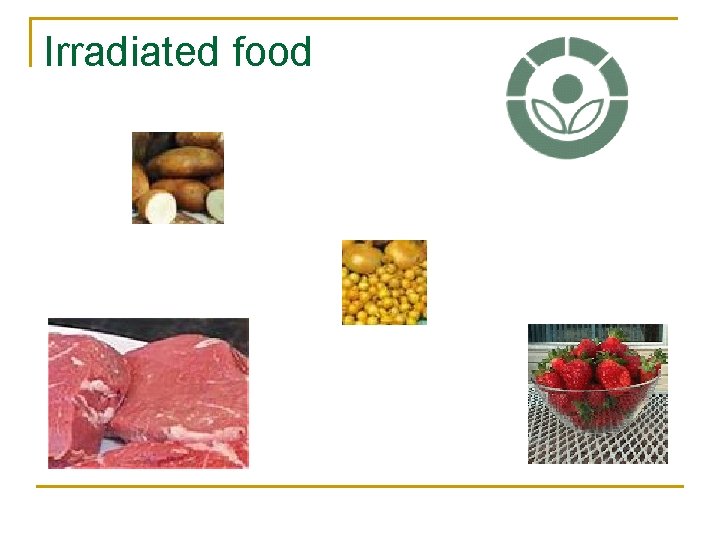
Irradiated food
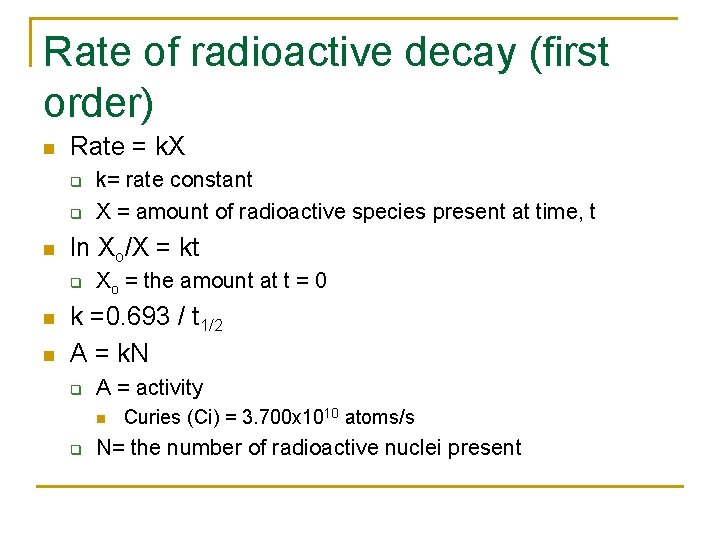
Rate of radioactive decay (first order) n Rate = k. X q q n ln Xo/X = kt q n n k= rate constant X = amount of radioactive species present at time, t Xo = the amount at t = 0 k =0. 693 / t 1/2 A = k. N q A = activity n q Curies (Ci) = 3. 700 x 1010 atoms/s N= the number of radioactive nuclei present
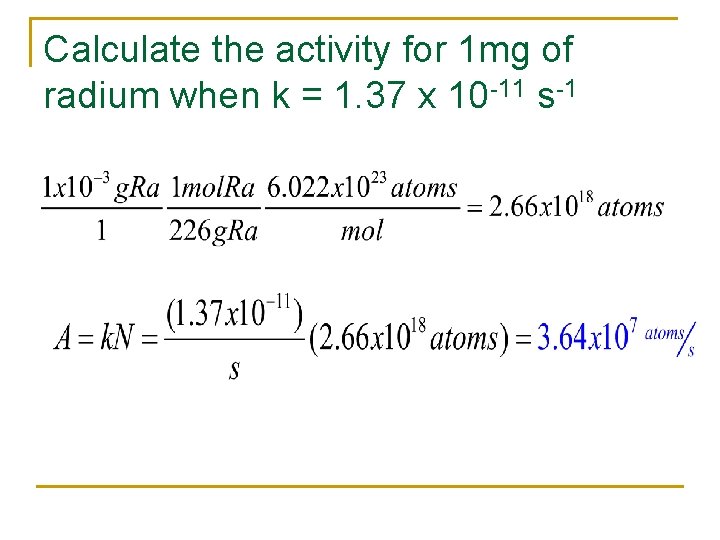
Calculate the activity for 1 mg of radium when k = 1. 37 x 10 -11 s-1
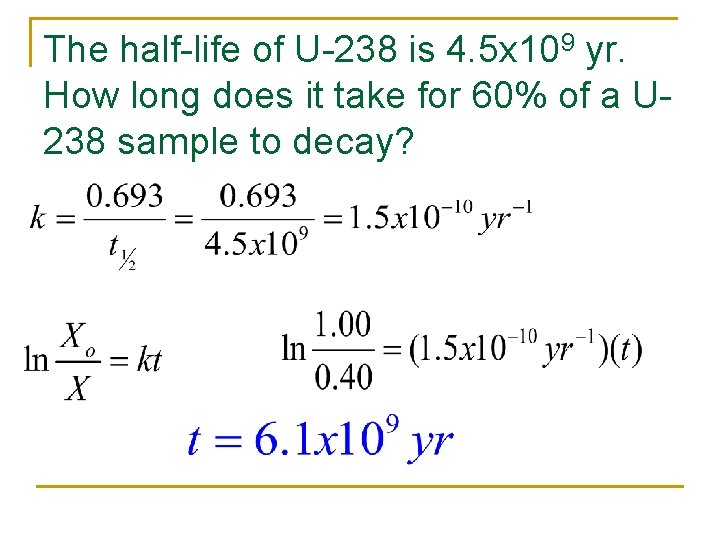
The half-life of U-238 is 4. 5 x 10⁹ yr. How long does it take for 60% of a U 238 sample to decay?
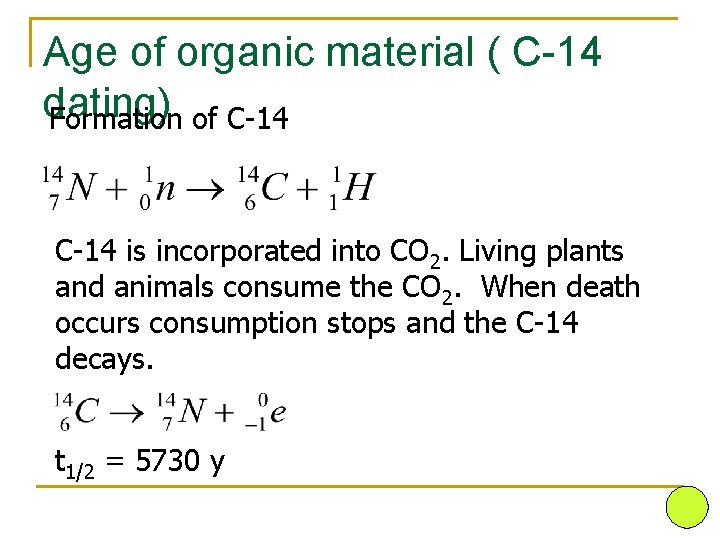
Age of organic material ( C-14 dating) Formation of C-14 is incorporated into CO 2. Living plants and animals consume the CO 2. When death occurs consumption stops and the C-14 decays. t 1/2 = 5730 y
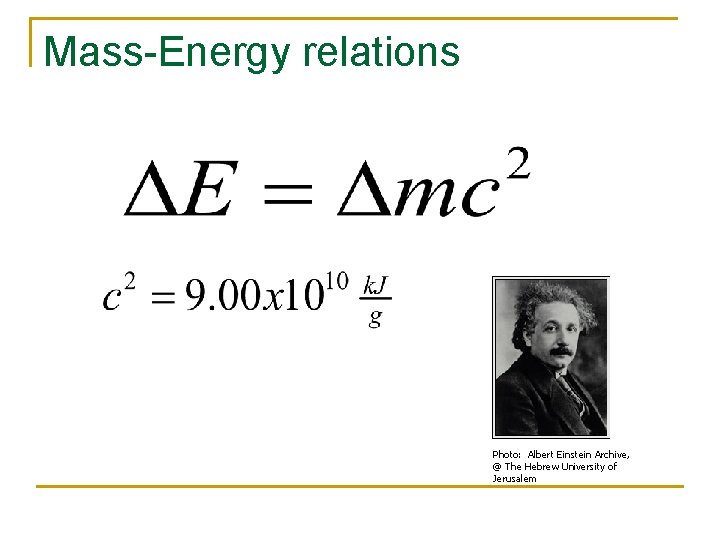
Mass-Energy relations Photo: Albert Einstein Archive, @ The Hebrew University of Jerusalem
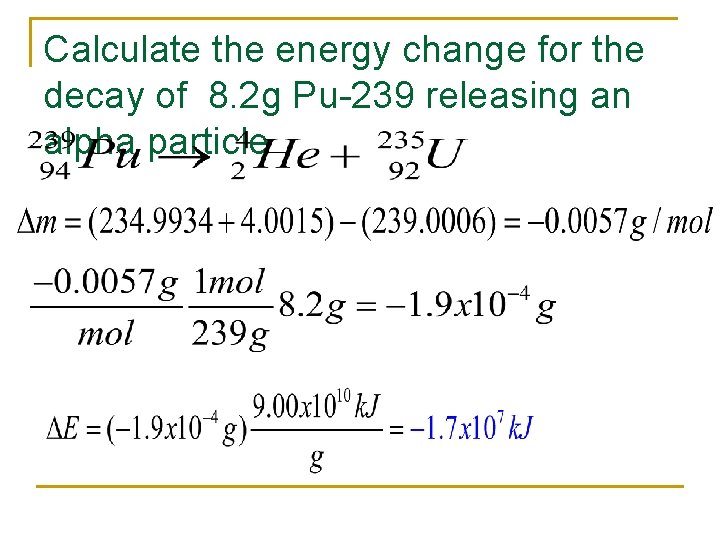
Calculate the energy change for the decay of 8. 2 g Pu-239 releasing an alpha particle
Mass defect n n A nucleus weighs less than the individual protons and neutron of which it is composed Mass defect = (n + p) – (mass of nucleus)
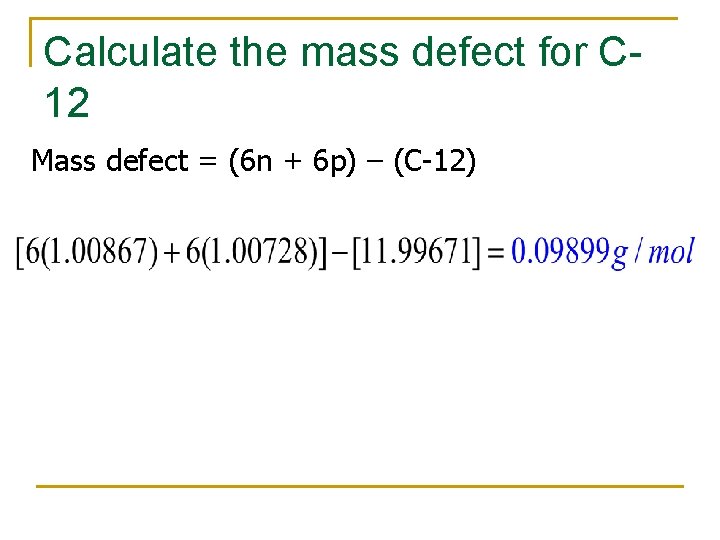
Calculate the mass defect for C 12 Mass defect = (6 n + 6 p) – (C-12)
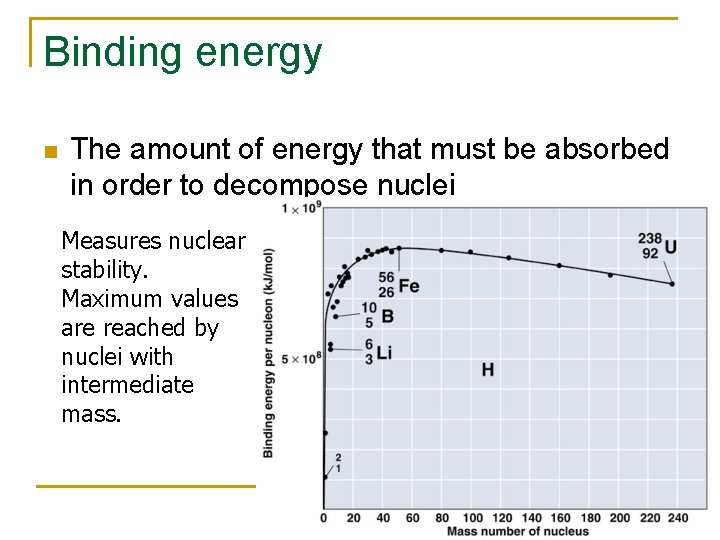
Binding energy n The amount of energy that must be absorbed in order to decompose nuclei Measures nuclear stability. Maximum values are reached by nuclei with intermediate mass.
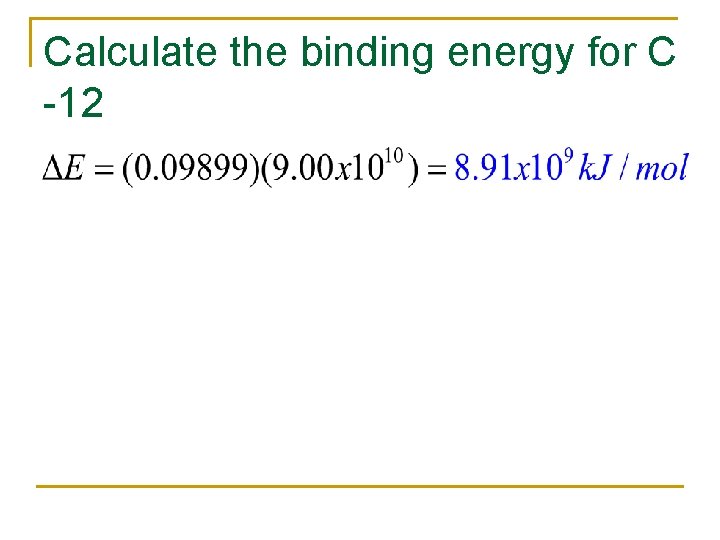
Calculate the binding energy for C -12
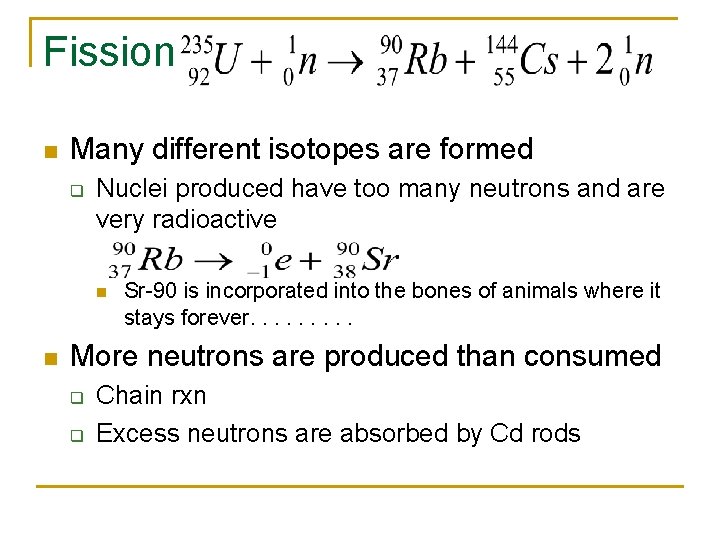
Fission n Many different isotopes are formed q Nuclei produced have too many neutrons and are very radioactive n n Sr-90 is incorporated into the bones of animals where it stays forever. . More neutrons are produced than consumed q q Chain rxn Excess neutrons are absorbed by Cd rods
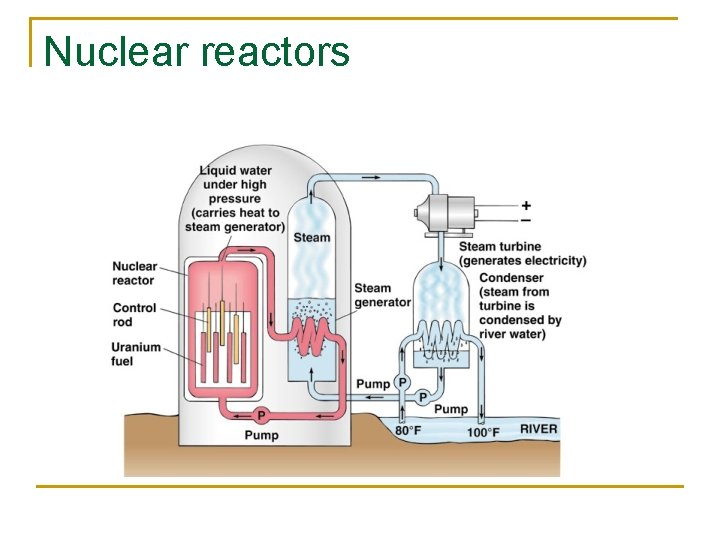
Nuclear reactors
Why nuclear energy n n n Fossil fuels are quickly being depleted Produces tons of energy Can be built anywhere
Why not nuclear energy n Expensive q n Accidents q q q n Three mile island Chernobyl Japan tsunami Disposal of radioactive waste q q n About 4 cents more than fossil fuel Yucca Mountain, Nevada? Utah? ? ? Heat pollution
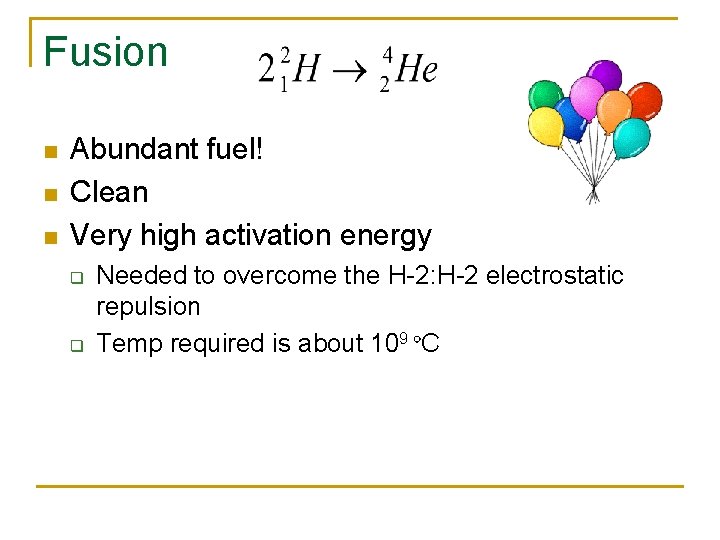
Fusion n Abundant fuel! Clean Very high activation energy q q Needed to overcome the H-2: H-2 electrostatic repulsion Temp required is about 109 C