
Nuclear Power Plants By Alyssa Outhwaite Radioactive Isotopes
Nuclear Power Plants By: Alyssa Outhwaite

Radioactive Isotopes & Gaseous Diffusion • The isotope Uranium-235 is used in nuclear power plants as a fuel. • Uranium-235 is actually very rare • In order to create U-235, regular uranium is taken and enriched to a concentration of 235. • This is done by the process of gaseous diffusion; where uranium is combine with fluorine to create uraniumhexafluoride.
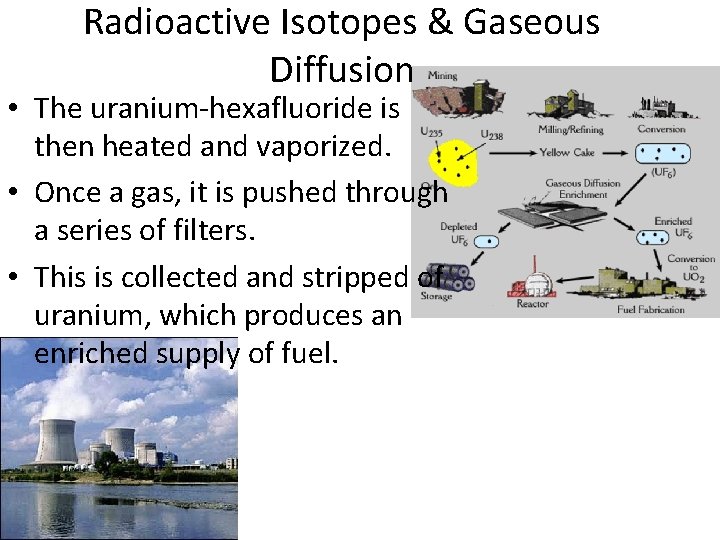
Radioactive Isotopes & Gaseous Diffusion • The uranium-hexafluoride is then heated and vaporized. • Once a gas, it is pushed through a series of filters. • This is collected and stripped of uranium, which produces an enriched supply of fuel.
Worker Precautions • In the nuclear plant radiation is emitted and works have to take certain safety measures to stay out of harms way. • Nuclear plants have regulations on the amount of radiation that any worker can receive to limit radiation exposure.
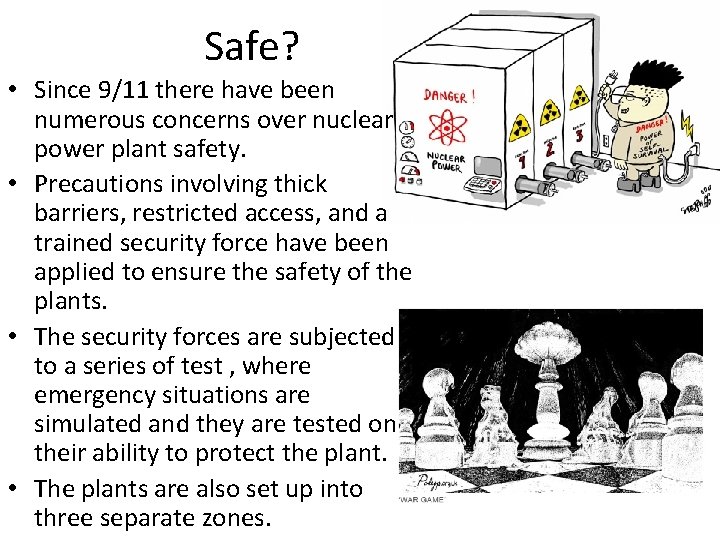
Safe? • Since 9/11 there have been numerous concerns over nuclear power plant safety. • Precautions involving thick barriers, restricted access, and a trained security force have been applied to ensure the safety of the plants. • The security forces are subjected to a series of test , where emergency situations are simulated and they are tested on their ability to protect the plant. • The plants are also set up into three separate zones.
Safe? • The first zone is the “ownercontrolled area” which serves as a buffer region. • The second zone is the “protected area” which is a restricted portion where only certain people can enter. • The third zone is the “vital area” which has further restrictions, additional barriers, and access requirements. • The plants are greatly secured and are fairly protected, but even with all the precautions taken there is always some possibility of invasion.
Accidents • There have been several U. S. accidents involving Nuclear plants. • Perhaps one of the most widely know is the Three Mile Island incident. • In Harrisburg, PA, one of two reactors lost coolant causing the radioactive fuel to overheat. • The partial meltdown involved the release of some radioactive material.
- Slides: 7