
Nuclear Power Planning with focus on infrastructure building

Nuclear Power Planning with focus on infrastructure building Akira Omoto Director, Division of Nuclear Power
Introduction Nuclear infrastructure building IAEA’s guidance documents and approach Summary Infrastructure WS 5 -7 November 2007 2
Increasing Nr. of countries considering introduction of nuclear power ü Currently 30 countries are operating NPPs. ü Almost an equivalent number of countries in the various stages of considering or planning their first nuclear power plant ü Some developed countries are revisiting the nuclear option ü 2007 IAEA Projection (published in RDS-1) by 2030 691 GWe in operation (up 321 GWe from now) in Hi-projection 447 GWe in operation (up 77 GWe from now) in Lo-projection ü Considering NP option in meeting the growing demand, considering; - Fossil price rise - Energy supply security - Environment (GHG emission, air pollution) ü Confidence from operational trend : Stable & competitive in many places around the world Infrastructure WS 5 -7 November 2007 3
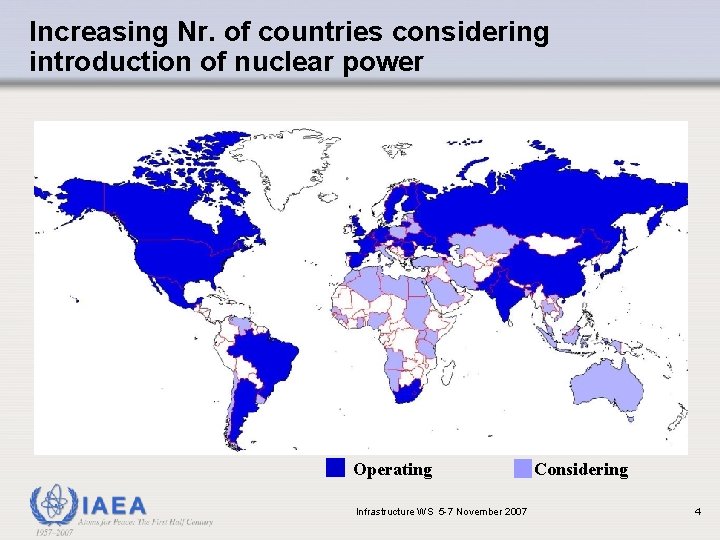
Increasing Nr. of countries considering introduction of nuclear power Operating Infrastructure WS 5 -7 November 2007 Considering 4
Introduction Nuclear infrastructure building IAEA’s guidance documents and approach Summary Infrastructure WS 5 -7 November 2007 5

Sound nuclear infrastructure • Is a key to successful construction/operation of NP • Has a wide spectrum of issues to be tackled Infrastructure WS 5 -7 November 2007 6
q From “policy decision to consider NP” to “start of operation of first NPP” : will be at least 10 -15 years, since there are many complex and inter-related issues to look at q Need step-by-step decision-making to reach q Requires long term commitment of the nation q Technology and market will evolve with time q Jumping into advanced stage without establishing balanced infrastructure : may eventually retard the whole process Potential risk of missing elements: • Commitment by the Government & prospective Operator • Definition of the role of government and private sector • Human resources development • Public acceptance • Licensing framework etc. Infrastructure WS 5 -7 November 2007 7
Issues to be considered in nuclear infrastructure building National Position Regulatory Framework Financing Safeguards Emergency Planning Nuclear Waste Nuclear Safety Stakeholder Involvement Management Procurement Legal Framework Radiation Protection Human Resource Development Security and Physical Protection Nuclear Fuel Cycle Environmental Protection Sites & Supporting Facilities Electrical Grid Industrial Involvement NE series guide NG-G-3. 1 “Milestones in the Development of a National Infrastructure for Nuclear Power, September 2007 Infrastructure WS 5 -7 November 2007 8
Key steps to follow Declaration of interest in nuclear as an option ENEGY PLANNING Phase 1: 1 -3 years ü Development of knowledge of commitment/obligation & Assessment (national capacity, role of government. . ) ü Milestone: Formal Intention To Implement Nuclear Power Program Phase 2: 3 -7 years Start implementation of INFRASTRUCTURE BUILDING PLAN… ü Milestone: Invitation To Bids Issued Phase 3: 3 -6 years üFirst Project Contract Signed CONSTRUCTION of the FIRST NPP ü Milestone: Ready for Criticality and Operational Testing Infrastructure WS 5 -7 November 2007 9
Main issues to reach milestones In each Phase 19 major issues to fulfil for reaching the corresponding milestone Each issue requires specific actions during each phase Infrastructure WS 5 -7 November 2007 10
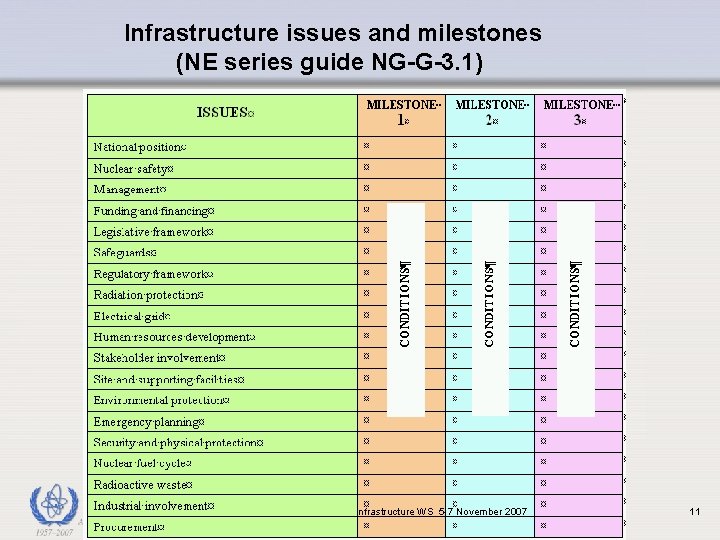
Infrastructure issues and milestones (NE series guide NG-G-3. 1) Infrastructure WS 5 -7 November 2007 11
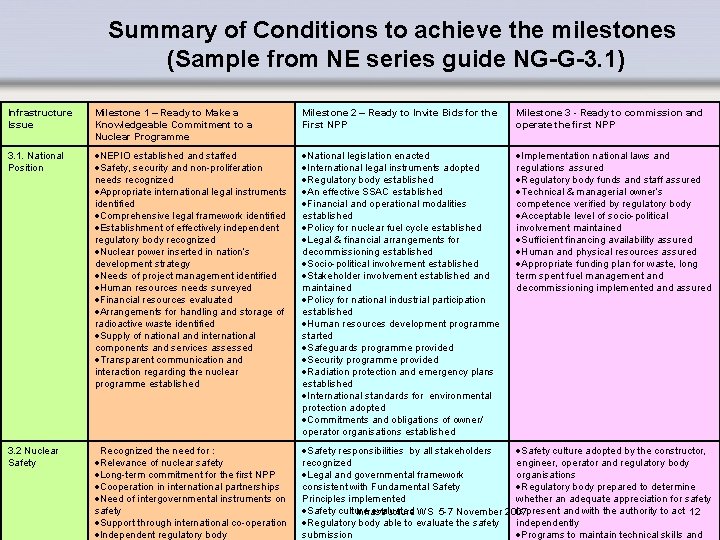
Summary of Conditions to achieve the milestones (Sample from NE series guide NG-G-3. 1) Infrastructure Issue Milestone 1 – Ready to Make a Knowledgeable Commitment to a Nuclear Programme Milestone 2 – Ready to Invite Bids for the First NPP Milestone 3 - Ready to commission and operate the first NPP 3. 1. National Position NEPIO established and staffed Safety, security and non-proliferation needs recognized Appropriate international legal instruments identified Comprehensive legal framework identified Establishment of effectively independent regulatory body recognized Nuclear power inserted in nation’s development strategy Needs of project management identified Human resources needs surveyed Financial resources evaluated Arrangements for handling and storage of radioactive waste identified Supply of national and international components and services assessed Transparent communication and interaction regarding the nuclear programme established National legislation enacted International legal instruments adopted Regulatory body established An effective SSAC established Financial and operational modalities established Policy for nuclear fuel cycle established Legal & financial arrangements for decommissioning established Socio-political involvement established Stakeholder involvement established and maintained Policy for national industrial participation established Human resources development programme started Safeguards programme provided Security programme provided Radiation protection and emergency plans established International standards for environmental protection adopted Commitments and obligations of owner/ operator organisations established Implementation national laws and regulations assured Regulatory body funds and staff assured Technical & managerial owner’s competence verified by regulatory body Acceptable level of socio-political involvement maintained Sufficient financing availability assured Human and physical resources assured Appropriate funding plan for waste, long term spent fuel management and decommissioning implemented and assured 3. 2 Nuclear Safety Recognized the need for : Relevance of nuclear safety Long-term commitment for the first NPP Cooperation in international partnerships Need of intergovernmental instruments on safety Support through international co-operation Independent regulatory body Safety responsibilities by all stakeholders Safety culture adopted by the constructor, recognized engineer, operator and regulatory body Legal and governmental framework organisations consistent with Fundamental Safety Regulatory body prepared to determine Principles implemented whether an adequate appreciation for safety Safety culture evaluated WS 5 -7 November 2007 is present and with the authority to act 12 Infrastructure Regulatory body able to evaluate the safety independently submission Programs to maintain technical skills and
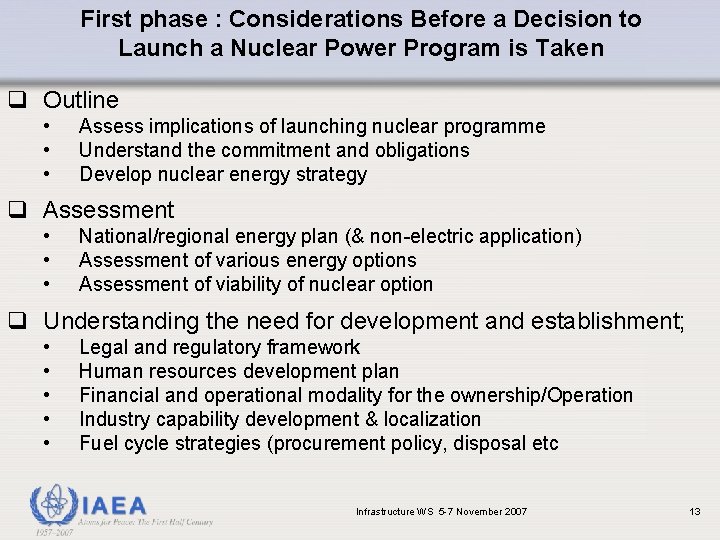
First phase : Considerations Before a Decision to Launch a Nuclear Power Program is Taken q Outline • • • Assess implications of launching nuclear programme Understand the commitment and obligations Develop nuclear energy strategy q Assessment • • • National/regional energy plan (& non-electric application) Assessment of various energy options Assessment of viability of nuclear option q Understanding the need for development and establishment; • • • Legal and regulatory framework Human resources development plan Financial and operational modality for the ownership/Operation Industry capability development & localization Fuel cycle strategies (procurement policy, disposal etc Infrastructure WS 5 -7 November 2007 13
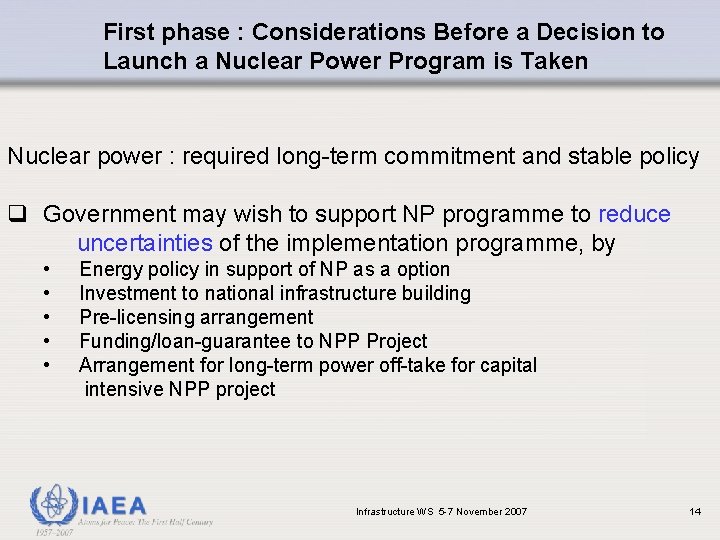
First phase : Considerations Before a Decision to Launch a Nuclear Power Program is Taken Nuclear power : required long-term commitment and stable policy q Government may wish to support NP programme to reduce uncertainties of the implementation programme, by • • • Energy policy in support of NP as a option Investment to national infrastructure building Pre-licensing arrangement Funding/loan-guarantee to NPP Project Arrangement for long-term power off-take for capital intensive NPP project Infrastructure WS 5 -7 November 2007 14
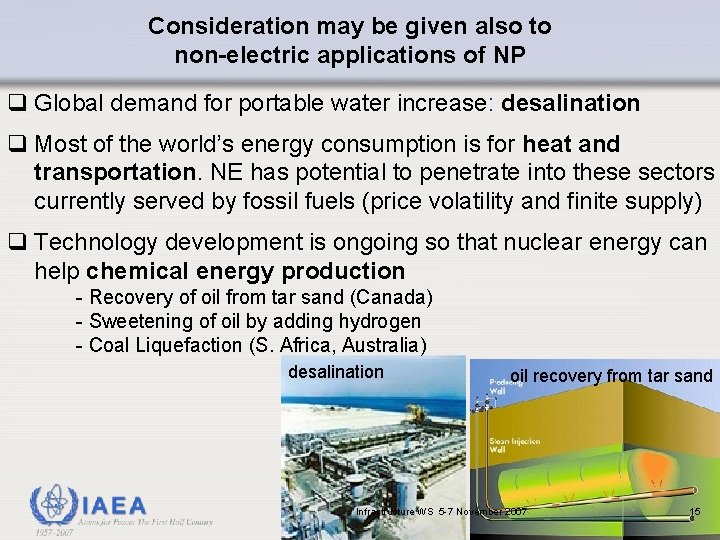
Consideration may be given also to non-electric applications of NP q Global demand for portable water increase: desalination q Most of the world’s energy consumption is for heat and transportation. NE has potential to penetrate into these sectors currently served by fossil fuels (price volatility and finite supply) q Technology development is ongoing so that nuclear energy can help chemical energy production - Recovery of oil from tar sand (Canada) - Sweetening of oil by adding hydrogen - Coal Liquefaction (S. Africa, Australia) desalination oil recovery from tar sand Infrastructure WS 5 -7 November 2007 15
Basic assessment by a WG (Inter-ministerial, inter-disciplinary) Ø To study issues and conditions necessary for successful implementation of nuclear power Ø To formulate policy, Ø To plan their implementation, and Ø To recommend to Government (Minister) Ø Issue to look at includes; • Nuclear power in the electricity market and generation mix • Economics of nuclear power • Expected role of the government and the private sector • Available nuclear power technology etc. (18 -24 months to conclude and recommend to the Government; TECDOC 1513, Section 2. 2) Infrastructure WS 5 -7 November 2007 16

2 nd phase : Policy decision for NP project ~ start of construction q Outline • Follows Policy Decision – substantive work begins for ensuring the necessary level of technical and institutional competence is achieved by State and commercial organizations. • Ensure the necessary level of technical/institutional competence is achieved q Assessment • Confirm viability of NP by feasibility study q Establish framework and capabilities • Enact legal framework • Establish regulatory body • Decide financial and operational modality for the ownership and implementation of NPP project (design assessment, establishing user requirement, tendering bid, bid evaluation) • Evaluate available technology • Tender bid & Bid evaluation etc. Infrastructure WS 5 -7 November 2007 17
EXAMPLE Consideration in evaluation of available technology q Desirable reactor & size would be different by countries (grid, finance, electricity market, multiple-purpose use etc. ) q Workshop on technology assessment (22 -26 October 2007) q Discussion of Common User Criteria may help (26 -30 November 2007 workshop) q In general Near term : most new nuclear build will likely be evolutionary designs pursuing economies of scale and based on operational experiences. Longer term: innovative designs (even shorter construction times and competitive economics) would emerge in the market including SMR (Small and Medium Sized Reactor). Infrastructure WS 5 -7 November 2007 18
Introduction Nuclear infrastructure building IAEA’s approach and guidance documents Summary Infrastructure WS 5 -7 November 2007 19
IAEA’s approach in providing support q Through Technical Cooperation Projects q Inter-departmental coordinated response to Member States q Recommend the use of relevant Agency documents q Recommend regional approach for efficiency q Recommend comprehensive assessment of infrastructure preparedness for balanced development of infrastructure • Milestone as checklist • Self-critical assessment and IAEA’s expert mission, if required q Recommend basic assessment by inter-ministerial and inter-disciplinary WG in early stage • Viability of nuclear power • The role of government and private sector • National industrial capability etc. Infrastructure WS 5 -7 November 2007 20
Agency’s recent/planned Guidance documents • TECDOC-1513 “ Basic Infrastructure for a Nuclear Power Project”, June 2006 • TECDOC-1522 “Potential for Sharing Nuclear Power Infrastructure between Countries”, October 2006 • TECDOC-1555 “Managing the First Nuclear Power Plant Project”, May 2007 • Brochure “Consideration to launch a nuclear power programme” , March 2007 • NE series guide NG-G-3. 1 “Milestones in the Development of a National Infrastructure for Nuclear Power, September 2007 • TECDOC-xxx “Improving Prospects for financing Nuclear Power Plant Projects” • TECDOC-xxx “Responsibilities and Competences of the Nuclear Power Implementing Organization to Initiate Nuclear Programme””. Infrastructure WS 5 -7 November 2007 21
Relationship between the Brochure and “Milestone” document - Both on preparation of infrastructure - Brochure: concise document for consideration by decision-makers - Milestone: will be usable as “checklist” utilized together with associated measuring index Infrastructure WS 5 -7 November 2007 22
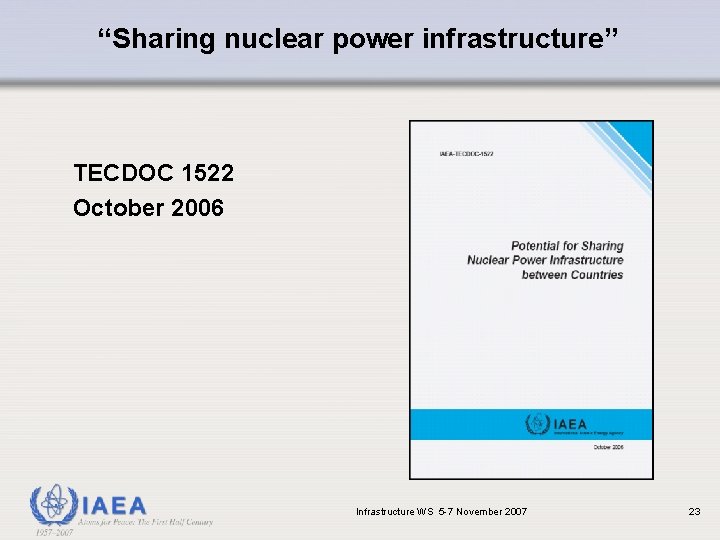
“Sharing nuclear power infrastructure” TECDOC 1522 October 2006 Infrastructure WS 5 -7 November 2007 23
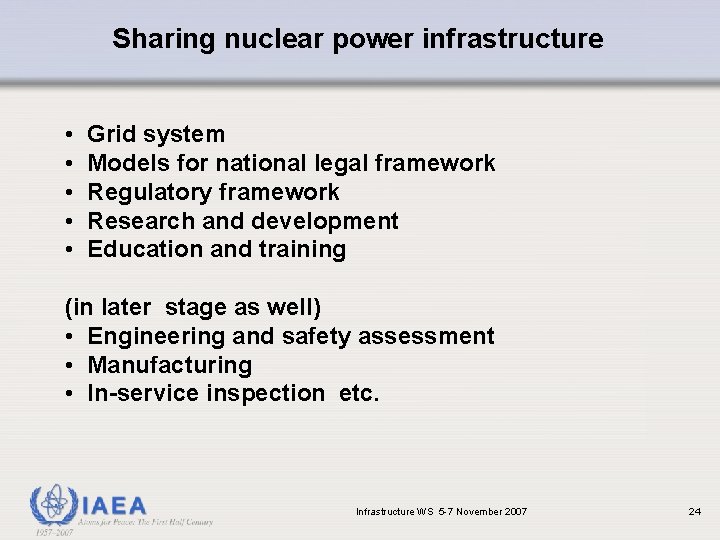
Sharing nuclear power infrastructure • • • Grid system Models for national legal framework Regulatory framework Research and development Education and training (in later stage as well) • Engineering and safety assessment • Manufacturing • In-service inspection etc. Infrastructure WS 5 -7 November 2007 24
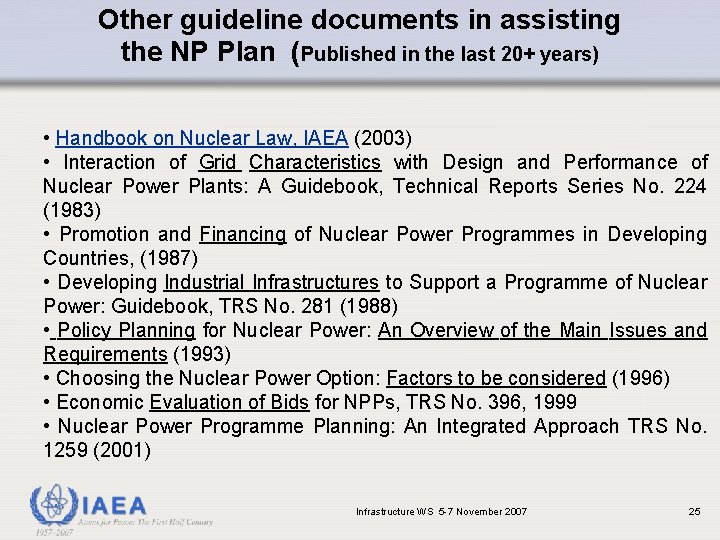
Other guideline documents in assisting the NP Plan (Published in the last 20+ years) • Handbook on Nuclear Law, IAEA (2003) • Interaction of Grid Characteristics with Design and Performance of Nuclear Power Plants: A Guidebook, Technical Reports Series No. 224 (1983) • Promotion and Financing of Nuclear Power Programmes in Developing Countries, (1987) • Developing Industrial Infrastructures to Support a Programme of Nuclear Power: Guidebook, TRS No. 281 (1988) • Policy Planning for Nuclear Power: An Overview of the Main Issues and Requirements (1993) • Choosing the Nuclear Power Option: Factors to be considered (1996) • Economic Evaluation of Bids for NPPs, TRS No. 396, 1999 • Nuclear Power Programme Planning: An Integrated Approach TRS No. 1259 (2001) Infrastructure WS 5 -7 November 2007 25
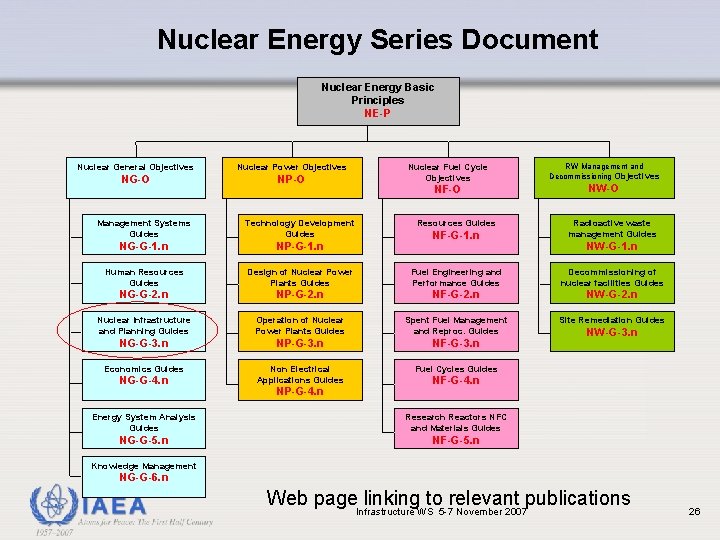
Nuclear Energy Series Document Nuclear Energy Basic Principles NE-P Nuclear General Objectives Nuclear Power Objectives NG-O NP-O Management Systems Guides Technology Development Guides NG-G-1. n NP-G-1. n Human Resources Guides Nuclear Fuel Cycle Objectives NF-O NW-O NF-G-1. n Radioactive waste management Guides Design of Nuclear Power Plants Guides Fuel Engineering and Performance Guides Decommissioning of nuclear facilities Guides NG-G-2. n NP-G-2. n NF-G-2. n NW-G-2. n Nuclear Infrastructure and Planning Guides Operation of Nuclear Power Plants Guides Spent Fuel Management and Reproc. Guides Site Remediation Guides NG-G-3. n NP-G-3. n NF-G-3. n Economics Guides Non Electrical Applications Guides Fuel Cycles Guides NG-G-4. n NP-G-4. n Resources Guides RW Management and Decommissioning Objectives NW-G-1. n NW-G-3. n NF-G-4. n Energy System Analysis Guides Research Reactors NFC and Materials Guides NG-G-5. n NF-G-5. n Knowledge Management NG-G-6. n Web page. Infrastructure linking. WSto 5 -7 relevant publications November 2007 26
SUMMARY q Wide variety of issues to be addressed in infrastructure building q Support from the IAEA, but decision by each county q Taking your time for • Basic assessment • Defining national NE policy and user requirement • Balanced development of the country’s nuclear infrastructure - “Haste is Waste” : a Japanese proverb Infrastructure WS 5 -7 November 2007 27
…Thank you for your attention Infrastructure WS 5 -7 November 2007 28
- Slides: 28