
Nuclear Physics Varan Satchithanandan Mentor Dr Richard Jones
- Slides: 24
Nuclear Physics Varan Satchithanandan Mentor: Dr. Richard Jones
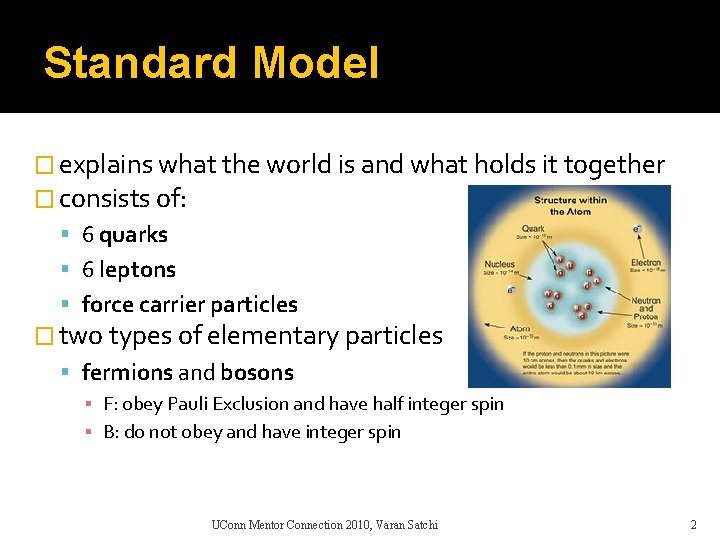
Standard Model � explains what the world is and what holds it together � consists of: 6 quarks 6 leptons force carrier particles � two types of elementary particles fermions and bosons ▪ F: obey Pauli Exclusion and have half integer spin ▪ B: do not obey and have integer spin UConn Mentor Connection 2010, Varan Satchi 2
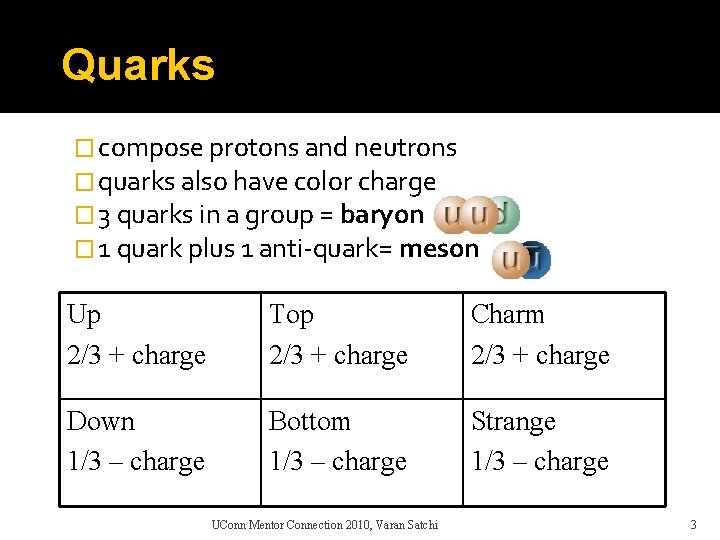
Quarks � compose protons and neutrons � quarks also have color charge � 3 quarks in a group = baryon � 1 quark plus 1 anti-quark= meson Up 2/3 + charge Top 2/3 + charge Charm 2/3 + charge Down 1/3 – charge Bottom 1/3 – charge Strange 1/3 – charge UConn Mentor Connection 2010, Varan Satchi 3
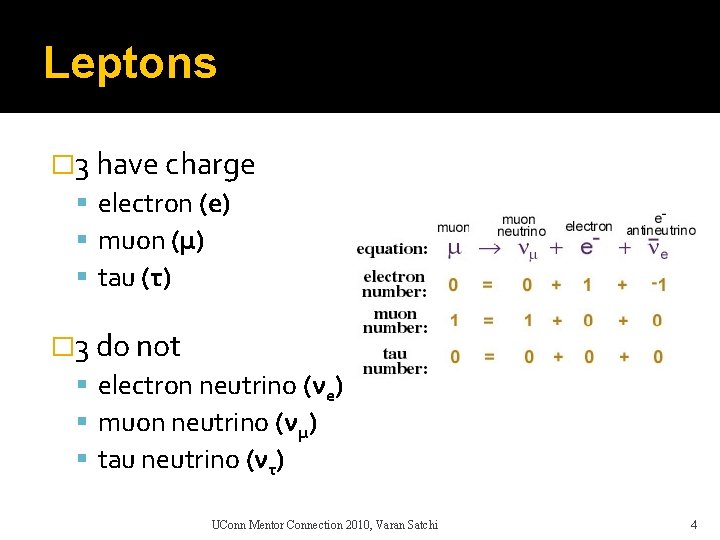
Leptons � 3 have charge electron (e) muon (μ) tau (τ) � 3 do not electron neutrino (νe) muon neutrino (νμ) tau neutrino (ντ) UConn Mentor Connection 2010, Varan Satchi 4
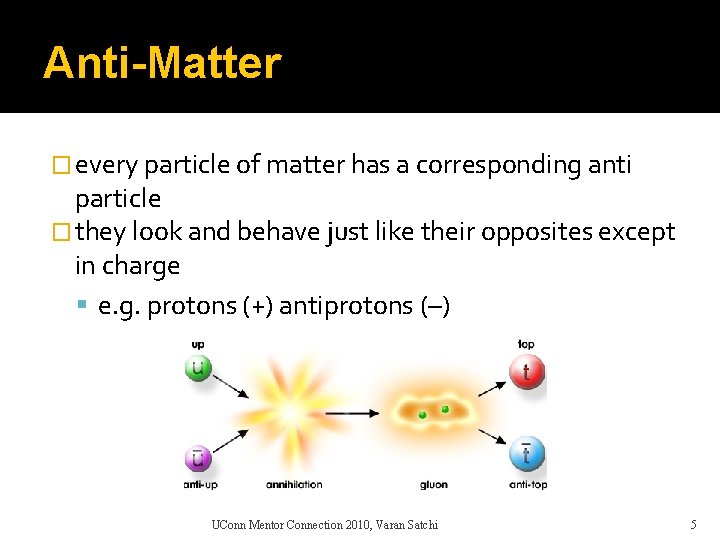
Anti-Matter � every particle of matter has a corresponding anti particle � they look and behave just like their opposites except in charge e. g. protons (+) antiprotons (–) UConn Mentor Connection 2010, Varan Satchi 5
Force Carrier Particles: A Background � four fundamental interactions between particles gravity electromagnetic strong weak � a force is a consequence of interactions between force particles UConn Mentor Connection 2010, Varan Satchi 6
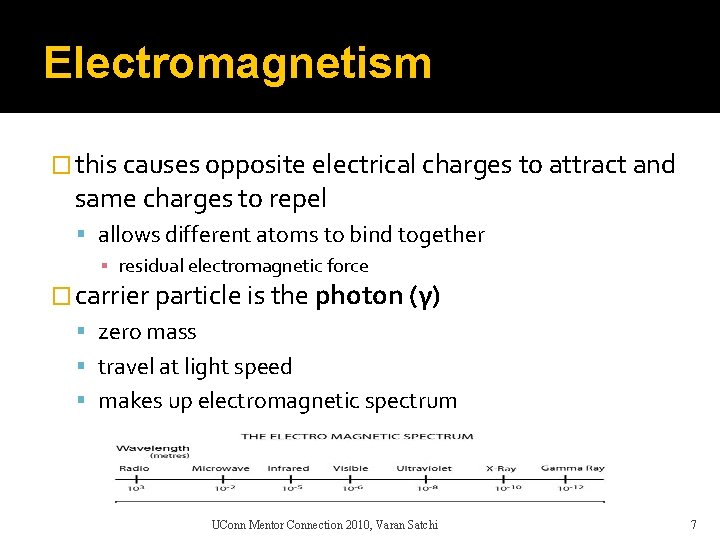
Electromagnetism � this causes opposite electrical charges to attract and same charges to repel allows different atoms to bind together ▪ residual electromagnetic force � carrier particle is the photon (γ) zero mass travel at light speed makes up electromagnetic spectrum UConn Mentor Connection 2010, Varan Satchi 7
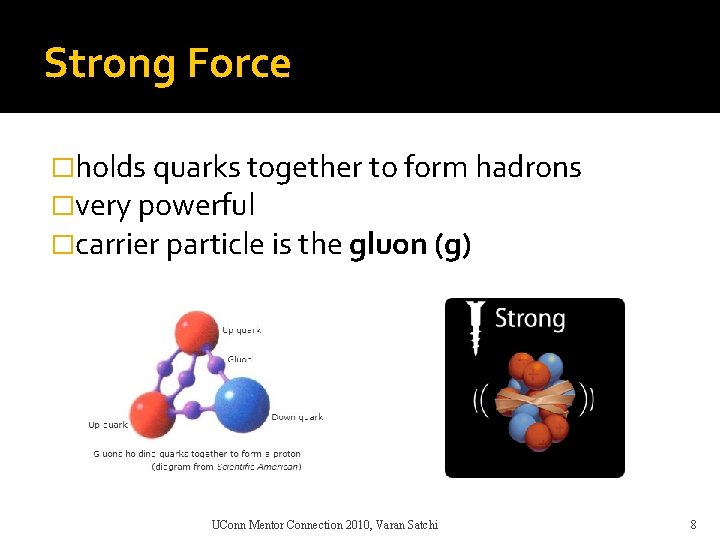
Strong Force �holds quarks together to form hadrons �very powerful �carrier particle is the gluon (g) UConn Mentor Connection 2010, Varan Satchi 8
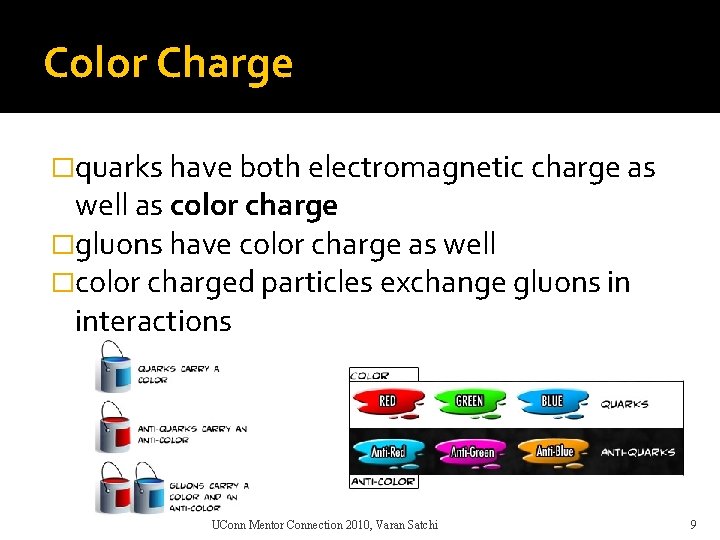
Color Charge �quarks have both electromagnetic charge as well as color charge �gluons have color charge as well �color charged particles exchange gluons in interactions UConn Mentor Connection 2010, Varan Satchi 9
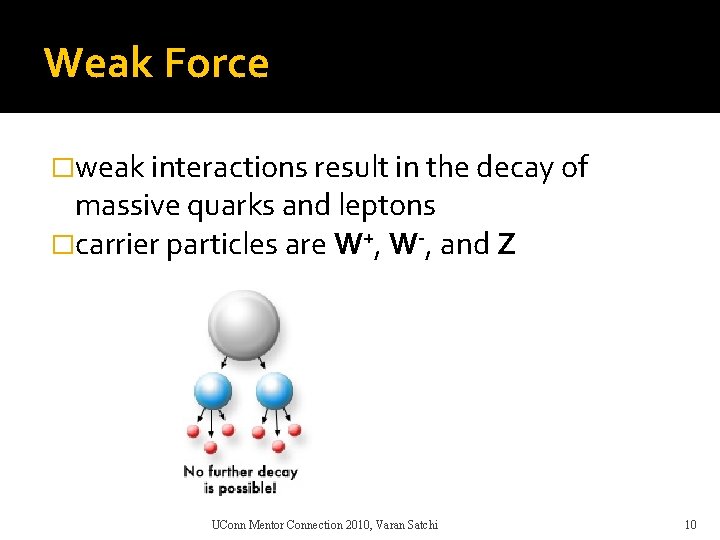
Weak Force �weak interactions result in the decay of massive quarks and leptons �carrier particles are W+, W-, and Z UConn Mentor Connection 2010, Varan Satchi 10
Electroweak �Standard Model has united weak and electromagnetic force �at short distances the attraction is roughly equivalent �same under high energy–short distance scale UConn Mentor Connection 2010, Varan Satchi 11
Gravity �SM does not explain �physicists searching for the graviton �force is very small – almost negligible UConn Mentor Connection 2010, Varan Satchi 12
Glue. X �exciting gluonic field generating exotic mesons �understanding the principle of confinement UConn Mentor Connection 2010, Varan Satchi 13
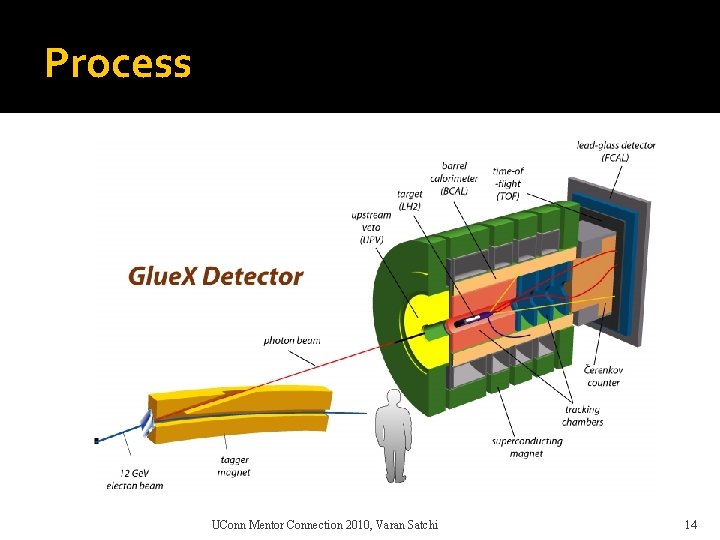
Process UConn Mentor Connection 2010, Varan Satchi 14
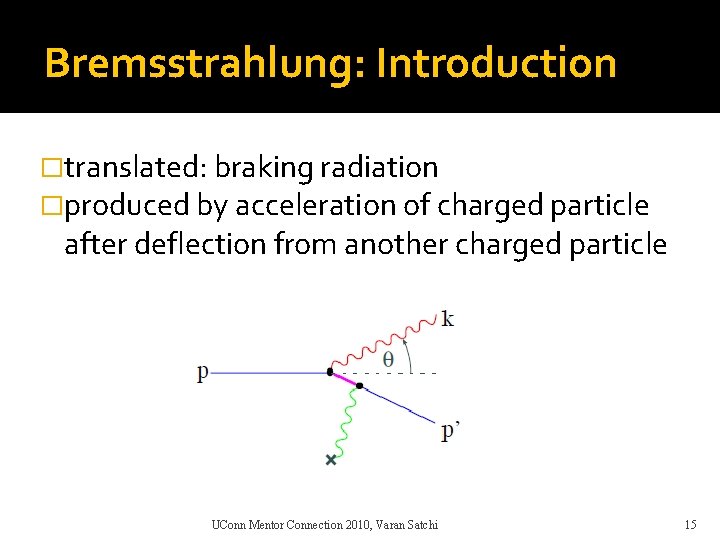
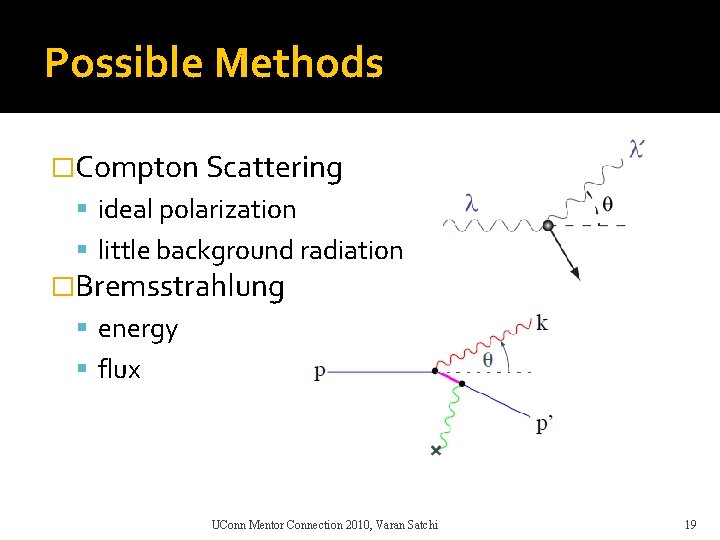
Bremsstrahlung: Introduction �translated: braking radiation �produced by acceleration of charged particle after deflection from another charged particle UConn Mentor Connection 2010, Varan Satchi 15
Coherent Bremsstrahlung �coherent: multiple particles of the same field involved in a process �two requirements: multiple atoms correct angle UConn Mentor Connection 2010, Varan Satchi 16
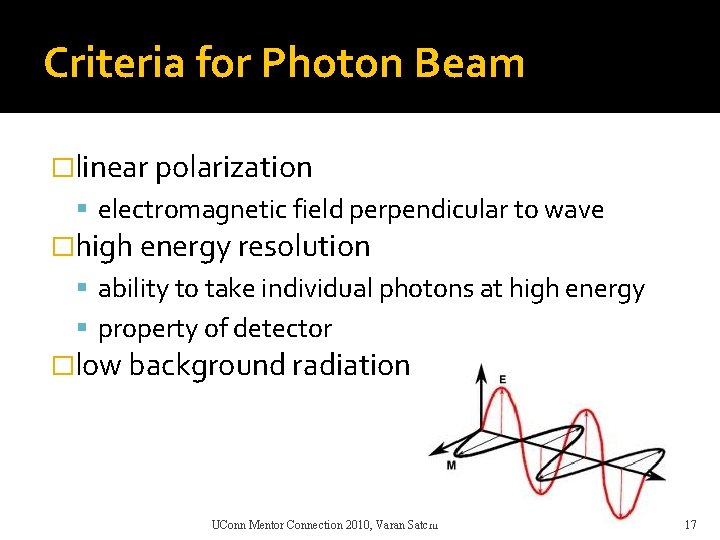
Criteria for Photon Beam �linear polarization electromagnetic field perpendicular to wave �high energy resolution ability to take individual photons at high energy property of detector �low background radiation UConn Mentor Connection 2010, Varan Satchi 17
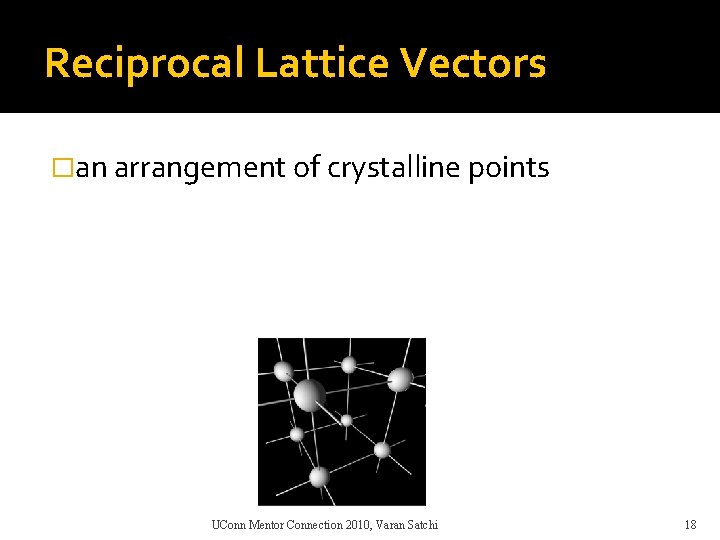
Reciprocal Lattice Vectors �an arrangement of crystalline points UConn Mentor Connection 2010, Varan Satchi 18
Possible Methods �Compton Scattering ideal polarization little background radiation �Bremsstrahlung energy flux UConn Mentor Connection 2010, Varan Satchi 19
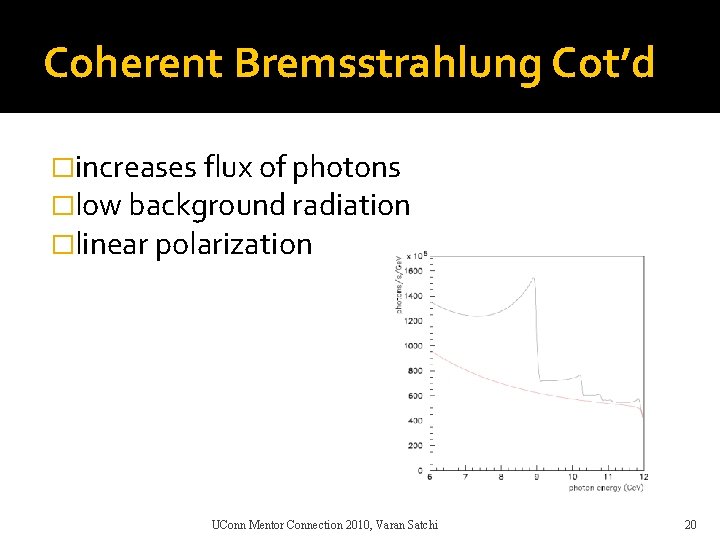
Coherent Bremsstrahlung Cot’d �increases flux of photons �low background radiation �linear polarization UConn Mentor Connection 2010, Varan Satchi 20
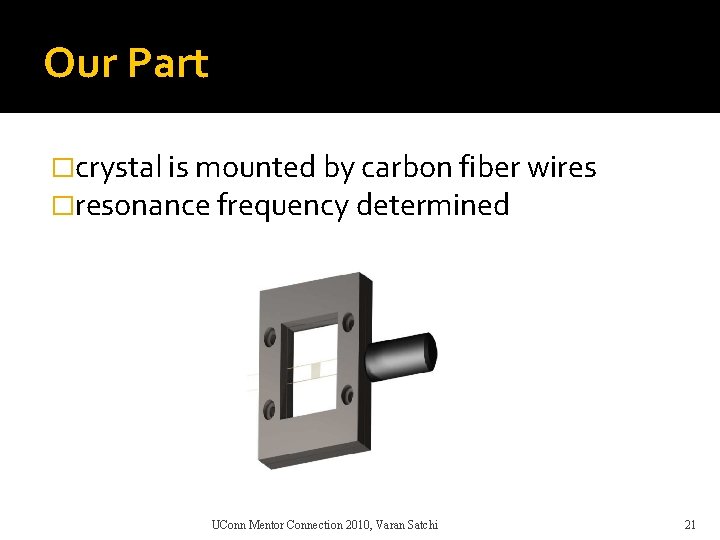
Our Part �crystal is mounted by carbon fiber wires �resonance frequency determined UConn Mentor Connection 2010, Varan Satchi 21
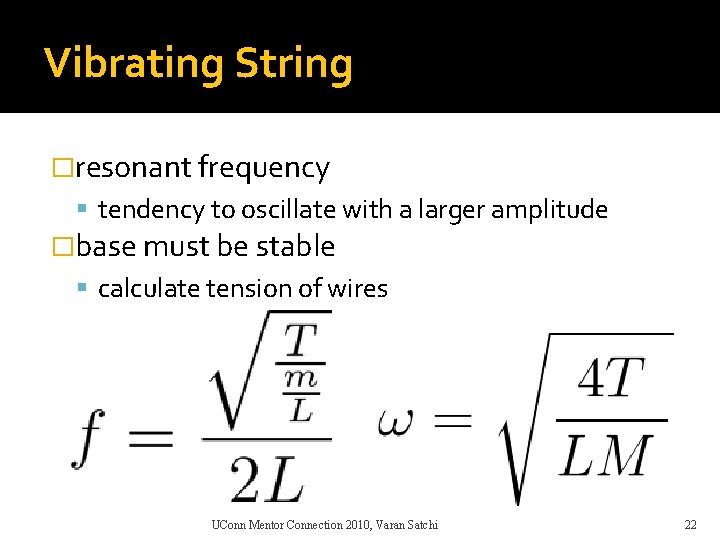
Vibrating String �resonant frequency tendency to oscillate with a larger amplitude �base must be stable calculate tension of wires UConn Mentor Connection 2010, Varan Satchi 22
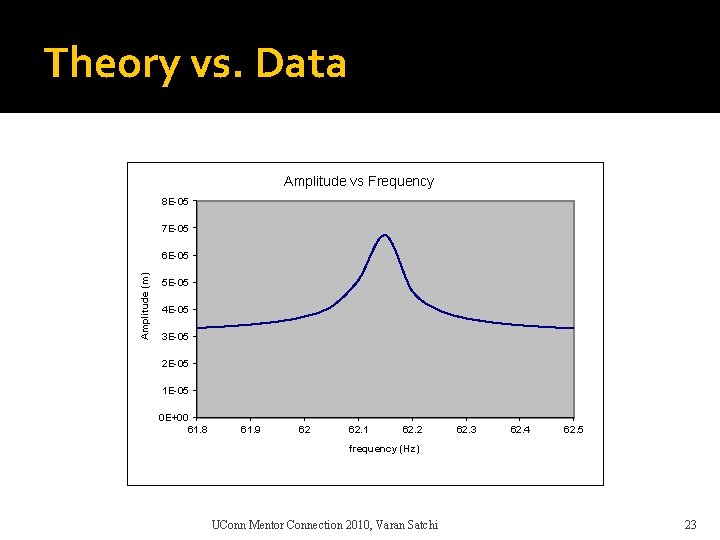
Theory vs. Data Amplitude vs Frequency 8 E-05 7 E-05 Amplitude (m) 6 E-05 5 E-05 4 E-05 3 E-05 2 E-05 1 E-05 0 E+00 61. 8 61. 9 62 62. 1 62. 2 62. 3 62. 4 62. 5 frequency (Hz) UConn Mentor Connection 2010, Varan Satchi 23
Conclusion �a review Standard Model mathematical concepts Glue. X