
Nuclear Physics the Shell Model Nuclear spinorbit Magic
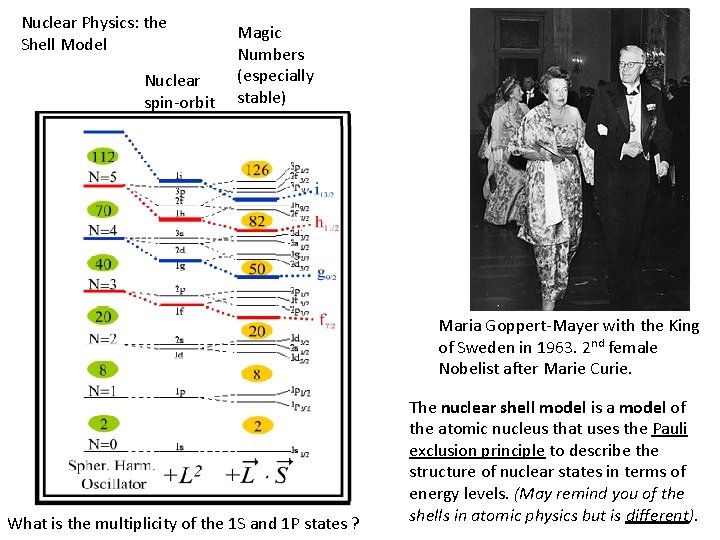
Nuclear Physics: the Shell Model Nuclear spin-orbit Magic Numbers (especially stable) Maria Goppert-Mayer with the King of Sweden in 1963. 2 nd female Nobelist after Marie Curie. What is the multiplicity of the 1 S and 1 P states ? The nuclear shell model is a model of the atomic nucleus that uses the Pauli exclusion principle to describe the structure of nuclear states in terms of energy levels. (May remind you of the shells in atomic physics but is different).
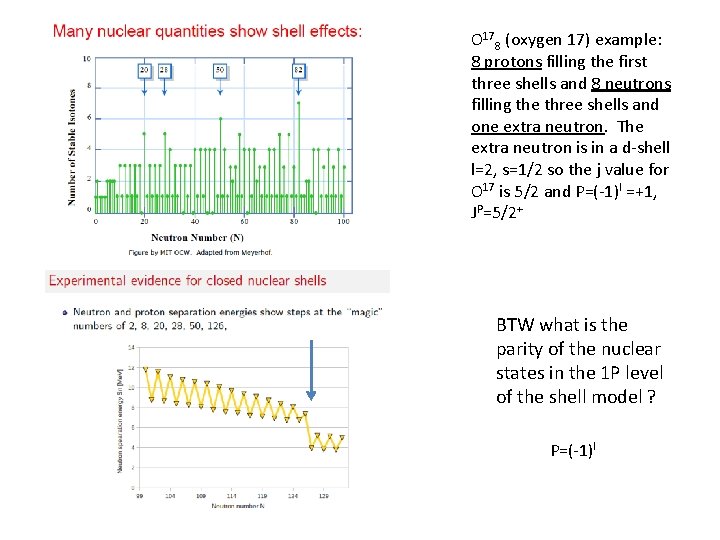
O 178 (oxygen 17) example: 8 protons filling the first three shells and 8 neutrons filling the three shells and one extra neutron. The extra neutron is in a d-shell l=2, s=1/2 so the j value for O 17 is 5/2 and P=(-1)l =+1, JP=5/2+ BTW what is the parity of the nuclear states in the 1 P level of the shell model ? P=(-1)l
Today’s Plan More QCD: 1) Quick review of nucleon substructure and the parton model 2) Evolution of αS versus Q 2 3) OZI rule 4) Color singlet bound states Pick a notable paper for a 15 minute presentation in April from Experimental Foundations of Particle Physics or other source.
Review questions 1. What is an example of experimental evidence that quarks have spin ½ ? Angular distribution of e+e- q qbar; Callan-Gross relation in deep inelastic scattering, 2. What is an example of experimental evidence that partons (quarks) in the nucleon are fractionally charged ? Ratio of e. P to νN cross-section (5/18); ratio of νN to anti-ν N (also steps in R) 3. What is an example of experimental evidence for the existence of gluons ? Three jet events 4. What is an example of experimental evidence for the existence of a quark-antiquark sea in the nucleon ? deviation of ratio of νN to anti-ν N from 3 5. Give some examples of experimental evidence for the existence of the color quantum number. Cross-section ratio R; pi-zero width; Δ++ and Pauli exclusion principle 6. Why does Bjorken scaling breakdown ? Gluon bremsstrahlung.
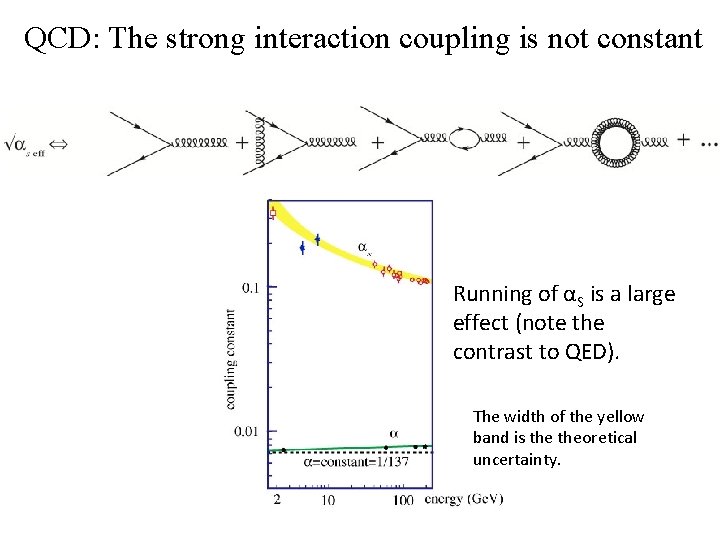
QCD: The strong interaction coupling is not constant Running of αS is a large effect (note the contrast to QED). The width of the yellow band is theoretical uncertainty.
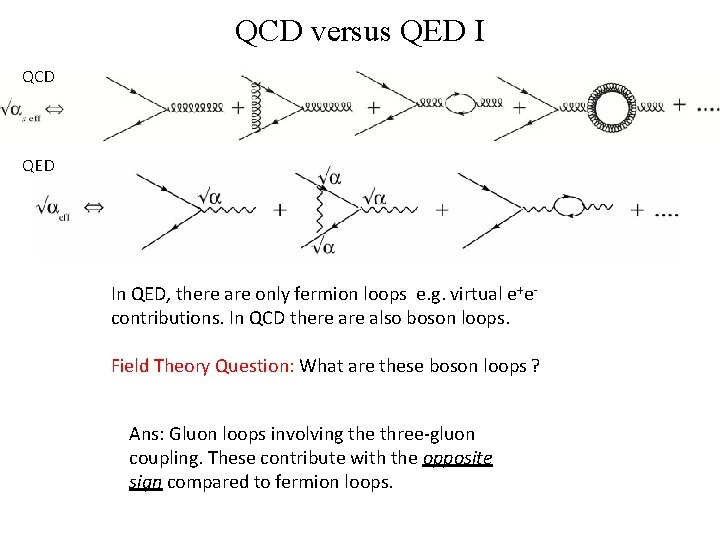
QCD versus QED I QCD QED In QED, there are only fermion loops e. g. virtual e+econtributions. In QCD there also boson loops. Field Theory Question: What are these boson loops ? Ans: Gluon loops involving the three-gluon coupling. These contribute with the opposite sign compared to fermion loops.
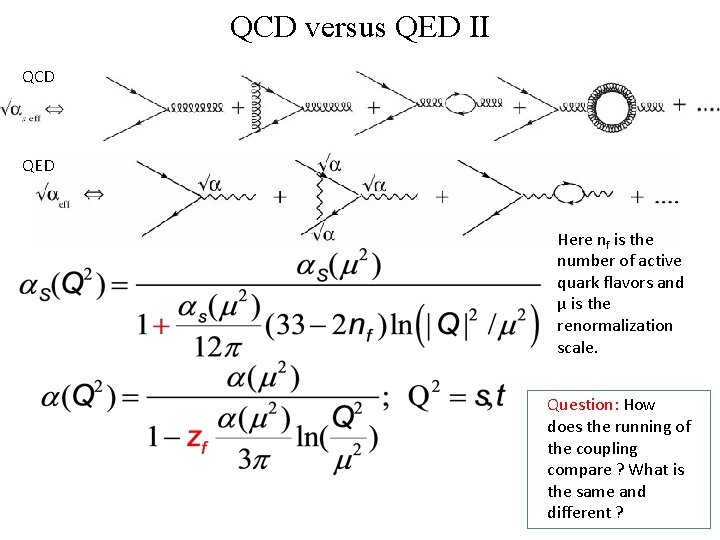
QCD versus QED II QCD QED Here nf is the number of active quark flavors and μ is the renormalization scale. Question: How does the running of the coupling compare ? What is the same and different ?
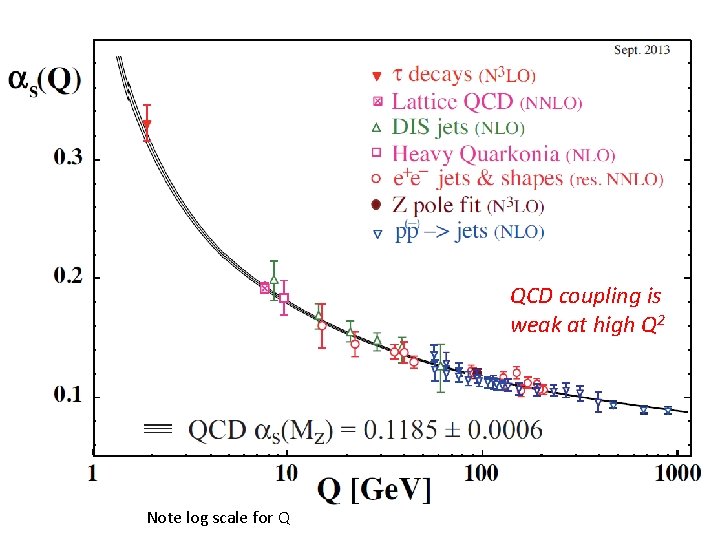
QCD coupling is weak at high Q 2 Note log scale for Q
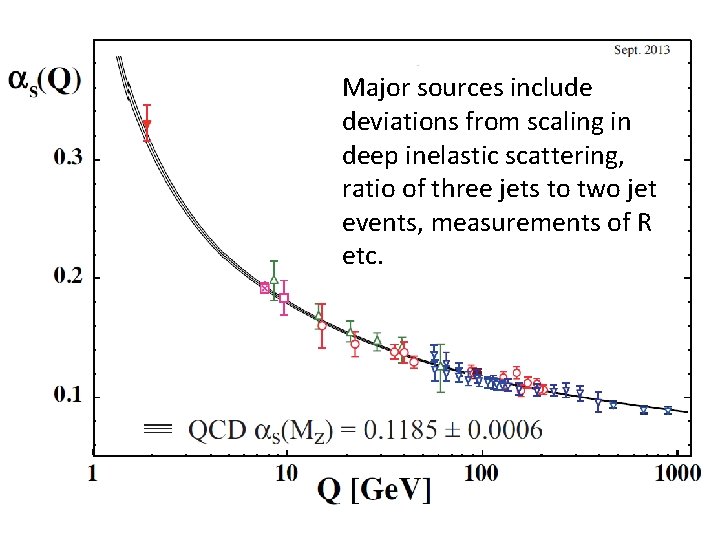
Major sources include deviations from scaling in deep inelastic scattering, ratio of three jets to two jet events, measurements of R etc.

QCD asymptotic freedom and confinement QCD Here nf is the number of active quark flavors and μ is the renormalization scale. 2004 Nobel Prize in Physics. David Politzer David Gross Frank Wilczek Both Politzer and Wilczek were graduate students at the time of their 1973 work.
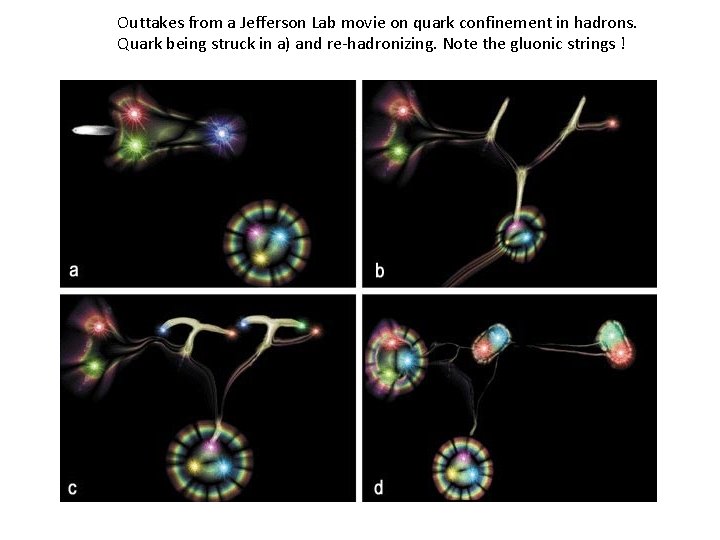
Outtakes from a Jefferson Lab movie on quark confinement in hadrons. Quark being struck in a) and re-hadronizing. Note the gluonic strings !
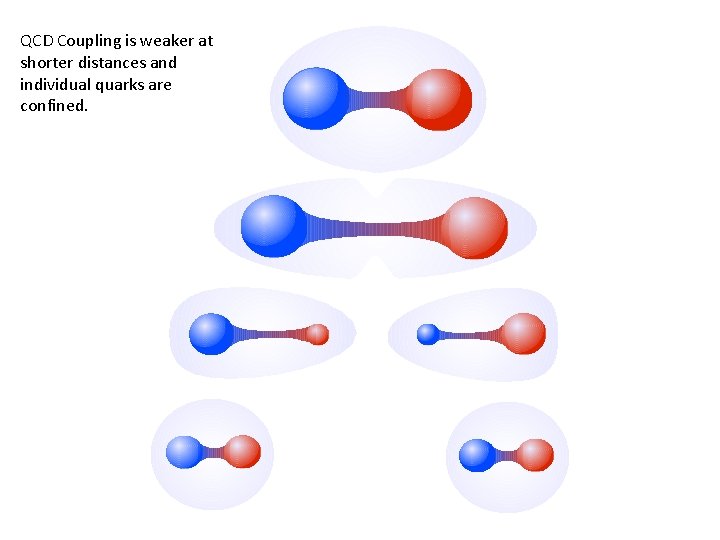
QCD Coupling is weaker at shorter distances and individual quarks are confined.
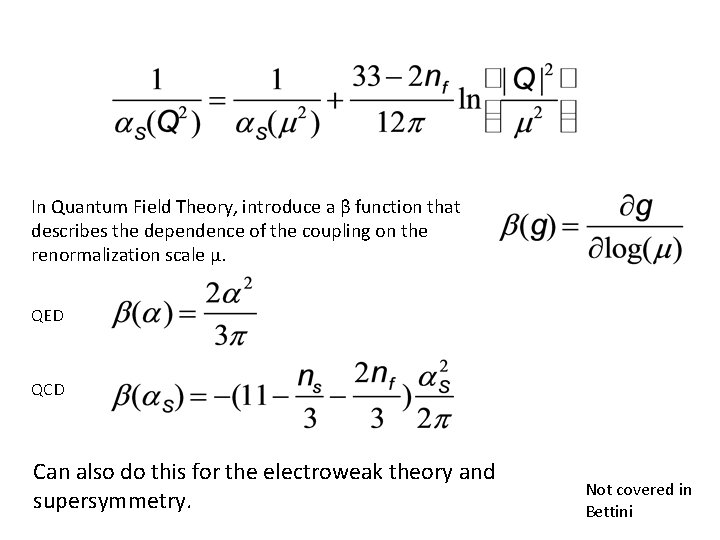
In Quantum Field Theory, introduce a β function that describes the dependence of the coupling on the renormalization scale μ. QED QCD Can also do this for the electroweak theory and supersymmetry. Not covered in Bettini
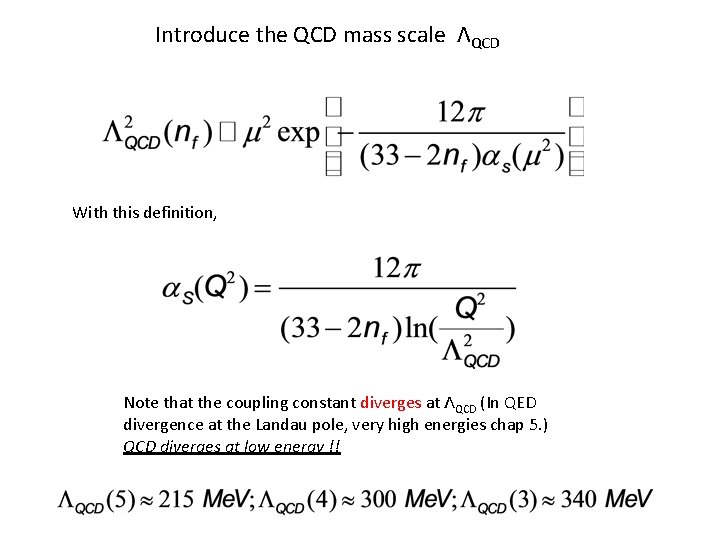
Introduce the QCD mass scale ΛQCD With this definition, Note that the coupling constant diverges at ΛQCD (In QED divergence at the Landau pole, very high energies chap 5. ) QCD diverges at low energy !!
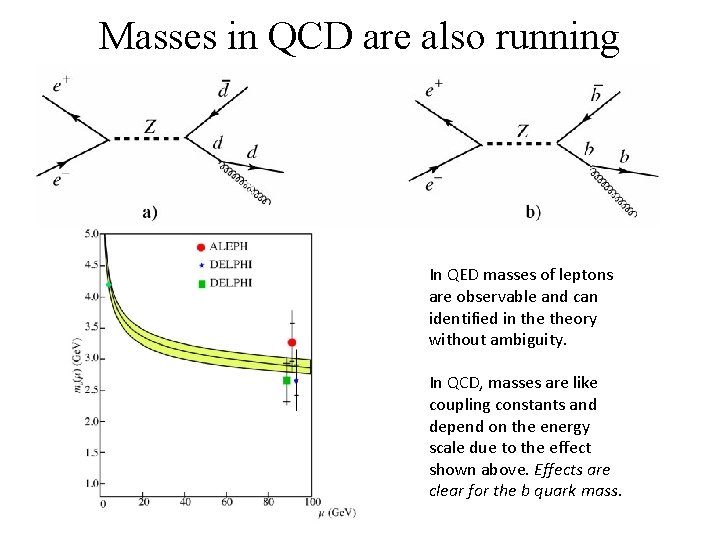
Masses in QCD are also running In QED masses of leptons are observable and can identified in theory without ambiguity. In QCD, masses are like coupling constants and depend on the energy scale due to the effect shown above. Effects are clear for the b quark mass.

OZI(Okubo Zweig Iizuka) Suppression Strong decays with disconnected quark lines are highly suppressed. Radiative charmonium decay Question: Draw the Feynman diagram for ϕ π+ π- π0 explicitly showing the gluons.
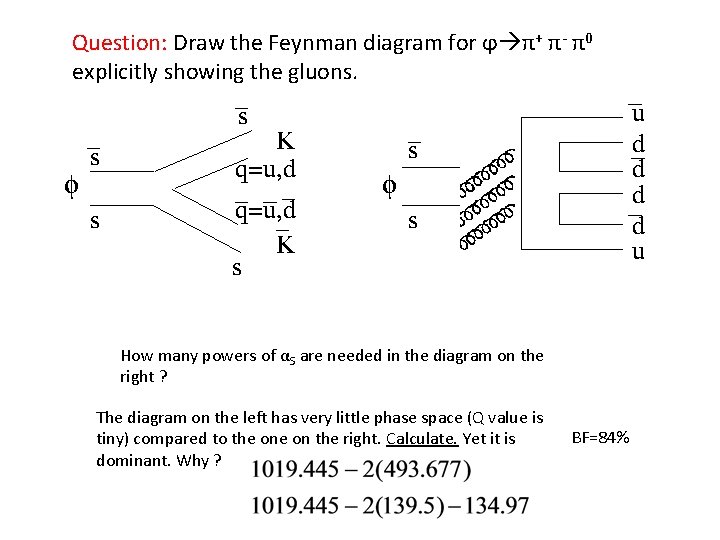
Question: Draw the Feynman diagram for ϕ π+ π- π0 explicitly showing the gluons. How many powers of αS are needed in the diagram on the right ? The diagram on the left has very little phase space (Q value is tiny) compared to the on the right. Calculate. Yet it is dominant. Why ? BF=84%
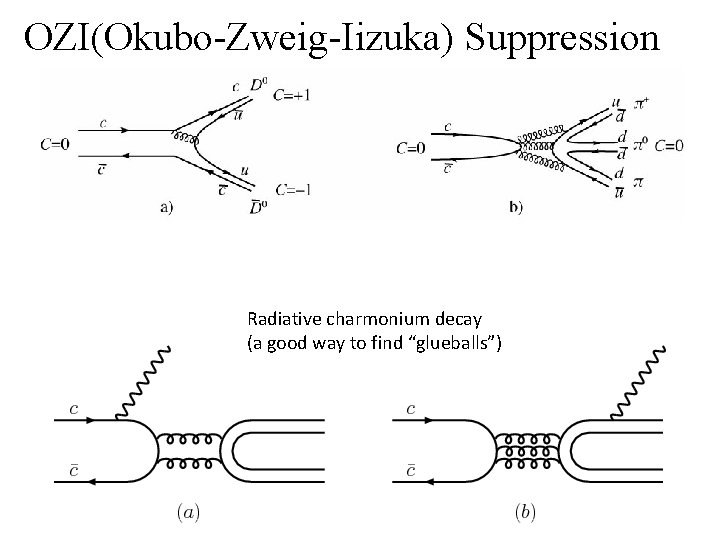
OZI(Okubo-Zweig-Iizuka) Suppression Radiative charmonium decay (a good way to find “glueballs”)
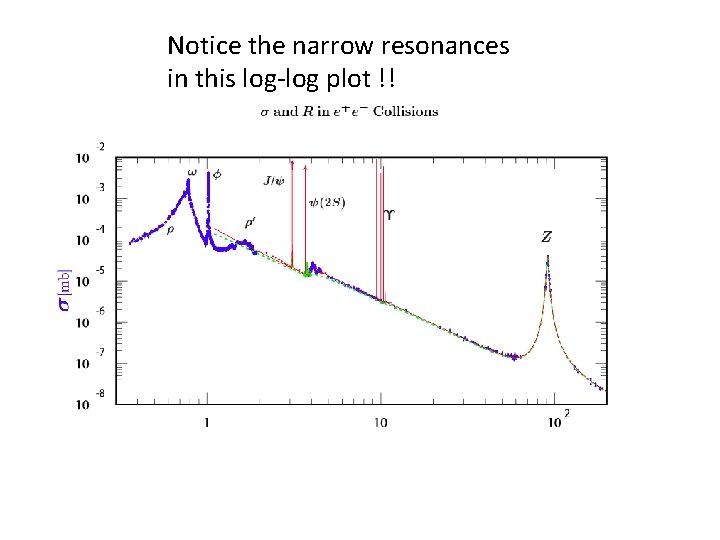
Notice the narrow resonances in this log-log plot !!
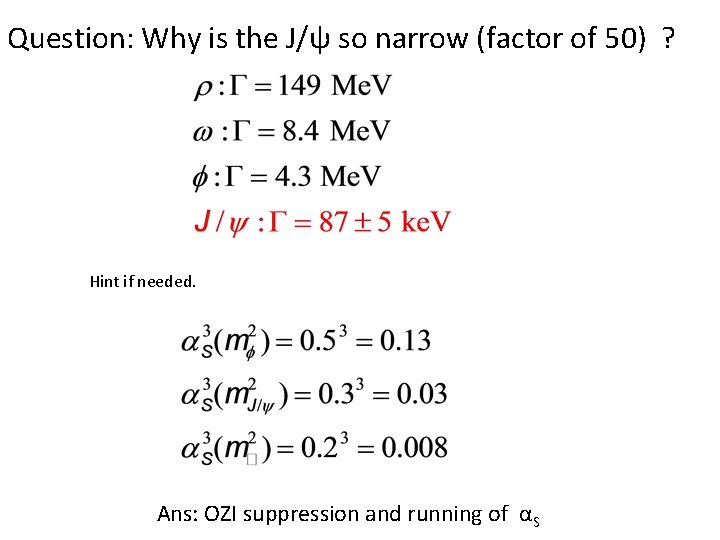
Question: Why is the J/ψ so narrow (factor of 50) ? Hint if needed. Ans: OZI suppression and running of αS
- Slides: 20