
Nuclear Physics Program presented to Astronomy and Astrophysics
- Slides: 18
Nuclear Physics Program presented to Astronomy and Astrophysics Advisory Committee October 12, 2006 Gene Henry Director, Physics Research Division Office of Nuclear Physics Office of Science Department of Energy
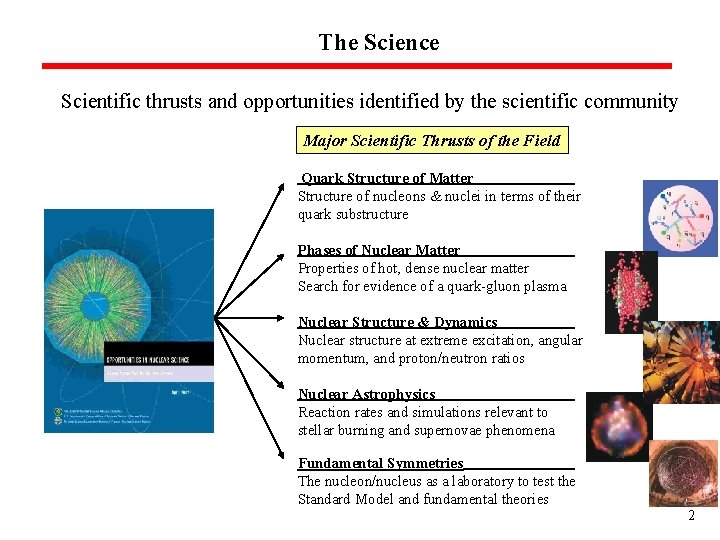
The Science Scientific thrusts and opportunities identified by the scientific community Major Scientific Thrusts of the Field Quark Structure of Matter Structure of nucleons & nuclei in terms of their quark substructure Phases of Nuclear Matter Properties of hot, dense nuclear matter Search for evidence of a quark-gluon plasma Nuclear Structure & Dynamics Nuclear structure at extreme excitation, angular momentum, and proton/neutron ratios Nuclear Astrophysics Reaction rates and simulations relevant to stellar burning and supernovae phenomena Fundamental Symmetries The nucleon/nucleus as a laboratory to test the Standard Model and fundamental theories 2
Nuclear Physics Why should the U. S. Government support it? Scientific opportunities for nuclear physics today are compelling • Fundamental questions are still not answered • Advances in accelerator/detector/computing technologies put the answers within reach • The discoveries and advancements will have significant impact on other scientific fields Leadership and competency in nuclear physics remain important to the Nation • The new knowledge/advancements are relevant to nuclear-related enterprises • Basic research drives advancements/development of new technologies and techniques • Basic research attracts/trains the next generation of scientists “We must continue to lead the world in human talent and creativity. Our greatest advantage in the world has always been our educated, hardworking, ambitious people -- and we're going to keep that edge. Tonight I announce an American Competitiveness Initiative, to encourage innovation throughout our economy, and to give our nation's children a firm grounding in math and science. ” President George W. Bush January 2006 1993 NAS COSEPUP (Committee on Science, Engineering and Public Policy) Report: The United States should be among the World leaders in all major areas of science • Supports World Class Research Toward National Goals • Enables Rapid Response to Breakthroughs in other Nations • Supports Excellence in University Science Education • Attracts Bright Young Students to Science The United States should maintain clear leadership in some major areas of science • IF Required by National Objectives • IF a Field is of a Broad Interest to Society • IF a Field Significantly Affects Other Areas of Science 3
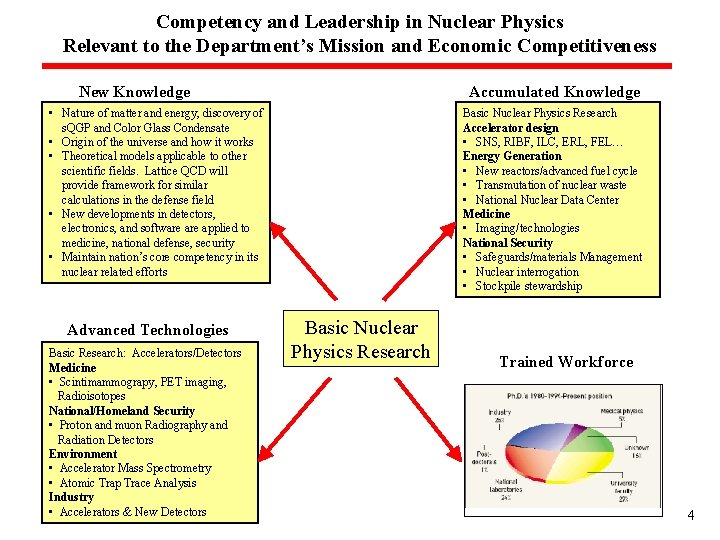
Competency and Leadership in Nuclear Physics Relevant to the Department’s Mission and Economic Competitiveness New Knowledge Accumulated Knowledge • Nature of matter and energy, discovery of s. QGP and Color Glass Condensate • Origin of the universe and how it works • Theoretical models applicable to other scientific fields. Lattice QCD will provide framework for similar calculations in the defense field • New developments in detectors, electronics, and software applied to medicine, national defense, security • Maintain nation’s core competency in its nuclear related efforts Advanced Technologies Basic Research: Accelerators/Detectors Medicine • Scintimammograpy, PET imaging, Radioisotopes National/Homeland Security • Proton and muon Radiography and Radiation Detectors Environment • Accelerator Mass Spectrometry • Atomic Trap Trace Analysis Industry • Accelerators & New Detectors Basic Nuclear Physics Research Accelerator design • SNS, RIBF, ILC, ERL, FEL… Energy Generation • New reactors/advanced fuel cycle • Transmutation of nuclear waste • National Nuclear Data Center Medicine • Imaging/technologies National Security • Safeguards/materials Management • Nuclear interrogation • Stockpile stewardship Basic Nuclear Physics Research Trained Workforce 4
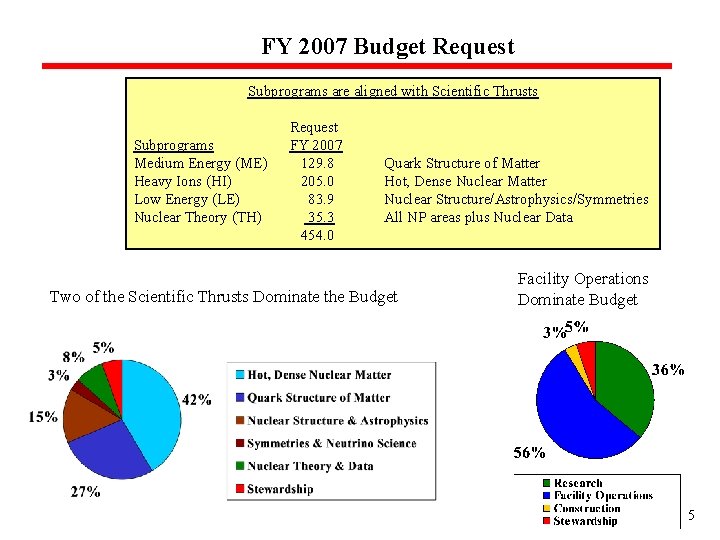
FY 2007 Budget Request Subprograms are aligned with Scientific Thrusts Subprograms Medium Energy (ME) Heavy Ions (HI) Low Energy (LE) Nuclear Theory (TH) Request FY 2007 129. 8 205. 0 83. 9 35. 3 454. 0 Quark Structure of Matter Hot, Dense Nuclear Matter Nuclear Structure/Astrophysics/Symmetries All NP areas plus Nuclear Data Two of the Scientific Thrusts Dominate the Budget Facility Operations Dominate Budget 5
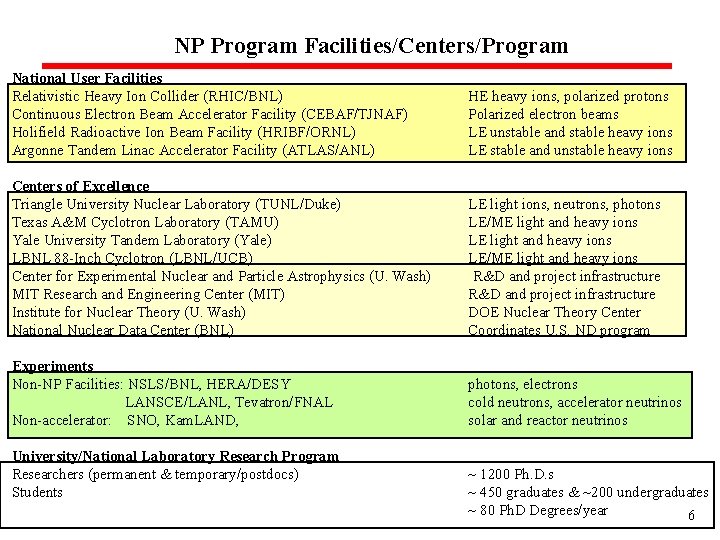
NP Program Facilities/Centers/Program National User Facilities Relativistic Heavy Ion Collider (RHIC/BNL) Continuous Electron Beam Accelerator Facility (CEBAF/TJNAF) Holifield Radioactive Ion Beam Facility (HRIBF/ORNL) Argonne Tandem Linac Accelerator Facility (ATLAS/ANL) HE heavy ions, polarized protons Polarized electron beams LE unstable and stable heavy ions LE stable and unstable heavy ions Centers of Excellence Triangle University Nuclear Laboratory (TUNL/Duke) Texas A&M Cyclotron Laboratory (TAMU) Yale University Tandem Laboratory (Yale) LBNL 88 -Inch Cyclotron (LBNL/UCB) Center for Experimental Nuclear and Particle Astrophysics (U. Wash) MIT Research and Engineering Center (MIT) Institute for Nuclear Theory (U. Wash) National Nuclear Data Center (BNL) LE light ions, neutrons, photons LE/ME light and heavy ions R&D and project infrastructure DOE Nuclear Theory Center Coordinates U. S. ND program Experiments Non-NP Facilities: NSLS/BNL, HERA/DESY LANSCE/LANL, Tevatron/FNAL Non-accelerator: SNO, Kam. LAND, photons, electrons cold neutrons, accelerator neutrinos solar and reactor neutrinos University/National Laboratory Research Program Researchers (permanent & temporary/postdocs) Students ~ 1200 Ph. D. s ~ 450 graduates & ~200 undergraduates ~ 80 Ph. D Degrees/year 6
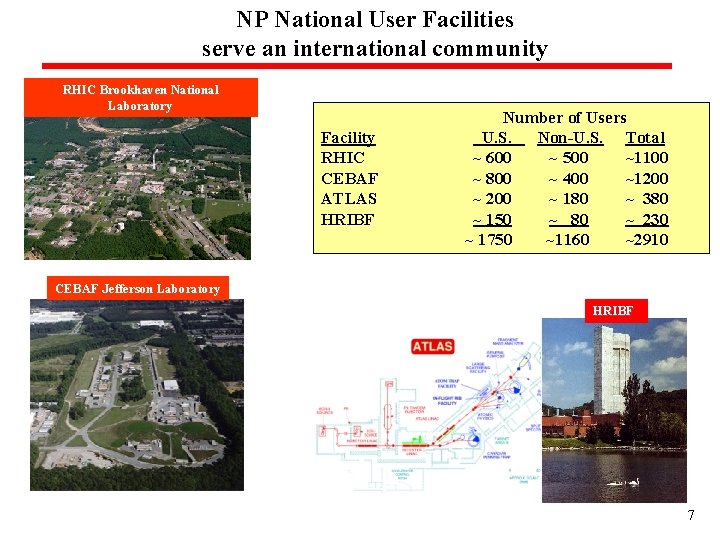
NP National User Facilities serve an international community RHIC Brookhaven National Laboratory Facility RHIC CEBAF ATLAS HRIBF Number of Users U. S. Non-U. S. Total ~ 600 ~ 500 ~1100 ~ 800 ~ 400 ~1200 ~ 180 ~ 380 ~ 150 ~ 80 ~ 230 ~ 1750 ~1160 ~2910 CEBAF Jefferson Laboratory HRIBF 7
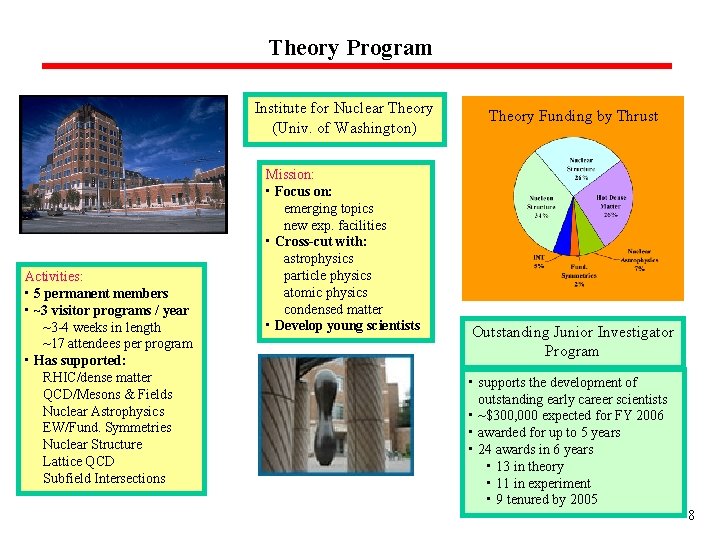
Theory Program Institute for Nuclear Theory (Univ. of Washington) Activities: • 5 permanent members • ~3 visitor programs / year ~3 -4 weeks in length ~17 attendees per program • Has supported: RHIC/dense matter QCD/Mesons & Fields Nuclear Astrophysics EW/Fund. Symmetries Nuclear Structure Lattice QCD Subfield Intersections Mission: • Focus on: emerging topics new exp. facilities • Cross-cut with: astrophysics particle physics atomic physics condensed matter • Develop young scientists Theory Funding by Thrust Outstanding Junior Investigator Program • supports the development of outstanding early career scientists • ~$300, 000 expected for FY 2006 • awarded for up to 5 years • 24 awards in 6 years • 13 in theory • 11 in experiment • 9 tenured by 2005 8
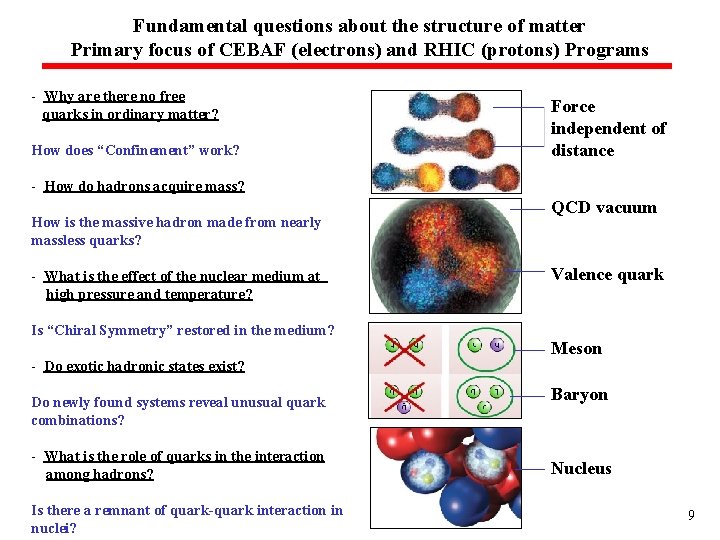
Fundamental questions about the structure of matter Primary focus of CEBAF (electrons) and RHIC (protons) Programs - Why are there no free quarks in ordinary matter? How does “Confinement” work? Force independent of distance - How do hadrons acquire mass? How is the massive hadron made from nearly massless quarks? - What is the effect of the nuclear medium at high pressure and temperature? QCD vacuum Valence quark Is “Chiral Symmetry” restored in the medium? - Do exotic hadronic states exist? Do newly found systems reveal unusual quark combinations? - What is the role of quarks in the interaction among hadrons? Is there a remnant of quark-quark interaction in nuclei? Meson Baryon Nucleus 9
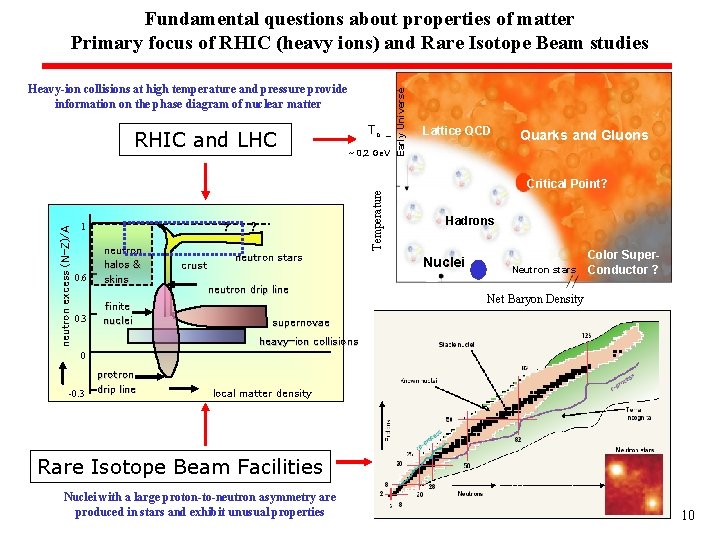
Heavy-ion collisions at high temperature and pressure provide information on the phase diagram of nuclear matter ? 1 0. 6 neutron halos & skins 0. 3 finite nuclei crust Tc ~ 0, 2 Ge. V ? neutron stars neutron drip line Temperature neutron excess (N-Z)/A RHIC and LHC Early Universe Fundamental questions about properties of matter Primary focus of RHIC (heavy ions) and Rare Isotope Beam studies Lattice QCD Quarks and Gluons Critical Point? Hadrons Nuclei Color Super. Neutron stars Conductor ? Net Baryon Density supernovae heavy-ion collisions 0 -0. 3 protron drip line local matter density Rare Isotope Beam Facilities Nuclei with a large proton-to-neutron asymmetry are produced in stars and exhibit unusual properties 10
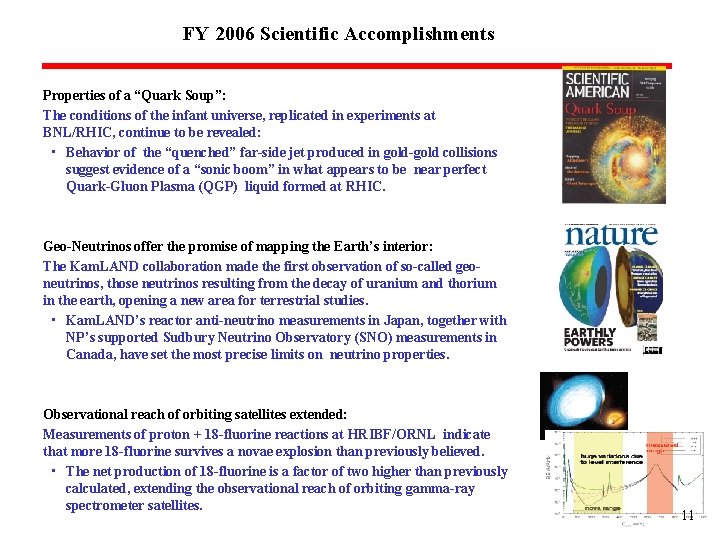
FY 2006 Scientific Accomplishments Properties of a “Quark Soup”: The conditions of the infant universe, replicated in experiments at BNL/RHIC, continue to be revealed: • Behavior of the “quenched” far-side jet produced in gold-gold collisions suggest evidence of a “sonic boom” in what appears to be near perfect Quark-Gluon Plasma (QGP) liquid formed at RHIC. Geo-Neutrinos offer the promise of mapping the Earth’s interior: The Kam. LAND collaboration made the first observation of so-called geoneutrinos, those neutrinos resulting from the decay of uranium and thorium in the earth, opening a new area for terrestrial studies. • Kam. LAND’s reactor anti-neutrino measurements in Japan, together with NP’s supported Sudbury Neutrino Observatory (SNO) measurements in Canada, have set the most precise limits on neutrino properties. Observational reach of orbiting satellites extended: Measurements of proton + 18 -fluorine reactions at HRIBF/ORNL indicate that more 18 -fluorine survives a novae explosion than previously believed. • The net production of 18 -fluorine is a factor of two higher than previously calculated, extending the observational reach of orbiting gamma-ray spectrometer satellites. 11
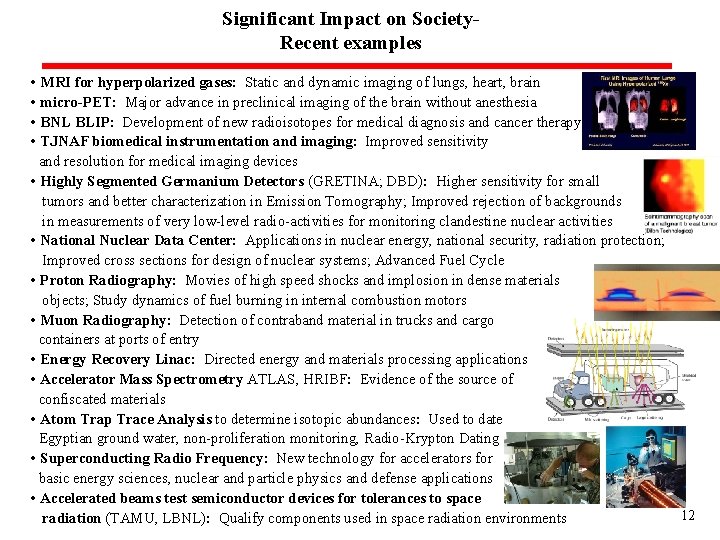
Significant Impact on Society- Recent examples • MRI for hyperpolarized gases: Static and dynamic imaging of lungs, heart, brain • micro-PET: Major advance in preclinical imaging of the brain without anesthesia • BNL BLIP: Development of new radioisotopes for medical diagnosis and cancer therapy • TJNAF biomedical instrumentation and imaging: Improved sensitivity and resolution for medical imaging devices • Highly Segmented Germanium Detectors (GRETINA; DBD): Higher sensitivity for small tumors and better characterization in Emission Tomography; Improved rejection of backgrounds in measurements of very low-level radio-activities for monitoring clandestine nuclear activities • National Nuclear Data Center: Applications in nuclear energy, national security, radiation protection; Improved cross sections for design of nuclear systems; Advanced Fuel Cycle • Proton Radiography: Movies of high speed shocks and implosion in dense materials objects; Study dynamics of fuel burning in internal combustion motors • Muon Radiography: Detection of contraband material in trucks and cargo containers at ports of entry • Energy Recovery Linac: Directed energy and materials processing applications • Accelerator Mass Spectrometry ATLAS, HRIBF: Evidence of the source of confiscated materials • Atom Trap Trace Analysis to determine isotopic abundances: Used to date Egyptian ground water, non-proliferation monitoring, Radio-Krypton Dating • Superconducting Radio Frequency: New technology for accelerators for basic energy sciences, nuclear and particle physics and defense applications • Accelerated beams test semiconductor devices for tolerances to space 12 radiation (TAMU, LBNL): Qualify components used in space radiation environments
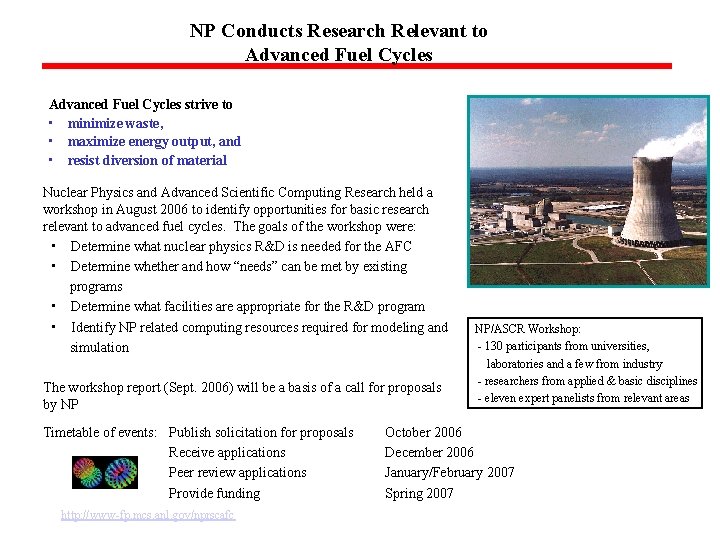
NP Conducts Research Relevant to Advanced Fuel Cycles strive to • minimize waste, • maximize energy output, and • resist diversion of material Nuclear Physics and Advanced Scientific Computing Research held a workshop in August 2006 to identify opportunities for basic research relevant to advanced fuel cycles. The goals of the workshop were: • Determine what nuclear physics R&D is needed for the AFC • Determine whether and how “needs” can be met by existing programs • Determine what facilities are appropriate for the R&D program • Identify NP related computing resources required for modeling and simulation The workshop report (Sept. 2006) will be a basis of a call for proposals by NP Timetable of events: Publish solicitation for proposals Receive applications Peer review applications Provide funding http: //www-fp. mcs. anl. gov/nprscafc NP/ASCR Workshop: - 130 participants from universities, laboratories and a few from industry - researchers from applied & basic disciplines - eleven expert panelists from relevant areas October 2006 December 2006 January/February 2007 Spring 2007
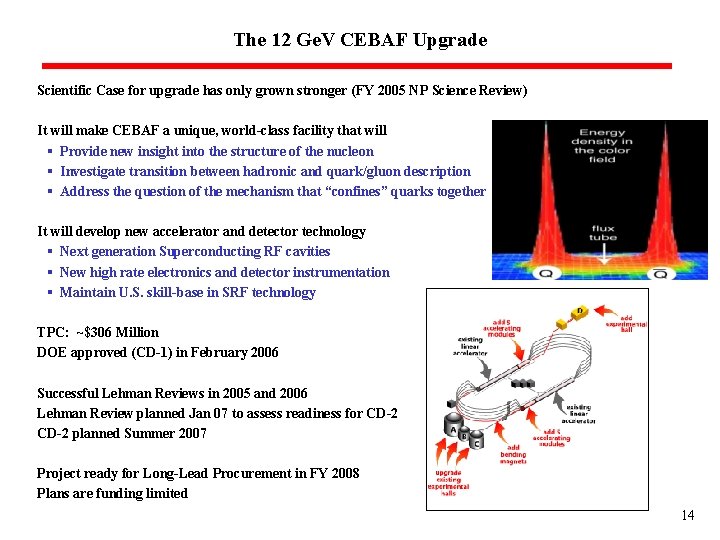
The 12 Ge. V CEBAF Upgrade Scientific Case for upgrade has only grown stronger (FY 2005 NP Science Review) It will make CEBAF a unique, world-class facility that will § Provide new insight into the structure of the nucleon § Investigate transition between hadronic and quark/gluon description § Address the question of the mechanism that “confines” quarks together It will develop new accelerator and detector technology § Next generation Superconducting RF cavities § New high rate electronics and detector instrumentation § Maintain U. S. skill-base in SRF technology TPC: ~$306 Million DOE approved (CD-1) in February 2006 Successful Lehman Reviews in 2005 and 2006 Lehman Review planned Jan 07 to assess readiness for CD-2 planned Summer 2007 Project ready for Long-Lead Procurement in FY 2008 Plans are funding limited 14
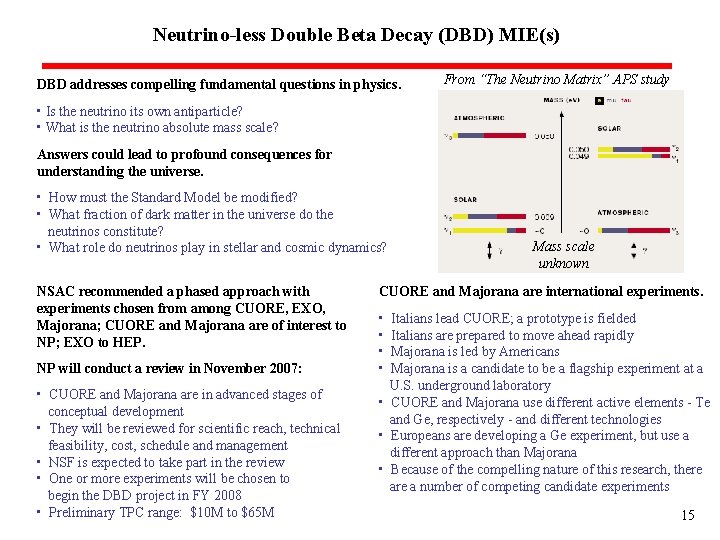
Neutrino-less Double Beta Decay (DBD) MIE(s) DBD addresses compelling fundamental questions in physics. From “The Neutrino Matrix” APS study • Is the neutrino its own antiparticle? • What is the neutrino absolute mass scale? Answers could lead to profound consequences for understanding the universe. • How must the Standard Model be modified? • What fraction of dark matter in the universe do the neutrinos constitute? • What role do neutrinos play in stellar and cosmic dynamics? NSAC recommended a phased approach with experiments chosen from among CUORE, EXO, Majorana; CUORE and Majorana are of interest to NP; EXO to HEP. NP will conduct a review in November 2007: • CUORE and Majorana are in advanced stages of conceptual development • They will be reviewed for scientific reach, technical feasibility, cost, schedule and management • NSF is expected to take part in the review • One or more experiments will be chosen to begin the DBD project in FY 2008 • Preliminary TPC range: $10 M to $65 M Mass scale unknown CUORE and Majorana are international experiments. • Italians lead CUORE; a prototype is fielded • Italians are prepared to move ahead rapidly • Majorana is led by Americans • Majorana is a candidate to be a flagship experiment at a U. S. underground laboratory • CUORE and Majorana use different active elements - Te and Ge, respectively - and different technologies • Europeans are developing a Ge experiment, but use a different approach than Majorana • Because of the compelling nature of this research, there are a number of competing candidate experiments 15
Program Management Activities National Academy scientific assessment of RIA • Assessment of the importance of U. S. capabilities for rare isotope beam studies • Report due October 2006 NSAC has been charged to: • Develop a new Long Range Plan for U. S. nuclear science community (December 2007) • Assess technical options for a U. S. rare isotope beam facility with available funds (March 2007) • Perform a Committee of Visitors (COV) review of ONP (February 2007) Workshop held on nuclear data R&D for the Advanced Fuel Cycle (AFC) • Organized with ASCR and NE (August 2006) to identify needs and R&D opportunities • About 130 participants from universities, laboratories and some industry • Information in the Report (end of September) will be used in FY 2007 solicitation for proposals NP User Facility Operations Efficiency Review • Conducted for the four NP user facilities (August 2006) • To identify cost drivers, trends, efforts implemented and planned to improve efficiencies • Findings of Review (Report - November 2006) revealing and will be useful in program planning OSTP/Physics of the Universe (POU) High Energy Density Physics (HEDP) Taskforce • HEDP Taskforce to deliver a Report outlining path forward for coordinated U. S. HEDP program OECD Global Science Working Group on Nuclear Physics (WGNP) • Document what efforts/facilities/plans/collaborations exist for nuclear physics world-wide • Identify opportunities for enhanced coordination and collaborations (Report March 2008) 16
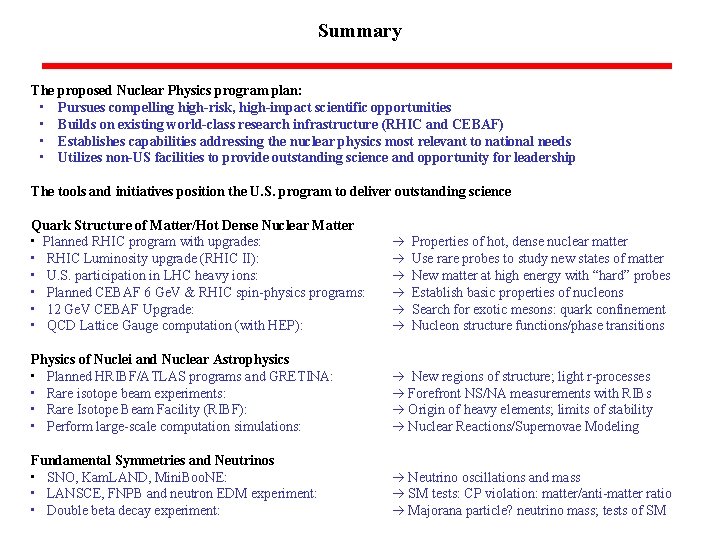
Summary The proposed Nuclear Physics program plan: • Pursues compelling high-risk, high-impact scientific opportunities • Builds on existing world-class research infrastructure (RHIC and CEBAF) • Establishes capabilities addressing the nuclear physics most relevant to national needs • Utilizes non-US facilities to provide outstanding science and opportunity for leadership The tools and initiatives position the U. S. program to deliver outstanding science Quark Structure of Matter/Hot Dense Nuclear Matter • Planned RHIC program with upgrades: • RHIC Luminosity upgrade (RHIC II): • U. S. participation in LHC heavy ions: • Planned CEBAF 6 Ge. V & RHIC spin-physics programs: • 12 Ge. V CEBAF Upgrade: • QCD Lattice Gauge computation (with HEP): Physics of Nuclei and Nuclear Astrophysics • Planned HRIBF/ATLAS programs and GRETINA: • Rare isotope beam experiments: • Rare Isotope Beam Facility (RIBF): • Perform large-scale computation simulations: New regions of structure; light r-processes Forefront NS/NA measurements with RIBs Origin of heavy elements; limits of stability Nuclear Reactions/Supernovae Modeling Fundamental Symmetries and Neutrinos • SNO, Kam. LAND, Mini. Boo. NE: • LANSCE, FNPB and neutron EDM experiment: • Double beta decay experiment: Neutrino oscillations and mass SM tests: CP violation: matter/anti-matter ratio Majorana particle? neutrino mass; tests of SM Properties of hot, dense nuclear matter Use rare probes to study new states of matter New matter at high energy with “hard” probes Establish basic properties of nucleons Search for exotic mesons: quark confinement Nucleon structure functions/phase transitions
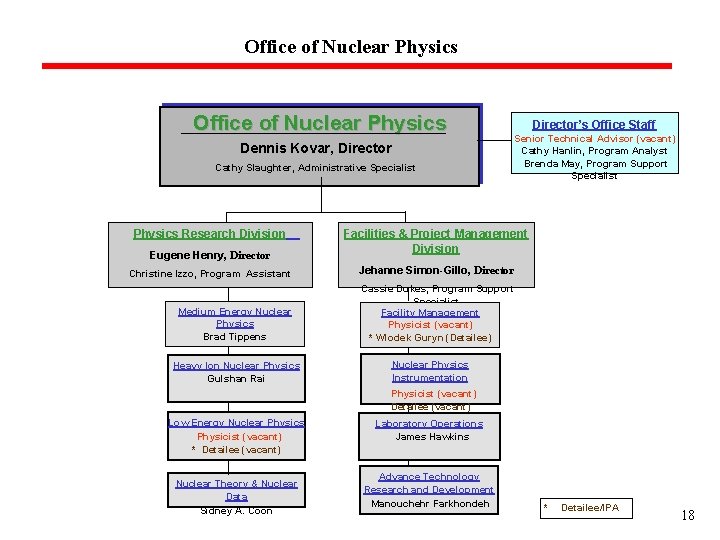
Office of Nuclear Physics Dennis Kovar, Director Cathy Slaughter, Administrative Specialist Physics Research Division Eugene Henry, Director’s Office Staff Senior Technical Advisor (vacant) Cathy Hanlin, Program Analyst Brenda May, Program Support Specialist Facilities & Project Management Division Christine Izzo, Program Assistant Jehanne Simon-Gillo, Director Medium Energy Nuclear Physics Brad Tippens Cassie Dukes, Program Support Specialist Facility Management Physicist (vacant) * Wlodek Guryn (Detailee) Heavy Ion Nuclear Physics Gulshan Rai Nuclear Physics Instrumentation Physicist (vacant) Detailee (vacant) Low Energy Nuclear Physics Physicist (vacant) * Detailee (vacant) Nuclear Theory & Nuclear Data Sidney A. Coon Laboratory Operations James Hawkins Advance Technology Research and Development Manouchehr Farkhondeh * Detailee/IPA 18