
Nuclear Physics PHY 361 2008 04 21 Outline

- Slides: 13
Nuclear Physics PHY 361 2008 -04 -21
Outline § history § structure of the nucleus • • • nuclear binding force liquid drop model shell model – magic numbers § binding energy • • chart of nuclides line of stability, drip line, island of stability § radioactivity • • , , decay fission, fusion
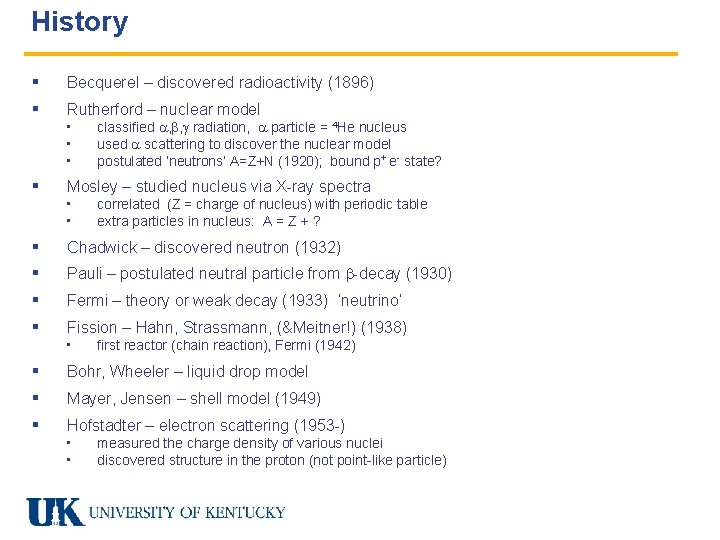
History § § Becquerel – discovered radioactivity (1896) Rutherford – nuclear model • • • § Mosley – studied nucleus via X-ray spectra • • § § correlated (Z = charge of nucleus) with periodic table extra particles in nucleus: A = Z + ? Chadwick – discovered neutron (1932) Pauli – postulated neutral particle from -decay (1930) Fermi – theory or weak decay (1933) ‘neutrino’ Fission – Hahn, Strassmann, (&Meitner!) (1938) • § § § classified , , radiation, particle = 4 He nucleus used scattering to discover the nuclear model postulated ‘neutrons’ A=Z+N (1920); bound p+ e- state? first reactor (chain reaction), Fermi (1942) Bohr, Wheeler – liquid drop model Mayer, Jensen – shell model (1949) Hofstadter – electron scattering (1953 -) • • measured the charge density of various nuclei discovered structure in the proton (not point-like particle)
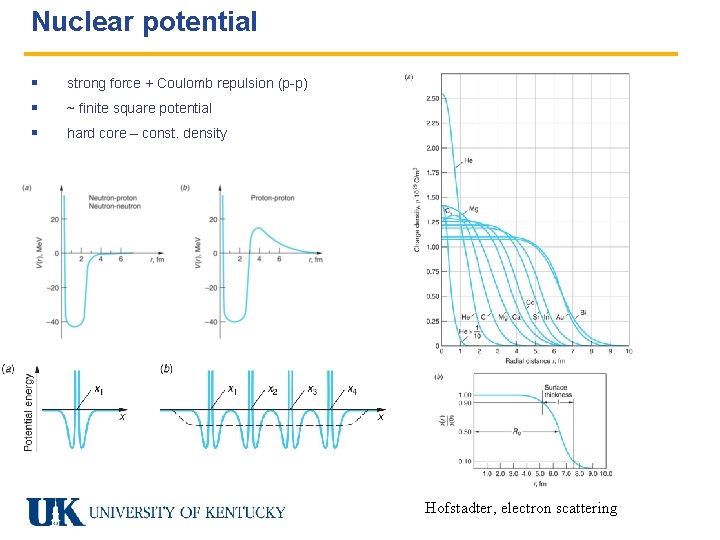
Nuclear potential § strong force + Coulomb repulsion (p-p) § ~ finite square potential § hard core – const. density Hofstadter, electron scattering
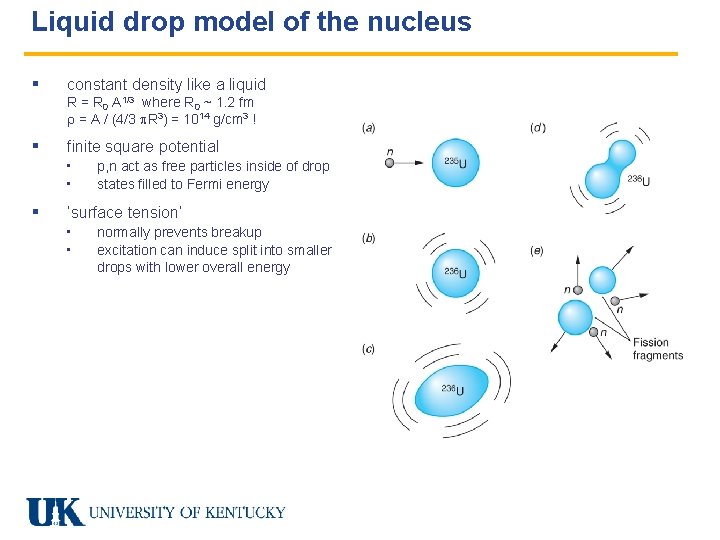
Liquid drop model of the nucleus § constant density like a liquid R = R 0 A 1/3 where R 0 ~ 1. 2 fm = A / (4/3 R 3) = 1014 g/cm 3 ! § finite square potential • • § p, n act as free particles inside of drop states filled to Fermi energy ‘surface tension’ • • normally prevents breakup excitation can induce split into smaller drops with lower overall energy
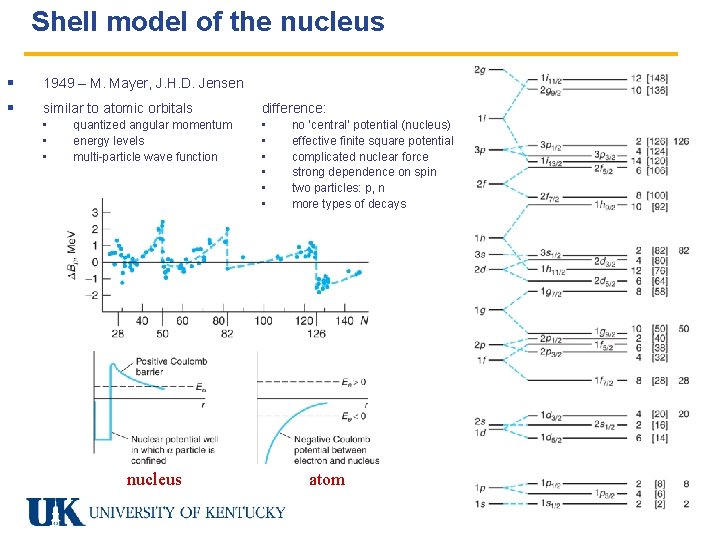
Shell model of the nucleus § 1949 – M. Mayer, J. H. D. Jensen § similar to atomic orbitals difference: • • • quantized angular momentum energy levels multi-particle wave function nucleus no ‘central’ potential (nucleus) effective finite square potential complicated nuclear force strong dependence on spin two particles: p, n more types of decays atom
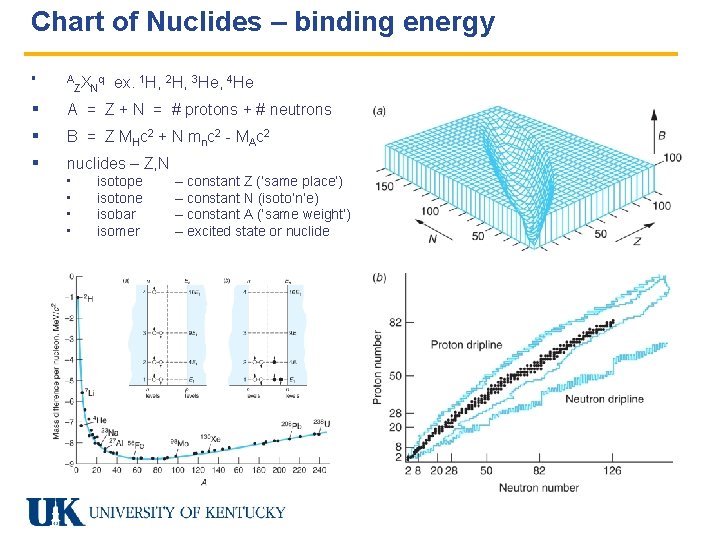
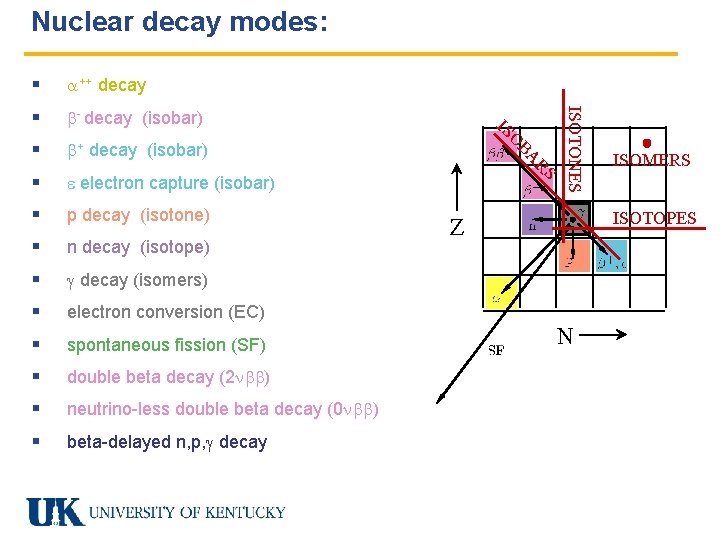
Chart of Nuclides – binding energy § A X q Z N § § § A = Z + N = # protons + # neutrons ex. 1 H, 2 H, 3 He, 4 He B = Z MHc 2 + N mnc 2 - MAc 2 nuclides – Z, N • • isotope isotone isobar isomer – constant Z (‘same place’) – constant N (isoto‘n’e) – constant A (‘same weight’) – excited state or nuclide
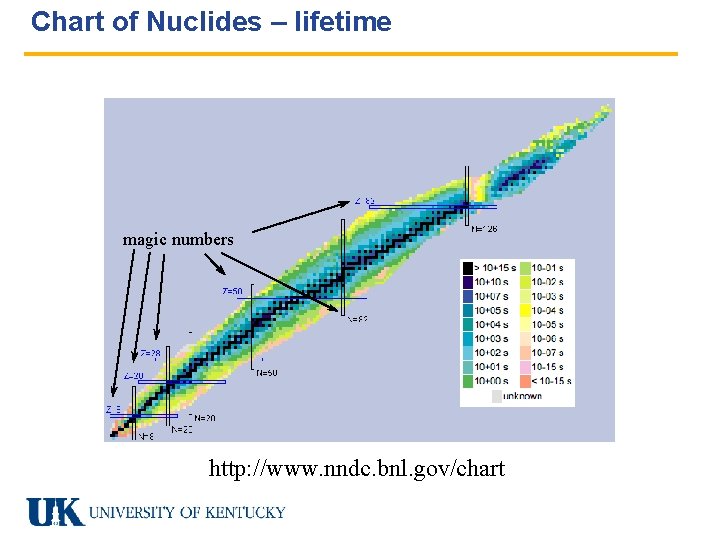
Chart of Nuclides – lifetime magic numbers http: //www. nndc. bnl. gov/chart
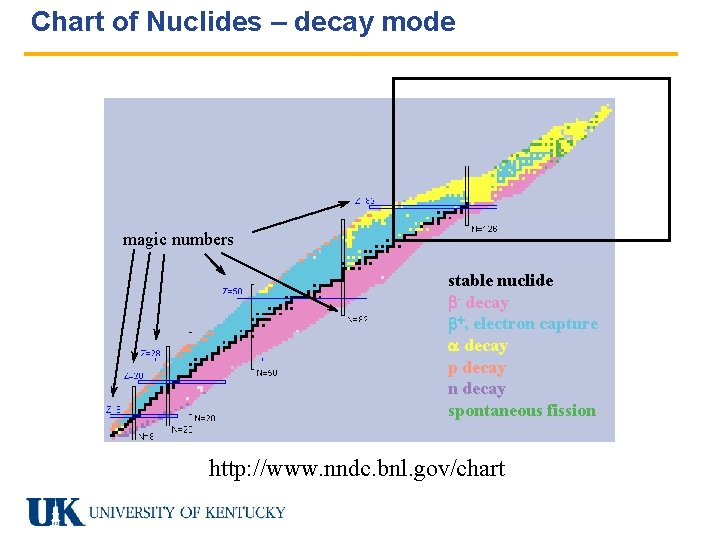
Chart of Nuclides – decay mode magic numbers stable nuclide - decay , electron capture decay p decay n decay spontaneous fission http: //www. nndc. bnl. gov/chart
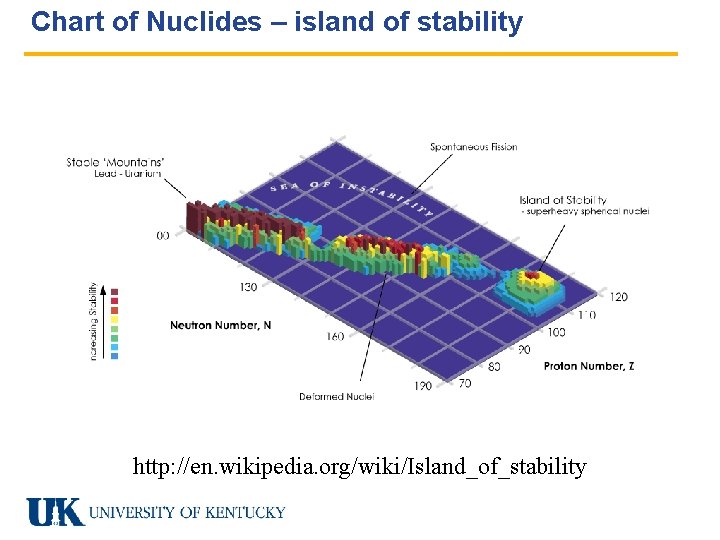
Chart of Nuclides – island of stability magic numbers http: //en. wikipedia. org/wiki/Island_of_stability
Nuclear decay modes: + decay (isobar) § electron capture (isobar) § p decay (isotone) § n decay (isotope) § decay (isomers) § electron conversion (EC) § spontaneous fission (SF) § double beta decay (2 ) § neutrino-less double beta decay (0 ) § beta-delayed n, p, decay ISOTONES § RS - decay (isobar) BA § O ++ decay IS § ISOMERS ISOTOPES Z N
Alpha-decay
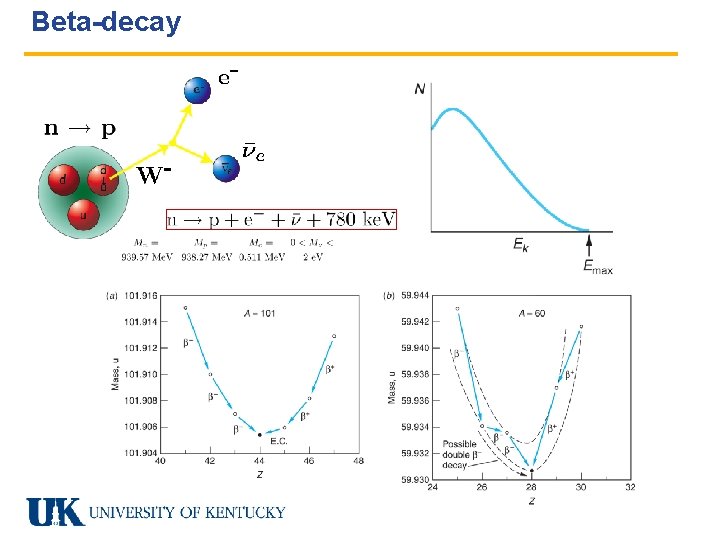
Beta-decay