
Nuclear Physics Phenomena in Cataclysmic Stellar Binary Systems
Nuclear Physics Phenomena in Cataclysmic Stellar Binary Systems Michael Wiescher (University of Notre Dame) q q q Interplay of Nuclear and Astrophysics Characteristic features of x-ray bursts Ignition (clusterization in nuclei) Time-scale (mass & shape of nuclei) Fate of Ashes from Thermo to Pycno (halo of nuclei) APS Meeting, Philadelphia 2003
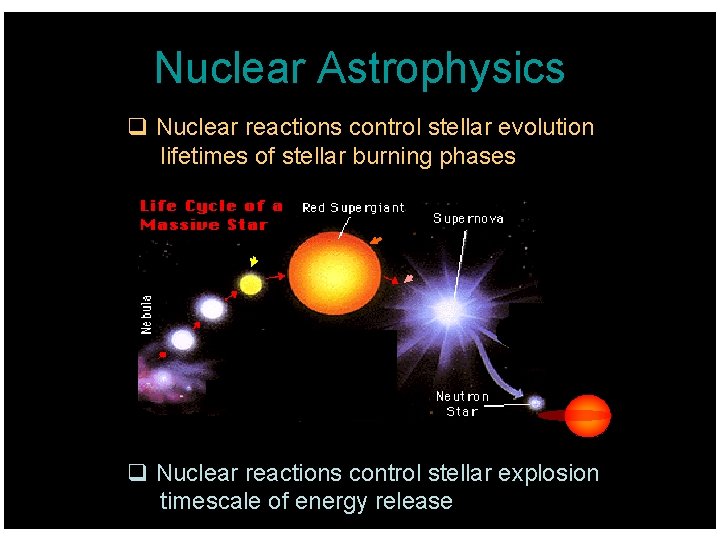
Nuclear Astrophysics q Nuclear reactions control stellar evolution lifetimes of stellar burning phases q Nuclear reactions control stellar explosion timescale of energy release
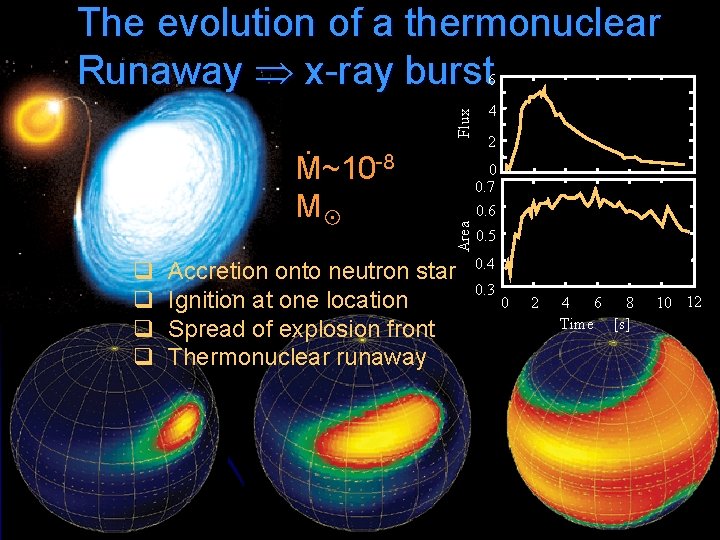
The evolution of a thermonuclear Runaway x-ray burst Flux 6 q q 2 0 0. 7 0. 6 Area Ṁ~10 -8 M☉ 4 Accretion onto neutron star Ignition at one location Spread of explosion front Thermonuclear runaway 0. 5 0. 4 0. 3 0 2 6 8 4 Time [s] 10 12
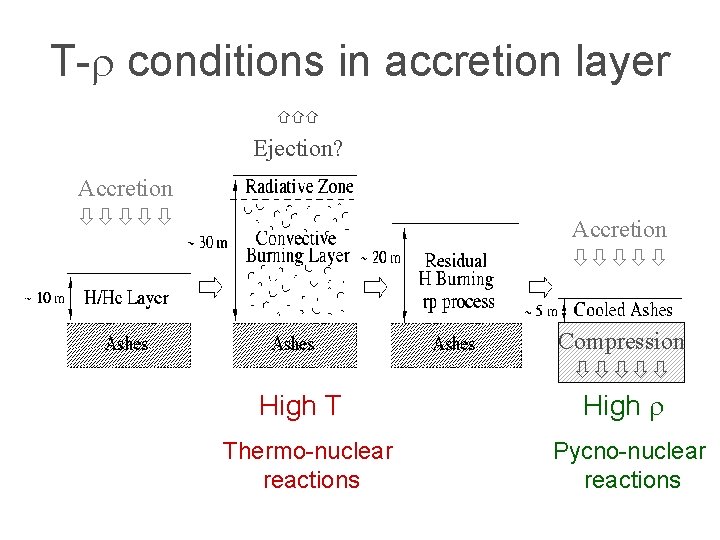
T- conditions in accretion layer ⇧⇧⇧ Ejection? Accretion Compression High T Thermo-nuclear reactions High Pycno-nuclear reactions
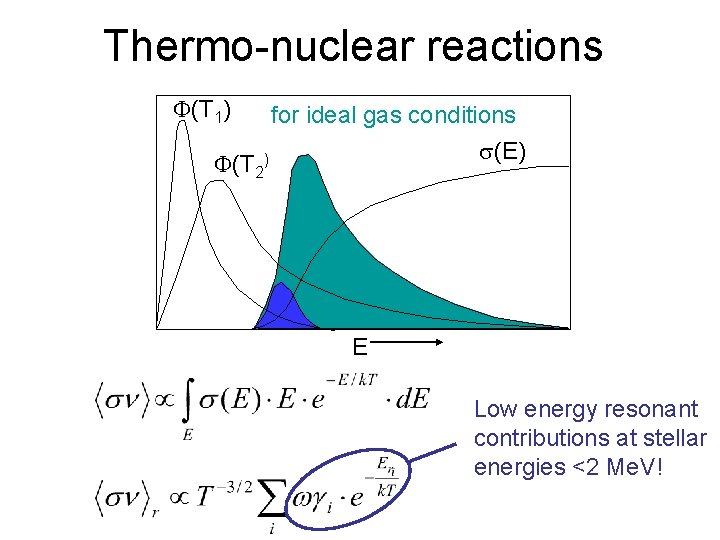
Thermo-nuclear reactions (T 1) (T 2 for ideal gas conditions (E) ) E Low energy resonant contributions at stellar energies <2 Me. V!
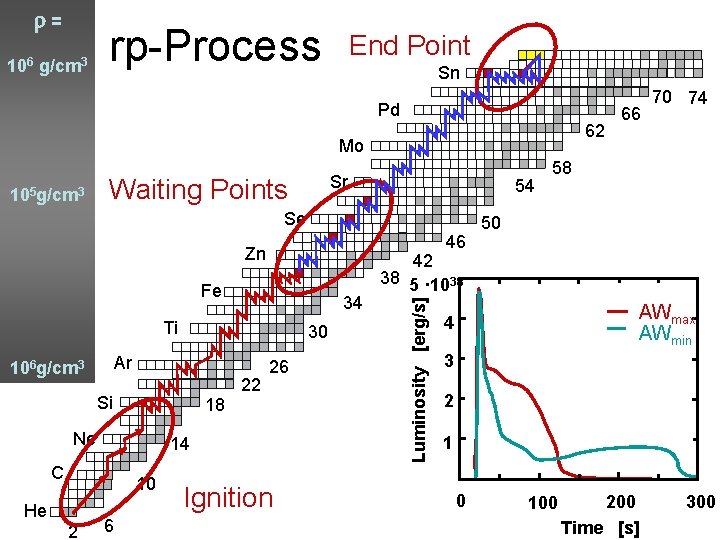
= 106 g/cm 3 rp-Process End Point Sn Pd 62 Mo 105 g/cm 3 Sr Waiting Points 54 Se 46 Fe 34 Ti 30 Ar 106 g/cm 3 22 Si 18 Ne 14 C 10 He 2 26 6 Ignition 58 50 42 38 5 · 1038 Luminosity [erg/s] Zn 66 70 74 AWmax AWmin 4 3 2 1 0 100 200 Time [s] 300

Excitation-Energy Alpha Cluster Structure in T=0, 1 nuclei Pronounced clustering in T=0, 1 nuclei near threshold Mass-Number
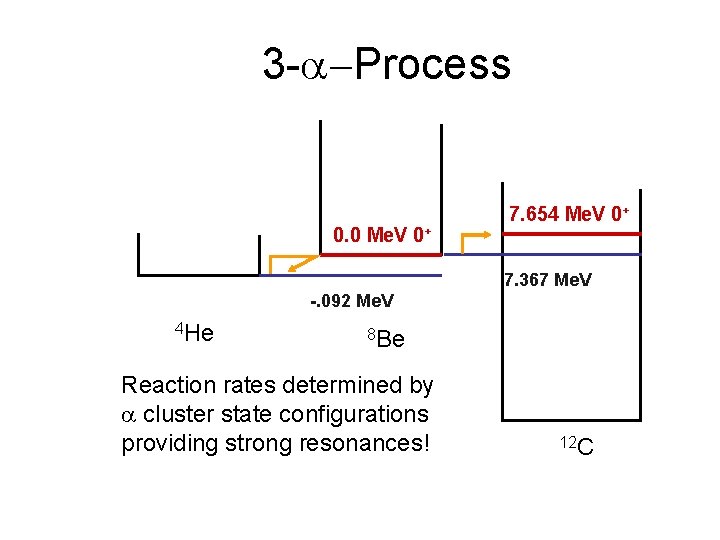
3 - -Process 0. 0 Me. V 0+ 7. 654 Me. V 0+ 7. 367 Me. V -. 092 Me. V 4 He 8 Be Reaction rates determined by cluster state configurations providing strong resonances! 12 C
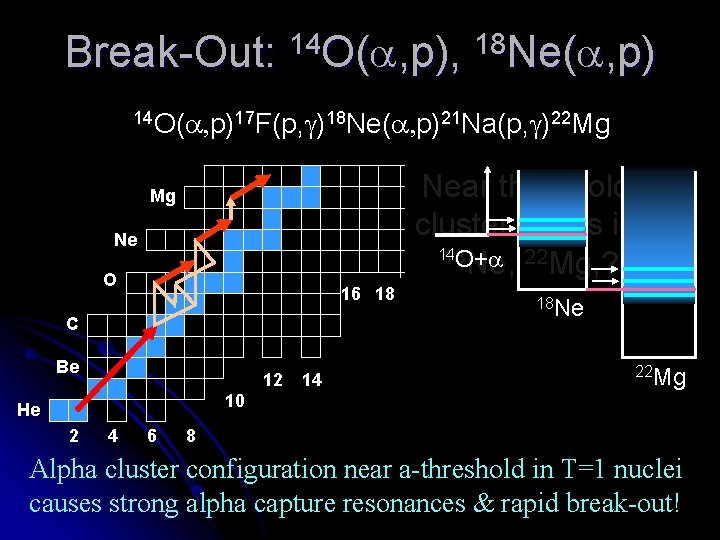
Break-Out: 14 O( , p), 18 Ne( , p) 14 O( , p)17 F(p, g)18 Ne( , p)21 Na(p, g)22 Mg Near threshold cluster states in: 14 18 O+ Ne, 22 Mg, ? Mg Ne O 16 18 C Be 12 14 18 Ne 22 Mg 10 He 2 4 6 8 Alpha cluster configuration near a-threshold in T=1 nuclei causes strong alpha capture resonances & rapid break-out!
![Consequences of break-out Break-Out HCNO O 200 400 600 800 1000 Time [s] -cluster](http://slidetodoc.com/presentation_image_h2/6ac59a70f7aad6fbb0e83ea0b4c6e39a/image-10.jpg "Consequences of break-out Break-Out HCNO O 200 400 600 800 1000 Time [s] -cluster")
Consequences of break-out Break-Out HCNO O 200 400 600 800 1000 Time [s] -cluster configuration near threshold
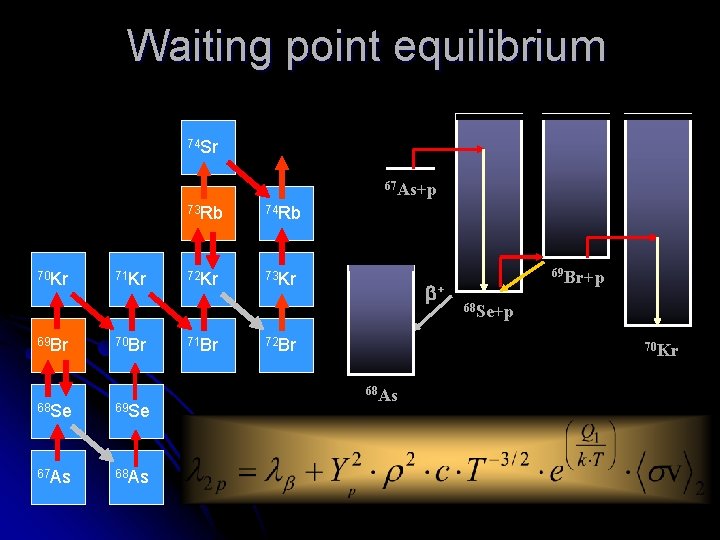
Waiting point equilibrium 74 Sr 67 As+p 70 Kr 69 Br 71 Kr 70 Br 68 Se 69 Se 67 As 68 As 73 Rb 74 Rb 72 Kr 73 Kr 71 Br b+ 72 Br 69 Br+p 68 Se+p 70 Kr 68 As
![Nuclear Masses & Nuclear Shape 100 Jaenecke AW 10 [s] 1 T 1/2 P-system](http://slidetodoc.com/presentation_image_h2/6ac59a70f7aad6fbb0e83ea0b4c6e39a/image-12.jpg "Nuclear Masses & Nuclear Shape 100 Jaenecke AW 10 [s] 1 T 1/2 P-system")
Nuclear Masses & Nuclear Shape 100 Jaenecke AW 10 [s] 1 T 1/2 P-system 0. 1 Shape. FRDM isomer 0. 01 Effective half-live of 68 Se 0. 001 Ganil 0. 0001 -2 -1 Q-value 0 [Me. V] 1 Shape deformations leads to shape isomeric states! Capture on long-lived isomers may increase reaction flow!
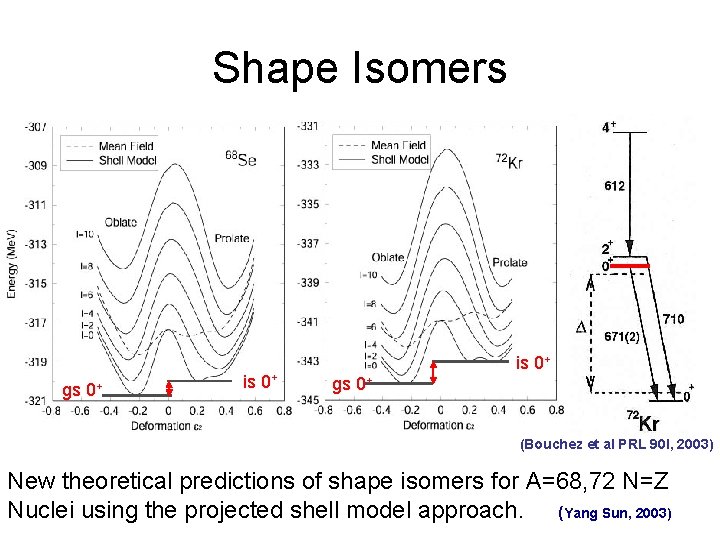
Shape Isomers gs 0+ is 0+ gs 0+ (Bouchez et al PRL 90 l, 2003) New theoretical predictions of shape isomers for A=68, 72 N=Z Nuclei using the projected shell model approach. (Yang Sun, 2003)
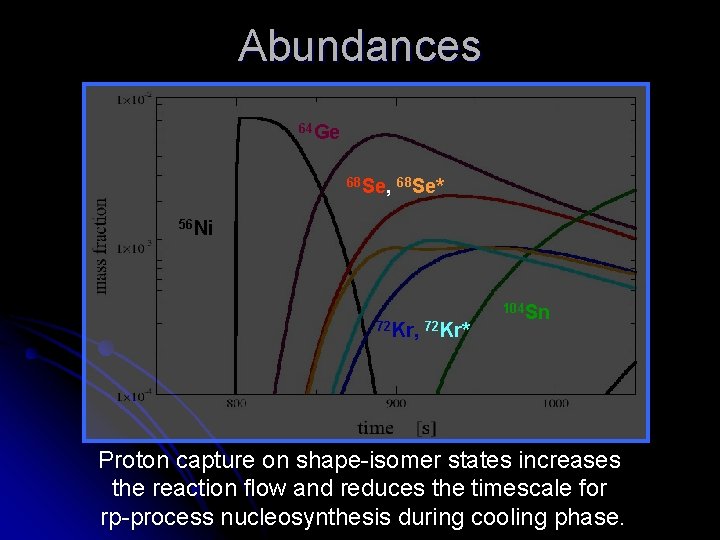
Abundances 64 Ge 68 Se, 68 Se* 56 Ni 72 Kr, 72 Kr* 104 Sn Proton capture on shape-isomer states increases the reaction flow and reduces the timescale for rp-process nucleosynthesis during cooling phase.
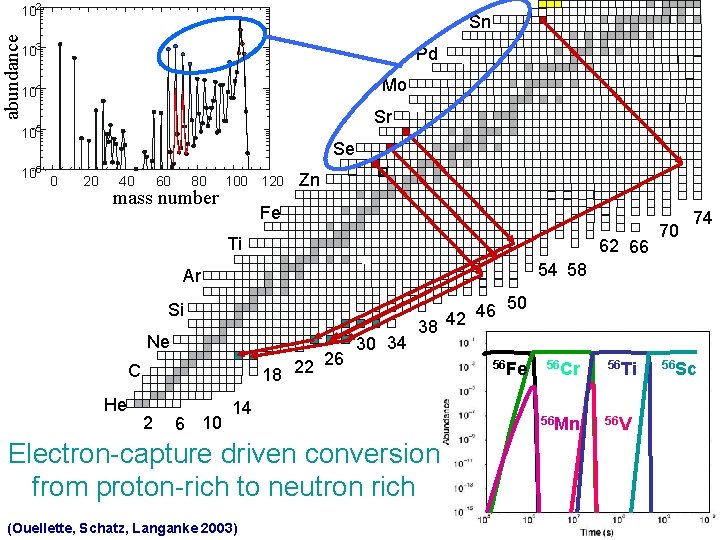
10 -2 abundance Sn 10 -3 Pd Mo 10 -4 Sr -5 10 10 -6 Se 0 20 40 60 80 mass number 100 120 Zn Fe Ti 62 66 Si Ne 26 22 18 C 2 6 10 74 54 58 Ar He 70 30 34 50 46 38 42 14 Electron-capture driven conversion from proton-rich to neutron rich (Ouellette, Schatz, Langanke 2003) 56 Fe 56 Cr 56 Mn 56 Ti 56 V 56 Sc
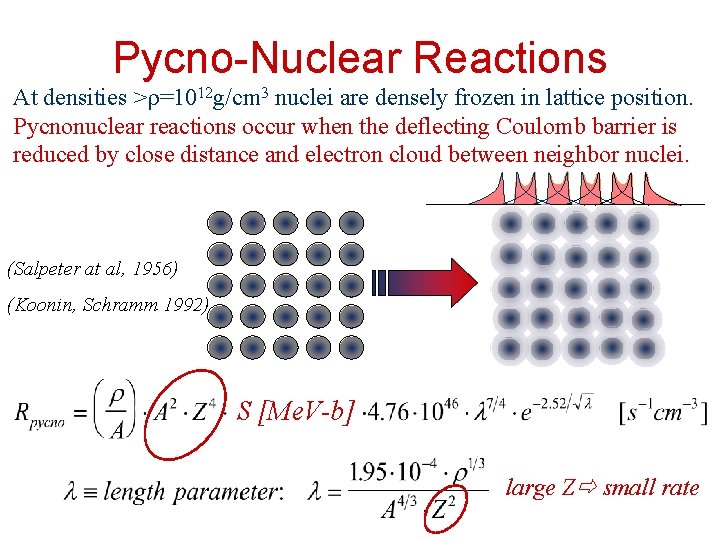
Pycno-Nuclear Reactions At densities > =1012 g/cm 3 nuclei are densely frozen in lattice position. Pycnonuclear reactions occur when the deflecting Coulomb barrier is reduced by close distance and electron cloud between neighbor nuclei. (Salpeter at al, 1956) (Koonin, Schramm 1992) S [Me. V-b] large Z small rate
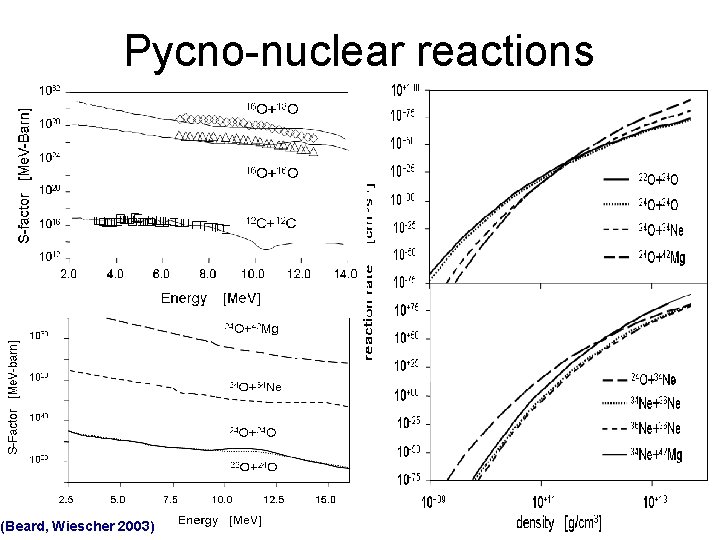
Pycno-nuclear reactions (Beard, Wiescher 2003)
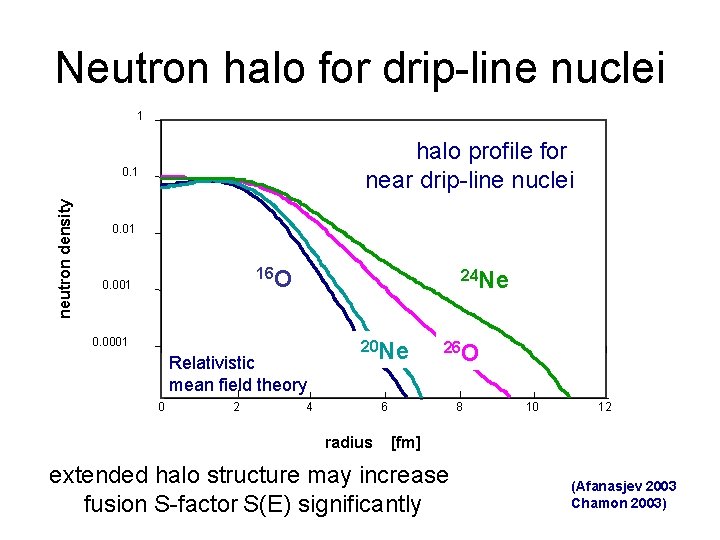
Neutron halo for drip-line nuclei 1 halo profile for near drip-line nuclei neutron density 0. 1 0. 01 16 O 0. 001 24 Ne 0. 0001 Relativistic mean field theory 0 2 20 Ne 26 O 6 8 4 radius 10 12 [fm] extended halo structure may increase fusion S-factor S(E) significantly (Afanasjev 2003 Chamon 2003)
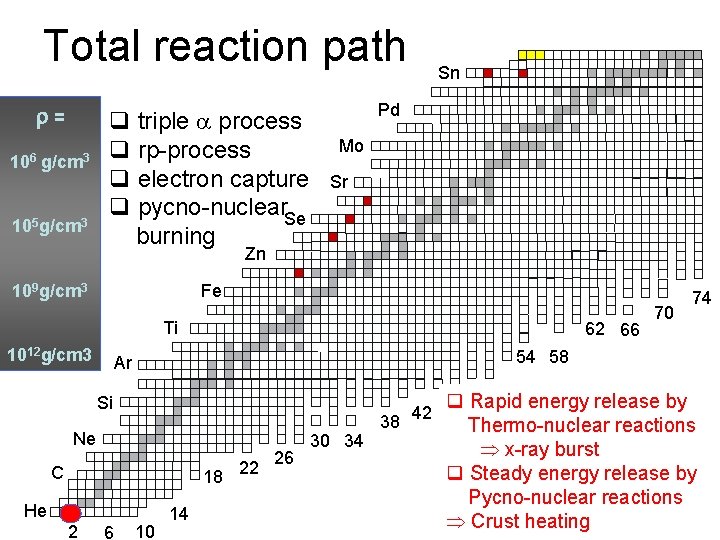
Total reaction path = 106 g/cm 3 105 g/cm 3 q triple process q rp-process q electron capture q pycno-nuclear. Se burning Sn Pd Mo Sr Zn 109 g/cm 3 Fe Ti 1012 g/cm 3 Ar Si Ne C He 2 6 62 66 70 74 54 58 50 q 46 Rapid energy release by 42 38 Thermo-nuclear reactions 30 34 x-ray burst 26 22 q Steady energy release by 18 Pycno-nuclear reactions 14 Crust heating 10
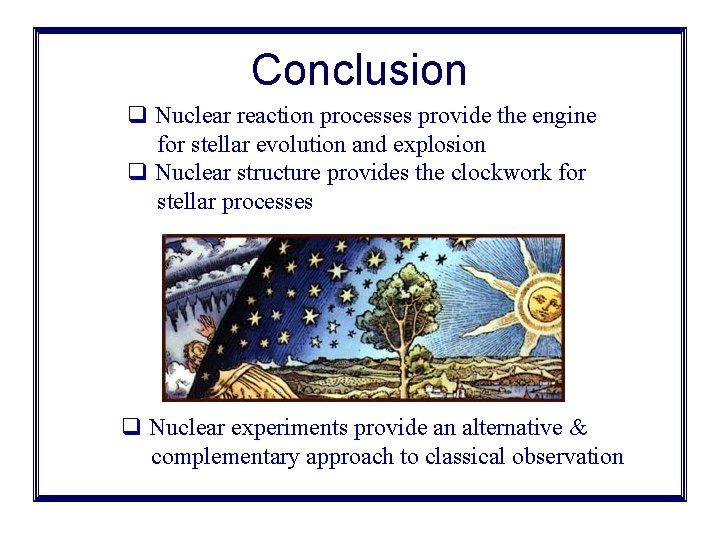
Conclusion q Nuclear reaction processes provide the engine for stellar evolution and explosion q Nuclear structure provides the clockwork for stellar processes q Nuclear experiments provide an alternative & complementary approach to classical observation
Acknowledgments Anatoli Afanasjev Ani Aprahamian Victoria Barnard Mary Beard Joachim Görres Karlheinz Langanke Hendrik Schatz Yang Sun Friedel Thielemann Notre Dame U. Surrey, UK Notre Dame U. Århús, Danmark NSCL/MSU Notre Dame U. Basel, Switzerland
- Slides: 21