
Nuclear Physics AP Physics B Joseph F Ruffolo
Nuclear Physics AP Physics B Joseph F. Ruffolo, Ph. D.
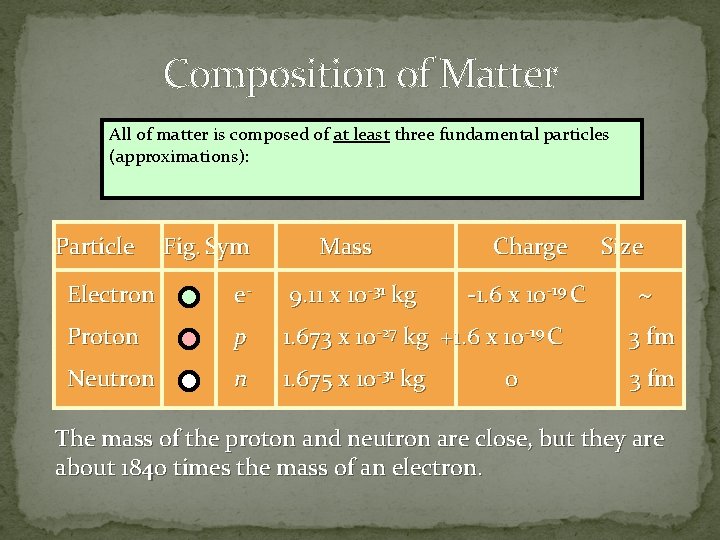
Composition of Matter All of matter is composed of at least three fundamental particles (approximations): Particle Fig. Sym Mass Charge -1. 6 x 10 -19 C Size Electron e- 9. 11 x 10 -31 kg Proton p 1. 673 x 10 -27 kg +1. 6 x 10 -19 C 3 fm Neutron n 1. 675 x 10 -31 kg 3 fm 0 The mass of the proton and neutron are close, but they are about 1840 times the mass of an electron.
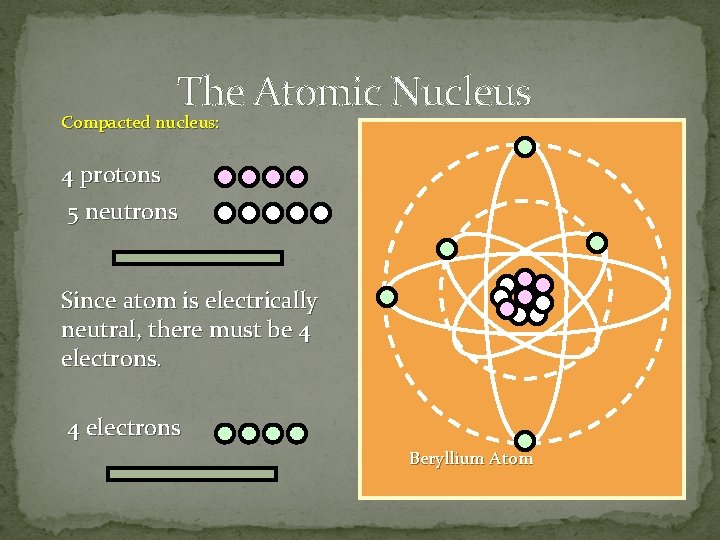
The Atomic Nucleus Compacted nucleus: 4 protons 5 neutrons Since atom is electrically neutral, there must be 4 electrons Beryllium Atom
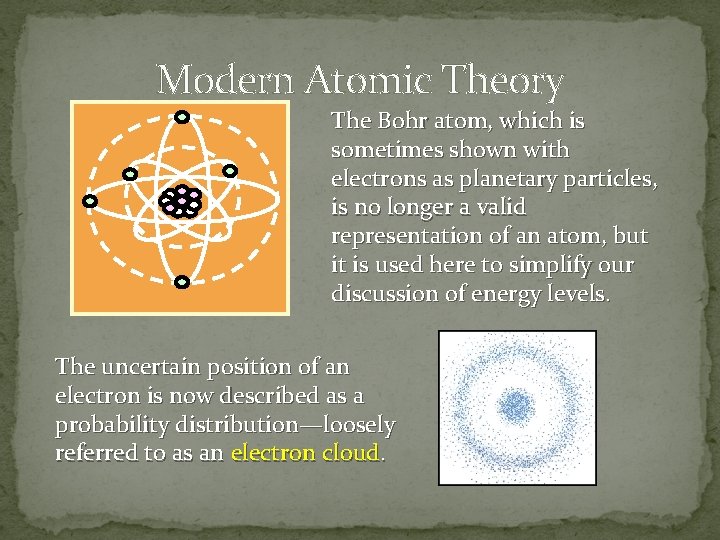
Modern Atomic Theory The Bohr atom, which is sometimes shown with electrons as planetary particles, is no longer a valid representation of an atom, but it is used here to simplify our discussion of energy levels. The uncertain position of an electron is now described as a probability distribution—loosely referred to as an electron cloud.
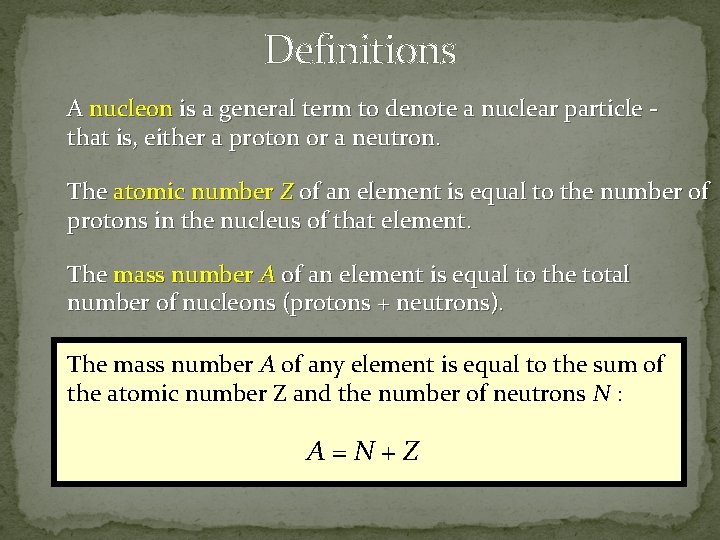
Definitions A nucleon is a general term to denote a nuclear particle that is, either a proton or a neutron. The atomic number Z of an element is equal to the number of protons in the nucleus of that element. The mass number A of an element is equal to the total number of nucleons (protons + neutrons). The mass number A of any element is equal to the sum of the atomic number Z and the number of neutrons N : A=N+Z
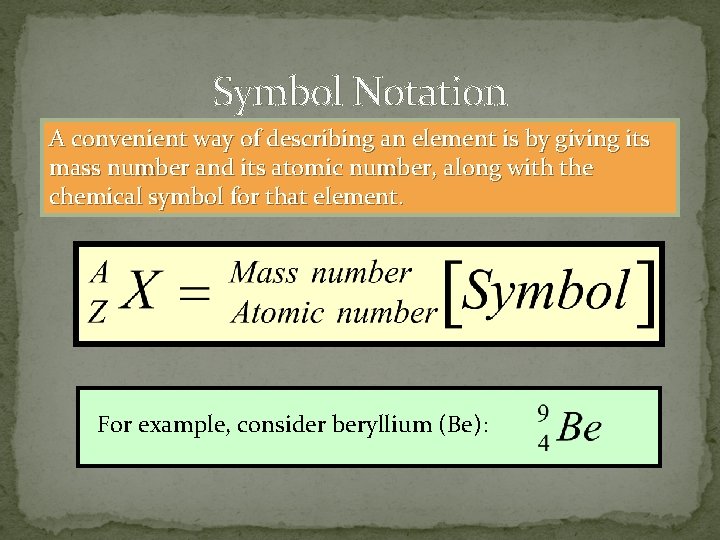
Symbol Notation A convenient way of describing an element is by giving its mass number and its atomic number, along with the chemical symbol for that element. For example, consider beryllium (Be):
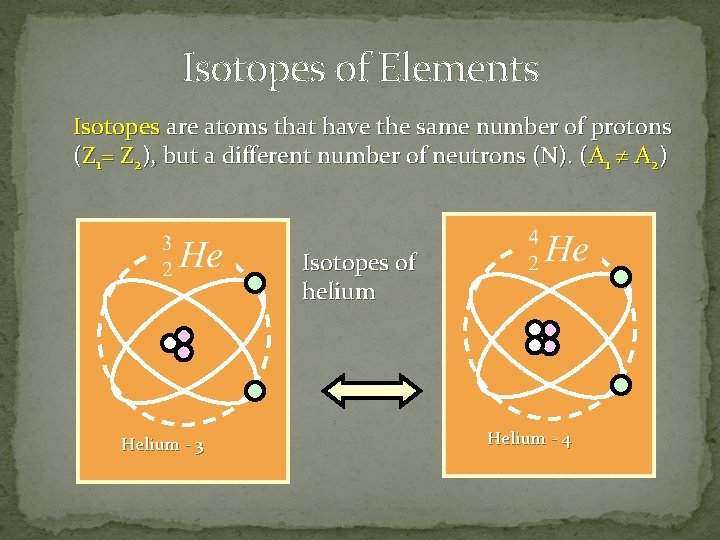
Isotopes of Elements Isotopes are atoms that have the same number of protons (Z 1= Z 2), but a different number of neutrons (N). (A 1 A 2) Isotopes of helium Helium - 3 Helium - 4
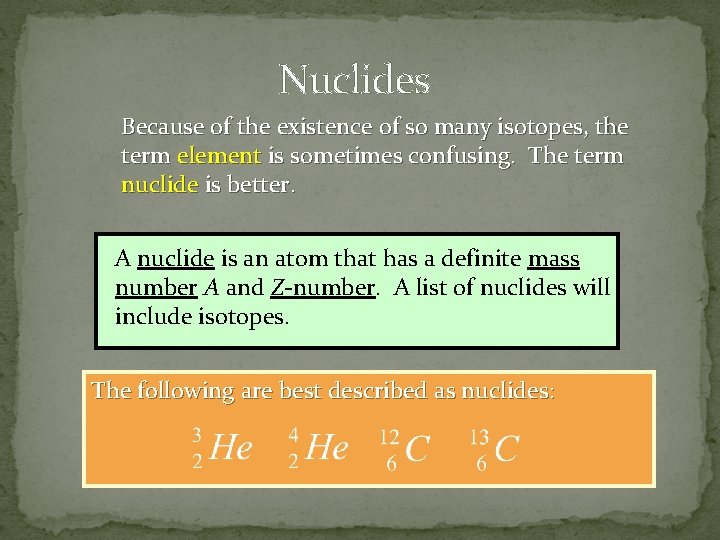
Nuclides Because of the existence of so many isotopes, the term element is sometimes confusing. The term nuclide is better. A nuclide is an atom that has a definite mass number A and Z-number. A list of nuclides will include isotopes. The following are best described as nuclides:
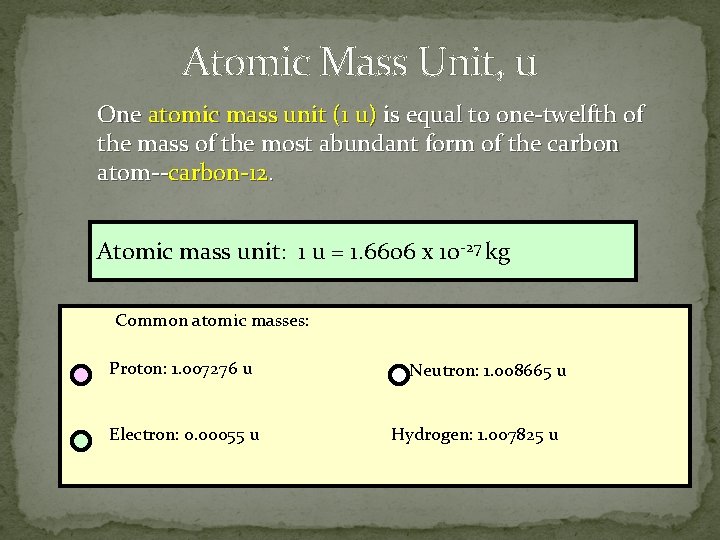
Atomic Mass Unit, u One atomic mass unit (1 u) is equal to one-twelfth of the mass of the most abundant form of the carbon atom--carbon-12. Atomic mass unit: 1 u = 1. 6606 x 10 -27 kg Common atomic masses: Proton: 1. 007276 u Electron: 0. 00055 u Neutron: 1. 008665 u Hydrogen: 1. 007825 u
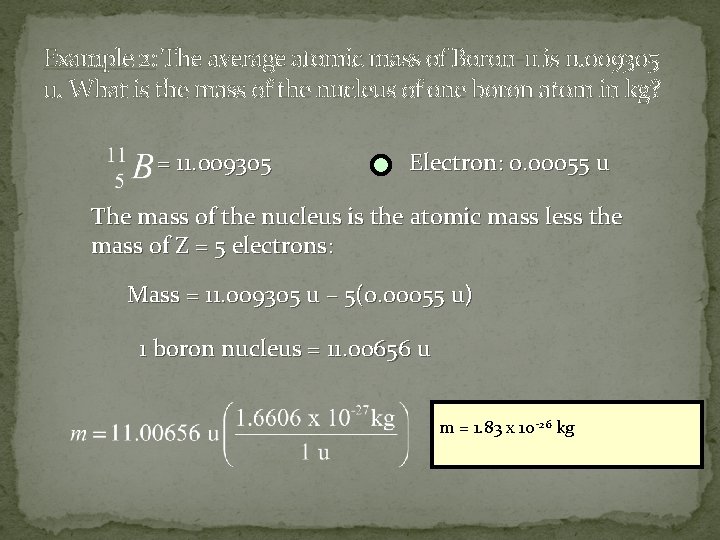
Example 2: The average atomic mass of Boron-11 is 11. 009305 u. What is the mass of the nucleus of one boron atom in kg? = 11. 009305 Electron: 0. 00055 u The mass of the nucleus is the atomic mass less the mass of Z = 5 electrons: Mass = 11. 009305 u – 5(0. 00055 u) 1 boron nucleus = 11. 00656 u m = 1. 83 x 10 -26 kg

Mass and Energy Recall Einstein’s equivalency formula for m and E: The energy of a mass of 1 u can be found: E = (1 u)c 2 = (1. 66 x 10 -27 kg)(3 x 10⁸ m/s)2 E = 1. 49 x 10 -10 J Or When converting amu to energy: E = 931. 5 Me. V
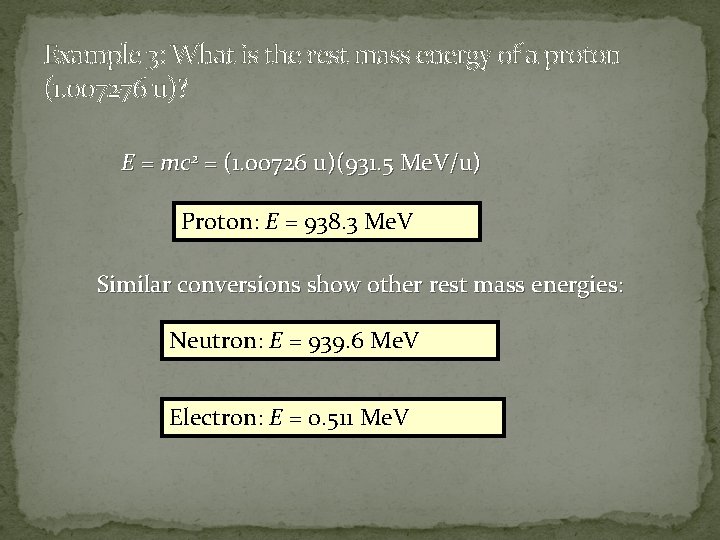
Example 3: What is the rest mass energy of a proton (1. 007276 u)? E = mc 2 = (1. 00726 u)(931. 5 Me. V/u) Proton: E = 938. 3 Me. V Similar conversions show other rest mass energies: Neutron: E = 939. 6 Me. V Electron: E = 0. 511 Me. V
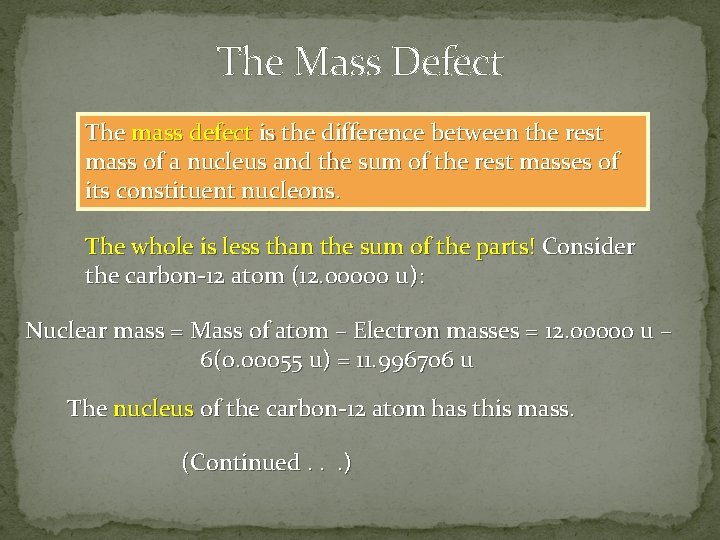
The Mass Defect The mass defect is the difference between the rest mass of a nucleus and the sum of the rest masses of its constituent nucleons. The whole is less than the sum of the parts! Consider the carbon-12 atom (12. 00000 u): Nuclear mass = Mass of atom – Electron masses = 12. 00000 u – 6(0. 00055 u) = 11. 996706 u The nucleus of the carbon-12 atom has this mass. (Continued. . . )
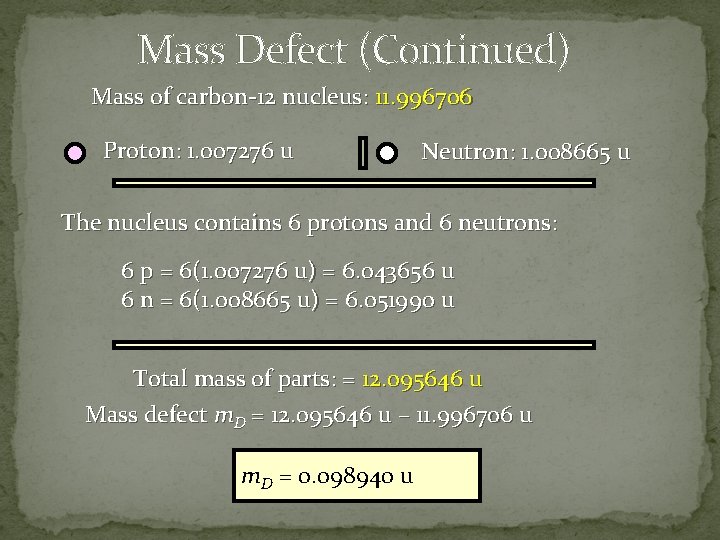
Mass Defect (Continued) Mass of carbon-12 nucleus: 11. 996706 Proton: 1. 007276 u Neutron: 1. 008665 u The nucleus contains 6 protons and 6 neutrons: 6 p = 6(1. 007276 u) = 6. 043656 u 6 n = 6(1. 008665 u) = 6. 051990 u Total mass of parts: = 12. 095646 u Mass defect m. D = 12. 095646 u – 11. 996706 u m. D = 0. 098940 u
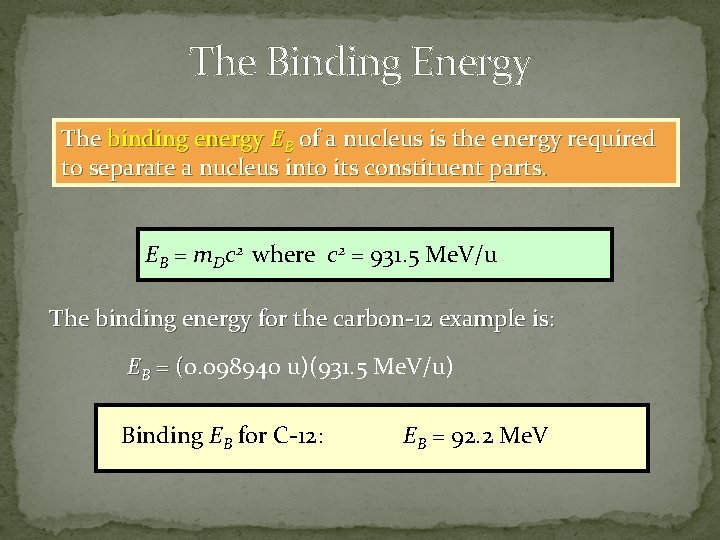
The Binding Energy The binding energy EB of a nucleus is the energy required to separate a nucleus into its constituent parts. EB = m. Dc 2 where c 2 = 931. 5 Me. V/u The binding energy for the carbon-12 example is: EB = (0. 098940 u)(931. 5 Me. V/u) ( Binding EB for C-12: EB = 92. 2 Me. V
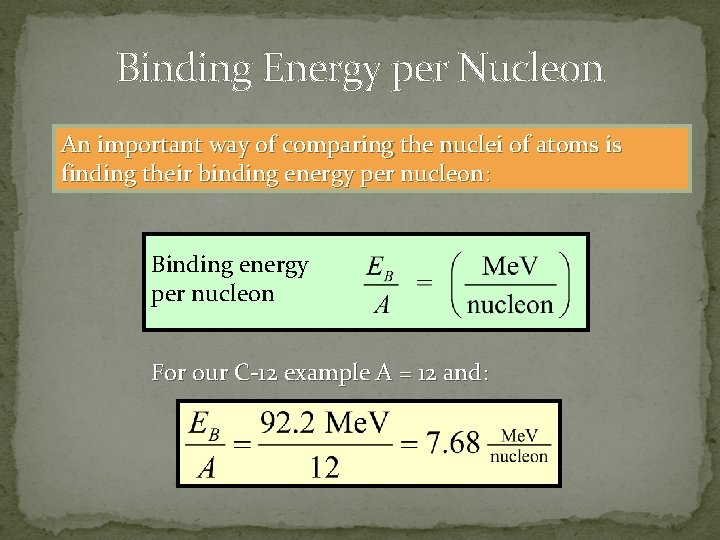
Binding Energy per Nucleon An important way of comparing the nuclei of atoms is finding their binding energy per nucleon: Binding energy per nucleon For our C-12 example A = 12 and:
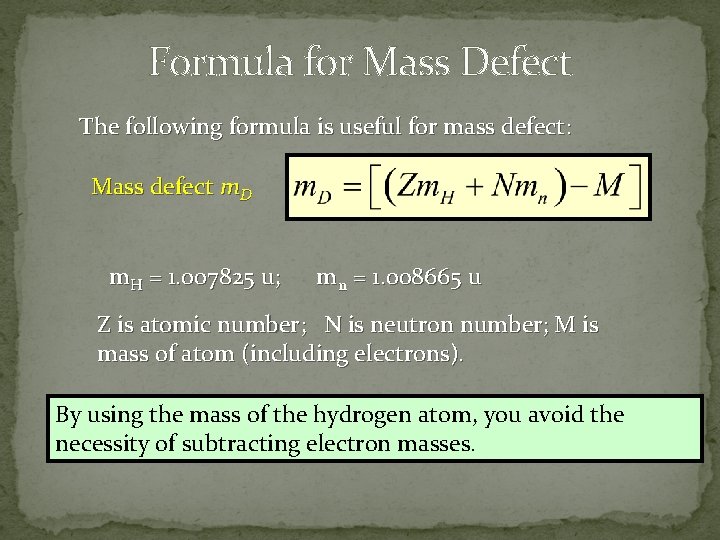
Formula for Mass Defect The following formula is useful for mass defect: Mass defect m. D m. H = 1. 007825 u; mn = 1. 008665 u Z is atomic number; N is neutron number; M is mass of atom (including electrons). By using the mass of the hydrogen atom, you avoid the necessity of subtracting electron masses.
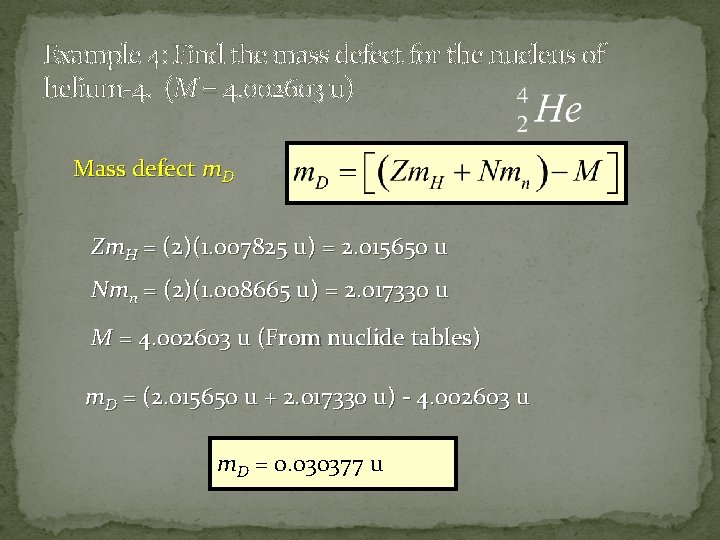
Example 4: Find the mass defect for the nucleus of helium-4. (M = 4. 002603 u) Mass defect m. D Zm. H = (2)(1. 007825 u) = 2. 015650 u Nmn = (2)(1. 008665 u) = 2. 017330 u M = 4. 002603 u (From nuclide tables) m. D = (2. 015650 u + 2. 017330 u) - 4. 002603 u m. D = 0. 030377 u
- Slides: 18