
Nuclear Physics and Electron Scattering Nuclear Physics Strong
![1 p knockout from 12 C(e, e'p)11 B (pm) [(Me. V/c) 3] DWIA calculations](https://slidetodoc.com/presentation_image/2be4ebff2f92e2b4acc5a66b23348c09/image-34.jpg "1 p knockout from 12 C(e, e'p)11 B (pm) [(Me. V/c) 3] DWIA calculations")
- Slides: 45
Nuclear Physics and Electron Scattering
“Nuclear” Physics = Strong Force • Four forces in nature – Gravity – Electromagnetic – Weak – Strong Responsible for binding protons and neutrons together to make nuclei, holds together quarks that make protons and neutrons • Why study the strong force? – The nucleus makes up 99. 9% of the mass of the atoms around you – Nuclear reactions crucial to understanding how the universe was formed – Because it’s hard! The underlying theory is simple, but it’s difficult to understand how we get from that theory to real protons, neutrons, nuclei 2
Scope of Nuclear Physics • Topics that fall under the umbrella of the label “nuclear physics” depends to some degree on where you are • In the United States, includes – Nuclear structure (how protons and neutrons combine to make atomic nucleus) 3
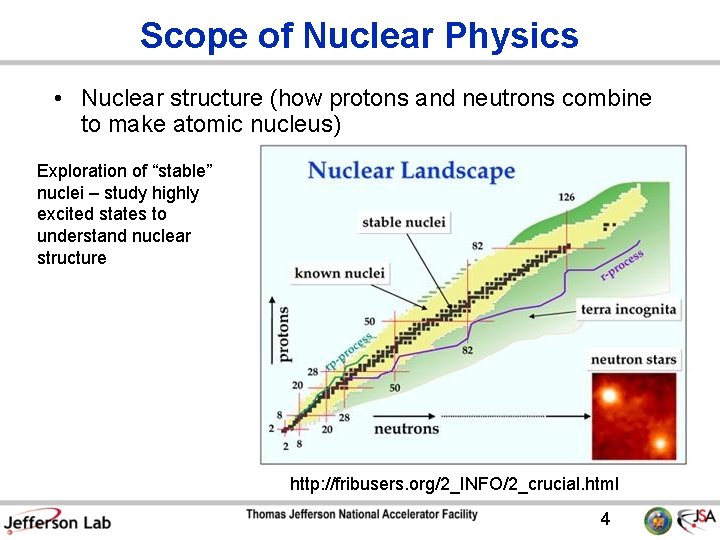
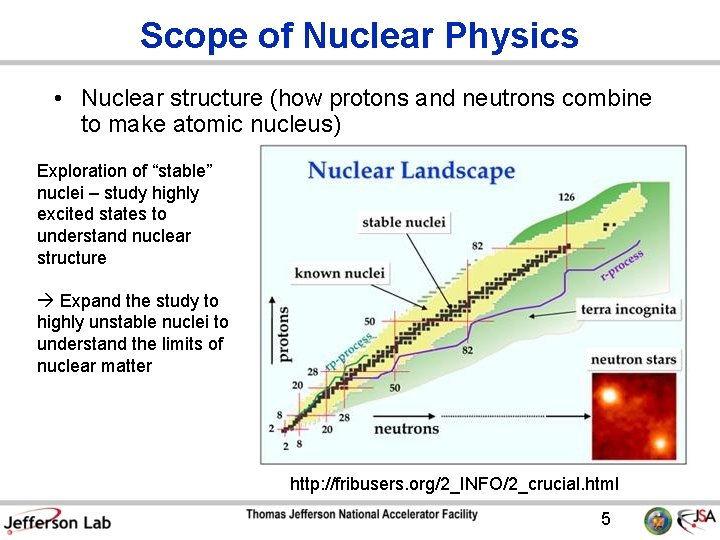
Scope of Nuclear Physics • Nuclear structure (how protons and neutrons combine to make atomic nucleus) Exploration of “stable” nuclei – study highly excited states to understand nuclear structure http: //fribusers. org/2_INFO/2_crucial. html 4
Scope of Nuclear Physics • Nuclear structure (how protons and neutrons combine to make atomic nucleus) Exploration of “stable” nuclei – study highly excited states to understand nuclear structure Expand the study to highly unstable nuclei to understand the limits of nuclear matter http: //fribusers. org/2_INFO/2_crucial. html 5
Scope of Nuclear Physics • Topics that fall under the umbrella of the label “nuclear physics” depends to some degree on where you are • In the United States, includes: – Nuclear structure (how protons and neutrons combine to make atomic nucleus) – Relativistic heavy ions – smashing together heavy nuclei at high energies to explore new states of strongly interacting matter 6
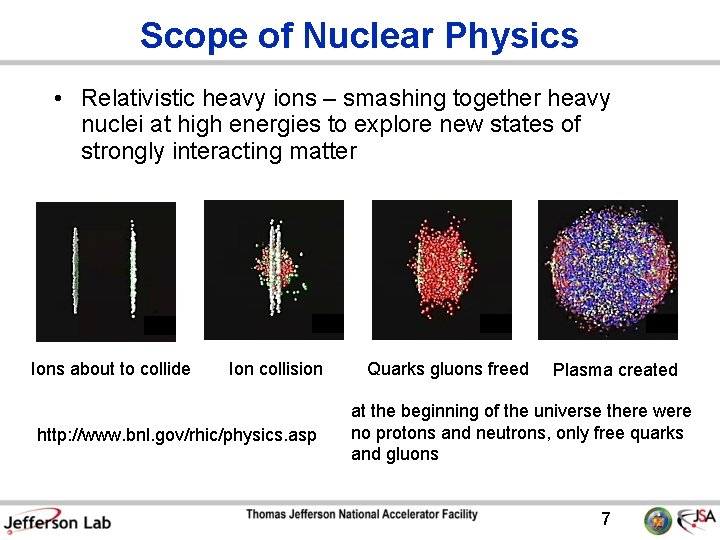
Scope of Nuclear Physics • Relativistic heavy ions – smashing together heavy nuclei at high energies to explore new states of strongly interacting matter Ions about to collide Ion collision http: //www. bnl. gov/rhic/physics. asp Quarks gluons freed Plasma created at the beginning of the universe there were no protons and neutrons, only free quarks and gluons 7
Scope of Nuclear Physics • Topics that fall under the umbrella of the label “nuclear physics” depends to some degree on where you are • In the United States, includes: – Nuclear structure (how protons and neutrons combine to make atomic nucleus) – Relativistic heavy ions – smashing together heavy nuclei at high energies to explore new states of strongly interacting matter – Quantum Chromodynamics how quarks and gluons interact to form protons and neutrons and eventually nuclei – Symmetry tests searches for physics beyond the Standard Model 8
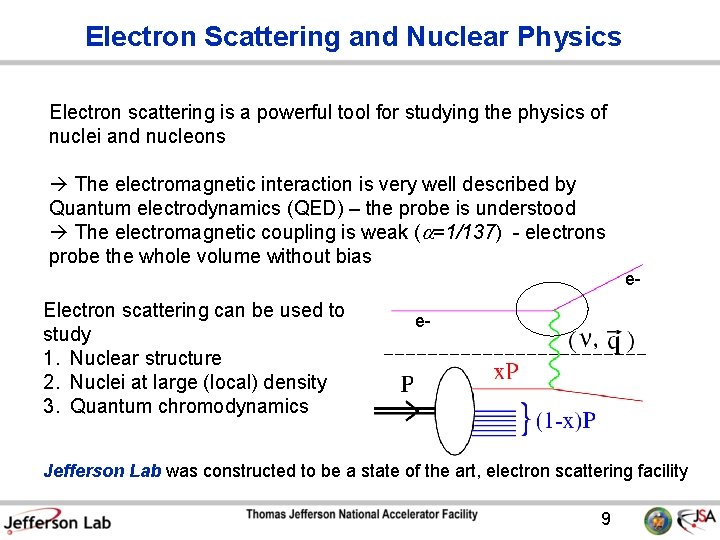
Electron Scattering and Nuclear Physics Electron scattering is a powerful tool for studying the physics of nuclei and nucleons The electromagnetic interaction is very well described by Quantum electrodynamics (QED) – the probe is understood The electromagnetic coupling is weak (a=1/137) - electrons probe the whole volume without bias e- Electron scattering can be used to study 1. Nuclear structure 2. Nuclei at large (local) density 3. Quantum chromodynamics e- Jefferson Lab was constructed to be a state of the art, electron scattering facility 9
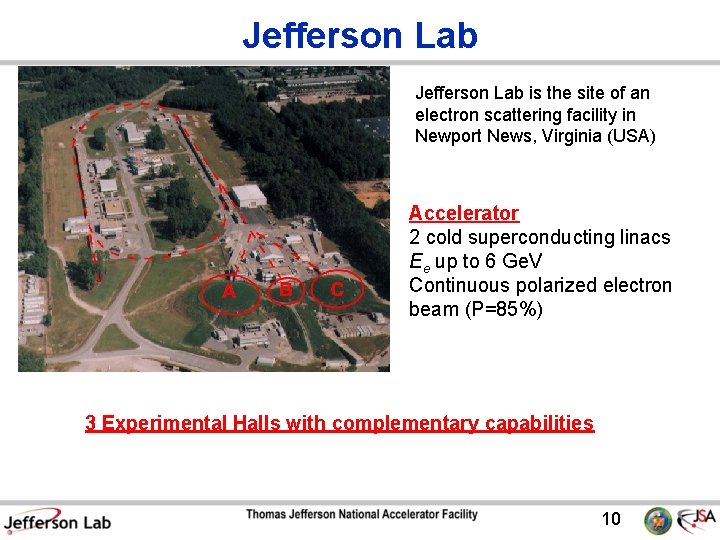
Jefferson Lab is the site of an electron scattering facility in Newport News, Virginia (USA) Accelerator 2 cold superconducting linacs Ee up to 6 Ge. V Continuous polarized electron beam (P=85%) 3 Experimental Halls with complementary capabilities 10
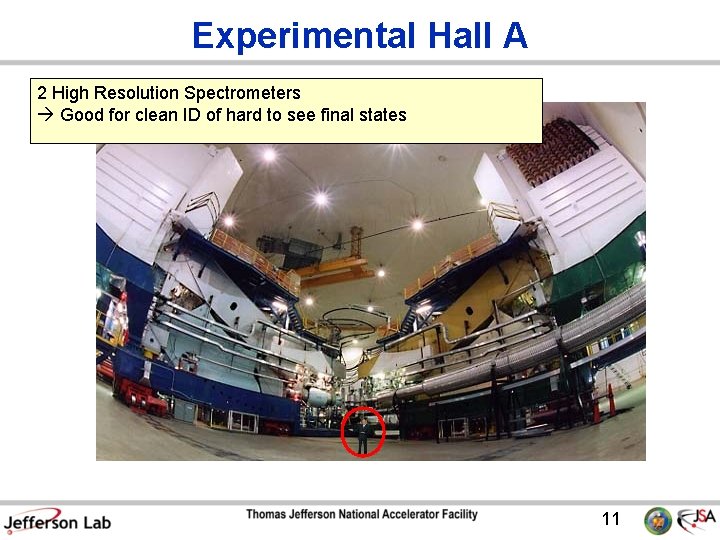
Experimental Hall A 2 High Resolution Spectrometers Good for clean ID of hard to see final states 11
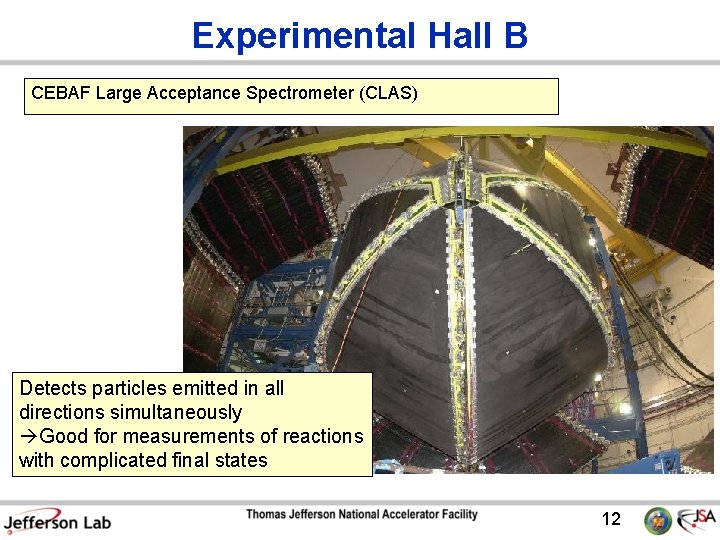
Experimental Hall B CEBAF Large Acceptance Spectrometer (CLAS) Detects particles emitted in all directions simultaneously Good for measurements of reactions with complicated final states 12
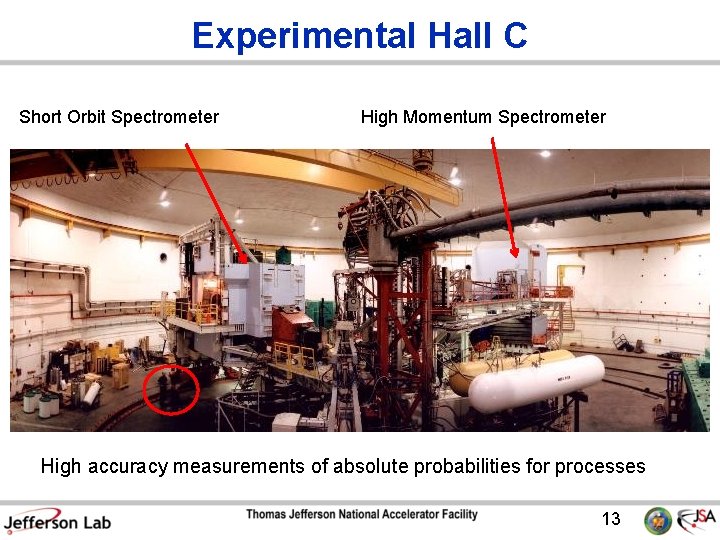
Experimental Hall C Short Orbit Spectrometer High Momentum Spectrometer High accuracy measurements of absolute probabilities for processes 13
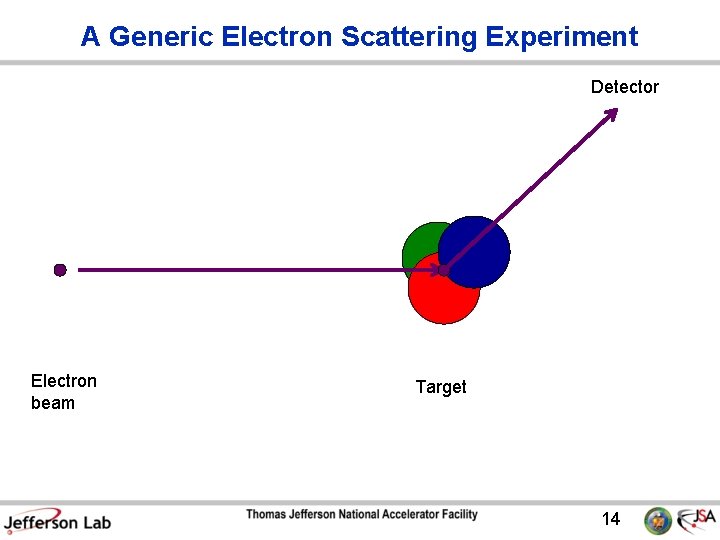
A Generic Electron Scattering Experiment Detector Electron beam Target 14
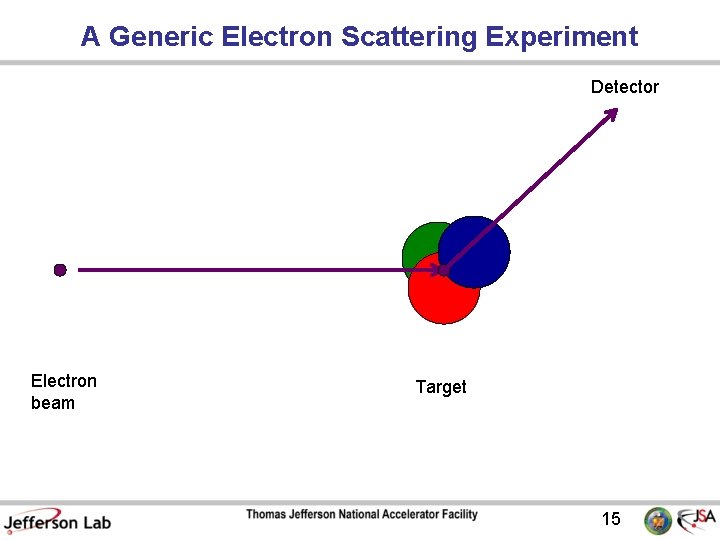
A Generic Electron Scattering Experiment Detector Electron beam Target 15
What we measure • In the “simplest” experiments, we measure the probability for an electron to scatter in a particular direction with a specific momentum • In more complicated experiments, we measure the above, in combination with the probability to produce another particle – The relative (and absolute) probabilities for different processes can tell us about the structure of the nucleus (or proton/neutron) we are probing • The common analogy is that it’s like trying to learn how a watch is made by throwing it against the wall and looking at the pieces! 16
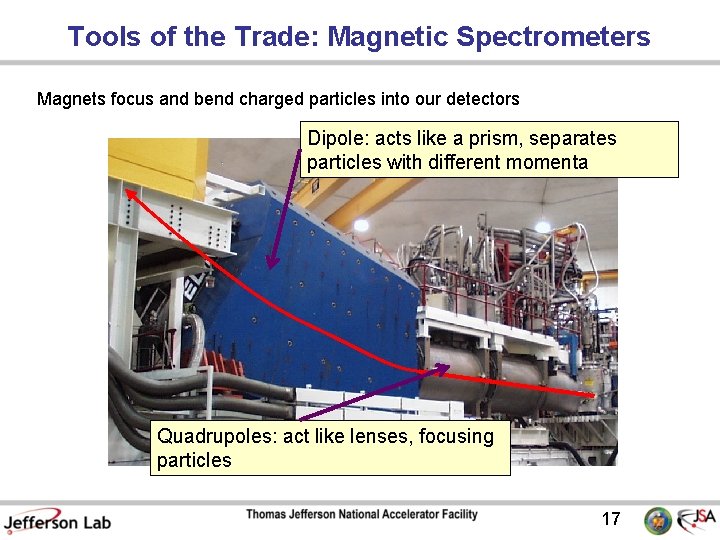
Tools of the Trade: Magnetic Spectrometers Magnets focus and bend charged particles into our detectors Dipole: acts like a prism, separates particles with different momenta Quadrupoles: act like lenses, focusing particles 17
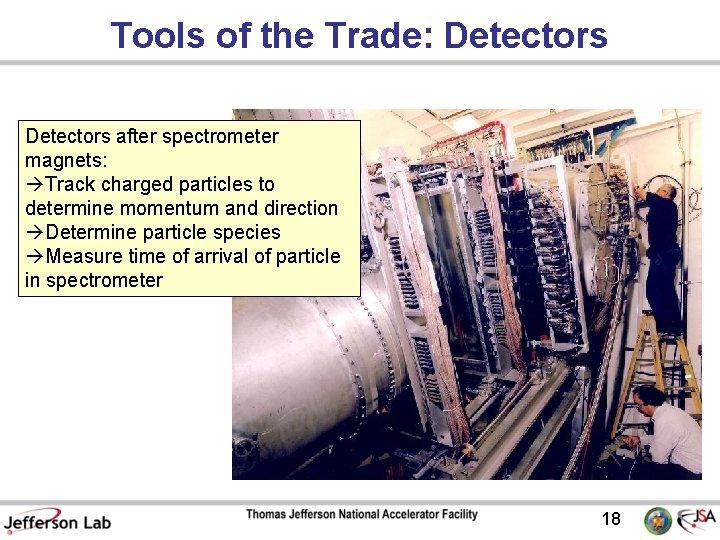
Tools of the Trade: Detectors after spectrometer magnets: Track charged particles to determine momentum and direction Determine particle species Measure time of arrival of particle in spectrometer 18
Jefferson Lab’s Original Mission Statement • Key Mission and Principal Focus (1987): – The study of the largely unexplored transition between the nucleon-meson and the quarkgluon descriptions of nuclear matter. The Role of Quarks in Nuclear Physics • We can describe nuclei, for the most part just using protons, neutrons, and other exchange particles: does there come a point at which we must describe in terms of quarks and gluons? – If not, why not? 19
Related Topics • Do individual nucleons change their size, shape, and quark structure in the nuclear medium? • How do quarks and gluons come together to determine the structure of the proton? – What is the distribution of charge and magnetism in the nucleon? – How is the spin of the proton built up from quarks and gluons? • What are the properties of the strong force (“QCD”) in the regime where quarks are confined? 20
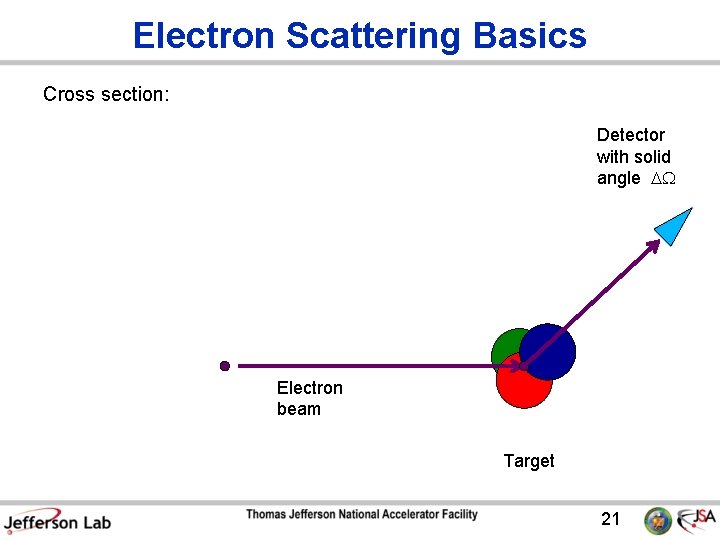
Electron Scattering Basics Cross section: Detector with solid angle W Electron beam Target 21
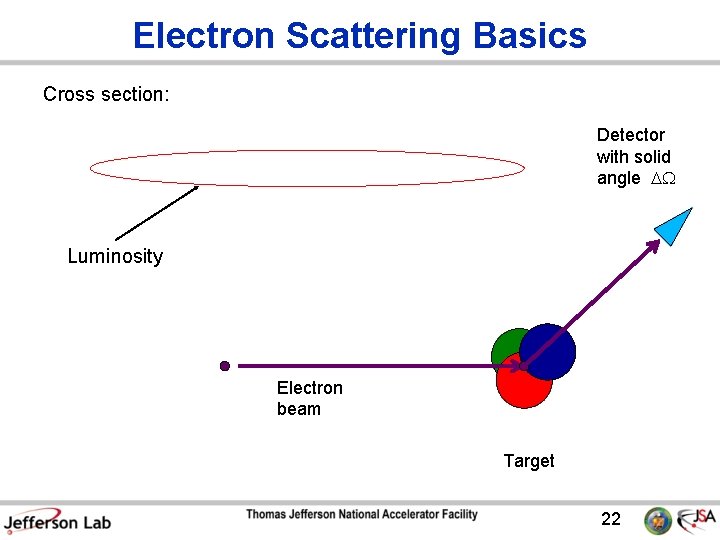
Electron Scattering Basics Cross section: Detector with solid angle W Luminosity Electron beam Target 22
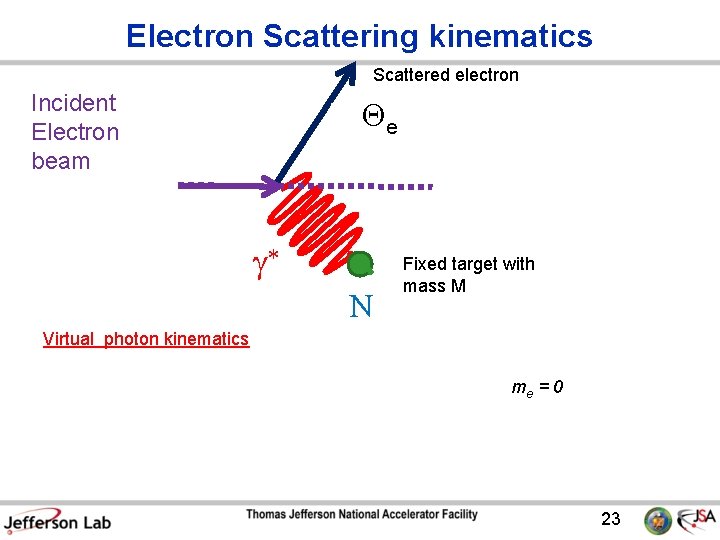
Electron Scattering kinematics Scattered electron Incident Electron beam Qe g* N Fixed target with mass M Virtual photon kinematics me = 0 23
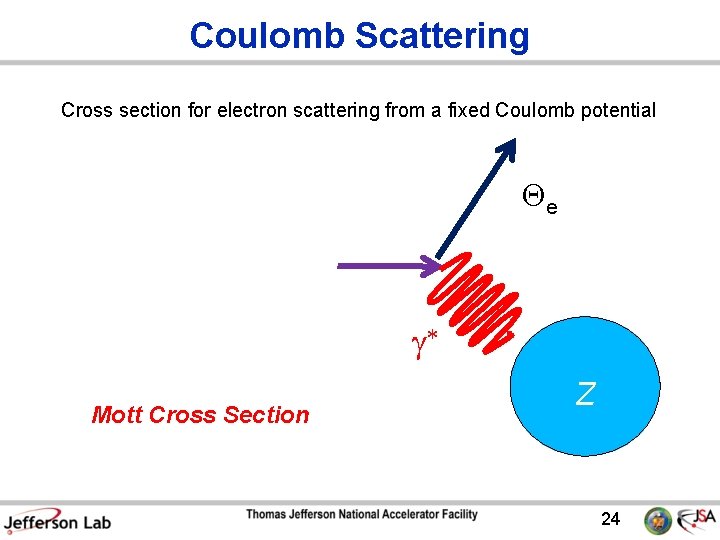
Coulomb Scattering Cross section for electron scattering from a fixed Coulomb potential Qe g* Mott Cross Section Z 24
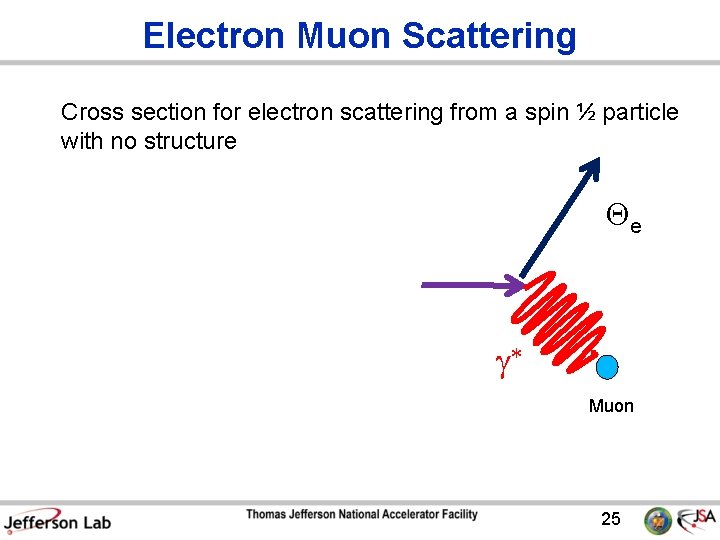
Electron Muon Scattering Cross section for electron scattering from a spin ½ particle with no structure Qe g* Muon 25
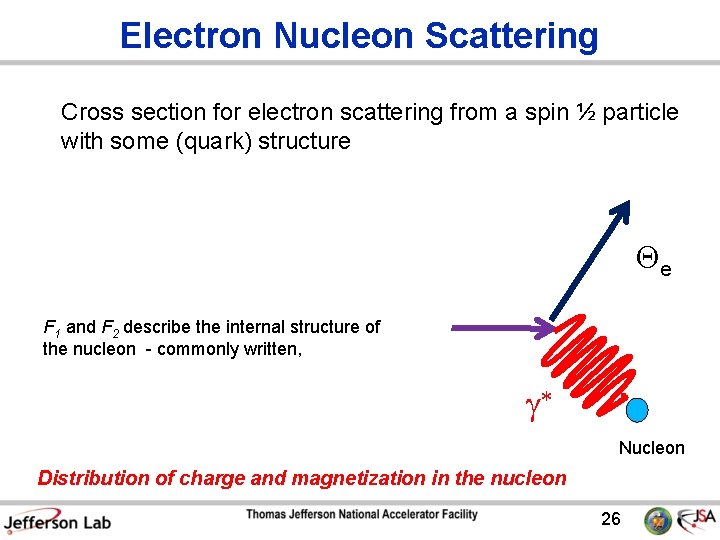
Electron Nucleon Scattering Cross section for electron scattering from a spin ½ particle with some (quark) structure Qe F 1 and F 2 describe the internal structure of the nucleon - commonly written, g* Nucleon Distribution of charge and magnetization in the nucleon 26
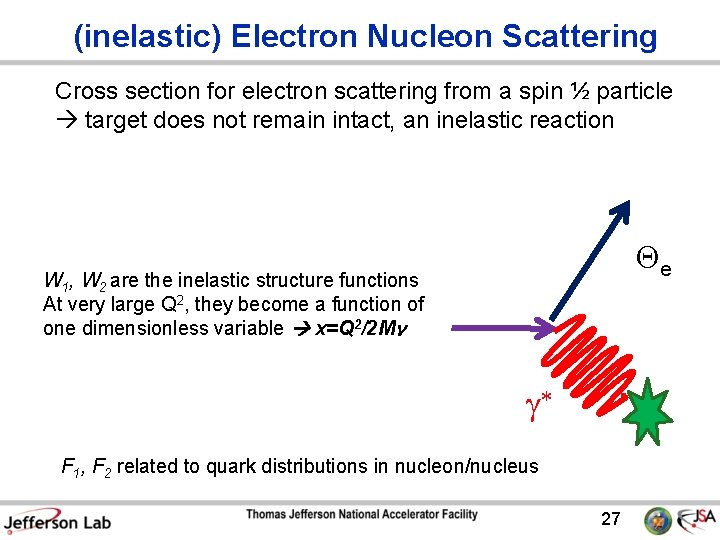
(inelastic) Electron Nucleon Scattering Cross section for electron scattering from a spin ½ particle target does not remain intact, an inelastic reaction Qe W 1, W 2 are the inelastic structure functions At very large Q 2, they become a function of one dimensionless variable x=Q 2/2 Mn g* F 1, F 2 related to quark distributions in nucleon/nucleus 27
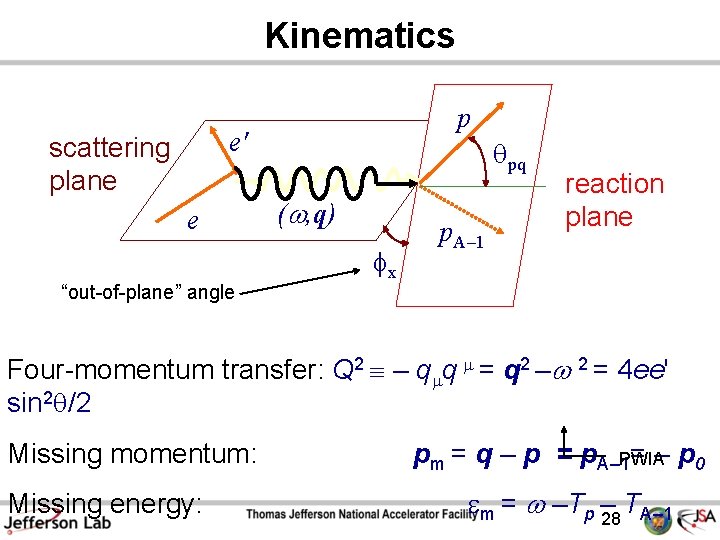
Kinematics p e' scattering plane e “out-of-plane” angle pq ( , q) x p. A– 1 reaction plane Four-momentum transfer: Q 2 – q q = q 2 – 2 = 4 ee' sin 2 /2 Missing momentum: Missing energy: pm = q – p = p. A– 1 PWIA = – p 0 m = –Tp – T 28 A– 1
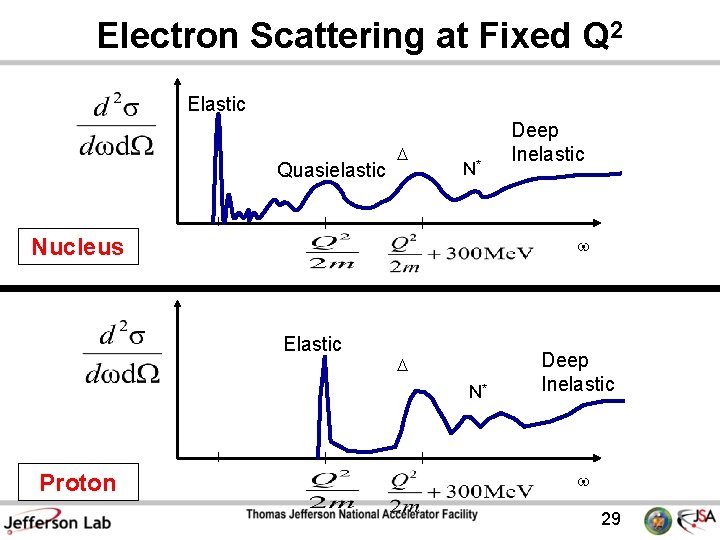
Electron Scattering at Fixed Q 2 Elastic Quasielastic N* Nucleus Elastic N* Proton Deep Inelastic 29
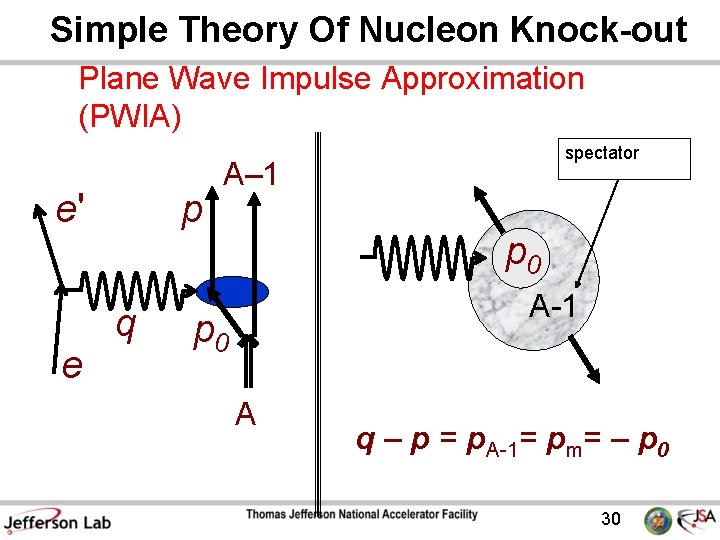
Simple Theory Of Nucleon Knock-out Plane Wave Impulse Approximation (PWIA) e' e p q spectator A– 1 p 0 A-1 p 0 A q – p = p. A-1= pm= – p 0 30
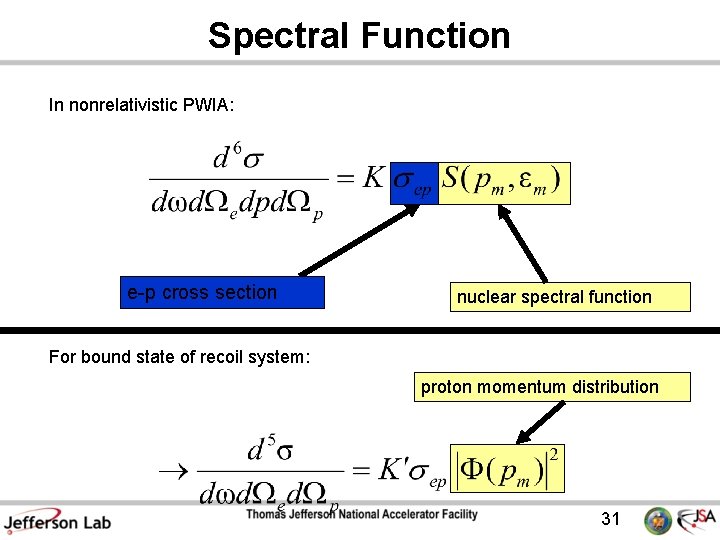
Spectral Function In nonrelativistic PWIA: e-p cross section nuclear spectral function For bound state of recoil system: proton momentum distribution 31
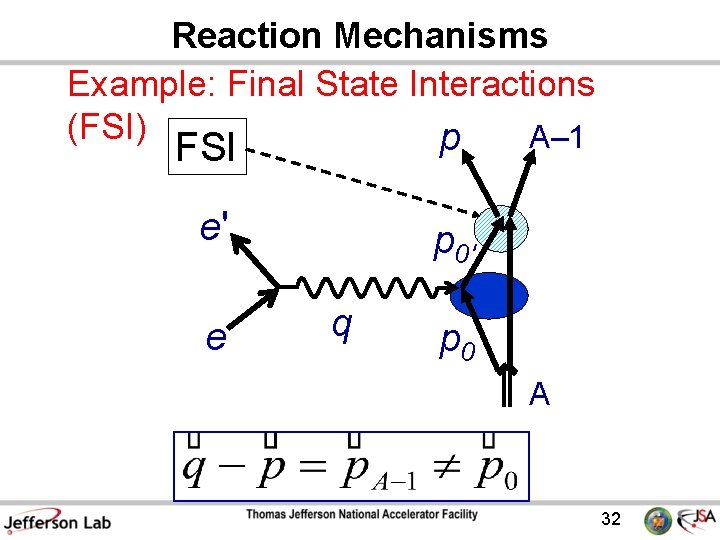
Reaction Mechanisms Example: Final State Interactions (FSI) A– 1 p FSI e' e p 0' q p 0 A 32
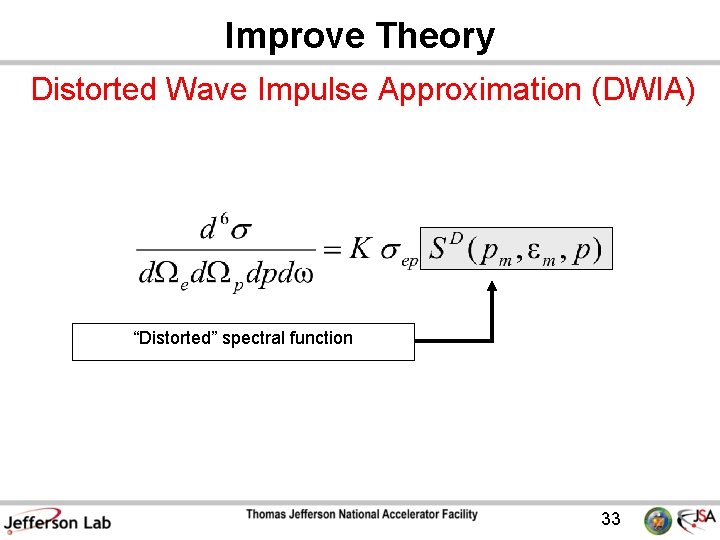
Improve Theory Distorted Wave Impulse Approximation (DWIA) “Distorted” spectral function 33
1 p knockout from 12 C(e, e'p)11 B (pm) [(Me. V/c) 3] DWIA calculations give correct shapes, but: Missing strength observed. NIKHEF pm [Me. V/c] G. van der Steenhoven, et al. , Nucl. Phys. A 480, 547 (1988). 34
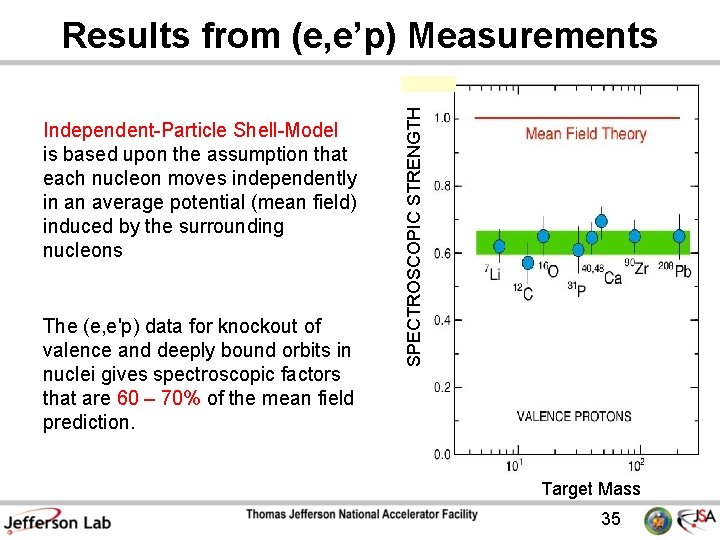
Independent-Particle Shell-Model is based upon the assumption that each nucleon moves independently in an average potential (mean field) induced by the surrounding nucleons The (e, e'p) data for knockout of valence and deeply bound orbits in nuclei gives spectroscopic factors that are 60 – 70% of the mean field prediction. SPECTROSCOPIC STRENGTH Results from (e, e’p) Measurements Target Mass 35
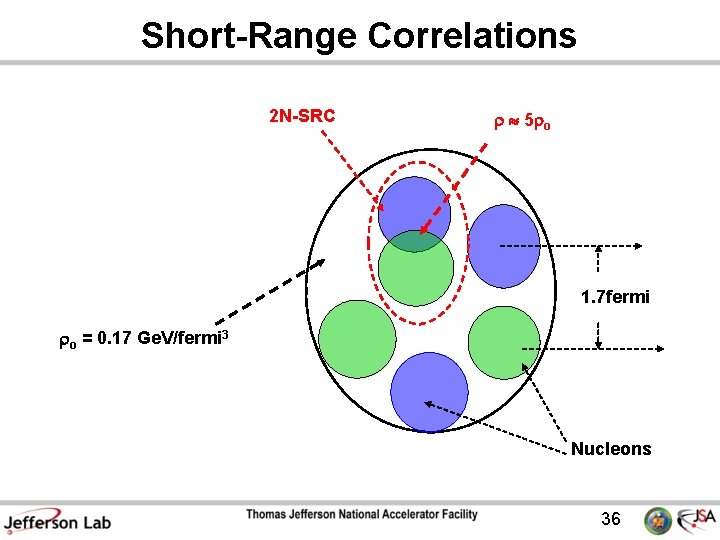
Short-Range Correlations 2 N-SRC 5 o 1. 7 fermi o = 0. 17 Ge. V/fermi 3 Nucleons 36
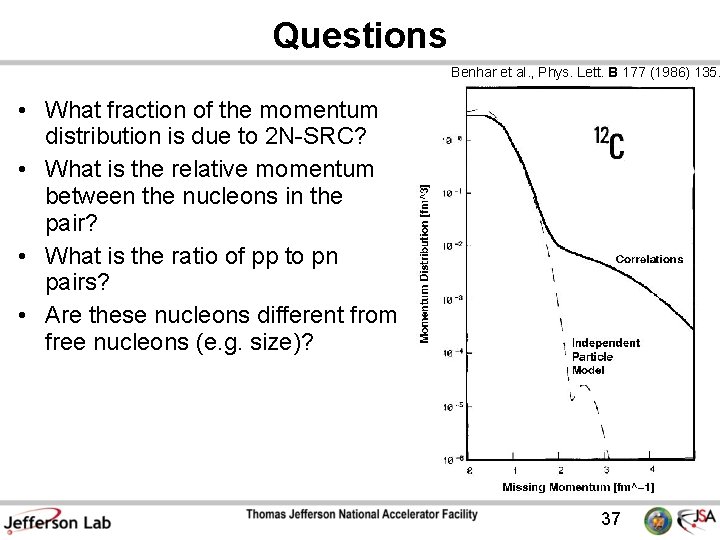
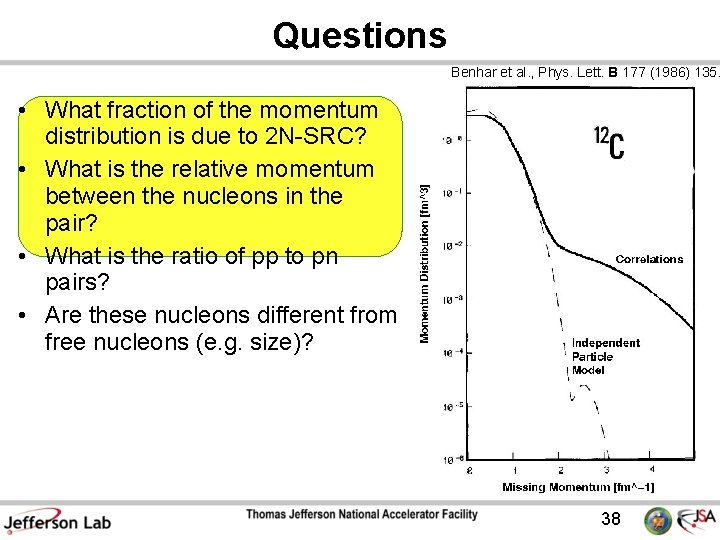
Questions Benhar et al. , Phys. Lett. B 177 (1986) 135. • What fraction of the momentum distribution is due to 2 N-SRC? • What is the relative momentum between the nucleons in the pair? • What is the ratio of pp to pn pairs? • Are these nucleons different from free nucleons (e. g. size)? 37
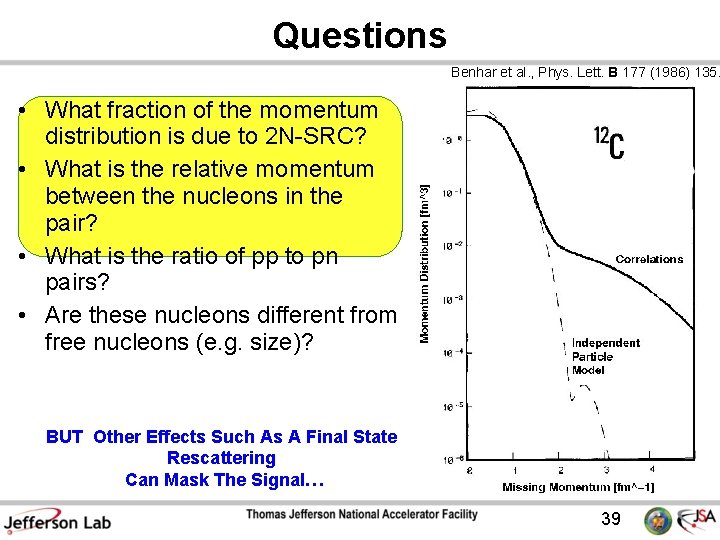
Questions Benhar et al. , Phys. Lett. B 177 (1986) 135. • What fraction of the momentum distribution is due to 2 N-SRC? • What is the relative momentum between the nucleons in the pair? • What is the ratio of pp to pn pairs? • Are these nucleons different from free nucleons (e. g. size)? 38
Questions Benhar et al. , Phys. Lett. B 177 (1986) 135. • What fraction of the momentum distribution is due to 2 N-SRC? • What is the relative momentum between the nucleons in the pair? • What is the ratio of pp to pn pairs? • Are these nucleons different from free nucleons (e. g. size)? BUT Other Effects Such As A Final State Rescattering Can Mask The Signal… 39
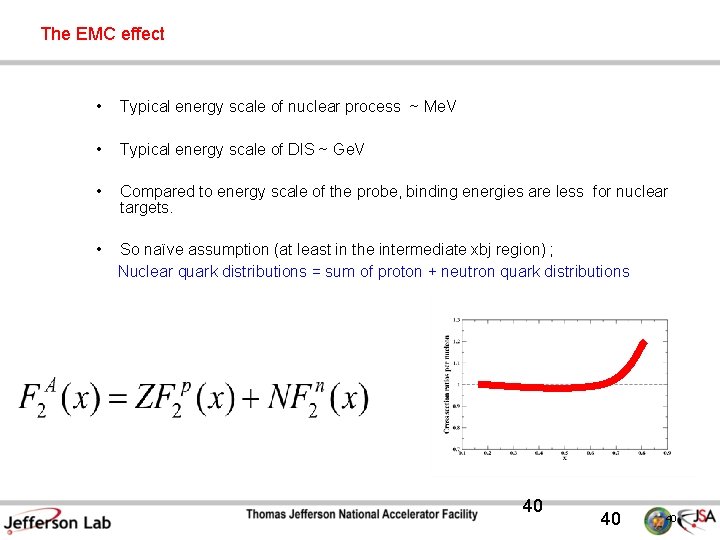
The EMC effect • Typical energy scale of nuclear process ~ Me. V • Typical energy scale of DIS ~ Ge. V • Compared to energy scale of the probe, binding energies are less for nuclear targets. • So naïve assumption (at least in the intermediate xbj region) ; Nuclear quark distributions = sum of proton + neutron quark distributions 40 40 40
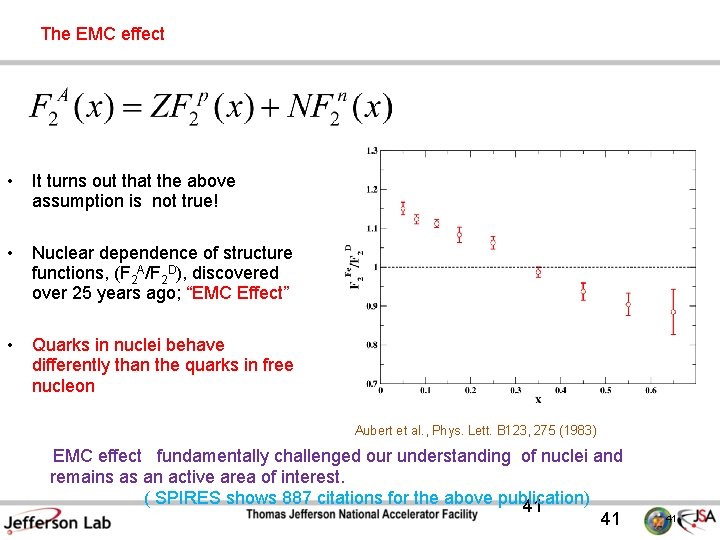
The EMC effect • It turns out that the above assumption is not true! • Nuclear dependence of structure functions, (F 2 A/F 2 D), discovered over 25 years ago; “EMC Effect” • Quarks in nuclei behave differently than the quarks in free nucleon Aubert et al. , Phys. Lett. B 123, 275 (1983) EMC effect fundamentally challenged our understanding of nuclei and remains as an active area of interest. ( SPIRES shows 887 citations for the above publication) 41 41 41
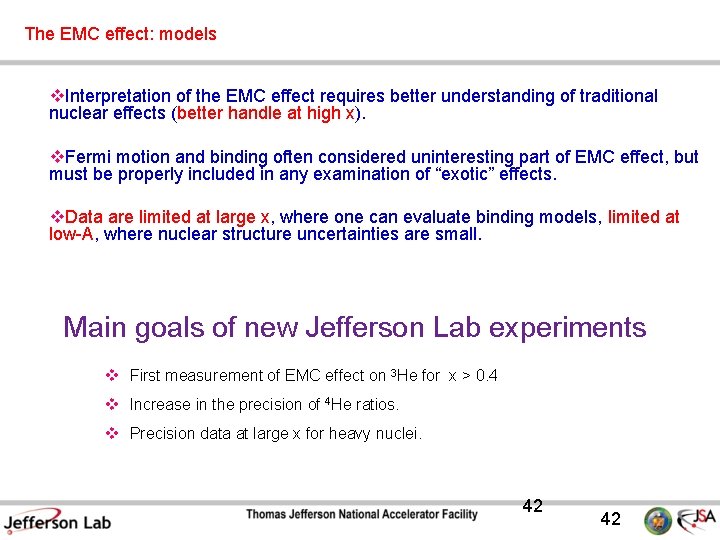
The EMC effect: models v. Interpretation of the EMC effect requires better understanding of traditional nuclear effects (better handle at high x). v. Fermi motion and binding often considered uninteresting part of EMC effect, but must be properly included in any examination of “exotic” effects. v. Data are limited at large x, where one can evaluate binding models, limited at low-A, where nuclear structure uncertainties are small. Main goals of new Jefferson Lab experiments v First measurement of EMC effect on 3 He for x > 0. 4 v Increase in the precision of 4 He ratios. v Precision data at large x for heavy nuclei. 42 42
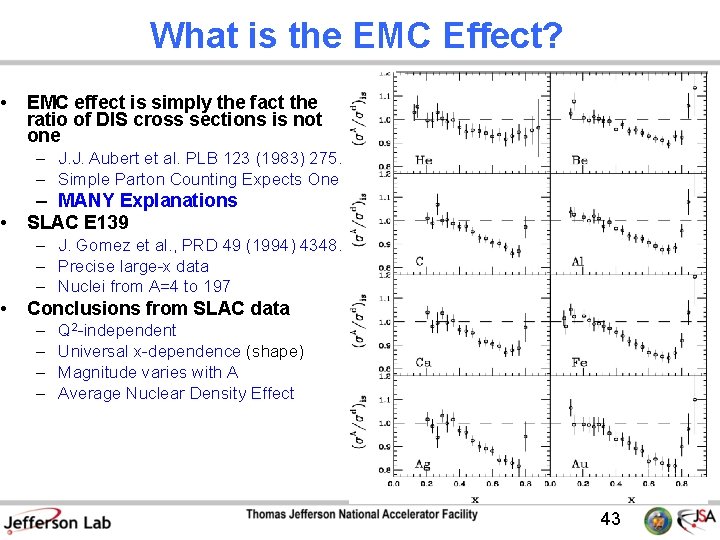
• • • What is the EMC Effect? EMC effect is simply the fact the ratio of DIS cross sections is not one – J. J. Aubert et al. PLB 123 (1983) 275. – Simple Parton Counting Expects One – MANY Explanations SLAC E 139 – J. Gomez et al. , PRD 49 (1994) 4348. – Precise large-x data – Nuclei from A=4 to 197 Conclusions from SLAC data – – Q 2 -independent Universal x-dependence (shape) Magnitude varies with A Average Nuclear Density Effect 43
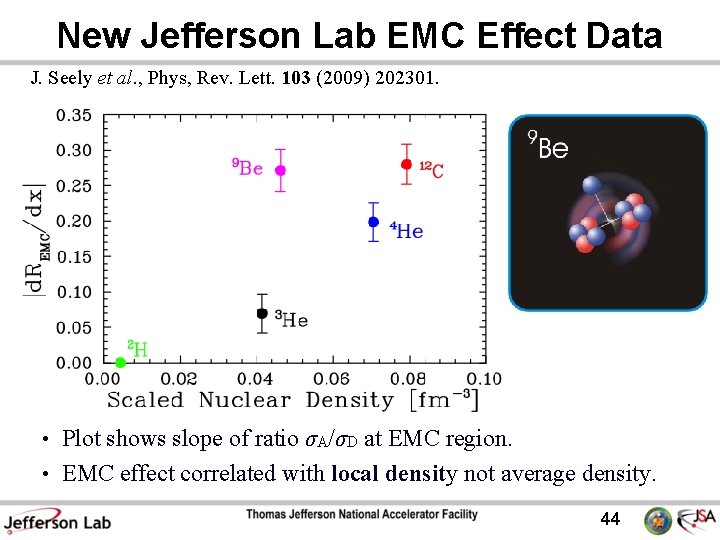
New Jefferson Lab EMC Effect Data J. Seely et al. , Phys, Rev. Lett. 103 (2009) 202301. Plot shows slope of ratio σA/σD at EMC region. • EMC effect correlated with local density not average density. • 44
If the EMC effect is a local density effect, then it seems reasonable to look for connections to other local density effects.