
Nuclear Medicine Physics Radioactivity and Radioactive Decay Radionuclide
- Slides: 48
Nuclear Medicine Physics • • Radioactivity and Radioactive Decay Radionuclide Production Jerry Allison, Ph. D. Department of Radiology and Imaging Medical College of Georgia
A note of thanks to Z. J. Cao, Ph. D. Medical College of Georgia And Sameer Tipnis, Ph. D. G. Donald Frey, Ph. D. Medical University of South Carolina for Sharing nuclear medicine presentation content
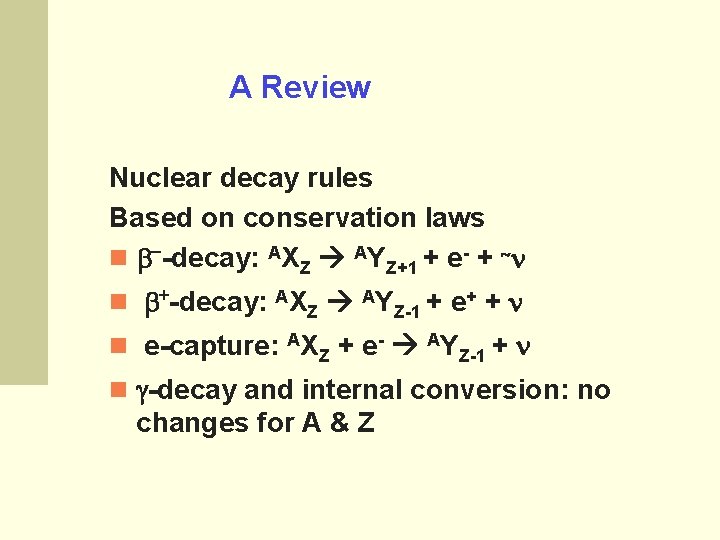
A Review Nuclear decay rules Based on conservation laws -decay: AXZ AYZ+1 + e- + ~ -decay: AXZ AYZ-1 + e+ + e-capture: AXZ + e- AYZ-1 + -decay and internal conversion: no changes for A & Z
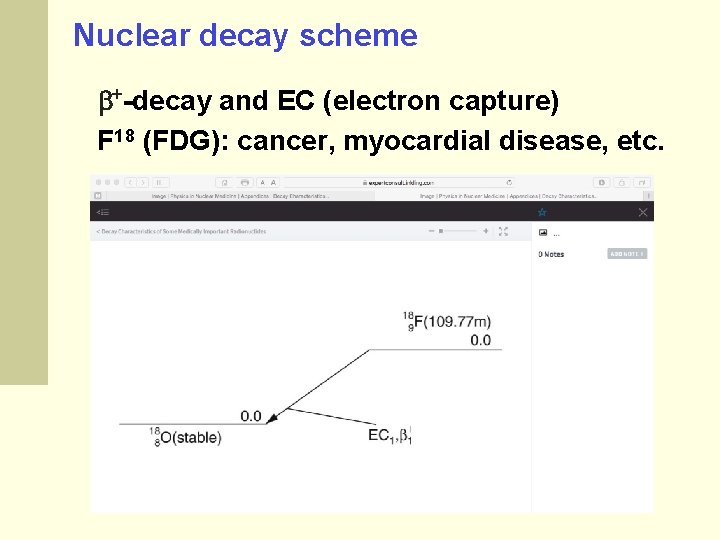
Nuclear decay scheme -decay and EC (electron capture) F 18 (FDG): cancer, myocardial disease, etc.
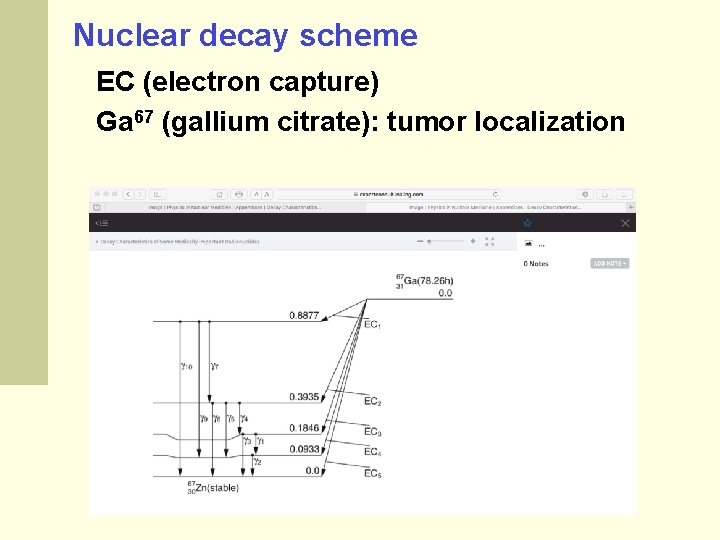
Nuclear decay scheme EC (electron capture) Ga 67 (gallium citrate): tumor localization
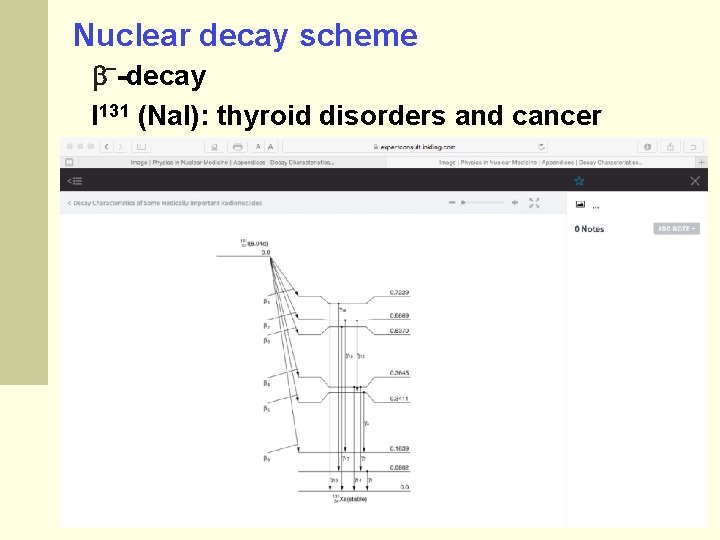
Nuclear decay scheme -decay I 131 (Na. I): thyroid disorders and cancer
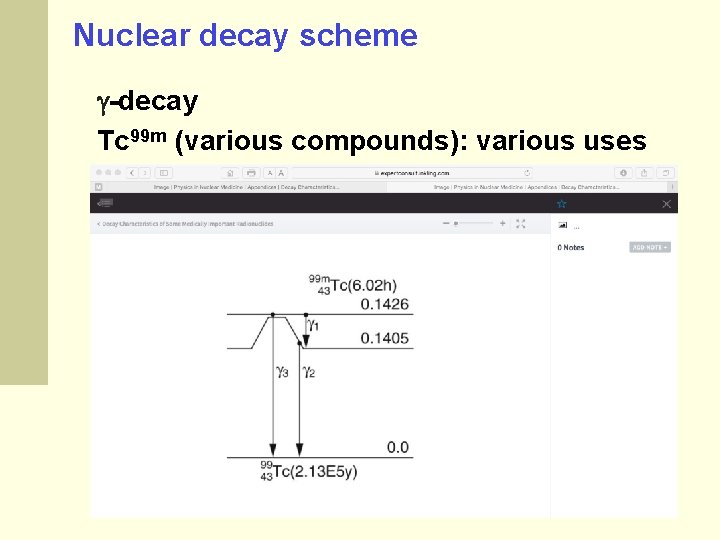
Nuclear decay scheme -decay Tc 99 m (various compounds): various uses
Following and decay and Electron Capture -ray emission or internal conversion follows if the child nucleus is in an excited state Any resultant electron vacancies are resolved through emission of characteristic X-rays and/or Auger electrons (radiation dose with no imaging benefit)
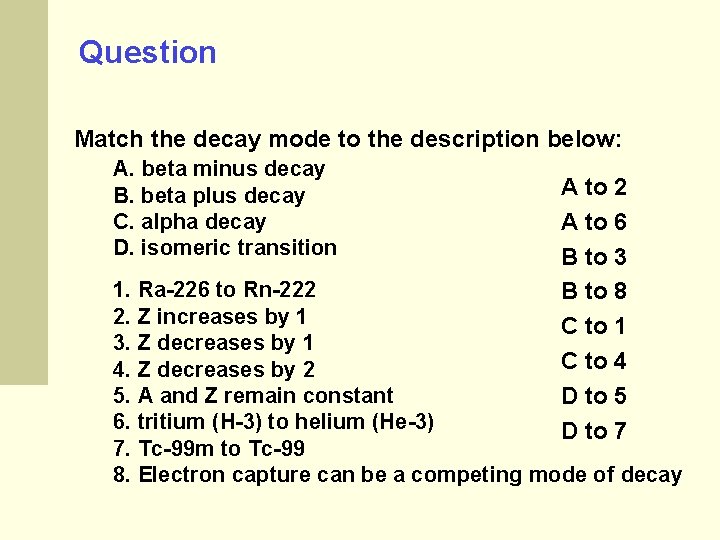
Question Match the decay mode to the description below: A. beta minus decay B. beta plus decay C. alpha decay D. isomeric transition A to 2 A to 6 B to 3 B to 8 C to 1 C to 4 D to 5 D to 7 1. Ra-226 to Rn-222 2. Z increases by 1 3. Z decreases by 1 4. Z decreases by 2 5. A and Z remain constant 6. tritium (H-3) to helium (He-3) 7. Tc-99 m to Tc-99 8. Electron capture can be a competing mode of decay
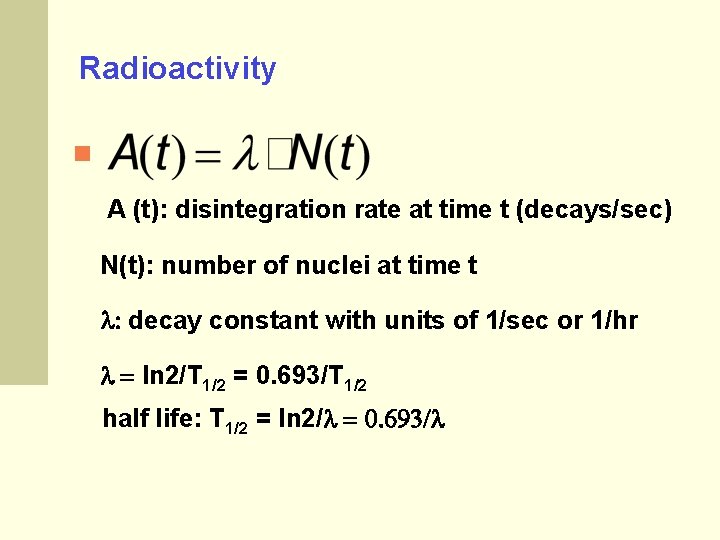
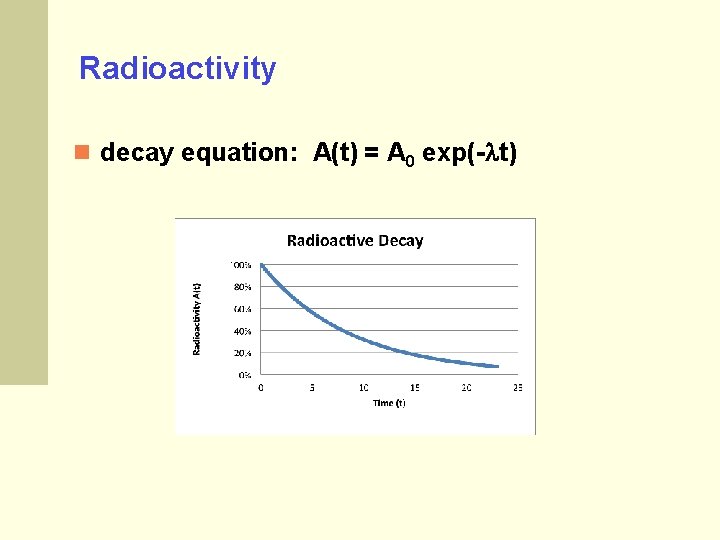
Radioactivity A (t): disintegration rate at time t (decays/sec) N(t): number of nuclei at time t : decay constant with units of 1/sec or 1/hr = ln 2/T 1/2 = 0. 693/T 1/2 half life: T 1/2 = ln 2/ = 0. 693/
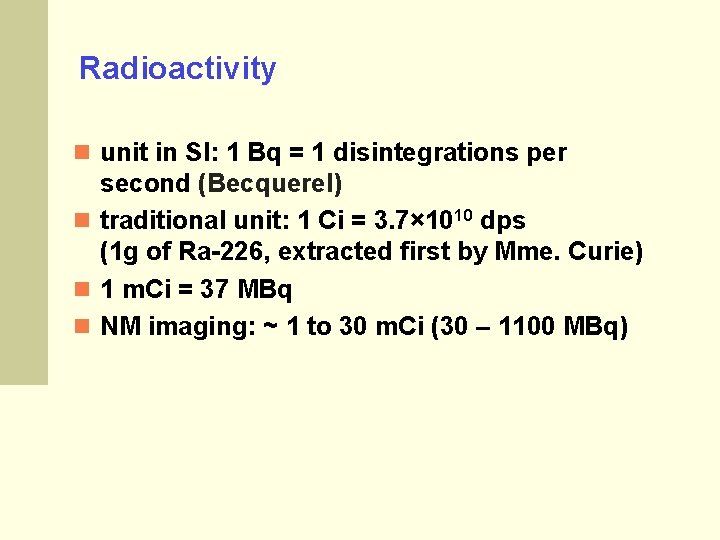
Radioactivity unit in SI: 1 Bq = 1 disintegrations per second (Becquerel) traditional unit: 1 Ci = 3. 7× 10¹⁰ dps (1 g of Ra-226, extracted first by Mme. Curie) 1 m. Ci = 37 MBq NM imaging: ~ 1 to 30 m. Ci (30 – 1100 MBq)
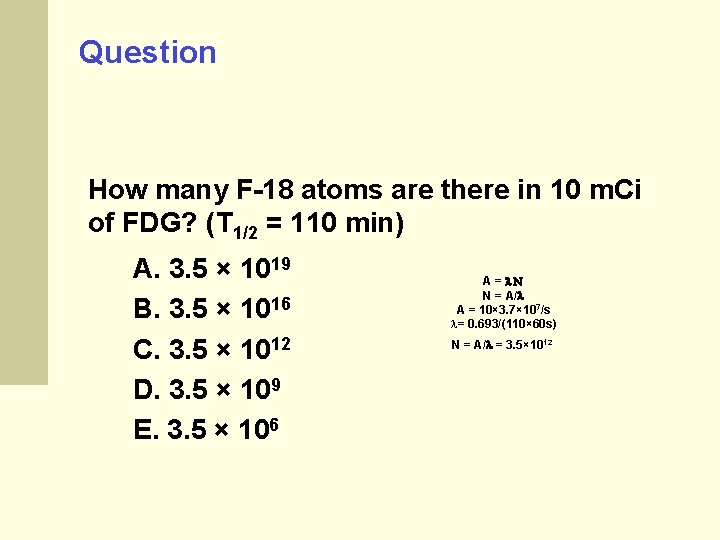
Question How many F-18 atoms are there in 10 m. Ci of FDG? (T 1/2 = 110 min) A. 3. 5 × 10¹⁹ B. 3. 5 × 10¹⁶ C. 3. 5 × 10¹² D. 3. 5 × 10⁹ E. 3. 5 × 10⁶ A = N N = A/ A = 10× 3. 7× 10⁷/s = 0. 693/(110× 60 s) N = A/ = 3. 5× 10¹²
Radioactivity decay equation: A(t) = A 0 exp(- t)
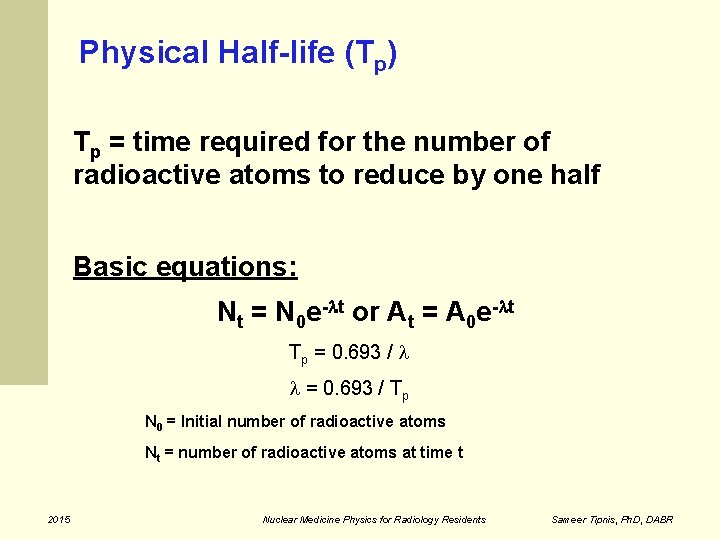
Physical Half-life (Tp) Tp = time required for the number of radioactive atoms to reduce by one half Basic equations: Nt = N 0 e- t or At = A 0 e- t Tp = 0. 693 / Tp N 0 = Initial number of radioactive atoms Nt = number of radioactive atoms at time t 2015 Nuclear Medicine Physics for Radiology Residents Sameer Tipnis, Ph. D, DABR
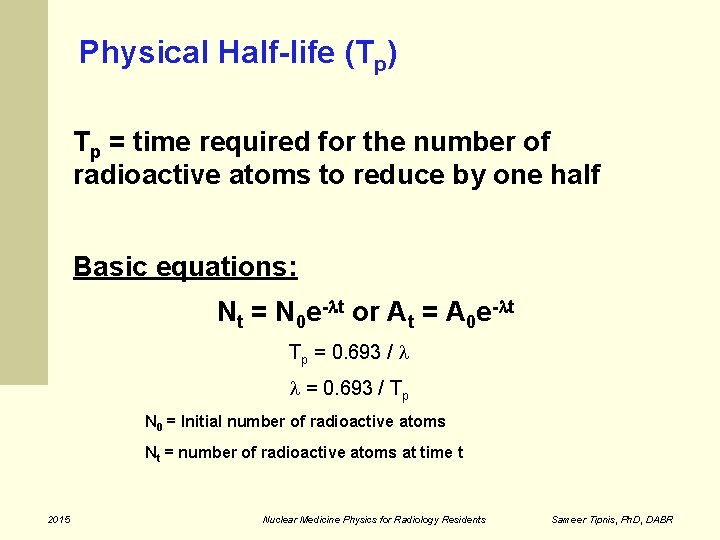
Physical Half-life (Tp) Tp = time required for the number of radioactive atoms to reduce by one half Basic equations: Nt = N 0 e- t or At = A 0 e- t Tp = 0. 693 / Tp N 0 = Initial number of radioactive atoms Nt = number of radioactive atoms at time t 2015 Nuclear Medicine Physics for Radiology Residents Sameer Tipnis, Ph. D, DABR
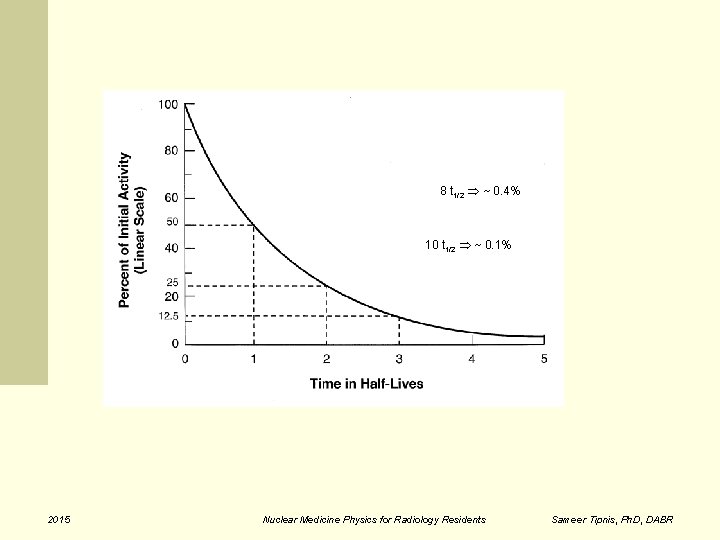
8 t 1/2 ~ 0. 4% 10 t 1/2 ~ 0. 1% 2015 Nuclear Medicine Physics for Radiology Residents Sameer Tipnis, Ph. D, DABR
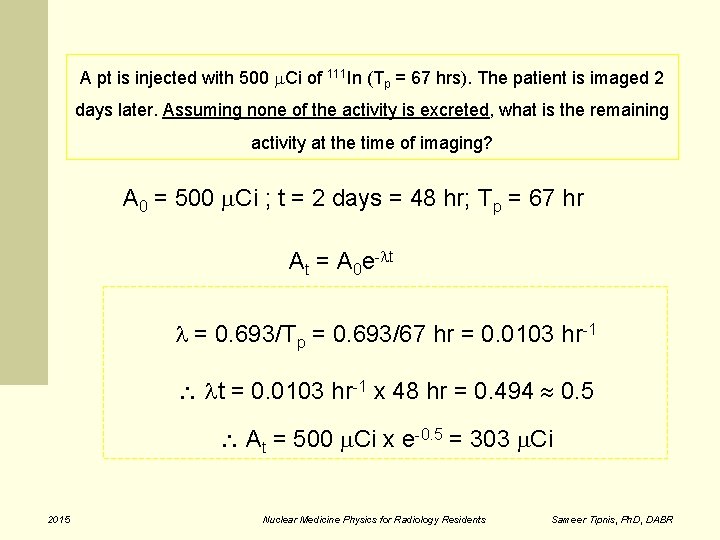
A pt is injected with 500 Ci of 111 In (Tp = 67 hrs). The patient is imaged 2 days later. Assuming none of the activity is excreted, what is the remaining activity at the time of imaging? A 0 = 500 Ci ; t = 2 days = 48 hr; Tp = 67 hr At = A 0 e- t = 0. 693/Tp = 0. 693/67 hr = 0. 0103 hr-1 t = 0. 0103 hr-1 x 48 hr = 0. 494 0. 5 At = 500 Ci x e-0. 5 = 303 Ci 2015 Nuclear Medicine Physics for Radiology Residents Sameer Tipnis, Ph. D, DABR
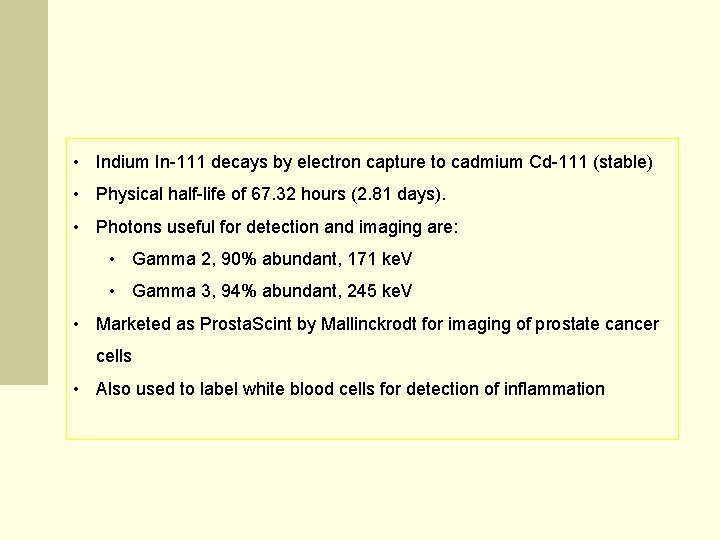
• Indium In-111 decays by electron capture to cadmium Cd-111 (stable) • Physical half-life of 67. 32 hours (2. 81 days). • Photons useful for detection and imaging are: • Gamma 2, 90% abundant, 171 ke. V • Gamma 3, 94% abundant, 245 ke. V • Marketed as Prosta. Scint by Mallinckrodt for imaging of prostate cancer cells • Also used to label white blood cells for detection of inflammation
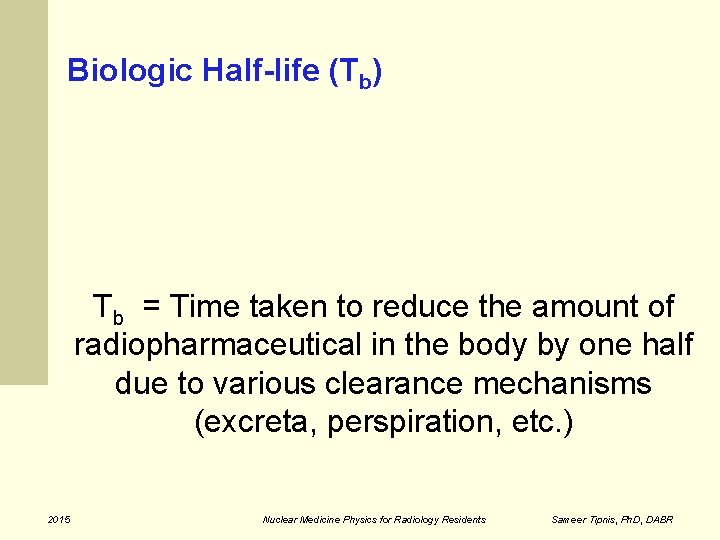
Biologic Half-life (Tb) Tb = Time taken to reduce the amount of radiopharmaceutical in the body by one half due to various clearance mechanisms (excreta, perspiration, etc. ) 2015 Nuclear Medicine Physics for Radiology Residents Sameer Tipnis, Ph. D, DABR
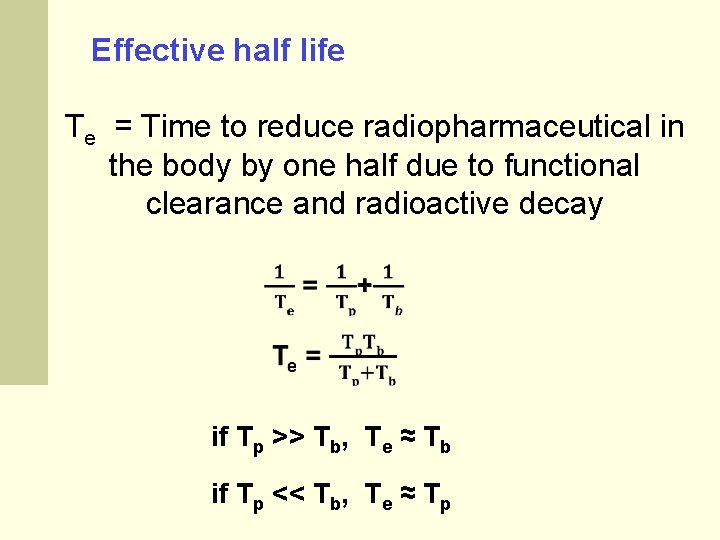
Effective half life Te = Time to reduce radiopharmaceutical in the body by one half due to functional clearance and radioactive decay if Tp >> Tb, Te ≈ Tb if Tp << Tb, Te ≈ Tp
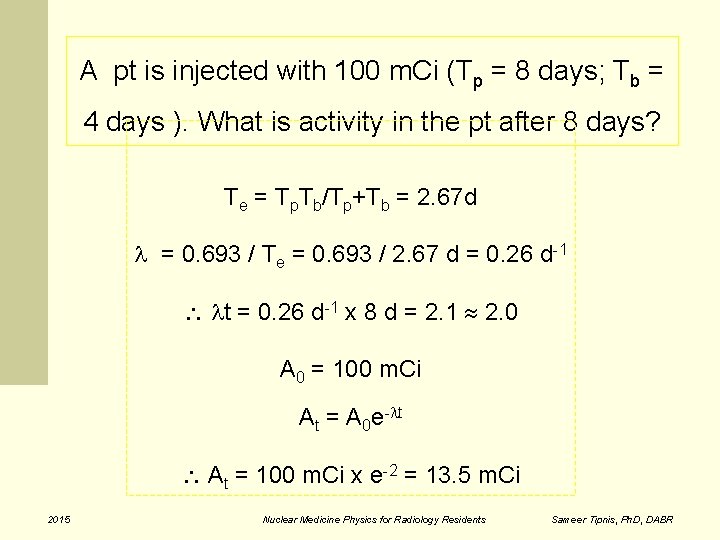
A pt is injected with 100 m. Ci (Tp = 8 days; Tb = 4 days ). What is activity in the pt after 8 days? Te = Tp. Tb/Tp+Tb = 2. 67 d = 0. 693 / Te = 0. 693 / 2. 67 d = 0. 26 d-1 t = 0. 26 d-1 x 8 d = 2. 1 2. 0 A 0 = 100 m. Ci At = A 0 e- t At = 100 m. Ci x e-2 = 13. 5 m. Ci 2015 Nuclear Medicine Physics for Radiology Residents Sameer Tipnis, Ph. D, DABR
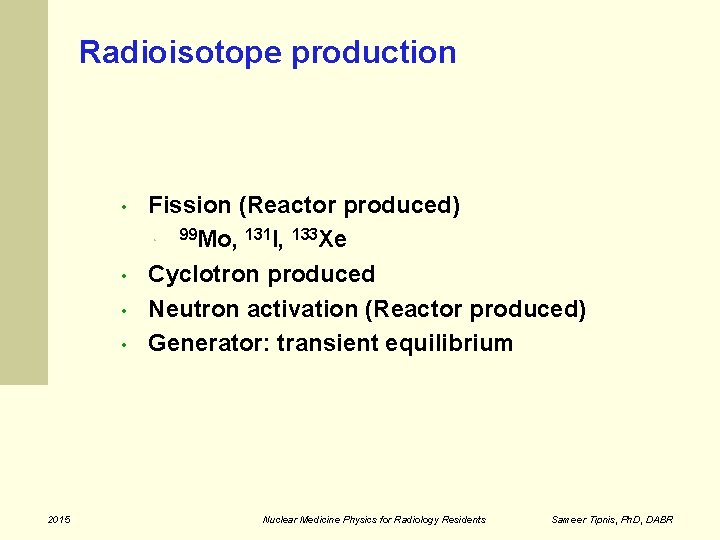
Radioisotope production • Fission (Reactor produced) 99 Mo, 131 I, 133 Xe Cyclotron produced Neutron activation (Reactor produced) Generator: transient equilibrium • • 2015 Nuclear Medicine Physics for Radiology Residents Sameer Tipnis, Ph. D, DABR
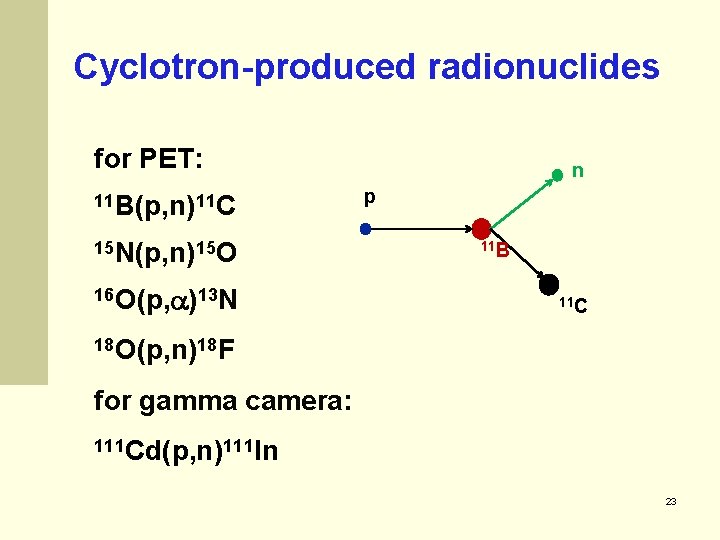
Cyclotron-produced radionuclides for PET: 11 B(p, n)11 C 15 N(p, n)15 O 16 O(p, a)13 N n p 11 B 11 C 18 O(p, n)18 F for gamma camera: 111 Cd(p, n)111 In 23
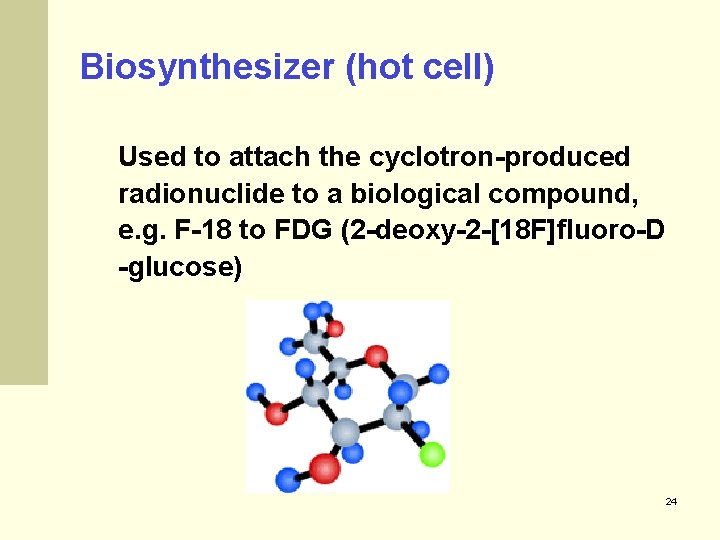
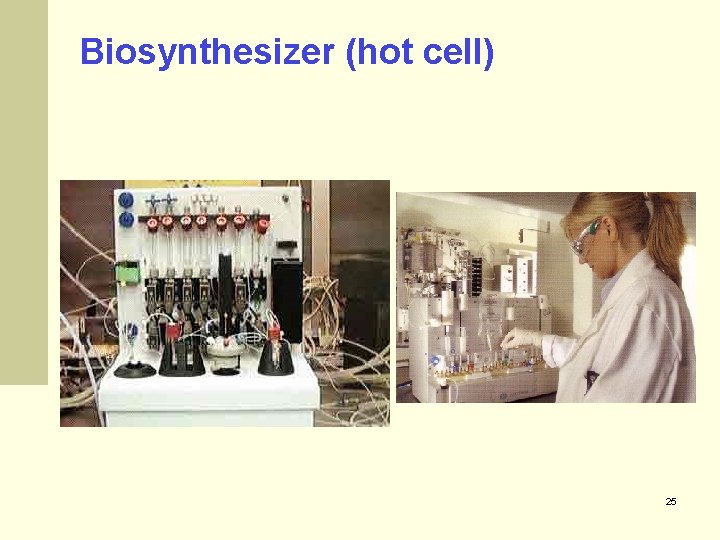
Biosynthesizer (hot cell) Used to attach the cyclotron-produced radionuclide to a biological compound, e. g. F-18 to FDG (2 -deoxy-2 -[18 F]fluoro-D -glucose) 24
Biosynthesizer (hot cell) 25
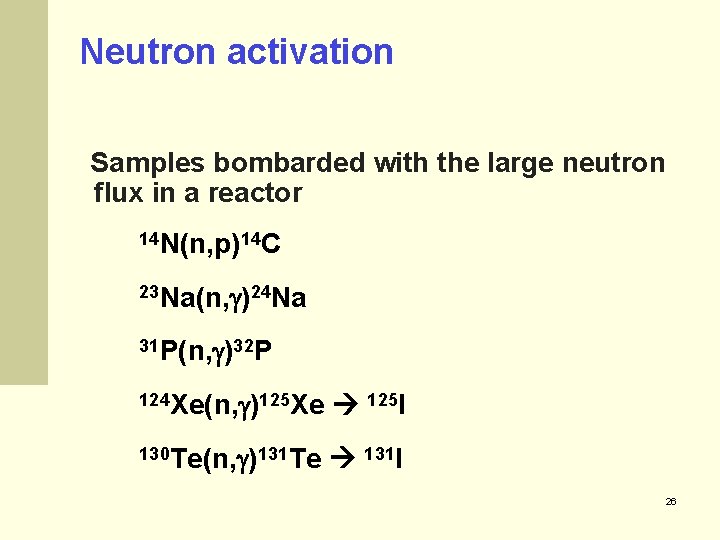
Neutron activation Samples bombarded with the large neutron flux in a reactor 14 N(n, p)14 C 23 Na(n, )24 Na 31 P(n, )32 P 124 Xe(n, )125 Xe 125 I 130 Te(n, )131 Te 131 I 26
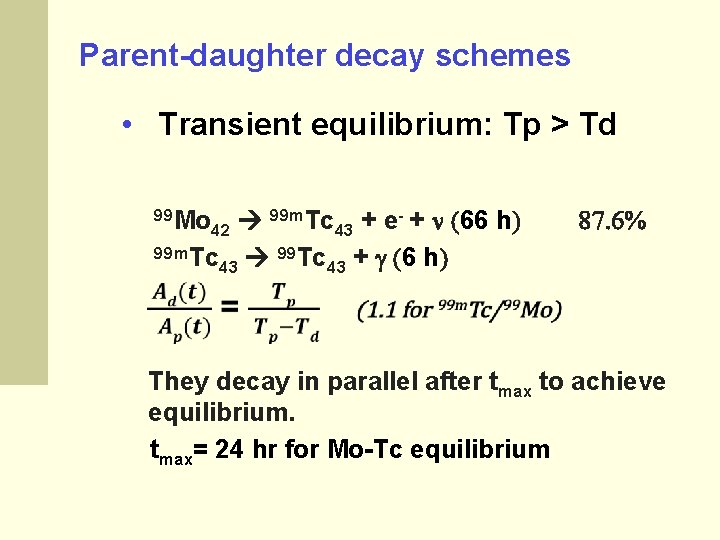
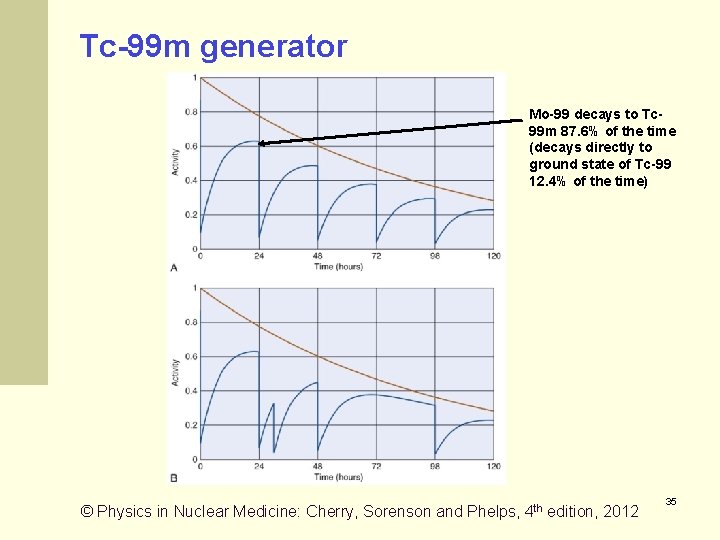
Parent-daughter decay schemes • Transient equilibrium: Tp > Td 99 m. Tc 43 + e- + 66 h 87. 6% 99 m. Tc 99 Tc 43 43 + 6 h 99 Mo 42 They decay in parallel after tmax to achieve equilibrium. tmax= 24 hr for Mo-Tc equilibrium
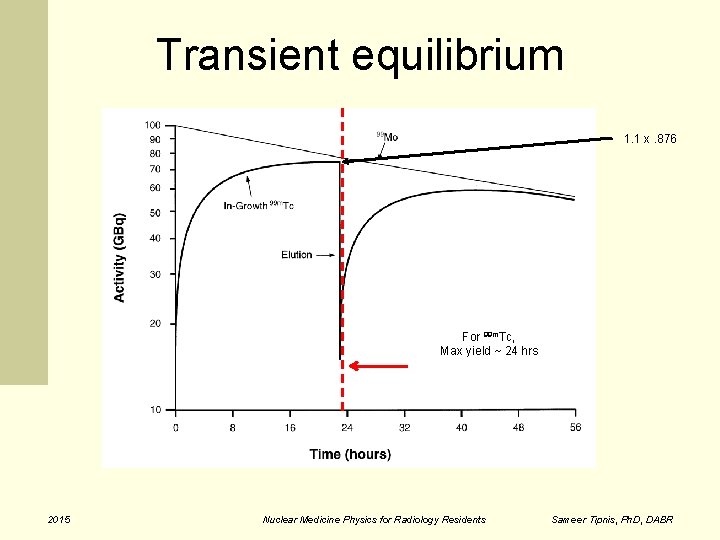
Transient equilibrium 1. 1 x. 876 For 99 m. Tc, Max yield ~ 24 hrs 2015 Nuclear Medicine Physics for Radiology Residents Sameer Tipnis, Ph. D, DABR
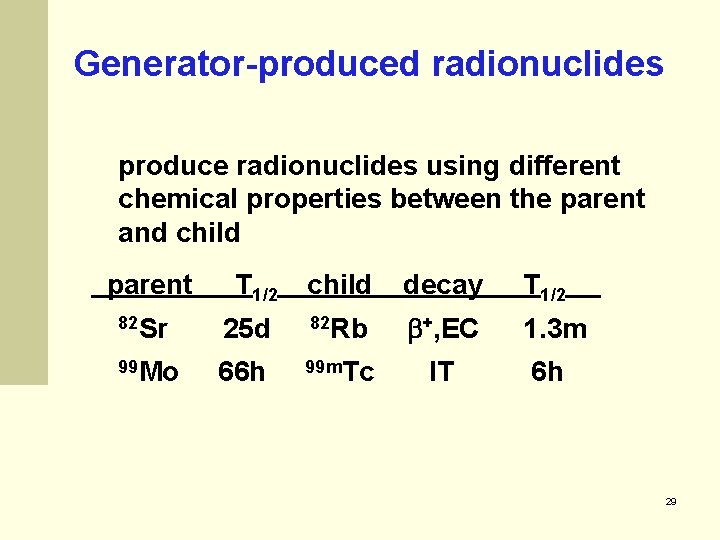
Generator-produced radionuclides produce radionuclides using different chemical properties between the parent and child parent T 1/2 child decay T 1/2 82 Sr 25 d 82 Rb +, EC 1. 3 m 99 Mo 66 h 99 m. Tc IT 6 h 29
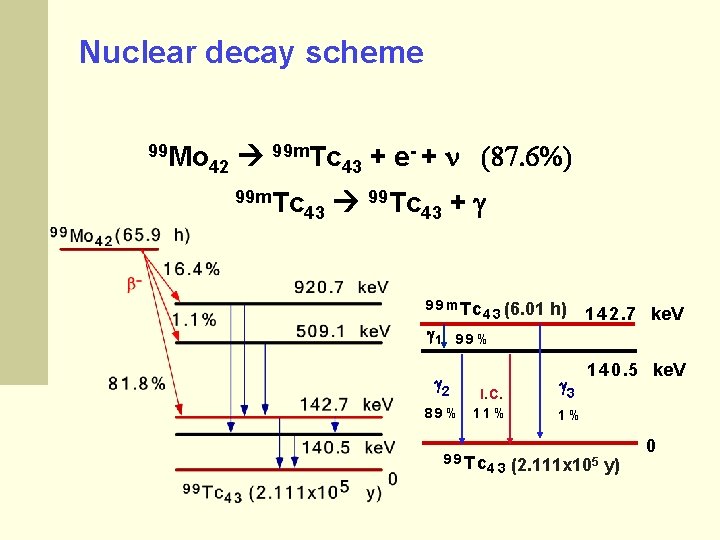
Nuclear decay scheme 99 Mo 99 m. Tc - + 87. 6% + e 42 43 99 m. Tc 99 Tc 43 43 + 9 9 m Tc 1 4 3 (6. 01 h) 1 4 2. 7 ke. V 99% 2 89% I. C. 11% 9 9 Tc 43 3 1 4 0. 5 ke. V 1% (2. 111 x 105 y) 0
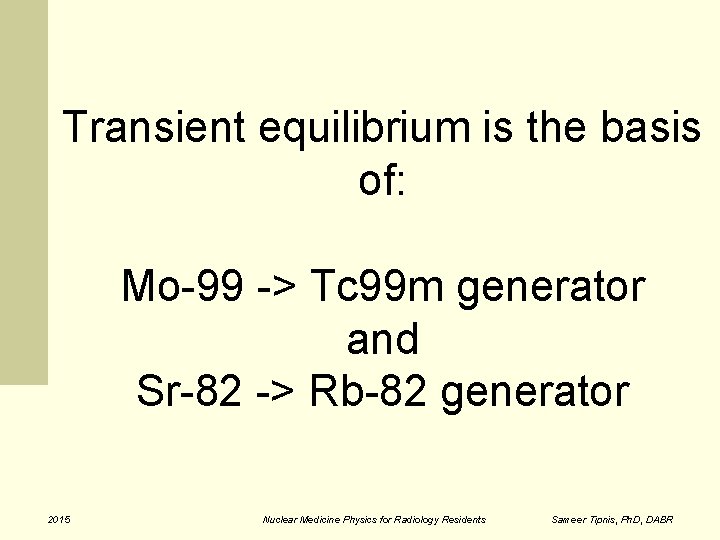
Transient equilibrium is the basis of: Mo-99 -> Tc 99 m generator and Sr-82 -> Rb-82 generator 2015 Nuclear Medicine Physics for Radiology Residents Sameer Tipnis, Ph. D, DABR
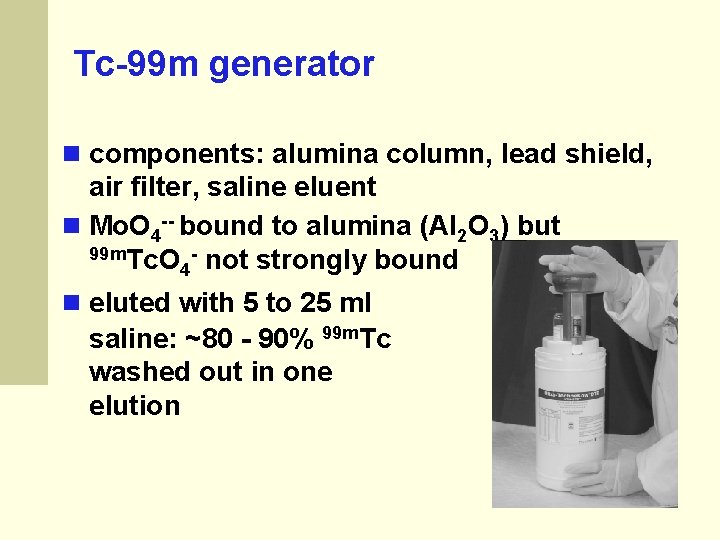
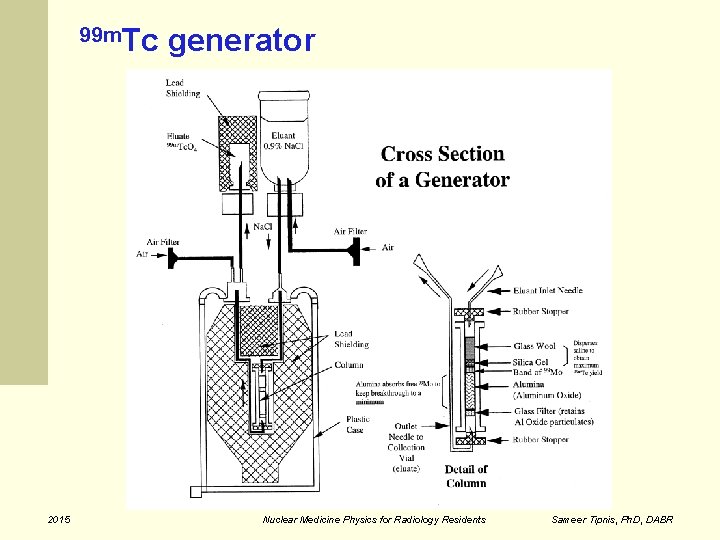
Tc-99 m generator components: alumina column, lead shield, air filter, saline eluent Mo. O 4 -- bound to alumina (Al 2 O 3) but 99 m. Tc. O - not strongly bound 4 eluted with 5 to 25 ml saline: ~80 - 90% 99 m. Tc washed out in one elution
99 m. Tc 2015 generator Nuclear Medicine Physics for Radiology Residents Sameer Tipnis, Ph. D, DABR
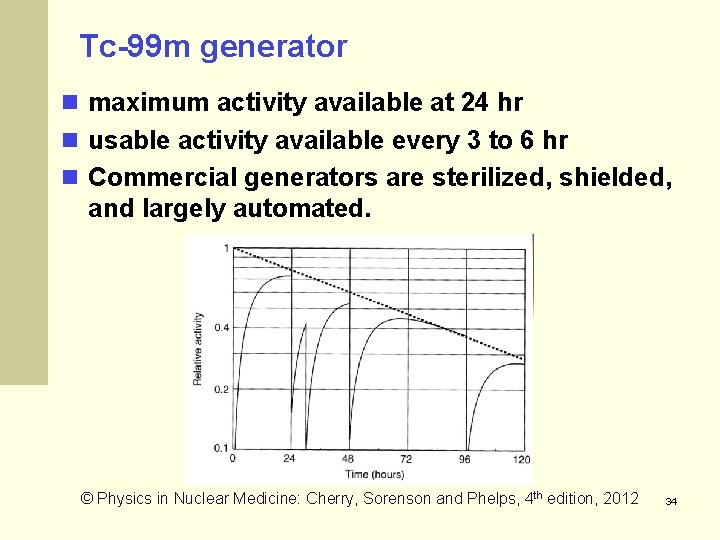
Tc-99 m generator maximum activity available at 24 hr usable activity available every 3 to 6 hr Commercial generators are sterilized, shielded, and largely automated. © Physics in Nuclear Medicine: Cherry, Sorenson and Phelps, 4 th edition, 2012 34
Tc-99 m generator Mo-99 decays to Tc 99 m 87. 6% of the time (decays directly to ground state of Tc-99 12. 4% of the time) © Physics in Nuclear Medicine: Cherry, Sorenson and Phelps, 4 th edition, 2012 35
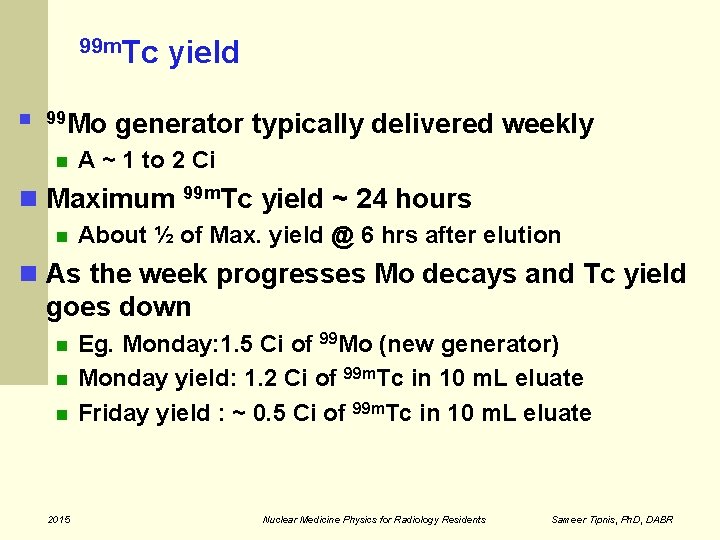
99 m. Tc 99 yield Mo generator typically delivered weekly A ~ 1 to 2 Ci Maximum 99 m. Tc yield ~ 24 hours About ½ of Max. yield @ 6 hrs after elution As the week progresses Mo decays and Tc yield goes down 2015 Eg. Monday: 1. 5 Ci of 99 Mo (new generator) Monday yield: 1. 2 Ci of 99 m. Tc in 10 m. L eluate Friday yield : ~ 0. 5 Ci of 99 m. Tc in 10 m. L eluate Nuclear Medicine Physics for Radiology Residents Sameer Tipnis, Ph. D, DABR
Major impurities from the generator The eluate from a generator contains Tc- 99 m and possibly tiny quantity of Mo-99. Also a small quantity of Al+++ may come out with eluate.
99 m. Tc QC Goal – to have the least amount of contaminants (Mo, alumina) in the eluate has high energy s (740 – 780 ke. V), and contributes to pt dose by Al+++ interferes with labeling process, clumps RBCs and can cause microemboli 99 Mo “Moly breakthrough” test – at first elution 2015 Nuclear Medicine Physics for Radiology Residents Sameer Tipnis, Ph. D, DABR
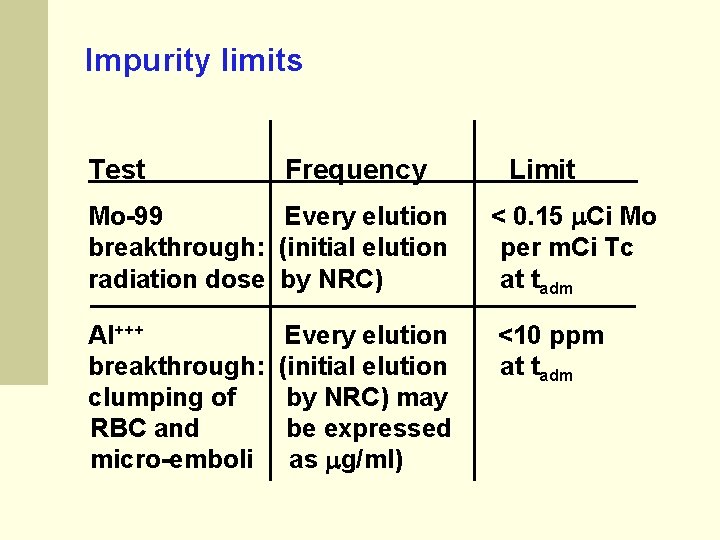
Impurity limits Test Frequency Limit Mo-99 Every elution breakthrough: (initial elution radiation dose by NRC) < 0. 15 m. Ci Mo per m. Ci Tc at tadm Al+++ breakthrough: clumping of RBC and micro-emboli <10 ppm at tadm Every elution (initial elution by NRC) may be expressed as mg/ml)
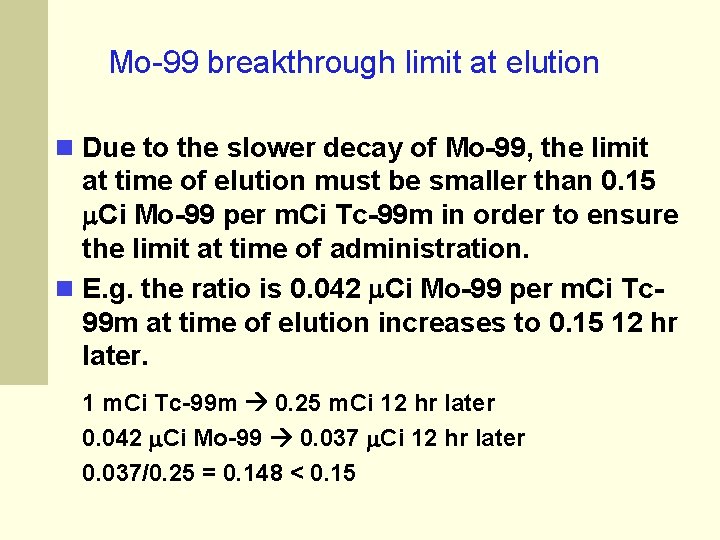
Mo-99 breakthrough limit at elution Due to the slower decay of Mo-99, the limit at time of elution must be smaller than 0. 15 m. Ci Mo-99 per m. Ci Tc-99 m in order to ensure the limit at time of administration. E. g. the ratio is 0. 042 m. Ci Mo-99 per m. Ci Tc 99 m at time of elution increases to 0. 15 12 hr later. 1 m. Ci Tc-99 m 0. 25 m. Ci 12 hr later 0. 042 m. Ci Mo-99 0. 037 m. Ci 12 hr later 0. 037/0. 25 = 0. 148 < 0. 15
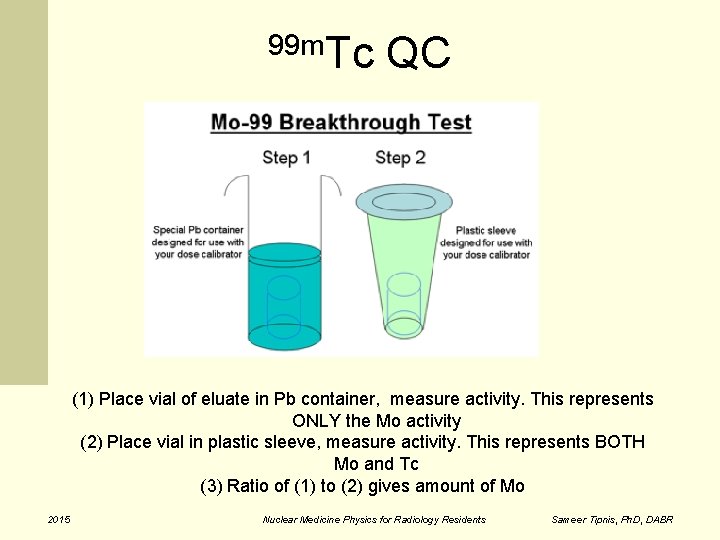
99 m. Tc QC (1) Place vial of eluate in Pb container, measure activity. This represents ONLY the Mo activity (2) Place vial in plastic sleeve, measure activity. This represents BOTH Mo and Tc (3) Ratio of (1) to (2) gives amount of Mo 2015 Nuclear Medicine Physics for Radiology Residents Sameer Tipnis, Ph. D, DABR
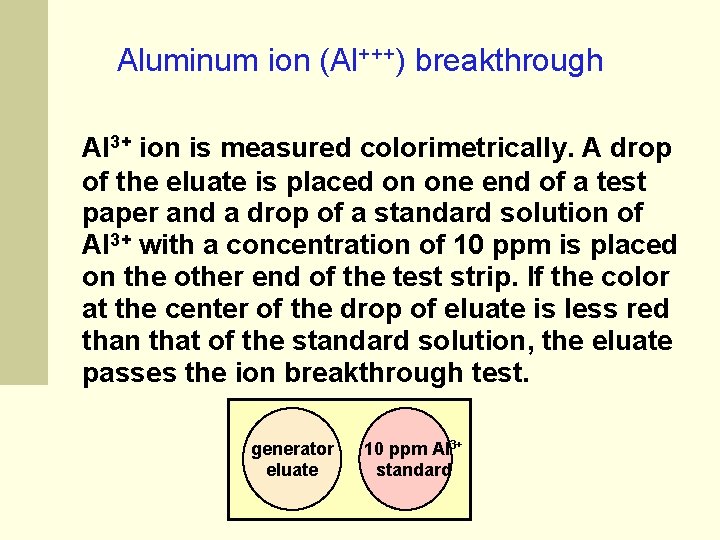
Aluminum ion (Al+++) breakthrough Al 3+ ion is measured colorimetrically. A drop of the eluate is placed on one end of a test paper and a drop of a standard solution of Al 3+ with a concentration of 10 ppm is placed on the other end of the test strip. If the color at the center of the drop of eluate is less red than that of the standard solution, the eluate passes the ion breakthrough test. generator eluate 10 ppm Al 3+ standard
99 m. Tc – a workhorse in NM! T 1/2 = 6 hr – ideally suited to study metabolic processes in patients 140 ke. V emission - low patient dose & ideal for gamma cameras No high-energy - radiation – low pt dose Versatile chemistry - can form tracers by being incorporated into a range of biologically-active substances to target tissue or organ of interest 2015 Nuclear Medicine Physics for Radiology Residents Sameer Tipnis, Ph. D, DABR
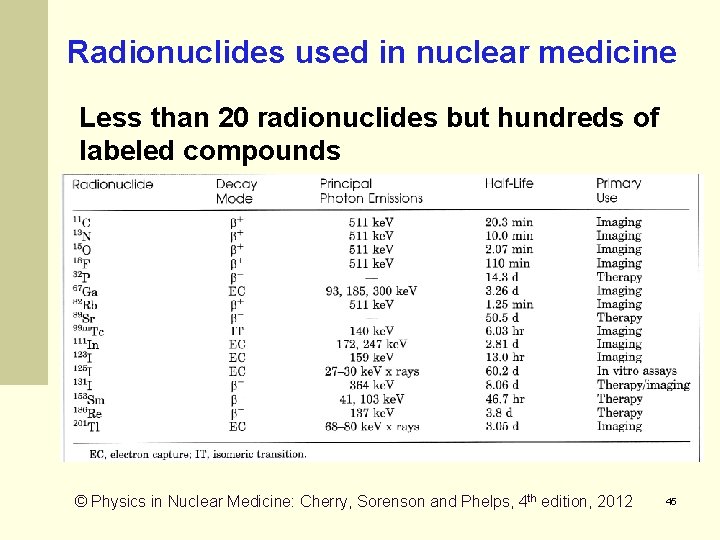
Ideal imaging radiopharmaceuticals Gamma energy 60 - 511 ke. V photons high enough to escape patient (lowers pt dose) but low enough to be detected (high detection efficiency) Half life several minutes to days to allow enough uptake in tissue and fast clearance from blood High target / background ratio Limited contamination, e. g. Tc-99 m/Mo-99 > 99. 985% Chemical properties: easy to attach to a wide range of biochemical compounds Cost-effective and convenient 2015 Nuclear Medicine Physics for Radiology Residents Sameer Tipnis, Ph. D, DABR
Radionuclides used in nuclear medicine Less than 20 radionuclides but hundreds of labeled compounds © Physics in Nuclear Medicine: Cherry, Sorenson and Phelps, 4 th edition, 2012 45
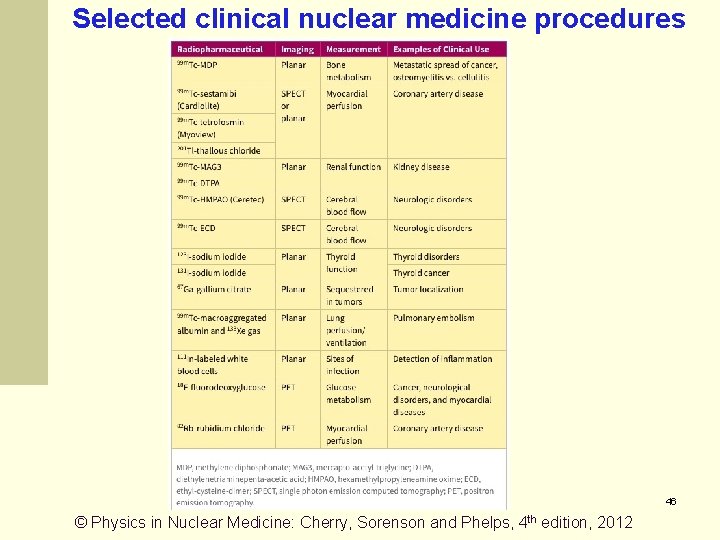
Selected clinical nuclear medicine procedures 46 © Physics in Nuclear Medicine: Cherry, Sorenson and Phelps, 4 th edition, 2012
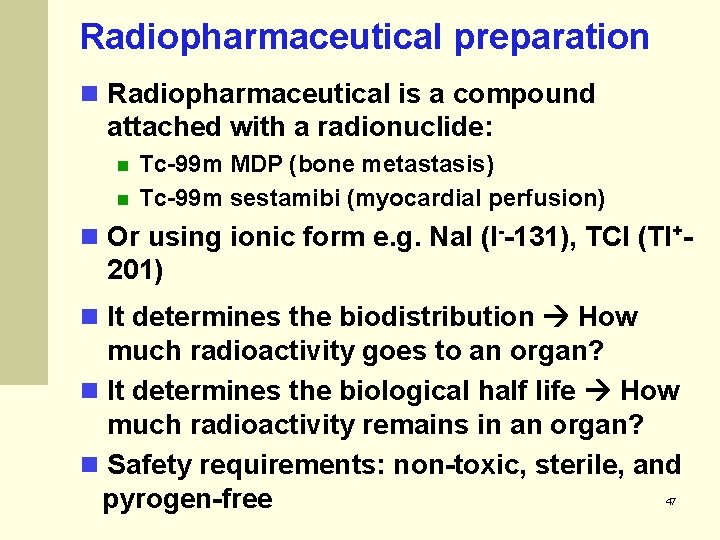
Radiopharmaceutical preparation Radiopharmaceutical is a compound attached with a radionuclide: Tc-99 m MDP (bone metastasis) Tc-99 m sestamibi (myocardial perfusion) Or using ionic form e. g. Na. I (I--131), TCl (Tl+- 201) It determines the biodistribution How much radioactivity goes to an organ? It determines the biological half life How much radioactivity remains in an organ? Safety requirements: non-toxic, sterile, and pyrogen-free 47
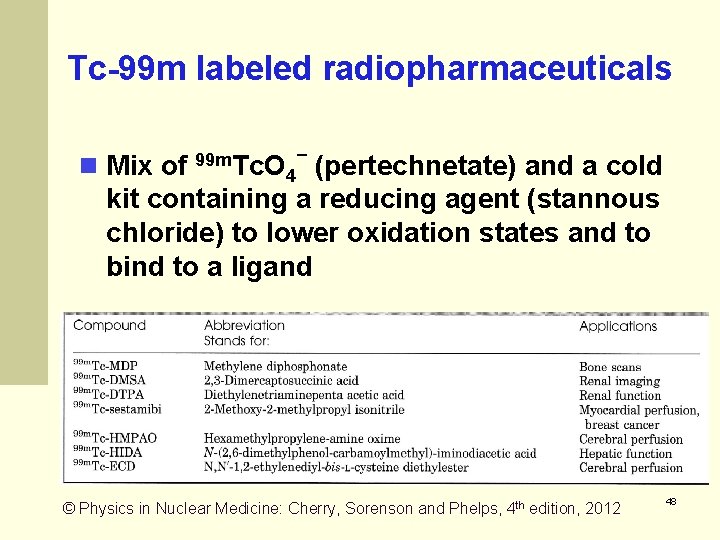
Tc-99 m labeled radiopharmaceuticals Mix of 99 m. Tc. O _ (pertechnetate) and a cold kit containing a reducing agent (stannous chloride) to lower oxidation states and to bind to a ligand 4 © Physics in Nuclear Medicine: Cherry, Sorenson and Phelps, 4 th edition, 2012 48