
Nuclear fusion in the Sun The spies of
![The measured Boron flux SSM FB [106 s-1 cm-2] BP 2000 5. 05 FRANEC](https://slidetodoc.com/presentation_image_h/0570e3b28e20c8481bfd87fe635ab0c7/image-6.jpg "The measured Boron flux SSM FB [106 s-1 cm-2] BP 2000 5. 05 FRANEC")
- Slides: 21
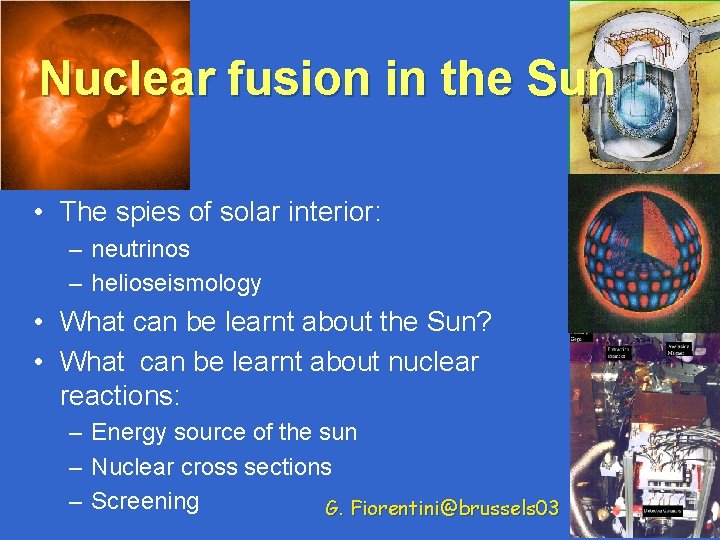
Nuclear fusion in the Sun • The spies of solar interior: – neutrinos – helioseismology • What can be learnt about the Sun? • What can be learnt about nuclear reactions: – Energy source of the sun – Nuclear cross sections – Screening G. Fiorentini@brussels 03
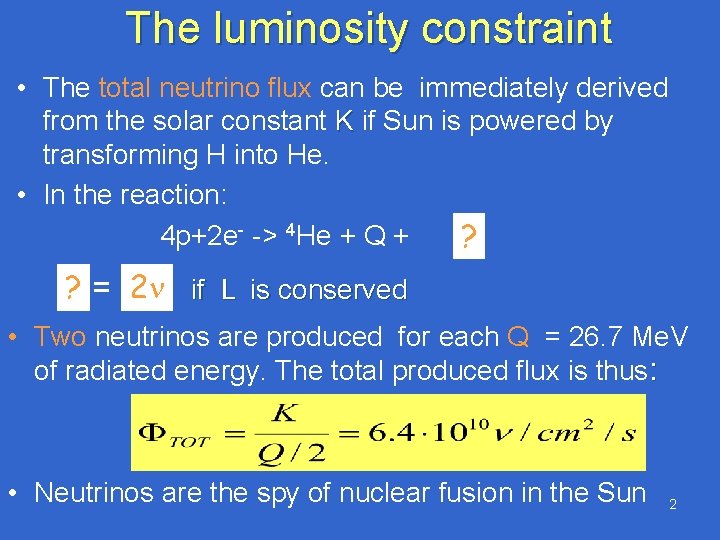
The luminosity constraint • The total neutrino flux can be immediately derived from the solar constant K if Sun is powered by transforming H into He. • In the reaction: 4 p+2 e- -> 4 He + Q + ? ? = 2 n if L is conserved • Two neutrinos are produced for each Q = 26. 7 Me. V of radiated energy. The total produced flux is thus: • Neutrinos are the spy of nuclear fusion in the Sun 2
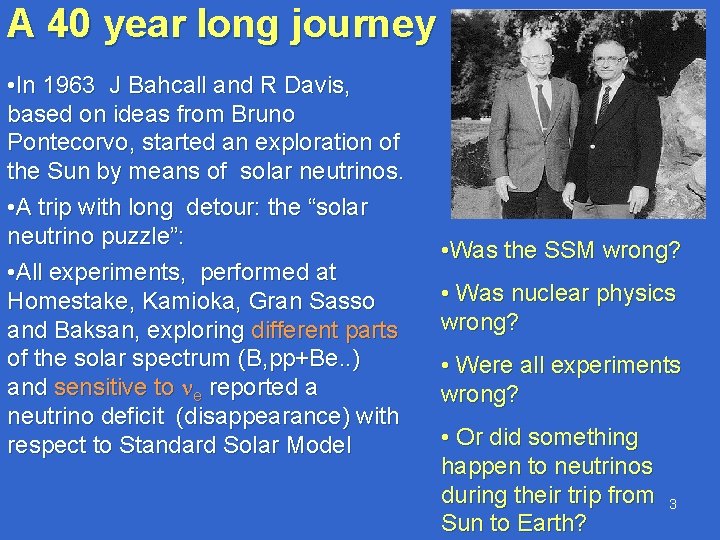
A 40 year long journey • In 1963 J Bahcall and R Davis, based on ideas from Bruno Pontecorvo, started an exploration of the Sun by means of solar neutrinos. • A trip with long detour: the “solar neutrino puzzle”: • All experiments, performed at Homestake, Kamioka, Gran Sasso and Baksan, exploring different parts of the solar spectrum (B, pp+Be. . ) and sensitive to ne reported a neutrino deficit (disappearance) with respect to Standard Solar Model • Was the SSM wrong? • Was nuclear physics wrong? • Were all experiments wrong? • Or did something happen to neutrinos during their trip from Sun to Earth? 3
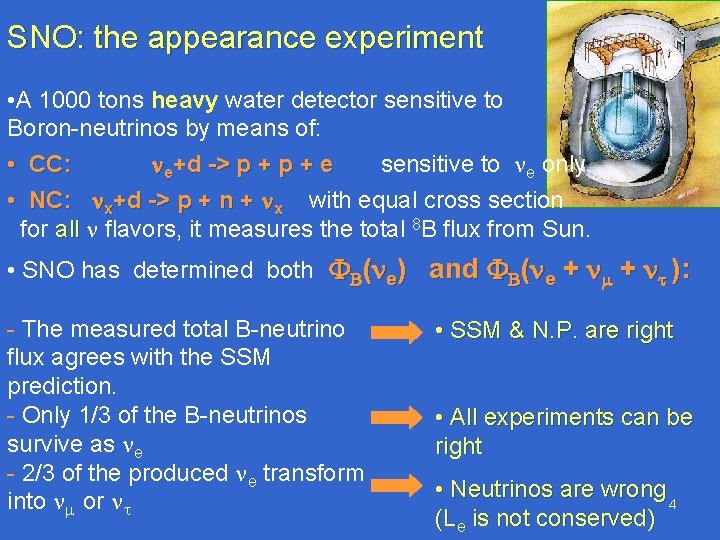
SNO: the appearance experiment • A 1000 tons heavy water detector sensitive to Boron-neutrinos by means of: • CC: ne+d -> p + e sensitive to ne only. • NC: nx+d -> p + nx with equal cross section for all n flavors, it measures the total 8 B flux from Sun. • SNO has determined both FB(ne) and FB(ne + nm + nt ): - The measured total B-neutrino flux agrees with the SSM prediction. - Only 1/3 of the B-neutrinos survive as ne - 2/3 of the produced ne transform into nm or nt • SSM & N. P. are right • All experiments can be right • Neutrinos are wrong 4 (Le is not conserved)
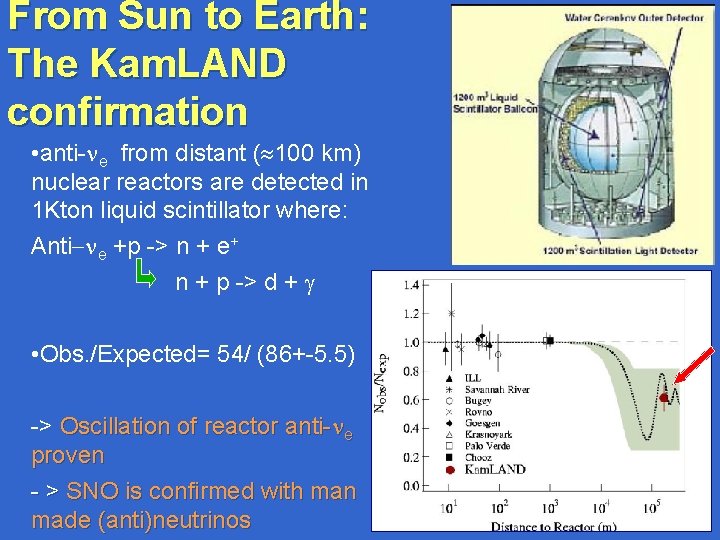
From Sun to Earth: The Kam. LAND confirmation • anti-ne from distant (» 100 km) nuclear reactors are detected in 1 Kton liquid scintillator where: Anti-ne +p -> n + e+ n + p -> d + g • Obs. /Expected= 54/ (86+-5. 5) -> Oscillation of reactor anti-ne proven - > SNO is confirmed with man made (anti)neutrinos 5
The measured Boron flux SSM FB [106 s-1 cm-2] BP 2000 5. 05 FRANEC GARSOM 5. 2 5. 3 • The total active Boron flux FB=F(ne + nm + nt) is now a measured quantity. By combining all observational data one has: FB= (5. 5 ± 0. 4) 106 cm-2 s-1. • The result is in good agreement with the SSM calculations • Note the present 1 s error is DFB/FB =7% • In the next few years one can expect : DFB/FB» 3%
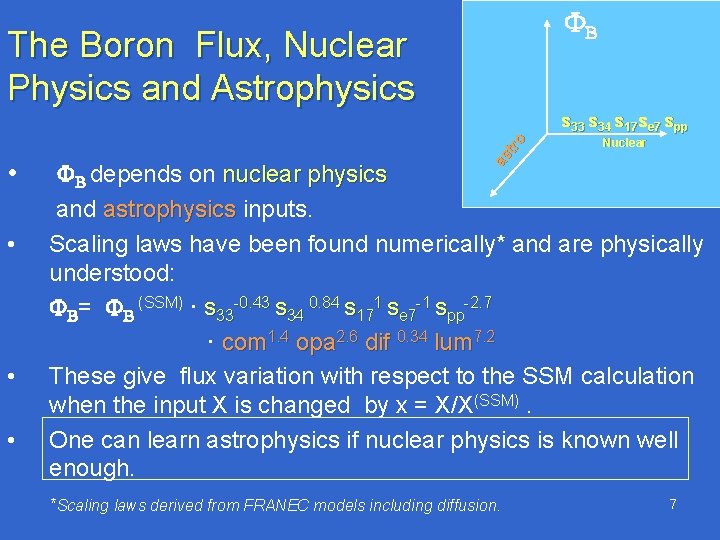
FB The Boron Flux, Nuclear Physics and Astrophysics • • as tro s 33 s 34 s 17 se 7 spp Nuclear FB depends on nuclear physics and astrophysics inputs. Scaling laws have been found numerically* and are physically understood: FB= FB (SSM) · s 33 -0. 43 s 34 0. 84 s 171 se 7 -1 spp-2. 7 · com 1. 4 opa 2. 6 dif 0. 34 lum 7. 2 These give flux variation with respect to the SSM calculation when the input X is changed by x = X/X(SSM). One can learn astrophysics if nuclear physics is known well enough. *Scaling laws derived from FRANEC models including diffusion. 7
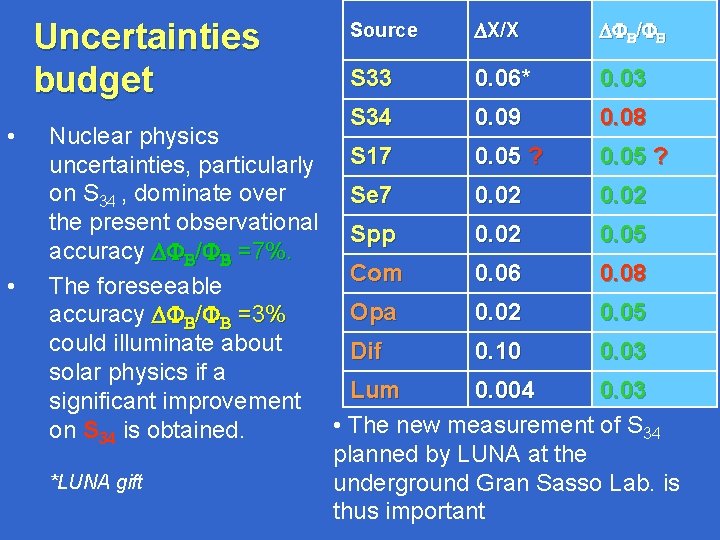
Uncertainties budget • • Source DX/X DFB/FB S 33 0. 06* 0. 03 S 34 0. 09 0. 08 Nuclear physics 0. 05 ? uncertainties, particularly S 17 on S 34 , dominate over Se 7 0. 02 the present observational Spp 0. 02 0. 05 accuracy DFB/FB =7%. Com 0. 06 0. 08 The foreseeable Opa 0. 02 0. 05 accuracy DFB/FB =3% could illuminate about Dif 0. 10 0. 03 solar physics if a Lum 0. 004 0. 03 significant improvement • The new measurement of S 34 on S 34 is obtained. planned by LUNA at the *LUNA gift underground Gran Sasso Lab. is thus important
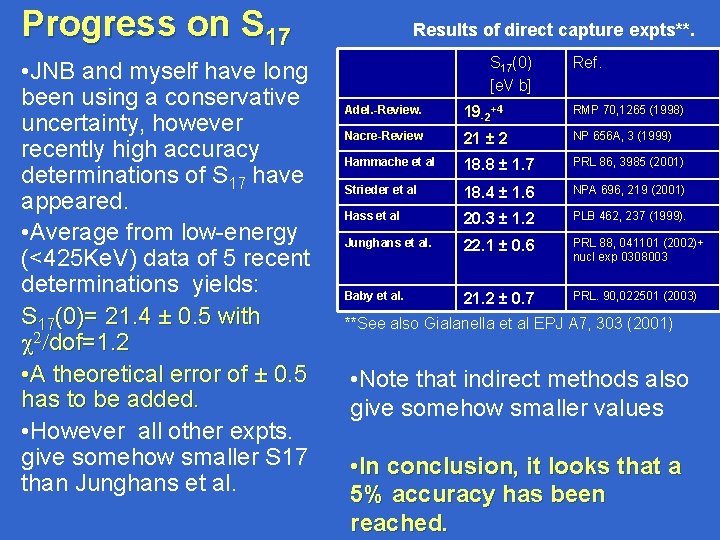
Progress on S 17 • JNB and myself have long been using a conservative uncertainty, however recently high accuracy determinations of S 17 have appeared. • Average from low-energy (<425 Ke. V) data of 5 recent determinations yields: S 17(0)= 21. 4 ± 0. 5 with c 2/dof=1. 2 • A theoretical error of ± 0. 5 has to be added. • However all other expts. give somehow smaller S 17 than Junghans et al. Results of direct capture expts**. S 17(0) [e. V b] Ref. Adel. -Review. 19 -2+4 RMP 70, 1265 (1998) Nacre-Review 21 ± 2 NP 656 A, 3 (1999) Hammache et al 18. 8 ± 1. 7 PRL 86, 3985 (2001) Strieder et al 18. 4 ± 1. 6 NPA 696, 219 (2001) Hass et al 20. 3 ± 1. 2 PLB 462, 237 (1999). Junghans et al. 22. 1 ± 0. 6 PRL 88, 041101 (2002)+ nucl exp 0308003 Baby et al. 21. 2 ± 0. 7 PRL. 90, 022501 (2003) **See also Gialanella et al EPJ A 7, 303 (2001) • Note that indirect methods also give somehow smaller values • In conclusion, it looks that a 5% accuracy has been reached.
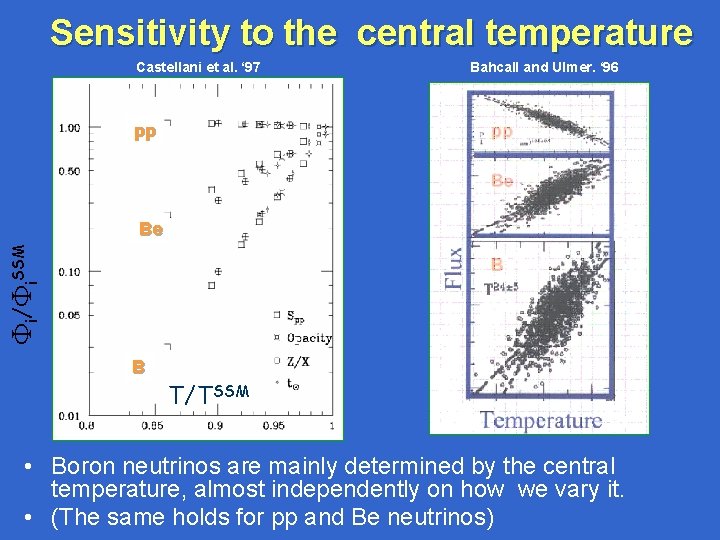
Sensitivity to the central temperature Castellani et al. ‘ 97 Bahcall and Ulmer. ‘ 96 pp Fi/Fi. SSM Be B T/TSSM • Boron neutrinos are mainly determined by the central temperature, almost independently on how we vary it. • (The same holds for pp and Be neutrinos)
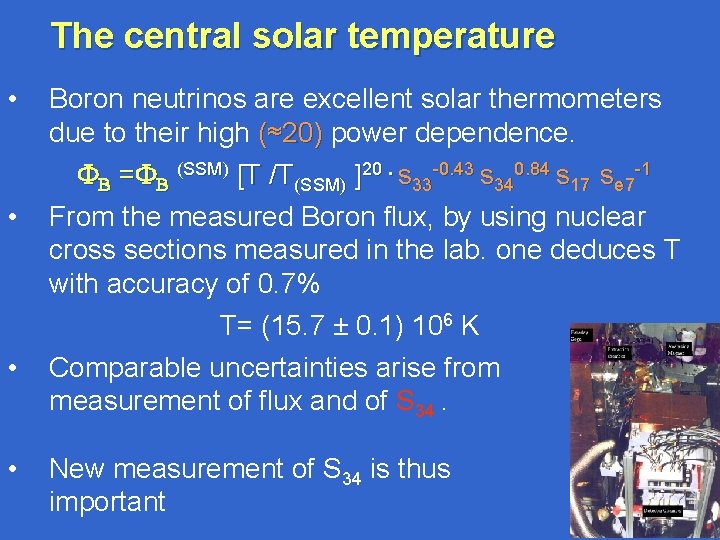
The central solar temperature • • Boron neutrinos are excellent solar thermometers due to their high (≈20) power dependence. FB =FB (SSM) [T /T(SSM) ]20. s 33 -0. 43 s 340. 84 s 17 se 7 -1 From the measured Boron flux, by using nuclear cross sections measured in the lab. one deduces T with accuracy of 0. 7% T= (15. 7 ± 0. 1) 106 K Comparable uncertainties arise from measurement of flux and of S 34. New measurement of S 34 is thus important
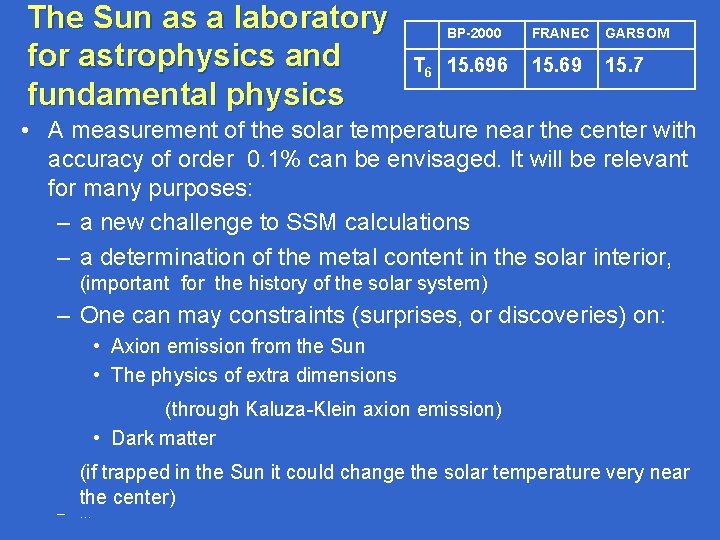
The Sun as a laboratory for astrophysics and fundamental physics BP-2000 T 6 15. 696 FRANEC GARSOM 15. 69 15. 7 • A measurement of the solar temperature near the center with accuracy of order 0. 1% can be envisaged. It will be relevant for many purposes: – a new challenge to SSM calculations – a determination of the metal content in the solar interior, (important for the history of the solar system) – One can may constraints (surprises, or discoveries) on: • Axion emission from the Sun • The physics of extra dimensions (through Kaluza-Klein axion emission) • Dark matter – (if trapped in the Sun it could change the solar temperature very near the center) …
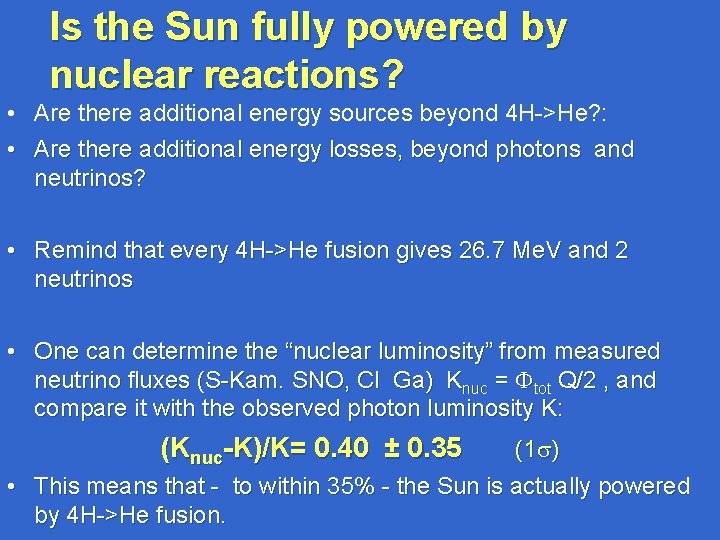
Is the Sun fully powered by nuclear reactions? • Are there additional energy sources beyond 4 H->He? : • Are there additional energy losses, beyond photons and neutrinos? • Remind that every 4 H->He fusion gives 26. 7 Me. V and 2 neutrinos • One can determine the “nuclear luminosity” from measured neutrino fluxes (S-Kam. SNO, Cl Ga) Knuc = Ftot Q/2 , and compare it with the observed photon luminosity K: (Knuc-K)/K= 0. 40 ± 0. 35 (1 s) • This means that - to within 35% - the Sun is actually powered by 4 H->He fusion.
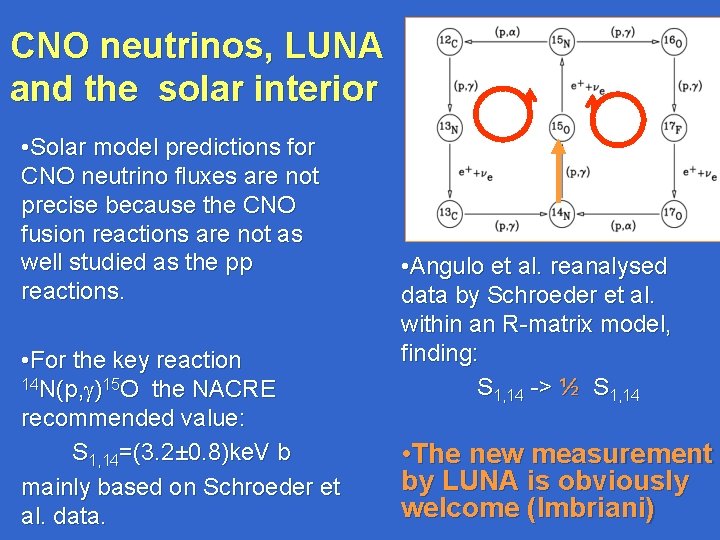
CNO neutrinos, LUNA and the solar interior • Solar model predictions for CNO neutrino fluxes are not precise because the CNO fusion reactions are not as well studied as the pp reactions. • For the key reaction 14 N(p, g)15 O the NACRE recommended value: S 1, 14=(3. 2± 0. 8)ke. V b mainly based on Schroeder et al. data. • Angulo et al. reanalysed data by Schroeder et al. within an R-matrix model, finding: S 1, 14 -> ½ S 1, 14 • The new measurement by LUNA is obviously welcome (Imbriani)
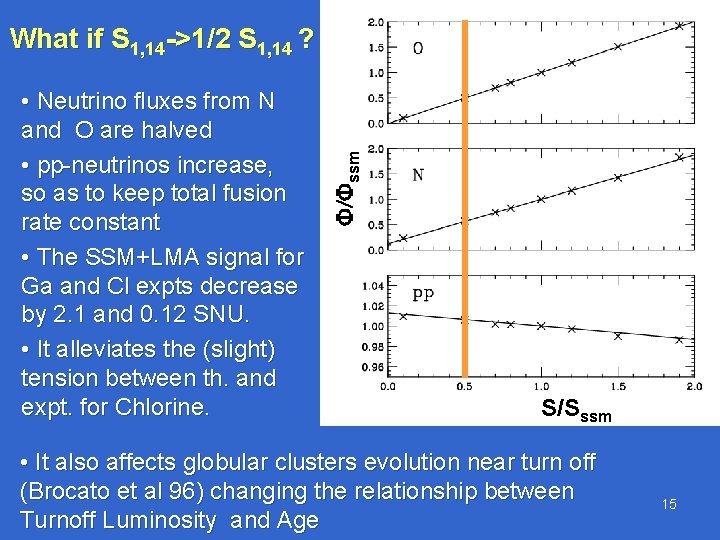
• Neutrino fluxes from N and O are halved • pp-neutrinos increase, so as to keep total fusion rate constant • The SSM+LMA signal for Ga and Cl expts decrease by 2. 1 and 0. 12 SNU. • It alleviates the (slight) tension between th. and expt. for Chlorine. F/Fssm What if S 1, 14 ->1/2 S 1, 14 ? S/Sssm • It also affects globular clusters evolution near turn off (Brocato et al 96) changing the relationship between Turnoff Luminosity and Age 15
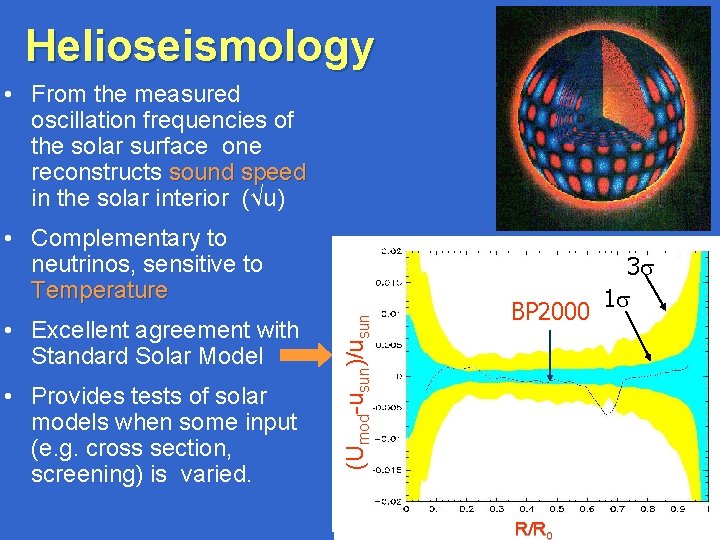
Helioseismology • From the measured oscillation frequencies of the solar surface one reconstructs sound speed in the solar interior (√u) • Excellent agreement with Standard Solar Model • Provides tests of solar models when some input (e. g. cross section, screening) is varied. (Umod-usun)/usun • Complementary to neutrinos, sensitive to Temperature BP 2000 R/Ro 3 s 1 s
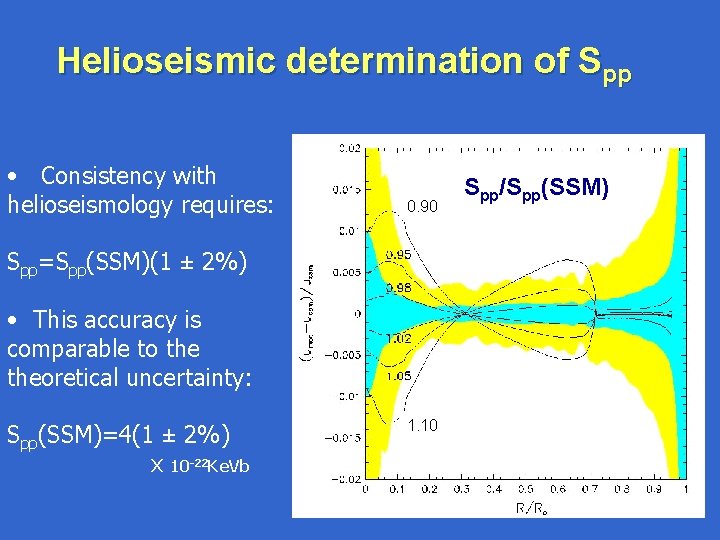
Heliosesimology and p+p -> d + e+ + n • The astrophysical factor Spp is the result of (sound) theoretical calculations, but it has not been measured in the laboratory. What if Spp≠ Spp(SSM) ? • The observed solar luminosity determines the rate of hydrogen burning in the sun. In order to keep it fixed, if the astrophysical factor Spp is (say) larger than Spp(SSM), temperature in the core has to be smaller than in the SSM. • On the other hand, chemical composition is essentially fixed by Sun history so that the “molecular weight” m is fixed. • Sound speed ≈ (k. T/m)1/2 has thus to be smaller than in SSM • Thus helioseismology can provide information on Spp Degl’Innocenti, GF and Ricci Phys Lett 416 B(1998)365 17
Helioseismic determination of Spp • Consistency with helioseismology requires: 0. 90 Spp/Spp(SSM) Spp=Spp(SSM)(1 ± 2%) • This accuracy is comparable to theoretical uncertainty: Spp(SSM)=4(1 ± 2%) x 10 -22 Ke. Vb 1. 10 18
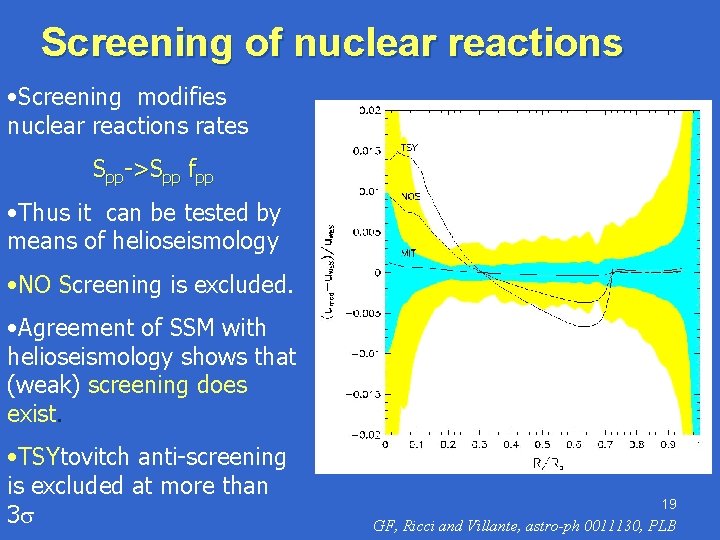
Screening of nuclear reactions • Screening modifies nuclear reactions rates Spp->Spp fpp • Thus it can be tested by means of helioseismology • NO Screening is excluded. • Agreement of SSM with helioseismology shows that (weak) screening does exist. • TSYtovitch anti-screening is excluded at more than 3 s 19 GF, Ricci and Villante, astro-ph 0011130, PLB
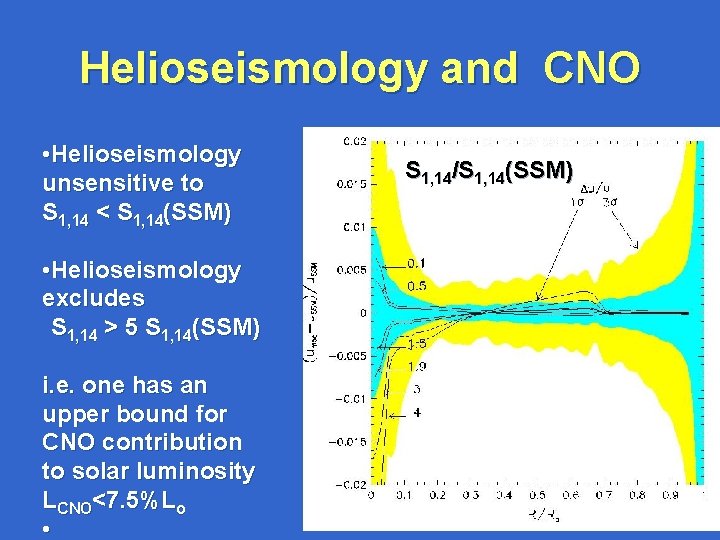
Helioseismology and CNO • Helioseismology unsensitive to S 1, 14 < S 1, 14(SSM) S 1, 14/S 1, 14(SSM) • Helioseismology excludes S 1, 14 > 5 S 1, 14(SSM) i. e. one has an upper bound for CNO contribution to solar luminosity LCNO<7. 5%Lo • 20
Summary • Solar neutrinos are becoming an important tool for studying the solar interior and fundamental physics. • Better determinations of S 34 and S 1, 14 are needed for fully exploiting the physics potential of solar neutrinos. • All this brings towards answering fundamental questions: – Is the Sun fully powered by nuclear reactions? – Is the Sun emitting something else, beyond photons and neutrinos? 21