
Nuclear Fuel Development Status and Prospect Sep 30


- Slides: 43
Nuclear Fuel Development Status and Prospect Sep. 30, 2014 JEON, Kyeong Lak KNF Proprietary Information 1
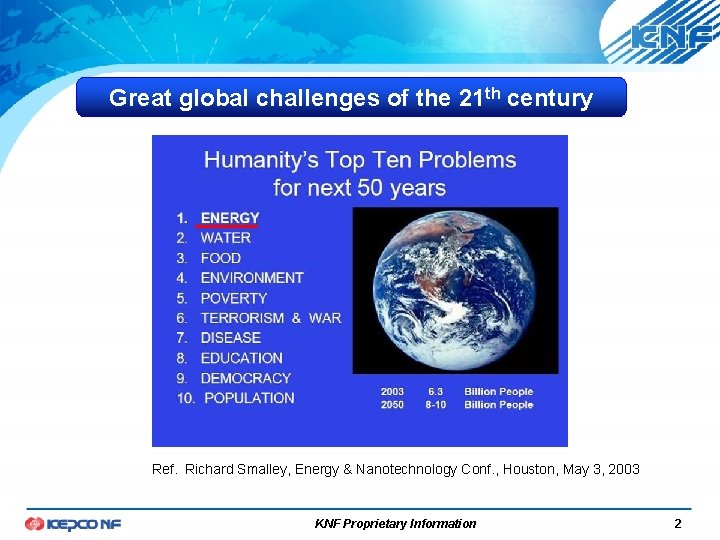
Great global challenges of the 21 th century Ref. Richard Smalley, Energy & Nanotechnology Conf. , Houston, May 3, 2003 KNF Proprietary Information 2
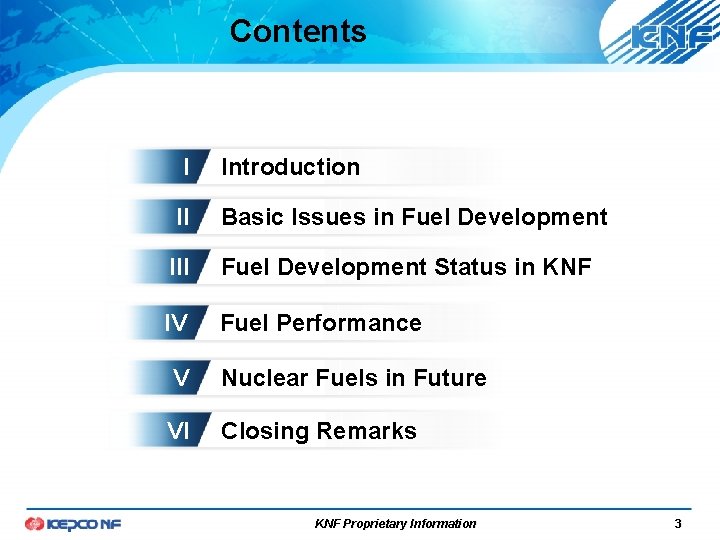
Contents I Introduction II Basic Issues in Fuel Development III Fuel Development Status in KNF IV Fuel Performance V Nuclear Fuels in Future VI Closing Remarks KNF Proprietary Information 3
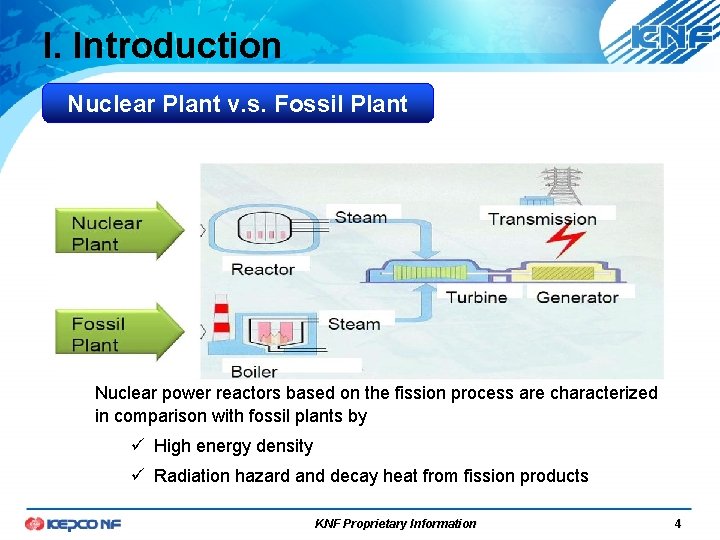
I. Introduction Nuclear Plant v. s. Fossil Plant Nuclear power reactors based on the fission process are characterized in comparison with fossil plants by ü High energy density ü Radiation hazard and decay heat from fission products KNF Proprietary Information 4
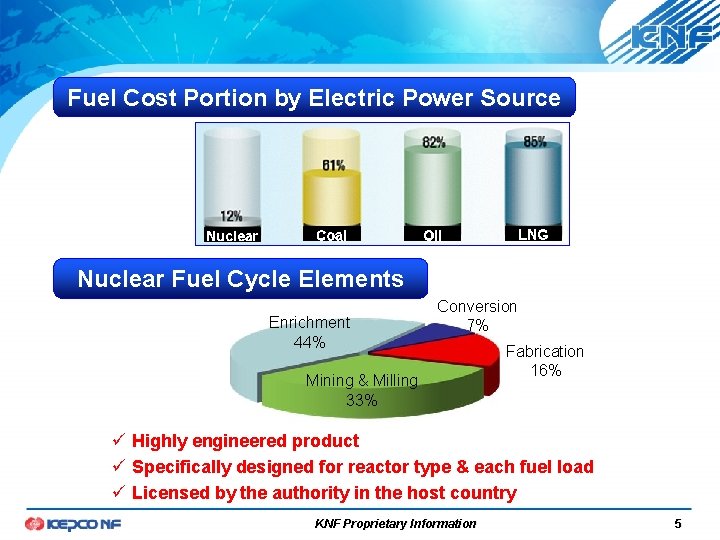
Fuel Cost Portion by Electric Power Source Nuclear Fuel Cycle Elements Enrichment 44% Conversion 7% Mining & Milling 33% Fabrication 16% ü Highly engineered product ü Specifically designed for reactor type & each fuel load ü Licensed by the authority in the host country KNF Proprietary Information 5
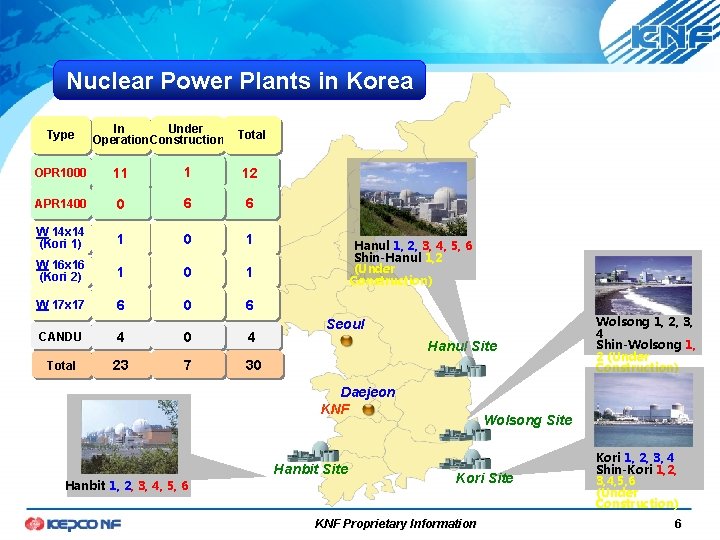
Nuclear Power Plants in Korea Type Under In Operation Construction Total OPR 1000 11 1 12 APR 1400 0 6 6 W 14 x 14 (Kori 1) 1 0 1 W 16 x 16 (Kori 2) 1 0 1 W 17 x 17 6 0 6 CANDU 4 0 4 Total 23 7 30 Hanul 1, 2, 3, 4, 5, 6 Shin-Hanul 1, 2 (Under Construction) Seoul Hanul Site Daejeon KNF Hanbit Site Hanbit 1, 2, 3, 4, 5, 6 Wolsong 1, 2, 3, 4 Shin-Wolsong 1, 2 (Under Construction) Wolsong Site Kori Site KNF Proprietary Information Kori 1, 2, 3, 4 Shin-Kori 1, 2, 3, 4, 5, 6 (Under Construction) 6
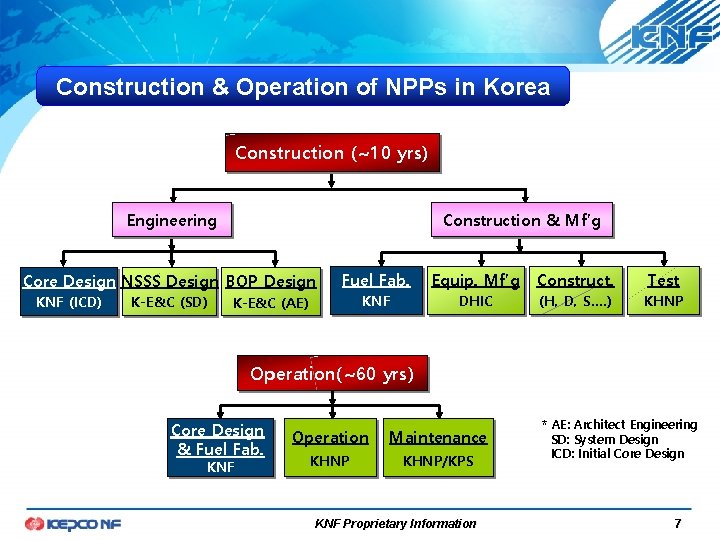
Construction & Operation of NPPs in Korea Construction (~10 yrs) Engineering Construction & Mf’g Core Design NSSS Design BOP Design KNF (ICD) K-E&C (SD) Fuel Fab. Equip. Mf’g Construct. Test KNF DHIC (H, D, S…. ) KHNP K-E&C (AE) Operation(~60 yrs) Core Design & Fuel Fab. KNF Operation Maintenance KHNP/KPS KNF Proprietary Information * AE: Architect Engineering SD: System Design ICD: Initial Core Design 7
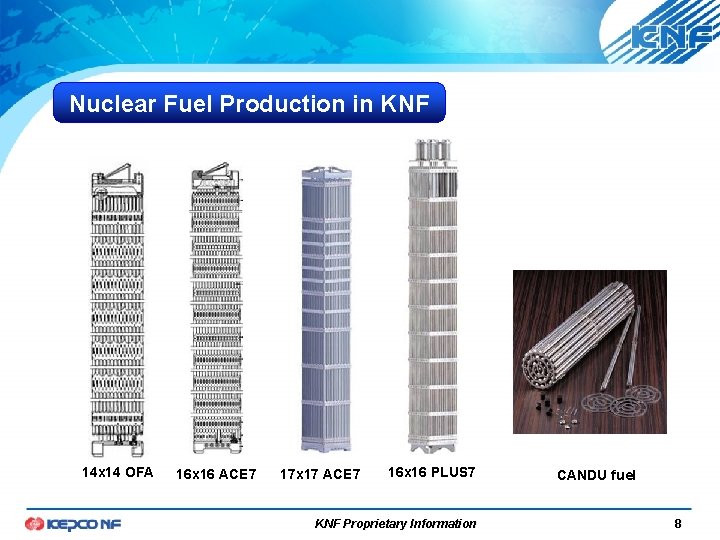
Nuclear Fuel Production in KNF 14 x 14 OFA 16 x 16 ACE 7 17 x 17 ACE 7 16 x 16 PLUS 7 KNF Proprietary Information CANDU fuel 8
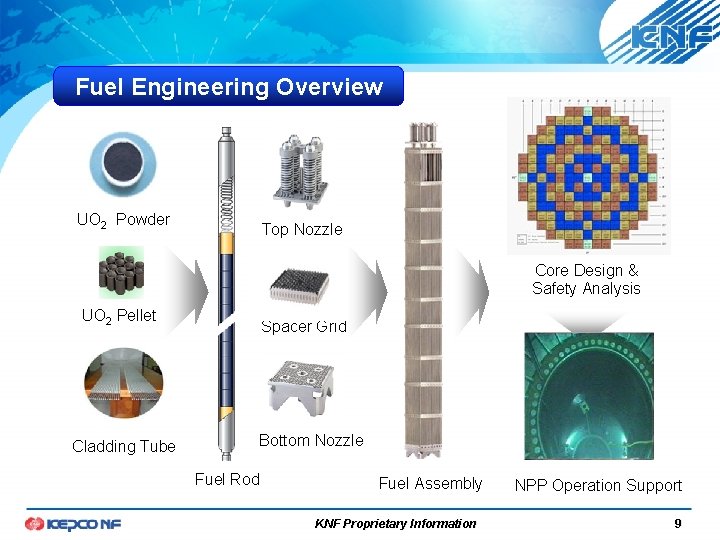
Fuel Engineering Overview UO 2 Powder Top Nozzle Core Design & Safety Analysis UO 2 Pellet Cladding Tube Spacer Grids Bottom Nozzle Fuel Rod Fuel Assembly KNF Proprietary Information NPP Operation Support 9
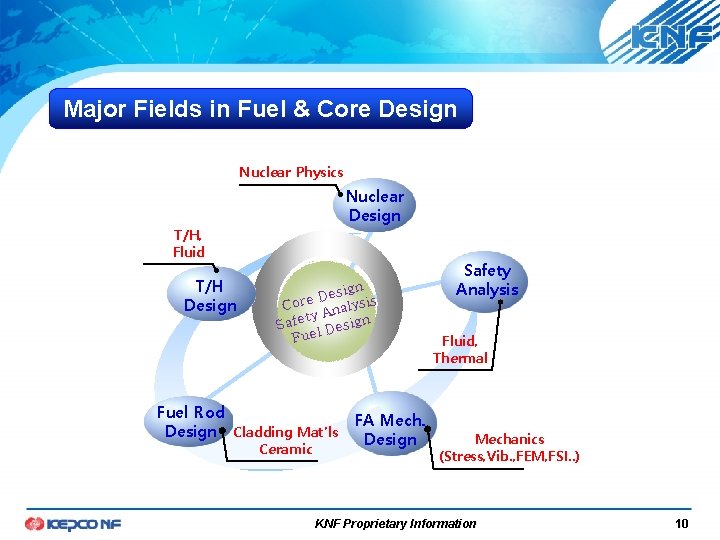
Major Fields in Fuel & Core Design Nuclear Physics Nuclear Design T/H, Fluid T/H Design s D e r Co alysi n A ty Safe l Design Fuel Rod Design Cladding Mat’ls Ceramic FA Mech. Design Safety Analysis Fluid, Thermal Mechanics (Stress, Vib. , FEM, FSI. . ) KNF Proprietary Information 10
II. Basic Issues in Fuel Development Objectives ü Safety : Thermal Margin • DNB Margin • LOCA Margin ü Economy : Burnup Performance • High Burnup • Long Cycle ü Reliability : Mechanical Integrity • Structural Robustness, Fretting Wear, Irradiation Growth, Corrosion, etc. • Debris Filtering • Shipping & Handling KNF Proprietary Information 11
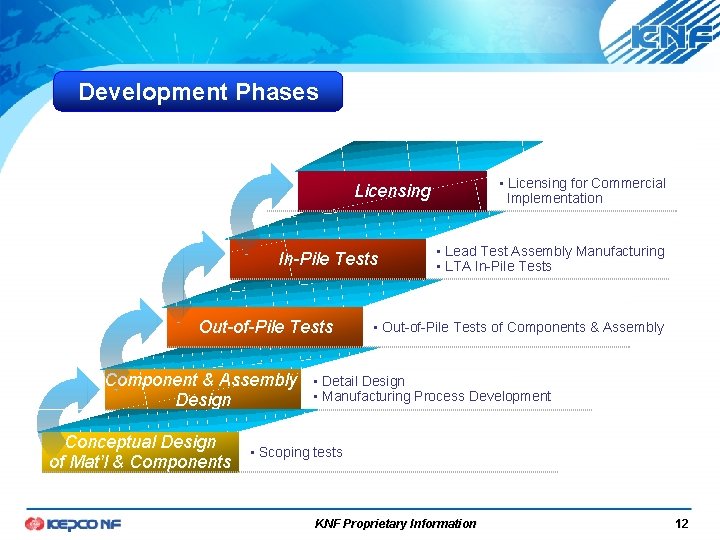
Development Phases • Licensing for Commercial Implementation Licensing In-Pile Tests Out-of-Pile Tests • Lead Test Assembly Manufacturing • LTA In-Pile Tests • Out-of-Pile Tests of Components & Assembly Component & Assembly • Detail Design • Manufacturing Process Development Design Conceptual Design of Mat’l & Components • Scoping tests KNF Proprietary Information 12
PWR Fuel Assembly W type PLUS 7(16 x 16) (14 OFA, 16 ACE 7, 17 ACE 7) Fuel Rods : 236 Guide Tubes : 4 Instr. Tube : 1 Top Nozzle : 1 Bot. Nozzle : 1 Zirc. S/G : 9 Inconel S/G : 2 P-Grid : 1 Fuel Rods : 264 Guide Tubes : 24 Instr. Tube : 1 Top Nozzle : 1 Bot. Nozzle : 1 Zirc. S/G : 6+5 Inconel S/G : 2 P-Grid : 1 KNF Proprietary Information 13
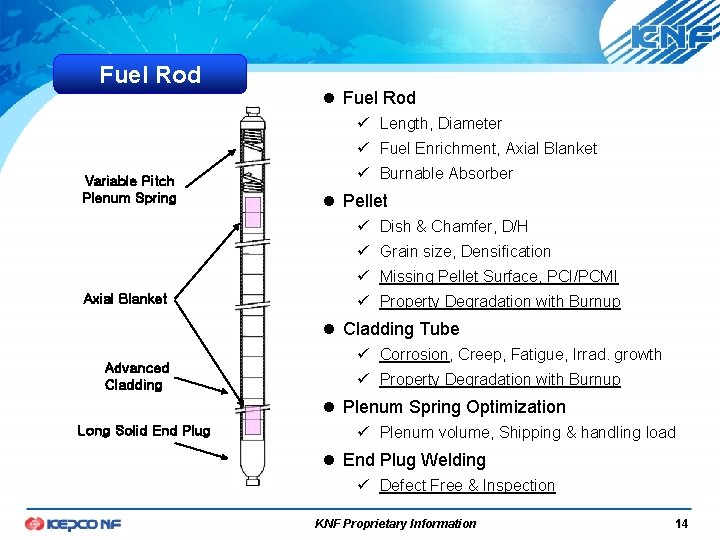
Fuel Rod l Fuel Rod ü Length, Diameter ü Fuel Enrichment, Axial Blanket Variable Pitch Plenum Spring ü Burnable Absorber l Pellet ü Dish & Chamfer, D/H ü Grain size, Densification ü Missing Pellet Surface, PCI/PCMI Axial Blanket ü Property Degradation with Burnup l Cladding Tube Advanced Cladding ü Corrosion, Creep, Fatigue, Irrad. growth ü Property Degradation with Burnup l Plenum Spring Optimization Long Solid End Plug ü Plenum volume, Shipping & handling load l End Plug Welding ü Defect Free & Inspection KNF Proprietary Information 14
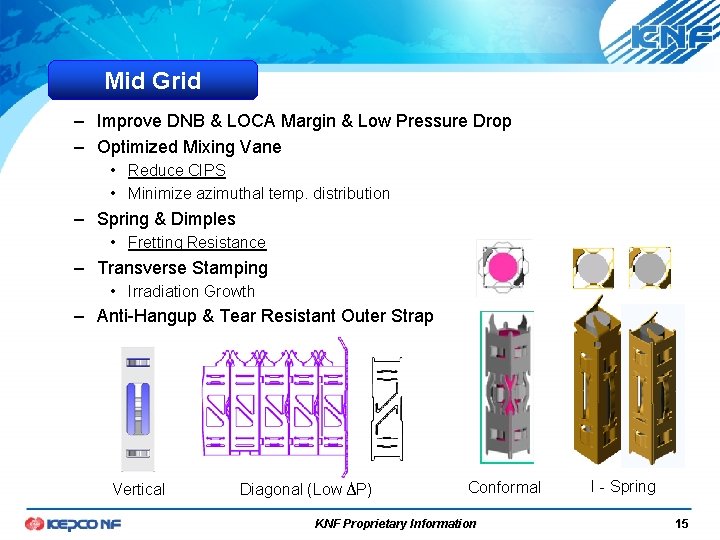
Mid Grid – Improve DNB & LOCA Margin & Low Pressure Drop – Optimized Mixing Vane • Reduce CIPS • Minimize azimuthal temp. distribution – Spring & Dimples • Fretting Resistance – Transverse Stamping • Irradiation Growth – Anti-Hangup & Tear Resistant Outer Strap Vertical Diagonal (Low ∆P) Conformal KNF Proprietary Information I - Spring 15
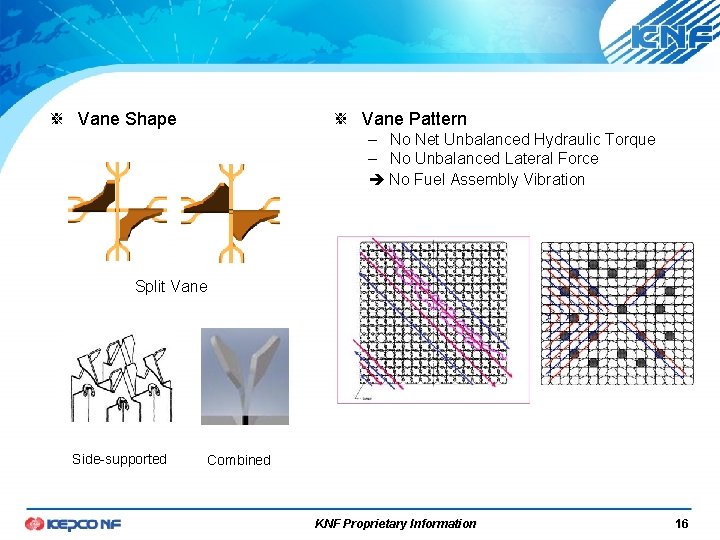
※ Vane Pattern ※ Vane Shape – No Net Unbalanced Hydraulic Torque – No Unbalanced Lateral Force No Fuel Assembly Vibration Split Vane Side-supported Combined KNF Proprietary Information 16
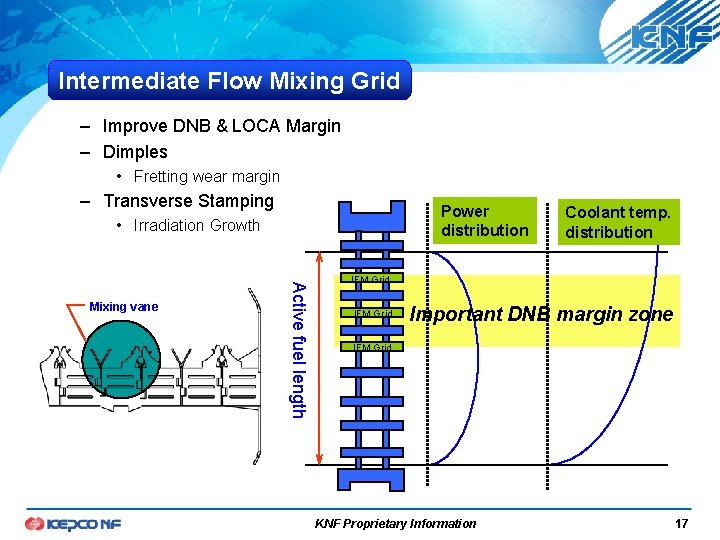
Intermediate Flow Mixing Grid – Improve DNB & LOCA Margin – Dimples • Fretting wear margin – Transverse Stamping Power distribution • Irradiation Growth Active fuel length Mixing vane Coolant temp. distribution IFM Grid Important DNB margin zone IFM Grid KNF Proprietary Information 17
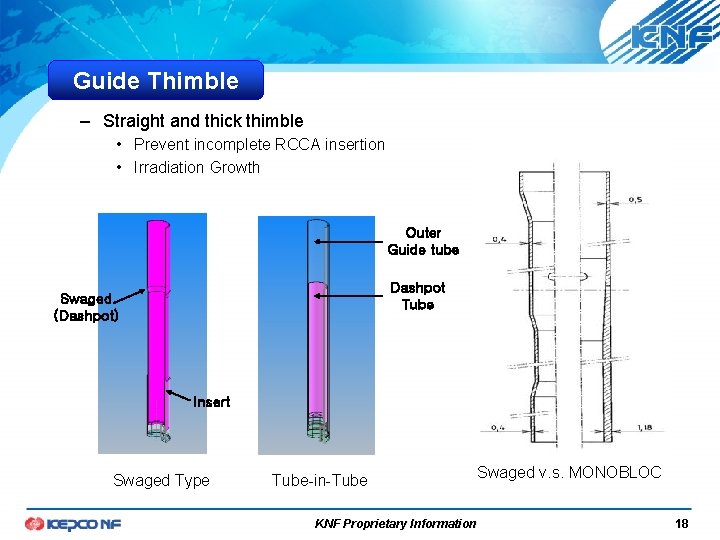
Guide Thimble – Straight and thick thimble • Prevent incomplete RCCA insertion • Irradiation Growth Outer Guide tube Dashpot Tube Swaged (Dashpot) Insert Swaged Type Tube-in-Tube KNF Proprietary Information Swaged v. s. MONOBLOC 18
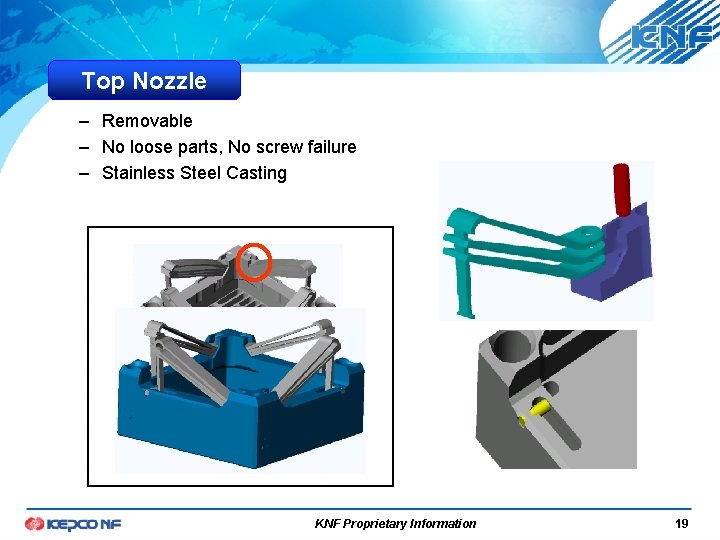
Top Nozzle – Removable – No loose parts, No screw failure – Stainless Steel Casting KNF Proprietary Information 19
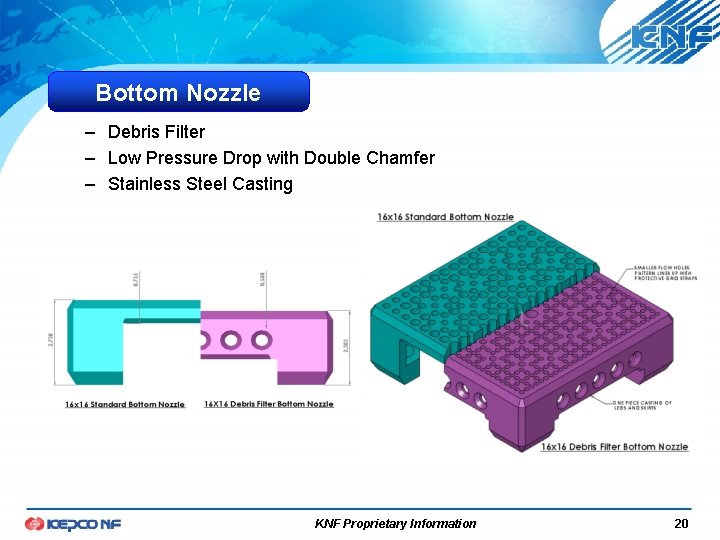
Bottom Nozzle – Debris Filter – Low Pressure Drop with Double Chamfer – Stainless Steel Casting KNF Proprietary Information 20
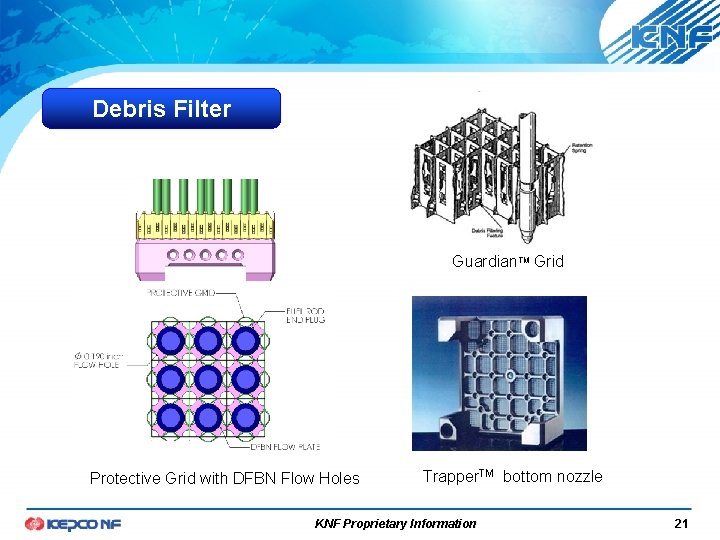
Debris Filter Guardian. TM Grid Protective Grid with DFBN Flow Holes Trapper. TM bottom nozzle KNF Proprietary Information 21
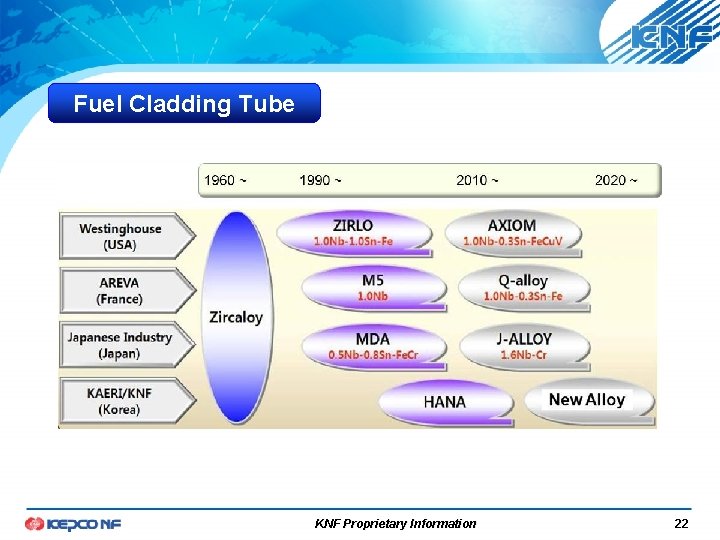
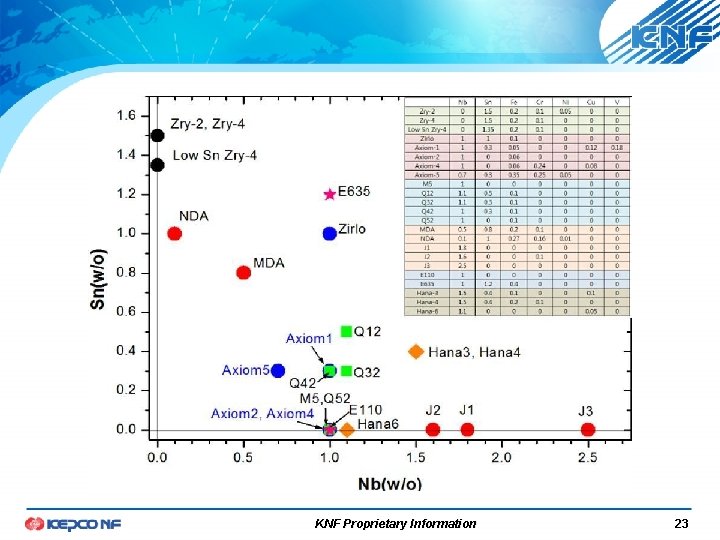
Fuel Cladding Tube KNF Proprietary Information 22
KNF Proprietary Information 23
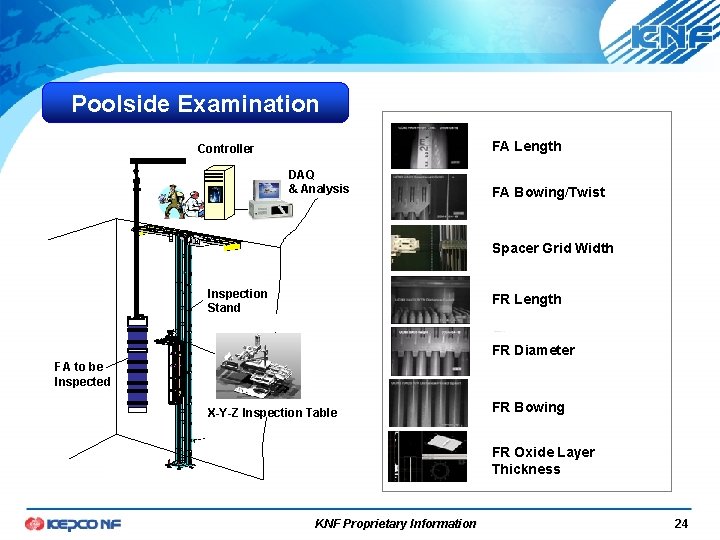
Poolside Examination FA Length Controller DAQ & Analysis FA Bowing/Twist Spacer Grid Width Inspection Stand FR Length FR Diameter FA to be Inspected X-Y-Z Inspection Table FR Bowing FR Oxide Layer Thickness KNF Proprietary Information 24
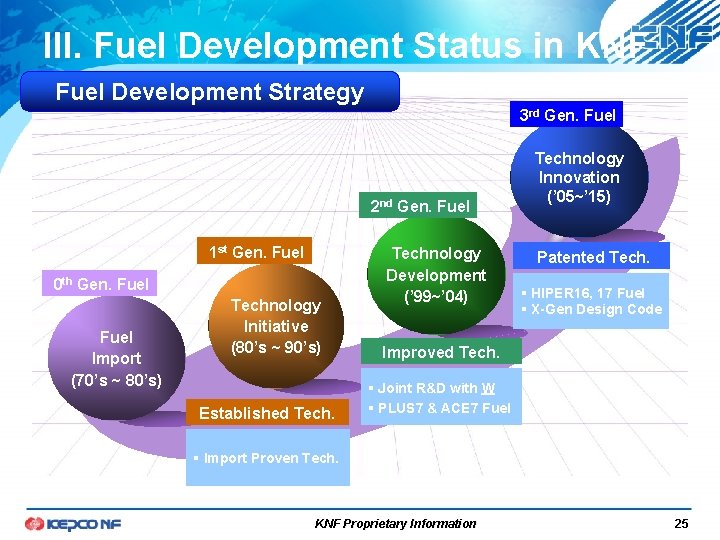
III. Fuel Development Status in KNF Fuel Development Strategy 3 rd Gen. Fuel 2 nd Gen. Fuel 1 st Gen. Fuel 0 th Gen. Fuel Import (70’s ~ 80’s) Technology Initiative (80’s ~ 90’s) Established Technology Development (’ 99~’ 04) Technology 고유 핵연료 Innovation 확보기 (’ 05~’ 15) Patented Tech. § HIPER 16, 17 Fuel § X-Gen Design Code Improved Tech. § Joint R&D with W § PLUS 7 & ACE 7 Fuel § Import Proven Tech. KNF Proprietary Information 25
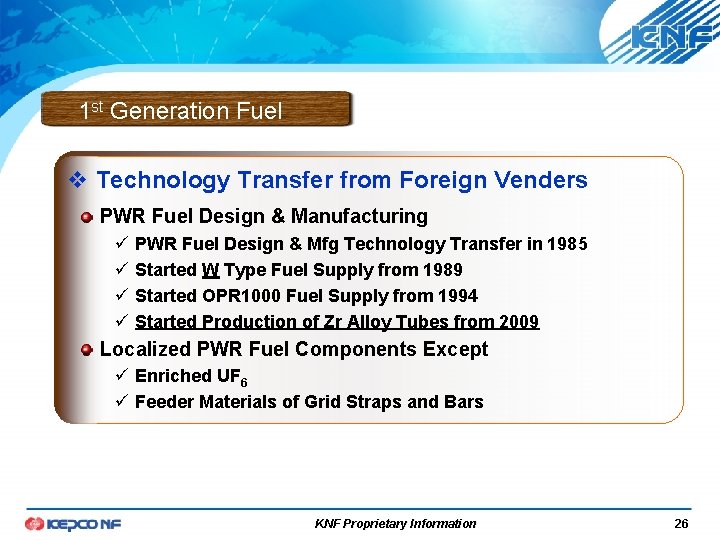
1 st Generation Fuel v Technology Transfer from Foreign Venders PWR Fuel Design & Manufacturing ü ü PWR Fuel Design & Mfg Technology Transfer in 1985 Started W Type Fuel Supply from 1989 Started OPR 1000 Fuel Supply from 1994 Started Production of Zr Alloy Tubes from 2009 Localized PWR Fuel Components Except ü Enriched UF 6 ü Feeder Materials of Grid Straps and Bars KNF Proprietary Information 26
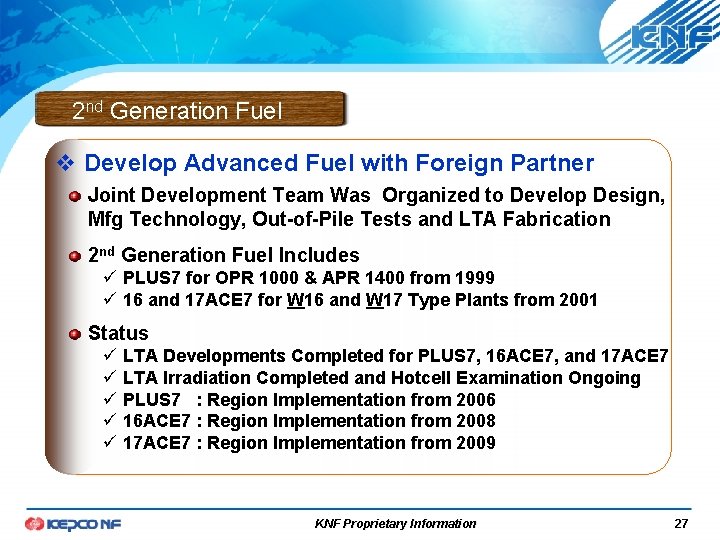
2 nd Generation Fuel v Develop Advanced Fuel with Foreign Partner Joint Development Team Was Organized to Develop Design, Mfg Technology, Out-of-Pile Tests and LTA Fabrication 2 nd Generation Fuel Includes ü PLUS 7 for OPR 1000 & APR 1400 from 1999 ü 16 and 17 ACE 7 for W 16 and W 17 Type Plants from 2001 Status ü ü ü LTA Developments Completed for PLUS 7, 16 ACE 7, and 17 ACE 7 LTA Irradiation Completed and Hotcell Examination Ongoing PLUS 7 : Region Implementation from 2006 16 ACE 7 : Region Implementation from 2008 17 ACE 7 : Region Implementation from 2009 KNF Proprietary Information 27
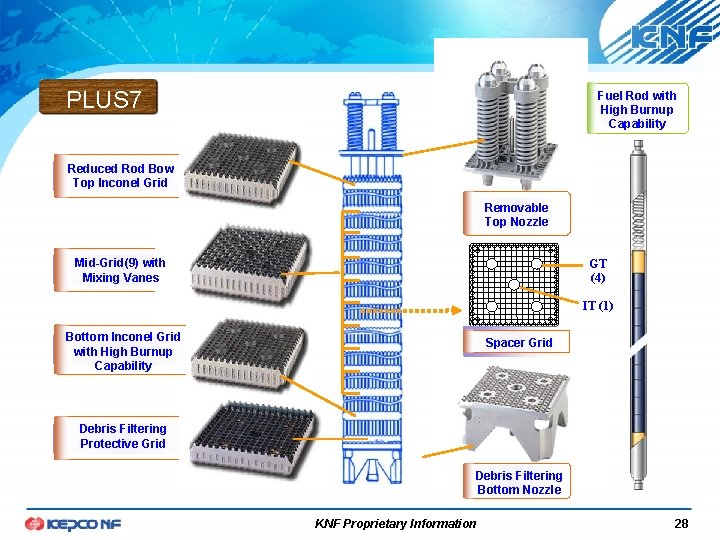
PLUS 7 Fuel Rod with High Burnup Capability Reduced Rod Bow Top Inconel Grid Removable Top Nozzle Mid-Grid(9) with Mixing Vanes GT (4) IT (1) Bottom Inconel Grid with High Burnup Capability Spacer Grid Debris Filtering Protective Grid Debris Filtering Bottom Nozzle KNF Proprietary Information 28
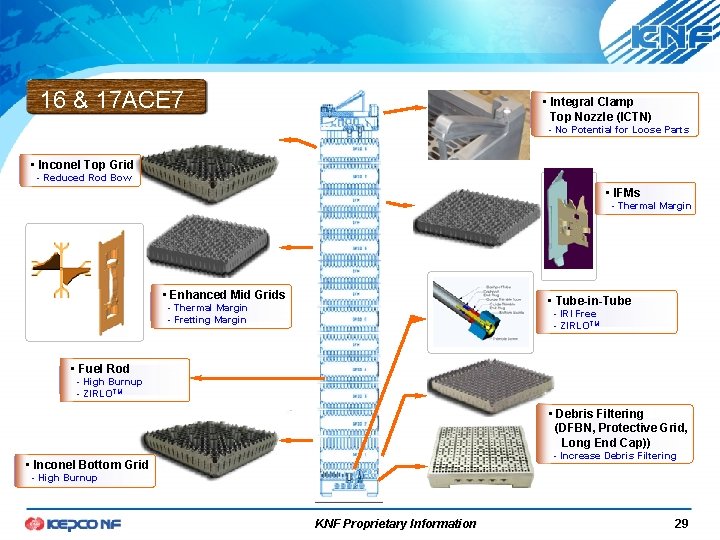
16 & 17 ACE 7 • Integral Clamp Top Nozzle (ICTN) - No Potential for Loose Parts • Inconel Top Grid - Reduced Rod Bow • IFMs - Thermal Margin • Enhanced Mid Grids • Tube-in-Tube - Thermal Margin - Fretting Margin - IRI Free - ZIRLOTM • Fuel Rod - High Burnup - ZIRLOTM • Debris Filtering (DFBN, Protective Grid, Long End Cap)) - Increase Debris Filtering • Inconel Bottom Grid - High Burnup KNF Proprietary Information 29
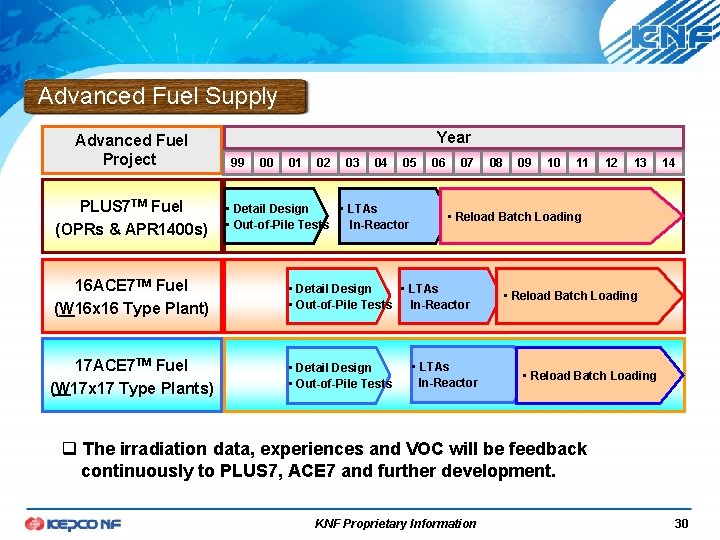
Advanced Fuel Supply Advanced Fuel Project PLUS 7 TM Fuel (OPRs & APR 1400 s) 16 ACE 7 TM Fuel (W 16 x 16 Type Plant) 17 ACE 7 TM Fuel (W 17 x 17 Type Plants) Year 99 00 01 02 03 04 05 • Detail Design • LTAs • Out-of-Pile Tests In-Reactor 06 07 09 10 11 12 13 14 • Reload Batch Loading • Detail Design • LTAs • Out-of-Pile Tests In-Reactor • Detail Design • Out-of-Pile Tests 08 • LTAs In-Reactor • Reload Batch Loading q The irradiation data, experiences and VOC will be feedback continuously to PLUS 7, ACE 7 and further development. KNF Proprietary Information 30
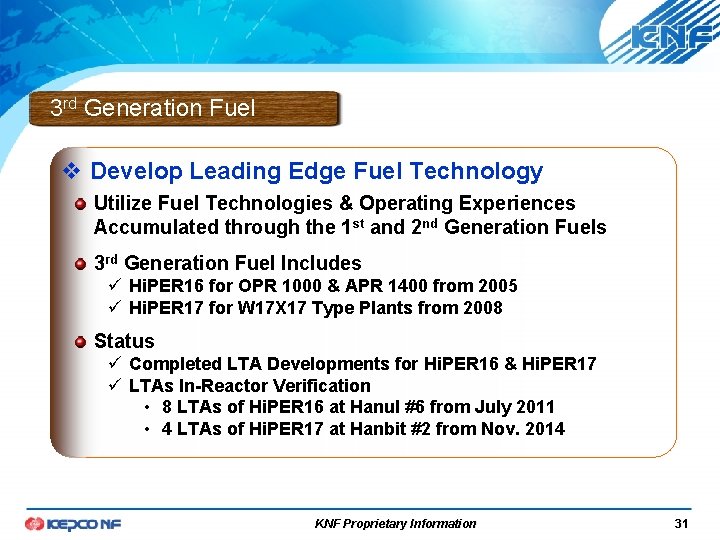
3 rd Generation Fuel v Develop Leading Edge Fuel Technology Utilize Fuel Technologies & Operating Experiences Accumulated through the 1 st and 2 nd Generation Fuels 3 rd Generation Fuel Includes ü Hi. PER 16 for OPR 1000 & APR 1400 from 2005 ü Hi. PER 17 for W 17 X 17 Type Plants from 2008 Status ü Completed LTA Developments for Hi. PER 16 & Hi. PER 17 ü LTAs In-Reactor Verification • 8 LTAs of Hi. PER 16 at Hanul #6 from July 2011 • 4 LTAs of Hi. PER 17 at Hanbit #2 from Nov. 2014 KNF Proprietary Information 31
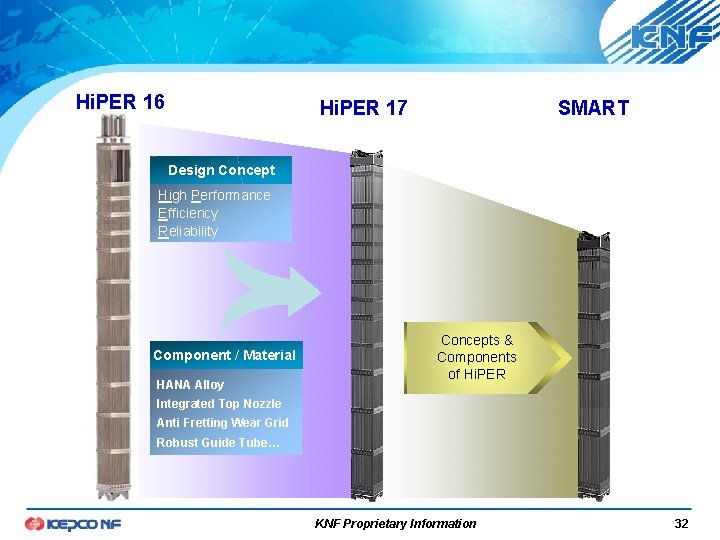
Hi. PER 16 Hi. PER 17 SMART Design Concept High Performance Efficiency Reliability Component / Material HANA Alloy Concepts & Components of Hi. PER Integrated Top Nozzle Anti Fretting Wear Grid Robust Guide Tube… KNF Proprietary Information 32
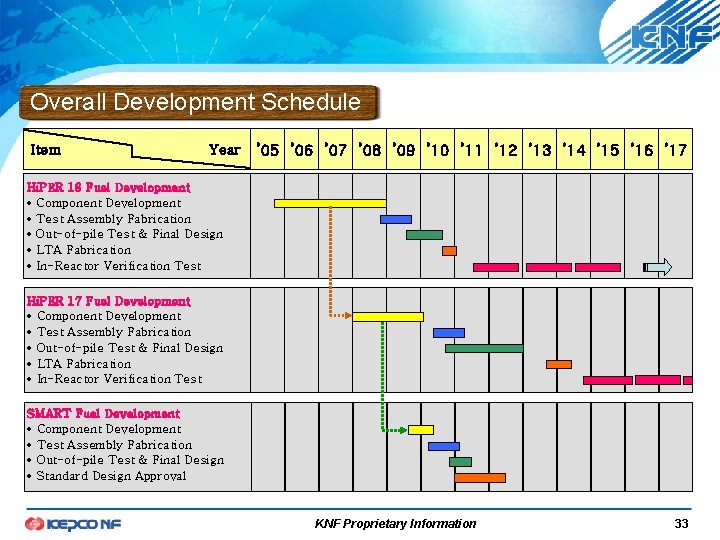
Overall Development Schedule Item Year ’ 05 ’ 06 ’ 07 ’ 08 ’ 09 ’ 10 ’ 11 ’ 12 ’ 13 ’ 14 ’ 15 ’ 16 ’ 17 Hi. PER 16 Fuel Development · Component Development · Test Assembly Fabrication · Out-of-pile Test & Final Design · LTA Fabrication · In-Reactor Verification Test Hi. PER 17 Fuel Development · Component Development · Test Assembly Fabrication · Out-of-pile Test & Final Design · LTA Fabrication · In-Reactor Verification Test SMART Fuel Development · Component Development · Test Assembly Fabrication · Out-of-pile Test & Final Design · Standard Design Approval KNF Proprietary Information 33
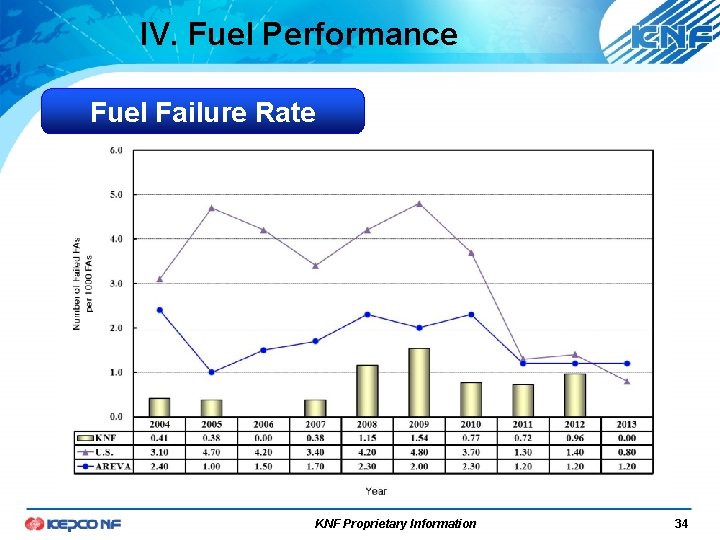
IV. Fuel Performance Fuel Failure Rate KNF Proprietary Information 34
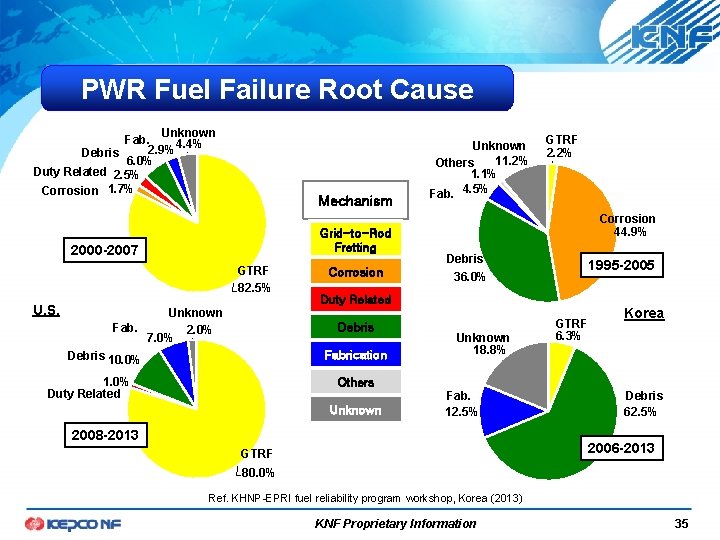
PWR Fuel Failure Root Cause Unknown Fab. 2. 9% 4. 4% Debris 6. 0% Duty Related 2. 5% Corrosion 1. 7% Mechanism Grid-to-Rod Fretting 2000 -2007 GTRF 82. 5% U. S. Unknown Fab. 2. 0% 7. 0% Corrosion Fabrication 1. 0% Duty Related GTRF 2. 2% Corrosion 44. 9% Debris 36. 0% 1995 -2005 Duty Related Debris 10. 0% Unknown 11. 2% Others 1. 1% Fab. 4. 5% Unknown 18. 8% GTRF 6. 3% Korea Others Unknown Fab. 12. 5% 2008 -2013 Debris 62. 5% 2006 -2013 GTRF 80. 0% Ref. KHNP-EPRI fuel reliability program workshop, Korea (2013) KNF Proprietary Information 35
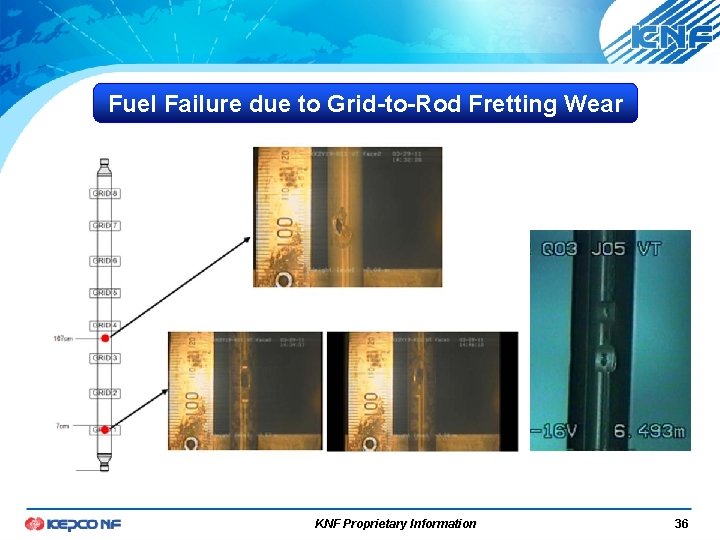
Fuel Failure due to Grid-to-Rod Fretting Wear KNF Proprietary Information 36
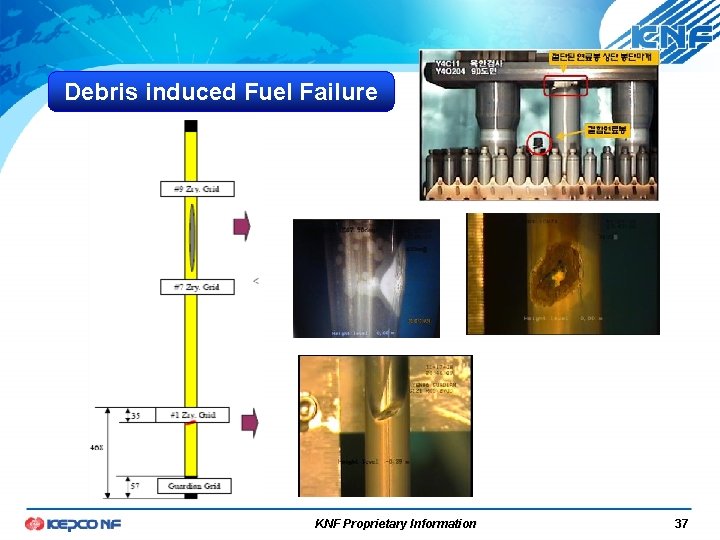
Debris induced Fuel Failure KNF Proprietary Information 37
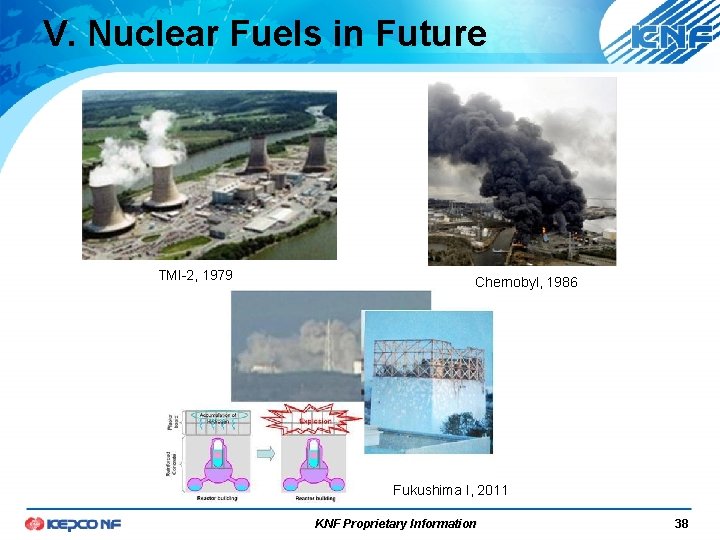
V. Nuclear Fuels in Future TMI-2, 1979 Chernobyl, 1986 Fukushima I, 2011 KNF Proprietary Information 38
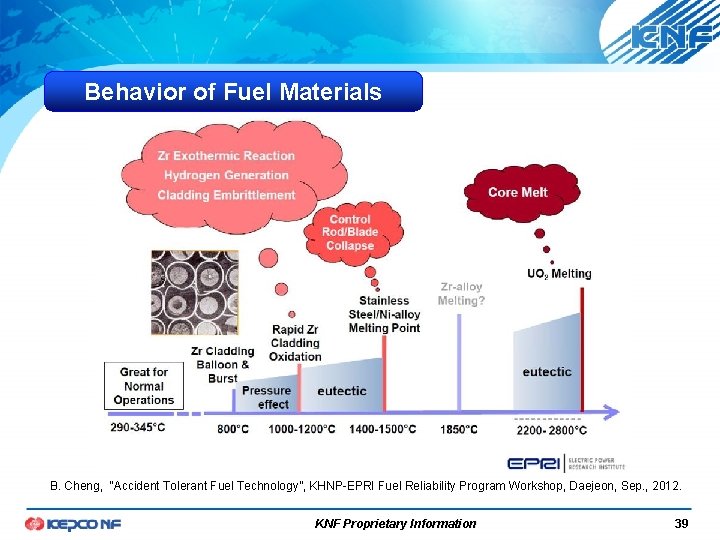
Behavior of Fuel Materials B. Cheng, “Accident Tolerant Fuel Technology”, KHNP-EPRI Fuel Reliability Program Workshop, Daejeon, Sep. , 2012. KNF Proprietary Information 39
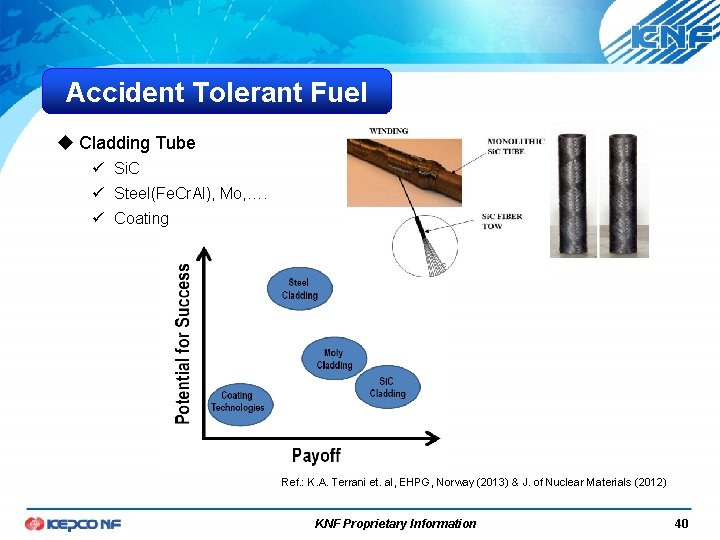
Accident Tolerant Fuel u Cladding Tube ü Si. C ü Steel(Fe. Cr. Al), Mo, …. ü Coating Ref. : K. A. Terrani et. al, EHPG, Norway (2013) & J. of Nuclear Materials (2012) KNF Proprietary Information 40
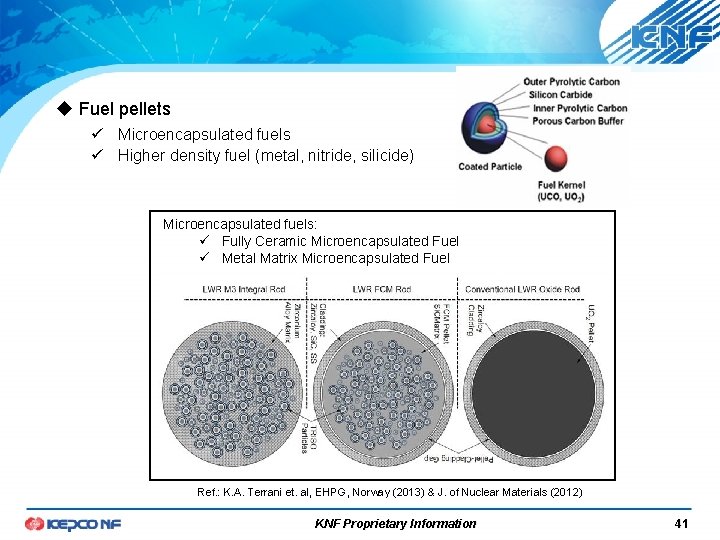
u Fuel pellets ü Microencapsulated fuels ü Higher density fuel (metal, nitride, silicide) Microencapsulated fuels: ü Fully Ceramic Microencapsulated Fuel ü Metal Matrix Microencapsulated Fuel Ref. : K. A. Terrani et. al, EHPG, Norway (2013) & J. of Nuclear Materials (2012) KNF Proprietary Information 41
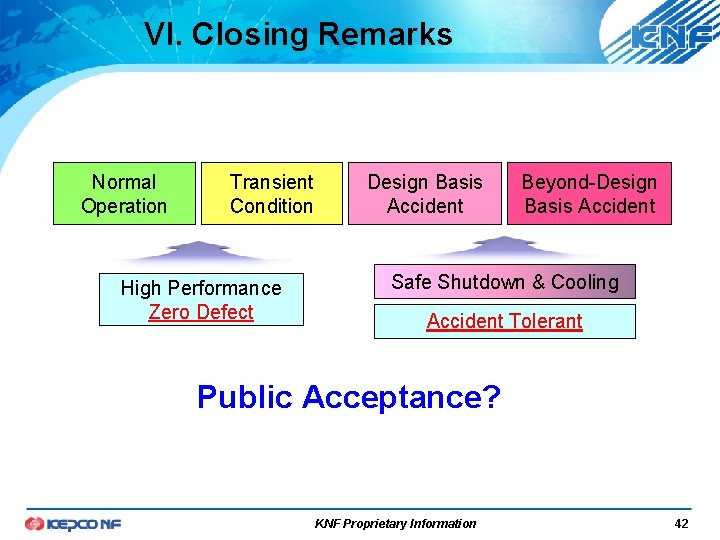
VI. Closing Remarks Normal Operation Transient Condition High Performance Zero Defect Design Basis Accident Beyond-Design Basis Accident Safe Shutdown & Cooling Accident Tolerant Public Acceptance? KNF Proprietary Information 42
TVEL Partners in Power !!! KNF Proprietary Information 43