
Nuclear Forensic Science An Emerging Discipline Stephen La
- Slides: 20
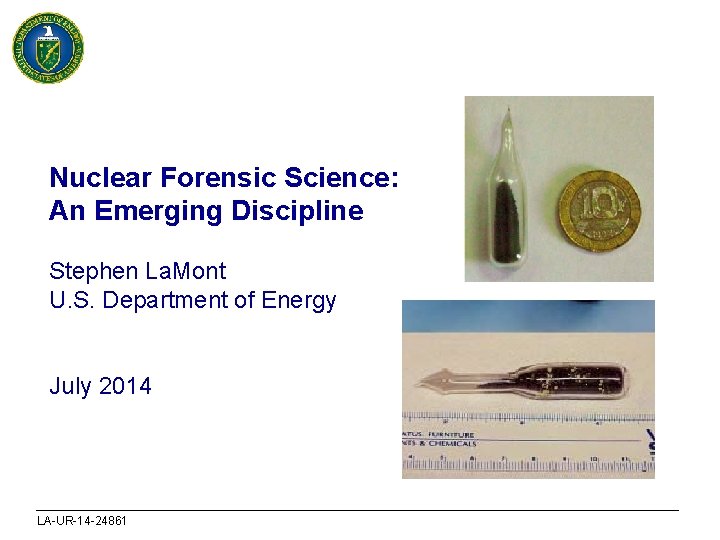
Nuclear Forensic Science: An Emerging Discipline Stephen La. Mont U. S. Department of Energy July 2014 LA-UR-14 -24861
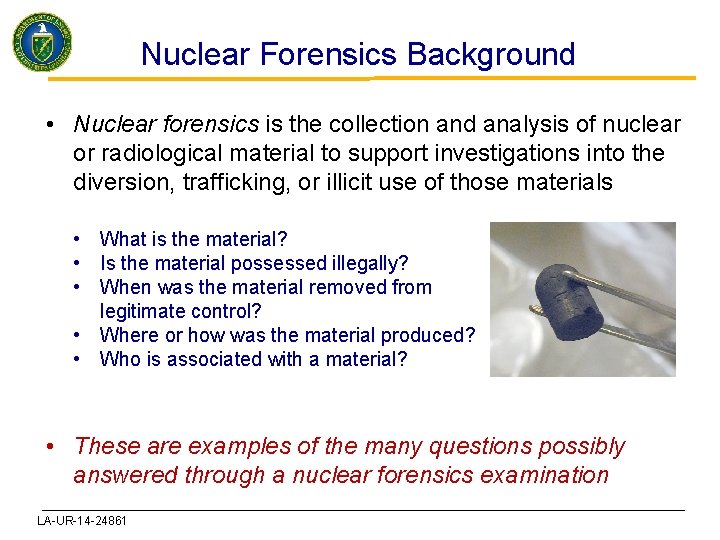
Nuclear Forensics Background • Nuclear forensics is the collection and analysis of nuclear or radiological material to support investigations into the diversion, trafficking, or illicit use of those materials • What is the material? • Is the material possessed illegally? • When was the material removed from legitimate control? • Where or how was the material produced? • Who is associated with a material? • These are examples of the many questions possibly answered through a nuclear forensics examination LA-UR-14 -24861
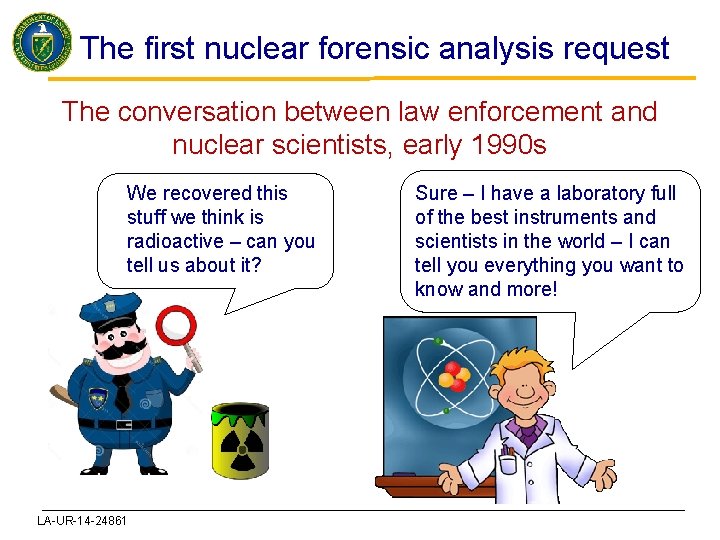
The first nuclear forensic analysis request The conversation between law enforcement and nuclear scientists, early 1990 s We recovered this stuff we think is radioactive – can you tell us about it? LA-UR-14 -24861 Sure – I have a laboratory full of the best instruments and scientists in the world – I can tell you everything you want to know and more!
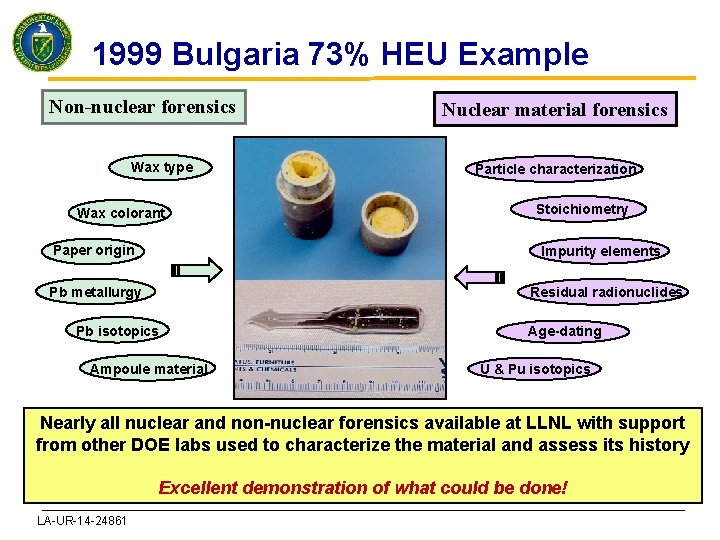
1999 Bulgaria 73% HEU Example Non-nuclear forensics Wax type Wax colorant Paper origin Nuclear material forensics Particle characterization Stoichiometry Impurity elements Residual radionuclides Pb metallurgy Pb isotopics Ampoule material Age-dating U & Pu isotopics Nearly all nuclear and non-nuclear forensics available at LLNL with support from other DOE labs used to characterize the material and assess its history Excellent demonstration of what could be done! LA-UR-14 -24861
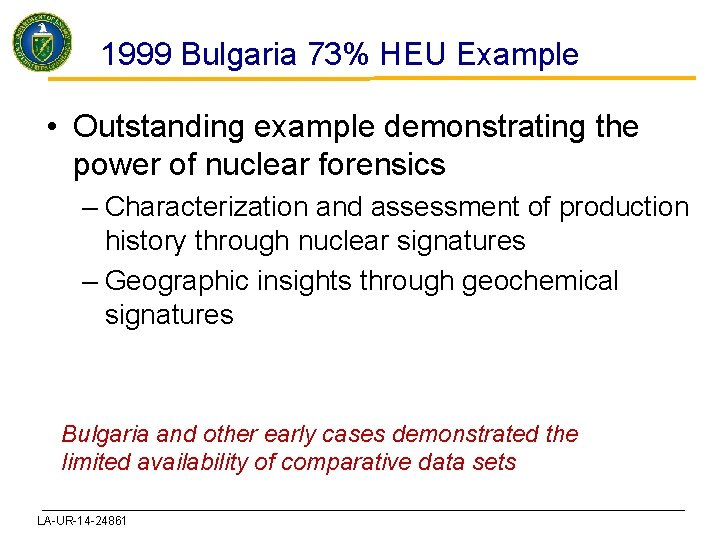
1999 Bulgaria 73% HEU Example • Outstanding example demonstrating the power of nuclear forensics – Characterization and assessment of production history through nuclear signatures – Geographic insights through geochemical signatures Bulgaria and other early cases demonstrated the limited availability of comparative data sets LA-UR-14 -24861
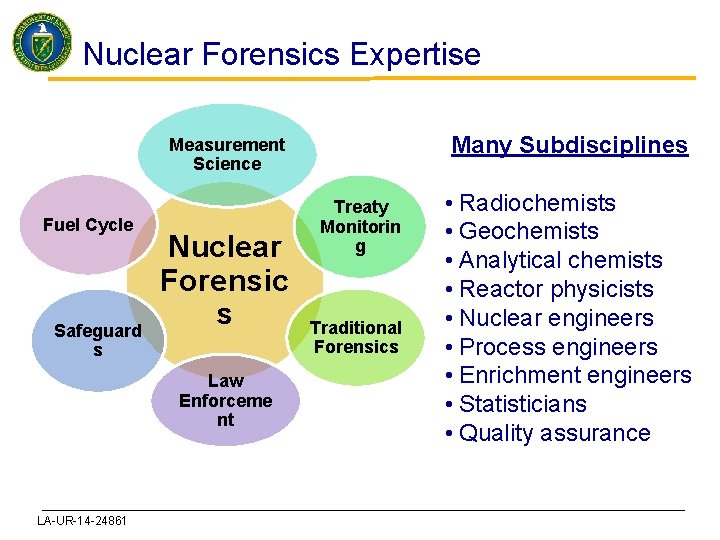
Nuclear Forensics Expertise Many Subdisciplines Measurement Science Fuel Cycle Safeguard s Nuclear Forensic s Law Enforceme nt LA-UR-14 -24861 Treaty Monitorin g Traditional Forensics • Radiochemists • Geochemists • Analytical chemists • Reactor physicists • Nuclear engineers • Process engineers • Enrichment engineers • Statisticians • Quality assurance
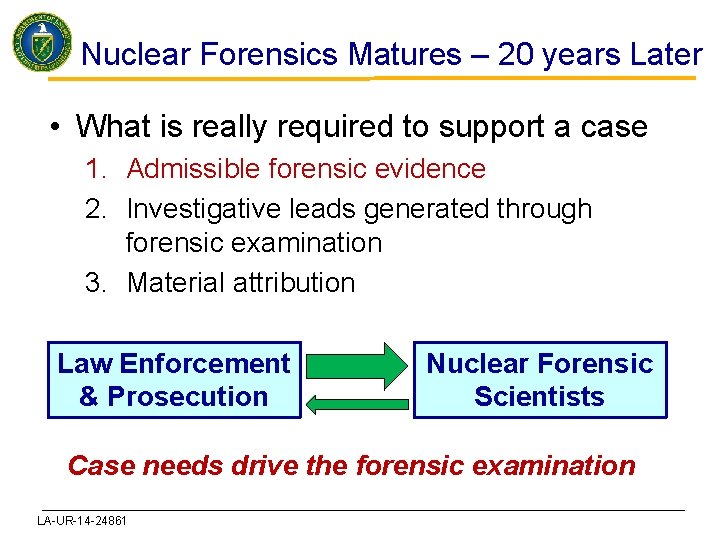
Nuclear Forensics Matures – 20 years Later • What is really required to support a case 1. Admissible forensic evidence 2. Investigative leads generated through forensic examination 3. Material attribution Law Enforcement & Prosecution Nuclear Forensic Scientists Case needs drive the forensic examination LA-UR-14 -24861
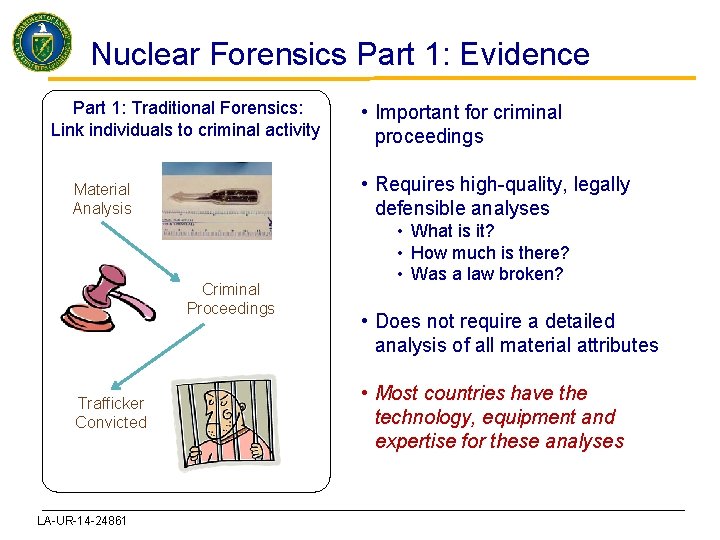
Nuclear Forensics Part 1: Evidence Part 1: Traditional Forensics: Link individuals to criminal activity • Requires high-quality, legally defensible analyses Material Analysis Criminal Proceedings Trafficker Convicted LA-UR-14 -24861 • Important for criminal proceedings • What is it? • How much is there? • Was a law broken? • Does not require a detailed analysis of all material attributes • Most countries have the technology, equipment and expertise for these analyses
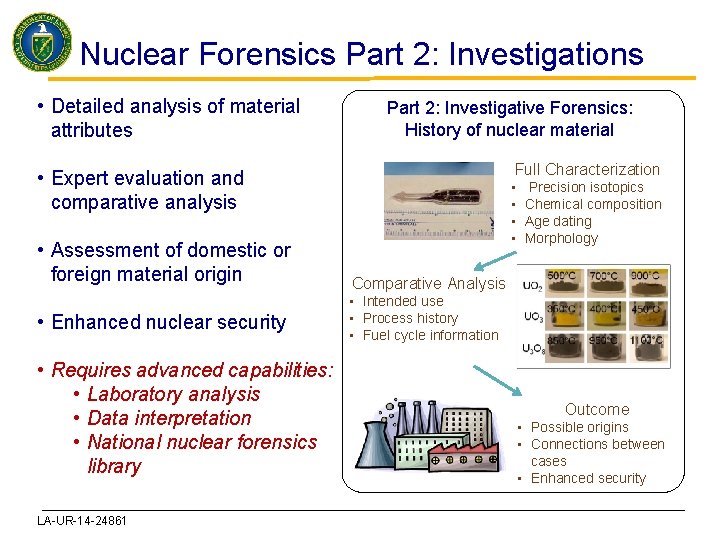
Nuclear Forensics Part 2: Investigations • Detailed analysis of material attributes Part 2: Investigative Forensics: History of nuclear material Full Characterization • Expert evaluation and comparative analysis • Assessment of domestic or foreign material origin • Enhanced nuclear security • Requires advanced capabilities: • Laboratory analysis • Data interpretation • National nuclear forensics library LA-UR-14 -24861 • • Precision isotopics Chemical composition Age dating Morphology Comparative Analysis • Intended use • Process history • Fuel cycle information Outcome • Possible origins • Connections between cases • Enhanced security
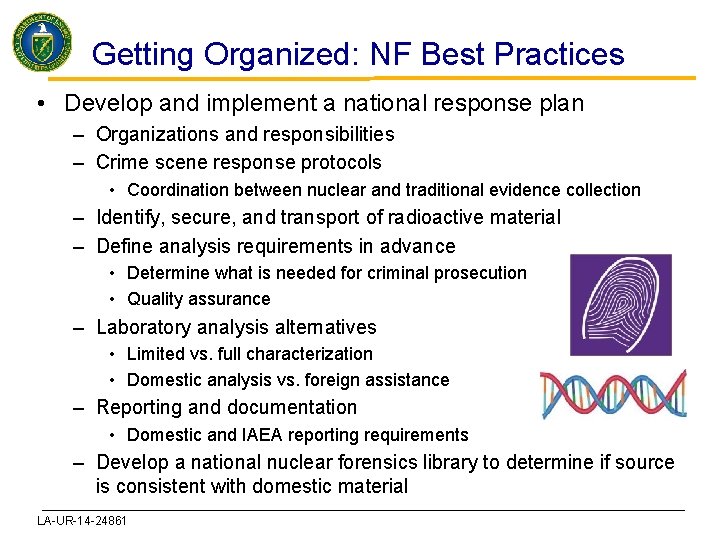
Getting Organized: NF Best Practices • Develop and implement a national response plan – Organizations and responsibilities – Crime scene response protocols • Coordination between nuclear and traditional evidence collection – Identify, secure, and transport of radioactive material – Define analysis requirements in advance • Determine what is needed for criminal prosecution • Quality assurance – Laboratory analysis alternatives • Limited vs. full characterization • Domestic analysis vs. foreign assistance – Reporting and documentation • Domestic and IAEA reporting requirements – Develop a national nuclear forensics library to determine if source is consistent with domestic material LA-UR-14 -24861
Integration of Quality Assurance (QA) • Quality assurance is now an important part of any nuclear forensics program – Ensures admissibility of evidence during criminal proceedings – Provides reliable investigative information • International Organization for Standards (ISO) – ISO 17020 for Field Work – ISO 17025 for Laboratory Analysis – ISO 17043 for Proficiency Testing • Regularly evaluate capabilities using table top, laboratory proficiency, and end-to-end test exercises LA-UR-14 -24861
Investigating Possible Material Origin • If some nuclear material is found outside of administrative controls anywhere in the world, then each country should be able to answer the question: “Is it consistent with our material? ” • Verifying inventory based on material accountancy data or source registries may not be sufficient – A serious problem for small quantities – Materials that pre-date implementation of good accounting practices • This question forms a basic requirement for developing a national nuclear forensic library LA-UR-14 -24861
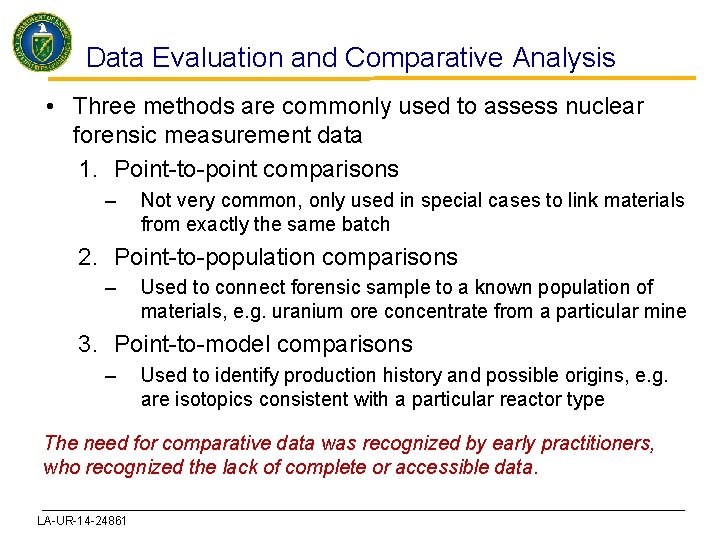
Data Evaluation and Comparative Analysis • Three methods are commonly used to assess nuclear forensic measurement data 1. Point-to-point comparisons – Not very common, only used in special cases to link materials from exactly the same batch 2. Point-to-population comparisons – Used to connect forensic sample to a known population of materials, e. g. uranium ore concentrate from a particular mine 3. Point-to-model comparisons – Used to identify production history and possible origins, e. g. are isotopics consistent with a particular reactor type The need for comparative data was recognized by early practitioners, who recognized the lack of complete or accessible data. LA-UR-14 -24861
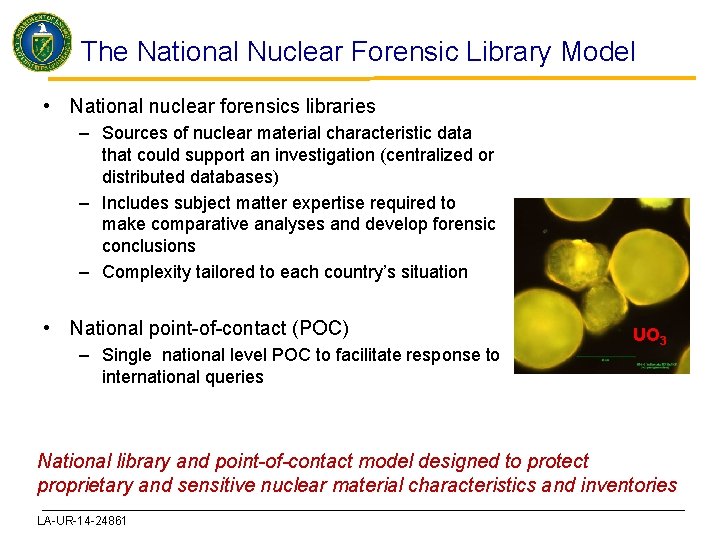
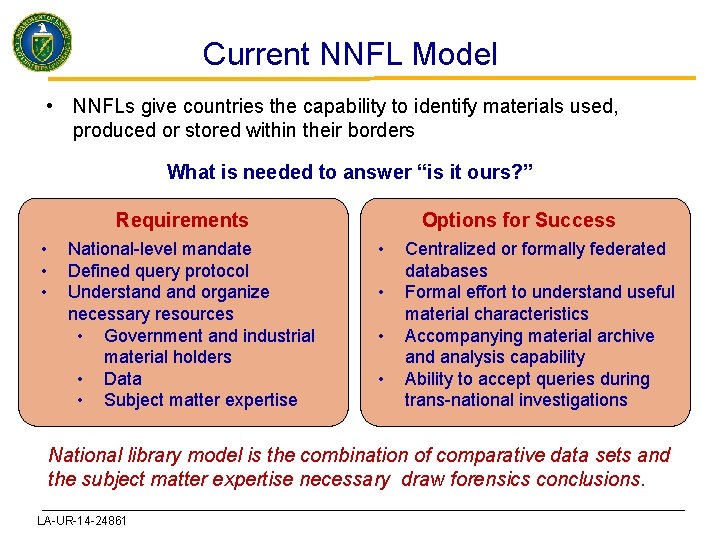
The National Nuclear Forensic Library Model • National nuclear forensics libraries – Sources of nuclear material characteristic data that could support an investigation (centralized or distributed databases) – Includes subject matter expertise required to make comparative analyses and develop forensic conclusions – Complexity tailored to each country’s situation • National point-of-contact (POC) – Single national level POC to facilitate response to international queries UO 3 National library and point-of-contact model designed to protect proprietary and sensitive nuclear material characteristics and inventories LA-UR-14 -24861
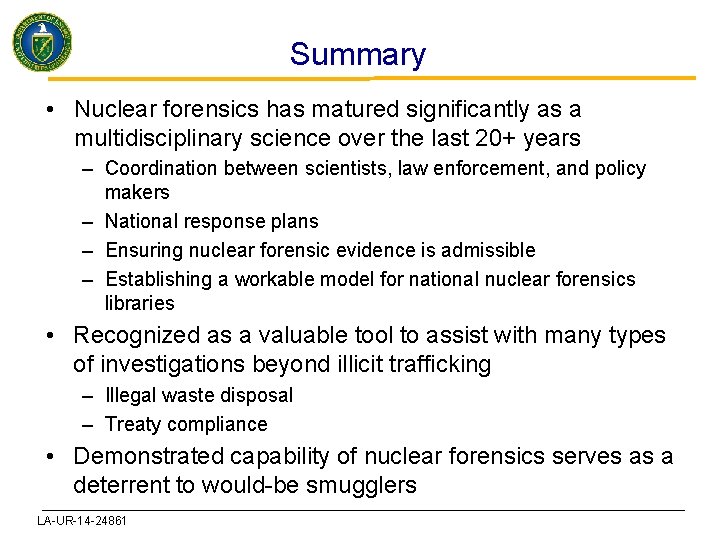
Summary • Nuclear forensics has matured significantly as a multidisciplinary science over the last 20+ years – Coordination between scientists, law enforcement, and policy makers – National response plans – Ensuring nuclear forensic evidence is admissible – Establishing a workable model for national nuclear forensics libraries • Recognized as a valuable tool to assist with many types of investigations beyond illicit trafficking – Illegal waste disposal – Treaty compliance • Demonstrated capability of nuclear forensics serves as a deterrent to would-be smugglers LA-UR-14 -24861
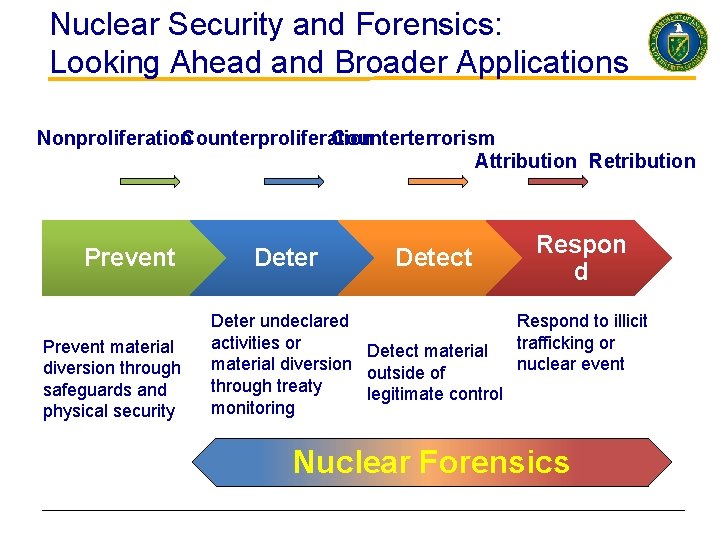
Nuclear Security and Forensics: Looking Ahead and Broader Applications Nonproliferation Counterterrorism Attribution Retribution Prevent material diversion through safeguards and physical security Deter Detect Respon d Deter undeclared Respond to illicit activities or trafficking or Detect material diversion outside of nuclear event through treaty legitimate control monitoring Nuclear Forensics
Acknowledgements • U. S. Department of Energy – Marcia Brisson, Heather Dion & Ed Fei • U. S. Department of State – Michael Curry & Sarah Fendrich • U. S. Department of Homeland Security – Frank Wong • U. S. Federal Bureau of Investigation – Ben Garret, James Blankenship, Brian Kile • Lawrence Livermore National Laboratory – Ian Hutcheon, Michael Kristo, Martin Robel, Kim Knight, Ross Williams • Los Alamos National Laboratory – Lav Tandon, Robert Steiner • Pacific Northwest National Laboratory – John Wacker LA-UR-14 -24861
Backup Slides LA-UR-14 -24861
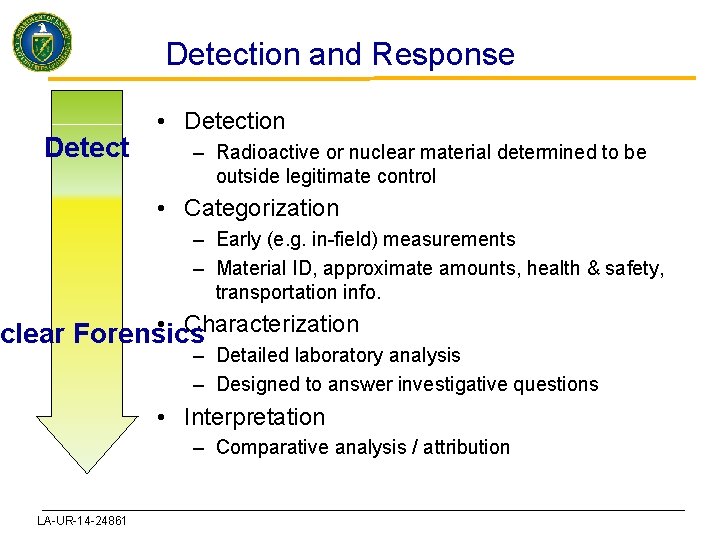
Detection and Response Detect • Detection – Radioactive or nuclear material determined to be outside legitimate control • Categorization – Early (e. g. in-field) measurements – Material ID, approximate amounts, health & safety, transportation info. • Characterization clear Forensics – Detailed laboratory analysis – Designed to answer investigative questions • Interpretation – Comparative analysis / attribution LA-UR-14 -24861
Current NNFL Model • NNFLs give countries the capability to identify materials used, produced or stored within their borders What is needed to answer “is it ours? ” Requirements • • • National-level mandate Defined query protocol Understand organize necessary resources • Government and industrial material holders • Data • Subject matter expertise Options for Success • • Centralized or formally federated databases Formal effort to understand useful material characteristics Accompanying material archive and analysis capability Ability to accept queries during trans-national investigations National library model is the combination of comparative data sets and the subject matter expertise necessary draw forensics conclusions. LA-UR-14 -24861