
Nuclear enhancement of the spin Hall angle near
- Slides: 1
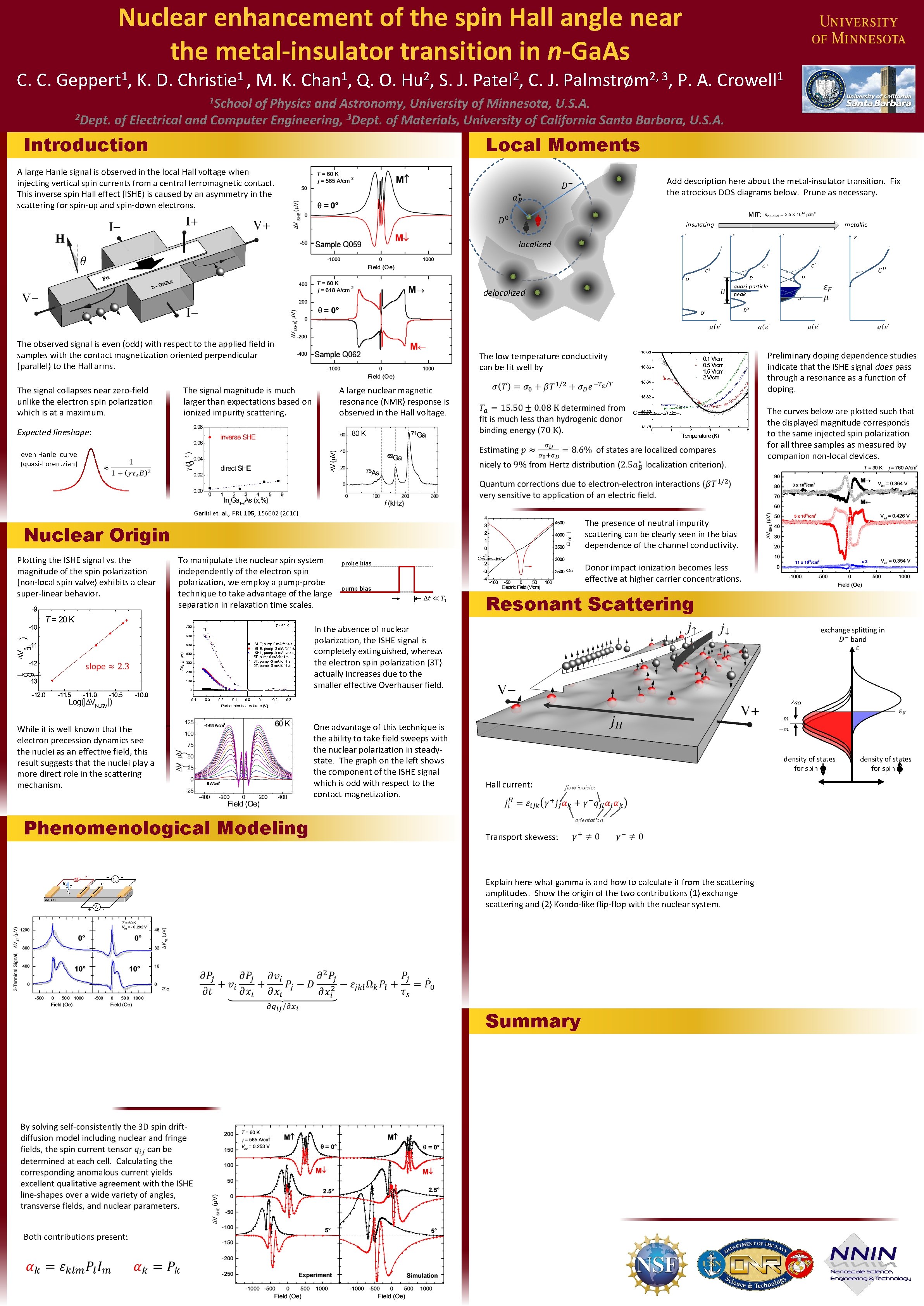
Nuclear enhancement of the spin Hall angle near the metal-insulator transition in n-Ga. As C. C. 1 Geppert , K. D. 1 Christie , M. K. 1 Chan , Q. O. 2 Hu , S. J. 2 Patel , C. J. 2, 3 Palmstrøm , P. A. 1 Crowell 1 School of Physics and Astronomy, University of Minnesota, U. S. A. 2 Dept. of Electrical and Computer Engineering, 3 Dept. of Materials, University of California Santa Barbara, U. S. A. Introduction Local Moments A large Hanle signal is observed in the local Hall voltage when injecting vertical spin currents from a central ferromagnetic contact. This inverse spin Hall effect (ISHE) is caused by an asymmetry in the scattering for spin-up and spin-down electrons. Add description here about the metal-insulator transition. Fix the atrocious DOS diagrams below. Prune as necessary. MIT: metallic insulating localized quasi-particle peak delocalized The observed signal is even (odd) with respect to the applied field in samples with the contact magnetization oriented perpendicular (parallel) to the Hall arms. The signal collapses near zero-field unlike the electron spin polarization which is at a maximum. The low temperature conductivity can be fit well by The signal magnitude is much larger than expectations based on ionized impurity scattering. A large nuclear magnetic resonance (NMR) response is observed in the Hall voltage. The curves below are plotted such that the displayed magnitude corresponds to the same injected spin polarization for all three samples as measured by companion non-local devices. Expected lineshape: even Hanle curve (quasi-Lorentzian) Garlid et. al. , PRL 105, 156602 (2010) The presence of neutral impurity scattering can be clearly seen in the bias dependence of the channel conductivity. Nuclear Origin Plotting the ISHE signal vs. the magnitude of the spin polarization (non-local spin valve) exhibits a clear super-linear behavior. Preliminary doping dependence studies indicate that the ISHE signal does pass through a resonance as a function of doping. To manipulate the nuclear spin system independently of the electron spin polarization, we employ a pump-probe technique to take advantage of the large separation in relaxation time scales. probe bias pump bias Donor impact ionization becomes less effective at higher carrier concentrations. Resonant Scattering In the absence of nuclear polarization, the ISHE signal is completely extinguished, whereas the electron spin polarization (3 T) actually increases due to the smaller effective Overhauser field. While it is well known that the electron precession dynamics see the nuclei as an effective field, this result suggests that the nuclei play a more direct role in the scattering mechanism. Phenomenological Modeling One advantage of this technique is the ability to take field sweeps with the nuclear polarization in steadystate. The graph on the left shows the component of the ISHE signal which is odd with respect to the contact magnetization. density of states for spin. Hall current: flow indicies orientation Transport skewess: Explain here what gamma is and how to calculate it from the scattering amplitudes. Show the origin of the two contributions (1) exchange scattering and (2) Kondo-like flip-flop with the nuclear system. Summary Both contributions present: density of states for spin.