
Nuclear Energy for Oil Extraction in Canadian Tar
- Slides: 22
Nuclear Energy for Oil Extraction in Canadian Tar Sands: Integration of Nuclear Power with In-Situ Oil Extraction Professor Andrew C. Kadak Professor of the Practice Massachusetts Institute of Technology Nuclear Science & Engineering Life Cycle Assessment Special Nuclear Session November 3 rd, 2006, 1: 30 pm-3: 00 pm University of Calgary
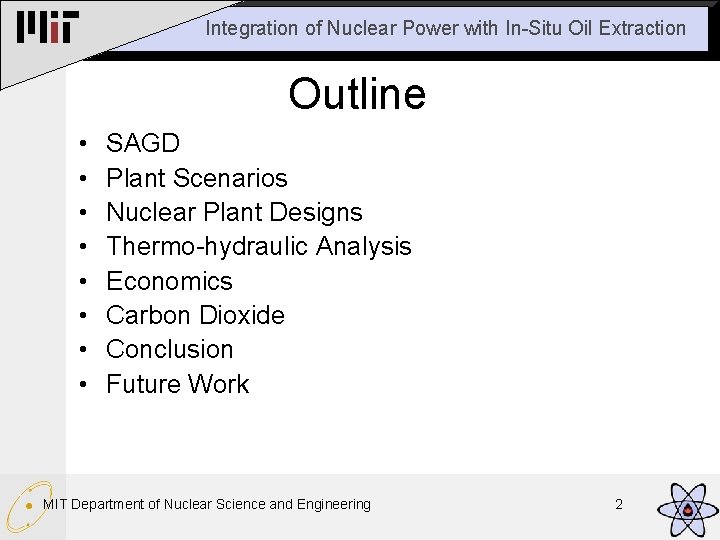
Integration of Nuclear Power with In-Situ Oil Extraction Outline • • SAGD Plant Scenarios Nuclear Plant Designs Thermo-hydraulic Analysis Economics Carbon Dioxide Conclusion Future Work MIT Department of Nuclear Science and Engineering 2
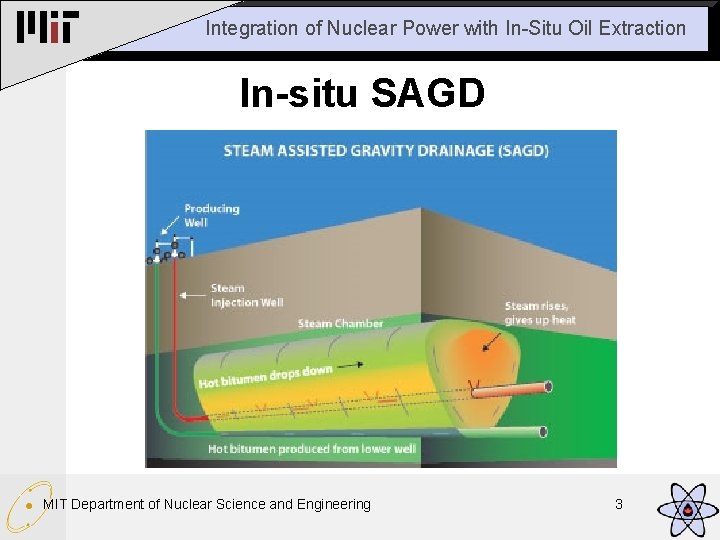
Integration of Nuclear Power with In-Situ Oil Extraction In-situ SAGD MIT Department of Nuclear Science and Engineering 3
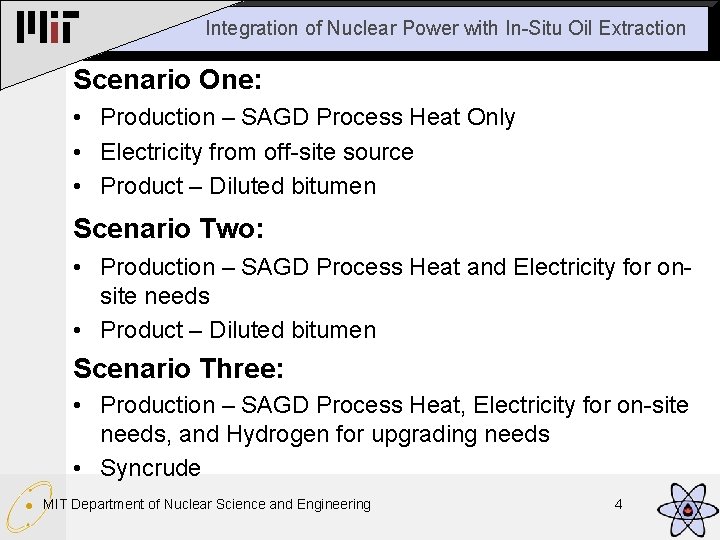
Integration of Nuclear Power with In-Situ Oil Extraction Scenario One: • Production – SAGD Process Heat Only • Electricity from off-site source • Product – Diluted bitumen Scenario Two: • Production – SAGD Process Heat and Electricity for onsite needs • Product – Diluted bitumen Scenario Three: • Production – SAGD Process Heat, Electricity for on-site needs, and Hydrogen for upgrading needs • Syncrude MIT Department of Nuclear Science and Engineering 4
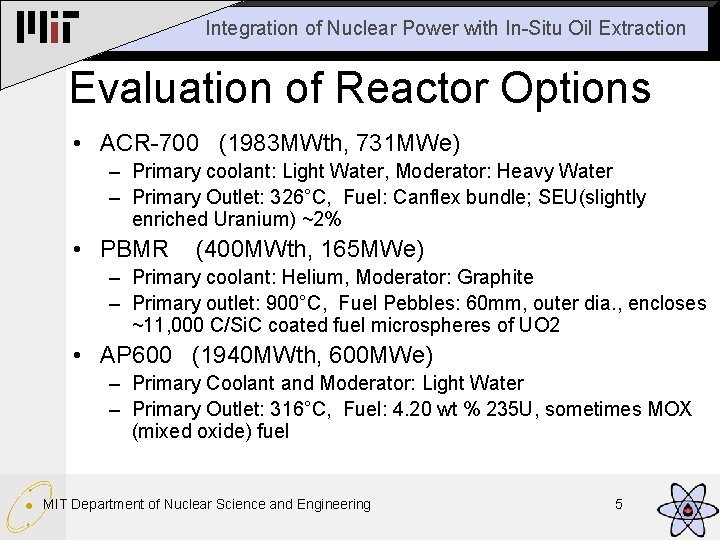
Integration of Nuclear Power with In-Situ Oil Extraction Evaluation of Reactor Options • ACR-700 (1983 MWth, 731 MWe) – Primary coolant: Light Water, Moderator: Heavy Water – Primary Outlet: 326°C, Fuel: Canflex bundle; SEU(slightly enriched Uranium) ~2% • PBMR (400 MWth, 165 MWe) – Primary coolant: Helium, Moderator: Graphite – Primary outlet: 900°C, Fuel Pebbles: 60 mm, outer dia. , encloses ~11, 000 C/Si. C coated fuel microspheres of UO 2 • AP 600 (1940 MWth, 600 MWe) – Primary Coolant and Moderator: Light Water – Primary Outlet: 316°C, Fuel: 4. 20 wt % 235 U, sometimes MOX (mixed oxide) fuel MIT Department of Nuclear Science and Engineering 5
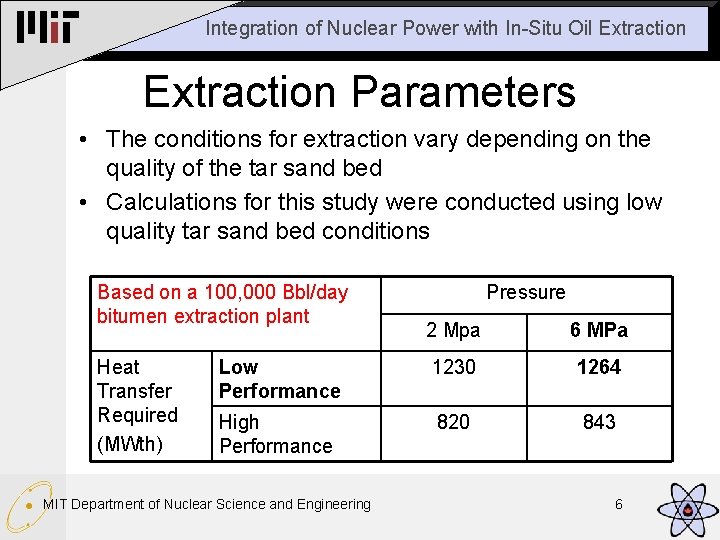
Integration of Nuclear Power with In-Situ Oil Extraction Parameters • The conditions for extraction vary depending on the quality of the tar sand bed • Calculations for this study were conducted using low quality tar sand bed conditions Based on a 100, 000 Bbl/day bitumen extraction plant Heat Transfer Required (MWth) Pressure 2 Mpa 6 MPa Low Performance 1230 1264 High Performance 820 843 MIT Department of Nuclear Science and Engineering 6
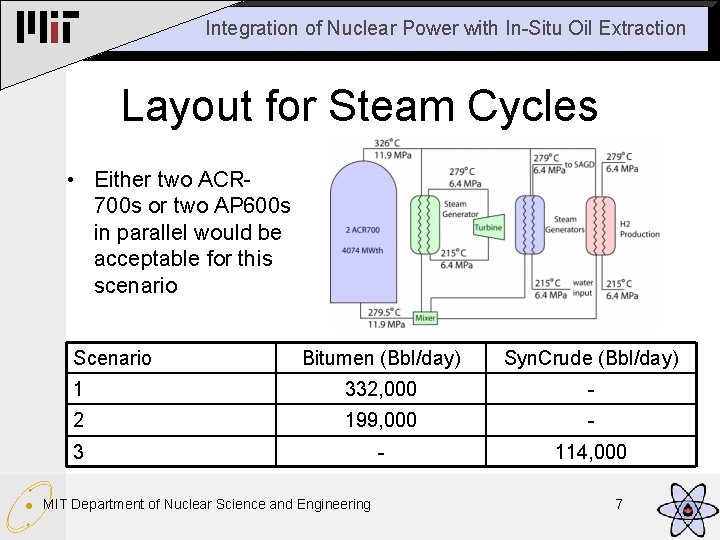
Integration of Nuclear Power with In-Situ Oil Extraction Layout for Steam Cycles • Either two ACR 700 s or two AP 600 s in parallel would be acceptable for this scenario Scenario Bitumen (Bbl/day) Syn. Crude (Bbl/day) 1 332, 000 - 2 199, 000 - 3 - 114, 000 MIT Department of Nuclear Science and Engineering 7
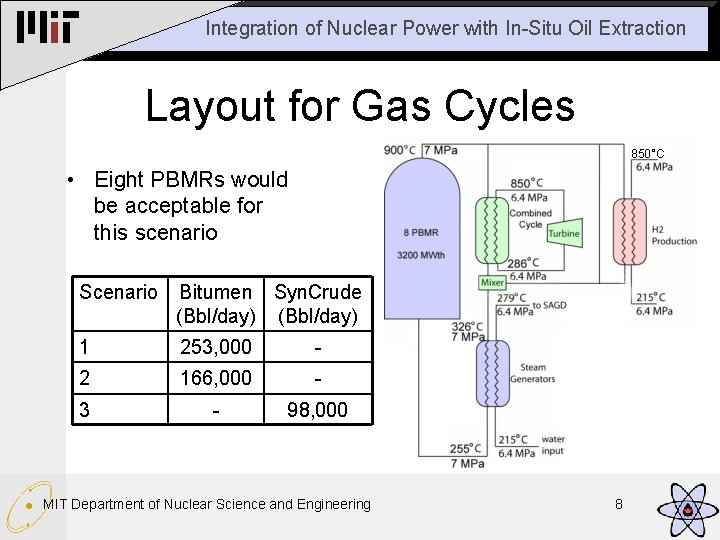
Integration of Nuclear Power with In-Situ Oil Extraction Layout for Gas Cycles 850°C • Eight PBMRs would be acceptable for this scenario Scenario Bitumen Syn. Crude (Bbl/day) 1 253, 000 - 2 166, 000 - 3 - 98, 000 MIT Department of Nuclear Science and Engineering 8
Integration of Nuclear Power with In-Situ Oil Extraction Economics MIT Department of Nuclear Science and Engineering 9
Integration of Nuclear Power with In-Situ Oil Extraction Purpose of economic analysis 1. Should natural gas or nuclear be used for the SAGD extraction process? 2. Should the electricity requirements of the plant be fulfilled by buying electricity off the power grids, or by making it at the plant? 3. Should the hydrogen required for the bitumen upgrading process be bought from private suppliers, or produced at the plant? **This is meant to be a comparison between nuclear and natural gas energy sources for this application, not an estimate of the actual full cost of the facility. MIT Department of Nuclear Science and Engineering 10
Integration of Nuclear Power with In-Situ Oil Extraction Economic Assumptions • All costs are in US dollars (US$) • The lifetime for the plants are assumed to be 30 years, and the Net Present Value (NPV) is calculated for a 10% discount rate • No inflation is assumed • Easy access to Alberta electricity power grid is assumed, price is ~US$0. 05/k. Whr • Buying price of hydrogen is assumed to be ~US$2. 50/kg of H 2 • Natural gas price is assumed to be $8. 00/mm. Btu MIT Department of Nuclear Science and Engineering 11
Integration of Nuclear Power with In-Situ Oil Extraction Economic Assumptions, Cont’d. • A 90% learning curve is assumed for building additional nuclear reactors • Costs do not include that of processing and upgrading plants as these are held constant and independent of heat source used. • 4 categories of cost: capital, O&M, fuel, and decommissioning • 3 final types of costs looked at: Cost of Process Heat, Cost of Electricity, and Cost of Hydrogen Production MIT Department of Nuclear Science and Engineering 12
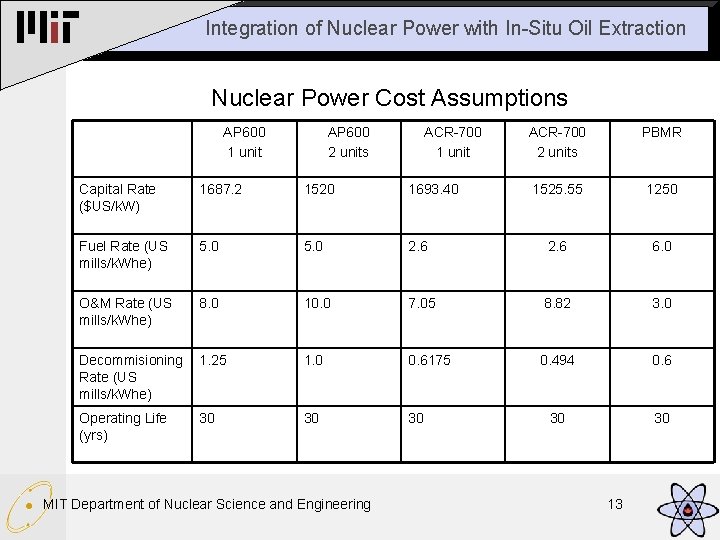
Integration of Nuclear Power with In-Situ Oil Extraction Nuclear Power Cost Assumptions AP 600 1 unit AP 600 2 units ACR-700 1 unit ACR-700 2 units PBMR 1525. 55 1250 Capital Rate ($US/k. W) 1687. 2 1520 1693. 40 Fuel Rate (US mills/k. Whe) 5. 0 2. 6 6. 0 O&M Rate (US mills/k. Whe) 8. 0 10. 0 7. 05 8. 82 3. 0 Decommisioning Rate (US mills/k. Whe) 1. 25 1. 0 0. 6175 0. 494 0. 6 Operating Life (yrs) 30 30 30 MIT Department of Nuclear Science and Engineering 13
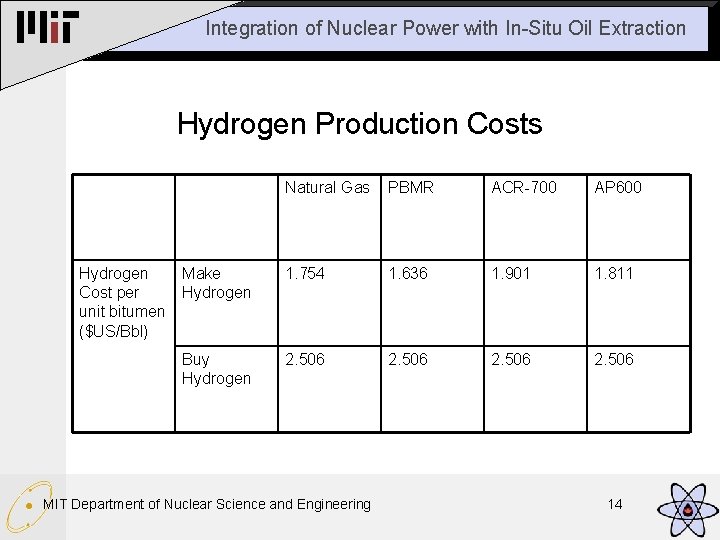
Integration of Nuclear Power with In-Situ Oil Extraction Hydrogen Production Costs Natural Gas PBMR ACR-700 AP 600 Hydrogen Make Cost per Hydrogen unit bitumen ($US/Bbl) 1. 754 1. 636 1. 901 1. 811 Buy Hydrogen 2. 506 MIT Department of Nuclear Science and Engineering 14
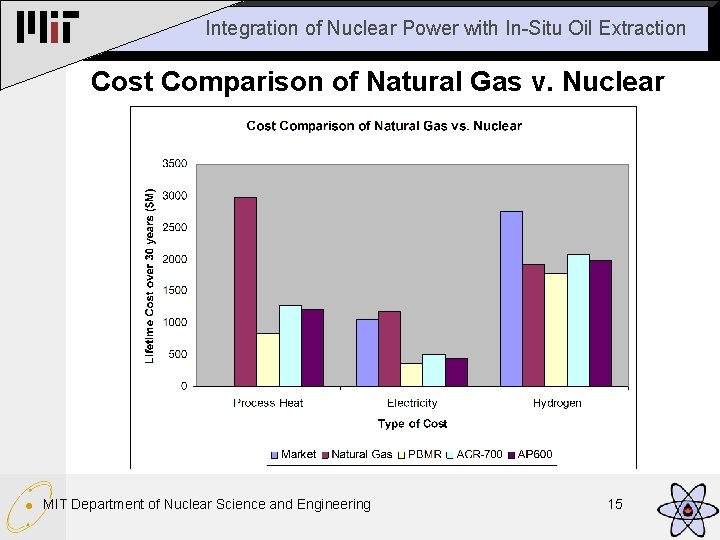
Integration of Nuclear Power with In-Situ Oil Extraction Cost Comparison of Natural Gas v. Nuclear MIT Department of Nuclear Science and Engineering 15
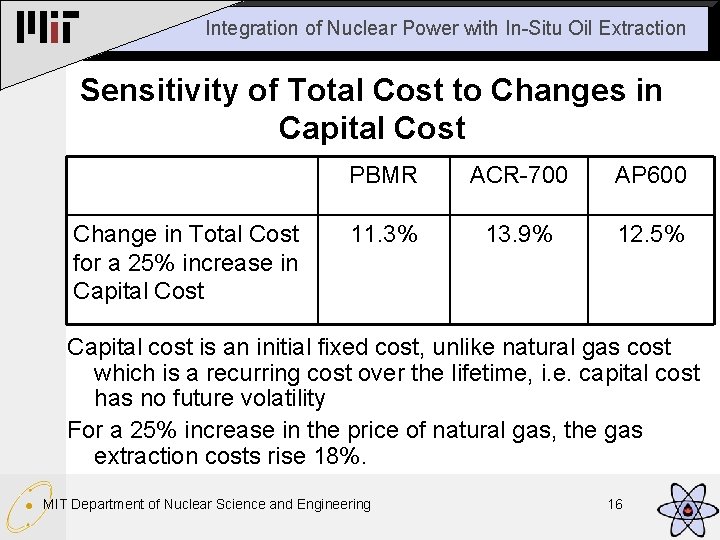
Integration of Nuclear Power with In-Situ Oil Extraction Sensitivity of Total Cost to Changes in Capital Cost Change in Total Cost for a 25% increase in Capital Cost PBMR ACR-700 AP 600 11. 3% 13. 9% 12. 5% Capital cost is an initial fixed cost, unlike natural gas cost which is a recurring cost over the lifetime, i. e. capital cost has no future volatility For a 25% increase in the price of natural gas, the gas extraction costs rise 18%. MIT Department of Nuclear Science and Engineering 16
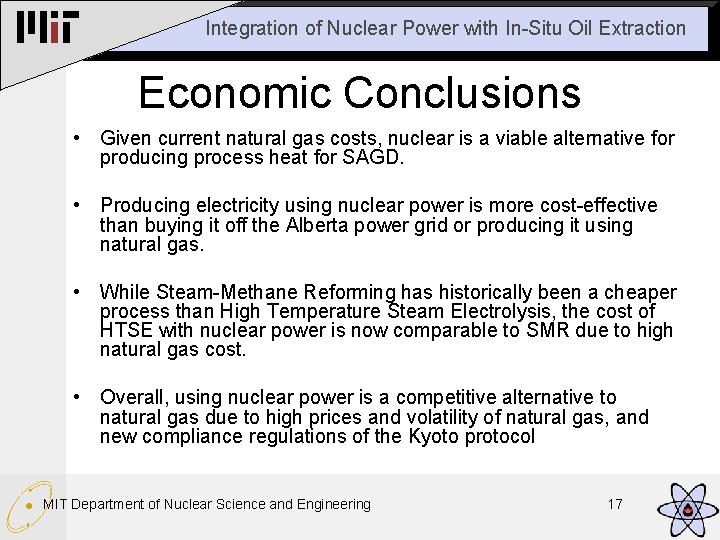
Integration of Nuclear Power with In-Situ Oil Extraction Economic Conclusions • Given current natural gas costs, nuclear is a viable alternative for producing process heat for SAGD. • Producing electricity using nuclear power is more cost-effective than buying it off the Alberta power grid or producing it using natural gas. • While Steam-Methane Reforming has historically been a cheaper process than High Temperature Steam Electrolysis, the cost of HTSE with nuclear power is now comparable to SMR due to high natural gas cost. • Overall, using nuclear power is a competitive alternative to natural gas due to high prices and volatility of natural gas, and new compliance regulations of the Kyoto protocol MIT Department of Nuclear Science and Engineering 17
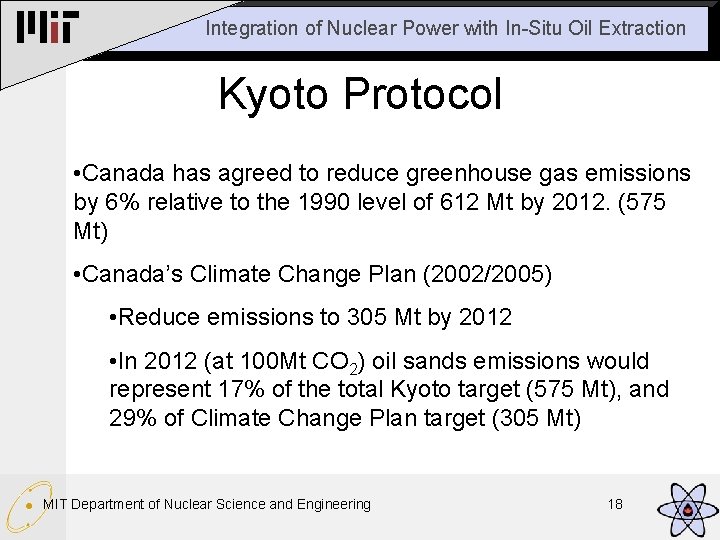
Integration of Nuclear Power with In-Situ Oil Extraction Kyoto Protocol • Canada has agreed to reduce greenhouse gas emissions by 6% relative to the 1990 level of 612 Mt by 2012. (575 Mt) • Canada’s Climate Change Plan (2002/2005) • Reduce emissions to 305 Mt by 2012 • In 2012 (at 100 Mt CO 2) oil sands emissions would represent 17% of the total Kyoto target (575 Mt), and 29% of Climate Change Plan target (305 Mt) MIT Department of Nuclear Science and Engineering 18
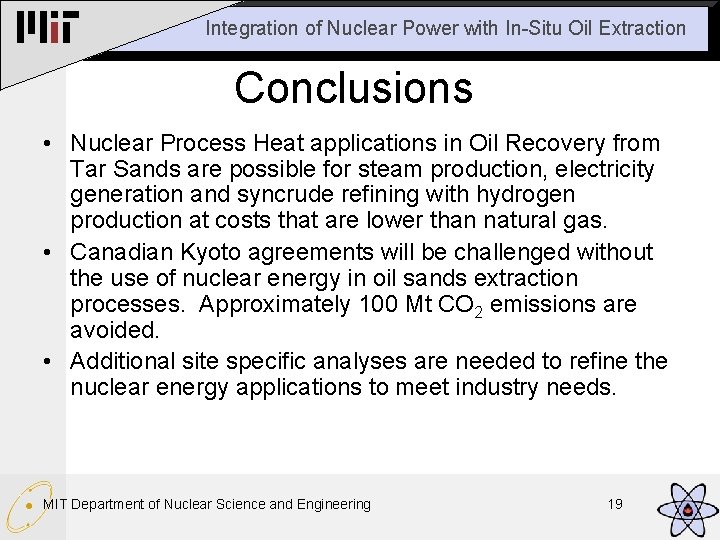
Integration of Nuclear Power with In-Situ Oil Extraction Conclusions • Nuclear Process Heat applications in Oil Recovery from Tar Sands are possible for steam production, electricity generation and syncrude refining with hydrogen production at costs that are lower than natural gas. • Canadian Kyoto agreements will be challenged without the use of nuclear energy in oil sands extraction processes. Approximately 100 Mt CO 2 emissions are avoided. • Additional site specific analyses are needed to refine the nuclear energy applications to meet industry needs. MIT Department of Nuclear Science and Engineering 19
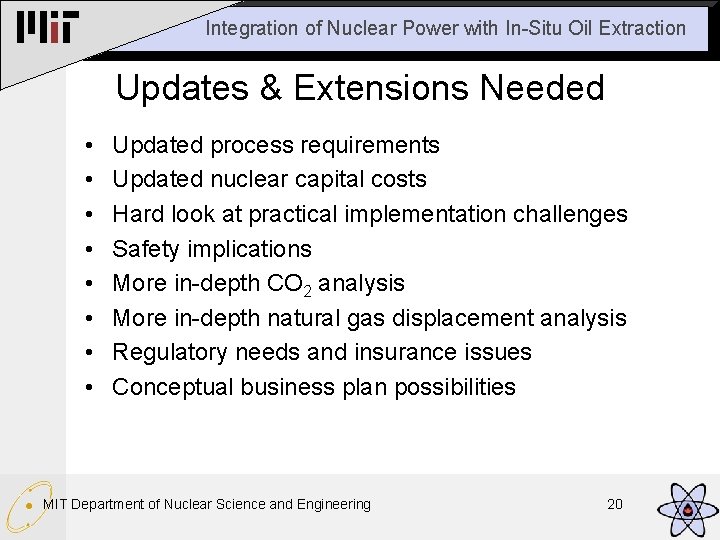
Integration of Nuclear Power with In-Situ Oil Extraction Updates & Extensions Needed • • Updated process requirements Updated nuclear capital costs Hard look at practical implementation challenges Safety implications More in-depth CO 2 analysis More in-depth natural gas displacement analysis Regulatory needs and insurance issues Conceptual business plan possibilities MIT Department of Nuclear Science and Engineering 20
Integration of Nuclear Power with In-Situ Oil Extraction Acknowledgements This study was prepared as an MIT class design project in the Department of Nuclear Science & Engineering. The authors of the original study included: G. Becerra, E. Esparza, E. Helvenston, S. Hembrador, K. Hohnholt, T. Khan, D. Legault, M. Lyttle, C. Murray, N. Parmar, S. Sheppard, C. Sizer, E. Zakszewski, K. Zeller Assistance and information were also provided by: Ryan Hannink of MIT, Dr. Julian Lebenhaft of AECL, William Green of MIT, The Canadian Nuclear Safety Commission, Westinghouse Electric Company, James Fong of Petro-Canada, Bilge Yildiz of Argonne National Laboratory, Brian Rolfe of AECL, Michael Stawicki and Professor Mujid Kazimi of the MIT Nuclear Science and Engineering Department, Thomas Downar of Purdue, Daniel Bersak of DRB photography, MIT alumnus Curtis Smith of INL, and the faculty members of the MIT Department of Nuclear Science and Engineering 21
Integration of Nuclear Power with In-Situ Oil Extraction Questions MIT Department of Nuclear Science and Engineering 22