
Nuclear Data Evaluations for Tungsten 182 184 186
- Slides: 33
Nuclear Data Evaluations for Tungsten 182 -184, 186 W and 63, 65 Cu isotopes L. C. Leal, M. T. Pigni, and V. Sobes Oak Ridge National Laboratory Oak Ridge, TN CSEWG Brookhaven National Laboratory May 7 -8, 2015 ORNL is managed by UT-Battelle for the US Department of Energy
Presentation Road Map • Nuclear Data Evaluation Overview at ORNL not including CIELO activities • Evaluation Procedure with SAMMY § Differential data evaluation process § Connection to integral data (benchmark) • Evaluation work on 183 W (Pigni) • Evaluation work on 182, 184, 186 Tungsten (Leal) • Evaluation work on 63, 65 Cu (Sobes) • Concluding Remarks 2 L. Leal
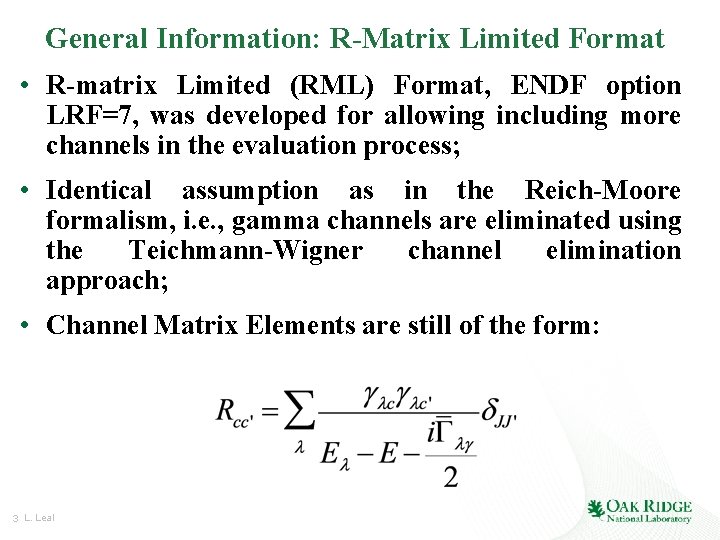
General Information: R-Matrix Limited Format • R-matrix Limited (RML) Format, ENDF option LRF=7, was developed for allowing including more channels in the evaluation process; • Identical assumption as in the Reich-Moore formalism, i. e. , gamma channels are eliminated using the Teichmann-Wigner channel elimination approach; • Channel Matrix Elements are still of the form: 3 L. Leal
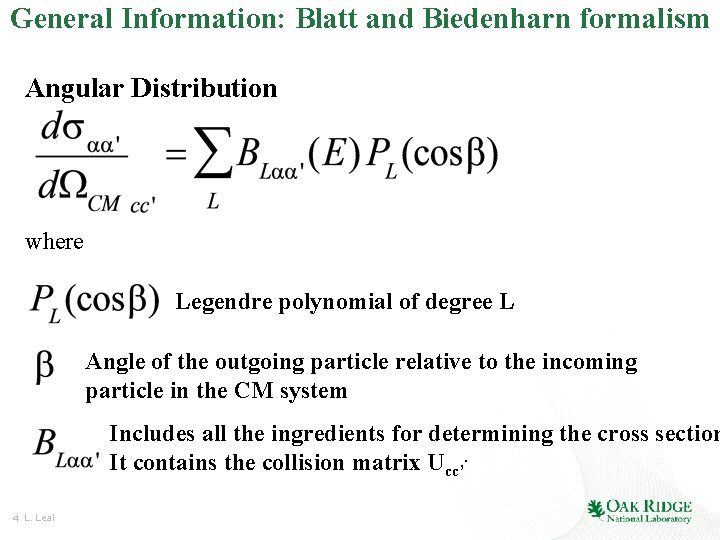
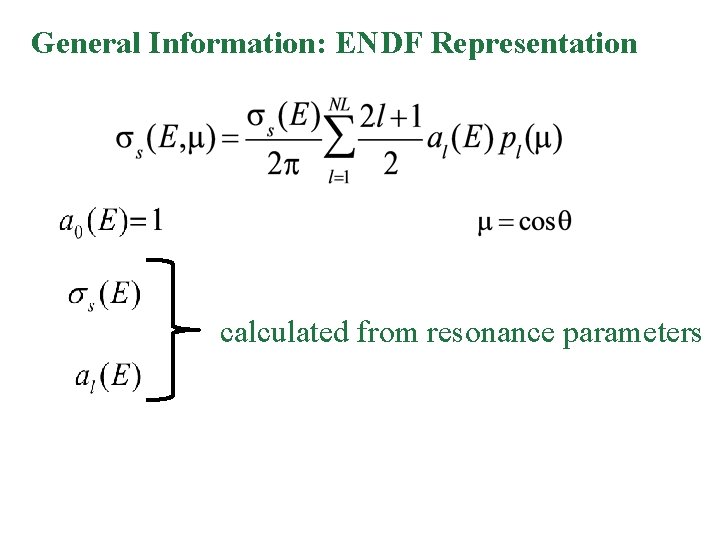
General Information: Blatt and Biedenharn formalism Angular Distribution where Legendre polynomial of degree L Angle of the outgoing particle relative to the incoming particle in the CM system Includes all the ingredients for determining the cross section It contains the collision matrix Ucc’. 4 L. Leal
General Information: ENDF Representation calculated from resonance parameters
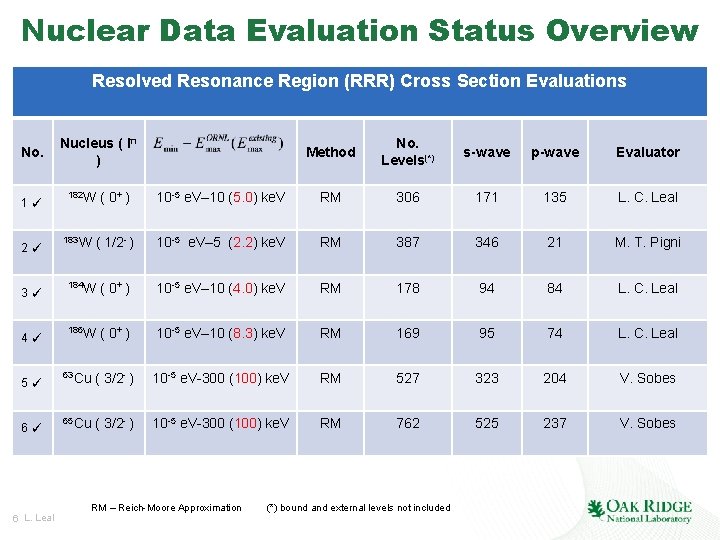
Nuclear Data Evaluation Status Overview Resolved Resonance Region (RRR) Cross Section Evaluations No. Nucleus ( Iπ ) Method No. Levels(*) s-wave p-wave Evaluator 1 ✓ 182 W ( 0+ ) 10 -5 e. V– 10 (5. 0) ke. V RM 306 171 135 L. C. Leal 2 ✓ 183 W ( 1/2 - ) 10 -5 e. V– 5 (2. 2) ke. V RM 387 346 21 M. T. Pigni 3 ✓ 184 W ( 0+ ) 10 -5 e. V– 10 (4. 0) ke. V RM 178 94 84 L. C. Leal 4 ✓ 186 W ( 0+ ) 10 -5 e. V– 10 (8. 3) ke. V RM 169 95 74 L. C. Leal 5 ✓ 63 Cu ( 3/2 - ) 10 -5 e. V-300 (100) ke. V RM 527 323 204 V. Sobes 6 ✓ 65 Cu ( 3/2 - ) 10 -5 e. V-300 (100) ke. V RM 762 525 237 V. Sobes 6 L. Leal RM – Reich-Moore Approximation (*) bound and external levels not included
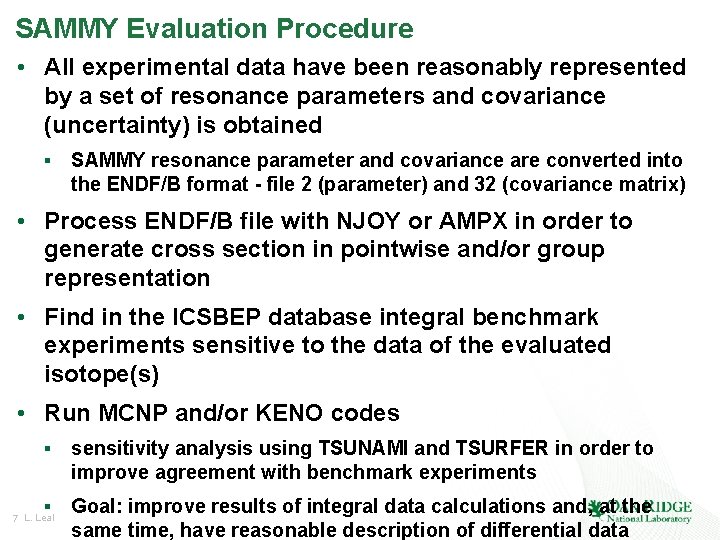
SAMMY Evaluation Procedure • All experimental data have been reasonably represented by a set of resonance parameters and covariance (uncertainty) is obtained § SAMMY resonance parameter and covariance are converted into the ENDF/B format - file 2 (parameter) and 32 (covariance matrix) • Process ENDF/B file with NJOY or AMPX in order to generate cross section in pointwise and/or group representation • Find in the ICSBEP database integral benchmark experiments sensitive to the data of the evaluated isotope(s) • Run MCNP and/or KENO codes § sensitivity analysis using TSUNAMI and TSURFER in order to improve agreement with benchmark experiments § Goal: improve results of integral data calculations and, at the same time, have reasonable description of differential data 7 L. Leal
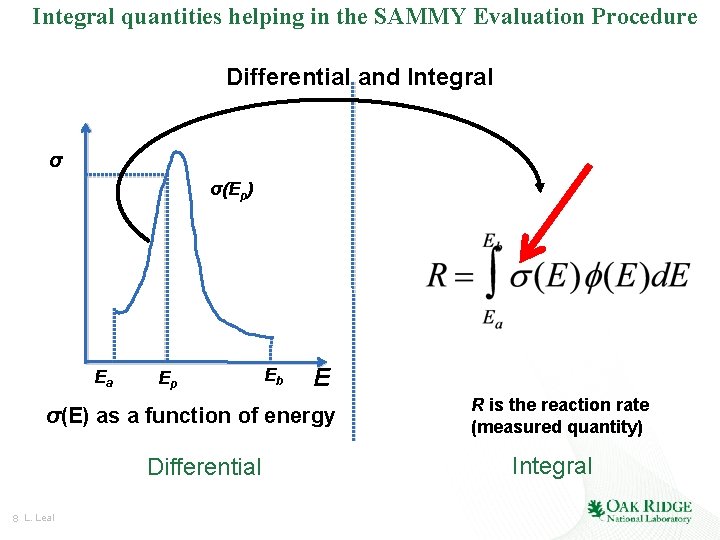
Integral quantities helping in the SAMMY Evaluation Procedure Differential and Integral σ σ(Ep) Ea Ep Eb E σ(E) as a function of energy Differential 8 L. Leal R is the reaction rate (measured quantity) Integral
External Levels and Database • External levels: bound levels (negative resonances) and levels above the resonance region Careful determination of the external levels is needed before starting a SAMMY evaluation § It provides a good understanding of the scattering potential cross section § Indicates whether background effects a properly calculated § (Effective) nuclear scattering radii are well defined once the external levels have been determined § § Provides an insight whether a direct reaction component is present • Consistency of the database § § § 9 L. Leal Resolution function (ORELA, GELINA, …) Data normalization …
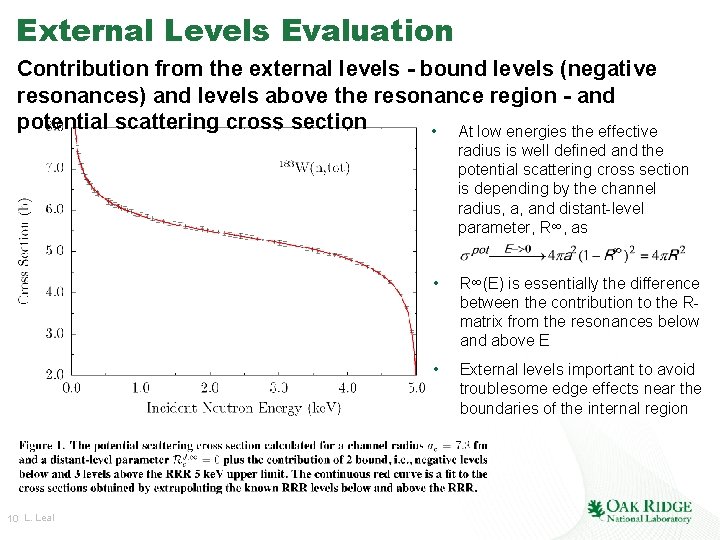
External Levels Evaluation Contribution from the external levels - bound levels (negative resonances) and levels above the resonance region - and potential scattering cross section • At low energies the effective radius is well defined and the potential scattering cross section is depending by the channel radius, a, and distant-level parameter, R∞, as 10 L. Leal • R∞(E) is essentially the difference between the contribution to the Rmatrix from the resonances below and above E • External levels important to avoid troublesome edge effects near the boundaries of the internal region
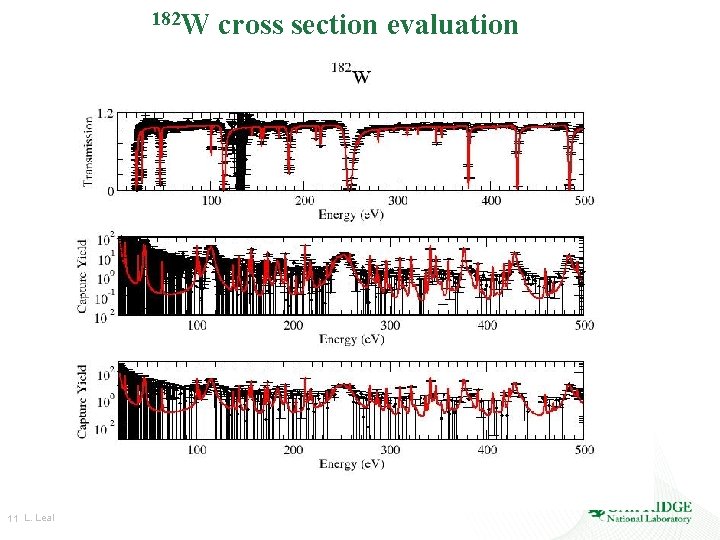
182 W 11 L. Leal cross section evaluation
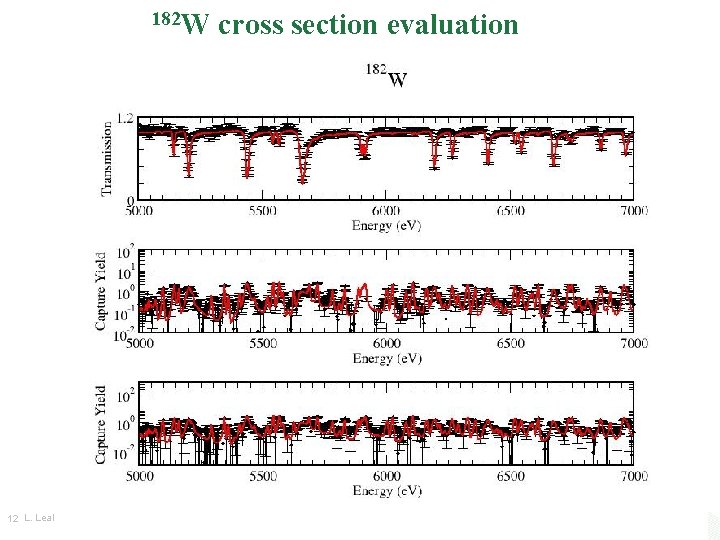
182 W 12 L. Leal cross section evaluation
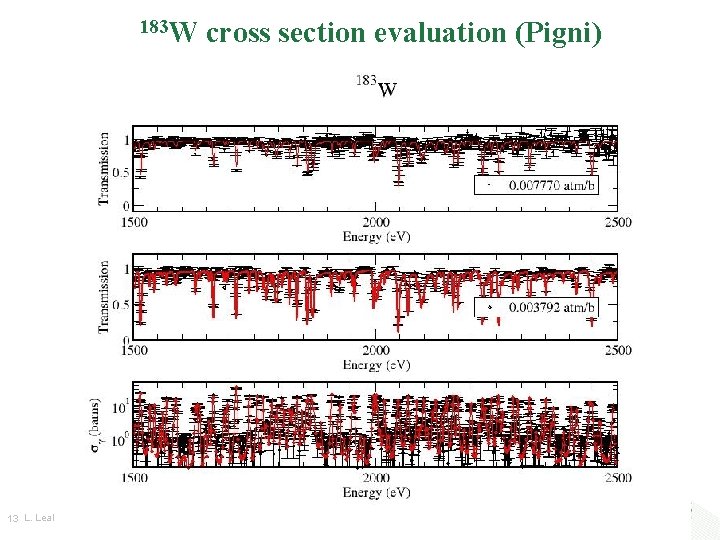
183 W 13 L. Leal cross section evaluation (Pigni)
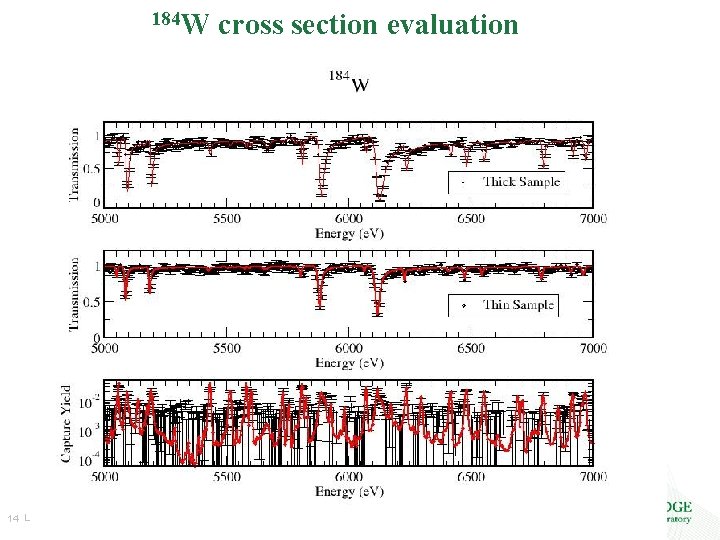
184 W 14 L. Leal cross section evaluation
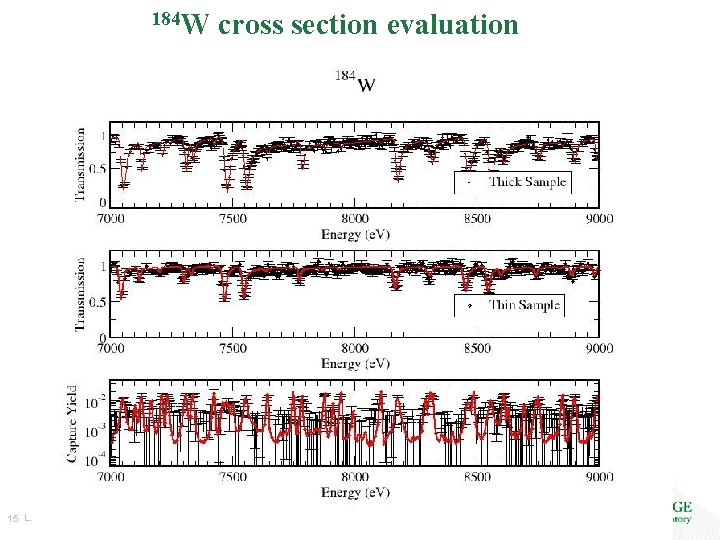
184 W 15 L. Leal cross section evaluation
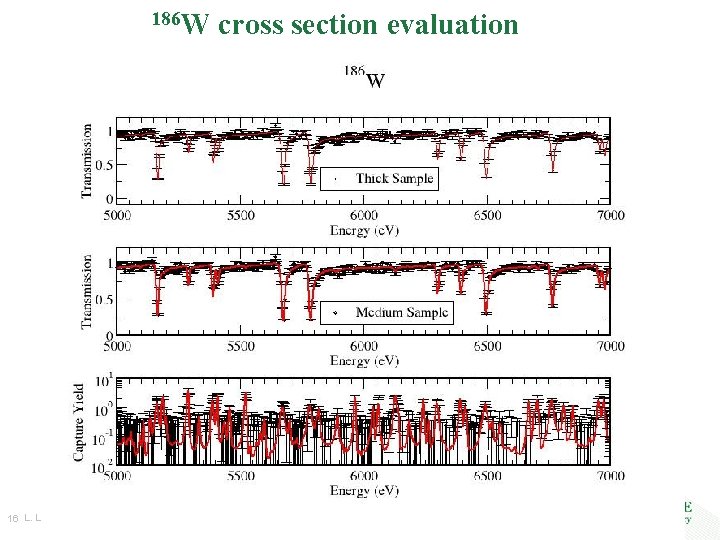
186 W 16 L. Leal cross section evaluation
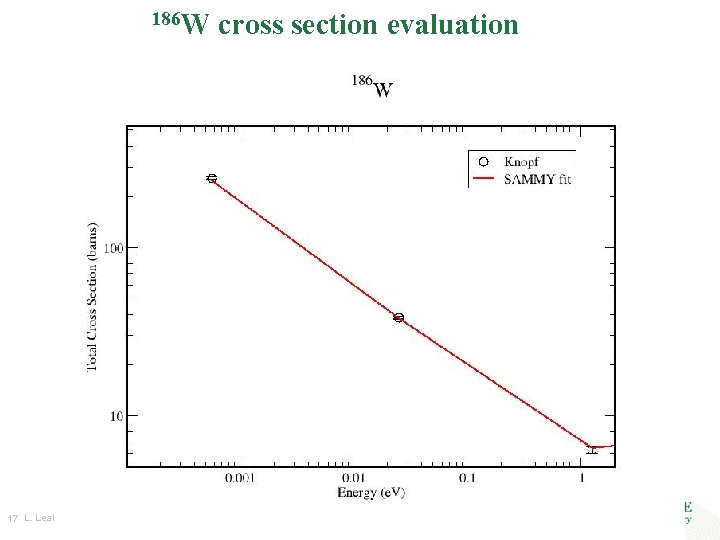
186 W 17 L. Leal cross section evaluation
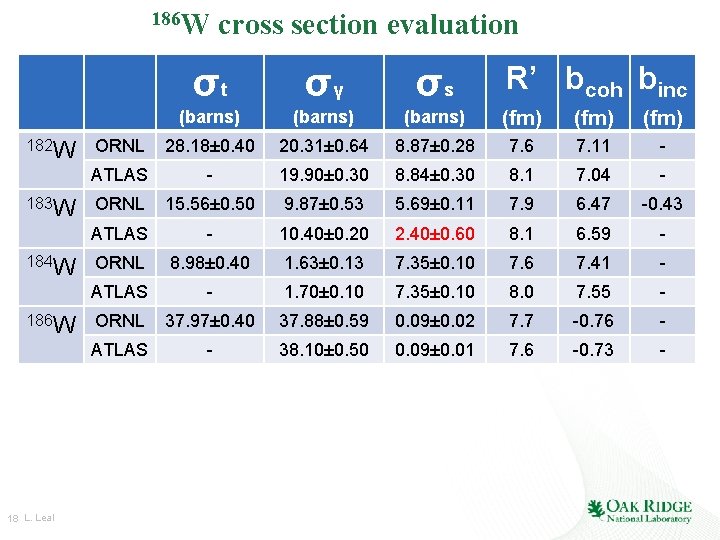
186 W 182 W 183 W 184 W 186 W 18 L. Leal cross section evaluation R’ bcoh binc σt σγ σs (barns) (fm) ORNL 28. 18± 0. 40 20. 31± 0. 64 8. 87± 0. 28 7. 6 7. 11 - ATLAS - 19. 90± 0. 30 8. 84± 0. 30 8. 1 7. 04 - ORNL 15. 56± 0. 50 9. 87± 0. 53 5. 69± 0. 11 7. 9 6. 47 -0. 43 ATLAS - 10. 40± 0. 20 2. 40± 0. 60 8. 1 6. 59 - ORNL 8. 98± 0. 40 1. 63± 0. 13 7. 35± 0. 10 7. 6 7. 41 - ATLAS - 1. 70± 0. 10 7. 35± 0. 10 8. 0 7. 55 - ORNL 37. 97± 0. 40 37. 88± 0. 59 0. 09± 0. 02 7. 7 -0. 76 - ATLAS - 38. 10± 0. 50 0. 09± 0. 01 7. 6 -0. 73 -
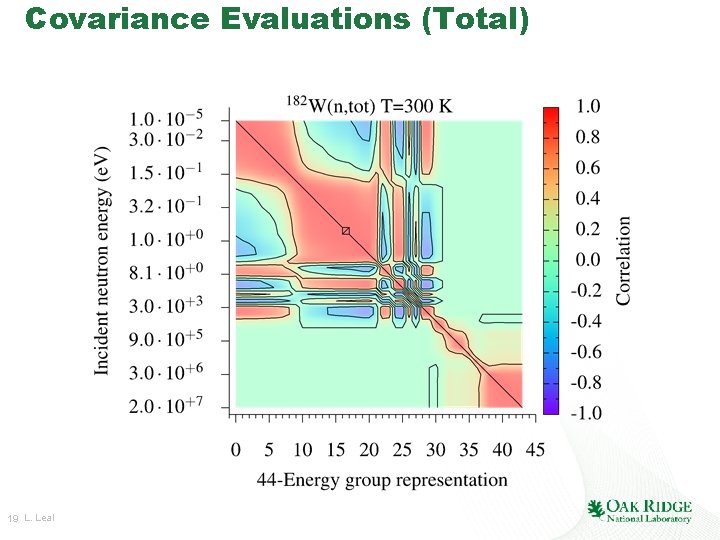
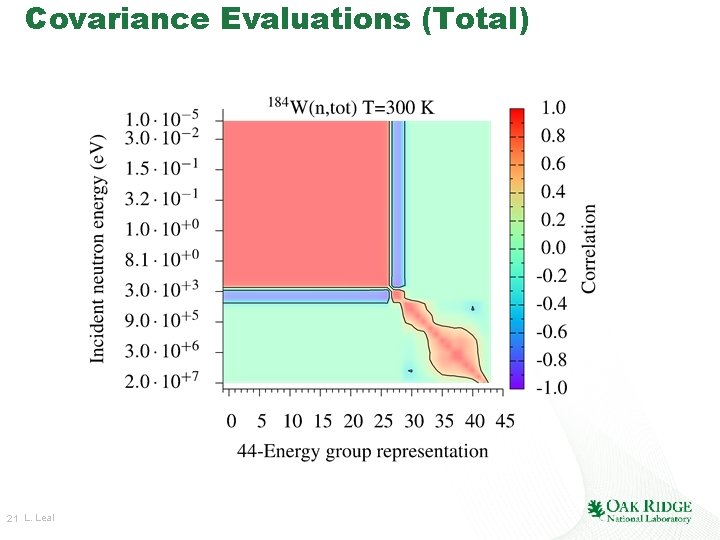
Covariance Evaluations (Total) 19 L. Leal
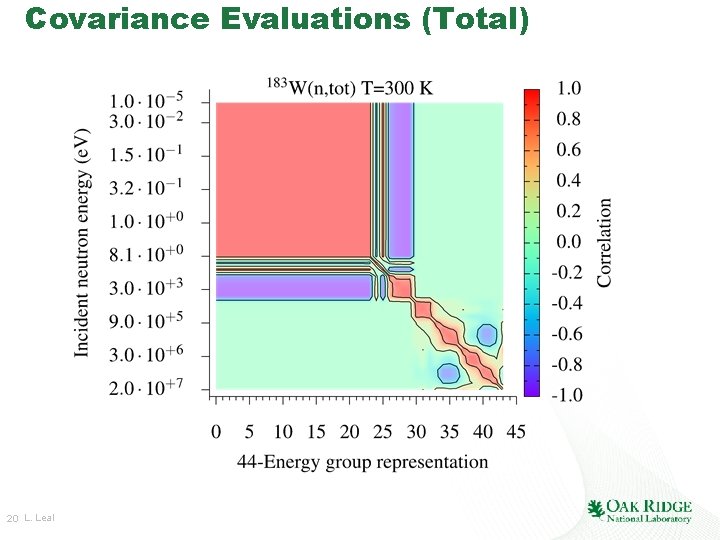
Covariance Evaluations (Total) 20 L. Leal
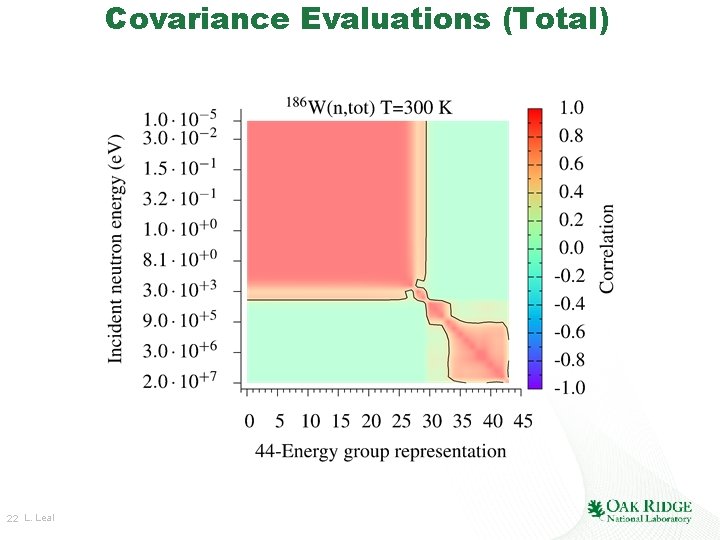
Covariance Evaluations (Total) 21 L. Leal
Covariance Evaluations (Total) 22 L. Leal
Cu Cross Section Evaluations Thermal (Sobes) Motivation § Nuclear Data Advisory Group (NDAG) identified 63 Cu and 65 Cu important for criticality safety applications § Purpose of Differential Measurements: – Thermal Cross Section Shape – Thermal Cross Section Uncertainty – SAMMY Resolved Resonance Analysis 23 L. Leal
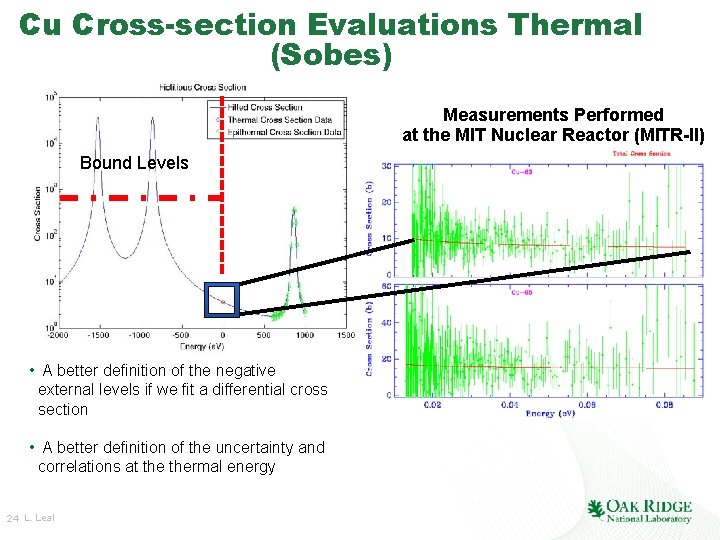
Cu Cross-section Evaluations Thermal (Sobes) Measurements Performed at the MIT Nuclear Reactor (MITR-II) Bound Levels • A better definition of the negative external levels if we fit a differential cross section • A better definition of the uncertainty and correlations at thermal energy 24 L. Leal
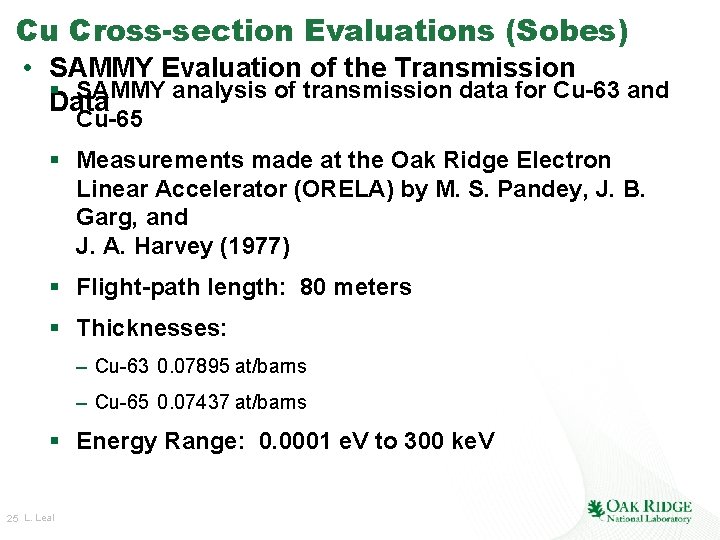
Cu Cross-section Evaluations (Sobes) • SAMMY Evaluation of the Transmission § SAMMY analysis of transmission data for Cu-63 and Data Cu-65 § Measurements made at the Oak Ridge Electron Linear Accelerator (ORELA) by M. S. Pandey, J. B. Garg, and J. A. Harvey (1977) § Flight-path length: 80 meters § Thicknesses: – Cu-63 0. 07895 at/barns – Cu-65 0. 07437 at/barns § Energy Range: 0. 0001 e. V to 300 ke. V 25 L. Leal
Updated 63, 65 Cu Evaluations (Sobes) • Three major improvements of consequence to the Zeus benchmarks: – Resolved resonance region expanded three-fold – Capture cross section evaluated based on experimental measurements – Detailed angular distributions generated for elastic scattering 26 L. Leal
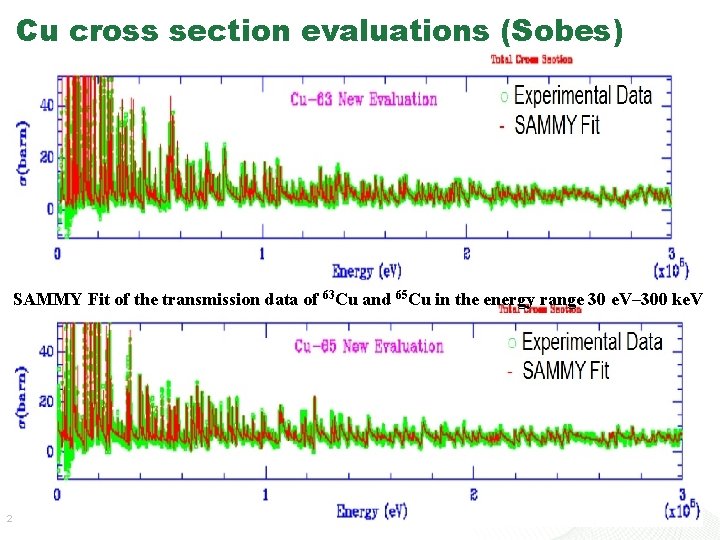
Cu cross section evaluations (Sobes) SAMMY Fit of the transmission data of 63 Cu and 65 Cu in the energy range 30 e. V– 300 ke. V 27 L. Leal
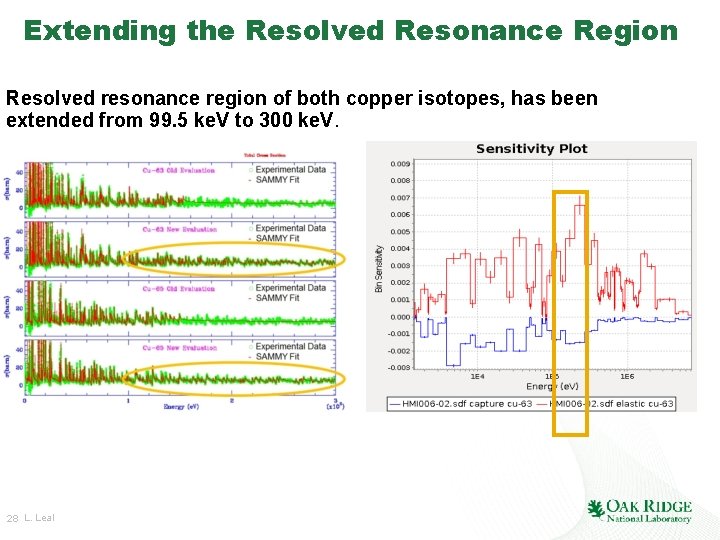
Extending the Resolved Resonance Region Resolved resonance region of both copper isotopes, has been extended from 99. 5 ke. V to 300 ke. V. 28 L. Leal
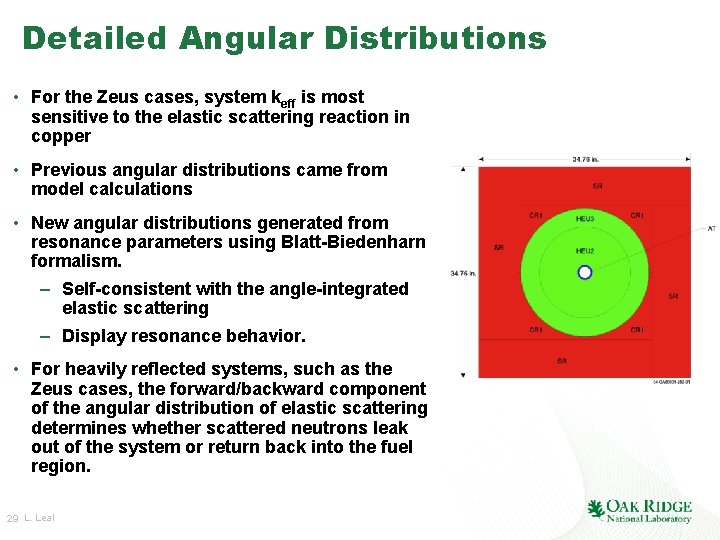
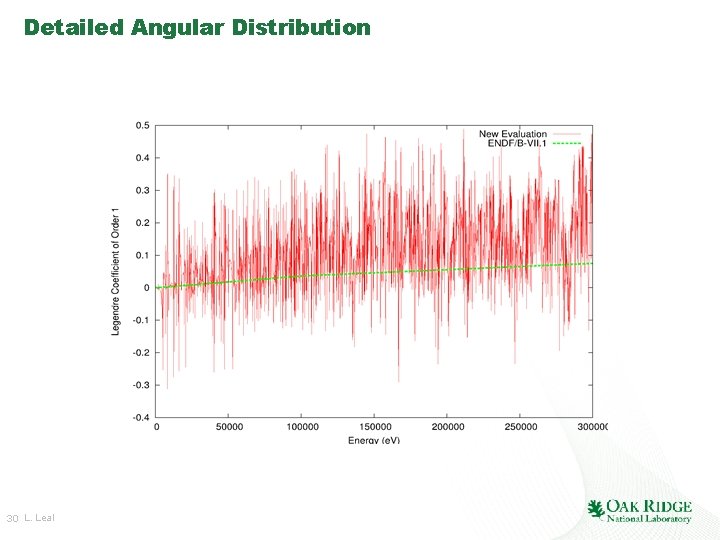
Detailed Angular Distributions • For the Zeus cases, system keff is most sensitive to the elastic scattering reaction in copper • Previous angular distributions came from model calculations • New angular distributions generated from resonance parameters using Blatt-Biedenharn formalism. – Self-consistent with the angle-integrated elastic scattering – Display resonance behavior. • For heavily reflected systems, such as the Zeus cases, the forward/backward component of the angular distribution of elastic scattering determines whether scattered neutrons leak out of the system or return back into the fuel region. 29 L. Leal
Detailed Angular Distribution 30 L. Leal
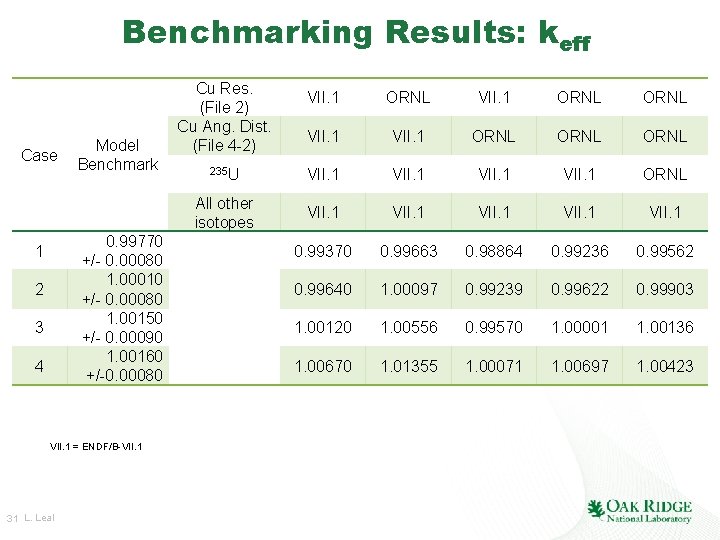
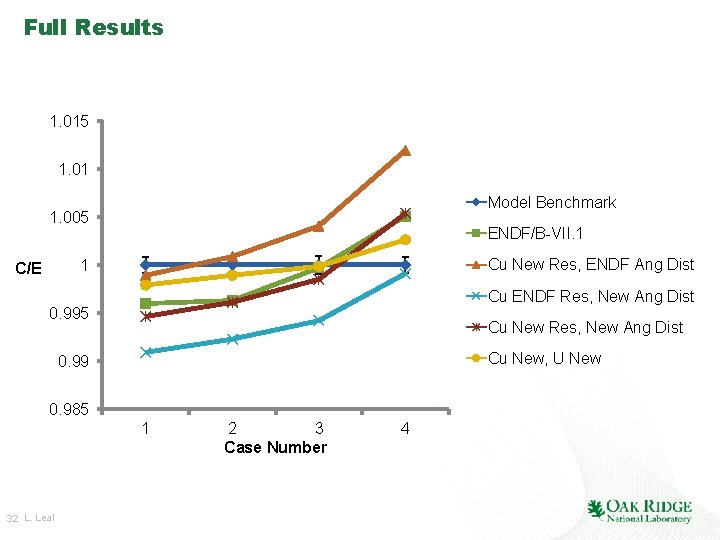
Benchmarking Results: keff Case Model Benchmark 0. 99770 +/- 0. 00080 1. 00010 +/- 0. 00080 1. 00150 +/- 0. 00090 1. 00160 +/-0. 00080 1 2 3 4 VII. 1 = ENDF/B-VII. 1 31 L. Leal Cu Res. (File 2) Cu Ang. Dist. (File 4 -2) VII. 1 ORNL ORNL 235 U VII. 1 ORNL All other isotopes VII. 1 0. 99370 0. 99663 0. 98864 0. 99236 0. 99562 0. 99640 1. 00097 0. 99239 0. 99622 0. 99903 1. 00120 1. 00556 0. 99570 1. 00001 1. 00136 1. 00670 1. 01355 1. 00071 1. 00697 1. 00423
Full Results 1. 015 1. 01 Model Benchmark 1. 005 ENDF/B-VII. 1 Cu New Res, ENDF Ang Dist 1 C/E Cu ENDF Res, New Ang Dist 0. 995 Cu New Res, New Ang Dist Cu New, U New 0. 99 0. 985 1 32 L. Leal 2 3 Case Number 4
Concluding Remarks • Resolved resonance evaluations were done for 182 W, 183 W, 184 W, 186 W, 63 Cu and 65 Cu; • Thermal data, coherent and incoherent data were used in the evaluation; • Resonance parameter covariance generated; • Resonance ranges extended with the help of high-resolution differential data; • RML Format (LRF=7) were used; • Blatt and Biedenharn methodology used for angular data representation; 33 L. Leal