
Nuclear Chemistry Nuclear Chemistry Part 04 A Induced
![7 14 N Target [918*F] + 2 4 He [918*F] Metastable Isotope Bullet 8](https://slidetodoc.com/presentation_image_h2/a896f9b83c6d4e9a30015413ee2b063a/image-5.jpg "7 14 N Target [918*F] + 2 4 He [918*F] Metastable Isotope Bullet 8")
![13 27 Al + Target 2 4 He [1530*P] Bullet Metastable Isotope [1530*P] 14](https://slidetodoc.com/presentation_image_h2/a896f9b83c6d4e9a30015413ee2b063a/image-7.jpg "13 27 Al + Target 2 4 He [1530*P] Bullet Metastable Isotope [1530*P] 14")
- Slides: 11
Nuclear Chemistry
Nuclear Chemistry Part 04 A Induced Nuclear Reactions
1. Particle-Particle Reactions Bombardment Reactions - a large atom is the “target” - target may be nonradioactive or radioactive - target is induced to react - a smaller particle is the “bullet” - may be as small as an alpha particle or as large as an iron atom
2. Induced Reactions using Charged Particles - first induced transmutation - Ernest Rutherford (NZ), 1915 - bombarded N 2 with alpha particles - alpha particles were “captured” by the nitrogen nuclei
7 14 N Target [918*F] + 2 4 He [918*F] Metastable Isotope Bullet 8 17 O + 11 H Hydrogen atom or proton
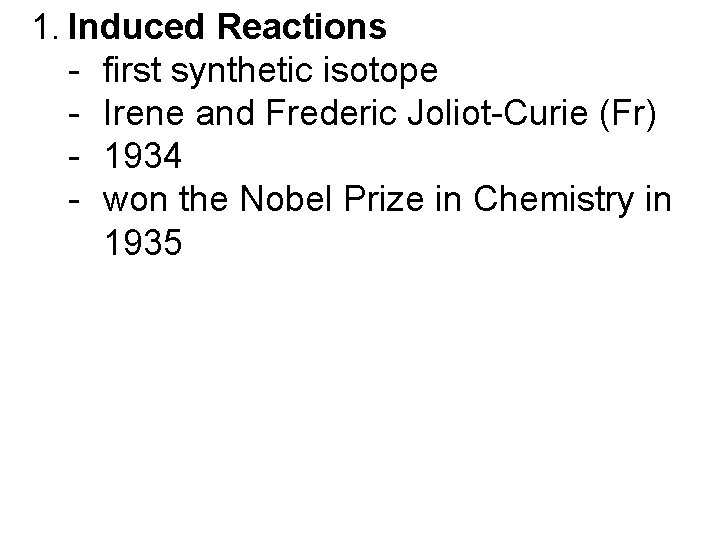
1. Induced Reactions - first synthetic isotope - Irene and Frederic Joliot-Curie (Fr) - 1934 - won the Nobel Prize in Chemistry in 1935
13 27 Al + Target 2 4 He [1530*P] Bullet Metastable Isotope [1530*P] 14 30 Si + + 0 1 n 1 0 e positron new isotope antiparticle of electron
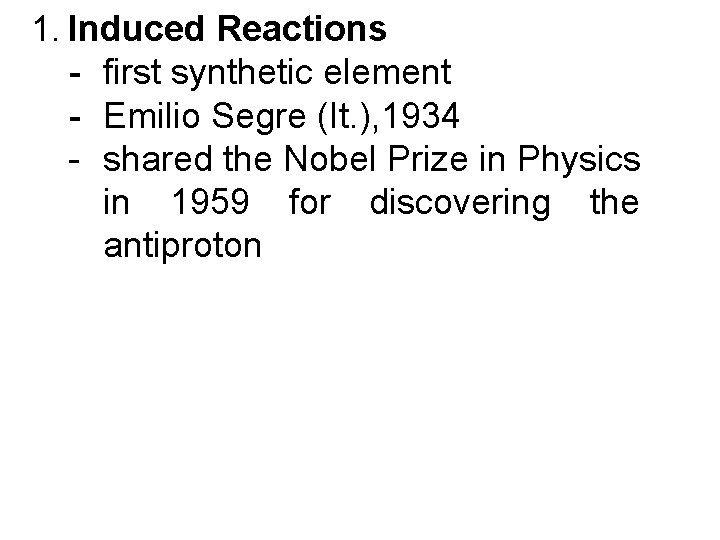
1. Induced Reactions - first synthetic element - Emilio Segre (It. ), 1934 - shared the Nobel Prize in Physics in 1959 for discovering the antiproton
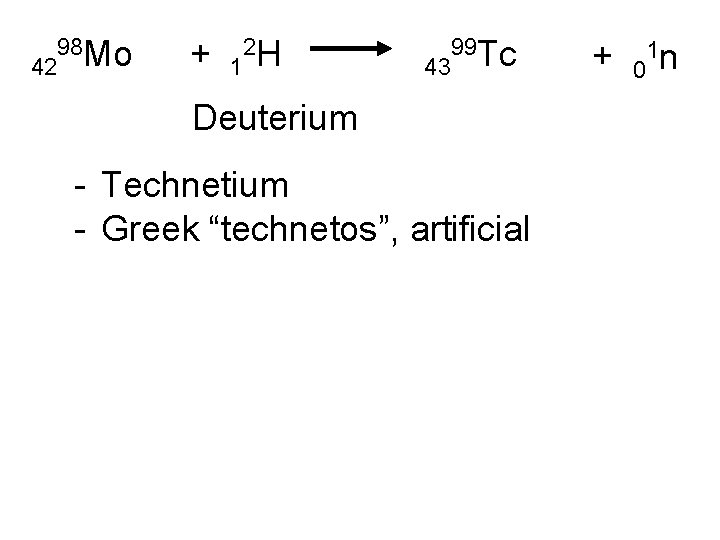
42 98 Mo + 1 2 H 43 99 Tc Deuterium - Technetium - Greek “technetos”, artificial + 0 1 n
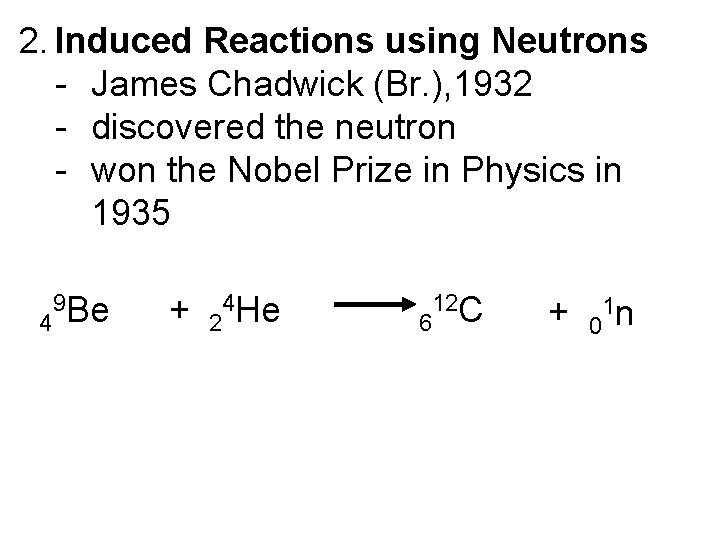
2. Induced Reactions using Neutrons - James Chadwick (Br. ), 1932 - discovered the neutron - won the Nobel Prize in Physics in 1935 4 9 Be + 2 4 He 6 12 C + 0 1 n
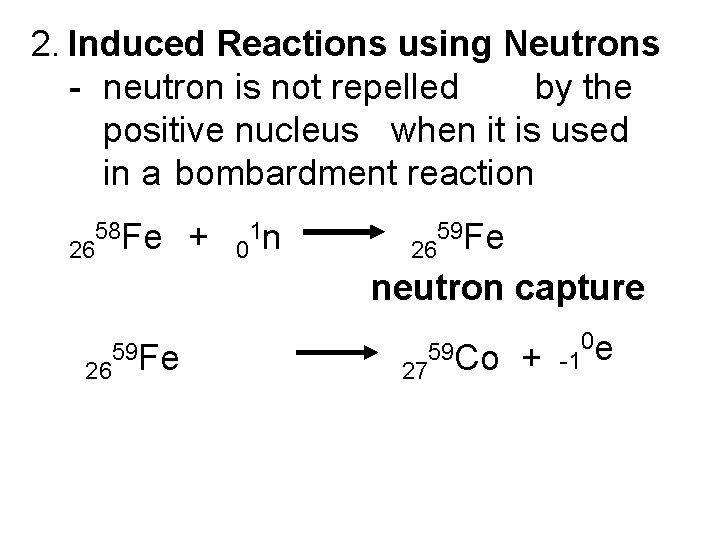
2. Induced Reactions using Neutrons - neutron is not repelled by the positive nucleus when it is used in a bombardment reaction 26 58 Fe + 0 1 n 26 59 Fe neutron capture 26 59 Fe 27 59 Co + -1 0 e