
Nuclear Chemistry Nuclear Chemistry Objectives Students will be
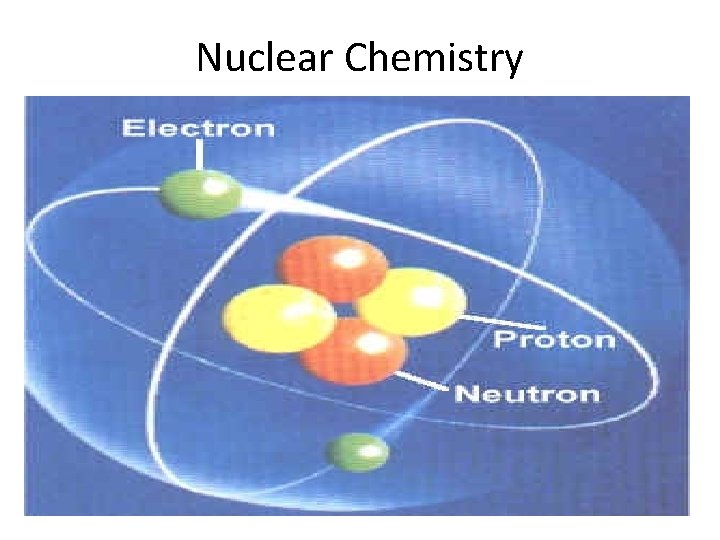
Nuclear Chemistry
Nuclear Chemistry Objectives • • • Students will be able to identify what radioisotopes are and why they undergo radioactivity. Students will be able to compare properties of nuclear reactions with chemical reactions. Students will demonstrate understanding of radioactive decay through application and graphing. Students will assess the application of nuclear chemistry as a continual alternative resource of energy for developed countries. Students will understand classify nuclear reactions by the types of radiation produced.
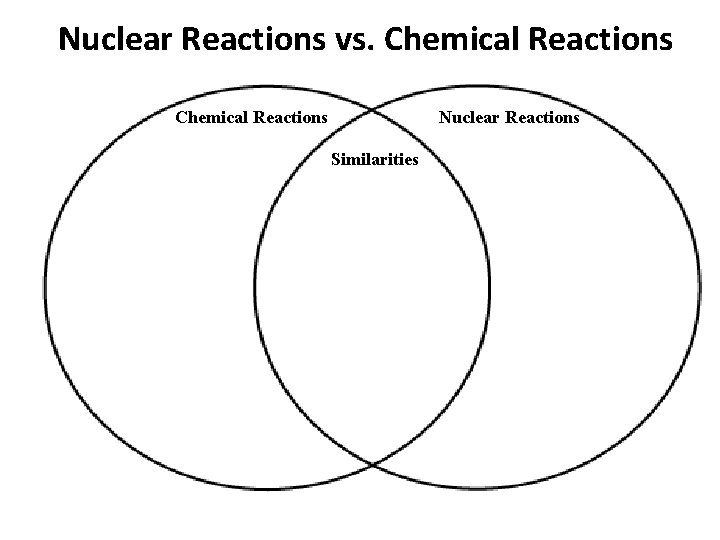
Nuclear Reactions vs. Chemical Reactions Nuclear Reactions Similarities
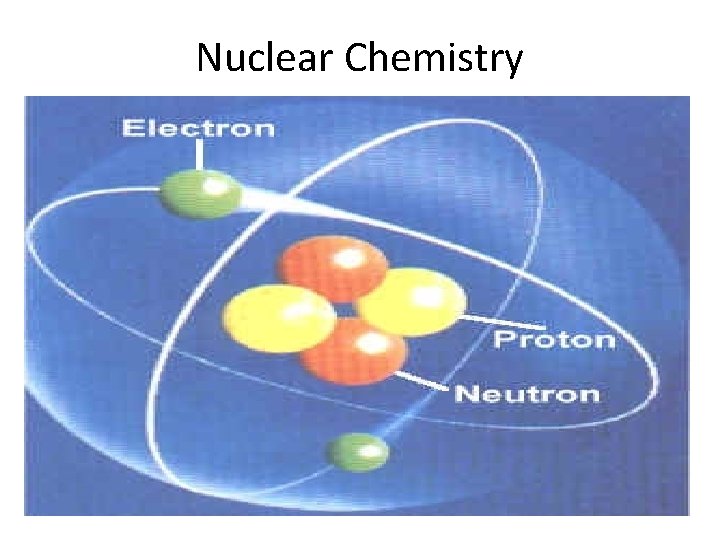
Nuclear Chemistry
Bell Ringer: Atomic Forces 1. What are the two primary forces within an atom? 2. Distinguish between these forces. 3. a. Which one of the forces is stronger ? b. Why is this important to the atom’s existence?
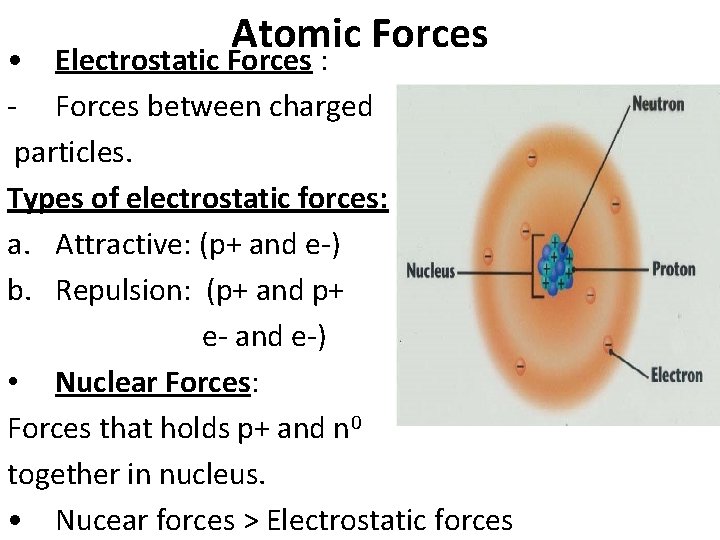
Atomic Forces • Electrostatic Forces : - Forces between charged particles. Types of electrostatic forces: a. Attractive: (p+ and e-) b. Repulsion: (p+ and p+ e- and e-) • Nuclear Forces: Forces that holds p+ and n 0 together in nucleus. • Nucear forces > Electrostatic forces
Atomic History and Structure Quiz • Chpt. 4 in textbook
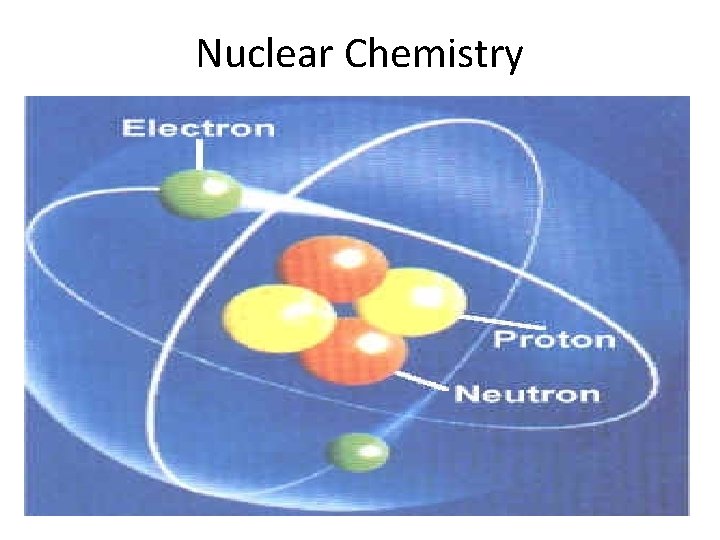
Nuclear Chemistry
Nuclear Chemistry Objectives • Students will be able to identify what radioisotopes are and why they undergo radioactive decay. • Students will demonstrate understanding of radioactive decay through applications and graphing. • Students will understand classify nuclear reactions by the types of radiation produced.
Nuclear Chemistry
Radioisotopes • Radioisotopes: atoms with an unstable nucleus. What determines if an atom has an unstable nucleus?
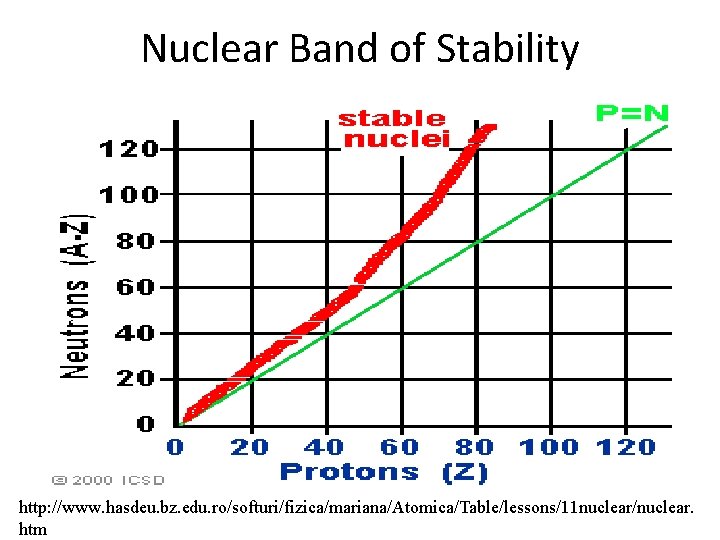
Nuclear Band of Stability http: //www. hasdeu. bz. edu. ro/softuri/fizica/mariana/Atomica/Table/lessons/11 nuclear/nuclear. htm
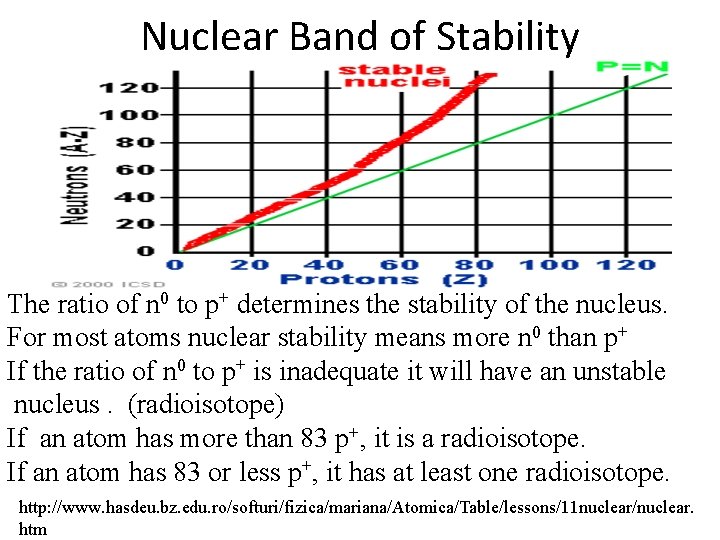
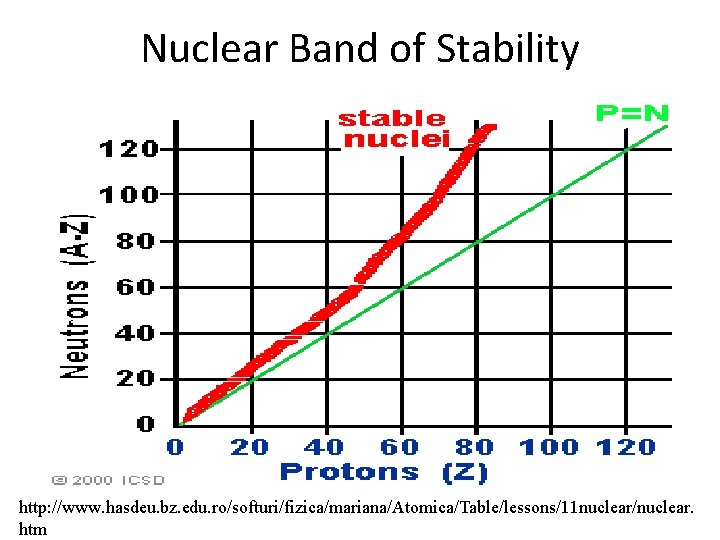
Nuclear Band of Stability The ratio of n 0 to p+ determines the stability of the nucleus. For most atoms nuclear stability means more n 0 than p+ If the ratio of n 0 to p+ is inadequate it will have an unstable nucleus. (radioisotope) If an atom has more than 83 p+, it is a radioisotope. If an atom has 83 or less p+, it has at least one radioisotope. http: //www. hasdeu. bz. edu. ro/softuri/fizica/mariana/Atomica/Table/lessons/11 nuclear/nuclear. htm
Radioisotopes • Atoms with unstable nuclei. • The ratio of protons-to-neutrons is not adequate for nuclear stability. • Most elements need more neutrons than protons to maintain stability within the nucleus. • Elements with more than 83 protons are radioisotopes. • Elements with less than 83 protons have at least one radioisotope.
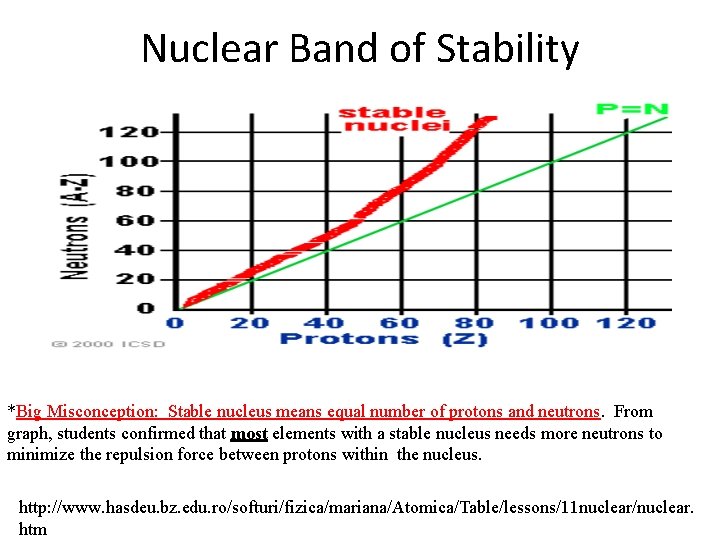
Nuclear Band of Stability *Big Misconception: Stable nucleus means equal number of protons and neutrons. From graph, students confirmed that most elements with a stable nucleus needs more neutrons to minimize the repulsion force between protons within the nucleus. http: //www. hasdeu. bz. edu. ro/softuri/fizica/mariana/Atomica/Table/lessons/11 nuclear/nuclear. htm
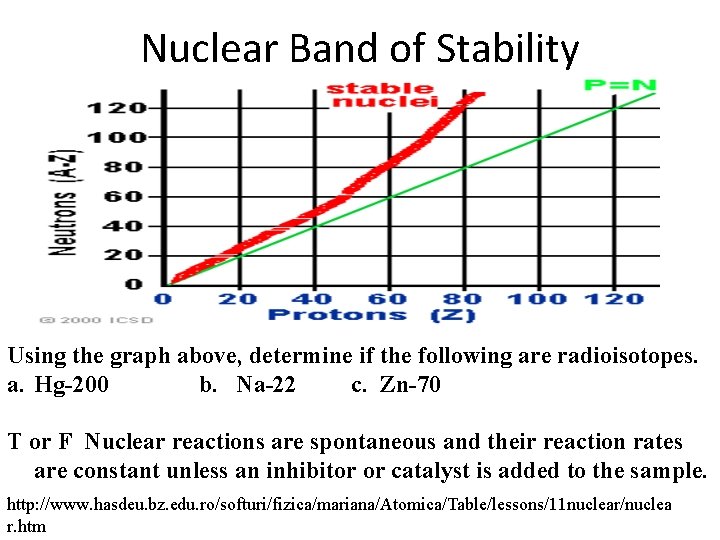
Nuclear Band of Stability Using the graph above, determine if the following are radioisotopes. a. Hg-200 b. Na-22 c. Zn-70 T or F Nuclear reactions are spontaneous and their reaction rates are constant unless an inhibitor or catalyst is added to the sample. http: //www. hasdeu. bz. edu. ro/softuri/fizica/mariana/Atomica/Table/lessons/11 nuclear/nuclea r. htm
Radiosotope’s Notation • What is the radioisotope notation for each of the following? a. Polonium (Po). It has a mass number of 210. b. Rn-240 with an atomic number of 86. c. Th-230.
Nuclear Reactions • A reaction that occurs within the nucleus of a radioisotope in order to stabilize it. • Also called: radioactive decay; radioactivity • Spontaneous Reactions (occurs naturally). • Reaction rates (speed of reactions) remain constant for radioisotopes despite changes in temperature, pressure, or addition of catalyst. • Radioisotopes have half-lives.
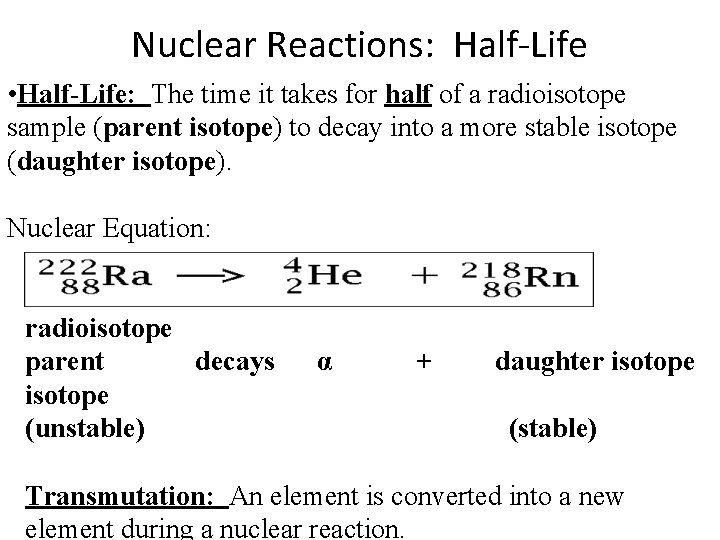
Nuclear Reactions: Half-Life • Half-Life: The time it takes for half of a radioisotope sample (parent isotope) to decay into a more stable isotope (daughter isotope). Nuclear Equation: radioisotope parent decays isotope (unstable) α + daughter isotope (stable) Transmutation: An element is converted into a new element during a nuclear reaction.
Radioactive Decay Problems 1. a. A patient is given a 100 mg sample of I-131. How much of the isotope will remain in the body after 16 days? The half-life of I-131 isotopes is 8 days. b. How many days will pass for a 1. 0 g sample of I-131 isotope to decay to 0. 25 g.
Nuclear Chemistry Worksheet • Complete for homework. • Tomorrow: Radioactive Decay Lab
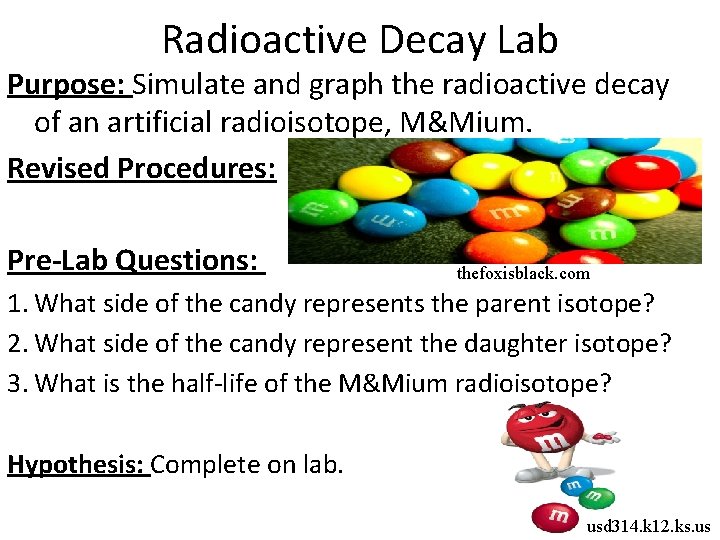
Radioactive Decay Lab Purpose: Simulate and graph the radioactive decay of an artificial radioisotope, M&Mium. Revised Procedures: Pre-Lab Questions: thefoxisblack. com 1. What side of the candy represents the parent isotope? 2. What side of the candy represent the daughter isotope? 3. What is the half-life of the M&Mium radioisotope? Hypothesis: Complete on lab. usd 314. k 12. ks. us
Radioactive Decay
Infinite Campus Update: Chemistry • Radioactive Decay Lab (15 pts. ) • Modeling Radioactive Decay (5 pts. )
Infinite Campus Update: pre-AP Chem • Radioactivity Article (10 pts) • Modeling Radioactive Decay (5 pts. )
Atomic Structure and Nuclear Chemistry Review
Nuclear Band of Stability http: //www. hasdeu. bz. edu. ro/softuri/fizica/mariana/Atomica/Table/lessons/11 nuclear/nuclear. htm
Radioactive Decay Lab: Data Table Number of Half. Lives 0 1 2 3 4 5 6 7 Total Time (seconds) # of M&Miums (parent isotope) Daughter Isotope (decayed)
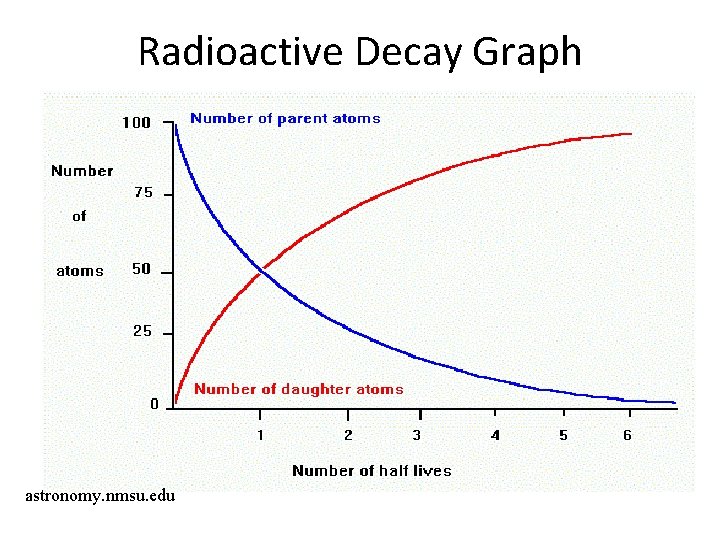
Radioactive Decay Graph astronomy. nmsu. edu
Nuclear Radiation • What is nuclear radiation?
M&Mium Lab Due
Nuclear Radiation: • Matter and large amounts of energy produced during a nuclear reaction. • Three main types of nuclear radiation: 1. Alpha radiation (α ) 2. Beta radiation (β) 3. Gamma radiation (ϒ)
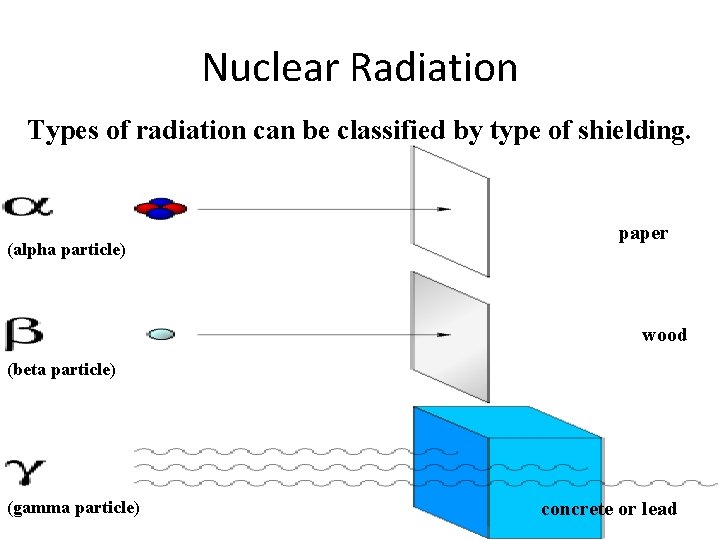
Nuclear Radiation Types of radiation can be classified by type of shielding. (alpha particle) paper wood (beta particle) (gamma particle) concrete or lead
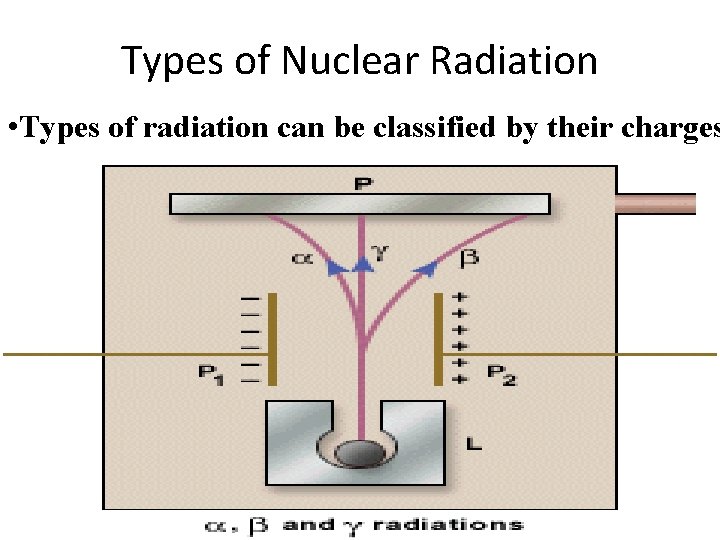
Types of Nuclear Radiation • Types of radiation can be classified by their charges
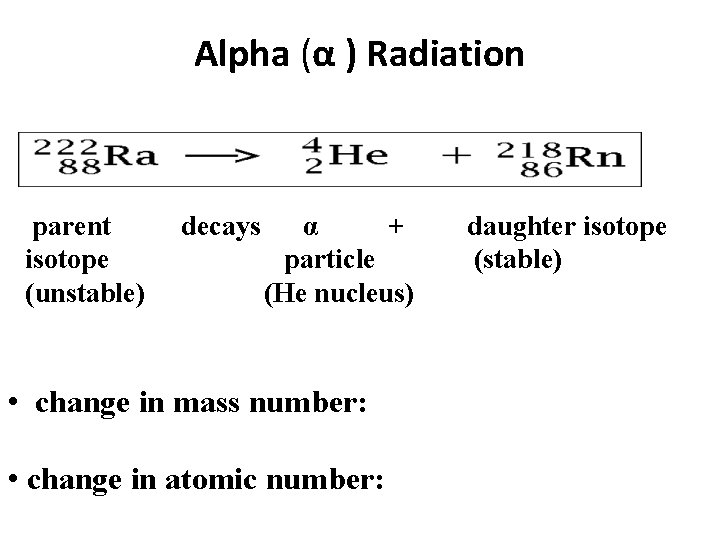
Alpha (α ) Radiation parent isotope (unstable) decays α + particle (He nucleus) • change in mass number: • change in atomic number: daughter isotope (stable)
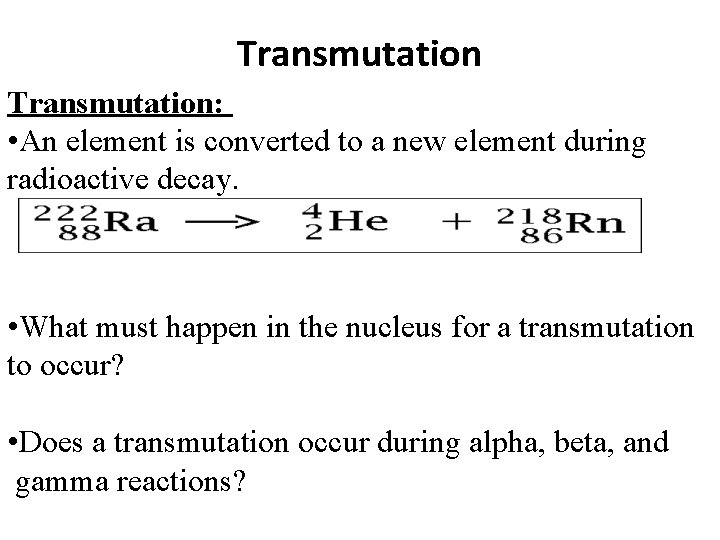
Transmutation: • An element is converted to a new element during radioactive decay. • What must happen in the nucleus for a transmutation to occur? • Does a transmutation occur during alpha, beta, and gamma reactions?
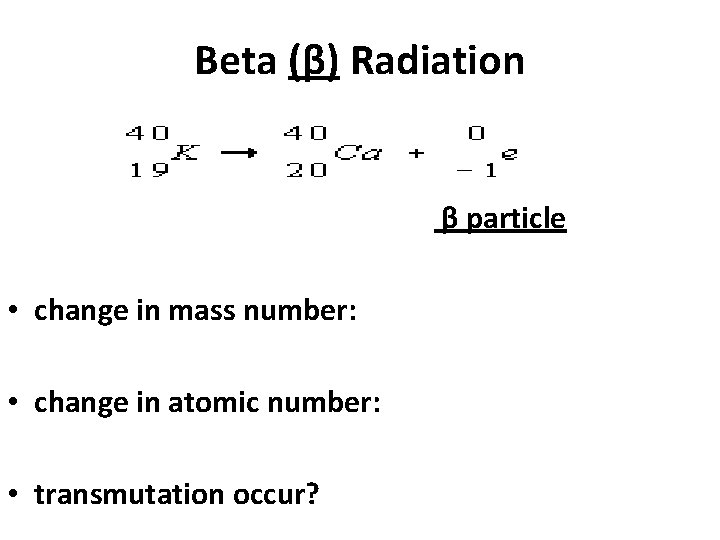
Beta (β) Radiation β particle • change in mass number: • change in atomic number: • transmutation occur?
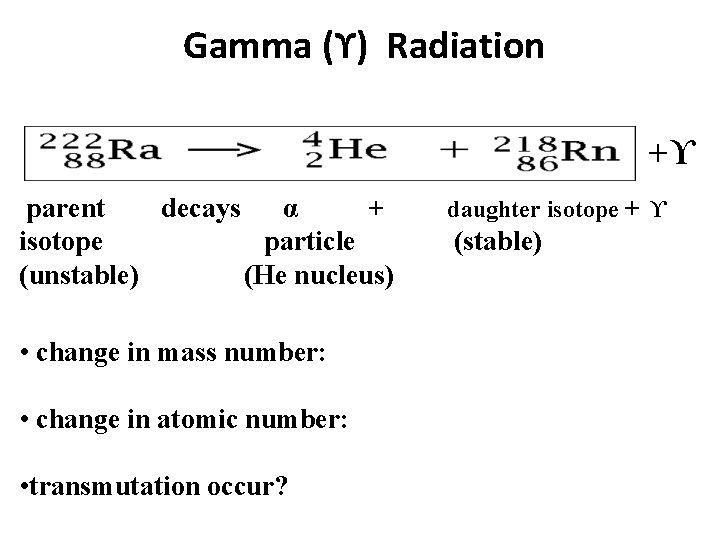
Gamma (ϒ) Radiation +ϒ parent decays α + isotope particle (unstable) (He nucleus) • change in mass number: • change in atomic number: • transmutation occur? daughter isotope + ϒ (stable)
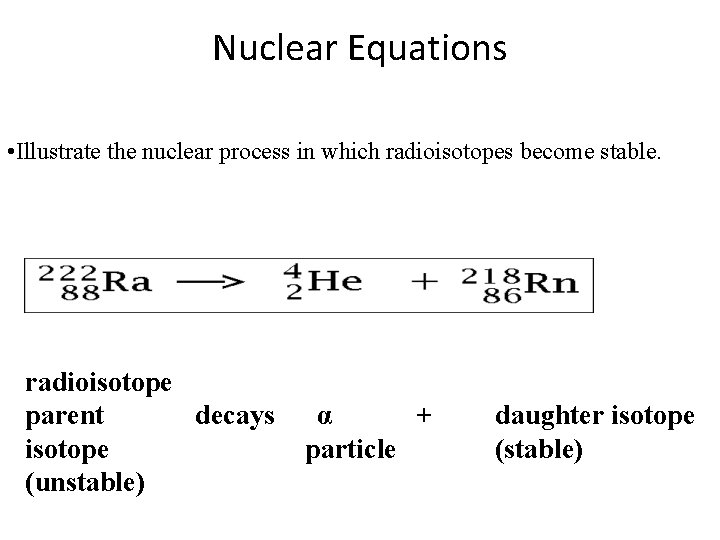
Nuclear Equations • Illustrate the nuclear process in which radioisotopes become stable. radioisotope parent decays isotope (unstable) α + particle daughter isotope (stable)
Nuclear Equations
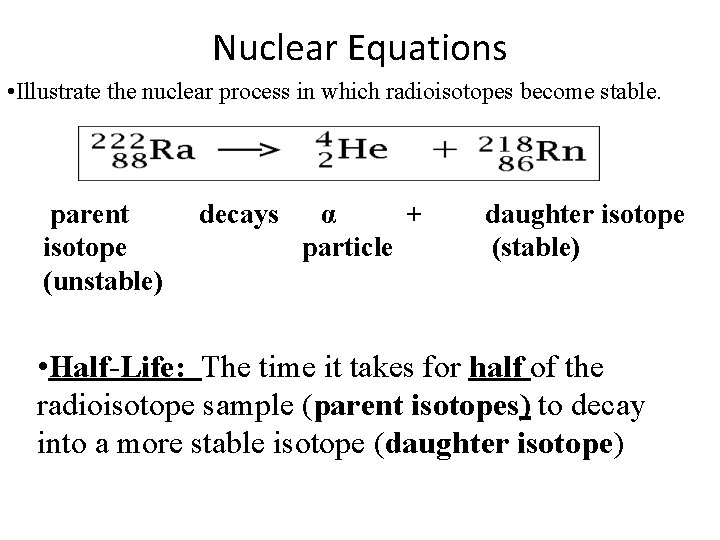
Nuclear Equations • Illustrate the nuclear process in which radioisotopes become stable. parent isotope (unstable) decays α + particle daughter isotope (stable) • Half-Life: The time it takes for half of the radioisotope sample (parent isotopes) to decay into a more stable isotope (daughter isotope)
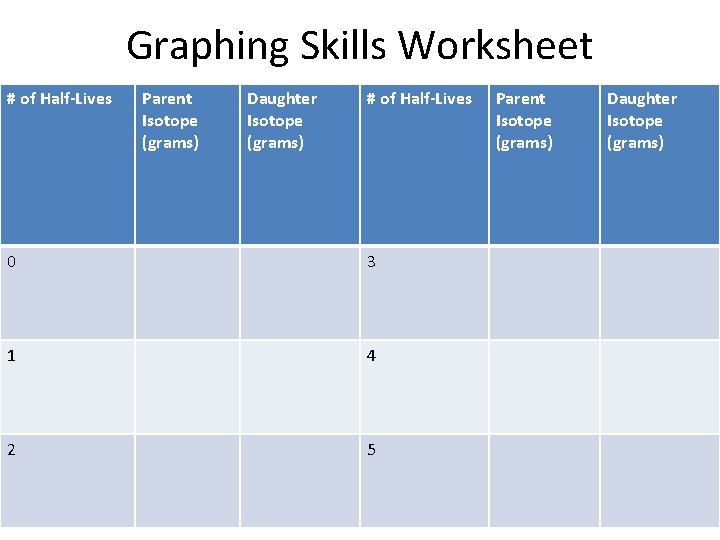
Graphing Skills Worksheet # of Half-Lives Parent Isotope (grams) Daughter Isotope (grams) # of Half-Lives 0 3 1 4 2 5 Parent Isotope (grams) Daughter Isotope (grams)
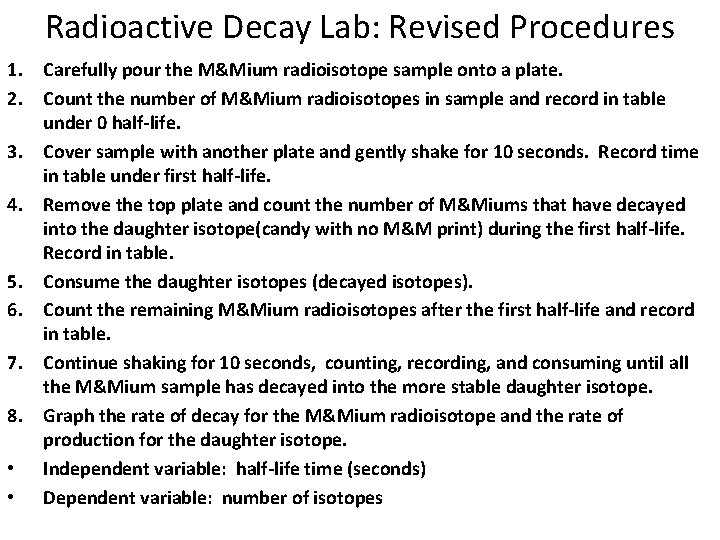
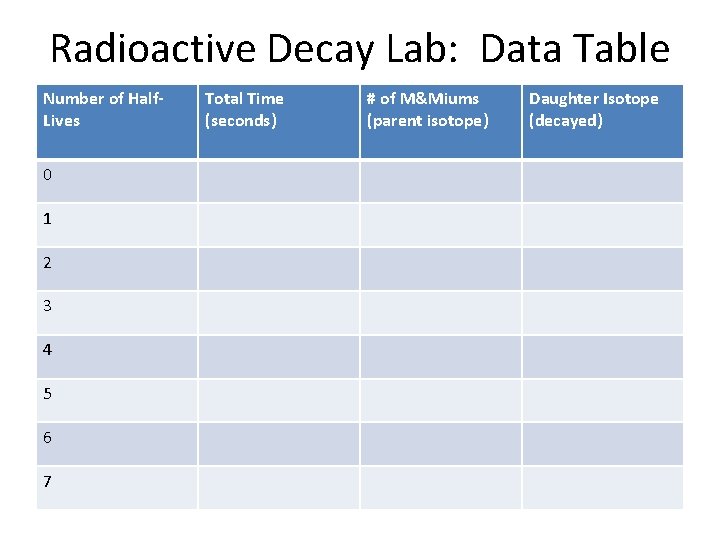
Radioactive Decay Lab: Revised Procedures 1. Carefully pour the M&Mium radioisotope sample onto a plate. 2. Count the number of M&Mium radioisotopes in sample and record in table under 0 half-life. 3. Cover sample with another plate and gently shake for 10 seconds. Record time in table under first half-life. 4. Remove the top plate and count the number of M&Miums that have decayed into the daughter isotope(candy with no M&M print) during the first half-life. Record in table. 5. Consume the daughter isotopes (decayed isotopes). 6. Count the remaining M&Mium radioisotopes after the first half-life and record in table. 7. Continue shaking for 10 seconds, counting, recording, and consuming until all the M&Mium sample has decayed into the more stable daughter isotope. 8. Graph the rate of decay for the M&Mium radioisotope and the rate of production for the daughter isotope. • Independent variable: half-life time (seconds) • Dependent variable: number of isotopes
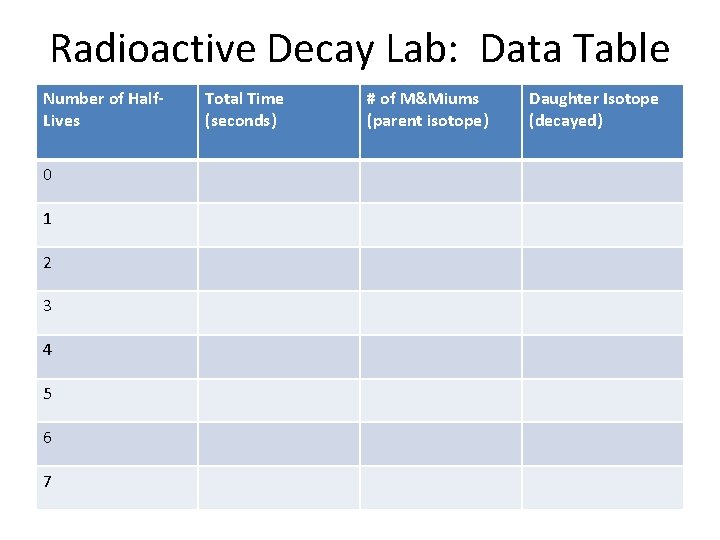
Radioactive Decay Lab: Data Table Number of Half. Lives 0 1 2 3 4 5 6 7 Total Time (seconds) # of M&Miums (parent isotope) Daughter Isotope (decayed)
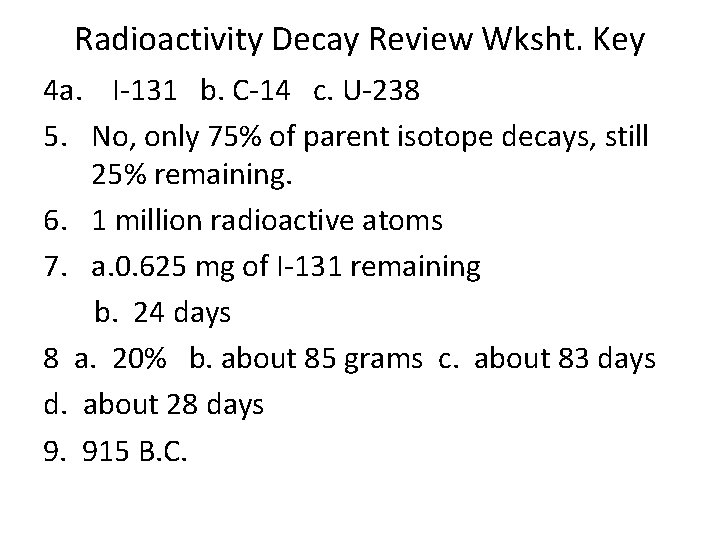
Radioactivity Decay Review Wksht. Key 4 a. I-131 b. C-14 c. U-238 5. No, only 75% of parent isotope decays, still 25% remaining. 6. 1 million radioactive atoms 7. a. 0. 625 mg of I-131 remaining b. 24 days 8 a. 20% b. about 85 grams c. about 83 days d. about 28 days 9. 915 B. C.
Nuclear Chemistry Objectives • Students will understand, classify, and predict nuclear reactions by the types of radiation produced.
Nuclear Radiation • Types of radiation can be classified by changes in mass number and atomic number between the parent isotope and the daughter isotope.
Nuclear Radiation: Bell Ringer 1. What are three main types of nuclear radiation? 2. List three ways you can distinguish between these types of radiation.
Nuclear Radiation Problems
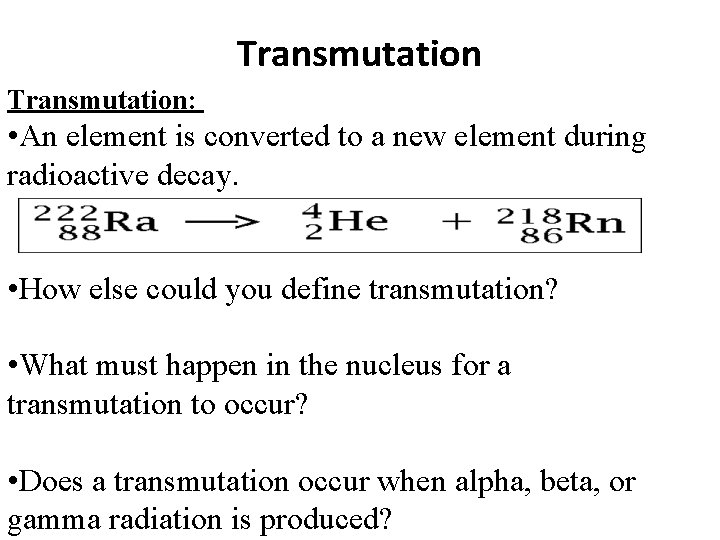
Transmutation: • An element is converted to a new element during radioactive decay. • How else could you define transmutation? • What must happen in the nucleus for a transmutation to occur? • Does a transmutation occur when alpha, beta, or gamma radiation is produced?
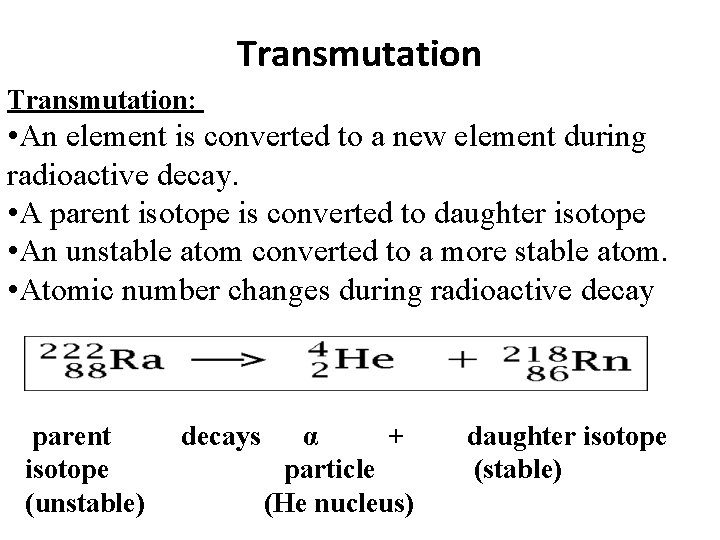
Transmutation: • An element is converted to a new element during radioactive decay. • A parent isotope is converted to daughter isotope • An unstable atom converted to a more stable atom. • Atomic number changes during radioactive decay parent isotope (unstable) decays α + particle (He nucleus) daughter isotope (stable)
Nuclear Chemistry Objective • Students can explain the difference between fission and fusion. • Students can analyze the benefits and risks of nuclear energy
Transmutation occurs during: 1. Radioactive Decay 2. Bombarding an atom’s nucleus with particles. -can occur naturally or artificially -fission and fusion nuclear reactions
Fission vs. Fusion Fission Fusion Similarities
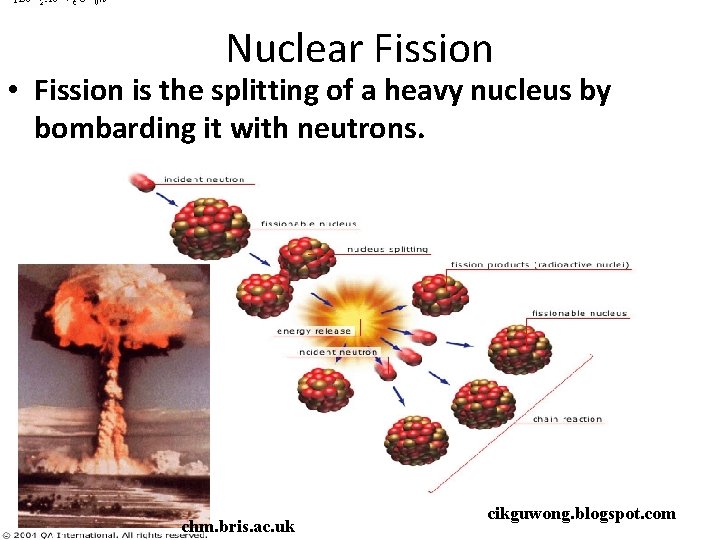
Nuclear Fission • Fission is the splitting of a heavy nucleus by bombarding it with neutrons. chm. bris. ac. uk cikguwong. blogspot. com
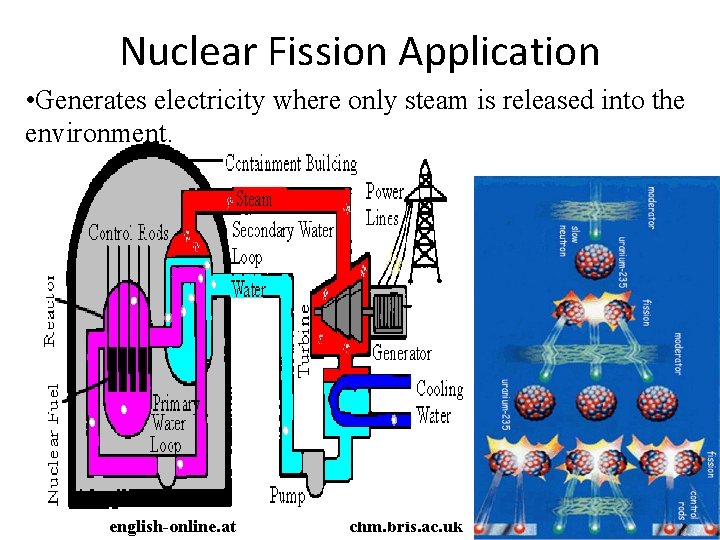
Nuclear Fission Application • Generates electricity where only steam is released into the environment. english-online. at chm. bris. ac. uk
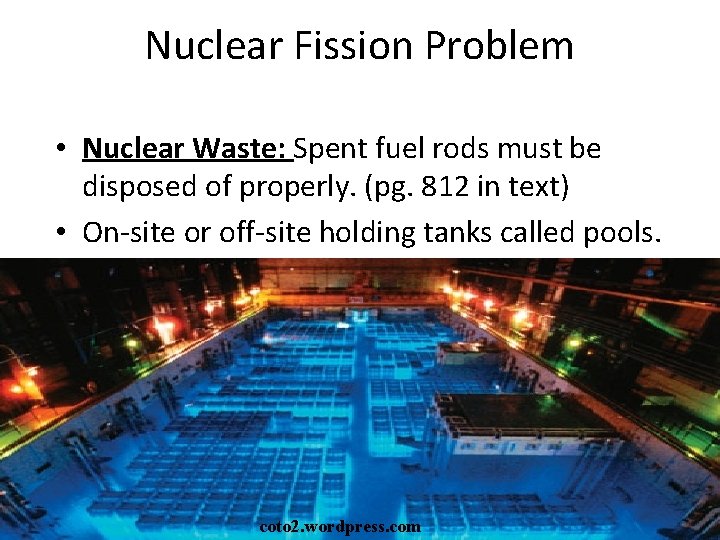
Nuclear Fission Problem • Nuclear Waste: Spent fuel rods must be disposed of properly. (pg. 812 in text) • On-site or off-site holding tanks called pools. coto 2. wordpress. com
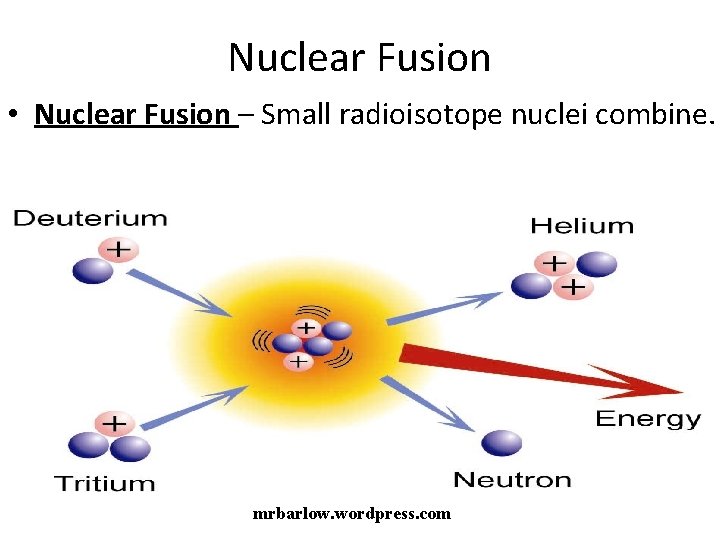
Nuclear Fusion • Nuclear Fusion – Small radioisotope nuclei combine. mrbarlow. wordpress. com
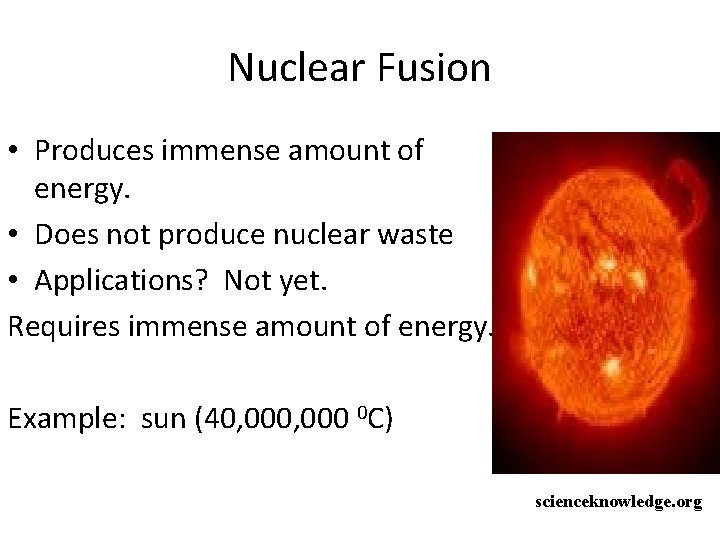
Nuclear Fusion • Produces immense amount of energy. • Does not produce nuclear waste • Applications? Not yet. Requires immense amount of energy. Example: sun (40, 000 0 C) scienceknowledge. org

Nuclear Chemistry Objectives Students will assess the application of nuclear chemistry as a continual alternative resource of energy for developed countries. Assessment by: -reading and annotating literature that addresses pros and cons of nuclear energy. - Debating with peers why we should or should not depend on nuclear energy. - Formulating an opinion based on facts as to why the U. S. should continue to support the research and development of nuclear energy. (ORQ format) •
Exit Slip 1. What is the difference between fission and fusion and give an example of each? 2. Should the United States continue the research, development, and application of nuclear energy through nuclear fission?
Nuclear Chemistry Objective • I can analyze the benefits and risks of nuclear energy. (SC-H-ET-S-2)
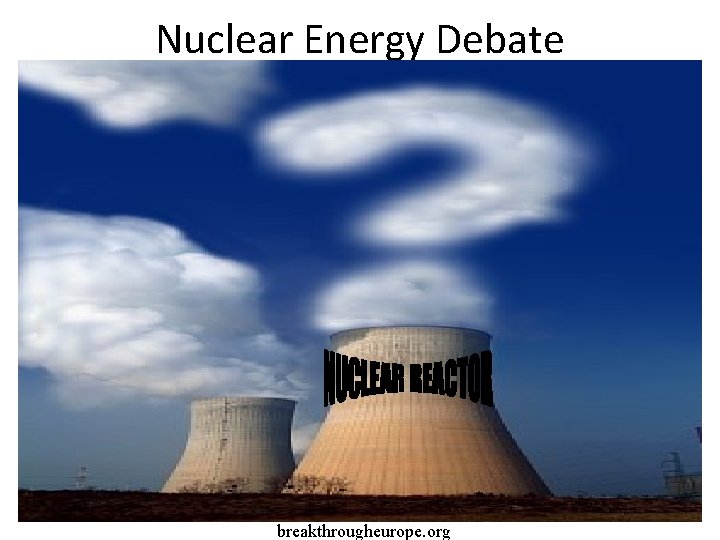
Nuclear Energy Debate breakthrougheurope. org
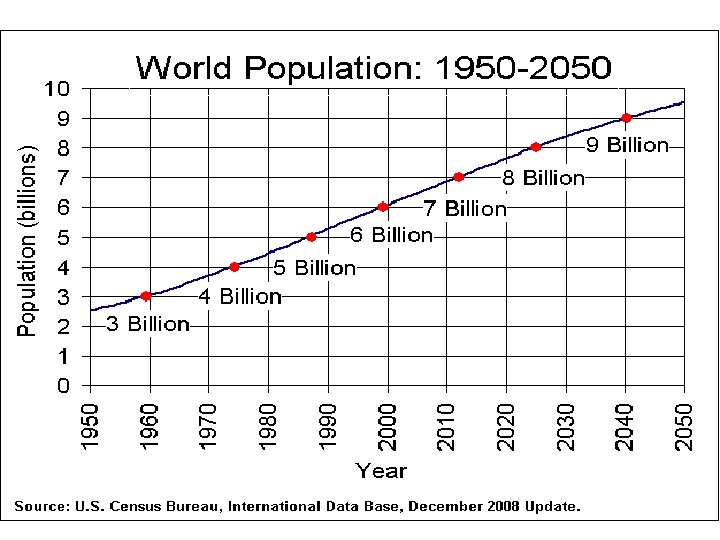
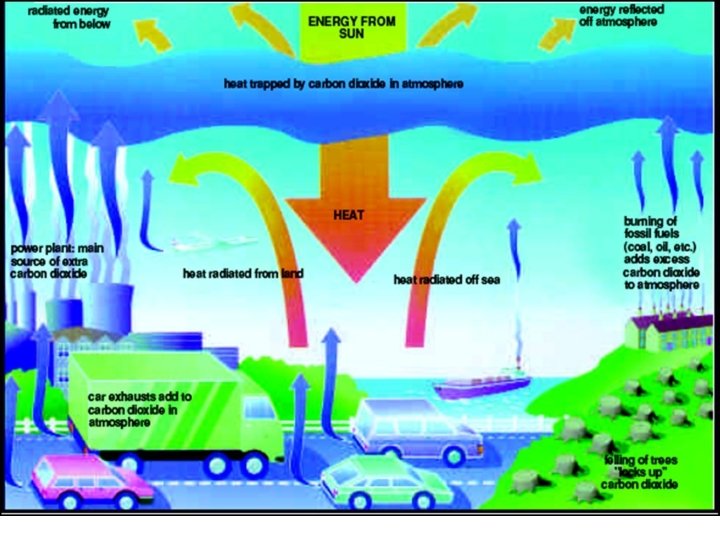

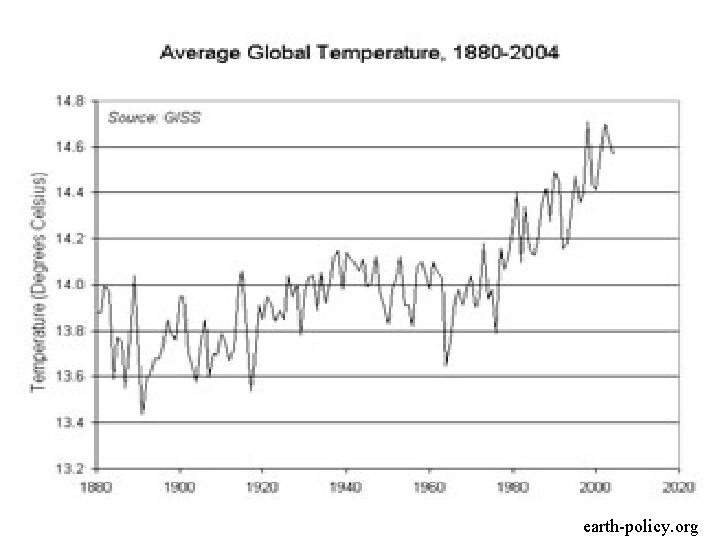
earth-policy. org
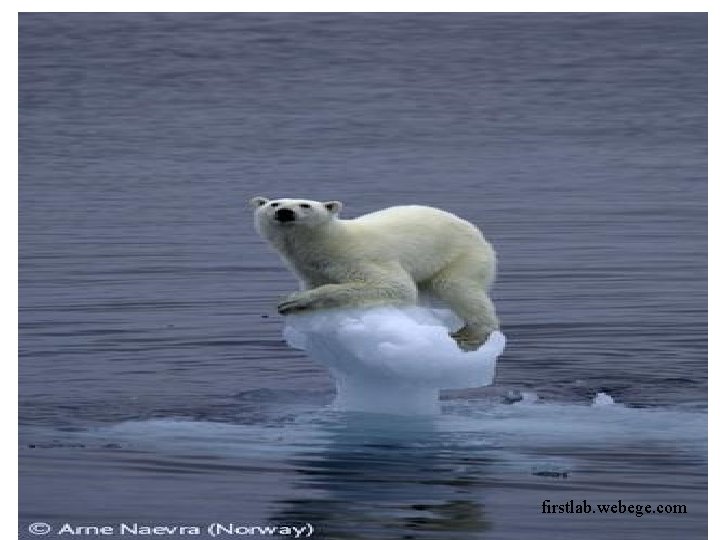
firstlab. webege. com
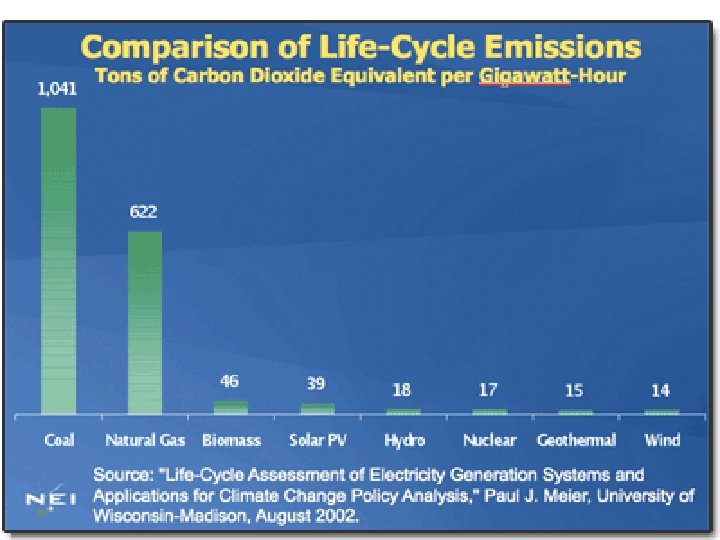
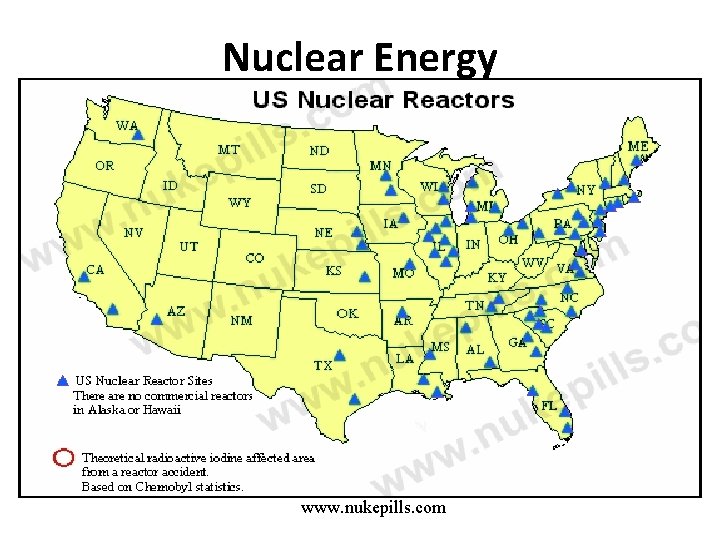
Nuclear Energy www. nukepills. com
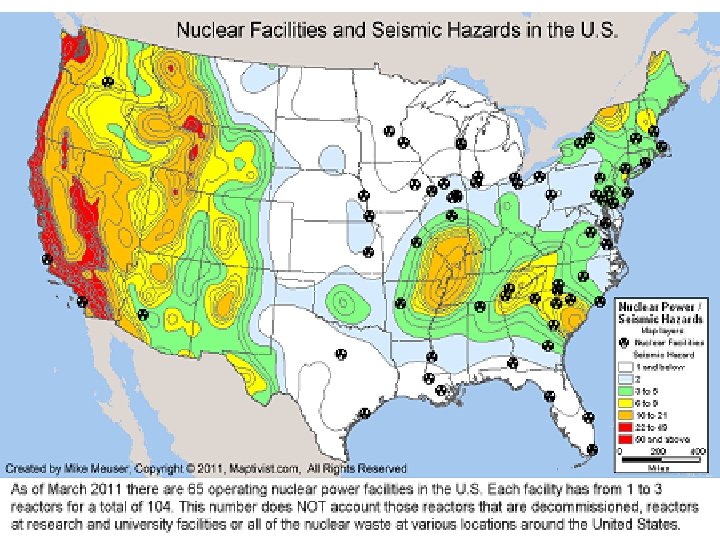
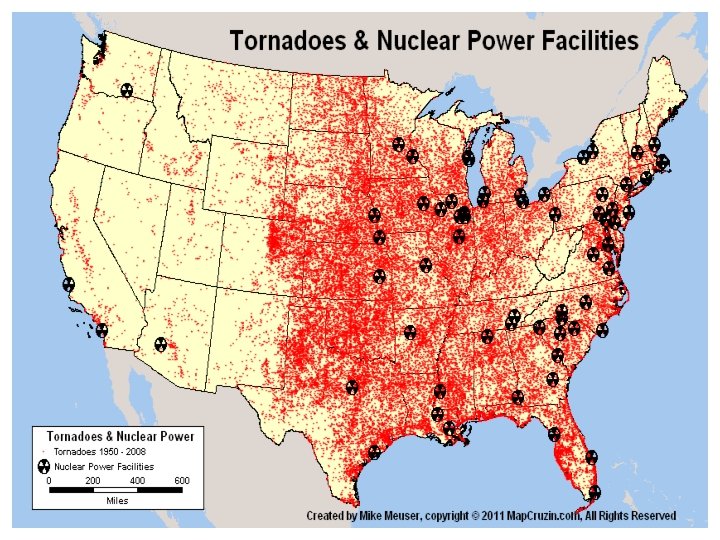
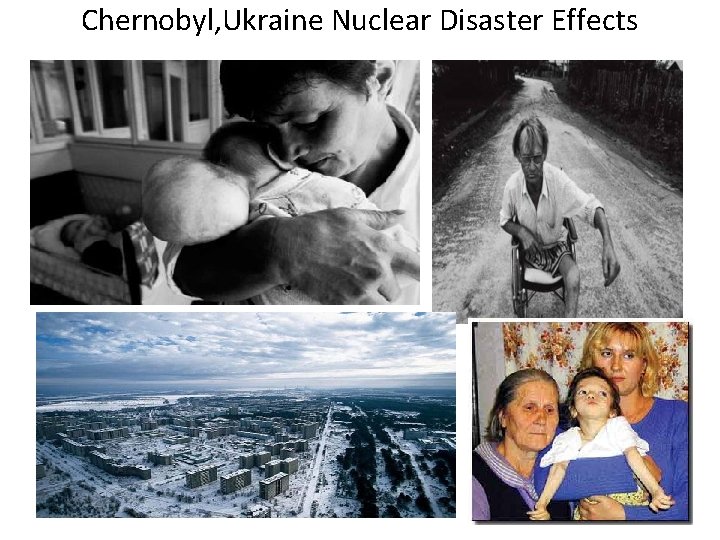
Chernobyl, Ukraine Nuclear Disaster Effects
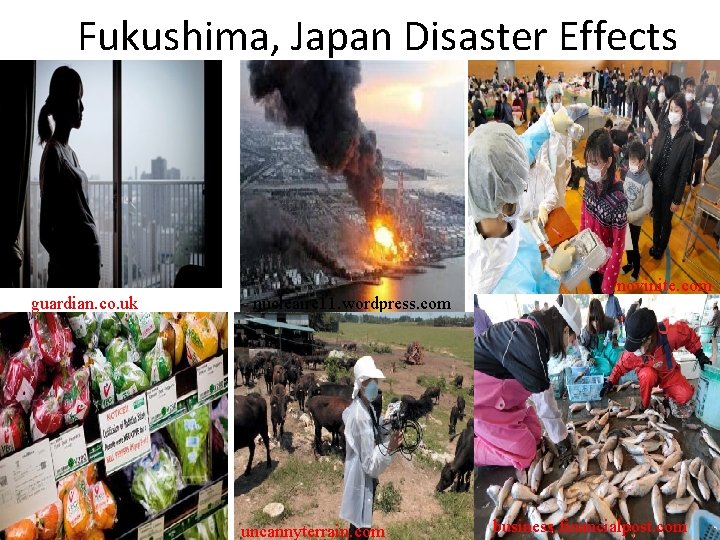
Fukushima, Japan Disaster Effects guardian. co. uk nucleaire 11. wordpress. com uncannyterrain. com novinite. com business. financialpost. com
Gallery Walk: Nuclear Energy Pros and Cons • Each debate group record on chart paper important pros and cons you addressed today. • Walk around and observe what other debate groups discussed.
Exit Slip: Nuclear Energy 1. Did today’s nuclear energy debate strengthen or weaken your view on this issue? 2. What is your view on this issue now: Should the U. S. continue to support the research, development, and application of nuclear energy? *Make sure to validate your view with several supporting facts. *
- Slides: 77