
NUCLEAR CHEMISTRY Introduction Nuclear chemistry is the subfield
NUCLEAR CHEMISTRY
Introduction � � Nuclear chemistry is the sub-field of chemistry dealing with radioactivity, nuclear processes, and transformations in the nuclei of atoms, such as nuclear transmutation and nuclear properties. It is the chemistry of radioactive elements such as the actinides, radium and radon together with the chemistry associated with equipment (such as nuclear reactors) which are designed to perform nuclear processes.
� This includes the corrosion of surfaces and the behavior under conditions of both normal and abnormal operation (such as during an accident). An important area is the behavior of objects and materials after being placed into a nuclear waste storage or disposal site.

Subatomic particles � In the physical sciences, subatomic particles are smaller than atoms. They can be composite particles, such as the neutron and proton; or elementary particles, which according to the standard model are not made of other particles. Particle physics and nuclear physics study these particles and how they interact.
Nuclear binding energy � Nuclear binding energy is the minimum energy that would be required to disassemble the nucleus of an atom into its component parts. These component parts are neutrons and protons, which are collectively called nucleons. The binding energy is always a positive number, as we need to spend energy in moving these nucleons, attracted to each other by the strong nuclear force, away from each other.
� The mass of an atomic nucleus is less than the sum of the individual masses of the free caonstituent protons and neutrons, according to Einstein's equation E=mc 2. This 'missing mass' is known as the mass defect, and represents the energy that was released when the nucleus was formed.
The liquid drop model � � The liquid drop model accounts for the spherical shape of most nuclei, and makes a rough prediction of binding energy. The corresponding mass formula is defined purely in terms of the numbers of protons and neutrons it contains. The original Weizsäcker formula defines five terms:
� Volume energy, when an assembly of nucleons of the same size is packed together into the smallest volume, each interior nucleon has a certain number of other nucleons in contact with it. So, this nuclear energy is proportional to the volume. � Surface energy corrects for the previous assumption made that every nucleon interacts with the same number of other nucleons. This term is negative and proportional to the surface area, and is therefore roughly equivalent to liquid surface tension.
� � � Coulomb energy, the potential energy from each pair of protons. As this is a repulsive force, the binding energy is reduced. Asymmetry energy (also called Pauli Energy), which accounts for the Pauli exclusion principle. Unequal numbers of neutrons and protons imply filling higher energy levels for one type of particle, while leaving lower energy levels vacant for the other type. Pairing energy, which accounts for the tendency of proton pairs and neutron pairs to occur. An even number of particles is more stable than an odd number due to spin coupling.
Neutron–proton ratio(NP ratio � The neutron–proton ratio (N/Z ratio or nuclear ratio) of an atomic nucleus is the ratio of its number of neutrons to its number of protons. Among stable nuclei and naturally occurring nuclei, this ratio generally increases with increasing atomic number. This is because electrical repulsive forces between protons scale with distance differently than strong nuclear force attractions.
� In particular, most pairs of protons in large nuclei are not far enough apart, such that electrical repulsion dominates over the strong nuclear force, and thus proton density in stable larger nuclei must be lower than in stable smaller nuclei where more pairs of protons have appreciable short-range nuclear force attractions.
Nuclear Forces � Nuclear forces (also known as nuclear interactions or strong forces) are the forces that act between two or more nucleons. They bind protons and neutrons (“nucleons”) into atomic nuclei. The nuclear force is about 10 millions times stronger than the chemical binding that holds atoms together in molecules.
� This is the reason why nuclear reactors produce about a million times more energy per kilogram fuel as compared to chemical fuel like oil or coal. However, the range of the nuclear force is short, only a few femtometer (1 fm =10− 15 m), beyond which it decreases rapidly. That is why, in spite of its enormous strength, we do not feel anything of this force on the atomic scale or in everyday life.
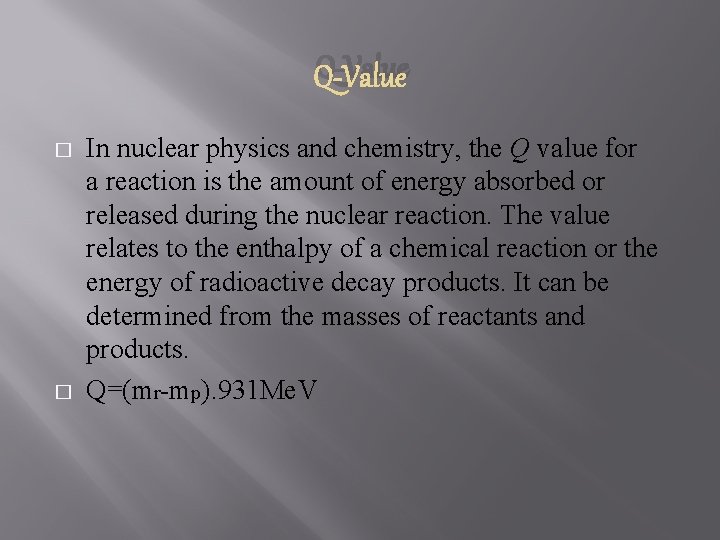
Q-Value � � In nuclear physics and chemistry, the Q value for a reaction is the amount of energy absorbed or released during the nuclear reaction. The value relates to the enthalpy of a chemical reaction or the energy of radioactive decay products. It can be determined from the masses of reactants and products. Q=(mr-mp). 931 Me. V
Geiger counter � A Geiger counter is an instrument used for detecting and measuring ionizing radiation. Also known as a Geiger–Muller counter (or Geiger–Müller counter), it is widely used in applications such as radiation dosimetry, radiological protection, experimental physics, and the nuclear industry.
� It detects ionizing radiation such as alpha particles, beta particles, and gamma rays using the ionization effect produced in a Geiger–Müller tube, which gives its name to the instrument. In wide and prominent use as a hand-held radiation survey instrument, it is perhaps one of the world's bestknown radiation detection instruments.
Principle of Operation � � A Geiger counter consists of a Geiger–Müller tube (the sensing element which detects the radiation) and the processing electronics, which displays the result. The Geiger–Müller tube is filled with an inert gas such as helium, neon, or argon at low pressure, to which a high voltage is applied. The tube briefly conducts electrical charge when a particle or photon of incident radiation makes the gas conductive by ionization.
� The ionization is considerably amplified within the tube by the Townsend discharge effect to produce an easily measured detection pulse, which is fed to the processing and display electronics. This large pulse from the tube makes the Geiger counter relatively cheap to manufacture, as the subsequent electronics are greatly simplified. The electronics also generate the high voltage, typically 400– 900 volts, that has to be applied to the Geiger–Müller tube to enable its operation. To stop the discharge in the Geiger– Müller tube a little halogen gas or organic material (alcohol) is added to the gas mixture.
Nuclear fission � In nuclear physics and nuclear chemistry, nuclear fission is a nuclear reaction or a radioactive decay process in which the nucleus of an atom splits into two or more smaller, lighter nuclei. The fission process often produces gamma photons, and releases a very large amount of energy even by the energetic standards of radioactive decay.
Nuclear fusion � Nuclear fusion is a reaction in which two or more atomic nuclei are combined to form one or more different atomic nuclei and subatomic particles (neutrons or protons). The difference in mass between the reactants and products is manifested as either the release or absorption of energy. This difference in mass arises due to the difference in atomic "binding energy" between the atomic nuclei before and after the reaction. Fusion is the process that powers active or "main sequence" stars, or other high magnitude stars.
- Slides: 20