
Nuclear Bombardment Reactions Nuclear Bombardment Reactions In 1919
Nuclear Bombardment Reactions
Nuclear Bombardment Reactions • In 1919, Ernest Rutherford discovered that it is possible to change the nucleus of one element into the nucleus of another element. – Transmutation is the change of one element to another by bombarding the nucleus of the element with nuclear particles or nuclei. www. assignmentpoint. com
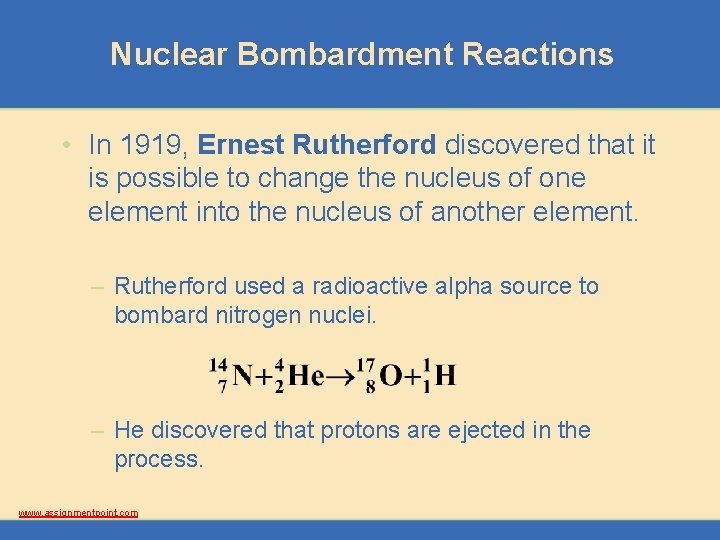
Nuclear Bombardment Reactions • In 1919, Ernest Rutherford discovered that it is possible to change the nucleus of one element into the nucleus of another element. – Rutherford used a radioactive alpha source to bombard nitrogen nuclei. – He discovered that protons are ejected in the process. www. assignmentpoint. com
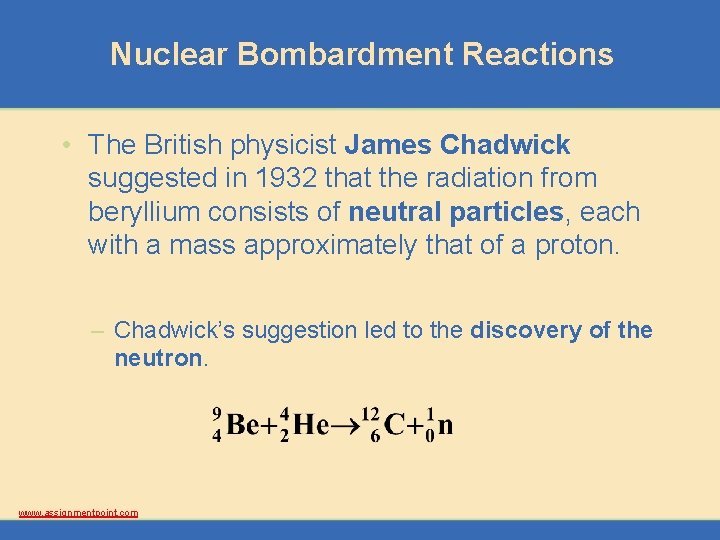
Nuclear Bombardment Reactions • The British physicist James Chadwick suggested in 1932 that the radiation from beryllium consists of neutral particles, each with a mass approximately that of a proton. – Chadwick’s suggestion led to the discovery of the neutron. www. assignmentpoint. com
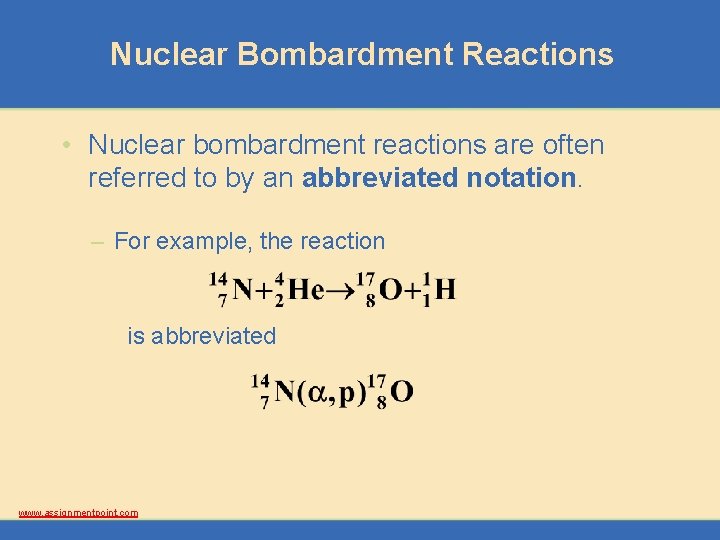
Nuclear Bombardment Reactions • Nuclear bombardment reactions are often referred to by an abbreviated notation. – For example, the reaction is abbreviated www. assignmentpoint. com
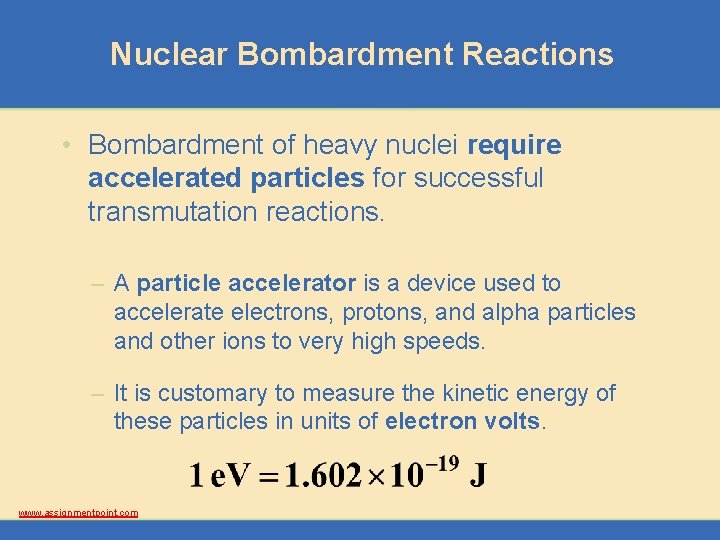
Nuclear Bombardment Reactions • Bombardment of heavy nuclei require accelerated particles for successful transmutation reactions. – A particle accelerator is a device used to accelerate electrons, protons, and alpha particles and other ions to very high speeds. – It is customary to measure the kinetic energy of these particles in units of electron volts. www. assignmentpoint. com
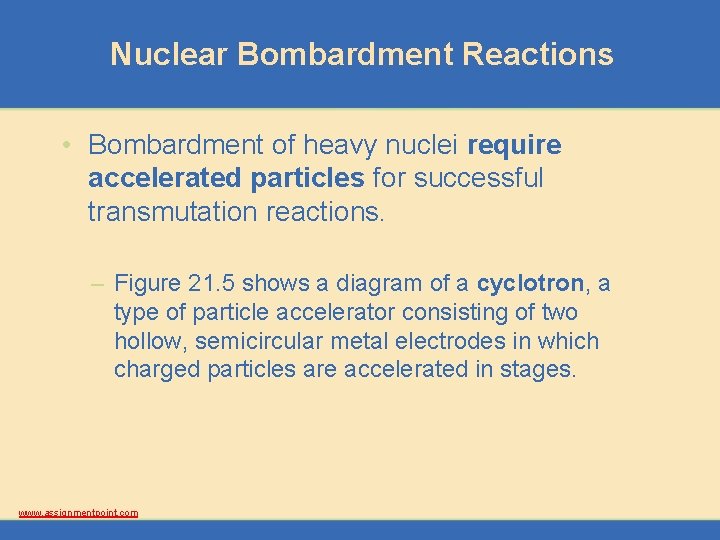
Nuclear Bombardment Reactions • Bombardment of heavy nuclei require accelerated particles for successful transmutation reactions. – Figure 21. 5 shows a diagram of a cyclotron, a type of particle accelerator consisting of two hollow, semicircular metal electrodes in which charged particles are accelerated in stages. www. assignmentpoint. com
- Slides: 7