
Nuclear Astrophysics nTOF CERN Tagliente Giuseppe Istituto Nazionale
- Slides: 38
Nuclear Astrophysics @ n_TOF, CERN Tagliente Giuseppe Istituto Nazionale Fisica Nucleare, Sez. di Bari (on behalf of the n_TOF collaboration) International School of Nuclear Physics 36 th Course: Nuclei in the laboratory and in the cosmos International School of Nuclear Physics – Erice, September 16 -24, 2014 G. Tagliente – INFN Bari 1
The n_TOF Collaboration (~100 Researchers from 30 Institutes) CERN Technische Universitat Wien Austria IRMM EC-Joint Research Center, Geel Belgium Charles Univ. (Prague) Czech Republic IN 2 P 3 -Orsay, CEA-Saclay France KIT – Karlsruhe, Goethe University, Frankfurt Germany Univ. of Athens, Ioannina, Demokritos Greece INFN Bari, Bologna, LNL, LNS, Trieste, ENEA – Bologna Italy Univ. of Tokio Japan Univ. of Lodz Poland ITN Lisbon Portugal IFIN – Bucarest Rumania CIEMAT, Univ. of Valencia, Santiago de Compostela, University of Cataluna, Sevilla Spain University of Basel, PSI Switzerland Univ. of Manchester, Univ. of York UK International School of Nuclear Physics – Erice, September 16 -24, 2014 G. Tagliente – INFN Bari
n_TOF Scientific Motivations – Neutron cross sections relevant for Nuclear Astrophysics – Measurements of neutron cross sections relevant for Nuclear Waste Transmutation and related Nuclear Technologies (ADS) – Neutrons as probes for fundamental Nuclear Physics International School of Nuclear Physics – Erice, September 16 -24, 2014 G. Tagliente – INFN Bari
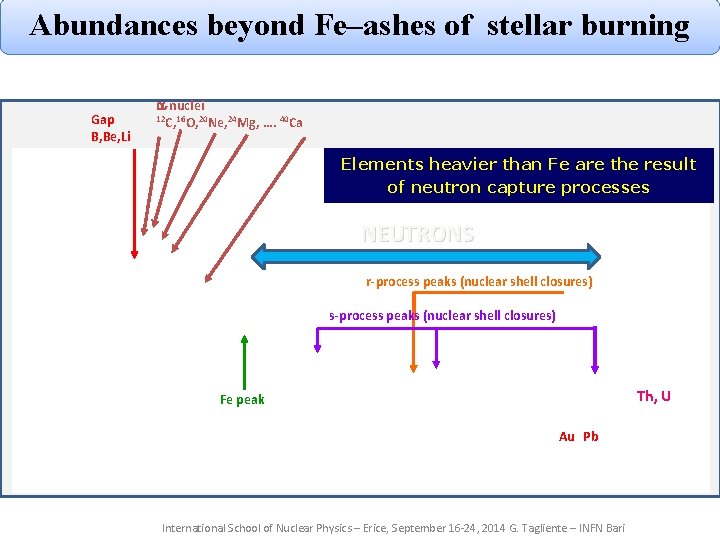
Abundances beyond Fe–ashes of stellar burning Gap B, Be, Li a-nuclei 12 C, 16 O, 20 Ne, 24 Mg, …. 40 Ca Elements heavier than Fe are the result of neutron capture processes NEUTRONS H 30 000 C 10 Fe 1 Au 2 10 -7 r-process peaks (nuclear shell closures) s-process peaks (nuclear shell closures) Th, U Fe peak Au Pb International School of Nuclear Physics – Erice, September 16 -24, 2014 G. Tagliente – INFN Bari
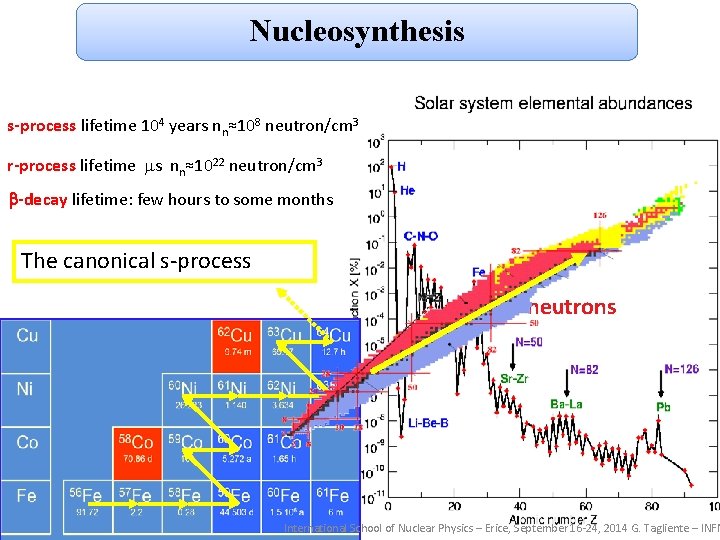
Nucleosynthesis s-process lifetime 104 years nn≈108 neutron/cm 3 r-process lifetime ms nn≈1022 neutron/cm 3 b-decay lifetime: few hours to some months The canonical s-process neutrons International School of Nuclear Physics – Erice, September 16 -24, 2014 G. Tagliente – INFN
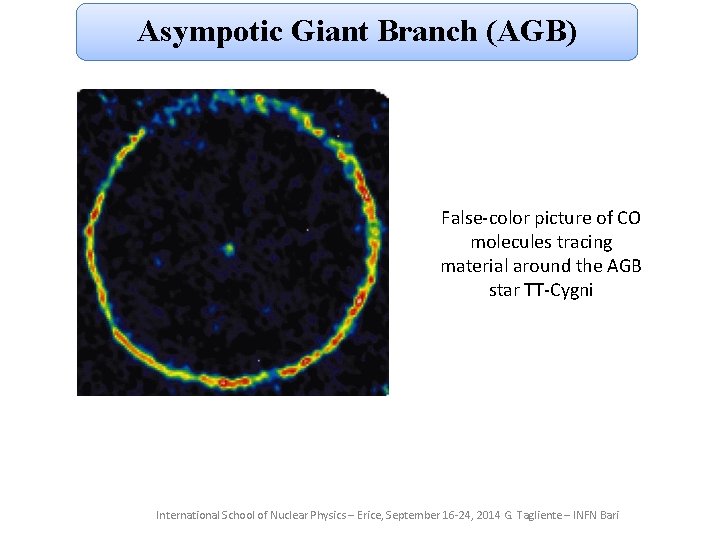
Asympotic Giant Branch (AGB) False-color picture of CO molecules tracing material around the AGB star TT-Cygni International School of Nuclear Physics – Erice, September 16 -24, 2014 G. Tagliente – INFN Bari
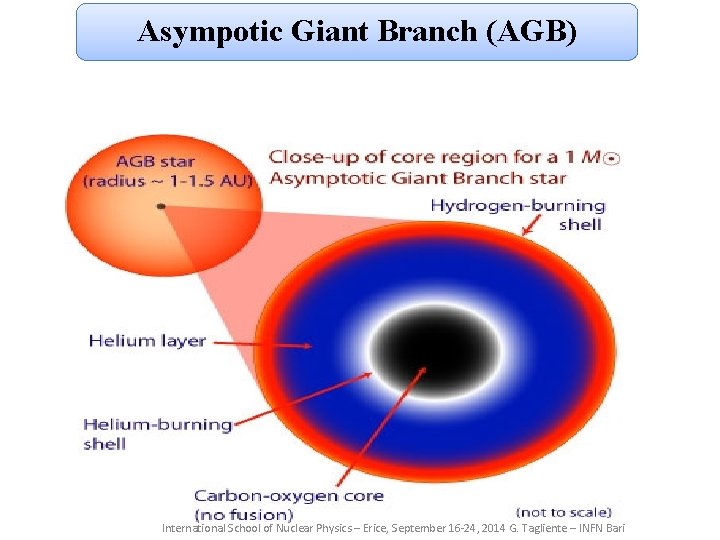
Asympotic Giant Branch (AGB) International School of Nuclear Physics – Erice, September 16 -24, 2014 G. Tagliente – INFN Bari
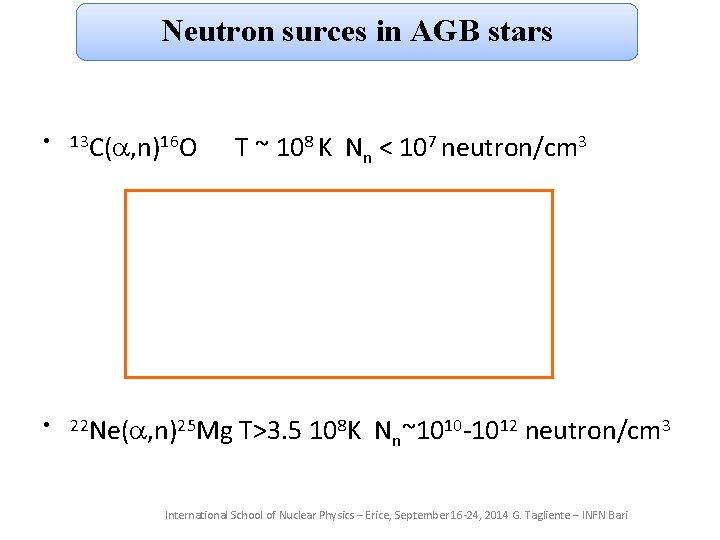
Neutron surces in AGB stars • 13 C(a, n)16 O T ~ 108 K Nn < 107 neutron/cm 3 • 22 Ne(a, n)25 Mg T>3. 5 108 K Nn~1010 -1012 neutron/cm 3 International School of Nuclear Physics – Erice, September 16 -24, 2014 G. Tagliente – INFN Bari
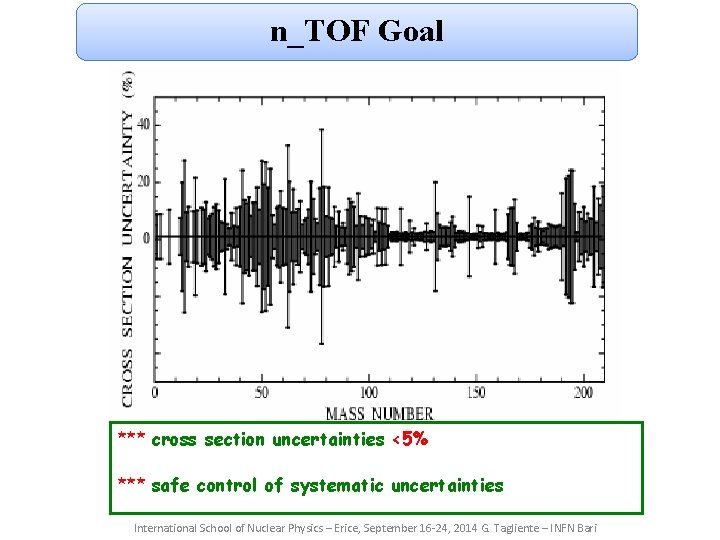
n_TOF Goal *** cross section uncertainties <5% *** safe control of systematic uncertainties International School of Nuclear Physics – Erice, September 16 -24, 2014 G. Tagliente – INFN Bari
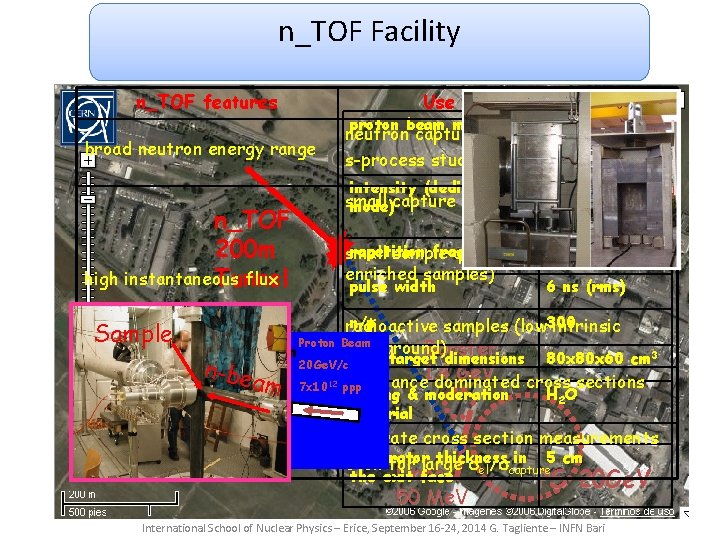
n_TOF Facility n_TOF features broad neutron energy range n_TOF 200 m high instantaneous flux Tunnel Use in astrophysics proton beam momentum 20 Ge. V/c neutron capture cross sections for s-process studies (thermal– 1 Me. V) intensity (dedicated 7 x 10¹² small mode)capture cross sections protons/pulse repetition frequency 1 pulse/2. 4 s small sample quantities (isotopically enriched samples) pulse width 6 ns (rms) n/p radioactive samples (low 300 intrinsic Proton Beam background) Booster Pb Spallation lead target dimensions 80 x 60 cm 3 20 Ge. V/c Target n e Ge. V excellent energy-b resolution resonance 1. 4 dominated cross sections am 7 x 10¹² ppp Sample Neutron Beam low neutron sensitivity o prod. angle 10 backgrounds low cooling & moderation material H 2 O accurate cross section measurements moderator thickness in 5 cm even for large sel/scapture Linac the exit face 50 Me. V PS 20 Ge. V International School of Nuclear Physics – Erice, September 16 -24, 2014 G. Tagliente – INFN Bari
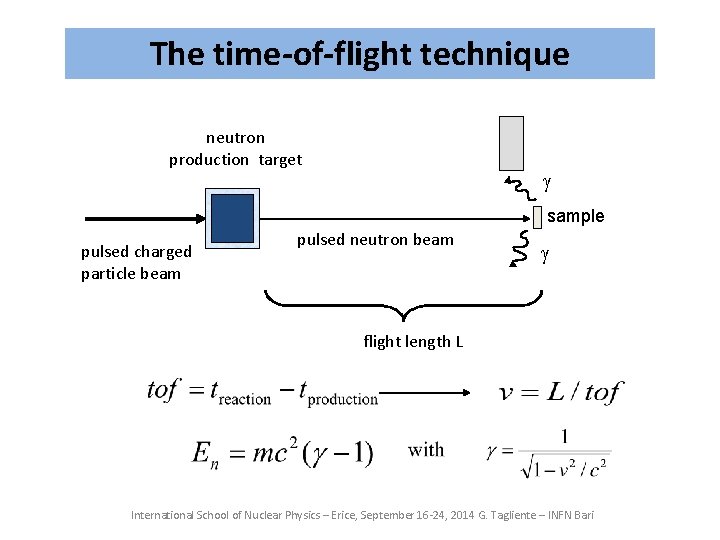
The time-of-flight technique neutron production target sample pulsed charged particle beam pulsed neutron beam flight length L International School of Nuclear Physics – Erice, September 16 -24, 2014 G. Tagliente – INFN Bari
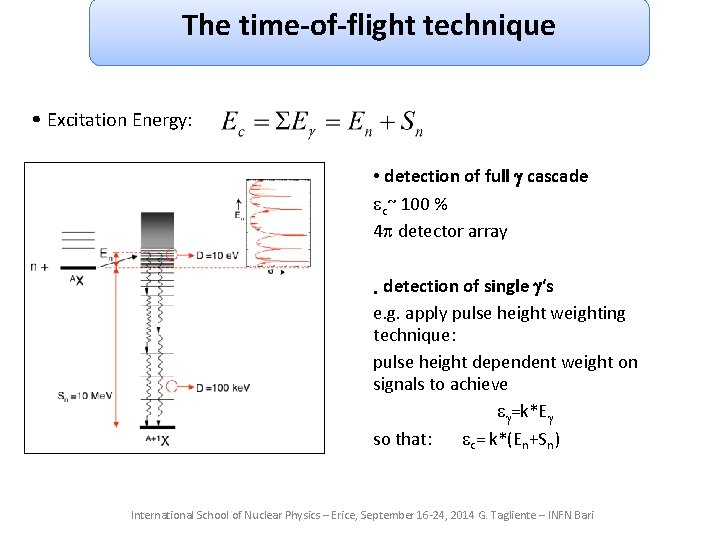
The time-of-flight technique • Excitation Energy: • detection of full cascade ec~ 100 % 4 p detector array detection of single ‘s e. g. apply pulse height weighting technique: pulse height dependent weight on signals to achieve e =k*E so that: ec= k*(En+Sn) • International School of Nuclear Physics – Erice, September 16 -24, 2014 G. Tagliente – INFN Bari
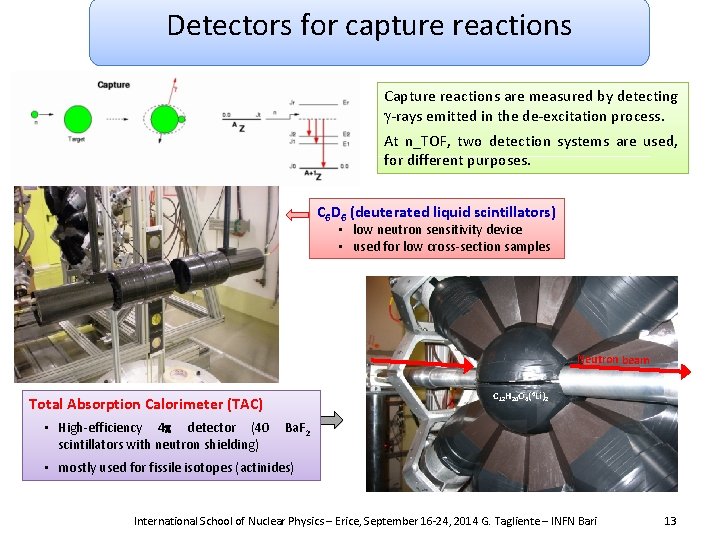
Detectors for capture reactions Capture reactions are measured by detecting -rays emitted in the de-excitation process. At n_TOF, two detection systems are used, for different purposes. C 6 D 6 (deuterated liquid scintillators) • low neutron sensitivity device • used for low cross-section samples Neutron beam C 12 H 20 O 4(6 Li)2 Total Absorption Calorimeter (TAC) • High-efficiency 4 p detector (40 scintillators with neutron shielding) Ba. F 2 • mostly used for fissile isotopes (actinides) International School of Nuclear Physics – Erice, September 16 -24, 2014 G. Tagliente – INFN Bari 13
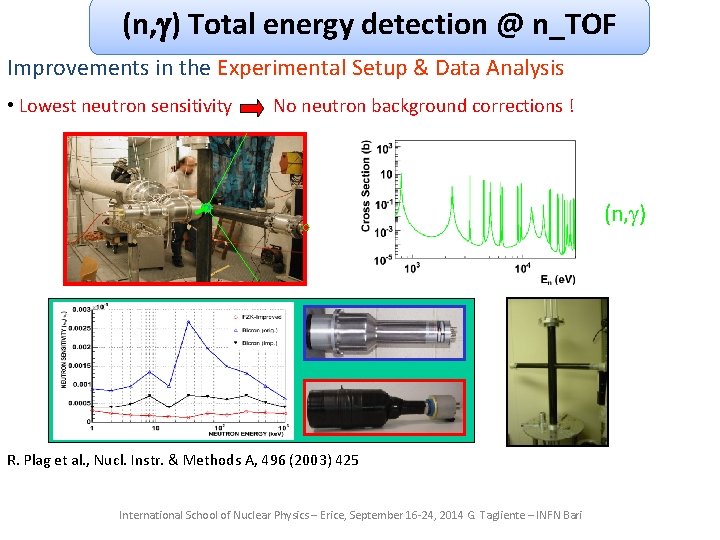
(n, ) Total energy detection @ n_TOF Improvements in the Experimental Setup & Data Analysis • Lowest neutron sensitivity No neutron background corrections ! (n, ) R. Plag et al. , Nucl. Instr. & Methods A, 496 (2003) 425 International School of Nuclear Physics – Erice, September 16 -24, 2014 G. Tagliente – INFN Bari
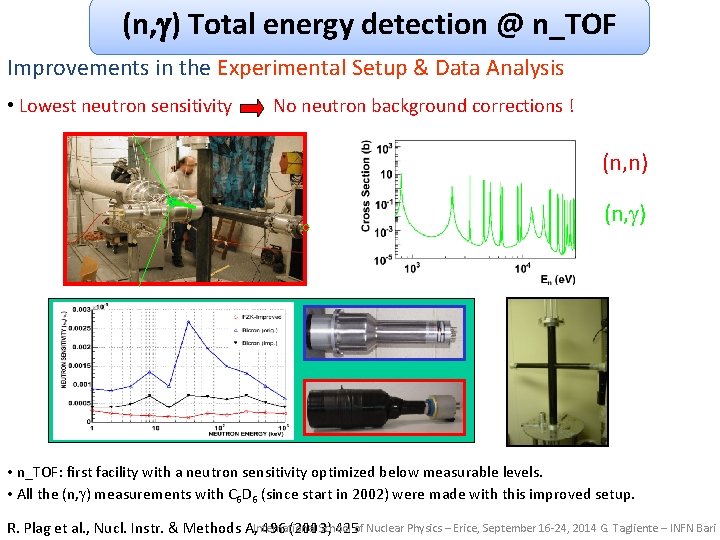
(n, ) Total energy detection @ n_TOF Improvements in the Experimental Setup & Data Analysis • Lowest neutron sensitivity No neutron background corrections ! (n, n) (n, ) • n_TOF: first facility with a neutron sensitivity optimized below measurable levels. • All the (n, ) measurements with C 6 D 6 (since start in 2002) were made with this improved setup. School R. Plag et al. , Nucl. Instr. & Methods A, International 496 (2003) 425 of Nuclear Physics – Erice, September 16 -24, 2014 G. Tagliente – INFN Bari
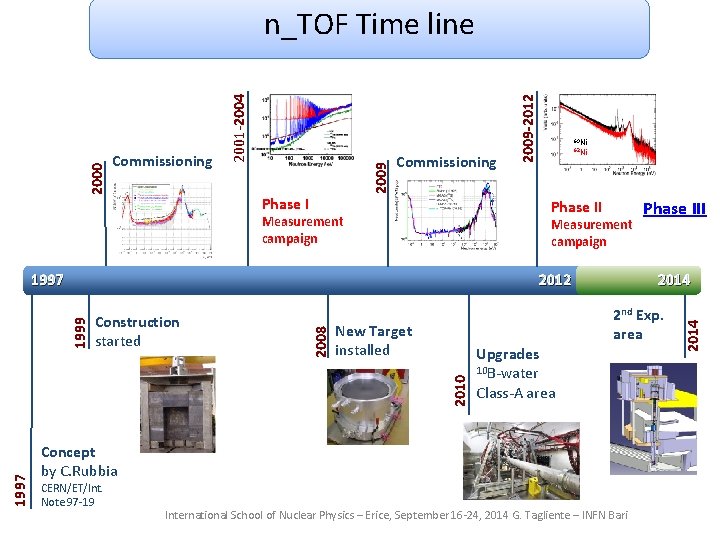
62 Ni Phase II Measurement campaign 2 nd Exp. area New Target installed 2010 2008 Construction started Upgrades 10 B-water Class-A area Concept by C. Rubbia CERN/ET/Int. Note 97 -19 Phase III 2014 2012 1999 1997 63 Ni International School of Nuclear Physics – Erice, September 16 -24, 2014 G. Tagliente – INFN Bari 2014 Phase I Commissioning 2009 -2012 2009 Commissioning 2001 -2004 2000 n_TOF Time line
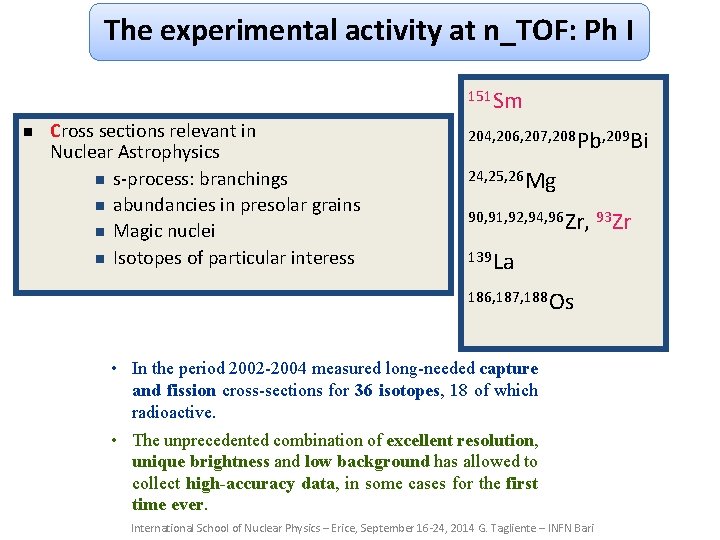
The experimental activity at n_TOF: Ph I 151 Sm n Cross sections relevant in Nuclear Astrophysics n s-process: branchings n abundancies in presolar grains n Magic nuclei n Isotopes of particular interess 204, 206, 207, 208 Pb, 209 Bi 24, 25, 26 Mg 90, 91, 92, 94, 96 Zr, 93 Zr 139 La 186, 187, 188 Os • In the period 2002 -2004 measured long-needed capture and fission cross-sections for 36 isotopes, 18 of which radioactive. • The unprecedented combination of excellent resolution, unique brightness and low background has allowed to collect high-accuracy data, in some cases for the first time ever. International School of Nuclear Physics – Erice, September 16 -24, 2014 G. Tagliente – INFN Bari
n_TOF Phase II International School of Nuclear Physics – Erice, September 16 -24, 2014 G. Tagliente – INFN Bari
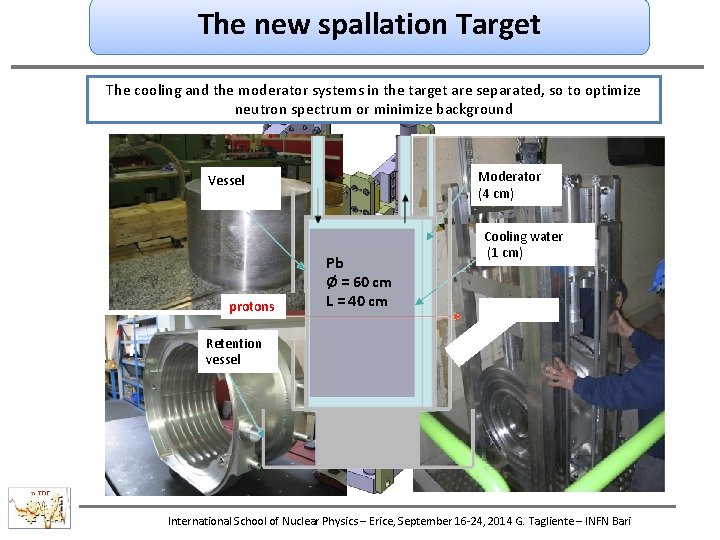
The new spallation Target The cooling and the moderator systems in the target are separated, so to optimize neutron spectrum or minimize background Moderator (4 cm) Vessel protons Pb Ø = 60 cm L = 40 cm Cooling water (1 cm) Retention vessel International School of Nuclear Physics – Erice, September 16 -24, 2014 G. Tagliente – INFN Bari
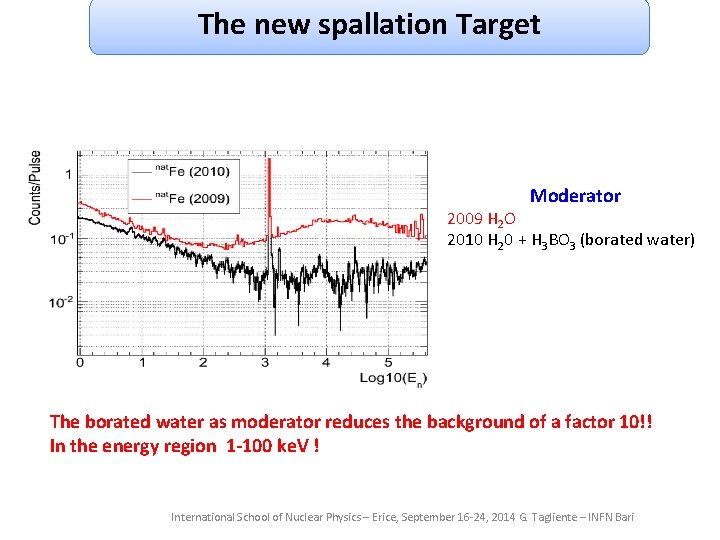
The new spallation Target Moderator 2009 H 2 O 2010 H 20 + H 3 BO 3 (borated water) The borated water as moderator reduces the background of a factor 10!! In the energy region 1 -100 ke. V ! International School of Nuclear Physics – Erice, September 16 -24, 2014 G. Tagliente – INFN Bari
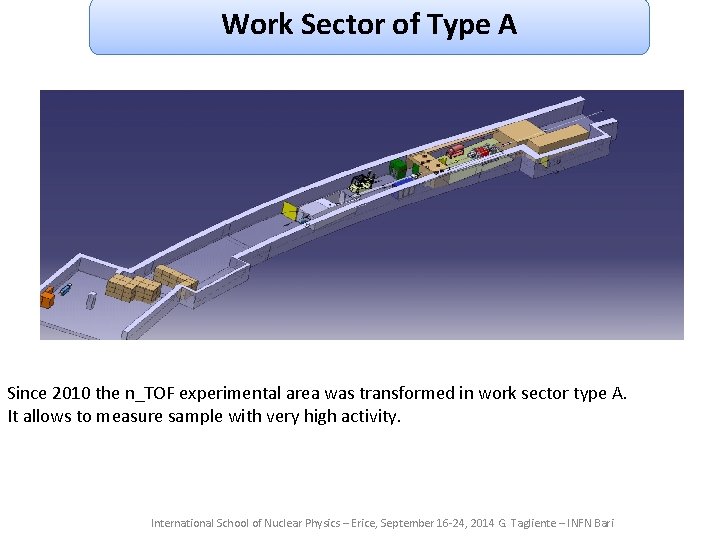
Work Sector of Type A Since 2010 the n_TOF experimental area was transformed in work sector type A. It allows to measure sample with very high activity. International School of Nuclear Physics – Erice, September 16 -24, 2014 G. Tagliente – INFN Bari
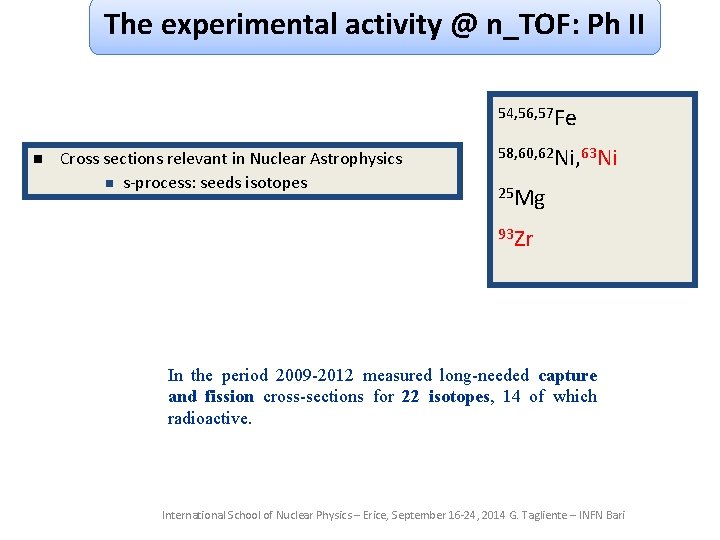
The experimental activity @ n_TOF: Ph II 54, 56, 57 Fe n Cross sections relevant in Nuclear Astrophysics n s-process: seeds isotopes 58, 60, 62 Ni, 63 Ni 25 Mg 93 Zr In the period 2009 -2012 measured long-needed capture and fission cross-sections for 22 isotopes, 14 of which radioactive. International School of Nuclear Physics – Erice, September 16 -24, 2014 G. Tagliente – INFN Bari
Experimental results International School of Nuclear Physics – Erice, September 16 -24, 2014 G. Tagliente – INFN Bari
International School of Nuclear Physics – Erice, September 16 -24, 2014 G. Tagliente – INFN Bari
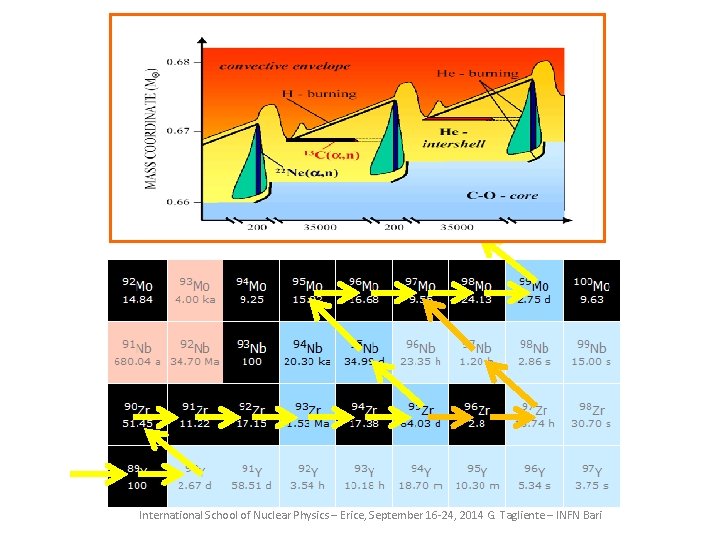
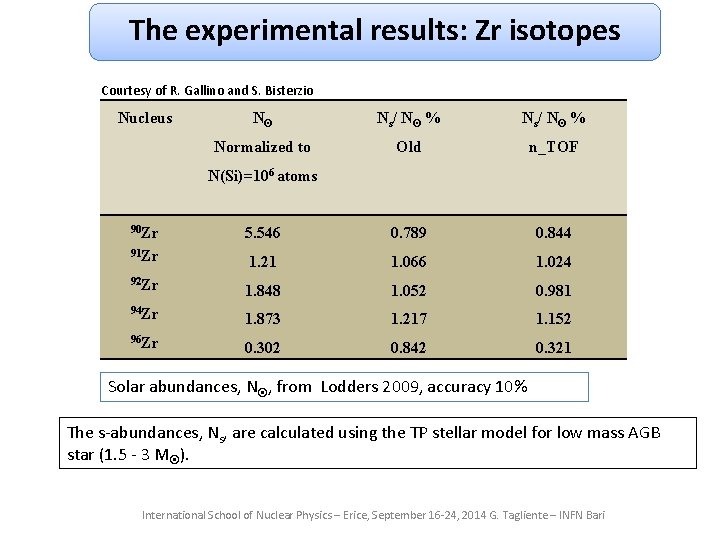
The experimental results: Zr isotopes Courtesy of R. Gallino and S. Bisterzio Nucleus Nʘ Ns / N ʘ % Normalized to Old n_TOF 5. 546 0. 789 0. 844 1. 21 1. 066 1. 024 1. 848 1. 052 0. 981 1. 873 1. 217 1. 152 0. 302 0. 842 0. 321 N(Si)=106 atoms 90 Zr 91 Zr 92 Zr 94 Zr 96 Zr Solar abundances, N , from Lodders 2009, accuracy 10% The s-abundances, Ns, are calculated using the TP stellar model for low mass AGB star (1. 5 - 3 M ). International School of Nuclear Physics – Erice, September 16 -24, 2014 G. Tagliente – INFN Bari
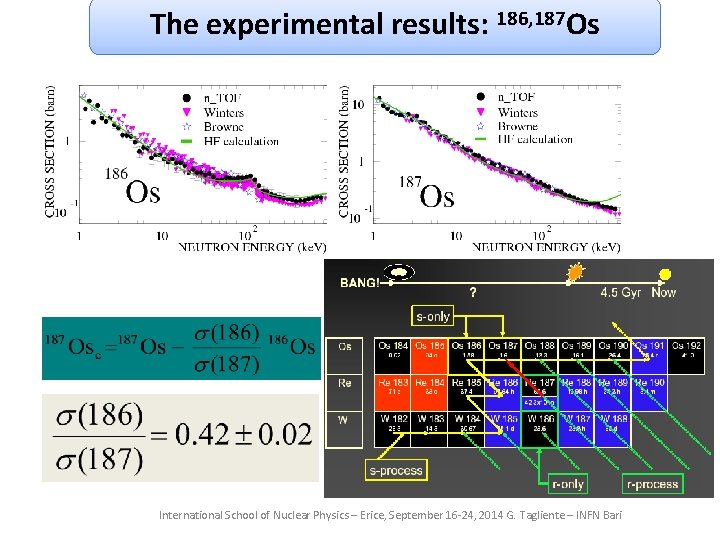
The experimental results: 186, 187 Os International School of Nuclear Physics – Erice, September 16 -24, 2014 G. Tagliente – INFN Bari
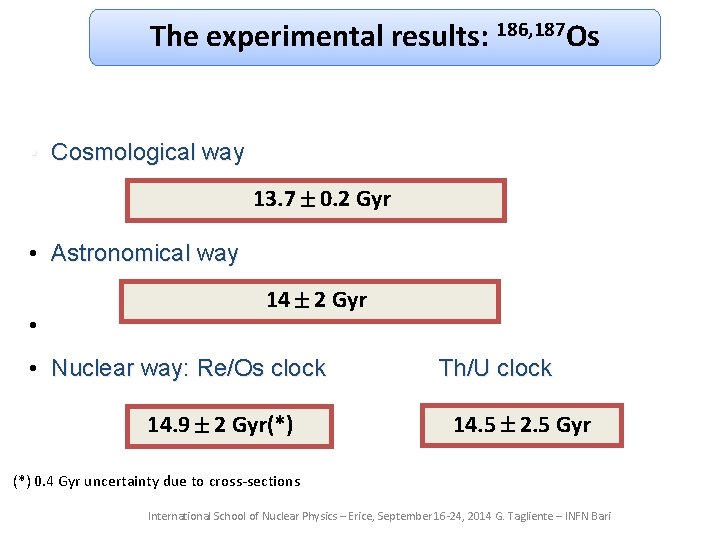
The experimental results: 186, 187 Os • Cosmological way 13. 7 0. 2 Gyr • Astronomical way • 14 2 Gyr • Nuclear way: Re/Os clock 14. 9 2 Gyr(*) Th/U clock 14. 5 2. 5 Gyr (*) 0. 4 Gyr uncertainty due to cross-sections International School of Nuclear Physics – Erice, September 16 -24, 2014 G. Tagliente – INFN Bari
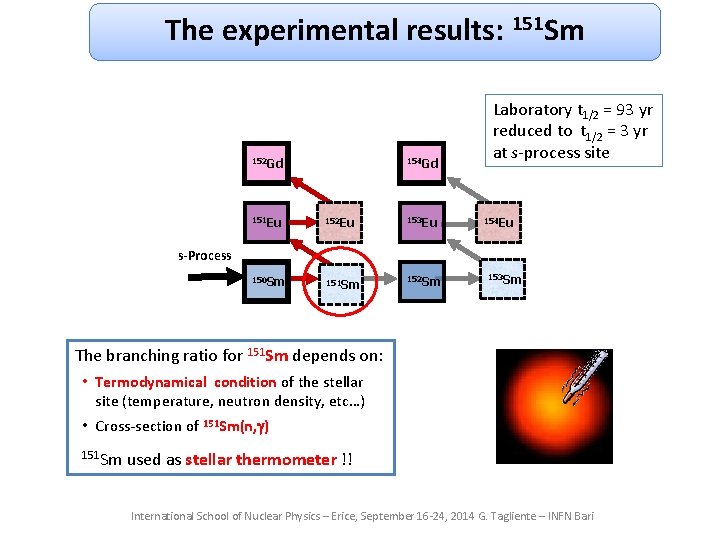
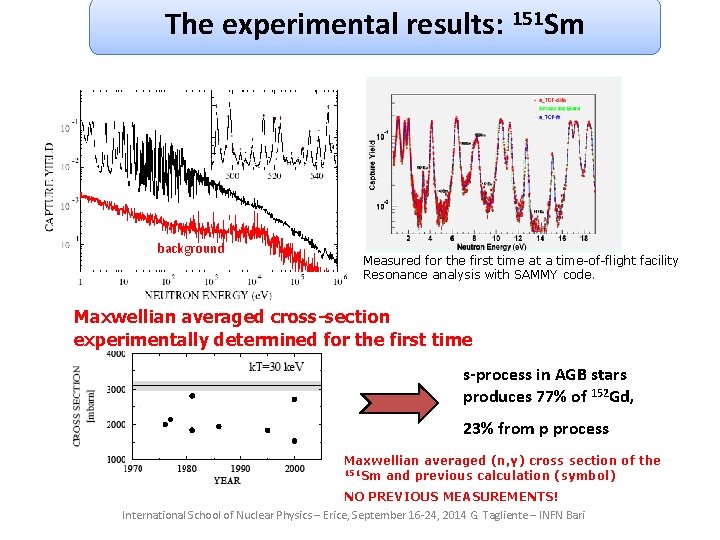
The experimental results: 151 Sm 152 Gd 154 Gd 151 Eu 152 Eu 153 Eu 150 Sm 151 Sm 152 Sm Laboratory t 1/2 = 93 yr reduced to t 1/2 = 3 yr at s-process site 154 Eu s-Process 153 Sm The branching ratio for 151 Sm depends on: • Termodynamical condition of the stellar site (temperature, neutron density, etc…) • Cross-section of 151 Sm(n, ) 151 Sm used as stellar thermometer !! International School of Nuclear Physics – Erice, September 16 -24, 2014 G. Tagliente – INFN Bari
The experimental results: 151 Sm background Measured for the first time at a time-of-flight facility Resonance analysis with SAMMY code. Maxwellian averaged cross-section experimentally determined for the first time s-process in AGB stars produces 77% of 152 Gd, 23% from p process Maxwellian averaged (n, γ) cross section of the 151 Sm and previous calculation (symbol) NO PREVIOUS MEASUREMENTS! International School of Nuclear Physics – Erice, September 16 -24, 2014 G. Tagliente – INFN Bari
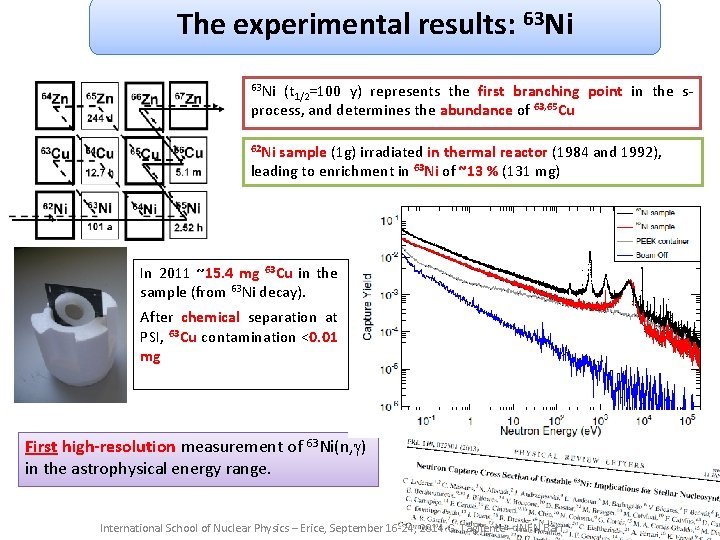
The experimental results: 63 Ni (t 1/2=100 y) represents the first branching point in the sprocess, and determines the abundance of 63, 65 Cu 62 Ni sample (1 g) irradiated in thermal reactor (1984 and 1992), leading to enrichment in 63 Ni of ~13 % (131 mg) In 2011 ~15. 4 mg 63 Cu in the sample (from 63 Ni decay). After chemical separation at PSI, 63 Cu contamination <0. 01 mg First high-resolution measurement of 63 Ni(n, ) in the astrophysical energy range. International School of Nuclear Physics – Erice, September 16 -24, 2014 G. Tagliente – INFN Bari
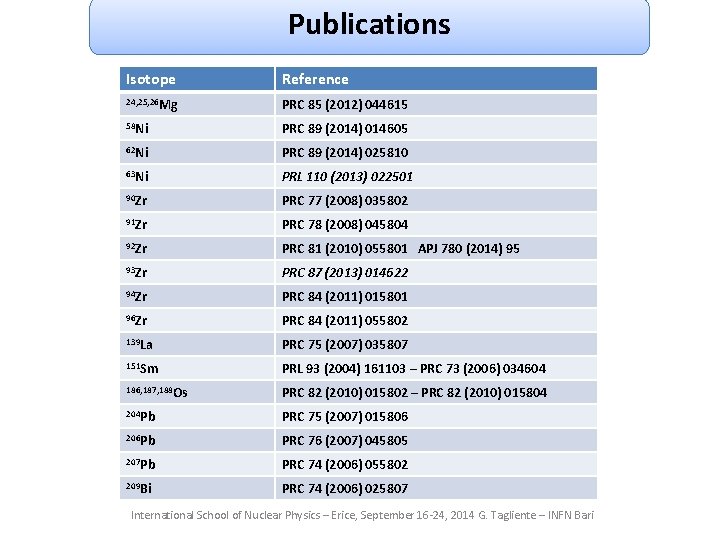
Publications Isotope Reference 24, 25, 26 Mg PRC 85 (2012) 044615 58 Ni PRC 89 (2014) 014605 62 Ni PRC 89 (2014) 025810 63 Ni PRL 110 (2013) 022501 90 Zr PRC 77 (2008) 035802 91 Zr PRC 78 (2008) 045804 92 Zr PRC 81 (2010) 055801 APJ 780 (2014) 95 93 Zr PRC 87 (2013) 014622 94 Zr PRC 84 (2011) 015801 96 Zr PRC 84 (2011) 055802 139 La PRC 75 (2007) 035807 151 Sm PRL 93 (2004) 161103 – PRC 73 (2006) 034604 186, 187, 188 Os PRC 82 (2010) 015802 – PRC 82 (2010) 015804 204 Pb PRC 75 (2007) 015806 206 Pb PRC 76 (2007) 045805 207 Pb PRC 74 (2006) 055802 209 Bi PRC 74 (2006) 025807 International School of Nuclear Physics – Erice, September 16 -24, 2014 G. Tagliente – INFN Bari
The second Experimental ARea @ n_TOF International School of Nuclear Physics – Erice, September 16 -24, 2014 G. Tagliente – INFN Bari
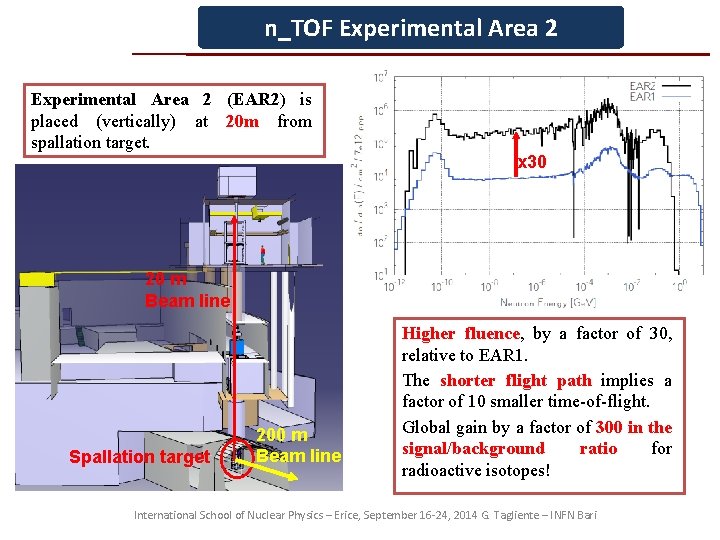
n_TOF Experimental Area 2 (EAR 2) is placed (vertically) at 20 m from spallation target. x 30 20 m Beam line Spallation target 200 m Beam line Higher fluence, by a factor of 30, relative to EAR 1. The shorter flight path implies a factor of 10 smaller time-of-flight. Global gain by a factor of 300 in the signal/background ratio for radioactive isotopes! International School of Nuclear Physics – Erice, September 16 -24, 2014 G. Tagliente – INFN Bari
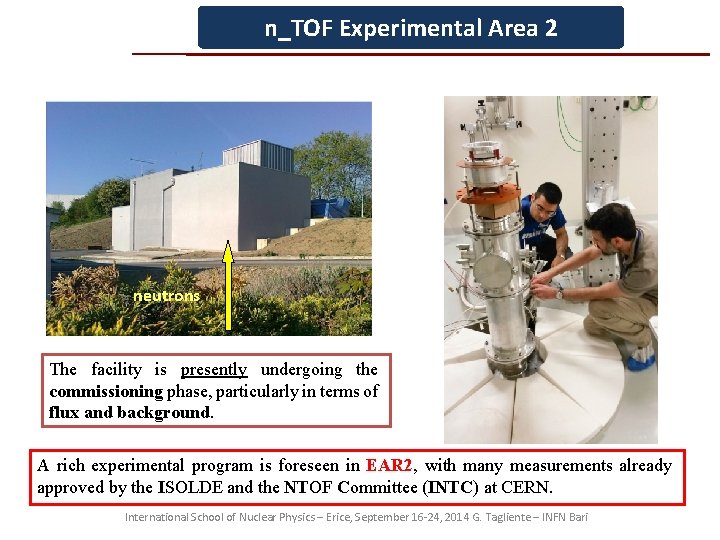
n_TOF Experimental Area 2 neutrons The facility is presently undergoing the commissioning phase, particularly in terms of flux and background. A rich experimental program is foreseen in EAR 2, with many measurements already approved by the ISOLDE and the NTOF Committee (INTC) at CERN. International School of Nuclear Physics – Erice, September 16 -24, 2014 G. Tagliente – INFN Bari
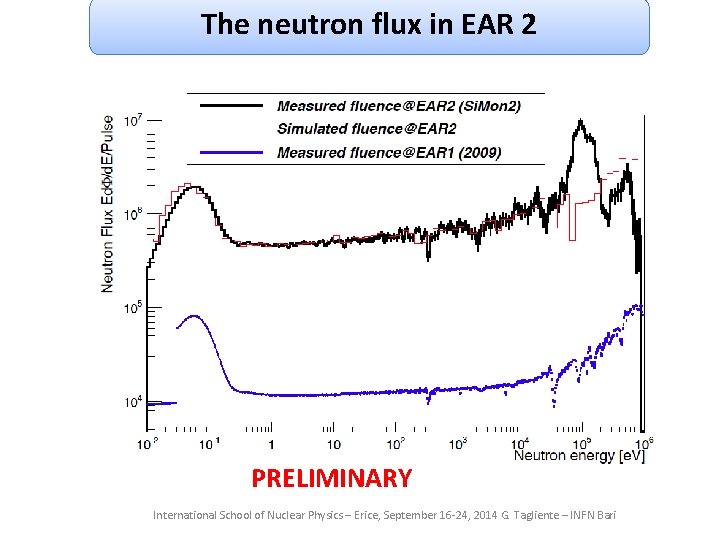
The neutron flux in EAR 2 PRELIMINARY International School of Nuclear Physics – Erice, September 16 -24, 2014 G. Tagliente – INFN Bari
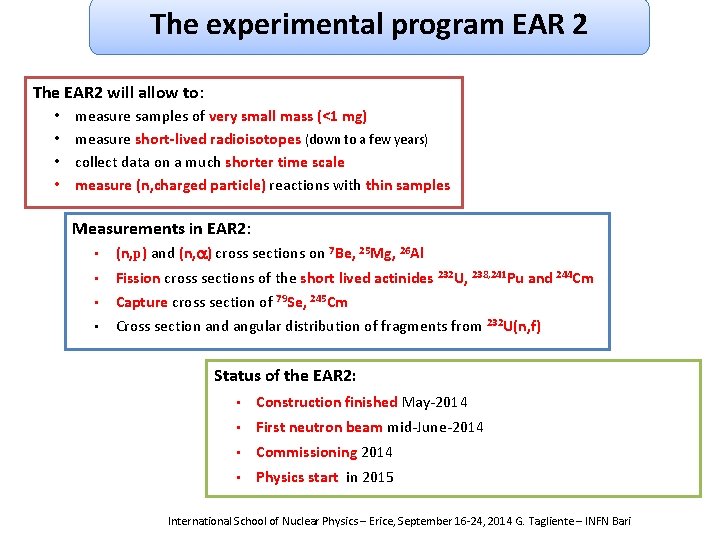
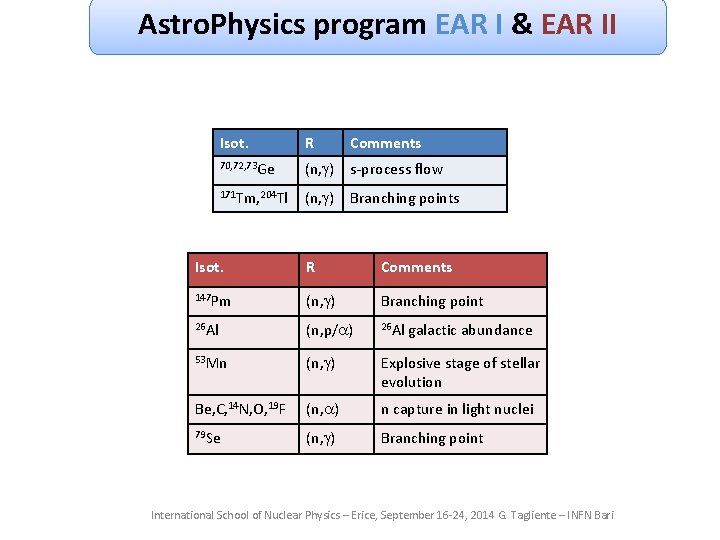
The experimental program EAR 2 The EAR 2 will allow to: • • measure samples of very small mass (<1 mg) measure short-lived radioisotopes (down to a few years) collect data on a much shorter time scale measure (n, charged particle) reactions with thin samples Measurements in EAR 2: ISR • (n, p) and (n, a) cross sections on 7 Be, 25 Mg, 26 Al • Fission cross sections of the short lived actinides 232 U, 238, 241 Pu and 244 Cm • Capture cross section of 79 Se, 245 Cm • Cross section and angular distribution of fragments from 232 U(n, f) Status of the EAR 2: n_TOF target pit • Construction finished May-2014 • First neutron beam mid-June-2014 • Commissioning 2014 • Physics start in 2015 International School of Nuclear Physics – Erice, September 16 -24, 2014 G. Tagliente – INFN Bari
Astro. Physics program EAR I & EAR II Isot. R Comments 70, 72, 73 Ge (n, ) s-process flow 171 Tm, 204 Tl (n, ) Branching points Isot. R Comments 147 Pm (n, ) Branching point 26 Al (n, p/a) 26 Al 53 Mn (n, ) Explosive stage of stellar evolution Be, C, 14 N, O, 19 F (n, a) n capture in light nuclei 79 Se (n, ) Branching point galactic abundance International School of Nuclear Physics – Erice, September 16 -24, 2014 G. Tagliente – INFN Bari
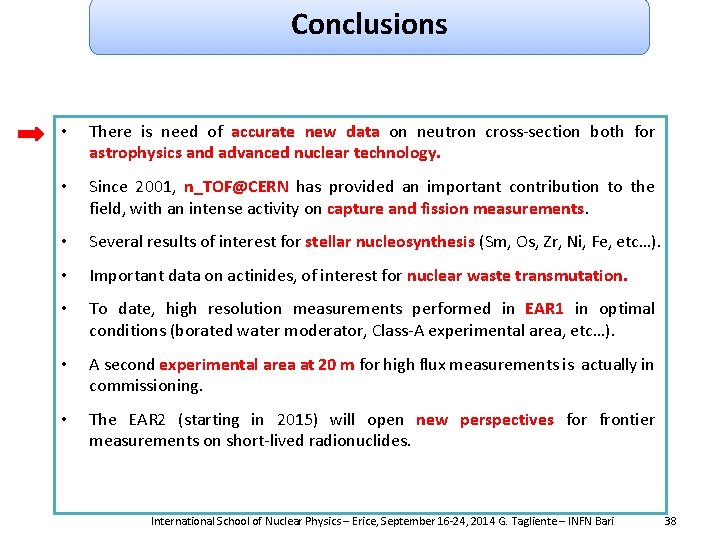
Conclusions • There is need of accurate new data on neutron cross-section both for astrophysics and advanced nuclear technology. • Since 2001, n_TOF@CERN has provided an important contribution to the field, with an intense activity on capture and fission measurements. • Several results of interest for stellar nucleosynthesis (Sm, Os, Zr, Ni, Fe, etc…). • Important data on actinides, of interest for nuclear waste transmutation. • To date, high resolution measurements performed in EAR 1 in optimal conditions (borated water moderator, Class-A experimental area, etc…). • A second experimental area at 20 m for high flux measurements is actually in commissioning. • The EAR 2 (starting in 2015) will open new perspectives for frontier measurements on short-lived radionuclides. International School of Nuclear Physics – Erice, September 16 -24, 2014 G. Tagliente – INFN Bari 38