
Nuclear Anapole Moments Proof of principle for the


- Slides: 33
Nuclear Anapole Moments • Proof of principle for the ZOMBIES nuclear anapole moment “factory” • Near-future prospects for anapole measurements • Questions for theorists: what measurements maximize physics impact? De. Mille Sidney Cahn Physics Department Yale University Past Funding Group NSF
ZOMBIES @ Yale Emine Altuntas David De. Mille Jeffrey Ammon Group David Rahmlow, Dennis Murphree
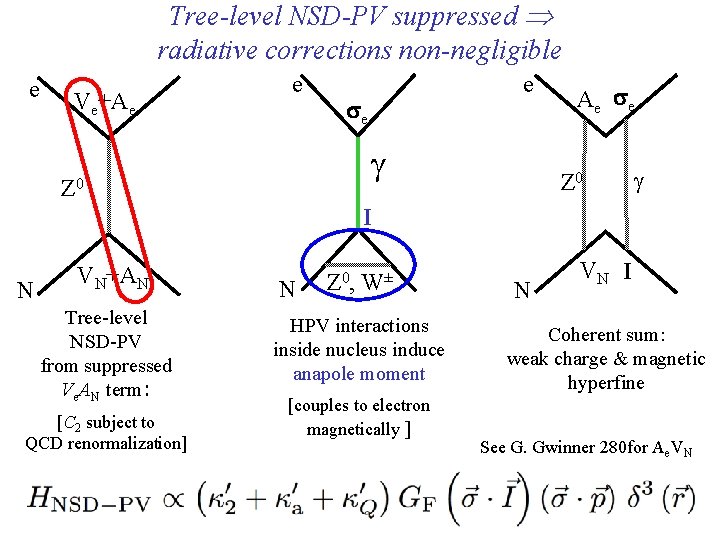
Tree-level NSD-PV suppressed radiative corrections non-negligible e Ve+Ae e e e Z 0 A e e Z 0 I N VN+AN Tree-level NSD-PV from suppressed Ve. AN term: [C 2 subject to QCD renormalization] N Z 0, W ± HPV interactions inside nucleus induce anapole moment [couples to electron magnetically ] N VN I Coherent sum: weak charge & magnetic hyperfine See G. Gwinner 280 for Ae. VN
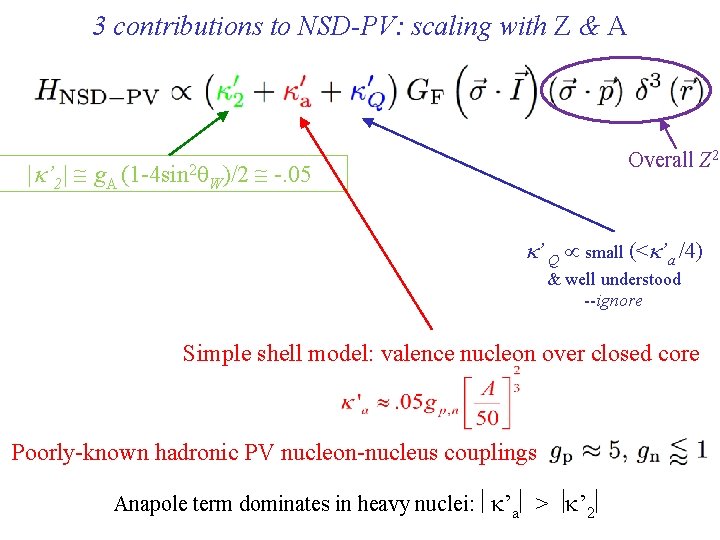
3 contributions to NSD-PV: scaling with Z & A | ’ 2| g. A (1 -4 sin 2 W)/2 Overall Z 2 -. 05 ’ Q small (< ’a /4) & well understood --ignore Simple shell model: valence nucleon over closed core Poorly-known hadronic PV nucleon-nucleus couplings Anapole term dominates in heavy nuclei: ’a > ’ 2
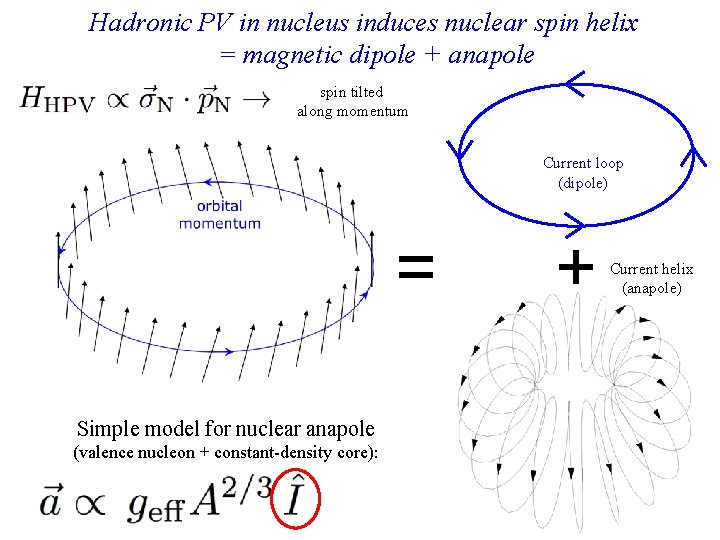
Hadronic PV in nucleus induces nuclear spin helix = magnetic dipole + anapole spin tilted along momentum Current loop (dipole) = Simple model for nuclear anapole (valence nucleon + constant-density core): + Current helix (anapole)
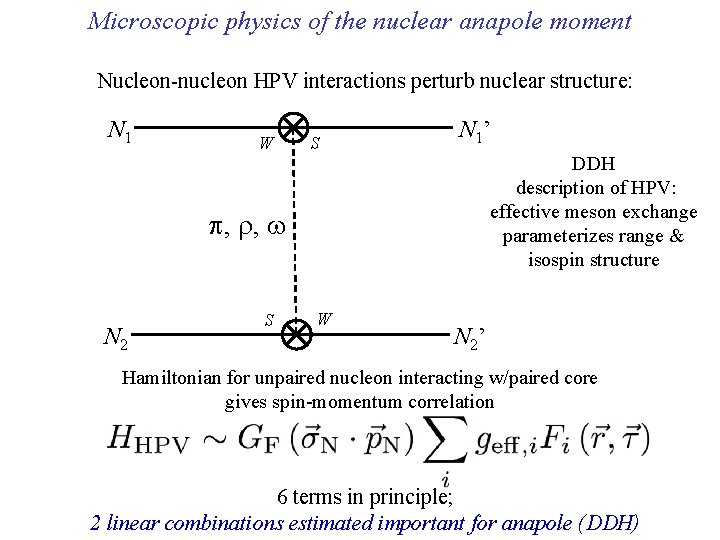
Microscopic physics of the nuclear anapole moment Nucleon-nucleon HPV interactions perturb nuclear structure: N 1 W S N 1’ DDH description of HPV: effective meson exchange parameterizes range & isospin structure , , N 2 S W N 2’ Hamiltonian for unpaired nucleon interacting w/paired core gives spin-momentum correlation 6 terms in principle; 2 linear combinations estimated important for anapole (DDH)
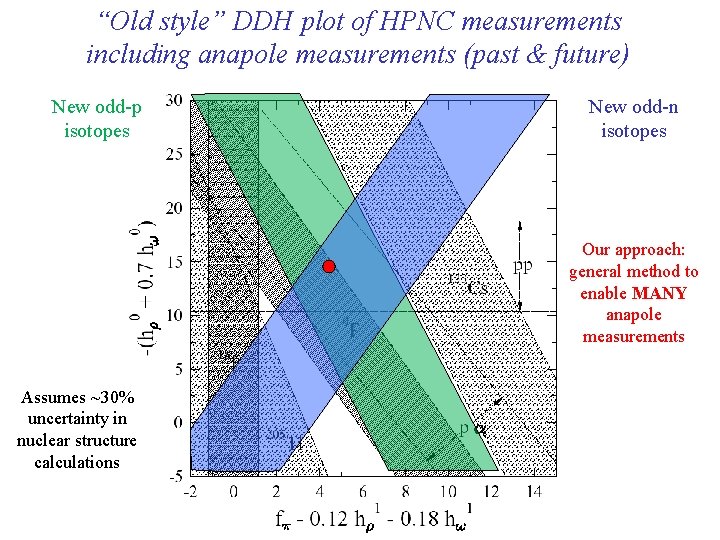
“Old style” DDH plot of HPNC measurements including anapole measurements (past & future) New odd-p isotopes New odd-n isotopes Our approach: general method to enable MANY anapole measurements Assumes ~30% uncertainty in nuclear structure calculations
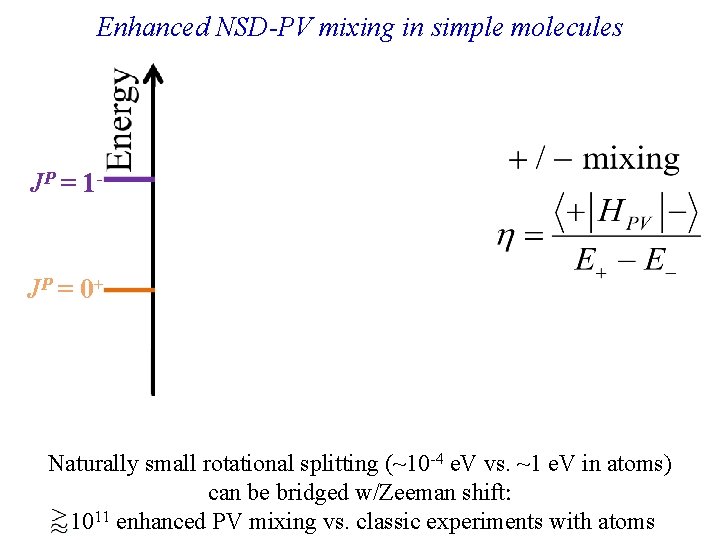
Enhanced NSD-PV mixing in simple molecules JP = 1 - JP = 0+ Naturally small rotational splitting (~10 -4 e. V vs. ~1 e. V in atoms) can be bridged w/Zeeman shift: 1011 enhanced PV mixing vs. classic experiments with atoms
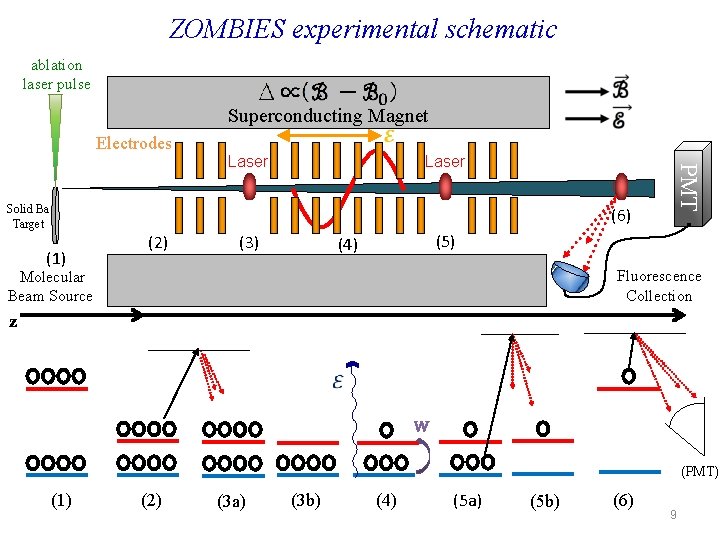
ZOMBIES experimental schematic ablation laser pulse Superconducting Magnet Electrodes Laser Solid Ba Target (6) (1) (2) (3) PMT Laser (5) (4) Fluorescence Collection Molecular Beam Source z W (PMT) (1) (2) (3 a) (3 b) (4) (5 a) (5 b) (6) 9
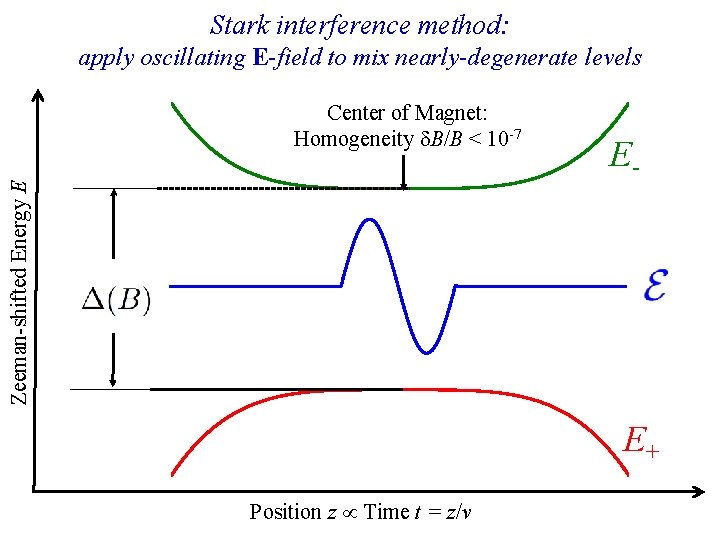
Stark interference method: apply oscillating E-field to mix nearly-degenerate levels Zeeman-shifted Energy E Center of Magnet: Homogeneity B/B < 10 -7 E- E+ Position z Time t = z/v
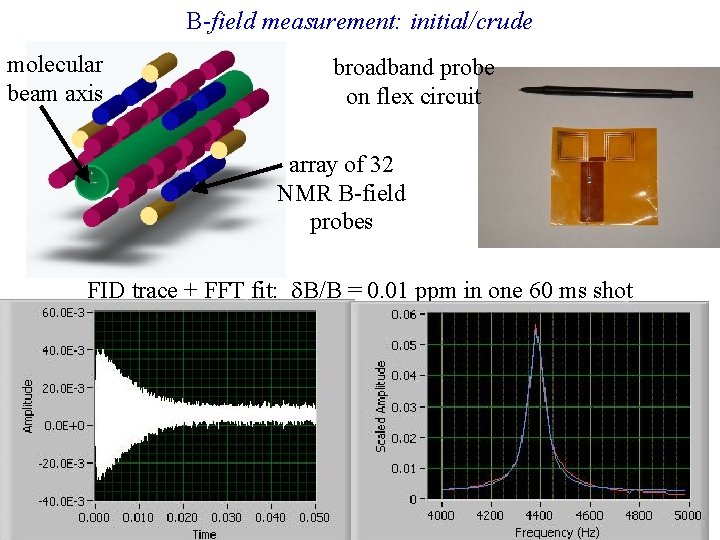
B-field measurement: initial/crude molecular beam axis broadband probe on flex circuit array of 32 NMR B-field probes FID trace + FFT fit: B/B = 0. 01 ppm in one 60 ms shot
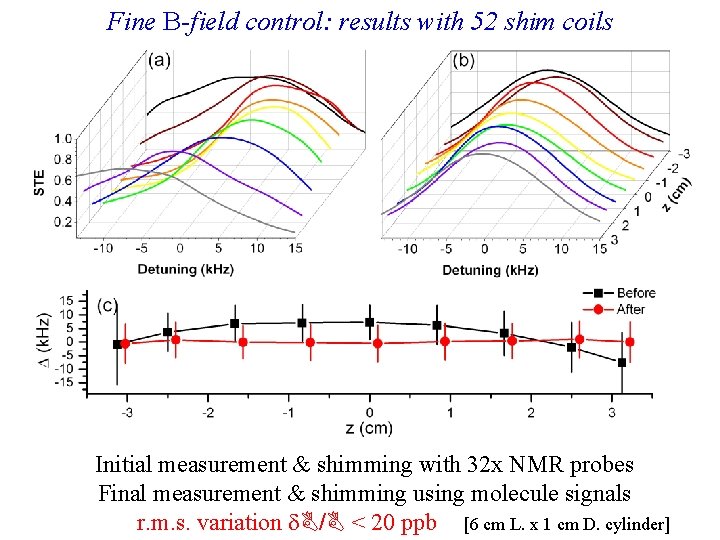
Fine B-field control: results with 52 shim coils Initial measurement & shimming with 32 x NMR probes Final measurement & shimming using molecule signals r. m. s. variation B/B < 20 ppb [6 cm L. x 1 cm D. cylinder]
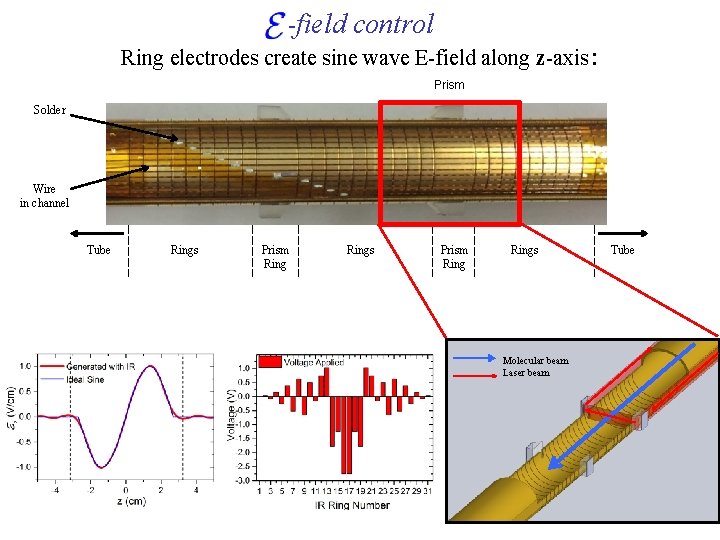
-field control Ring electrodes create sine wave E-field along z-axis: Prism Solder Wire in channel Tube Rings Prism Rings Molecular beam Laser beam Tube
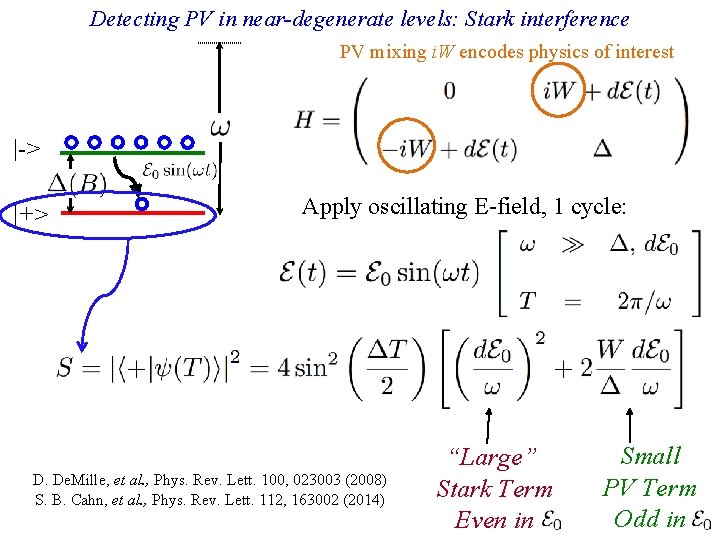
Detecting PV in near-degenerate levels: Stark interference PV mixing i. W encodes physics of interest |-> |+> Apply oscillating E-field, 1 cycle: D. De. Mille, et al. , Phys. Rev. Lett. 100, 023003 (2008) S. B. Cahn, et al. , Phys. Rev. Lett. 112, 163002 (2014) “Large” Stark Term Even in Small PV Term Odd in
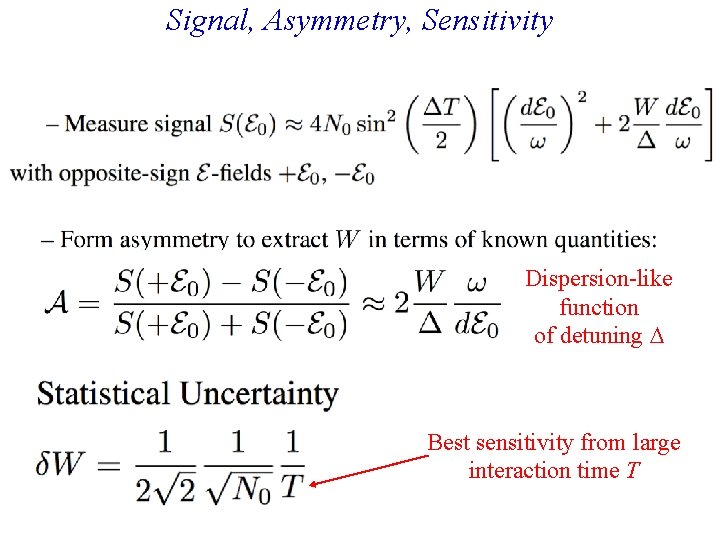
Signal, Asymmetry, Sensitivity Dispersion-like function of detuning D Best sensitivity from large interaction time T
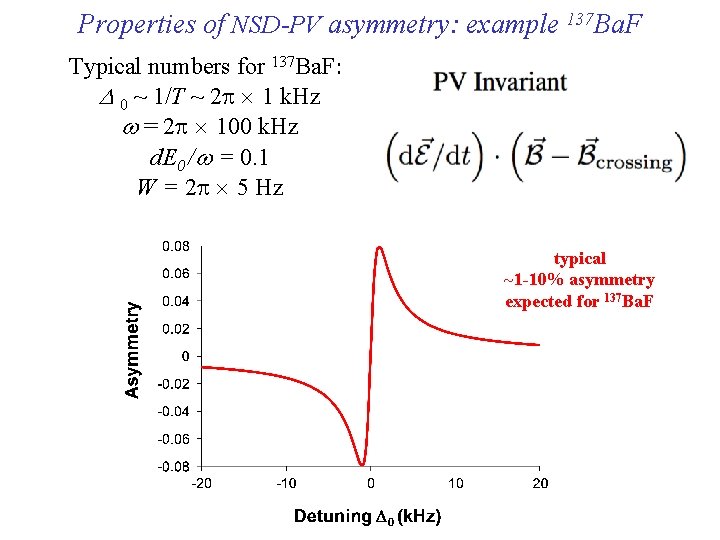
Properties of NSD-PV asymmetry: example 137 Ba. F Typical numbers for 137 Ba. F: 0 ~ 1/T ~ 2 1 k. Hz = 2 100 k. Hz d. E 0 / = 0. 1 W = 2 5 Hz typical ~1 -10% asymmetry expected for 137 Ba. F
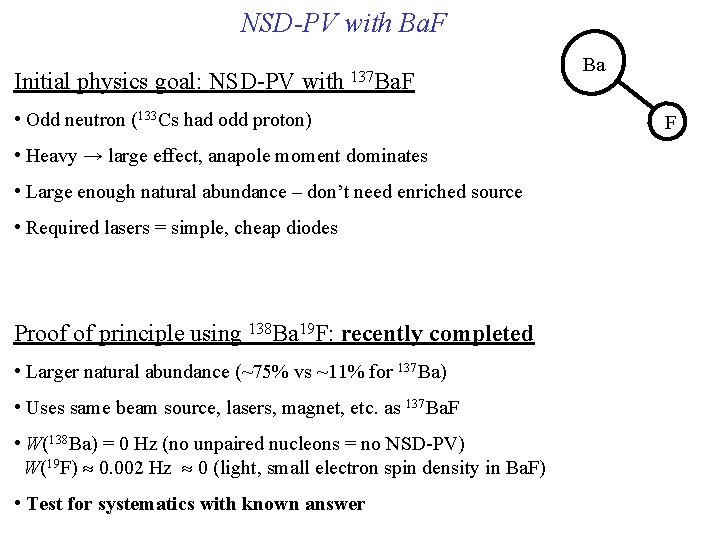
NSD-PV with Ba. F Initial physics goal: NSD-PV with 137 Ba. F • Odd neutron (133 Cs had odd proton) • Heavy → large effect, anapole moment dominates • Large enough natural abundance – don’t need enriched source • Required lasers = simple, cheap diodes Proof of principle using 138 Ba 19 F: recently completed • Larger natural abundance (~75% vs ~11% for 137 Ba) • Uses same beam source, lasers, magnet, etc. as 137 Ba. F • W(138 Ba) = 0 Hz (no unpaired nucleons = no NSD-PV) W(19 F) 0. 002 Hz 0 (light, small electron spin density in Ba. F) • Test for systematics with known answer Ba F
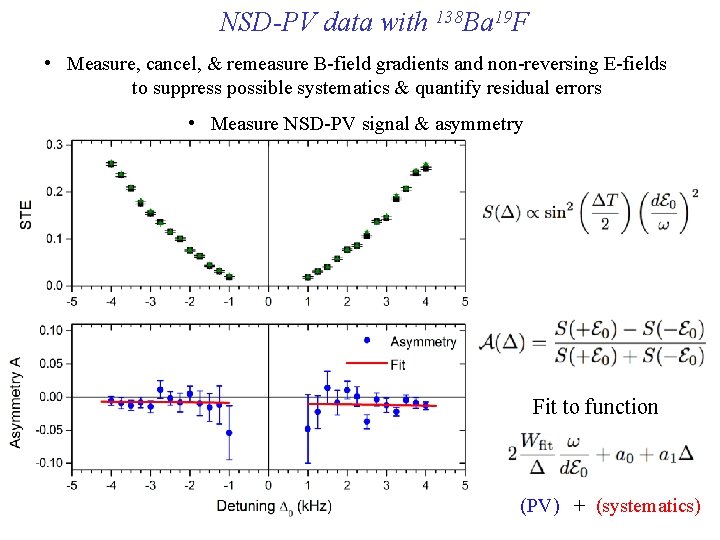
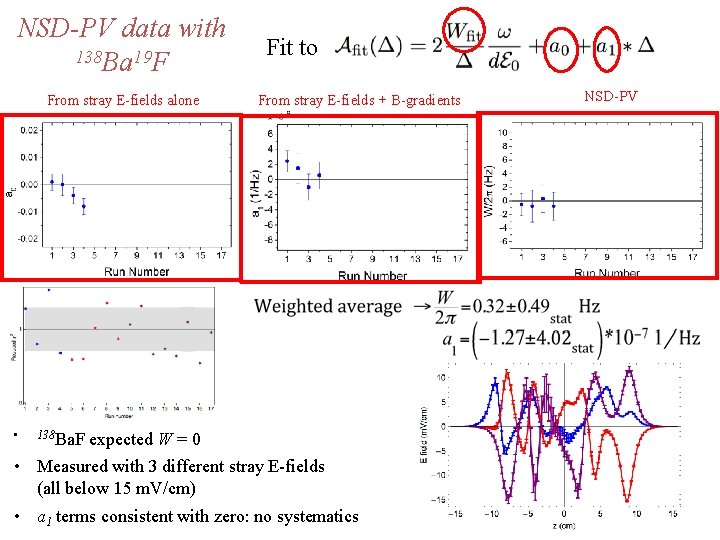
NSD-PV data with 138 Ba 19 F • Measure, cancel, & remeasure B-field gradients and non-reversing E-fields to suppress possible systematics & quantify residual errors • Measure NSD-PV signal & asymmetry Fit to function (PV) + (systematics)
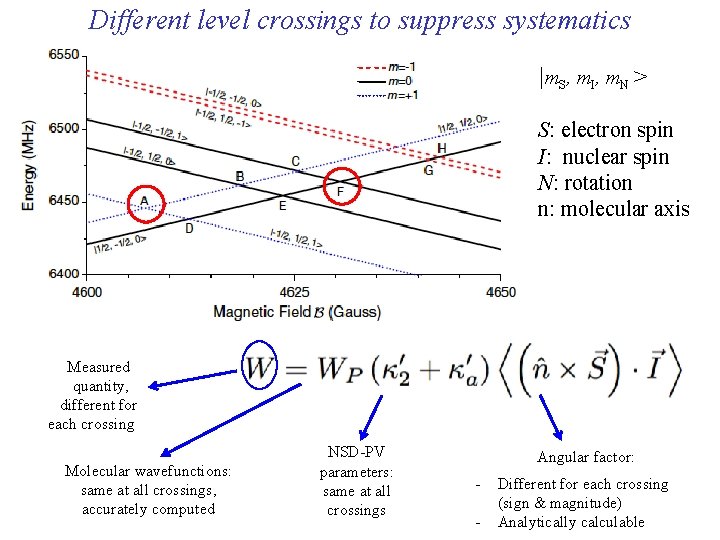
Different level crossings to suppress systematics |m. S, m. I, m. N > S: electron spin I: nuclear spin N: rotation n: molecular axis Measured quantity, different for each crossing Molecular wavefunctions: same at all crossings, accurately computed NSD-PV parameters: same at all crossings Angular factor: - Different for each crossing (sign & magnitude) Analytically calculable
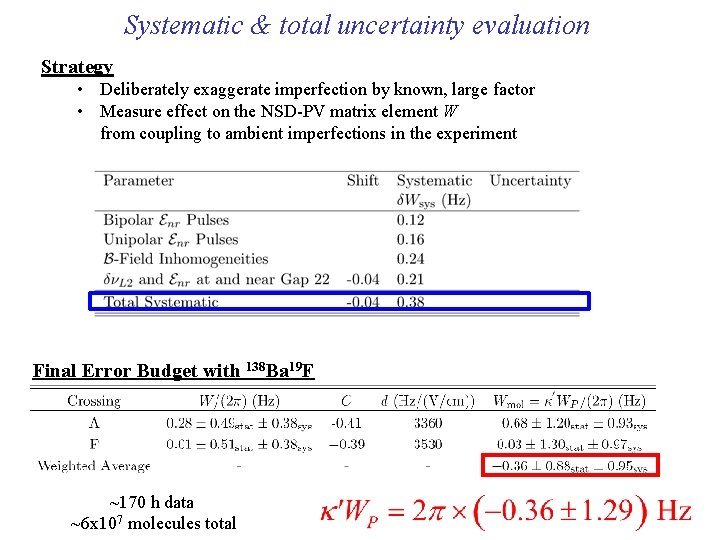
Systematic & total uncertainty evaluation Strategy • Deliberately exaggerate imperfection by known, large factor • Measure effect on the NSD-PV matrix element W from coupling to ambient imperfections in the experiment Final Error Budget with 138 Ba 19 F ~170 h data ~6 x 10⁷ molecules total
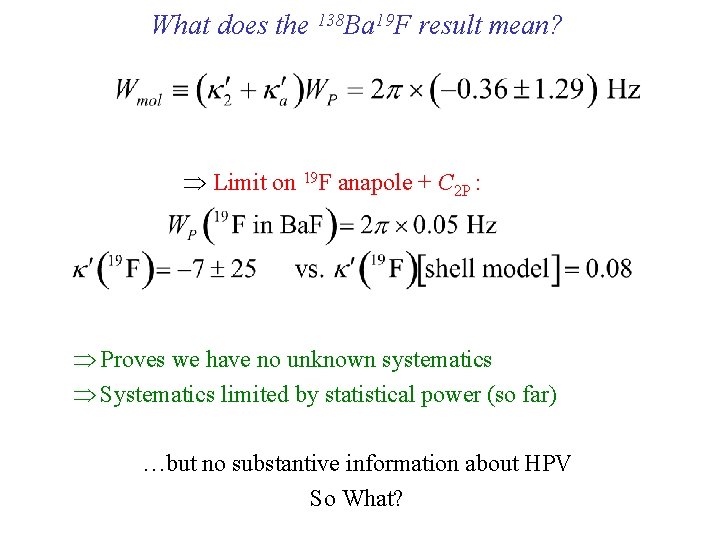
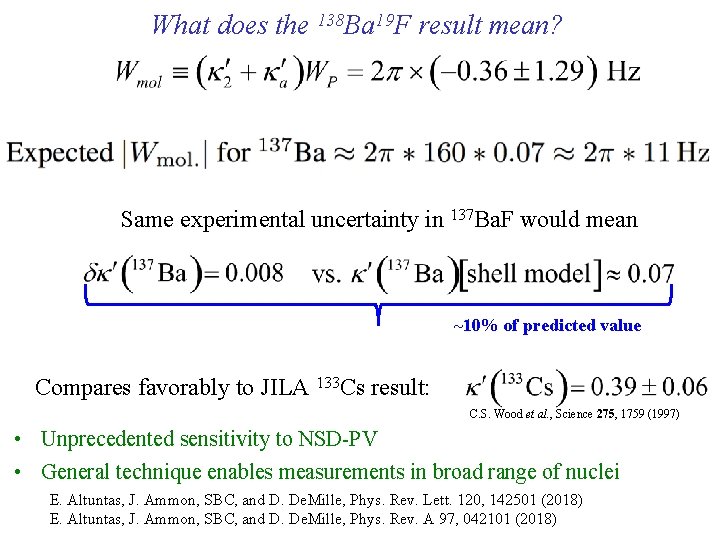
What does the 138 Ba 19 F result mean? Limit on 19 F anapole + C 2 P : Proves we have no unknown systematics Systematics limited by statistical power (so far) …but no substantive information about HPV So What?
What does the 138 Ba 19 F result mean? Same experimental uncertainty in 137 Ba. F would mean ~10% of predicted value Compares favorably to JILA 133 Cs result: C. S. Wood et al. , Science 275, 1759 (1997) • Unprecedented sensitivity to NSD-PV • General technique enables measurements in broad range of nuclei E. Altuntas, J. Ammon, SBC, and D. De. Mille, Phys. Rev. Lett. 120, 142501 (2018) E. Altuntas, J. Ammon, SBC, and D. De. Mille, Phys. Rev. A 97, 042101 (2018)
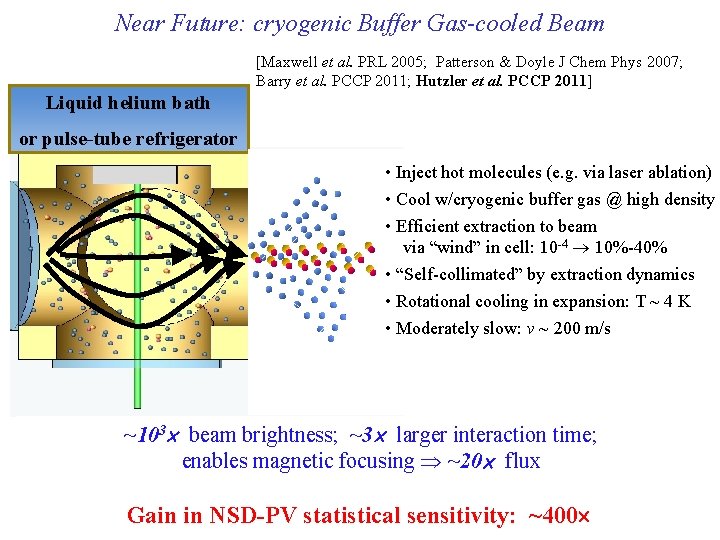
Near Future: cryogenic Buffer Gas-cooled Beam [Maxwell et al. PRL 2005; Patterson & Doyle J Chem Phys 2007; Barry et al. PCCP 2011; Hutzler et al. PCCP 2011] Liquid helium bath or pulse-tube refrigerator • Inject hot molecules (e. g. via laser ablation) • Cool w/cryogenic buffer gas @ high density • Efficient extraction to beam via “wind” in cell: 10 -4 10%-40% • “Self-collimated” by extraction dynamics • Rotational cooling in expansion: T ~ 4 K • Moderately slow: v ~ 200 m/s ~103 beam brightness; ~3 larger interaction time; enables magnetic focusing ~20 flux Gain in NSD-PV statistical sensitivity: ~400
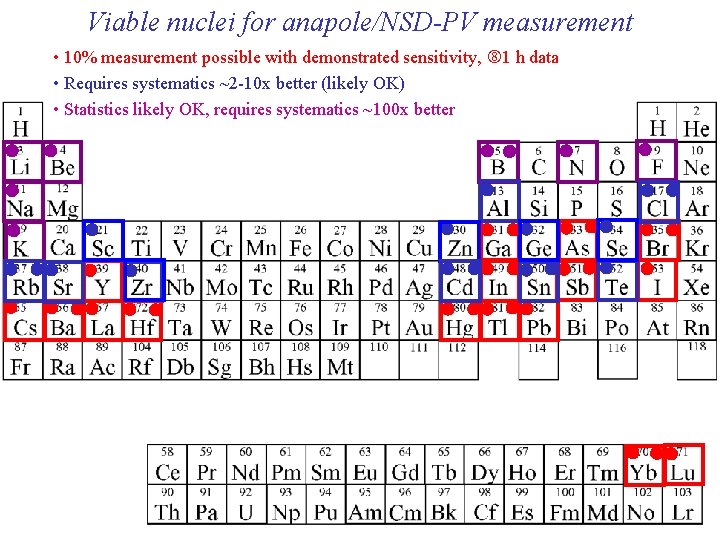
Viable nuclei for anapole/NSD-PV measurement • 10% measurement possible with demonstrated sensitivity, 1 h data • Requires systematics ~2 -10 x better (likely OK) • Statistics likely OK, requires systematics ~100 x better
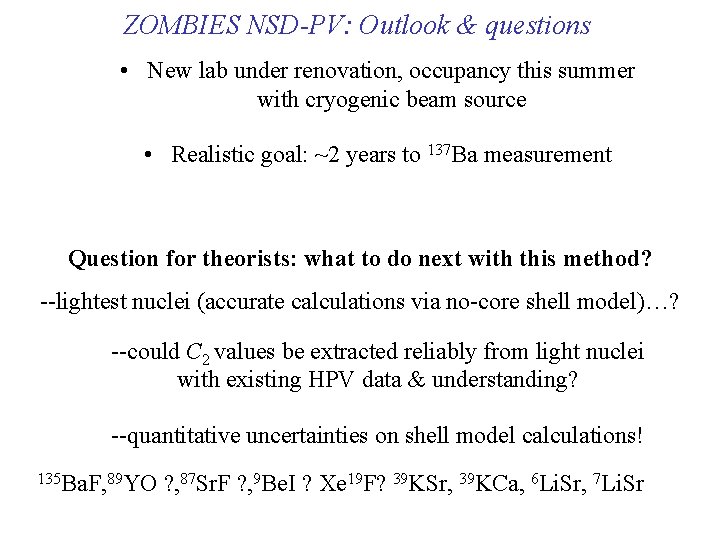
ZOMBIES NSD-PV: Outlook & questions • New lab under renovation, occupancy this summer with cryogenic beam source • Realistic goal: ~2 years to 137 Ba measurement Question for theorists: what to do next with this method? --lightest nuclei (accurate calculations via no-core shell model)…? --could C 2 values be extracted reliably from light nuclei with existing HPV data & understanding? --quantitative uncertainties on shell model calculations! 135 Ba. F, 89 YO ? , 87 Sr. F ? , 9 Be. I ? Xe 19 F? 39 KSr, 39 KCa, 6 Li. Sr, 7 Li. Sr
Extra slides
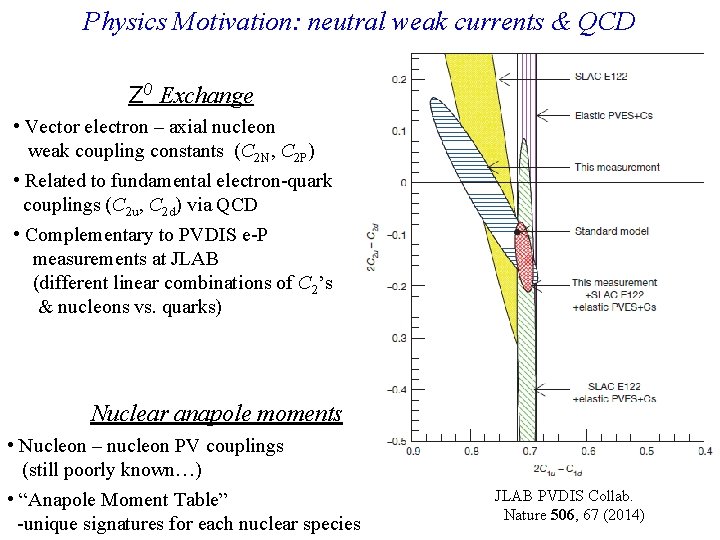
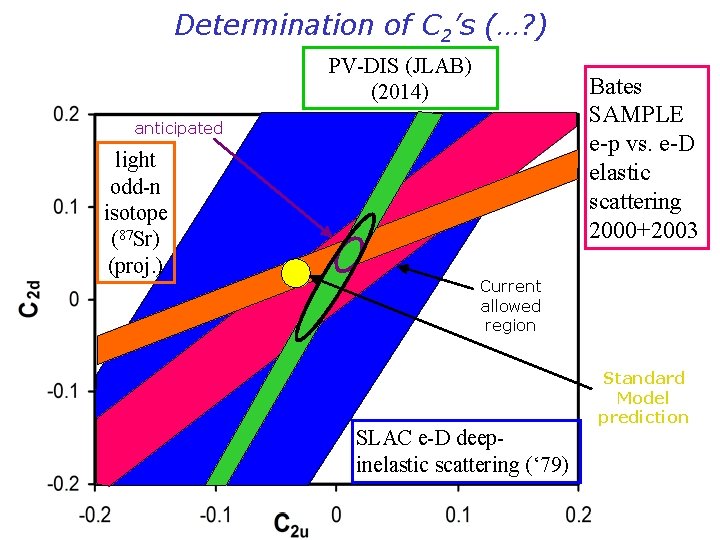
Physics Motivation: neutral weak currents & QCD Z 0 Exchange • Vector electron – axial nucleon weak coupling constants (C 2 N, C 2 P) • Related to fundamental electron-quark couplings (C 2 u, C 2 d) via QCD • Complementary to PVDIS e-P measurements at JLAB (different linear combinations of C 2’s & nucleons vs. quarks) Nuclear anapole moments • Nucleon – nucleon PV couplings (still poorly known…) • “Anapole Moment Table” -unique signatures for each nuclear species JLAB PVDIS Collab. Nature 506, 67 (2014)
NSD-PV data with 138 Ba 19 F From stray E-fields alone • 138 Ba. F Fit to From stray E-fields + B-gradients expected W = 0 • Measured with 3 different stray E-fields (all below 15 m. V/cm) • a 1 terms consistent with zero: no systematics NSD-PV
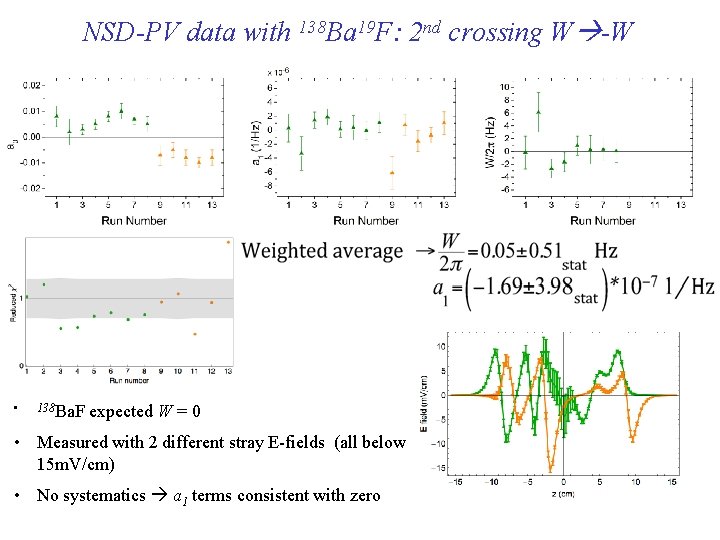
NSD-PV data with 138 Ba 19 F: 2 nd crossing W -W • 138 Ba. F expected W = 0 • Measured with 2 different stray E-fields (all below 15 m. V/cm) • No systematics a 1 terms consistent with zero 29
Determination of k. Z a. k. a. Ve. An a. k. a. C 2 P, N (…? ) Measurements with a few heavy nuclei should determine intranuclear PNC couplings to ~30% (nuclear structure unc. ) Additional measurements could be interpreted as measurements of Z with uncertainty Z/ Z ~ 0. 2 ( a/ Z) A 2/3 Goal: ~20% measurement of NSD-PNC in nuclei with a � Z i. e. Sr (Z=38, A=87) Requires technique with greatly improved sensitivity!
Determination of C 2’s (…? ) PV-DIS (JLAB) (2014) Bates SAMPLE e-p vs. e-D elastic scattering 2000+2003 anticipated light odd-n isotope (87 Sr) (proj. ) Current allowed region SLAC e-D deepinelastic scattering (‘ 79) Standard Model prediction
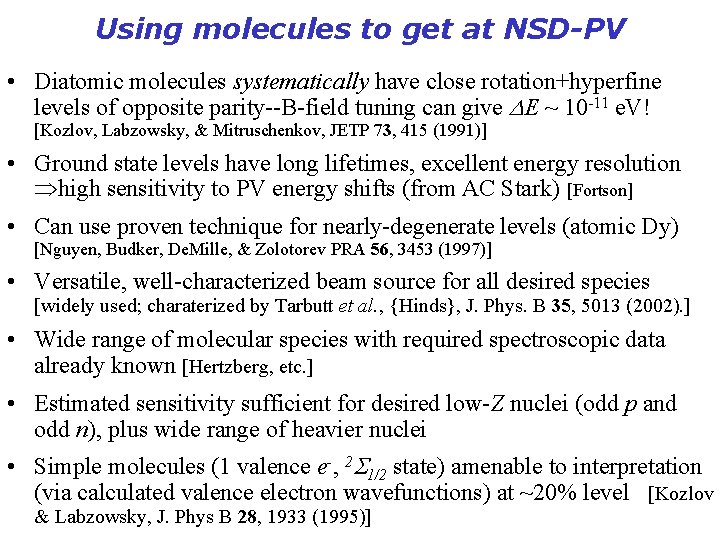
Using molecules to get at NSD-PV • Diatomic molecules systematically have close rotation+hyperfine levels of opposite parity--B-field tuning can give E ~ 10 -11 e. V! [Kozlov, Labzowsky, & Mitruschenkov, JETP 73, 415 (1991)] • Ground state levels have long lifetimes, excellent energy resolution high sensitivity to PV energy shifts (from AC Stark) [Fortson] • Can use proven technique for nearly-degenerate levels (atomic Dy) [Nguyen, Budker, De. Mille, & Zolotorev PRA 56, 3453 (1997)] • Versatile, well-characterized beam source for all desired species [widely used; charaterized by Tarbutt et al. , {Hinds}, J. Phys. B 35, 5013 (2002). ] • Wide range of molecular species with required spectroscopic data already known [Hertzberg, etc. ] • Estimated sensitivity sufficient for desired low-Z nuclei (odd p and odd n), plus wide range of heavier nuclei • Simple molecules (1 valence e-, 2 S 1/2 state) amenable to interpretation (via calculated valence electron wavefunctions) at ~20% level [Kozlov & Labzowsky, J. Phys B 28, 1933 (1995)]
The ZOMBIES NSD-PV experiment at Yale Zeeman-tuned Optically prepared and detected Molecular Beams for the Investigation of Electroweak effects using S tark interference