
NTS 507 WEALTH AND POVERTY IN THE BIBLE
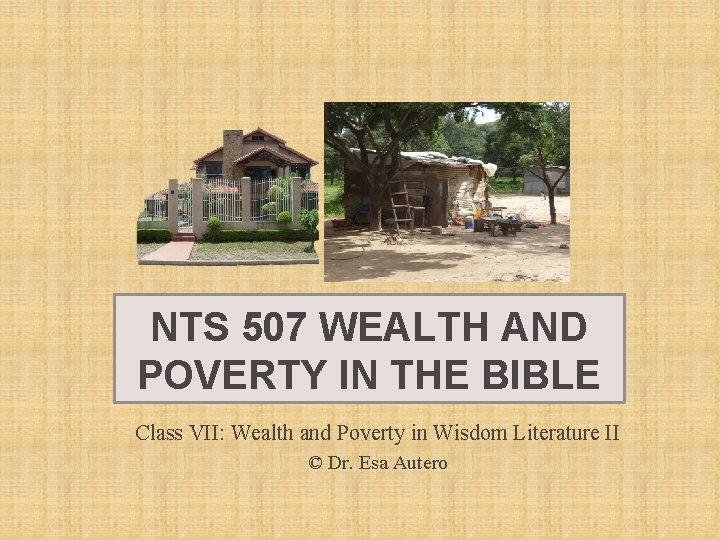
NTS 507 WEALTH AND POVERTY IN THE BIBLE Class VII: Wealth and Poverty in Wisdom Literature II © Dr. Esa Autero
Wealth and Poverty in Wisdom Literature II 1. 1 Introduction q Wisdom of Proverbs focuses on q q Retribution theology “Fear of God” as resulting good life “Counter testimony” less prominent Wisdom of Job and Ecclesiastes q q Traditional retribution theology problematized more forcefully Psalms exhibit a mixture of perspectives
Wealth and Poverty in Wisdom Literature II 2. 1 Wealth and poverty in Job q Storyline of Job in a nutshell q q Upright and wealthy Job looses family, possessions & health (Job 1 -2) q “Hidden” conversation b/w God and Accuser q Divine “bet” to test Job’s integrity – is Job godly just for the gain? Dialogue between Job and his friends – why is Job suffering? (3 -37) q Job claims innocence and demands justice from God q Friends insist that Job is suffering due to Job’s own sin Retribution theology frames the discussion – why does Job suffer? Job is vindicated in the end as God appears to him (38 -42) q Was Job right or his friends right? – is retribution affirmed or negated?
Wealth and Poverty in Wisdom Literature II q Job’s predicament (1: 1 -8; 3: 1 -10, 20 -26) q Job as blameless, upright, wealthy, wise & respected (1: 1 -8; 31: 16 -26, 32, 38 -40) Job’s condition after loosing wealth, family & health “For my groaning comes at the sight of my food, And my cries pour out like water. 25 “For what I fear comes upon me, And what I dread befalls me. 26 “I am not at ease, nor am I quiet, And I am not at rest, but turmoil comes. ” (3: 24 -26) q
Wealth and Poverty in Wisdom Literature II q Retribution (A/C), wealth and poverty Job’s friends accuse him of sinning – and suffering as a result ELIPHAZ: “But as for me, I would seek God, And I would place my cause before God; 9 Who does great and unsearchable things, Wonders without number. 10 “He gives rain on the earth And sends water on the fields, 11 So that He sets on high those who are lowly, And those who mourn are lifted to safety. 12 “He frustrates the plotting of the shrewd, So that their hands cannot attain success…“But He saves from the sword of their mouth, And the poor from the hand of the mighty. 16 “So the helpless has hope, And unrighteousness must shut its mouth. (5: 8 -12, 15 -16) q Job is to place his case in God’s hands q God judges the wicked and saves the poor and the lowly q q Retribution as undeniable “biblical” fact
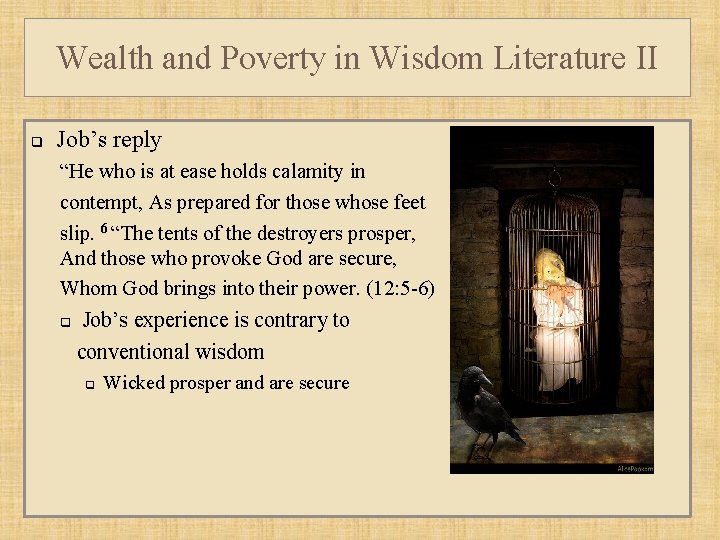
Wealth and Poverty in Wisdom Literature II q Job’s reply “He who is at ease holds calamity in contempt, As prepared for those whose feet slip. 6 “The tents of the destroyers prosper, And those who provoke God are secure, Whom God brings into their power. (12: 5 -6) q Job’s experience is contrary to conventional wisdom q Wicked prosper and are secure
Wealth and Poverty in Wisdom Literature II ELIPHAZ: “The wicked man writhes in pain all his days, And numbered are the years stored up for the ruthless…“He will not become rich, nor will his wealth endure; And his grain will not bend down to the ground. (15: 20, 29) ZOPHAR: “He [wicked] swallows riches, But will vomit them up; God will expel them from his belly. 16 “He sucks the poison of cobras; The viper’s tongue slays him. 17 “He does not look at the streams, The rivers flowing with honey and curds. 18 “He returns what he has attained And cannot swallow it; As to the riches of his trading, He cannot even enjoy them. 19 “For he has oppressed and forsaken the poor; He has seized a house which he has not built. (20: 15 -19) q Wicked are punished and will end up poor q Riches obtained by wickedness cannot be enjoyed q Retribution theology reiterated
Wealth and Poverty in Wisdom Literature II JOB: “Why do the wicked still live, Continue on also become very powerful? . . . Behold, their prosperity is not in their hand; The counsel of the wicked is far from me. 17 “How often is the lamp of the wicked put out, Or does their calamity fall on them? Does God apportion destruction in His anger? . . . “One dies in his full strength, Being wholly at ease and satisfied; 24 His sides are filled out with fat, And the marrow of his bones is moist, (21: 7, 16 -17, 23 -24) q Job protests – wicked prosper and calamity is far from them q Wicked die in prosperity and live a long life q Retribution theology & God’s justice challenged
Wealth and Poverty in Wisdom Literature II q Job’s punishment due to neglecting the poor (says Eliphaz) ELIPHAZ: “Is not your wickedness great, And your iniquities without end? 6 “For you have taken pledges of your brothers without cause, And stripped men naked. 7 “To the weary you have given no water to drink, And from the hungry you have withheld bread. 8 “But the earth belongs to the mighty man, And the honorable man dwells in it. 9 “You have sent widows away empty, And the strength of the orphans has been crushed. 10 “Therefore snares surround you, And sudden dread terrifies you, 11 Or darkness, so that you cannot see, And an abundance of water covers you. (22: 5 -11) q Job accused of neglecting and oppressing the poor and vulnerable “Therefore…” punishment is on him
Wealth and Poverty in Wisdom Literature II q Job accuses God of injustice (24: 1 -13, 22 -24) “Why are times not stored up by the Almighty, And why do those who know Him not see His days? 2 “Some remove the landmarks; They seize and devour flocks. 3 “They drive away the donkeys of the orphans; They take the widow’s ox for a pledge. 4 “They push the needy aside from the road; The poor of the land are made to hide themselves altogether. 5 “Behold, as wild donkeys in the wilderness They go forth seeking food in their activity, As bread or their children in the desert. 6 “They harvest their fodder in the field And glean the vineyard of the wicked. 7 “They spend the night naked, without clothing, And have no covering against the cold. 8 “They are wet with the mountain rains And hug the rock for want of a shelter. 9 “Others snatch the orphan from the breast, And against the poor they take a pledge. 10 “They cause the poor to go about naked without clothing, And they take away the sheaves from the hungry. 11 “Within the walls they produce oil; They tread wine presses but thirst. 12 “From the city men groan, And the souls of the wounded cry out; Yet God does not pay attention to folly. 13 “Others have been with those who rebel against the light; They do not want to know its ways Nor abide in its paths. 14 “The murderer arises at dawn; He kills the poor and the needy, And at night he is as a thief. (24: 1 -14) Does God not care how the wicked oppress and exploit the poor and the vulnerable?
Wealth and Poverty in Wisdom Literature II q Job’s life of piety was exemplary (29: 12 -25) “Oh that I were as in months gone by, As in the days when God watched over me; …Because I delivered the poor who cried for help, And the orphan who had no helper. 13 “The blessing of the one ready to perish came upon me, And I made the widow’s heart sing for joy. 14 “I put on righteousness, and it clothed me; My justice was like a robe and a turban. 15 “I was eyes to the blind And feet to the lame. 16 “I was a father to the needy, And I investigated the case which I did not know. 17 “I broke the jaws of the wicked And snatched the prey from his teeth. (29: 2, 12 -17) q Job rescued the poor and vulnerable – brought joy to them q q Job received a blessing for his compassion Job’s life characterized by justice and defense of the vulnerable Job is blameless – he says – how can this happen?
Wealth and Poverty in Wisdom Literature II “If I have kept the poor from their desire, Or have caused the eyes of the widow to fail, 17 Or have eaten my morsel alone, And the orphan has not shared it 18 (But from my youth he grew up with me as with a father, And from infancy I guided her), 19 If I have seen anyone perish for lack of clothing, Or that the needy had no covering, 20 If his loins have not thanked me, And if he has not been warmed with the fleece of my sheep, 21 If I have lifted up my hand against the orphan, Because I saw I had support in the gate, 22 Let my shoulder fall from the socket, And my arm be broken off at the elbow. 23 “For calamity from God is a terror to me, And because of His majesty I can do nothing. 24 “If I have put my confidence in gold, And called fine gold my trust, 25 If I have gloated because my wealth was great, And because my hand had secured so much; (31: 16 -25*) q Job has provided and defended the poor and the vulnerable q Job vows to his integrity as the defender of the vulnerable q He has trusted God instead of riches q He is unable to practice justice because God has inflicted calamity on him
Wealth and Poverty in Wisdom Literature II q Job’s experience – the experience of the poor (19: 7, 13 -29) “Behold, I cry, ‘Violence!’ but I get no answer; I shout for help, but there is no justice…“He has removed my brothers far from me, And my acquaintances are completely estranged from me. 14 “My relatives have failed, And my intimate friends have forgotten me. 15 “Those who live in my house and my maids consider me a stranger. I am a foreigner in their sight. 16 “I call to my servant, but he does not answer; I have to implore him with my mouth. 17 “My breath is offensive to my wife, And I am loathsome to my own brothers. 18 “Even young children despise me; I rise up and they speak against me. 19 “All my associates abhor me, And those I love have turned against me. 20 “My bone clings to my skin and my flesh, And I have escaped only by the skin of my teeth. 21 “Pity me, pity me, O you my friends, For the hand of God has struck me. 22 “Why do you persecute me as God does, And are not satisfied with my flesh? (19: 7, 13 -22)
Wealth and Poverty in Wisdom Literature II q Resolution – God appears to Job (38 -42) Then Job answered the LORD and said, 2 “I know that You can do all things, And that no purpose of Yours can be thwarted. 3 ‘Who is that hides counsel without knowledge? ’ Therefore I have declared that which I did not understand, Things too wonderful for me, which I did not know. ” 4 ‘Hear, now, and I will speak; I will ask You, and You instruct me. ’ 5 “I have heard of You by the hearing of the ear; But now my eye sees You; 6 Therefore I retract, And I repent in dust and ashes. ” (42: 1 -6) q Job humbles himself and is restored (42: 10 -17) q q Job does not receive specific answers to his questions Job’s friends are rebuked (42: 7 -9) 7 It came about after the LORD had spoken these words to Job, that the LORD said to Eliphaz the Temanite, “My wrath is kindled against you and against your two friends, because you have not spoken of Me what is right as My servant Job has. (42: 7; cf. 42: 9)
Wealth and Poverty in Wisdom Literature II q What does Job teach about wealth and poverty? q Care for the poor and vulnerable taken for granted q q q Retribution theology frames the dialogue – what’s the resolution? q q Was Job or his friends right? Job’s experience not incorrect – injustice does happen, reason not given Exposing and “speaking out” as prophetic task of the church How is retribution theology reformulated? * q q Non-negotiable part of “righteousness and justice” Job’s bold questioning: Job spoke of “what is right” (42: 7) Perspective of God’s sovereignty and secret wisdom foregrounded Is retribution rejected altogether or just qualified? Poverty caused by exploitation – not by God’s retribution Job opens a window to a real “experience of poverty” (19: 1 -22) q Many people w/ HIV, homeless, and poor identify w/ 3: 11 -26 &19: 1 -22**
Wealth and Poverty in Wisdom Literature II 2. 2 Ecclesiastes – “Yes, but…” theology* q Framework for understanding Qohelet’s perspective on wealth & poverty q Everything is “vanity” (Hb. hevel = “breath, wind, nothingness”) Vanity of vanities, ” says the Preacher, “Vanity of vanities! All is vanity. ” (1: 2) q q q Wisdom (1: 12 -18) & labor (2: 18 -23) Pleasure (2: 1 -11) & self-indulgence (2: 24 -26) Money, power & fame (2: 8 -9; 4: 4 -8; 5: 10; cf. Ps 49: 1 -2, 16 -17, 20) None of these can provide ultimate significance
Wealth and Poverty in Wisdom Literature II q Despite the vanity – wisdom & joy – at proper time (3: 1 -8*) “modest joy” as God’s blessing 7 Go then, eat your bread in happiness and drink your wine with a cheerful heart; for God has already approved your works. 8 Let your clothes be white all the time, and let not oil be lacking on your head. 9 Enjoy life with the woman whom you love all the days of your fleeting life which He has given to you under the sun; for this is your reward in life and in your toil in which you have labored under the sun. (9: 7 -10; 2: 24 -5; 3: 13; 5: 19; 6: 2; 11: 9) q q Wisdom is good & helpful – when not overindulged and kept in right perspective (1: 18; 2: 12 -13; 5: 1 -2; 7: 12; 8: 12 -13; 9: 13 -18; 12: 1 -8)
Wealth and Poverty in Wisdom Literature II q Tension between “received” wisdom and current experience q Action-consequences theology partially approved & contested 26 For to a person who is good in His sight He has given wisdom and knowledge and joy, while to the sinner He has given the task of gathering and collecting so that he may give to one who is good in God’s sight. This too is vanity and striving after wind. (2: 26; 3: 17; 10: 8 -11; 11: 18; 12: 13) q Contested through repetition of “vanity” & “counter sayings” 15 I have seen everything during my lifetime of futility; there is a righteous man who perishes in his righteousness and there is a wicked man who prolongs his life in his wickedness. 16 Do not be excessively righteous and do not be overly wise. Why should you ruin yourself? (7: 15 -16; 2: 21; 4: 16, 13 -14; 5: 8 -9; 8: 14 -17; 9: 1 -2, 12)
Wealth and Poverty in Wisdom Literature II 14 There is futility which is done on the earth, that is, there are righteous men to whom it happens according to the deeds of the wicked. On the other hand, there are evil men to whom it happens according to the deeds of the righteous. I say that this too is futility. 15 So I commended pleasure, for there is nothing good for a man under the sun except to eat and to drink and to be merry, and this will stand by him in his toils throughout the days of his life which God has given him under the sun. (8: 14 -15) q Decisive saying that unsettles the “conventional” wisdom q Yet, God’s justice is upheld (3: 17; 8: 12 -13; 11: 9; 12: 13 -14)
Wealth and Poverty in Wisdom Literature II Conclusion of the book 13 The conclusion, when all has been heard, is: fear God and keep His commandments, because this applies to every person. 14 For God will bring every act to judgment, everything which is hidden, whether it is good or evil. (12: 13 -14) q q Despite appearance of injustice & vanity God’s justice will prevail q q Yet, its outworking is mysterious Wisdom largely eludes though A/C theology not completely dismissed q Old wisdom and new experience in tension & dialogue God’s sovereignty and “otherness” affirmed & contemplated Traditional elements of “fear” and “obedience” affirmed BUT q Not naively or simplistically but w/ a sense of mystery
Wealth and Poverty in Wisdom Literature II 16 When I gave my heart to know wisdom and to see the task which has been done on the earth (even though one should never sleep day or night), 17 and I saw every work of God, I concluded that man cannot discover the work which has been done under the sun. Even though man should seek laboriously, he will not discover; and though the wise man should say, “I know, ” he cannot discover. q Traditional wisdom of “knowing”, “fearing”, “obeying” needs to be always “checked” by q q God’s sovereignty & hidden wisdom The release to the tension comes through Jesus Christ & resurrection
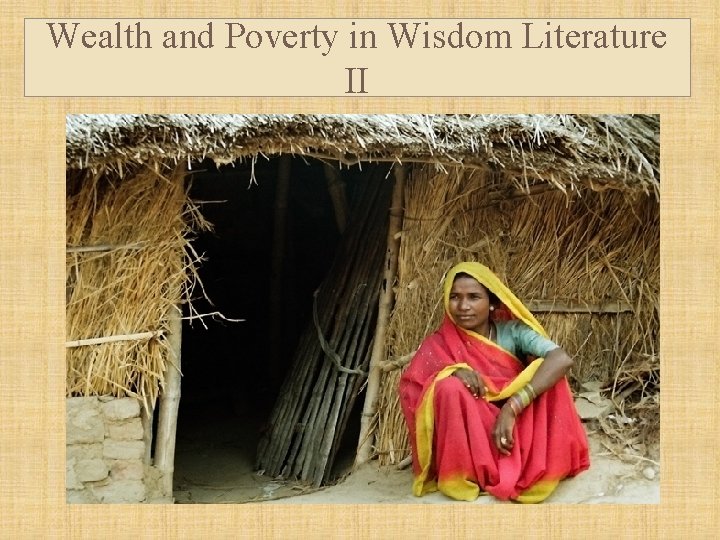
Wealth and Poverty in Wisdom Literature II q Wealth and poverty in Ecclesiastes Experience of poverty, oppression & injustice Then I looked again at all the acts of oppression which were being done under the sun. And behold I saw the tears of the oppressed and that they had no one to comfort them; and on the side of their oppressors was power, but they had no one to comfort them. 2 So I congratulated the dead who are already dead more than the living who are still living. 3 But better off than both of them is the one who has never existed, who has never seen the evil activity that is done under the sun. (4: 1 -3; 3: 16; 5: 8 -9; cf. 7: 7) q Reality of oppression & their predicament – from rich’s perspective q Oppressors and their powers q Theodic challenge accompanied by feelings of helplessness & resignation* q Cure: Enjoy what God has given you (8: 15)
Wealthand and. Poverty Wisdom Wealth in in Wisdom Literature II
Wealth and Poverty in Wisdom Literature II 8 If you see oppression (Hb. osheq) of the poor (rash) and denial of justice and righteousness in the province, do not be shocked at the sight; for one official watches over another official, and there are higher officials over them. 9 After all, a king who cultivates the field is an advantage to the land. (5: 8 -9) q Reality of oppression of the poor & denial of justice q q Corruption of leaders at every level q q q Human making, not God’s will “watching over another” – positively “watching out” or negatively rivalry Corrupt officials “covering one another”* & “brown-nosing” higher ones King’s role ambiguous – owner of all land* q Portrayed as just provider or corrupt official Reality of oppression, corruption of the entire society
Wealth and Poverty in Wisdom Literature II q Wealth – its fleeting nature (5: 10 -16; 6: 1 -9) 10 He who loves money will not be satisfied with money, nor he who loves abundance with its income. This too is vanity. 11 When good things increase, those who consume them increase. So what is the advantage to their owners except to look on? 12 The sleep of the working man is pleasant, whether he eats little or much; but the full stomach of the rich man does not allow him to sleep. 13 There is a grievous evil which I have seen under the sun: riches being hoarded by their owner to his hurt. 14 When those riches were lost through a bad investment and he had fathered a son, then there was nothing to support him. 15 As he had come naked from his mother’s womb, so will he return as he came. He will take nothing from the fruit of his labor that he can carry in his hand. 16 This also is a grievous evil—exactly as a man is born, thus will he die. So what is the advantage to him who toils for the wind? 17 Throughout his life he also eats in darkness with great vexation, sickness and anger. * 18 Here is what I have seen to be good and fitting: to eat, to drink and enjoy oneself in all one’s labor in which he toils under the sun during the few years of his life which God has given him; for this is his reward. 19 Furthermore, as for every man to whom God has given riches and wealth, He has also empowered him to eat from them and to receive his reward and rejoice in his labor; this is the gift of God. 20 For he will not often consider the years of his life, because God keeps him occupied with the gladness of his heart. (5: 10 -20)
Wealth and Poverty in Wisdom Literature II There is an evil which I have seen under the sun and it is prevalent among men— 2 a man to whom God has given riches and wealth and honor so that his soul lacks nothing of all that he desires; yet God has not empowered him to eat from them, for a foreigner enjoys them. This is vanity and a severe affliction. 3 If a man fathers a hundred children and lives many years, however many they be, but his soul is not satisfied with good things and he does not even have a proper burial, then I say, “Better the miscarriage than he, 4 for it comes in futility and goes into obscurity; and its name is covered in obscurity. 5 It never sees the sun and it never knows anything; it is better off than he. 6 Even if the other man lives a thousand years twice and does not enjoy good things—do not all go to one place? ” (6: 1 -6)
Wealth and Poverty in Wisdom Literature II q Never enough wealth – possessions bring “parasites” & worry q Anxiety of the rich over possession vs. “sweet” sleep of workers q q q Wealth does not bring happiness (cf. 1 Tim 6: 10) Fleeting nature of wealth – what to do when they are lost? q q q worker’s “conditions” from the perspective of the wealthy All the toil does not guarantee the permanence & security (cf. 4: 4) Inability to support even one’s own family Everybody returns ultimately to “nakedness” at death Everyone is confronted w/ life’s ills (sickness, trouble etc. ) – rich and poor Life is fleeting – enjoy what God gives q q God wealth to some and ability to enjoy it for some, not everyone Enjoyment helps “forget” the ultimate fate – death
Wealth and Poverty in Wisdom Literature II q Poverty and wisdom “better than…” (4: 6, 13 -16; 7: 11 -12; 9: 13 -18) 13 Also this I came to see as wisdom under the sun, and it impressed me. 14 There was a small city with few men in it and a great king came to it, surrounded it and constructed large siege works against it. 15 But there was found in it a poor wise man and he delivered the city by his wisdom. Yet no one remembered that poor man. 16 So I said, “Wisdom is better than strength. ” But the wisdom of the poor man is despised and his words are not heeded. 17 The words of the wise heard in quietness are better than the shouting of a ruler among fools. 18 Wisdom is better than weapons of war, but one sinner destroys much good. (9: 13 -18) q Wisdom is better than wealth and power q Poor are despised, neglected & forgotten – be they wise or foolish q Poor are ultimately trapped, not matter what they do
Wealth and Poverty in Wisdom Literature II q What is Qohelet’s message on wealth and poverty? Does Qohelet resort to cynicism and resignation? q Points out life’s cruel realities without idealizing q Important critique of wealth and endless pursuit of “vanities” q God-given enjoyment & goodness of material things q Affirms supremacy of wisdom over wealth q Critiques and unsettles simplistic notions of retribution q Reminds of unpredictability of possessions and ultimately of life q Affirms “fear of God” but… leaves us with unsettled “Yes, but…” q
Wealth and Poverty in Wisdom Literature II 2. 3 Wealth and Poverty in Psalms q Israel’s hymn book: corporate & individual lives of God’s people q Psalms as divine-human encounter q Human words to God or God’s word to humans? q Relationship w/ God q q q Images of God: shepherd, warrior, father, refuge, shelter, judge Pouring out heart to God q Trouble, suffering, sickness, questions, anger, anxiety, hatred, betrayal q Joy, praise, gladness, thanksgiving Wisdom Psalms – the art of living wisely q Retribution theology AND counter testimony of “how long o LORD”
Wealth and Poverty in Wisdom Literature II q God as the source of life and all good (Ps 65: 9 -13; 103: 14 -17, 27 -30) You visit the earth and cause it to overflow; You greatly enrich it; The stream of God is full of water; You prepare their grain, for thus You prepare the earth. 10 You water its furrows abundantly, You settle its ridges, You soften it with showers, You bless its growth. 11 You have crowned the year with Your bounty, And our paths drip with fatness. 12 The pastures of the wilderness drip, And the hills gird themselves with rejoicing. 13 The meadows are clothed with flocks And the valleys are covered with grain; They shout for joy, yes, they sing. (65: 9 -13) q God as the source of all life q q Reaffirmation of goodness of material world Beauty and abundance of the created world q Entire creation worships God it flourishes in its God-given purpose
Wealth and Poverty in Wisdom Literature II q Folly of riches (49: 1 -6, 16 -20) Why should I fear in days of adversity, When the iniquity of my foes surrounds me, 6 Even those who trust in their wealth And boast in the abundance of their riches? 7 No man can by any means redeem his brother Or give to God a ransom for him…Do not be afraid when a man becomes rich, When the glory of his house is increased; 17 For when he dies he will carry nothing away; His glory will not descend after him. 18 Though while he lives he congratulates himself— And though men praise you when you do well for yourself— 19 He shall go to the generation of his fathers; They will never see the light. 20 Man in his pomp, yet without understanding, Is like the beasts that perish. (49: 5 -7, 16 -20) q Trusting and fearing God and not the rich q Transitory nature of riches
Wealth and Poverty in Wisdom Literature II (Plea for) God’s deliverance (Ps 10; 62: 8 -10; 69: 29 -33; 70: 5; 108: 1 -2, 8 -11, 16, 22 -26) Why do You stand afar off, O LORD? Why do You hide Yourself in times of trouble? 2 In pride the wicked hotly pursue the afflicted (Hb. ani); Let them be caught in the plots which they have devised. 3 For the wicked boasts of his heart’s desire, And the greedy man curses and spurns the LORD. 4 The wicked, in the haughtiness of his countenance, does not seek Him. All his thoughts are, “There is no God. ” 5 His ways prosper at all times; Your judgments are on high, out of his sight; As for all his adversaries, he snorts at them. 6 He says to himself, “I will not be moved; Throughout all generations I will not be in adversity. ” 7 His mouth is full of curses and deceit and oppression; Under his tongue is mischief and wickedness. 8 He sits in the lurking places of the villages; In the hiding places he kills the innocent; His eyes stealthily watch for the unfortunate. 9 He lurks in a hiding place as a lion in his lair; He lurks to catch the afflicted (Hb. ani); He catches the afflicted (Hb. ani) when he draws him into his net. (10: 1 -9) q
Wealth and Poverty in Wisdom Literature II You have seen it, for You have beheld mischief and vexation to take it into Your hand. The unfortunate commits himself to You; You have been the helper of the orphan. 15 Break the arm of the wicked and the evildoer, Seek out his wickedness until You find none. 6 The LORD is King forever and ever; Nations have perished from His land. 17 O LORD, You have heard the desire of the humble [HB. anawim]; You will strengthen their heart, You will incline Your ear 18 To vindicate the orphan and the oppressed, So that man who is of the earth will no longer cause terror. (10: 14 -18) q The “why” of the poor and persecuted: “YHWH deliver me!” q q q Godless wicked “pursue”, “devise schemes”, is arrogant and prospers Curses, deceit and oppression – kills, plots, oppresses Prayer for God’s deliverance – of poor, orphan, oppressed q Deliverance “on the way” but has not come yet – counter saying to A/C*
Wealth and Poverty in Wisdom Literature II q (Plea for) God’s provision & protection (68: 5 -6; 82; 112: 5, 9; 113: 5 -9; 146: 5 -10) God takes His stand in His own congregation; He judges in the midst of the rulers. 2 How long will you judge unjustly And show partiality to the wicked? Selah. 3 Vindicate the weak and fatherless; Do justice to the afflicted (Hb. dal) and destitute (Hb. ani). 4 Rescue the weak (Hb. dal) and needy (ebyon); Deliver them out of the hand of the wicked. 5 They do not know nor do they understand; They walk about in darkness; All the foundations of the earth are shaken. 6 I said, “You are gods, And all of you are sons of the Most High. “Nevertheless you will die like men And fall like any one of the princes. ” 8 Arise, O God, judge the earth! For it is You who possesses all the nations. (Ps 82) q God’s judgement seat – among the “council” of gods or rulers(? ) q q Rulers rebuked for injustice Plea for God’s deliverance – entire creation affected is shaking q “gods” (angels or mighty rulers) will die like mortals when God delivers
Wealth and Poverty in Wisdom Literature II Let God arise, let His enemies be scattered, And let those who hate Him flee before Him…Sing to God, sing praises to His name; Lift up a song for Him who rides through the deserts, Whose name is the LORD, and exult before Him. 5 A father of the fatherless and a judge for the widows, Is God in His holy habitation. 6 God makes a home for the lonely; He leads out the prisoners into prosperity, Only the rebellious dwell in a parched land. (68: 1 -2, 4 -6) q q Corporate prayer for God to act – allusion to Exodus imagery Reiteration of God’s character as Father and protector q God in lofty habitation gives to homeless and sets prisoners free
Wealth and Poverty in Wisdom Literature II Who is like the LORD our God, Who is enthroned on high, 6 Who humbles Himself to behold The things that are in heaven and in the earth? 7 He raises the poor (Hb. dal) from the dust And lifts the needy (Hb. anawim) from the ash heap, 8 To make them sit with princes, With the princes of His people. 9 He makes the barren woman abide in the house As a joyful mother of children. Praise the LORD! (113: 5 -9) q q Almighty God stoops low to raise up the poor and vulnerable Reversal of fortunes: q q poor and needy “sit with princes” Barren (shamed) women filled with joy and significance
Wealth and Poverty in Wisdom Literature II q Wealth as God’s blessing (Ps 112: 1 -10; 37: 25 -26) Praise the LORD! How blessed is the man who fears the LORD, Who greatly delights in His commandments. 2 His descendants will be mighty on earth; The generation of the upright will be blessed. 3 Wealth and riches are in his house, And his righteousness endures forever. 4 Light arises in the darkness for the upright; He is gracious and compassionate and righteous. 5 It is well with the man who is gracious and lends; He will maintain his cause in judgment. 6 For he will never be shaken; The righteous will be remembered forever. (112: 1 -6) q Traditional retribution theology affirmed q q Blessing and riches for righteous who fears the LORD Righteous who prospers gives to the poor and uphold justice (vv. 5, 9)
Wealth and Poverty in Wisdom Literature II q King’s duties (Ps 72: 1 -4, 12 -14) Give the king Your judgments, O God, And Your righteousness to the king’s son. 2 May he judge Your people with righteousness And Your afflicted (Hb. ani) with justice. 3 Let the mountains bring peace to the people, And the hills, in righteousness. 4 May he vindicate the afflicted (Hb. ani) of the people, Save the children of the needy And crush the oppressor…For he will deliver the needy (Hb. ebyon) when he cries for help, The afflicted (Hb. ani) also, and him who has no helper. 13 He will have compassion on the poor (Hb. dal) and needy (ebyon), And the lives of the needy (ebyonim) he will save. 14 He will rescue their life from oppression and violence, And their blood will be precious in his sight; q What are the duties of Israel’s king? q Work of justice, protection & provision to the poor and vulnerable q “their blood…precious in his sight” – personal interest in protection
![Wealth and Poverty in Wisdom Literature II q “Poor and needy” [Hb. anawim, ani]](http://slidetodoc.com/presentation_image_h2/9191b5a315f1c0482cd0b79824e2c635/image-40.jpg "Wealth and Poverty in Wisdom Literature II q “Poor and needy” [Hb. anawim, ani]")
Wealth and Poverty in Wisdom Literature II q “Poor and needy” [Hb. anawim, ani] in Psalms q Some scholars: reference to “humble [spiritually] poor” q q Often “poor and needy” and other vulnerable groups combined q q q Some psalms uphold this idea (4; 35; 34: 6; 37: 14) Sometimes contrasted with “wicked”, “wicked wealthy” or “oppressors” Sometimes socio-economically poor and humble poor merge Mostly “poor/needy” need deliverance (25: 9; 34: 6; 69: 33; 76: 9; 147: 6; 149: 4) q q q The condition is not idealized or desired They long for justice and defeat of the enemies Sometimes a reference to Israel as oppressed by enemies (69: 30 -36)
Wealth and Poverty in Wisdom Literature II q Wealth and poverty in Psalms q God as giver of life and material blessings q q Prayers of deliverance – plea and (expectation of an) answer q q Individual and corporate catharsis – “Why? ” “How long o LORD” Individual and corporate laments – expectation of deliverance God is the protector who delivers the poor and the vulnerable q q Retribution theology both affirmed and problematized God is the God of justice God and God’s people provide for the poor and needy Kings/rulers duty to administer justice and care for the poor
Wealth and Poverty in Wisdom Literature II q Wealth and poverty in Old Testament 1) What are some of the main themes in OT regarding … (a) Wealth and material possessions (b) Poverty, marginality, and vulnerable 2) What is the specific contribution of each OT section a) Law b) prophets c) Writings to understanding wealth and poverty in OT 3) To what extent is the OT message (and themes) related to … (a) Exclusively to old covenant people and times (b) Applicable to new covenant people and present times
- Slides: 42