
NTRODUCTION TO EMBRYOLOGY AND FETAL DEVELOPMENT AND NORMAL
NTRODUCTION TO EMBRYOLOGY AND FETAL DEVELOPMENT AND NORMAL PREGNANCY 10/17/2021 1
Objective At the end of this secession the students will be able to: ü Describe the process of fertilization and the development of the fetus ü Describe the structures of placenta and its functions ü Describe the fetal circulation ü Describe fetal skull 10/17/2021 2
NTRODUCTION TO EMBRYOLOGY AND FETAL DEVELOPMENT Conception • Analogous terms are fertilization, impregnation or fecundation. • Fertilization is the union of the ovum and a Spermatozoa. • occur fairly quickly after release of the ovum because it usually occurs in the outer third of a fallopian tube, the ampullar portion. • The functional life span of aspermatozoa is about 48 hours / may be as long as 72 hours or longer. • Therefore, sexual coitus during this time may result in fertilization /pregnancy 10/17/2021 3
Development of the Fertilized Ovum q After fertilization the ova passes through the fallopian tube and reaches the uterus 3 or 4 days later. q The fertilized ovum divides into two , four, eight, and sixteen until a cluster of cells morula is formed. q Divisions occur once every 12 hours. q Next, fluid filled the cavity or blastocele appears in the morula becomes blastocyst. 10/17/2021 4
Cont. …………………. d • a single layer out side of the blastocyst is trophoblast which form the placenta and chorion. • while the remaining cells clumped together at one end forming the inner cell mass which becomes the fetus, umbilical cord and the amnion. • Embedding of the blastocyst is normally completed by the 11 th day after ovulation and the endometrium closes over it completely 10/17/2021 5

The Decidua This is the name of endometrium during pregnancy consists three layers. Ø The basal layer lies immediately above the myometrium. Ø The functional layer consists of tortus glands which are rich in secretions. Ø The compact layer forms the surface of the decidua and is composed of stroma cells and the neck of the glands 10/17/2021 6
Trophoblast ü Those trophoblastic cells are developing into the placenta, which will nourish the fetus and differentiate into layers, ü The outer syncitiotrophoblast (syncitium) is composed of nucleated protoplasm helps breaking down of tissue during embedding. ü The inner cytotrophoblast a well defined single layer of cells produces a hormone called human chorinic gonadotrophin (HCG). 10/17/2021 7

Inner cell mass The inner cell mass is forming the fetus itself. The cells differentiate into three layers: q The ectoderm mainly forms the skin and nervous system q The mesoderm forms bones , muscles , heart and blood vessels , including those are in placenta. q The endoderm forms mucous membranes and glands. q The three layers together are known as the embryonic plate. The amniotic cavity: lies on the side of the ectoderm and the yolk sac lies on the side of the endoderm provides nourishment for the embryo until the trophoblastic is efficiently developed to take over. 10/17/2021 8
Functions of Placenta Respiration v As pulmonary exchange of gases does not take place in the uterus v so the fetus must obtain oxygen and excrete carbon dioxide through the placenta Nutrition v Food for the fetus derives from the mother’s diet v The placenta broken down into forms and select those substances required by the fetus. Storage v The placenta metabolizes glucose , stores in the form of glycogen and reconverts it to glucose as required. v Also stores iron and the fat soluble vitamins. 10/17/2021 9
Cont. ……………. d Excretion Ø The main substance excerted from the fetus is carbondioxide Ø Bilirubin will also be excreted as red blood cells frequently. Protection Ø It provides a limited barrier to infection with the exception of the treponeona of syphilis. Ø Viruses can cross freely and may cause congenital abnormalities as in the case the rubella virus and HIV virus. 10/17/2021 10
Cont. …………. d Endocrine - Human chorinnic gondotroghin (HCG) is produced by the cytotrophoblastic layer of the chorinonic villi. o Oestrogens as the activity of the corpus luteum declines, the placenta takes over the production of oestrogen o Human placental lactogen (Hp. L) has a role in glucose metabolism in pregnancy. o Progestrone 10/17/2021 11
The Fetal Circulation v At the birth there is a dramatic alteration in this situation and almost instaneous change must occur. v In addition to the placenta , the umblical cord enable the fetal circulation to take place while allowing for the changes at birth. The Umbilical vein Leads from the umblical cord to the underside of the liver and carries blood rich in oxygen and nutrients. v It has a branch which joins the portal vein and supplies the liver. 10/17/2021 12
Cont. ……………. d The ductus vensous (from a vein to a vein) connects the umblica vein to the inferior venacava. • At this point the blood mixes with deoxygenated blood returning from the lower parts of the body. • Thus the blood throughout the body is at best partially oxygenated. The foramen ovale (oval opening) is a temporary opening between the atria which allows the majority of blood entering from the inferior vencava to pass left atrium. • The reason for this diversion is that the blood does not need to pass through the lungs since it is already oxygenated. 10/17/2021 13
Cont. …………. d • The ductus arteriosus (from an artery to an artery) leads from the bifuraction of the pulmonary artery to the descending aorta, entering it just beyond the point where the subclavian and carotid arteries leave. • The hypogastric arteries branch off from the internal iliac arteries and become umbilical arteries when they enter the umbilical cord. They return blood to the placenta. This is the only vessel in the fetus which carries unmixed blood. 10/17/2021 14
Cont. ……………. d Adaptation to extra Uterine life • At birth the baby takes a breath and blood is drawn to the lungs through the pulmonary arteries. • It is then collected and returned to the left atrium via the pulmonary veins resulting in a sudden inflow of blood. • The placental circulation ceases soon after birth and so less blood returns to the right side of the heart. • In this way the pressure in the left side of the heart is greater while that in the right side of the heart becomes less • it leads to stops the blood flowing from right to left. 10/17/2021 15
Cont. …………………. d • The cessation of the placenta circulation results in the collapse of the umbilical vein, the ductus venosus and the hypogastric arteries. These vesels after collapse change to the following structure. • The umbilical vein → the ligamentaum teres • The ductus venosus → the ligamentum venosum • The ductus arteriosus → the ligamentum arteriousm • The foramen ovale → the Fossa ovalis • The hypogastric arteries → the obliterated hypogastic arteries 10/17/2021 16
The Placental Circulation • The placenta is completely formed and functioning from 10 weeks after fertilization. • Between 12 and 20 weeks gestation the placenta weighs more than the fetus. • Fetal blood, low in oxygen, is pumped by the fetal heart towards the placenta along the umbilical arteries. • Having absorbed oxygen the blood is returned to the fetus via the umbilical vein. 10/17/2021 17
Appearance of the Placenta at Term • The placenta measures about 20 cm in diameter and 2. 5 cm thick from its center. • It weighs approximately one sixth of the baby’s weight at term • It has two surfaces. 1. The maternal surface : • maternal blood gives this surface a dark red color • part of the basal decidua will have been separated with it. • The surface is arranged in about 20 lobes which are separated by sulci 10/17/2021 18
Cont. ……………. . d 2. The fetal surface. • The amnion covering the fetal surface of the placenta gives it a whitish, shiny appearance. • Branches of the umbilical veins and arteries are visible and spreading out from the insertion of the umbilical cord. 10/17/2021 19
Amniotic sac Consists of a double membrane. 1) Chorionic – Outer layer adhere to the uterine wall. 2) Amnion-The inner layer of the amniotic sac containing an amniotic fluid secreted by the amnion • fetal urine also contributes to the volume from the 10 th weeks of the gestation on wards. • The total amount of amniotic fluid is about 1 litter and diminished to 800 ml at 38 weeks of gestation (term). • If exceeds 1500 ml, the condition is known as polyhdramnous and less than 300 ml oligohydraminous. • It constitutes 99% water and the remaining 1% is dissolved organic maters including substances and waste products. 10/17/2021 20
Cont. …………. d Function of amniotic fluid • • Allows for free movement of the fetus Protects the fetus from injury Maintains a constant temperature for the fetus During labor it protects the placenta and umbilical cord from the pressure of uterine contraction aids effacement of the cervix and dilation of the uterine o’s 10/17/2021 21
Anatomical Variations of the Placenta and the Cord Succenturiate lobe of placenta : • A small extra lobe separate from the main placenta and joined to it by blood vessels • The danger is may be retained in utro after delivery, lead to hemorrhage and infection. Circumvallate placenta : • An opaque ring is seen on the fetal surface, formed by a doubling back of the chorion and amnion. • may result in the membranes leaving the placenta nearer the center instead of at the edge as usually. 10/17/2021 22
Cont. …………. . d Bipartite Placenta: • Two complete and separate lobes are present, each with a cord leaving it. • The bipartite cord joins a short distance from the two parts of the placenta. • Danger-The extra lobe may retained during delivery. 10/17/2021 23
Cont. ……………d Battledore insertion of the cord : • The cord is attached at the very edge of the placenta • Likely it is detached up on applying traction during active management of the third stage of labor. Velamentous insertion of the cord : • It is inserted into the membranes some distance from the edge of the placenta. • The umbilical vessels run through the membranous from the cord to the placenta. • The vessels may tear with cervical dilatation and would result in sudden blood loss. 10/17/2021 24
Placenta infarction • Placental infarction occurs when the blood supply to an area is blocked and tissue necrosis results. • most common on the maternal surfaces and associated with vascular disease of the utero- placental unit. • As the area becomes necrotic, fetal circulation is reduced because blood flow through the placenta will decrease. • If the circulation through the rest of the organ is sufficient, a fetus may survive 20% to 30% of the placenta is infracted. • Placental infractions can be treated. 10/17/2021 25
Placental tumors (Haemongiomata of the Placenta) • These tumors are relatively common, found in approximately 1 percent of all placentas. • Most tumors are small without clinical significance but a few are large and associated with hydraminious, antepartum hemorrhage and premature labor. 10/17/2021 26
Umbilical Cord • The umbilical cord extends from the fetus to the placenta • Transmits the umbilical blood vessels, two arteries and one vein. • These are enclosed and protected by Wharton’s jelly, (a gelatinous substance formed from mesoderm). • The whole cord is covered in a layer of amnion continuous with that covering the placenta. • The length of the average cord is about 50 cm, considered to be short less than 40 cm. 10/17/2021 27
The fetal skull § Is a bony box like cavity which contains and protects the delicate brain of the fetus. § It is the most important part of the fetus because; Ø It contain the delicate brain Ø It is the least compressible part of the fetus. Ø It is the most difficult part to deliver whether it comes first or last. Ø It is the largest part of fetus. 10/17/2021 28
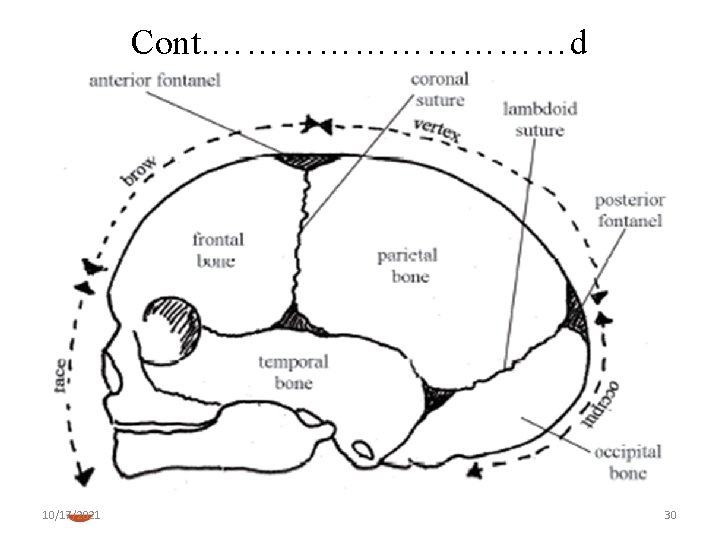
The fetal skull… ♦ Division The fetal skull is divided into three parts: ♣ The vault – is the large dome shaped part above the imaginary line drown from below the occipital protuberance to the orbital ridges. ♣ The face - area extending from the orbital ridges to the junction of the chin and neck. ♣ The base - is composed of bones which are firmly united to protect the vital centers in the medulla. 10/17/2021 29
Cont. ……………d 10/17/2021 30
The fetal skull… v. Bones of the vault �There are five main bones in the vault of the fetal skull. ♠ One occipital bones. which forms the back of the skull and part of its base. ♠ It joins with the cervical vertebrae (neck bones in the spinal column, or backbone) ü Its ossification center is known as occipital protuberance. ü It is roughly triangular in shape. ü In its lower part it forms the margins of the foramen magnum. 10/17/2021 31
The fetal skull… • • Two parietal bones – lie on either side of the skull. The ossification center of each bone is called partial eminence. They are the largest of the cranial bones. Roughly square in shape and curves as they lie over the parietal lobes of the brain. • Two frontal bones – form the forehead or sinciput. • Their ossification centers are named frontal eminence or frontal bosses. 10/17/2021 32
Cont. …………. d • Fuse in to a single bone by 8 years • The two temporal bones, one on each side of the head, closest to the ear. • Understanding the landmarks and measurements of the fetal skull will help you to recognise normal and abnormal presentations of the fetus during antenatal examinations, labour and delivery. 10/17/2021 33
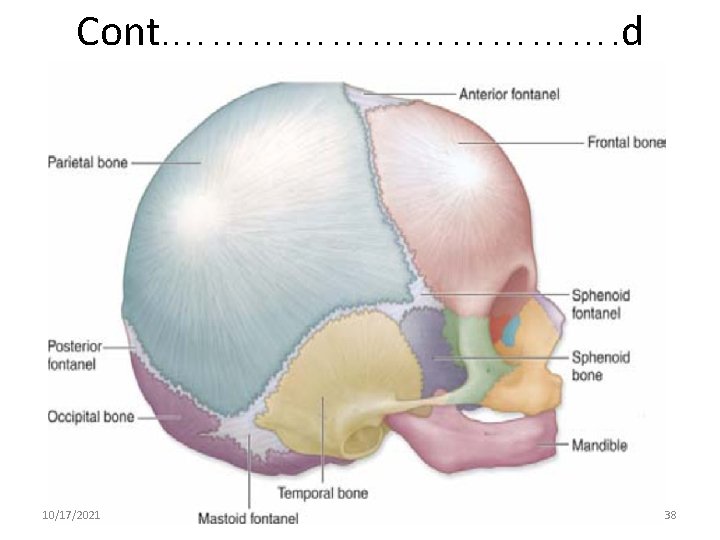
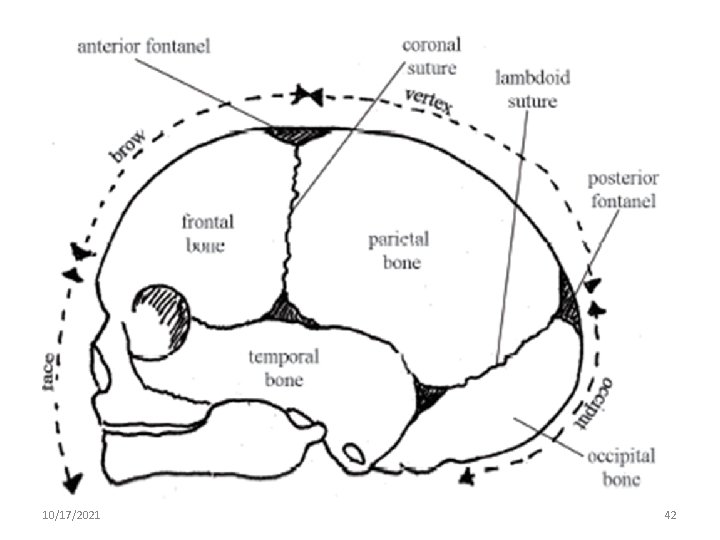
The fetal skull… v. Sutures § Is an area of membrane between the skull bones where ossification has not been completed. § Overlap during the process of molding at the time of birth. Types of sutures Ø Lambdoidal suture – separate the occipital bone from the two parietal bones. ü It is shaped like the Greek letter Lambda 10/17/2021 34
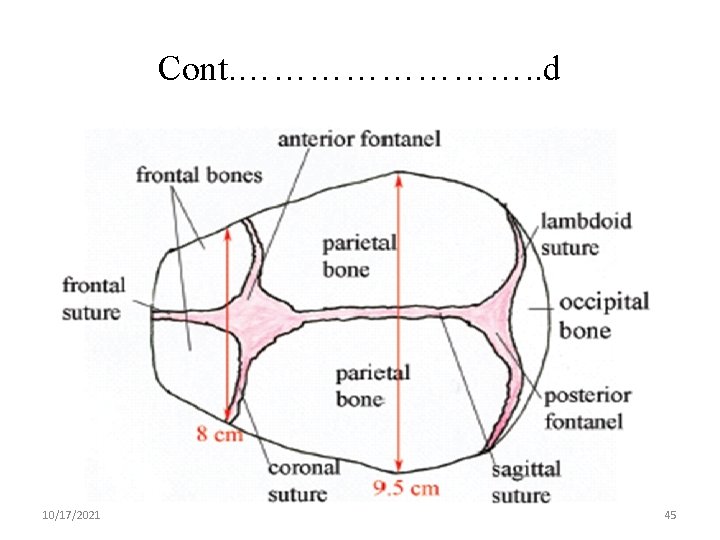
Fetal skull…. Ø Sagital suture- runs between the two parietal bones and runs from the anterior fontanel in front to the posterior fontanel behind. Ø Frontal sutures- runs between the frontal bones, extending from the root of nose below, to the anterior fontanelle above. Ø Coronal suture- separate frontal bones from parietal bones, passing from one temple to the other. 10/17/2021 35
The fetal skull… v Fontanels § Are areas where two or more sutures are meet. § There are two fontanels having great obstetrical importance. ♥ The anterior fontanel or bregma : -is formed where the sagital, coronal and frontal sutures meet. ü It is diamond in shape. ü It is much longer than posterior fontanel. ü Pulsation of cerebral vessels can be felt through it. ü Normally closes at 18 months of age 10/17/2021 36
The fetal skull… ♥ ü ü ü Posterior fontanel occurs at the junction of the lambdoidal and sagital sutures. It is very small and triangular in shape It is normally closes by 6 weeks of age 10/17/2021 37
Cont. ………………. d 10/17/2021 38
The fetal skull… v The Regions of the skull ♦ Vertex –is bounded by the anterior and posterior fontanels and parietal eminences ♦ Occiput – is the area between the base of the skull and the posterior fontanel. It is unusual and very risky for the occiput to be the presenting part. ♦ Sinciput (brow) – extends from the anterior fontanel and coronal suture to the orbital ridge ♦ Face – extends from the orbital ridges and the root of the nose to the junctions of the chin and neck. ü The point between the eye brow in known as the glabella. 10/17/2021 39
Cont. ……………d • Attitude: is the relationship of the fetal parts to one another, (head & limb to its trunk) & the normal attitude is flexion. • Presenting part - is the part of the fetus felt at the lower pole of the uterus & felt on abdominal examination and on vaginal examination. • Presentation - is the part of the fetus in the lower pole of the uterus & the normal presentation is vertex. • Abnormal presentations are - Breech , face, brow, shoulder - 10/17/2021 40
Cont. ……………. d • Position- is the relationship between the denominators of the presentation to the six areas of the mother’s pelvis. • Normal position is anterior or lateral. • Denominator -The part of the fetus which determines the position. • Vertex - Occiput • Breech - Sacrum • Face - Mentum • Engaged - When the biparital diameters of the fetal head passes through the pelvis brim 10/17/2021 41
10/17/2021 42
The fetal skull… v Land marks of the fetal skull Ø Occipput Ø Vertex Ø Sinciput Ø Posterior fontanel (Lambda) Ø Glabella Ø Mentum (chin) Ø Anterior fontanel (Bregma) Ø Occipital protuberance 10/17/2021 43
The fetal skull… Diameters of the fetal skull v Transverse Diameters q Biparietal diameter- between the parietal eminenences and measures 9. 5 cm • Engagement occur as this diameter pass through the plane of the brim. q Bi- temporal diameter – runs between the two extremities of the coronal sutures and is 8. 2 cm in length. 10/17/2021 44
Cont. …………. . d 10/17/2021 45
The fetal skull… v Anteroposterior or longitudinal diameters q Subocipitobregmatic- measured from below the occiput to the bregma. It measures 9. 5 cm. q Suboccipito frontal – measured from below occipital protuberance to the center of the frontal sutures, and measures 10 cm. q Occipito frontal – measured between the occiput and the glabella. It is 11. 5 cm in length q Mento-vertical – measured from the point of the chin to the highest point on the vertex slightly nearer to posterior fontanel then anterior, and it measures 13. 5 cm. 10/17/2021 46
The fetal skull… q. Sub mento vertical – measured from the point where the chin joins the neck to the highest point on the vertex. It is 11. 5 cm in length q. Sub mento bregmatic - measure from the point where the chin joins the neck to the center of the bregma and measures 9. 5 cm 10/17/2021 47
The fetal skull… v. The scalp tissue There are five layers of scalp tissue : �Skin containing hairs, (outer covering) �Subcutaneous tissue �Muscle layer – containing the tendon of Galea �Connective tissue – a loose layer �Periosteum – which covers the skull bones v. Two conditions involving these tissue can arise during labor and both cause a swelling on the infant’s head 1. Caput succedaneum – is an edematous swelling of the subcutaneous tissues of the fetal skull. v It occurs in early rupture of membranes in the 1 st stage of labor, because there is no bag of fore waters to take the pressure of dilating cervix off the fetal head. 10/17/2021 48
The fetal skull… ♠ ü ü ü Characteristics of the Caput succedaneum ; It is present at birth Occurs on the part of the head It may lie over a suture line It pits on pressure It disappears with in 24 - 48 hrs No treatment required unless it is excessive 10/17/2021 49
The fetal skull… 2. Cephelo hematoma – this swelling is due to bleeding between the skull bone and periosteum which covers it. ü The bleeding occurs because of friction between the skull bones and the periosteum. ♠ Characteristics ; It is not present at birth, but appears 2 -3 days after wards. � The swellings is limited by the periosteum and can there fore only occur over the bone , although it may be bilateral. It can not lie over a suture. The head is usually red- and bruised in appearance. 10/17/2021 50
Cont. …………. d �It takes 6 weeks to disappear completely. �Treatment is only required of the hematoma increase in size over a number of days. �RX- vit. K, injection to raise the prothrombin level and assist clotting. 10/17/2021 51
The fetal skull… v Molding • Is the change which takes place in the shape of the fetal skull as pass through the birth canal. • As the head descends through the pelvis in response to the down ward pressure of uterine contractions, so the skull bones overlap each other. • Molding takes place gradually with out being prolonged, the cerebral membranes and blood vessels are not likely to be damaged. 10/17/2021 52
The fetal skull… • The dangerous types of molding are : § Excessive molding ü Occurs when labor is prolonged or where the skull bones are not completely ossified (in prematurity ). § Upward molding ü Occurs when the baby delivers in the persistent occipito posterior position and the after coming head of the breech passes through the pelvis. ü It can result in intracranial hemorrhage. 10/17/2021 53
The fetal skull… § Rapid molding ü Occurs in a precipitate delivery, and during the delivery of the head of breach presentation. ü Results from rapid compression and decompression of the head which can rupture of the cerebral membrane. ü The infant is subjected to severe molding will suffer some degree of asphyxia at birth as a result of intracranial compression, thus they should be seen by pediatrician and get vit. K (0. 5 -mg/kg). 10/17/2021 54
NORMAL PREGNANCY Objectives At the end of this secession the students will be able to: - ü ü ü Define Preparation for Parenthood ? Describe physiological changes during pregnancy. Discuss minor disorder of pregnancy Describe Antenatal care Describe MTCT/PMTCT during pregnancy. 10/17/2021 55
Cont. ……………. d Definitions of terms. • Obstetrics - is a medical specialty focusing on the care of woman during pregnancy , child birth and postpartum. • Gynecology - is a medical specialty focusing on disorders or diseases of reproductive system. • Conception & fertilization - the union of egg & sperm in the bench mark of the beginning of pregnancy. • Pregnancy - the condition of having a developing conception with in the maternal body. • The state from conception to delivery of the fetus. • The normal duration is 280 days counted from the 1 st day of last menstrual period. 10/17/2021 56
Cont. ……………. d • Embryo-human conceptus from fertilization through eight weeks of pregnancy. • Fetus- from eight weeks until delivery. • Gestational age- duration of pregnancy expressed in completed weeks and is calculated from the first day of last normal menstrual period(LNMP/LMP). • Developmental age(fetal age)- is age of the offspring calculated from time of implantation. • Gravid- pregnant • Gravidity- total number of pregnancy including abortion • Parity- total number of live birth 10/17/2021 57
Cont. ………………. . d • • Prenatal - occurring before birth Intranatal - occurring with in birth Postnatal - occurring after birth Premigravida - a women pregnant for the 1 st time Multigravida- a women pregnant more than one times Primiparas - a women having born one child Multipara- a women having born more than one child Grundmultipara- a women born more than five child 10/17/2021 58
Preparation for Parenthood Childbirth Preparation • Preconception care/issues • Childbearing decisions • Childbirth education • Types of childbirth classes • Support during labor 10/17/2021 59
Cont. …………………d Preconception Care • Timing • Mental and physical health • Genetic counseling • Dental Health • Nutrition – Folic acid, 800 mg/day during child bearing age to prevent neural defects/anemia. • Supplements • When do you stop contraception? 10/17/2021 60
Cont. ……………. . d Childbearing Decisions • Choosing care provider for mom and baby • Choice of birth setting • Birth plan • Labor support decisions • Sibling preparation 10/17/2021 61
Cont. …………. d Childbirth Education • Goals of education • Childbirth programs • Early classes – 1 st trimester _2 nd & 3 rd trimester • Breastfeeding classes • Sibling Preparation • Grandparent classes • Cesarean Birth 10/17/2021 62
Support During Labor • Body-Conditioning Exercises • Relaxation Exercises -fatigue increases muscle tension and pain perception, decreases coping ability (make sure they’re rested) • Breathing Techniques – increase pain threshold and ability to cope, sense of control, uterus functions more efficiently • Support individuality - self care activities 10/17/2021 63

Supportive Relaxation Techniques – Comfort measures – Massage – Effleurage- A form of massage involving smooth strokes of the skin with one's hands. – Rest – Imagery - visualization – Vocalization – Warm water – Music – Birthing ball 10/17/2021 64
Physiological Changes of Pregnancy • There are physiological , biochemical and anatomical changes during pregnancy. • These changes may be systemic or local. • Most of the systemic changes return to pregnancy status 6 weeks after delivery. • These changes occur to maintain a healthy environment for the fetus with out compromising the mother’s health. • And prepare for the process of delivery and care of the newborn. • Understanding of the normal changes helps to understand coincidental disease processes. 10/17/2021 65
Gastro Intestinal Tract (GIT) • Nutritional requirements including for vitamin and minerals are increased so usually mother's appetite increase • Pregnant women tend to rest more often conserving energy and there by enhancing fetal nutrition • Oral cavity feels salivation • Gums- hypertrophic easily bleed (due to increased systemic estrogen) • Gastrointestinal mobility May be reduced due to increased progesterone (w/c decreased the hormone motline stimulate smooth muscles in GIT) • Hence gastric emptying is slowed leads to GIT constipation (due to increased water absorption) 10/17/2021 66
Cont. …………d • Stomach Production of gastrin and mucous increase and decreases PH, • PUD usually improve or disappear because of these changes during pregnancy , However because of the enlarging uterus heart burn is common due to gastric reflex. • Enlarging uterus slower emptying time, increase intra gastric pressure, acidity and gastric reflex • The anatomical position of small and large intestine as well as appendix will shift because of the enlarging uterus 10/17/2021 67
Gallbladder • Progesterone decreased motility → decreased empty time of bile →stasis →stone formation and infection. Liver • No morphological changes but functional changes • Decreased plasma protein (albumen) an globulin (synthesized by liver) increases serum alkaline phosphatase activity. 10/17/2021 68
Urinary systems • Each kidney increase in length and weight • The renal pelvis and ureter dilate and lengthen • Thus there is an increase urinary stasis increase risk of infection and stone formation Renal function • Change occur due to increased maternal and placental hormones (ACTH, ADH, cortisol, etc. ) and increase in plasma volume • Glomerular Filtration Rate increase by 50% (begins early and last up to term 10/17/2021 69
Cont. ……………. . d • Renal blood flow rate increase by 20 -25% (early to mid trimester) after the end of 2 nd trimester remain constant. • Urine volume dose not increase although glomerular filtration rate increase because of reabsorption. • Creatinine and BUN decrease because of increased clearance rate • Glycosuria is not necessarily as normal • Protein urea changes little during pregnancy Bladder • Is displaced upward anteriorly by enlarged uterus as a result it increases pressure leading to urinary urgency and frequency 10/17/2021 70
Hematological system: • Increase in blood volume – most striking change • The change occurs until term and the average increase in volume is 45 -50% • The mechanism for increase the volume of blood is not well understood (aldosterone related factor during pregnancy may contribute to this effect) increase water and salt retention. • RBC increased by 33% 10/17/2021 71
Cont. ………………. . d • Iron need increases because of increase in red blood cell mass • This is why Iron supplementation is necessary during pregnancy. • WBC total count usually increase • Platelets increase in production • Clotting factors - Several factors increase- F- I, F-VIII mainly • To lessees extent, F-VII, IX, X and XII • Decrease- F- XI, F-XIII 10/17/2021 72
Cardiovascular System • Heart slightly shift in position • Enlarging Uterus → diaphragm→ displace up ward → shift of apex beat • Cardiac capacity increase by 70 -80 ml and Cardiac out put increase a 49% during pregnancy reach may at 20 -24 weeks of gestation the constant until term • HR increase by 15 b/min than non pregnancy 10/17/2021 73
blood pressure • Systemic blood pressure declines slightly during pregnancy • There is little change in SBP but DBP decrease by 5 -10 mm. Hg from 12 -26 weeks, then increase to non pregnant level by term. • Venous pressure - No change in the upper body - Increase in the lower extremities enlarged - Decrease venous return to the heart increases pressure and results in edema. 10/17/2021 74
Pulmonary system • Capillary dilatation occurs in the respiratory route (Naso pharynx, larynx, trachea, bronchi) → make breathing difficult through nose, enlarged Uterus pushes the diaphragm and the lungs as well. Functional respiratory changes include • A slight increase in respiratory rate • 50% increase in minute ventilation • 40% increase in minute tidal volume • Progressive increase in oxygen consumption (15 -20% above non pregnant level by term) 10/17/2021 75
Changes in the Breast • Breast increases in size with enlargement of the nipple and increased vascularity and pigmentation of areola. Change in Skin • Hyperpigmentation over some part of the body , Face (fore head, cheek) - cholasma • Abdomen –sub umbilical midline dark purplish pigmentation of linea alba- linea nigra Stretch mainly Striea gravidarum • Enlarging abdomen → stretch on collagen fibers of the skin and effect of ACTH 10/17/2021 76
Change in Vagina and Uterus Vagina– increase in capacity and length secondary to the hypertrophy of the lining epithelium and muscle layer. • Increased glycogen content in the wall secondary to the effect of estrogen. • Increases vascularity and change the color to purple • Fold increases by term Uterus – Upper part fundus and body change in to upper uterine segment • Lower part cervix and isthmus change in to lower uterine segment • Weight increases from 60 gm to l kg at term, volume 10 ml to 5 liters. 10/17/2021 77
3. 7 Minor Disorders of Pregnancy • Minor disorders are only disorders that occur during pregnancy and are not life threatening. 1. Nausea and vomiting- This presents between 4 and 12 weeks gestation. Hormonal influences are listed as the most likely causes. • It is usually occurs in the morning but can occur any time during the day, aggravated by smelling of food. v Management: - Reassure the mother - Small frequent meals (dry meals) - Reduce fatty and fried containing foods. - Rest 10/17/2021 78
Cont. …………d 2. Heart burn: - is a burning sensation in the mid chest region. • Progesterone relaxes the cardiac sphincter of the stomach and allows reflex of gastric contents into esophagus. • Heart burn is most troublesome at 30 -40 weeks gestation because at this stage is under pressure from the growing uterus. Management: • Small and frequent meal, sleeping with more pillows than usual. • For persistence/sever case/ prescribe antacids. 10/17/2021 79
Cont. ……………d 3. Pica: - This is the term used when mother craves certain foods of unnatural substances such as coal, soil. . . etc. • The cause is unknown but hormones and changes in metabolism are blamed. Management: • Seek medical advice if the substance craved is potentially harmful to the unborn baby. 10/17/2021 80
Cont. …………. . d 4. Constipation: - Progesterone causes relaxation and decreased peristaltic activity of the gut, which is also displaced by the growing uterus. Management: • Increase the intake of water, fresh fruit, vegetables and roughages in the diet. • Exercise is helpful especially walking 10/17/2021 81
Cont. …………………. d 5. Backache - The hormones sometime soften the segments to such a degree that some support is needed. • Management: - Advice the mother to sleep on firm bed. - Advice support mechanisms of the back. 10/17/2021 82
6. Urinary frequency • pregnancy pressure by the enlarging uterus explain the common complaint of frequency of urination. • UTI is also common as the result of incomplete emptying of the bladder and stasis of urine. Microscopy of urine must be done in all cases. 10/17/2021 83
7. Ptyalism • Hyper salivation is also common. It is not related to increased salivation production; rather it is the result of reduced swallowing from nausea. 8. Hemorrhoids • Exacerbation or recurrence of previous hemorrhoids due to increase pressure in the rectal veins caused by obstruction of venous return by the large uterus and constipation during pregnancy 10/17/2021 84
Cont. …………. d 9. Fainting: - In early pregnancy fainting may be due to the vasodilation occurring under the influence of progesterone before there has been a compensatory increase in blood volume. • The weight of the uterine contents presses on the inferior venacava and slows the return of blood to the heart. Management: Avoid long period of standing - Sit or lie down when she feels slight dizziness - She would be wise not to lie on her back except during abdominal examination 10/17/2021 85
Cont. …………………. . d 10. Varicosities- Progesterone relaxes the smooth muscles of the veins and result in sluggish circulation. • The valves of the dilated veins become insufficient and varicosities result. • It occurs in legs, anus (hemorrhoids) and vulva. Management: • Exercising the calf muscles by rising on the toes • Elevate the leg and rest on the table • Support thighs and legs • Avoid constipation and advise adequate fluid intake. • Sanitary pad give support for vulva varicosities 10/17/2021 86
Diagnosis of Pregnancy • Pregnancy is mainly diagnosed on the symptoms reported by the woman and signs elicited by a health care provider. Signs and symptoms of pregnancy • These signs and symptoms are divided in to three classifications; presumptive, probable, and positive. 1) Possible (presumptive) signs • Early breast changes-increase in size, darkening of areola, 10/17/2021 87
Cont. ……………d • Amenorrhea-a women having regular cycle with out the use of hormonal contraceptives • Morning sickness • Bladder irritability like frequency of micturition • Quickening -the date of the first fetal movement felt by the mother provides an indicator of pregnancy. 10/17/2021 88
Cont. ……………. . d • A primigravid women feels it at 18 -20 weeks the multi gravid at 14 -16 weeks 2. Probable signs • Presence of HCG in - blood - urine • Uterine growth • Braxtonhicks contractions • Ballottement 10/17/2021 89
Cont. ……………d 3. Positive signs • Visualization of fetus by - Ultrasound 6 weeks of gestation - X-ray after 12 weeks of gestation • Fetal heart sounds by - Ultrasound - Fetal stethoscope or fetoscope (20 th to 24 th weeks of gestation) • Fetal movements by - Palpation - Visible 10/17/2021 90
Antenatal Care Definition: - Antenatal care is the care given to a woman during her pregnancy. v Objectives: 1. To promote and maintain good health of the mother and fetus during pregnancy 2. To ensure that the pregnancy result in healthy infant and healthy mother. 3. To detect early and treat appropriately 'high risk conditions (Medical or Obstetrical). 4. To prepare the woman for Labour, Lactation and the subsequent care of the baby. 10/17/2021 91
Definitions of terms Gravidity: Pregnancy Primigravida : a woman pregnant for the first time Multigravida : a woman who has had two or more pregnancies Parity : refers to delivery, Nulliparous : a woman who has not given birth to a child birth) Multipara : a woman who has given birth to more than one child Grand multipara : woman who has given birth to or more children Lie: is the relationship of the long axis (spine) of the fetus to the long axis of the mother’s uterus, Ø The normal lie is longitudinal and abnormal are transverse, oblique and variable. 10/17/2021 92
Cont. …………. d Presenting part: is the part of the fetus felt at the lower pole of the uterus • felt on abdominal examination and on vaginal examination. Presentation: is the part of the fetus in the lower pole of the uterus • the normal presentation is vertex, abnormal are breech, face, brow and shoulder. Position: is the relationship of the denominator to the six areas of the mother’s pelvis, • normal position is anterior or lateral abnormal is Malposition is Occipital posterior position. 10/17/2021 93
Cont. …………………. . d Positions of vertex presentation. • Left occiputo anterior (LOA) - the occiput points to the left iliopectineal eminence. The sagital suture is on the left oblique diameter. • Right occiputo anterior (ROA) - the occiput points to the right iliopectineal eminence. The sagital suture is in the left oblique diameter of the pelvis. • Left occiputo lateral (LOL) - The occiput points to the left iliopectineal line mid way between the iliopectineal eminence & the sacroiliac joint. The sagital suture is in the transverse diameter. 10/17/2021 94
Cont. …………d • Right occiputo lateral (ROL) - The occiput point to the right iliopectineral line midway between iliopectineal eminence & sacro iliac joint. The sagital suture is in the transverse diameter of the pelvis. • Left occiputo posterior (LOP) - The occiput points to the left sacroiliac joint. The sagital suture is in the left oblique diameter of the pelvis. 10/17/2021 95
Cont. ……………d • Right occiputo posterior (ROP) - The occiput point to the right sacroliliac joint. The sagital suture is in the right oblique diameter of the pelvis. • Direct occiputo anterior (DOA) - The occiput points to the symphysis pubis. The sagital suture is in the anterior posterior diameter of the pelvis. • Direct occiputo posterior (DOP) - The occiput points to the sacrum, the sagital suture is in the anterior posterior diameter of the pelvis. 10/17/2021 96
Cont. ……………. d Crowned: When the Bi-parietals pass the ischial spines and the head no longer recedes between contractions. Attitude: is the relationship of the fetal parts to one another, the normal is flexion, abnormal are extension and deflection Denominator: The part of the fetus which determines the position. • Vertex- occiput, breach -sacrum. Face- mentum). Engaged: when the Bi-parietal diameters of the fetal head passes through the pelvic brim. 10/17/2021 97
History Taking 1. 1. Identification • Name • Age- significant if less than 20 years and greater than 35 years • Marital status • Address- far distance from health institution • Religion • Occupation • Date of admission • Ward and bed number 10/17/2021 98
Cont. ……………d 1. 2 Chief compliant • Patient may have come for routine antenatal care follow up or may come with one or more specific complaints. • Note the duration of each compliant 1. 3 History of present pregnancy Get information on the following points • Gravidity • Parity • Abortion. • Last normal menstrual period (LNMP) • Expected date of delivery (EDD) 10/17/2021 99
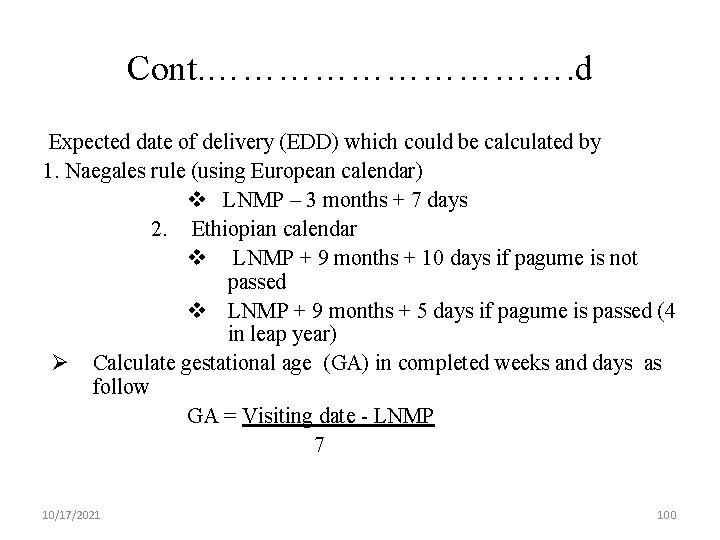
Cont. ……………. d Expected date of delivery (EDD) which could be calculated by 1. Naegales rule (using European calendar) v LNMP – 3 months + 7 days 2. Ethiopian calendar v LNMP + 9 months + 10 days if pagume is not passed v LNMP + 9 months + 5 days if pagume is passed (4 in leap year) Ø Calculate gestational age (GA) in completed weeks and days as follow GA = Visiting date - LNMP 7 10/17/2021 100
Cont. …………. . d • Quickening: the first time the mother felt fetal movement v In premigravida it is around 18 -20 weeks and in multigravida is it around 16 -18 weeks of gestation v presence of Antenatal care elsewhere. v Place and number of visits, what was done and laboratory results. v Elaboration of chief compliant 10/17/2021 101
Cont. ……………d • Danger symptoms of pregnancy (vaginal bleeding, sever headache, blurring of vision, epigastric or sever abdominal pain, profuse vaginal discharge, absence or reduction of fetal movement, fever and persistent vomiting) • Common complaints in pregnancy (like nausea and vomiting, weakness) • Pregnancy: unplanned, unwanted and unsupported • Ask positive and negative statement according to the patient compliant 10/17/2021 102
Cont. …………. . d 1. 4 past obstetric history: the following should be asked for all previous pregnancies in chronologic order • Date, month and year of gestation for example first deliver in may 2000 • Length of gestation: abortion (< 28 weeks), preterm (< 37 complete weeks), term (> 37 completed weeks to 40 weeks), postdate (> 42 weeks to 42 weeks), post term (> 42 completed weeks). • Significant antenatal medical problems like hypertension , ante partum haemorrhage, diabetes • Onset of labour (spontaneous or induced) • Fetal presentation (vertex, face, brow, breech or shoulder) 10/17/2021 103
Cont. ………………. . d • Duration of labour • Mode of delivery (spontaneous vaginal, instrumental delivery, caesarean section or destructive delivery) • Fetal out come (alive or dead, sex of the new born, weight of the new born, malformation and current condition) • Post partum complication- postpartum haemorrhage and Breast feeding 10/17/2021 104
Cont. ……………d 1. 5 gynaecology history • Family planning methods – use, type, duration and side effect • Sexual history- assess risk of sexually transmitted infections and HIV/AIDS • Gynaecology operations- female genital mutilation, laparotomy, dilatation and curettage, evacuation and curettage, manual vacuum aspiration • Menstrual history (age of menarche, interval of period 21 -36 days, amount of flow 10 -80 ml, duration of flow 2 -8 days, normally dark red and non-clotting ) 10/17/2021 105
Cont. ……………. d 1. 6 Past medical and surgical history: • History of diabetes mellitus, hypertension, hypo or hyper thyroidism, which may affect pregnancy or get aggravated by pregnancy • Blood transfusion important in haemolytic disease of the new born • Drugs because of risk of teratogenicity or allergic reaction • Maternal infection- TORCH syndrome. 10/17/2021 106
Cont. ……………. . d 1. 7 Personal, family and social history • Childhood development • Educational status • Habit like alcohol, smoking and elicit drug use • Occupation- exposure to radiation ansthesia- halothane, chemical factory and others • Income- low socio economic status associated with obstetric problems like preeclampsia, preterm • Family history- diabetes mellitus, hypertension, multiple pregnancy, genetic disorder 10/17/2021 107
Cont. ……………d 1. 8 Review of systems: check all systems 2. Physical examination • Examination must be done in a private room in the presence of an assistant preferably female • Proper explanation must be offered to the patient before, during and after the examination • Bladder should be emptied and the patient properly positioned on the couch • Warm hand instruments must be used • Adequate light, appropriate gloves and swabs should be prepared. • Always keep eye contact through out the examination. 10/17/2021 108
cont. …………………. d Examination of the Pregnant Woman at First Visit Objective: • To diagnose pregnancy • To identify high risk pregnancy • To give advice for pregnant mother General Appearance • As she walks in, observe any deformity, stunted growth, limp etc. does she look well or pale and tired? 10/17/2021 109
Cont. ……………. d Clinical Observation Height; - 150 cm or less needs special care. Weight: - The average weight gain during pregnancy is about 1214 kg • In the first trimester a woman should gain o. 4 kg per month and in the second and third trimester she should gain 0. 4 kg per week. • It is Considered as excessive if it is more than 3 kg a month during the second and third trimester; • It is less than normal if it is less than 1 kg per month during the second and third trimester. 10/17/2021 110
Cont. …………. d • The average distribution is as follow: the fetus 3300 gm, the placenta 600 gm, amniotic fluid 800 ml, uterus 900 -1000 gm, breast 400 gm, blood 1200 ml, deposition of fat 2500 gm and extracellular fluid 2600 ml. Blood pressure: - Checked and recorded at each visit, Physical Examination: Appearance: - The hair of a healthy woman is shining and glossy, bright eyes and clear, Face: - Oedema, sign of anaemia Neck - Swollen glands 10/17/2021 111
Cont. …………. d Respiratory and Cardiovascular System • Steps in examination are essentially the same as non pregnant patients. • Note that the following are normal finding in pregnancy • Decrease diaphragmatic excursion due to diaphragm elevation by gravid uterus • Point of maximal impulse (PMI) deviation to left is possible in pregnancy • S 3 gallop may be heard • Functional systolic murmur may be heard 10/17/2021 112
Cont. ……………d Breast Examination • Asses the size, any lumps in the breast • Nipples are they inverted or flat? • Teach the mother self - examination of the Breast Abdominal Examination AIMS • To observe signs of pregnancy • To assess fetal size and growth • To assess fetal health • To diagnose the location of fetal parts. • To detect any deviation from normal. 10/17/2021 113
Cont. ……………. . d Steps for Abdominal Examination 1. Inspection 2. Palpation 3. Auscultation • Inspection (5 s) a) Shape: - Longitudinal, ovoid in primigravida - Round and Broad in transverse lie in multipara. 10/17/2021 114
Cont. ………………d b) Size: - Should correspond with the supposed period of gestation c) Skin: - The dark line of pigmentation which is lineanigra • is there any rash? d) Strae gravidarum e) Scar - Any operation scar(c/s) 10/17/2021 115
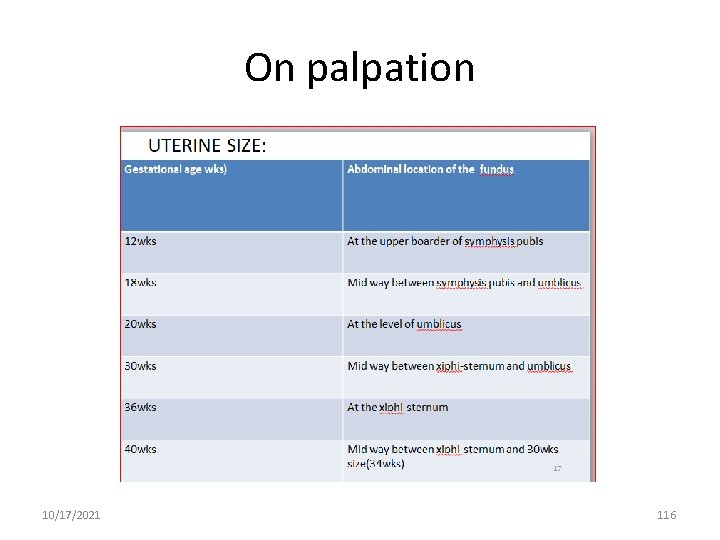
On palpation 10/17/2021 116
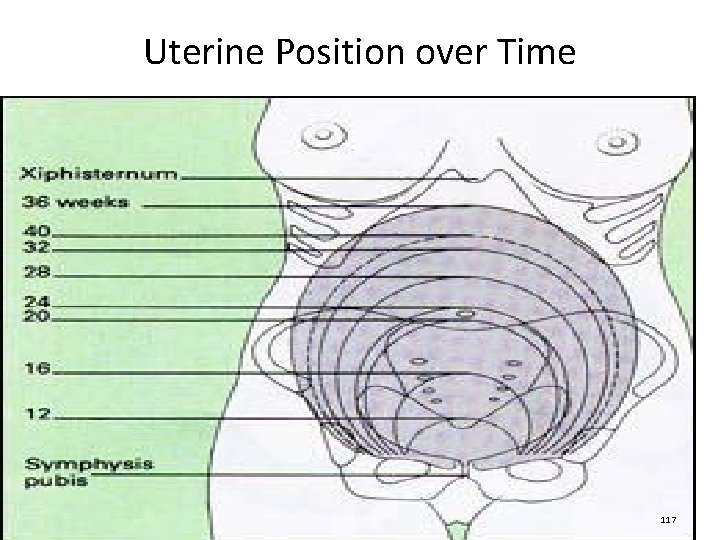
Uterine Position over Time 10/17/2021 117
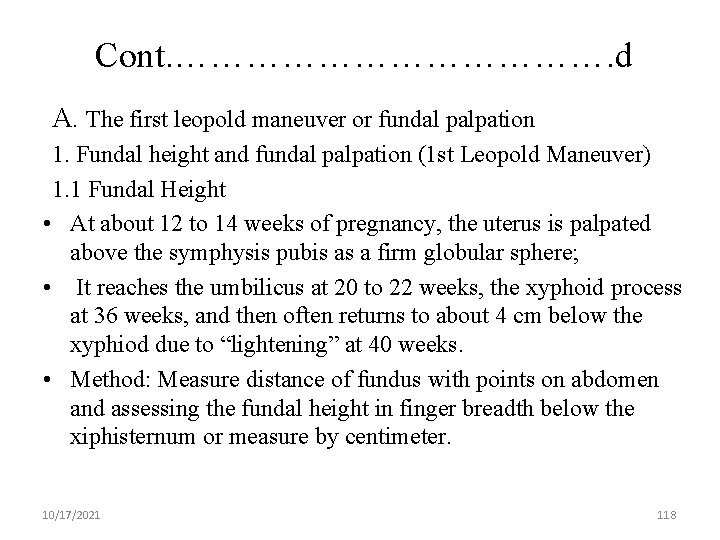
Cont. ………………. d A. The first leopold maneuver or fundal palpation 1. Fundal height and fundal palpation (1 st Leopold Maneuver) 1. 1 Fundal Height • At about 12 to 14 weeks of pregnancy, the uterus is palpated above the symphysis pubis as a firm globular sphere; • It reaches the umbilicus at 20 to 22 weeks, the xyphoid process at 36 weeks, and then often returns to about 4 cm below the xyphiod due to “lightening” at 40 weeks. • Method: Measure distance of fundus with points on abdomen and assessing the fundal height in finger breadth below the xiphisternum or measure by centimeter. 10/17/2021 118
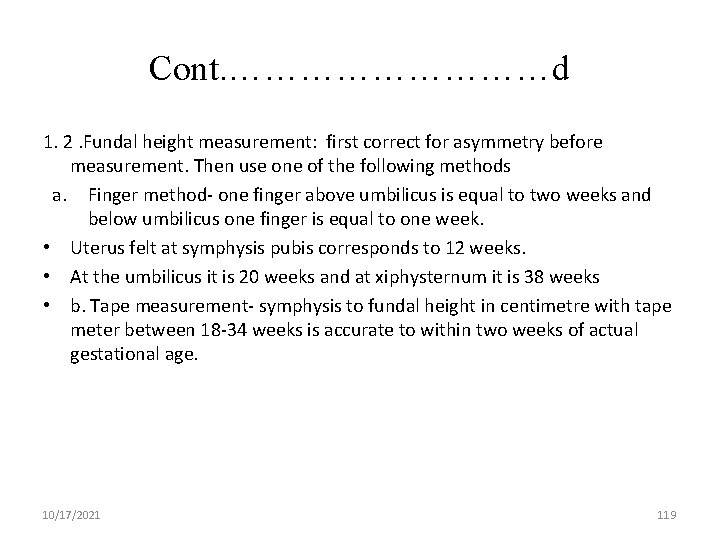
Cont. ……………d 1. 2. Fundal height measurement: first correct for asymmetry before measurement. Then use one of the following methods a. Finger method- one finger above umbilicus is equal to two weeks and below umbilicus one finger is equal to one week. • Uterus felt at symphysis pubis corresponds to 12 weeks. • At the umbilicus it is 20 weeks and at xiphysternum it is 38 weeks • b. Tape measurement- symphysis to fundal height in centimetre with tape meter between 18 -34 weeks is accurate to within two weeks of actual gestational age. 10/17/2021 119
Cont. …………. d II. Determine what occupies the fundus. • If soft, irregular, bulky mass is found it is breech. • If hard, round, smooth ballotable mass is found, it is the head. Ú Method of Fundal palpation- use two hands using palms of hands palpate on either side of the fundus. • Finger held close together, palpate the upper pole of the uterus & feel that as it is hard or soft or irregular. 10/17/2021 120
Cont. ……………d B. The Second Leopold manoeuvre or lateral palpation • Determines the lie of the foetus which could be longitudinal, transverse or oblique lie • In longitudinal lie it determines on which side of the abdomen is the foetal back. • The back of the fetus is linear, rigid and smooth in outline. • The extremities are felt as small irregular and bulky masses. • The fetal heart beat is best heard on the back side • Method of lateral palpation- always facing the mother, fix the hand on the center of the abdomen, fix the right hand & palpate with the left hand & vise versa. 10/17/2021 121
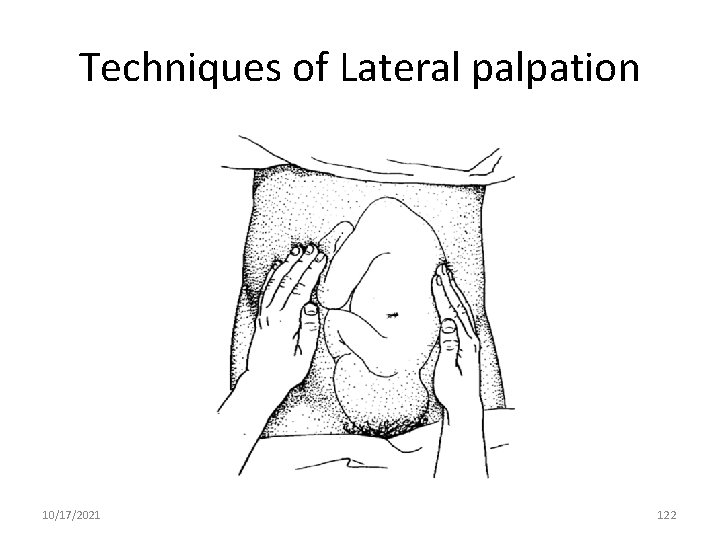
Techniques of Lateral palpation 10/17/2021 122
Cont. ……………d C. The Third Leopold manoeuvre or pelvic palpation • Determine what part of the foetus occupies the lower uterine pole which is also called the presentation. • The possibilities are the head (cephalic presentation), the breech (breech presentation), and the shoulder (shoulder presentation) • In cephalic presentation it determines the descent by using rule of fifth which measures the distance between upper border of symphysis pubis to the anterior shoulder. • 5/5 is floating head, 4/5 is fixed head, 2/5 denotes engaged head. • It determines the attitude of the fetus (relation of head to the trunk). • The provider face towards the maternal extremities. 10/17/2021 123
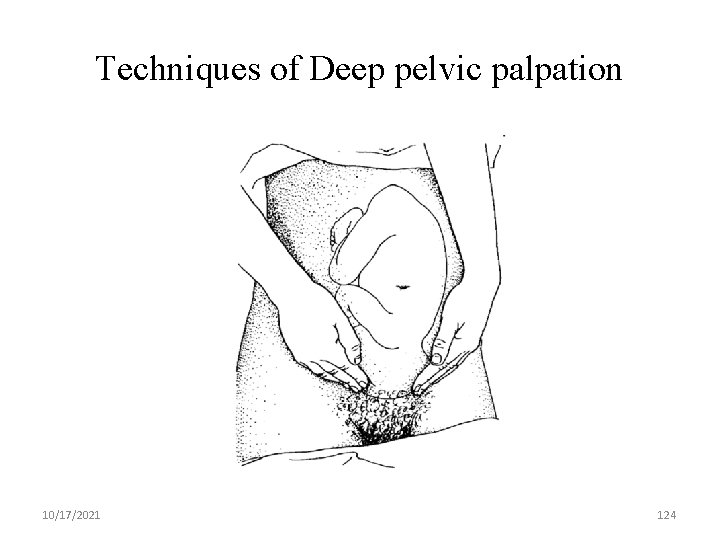
Techniques of Deep pelvic palpation 10/17/2021 124
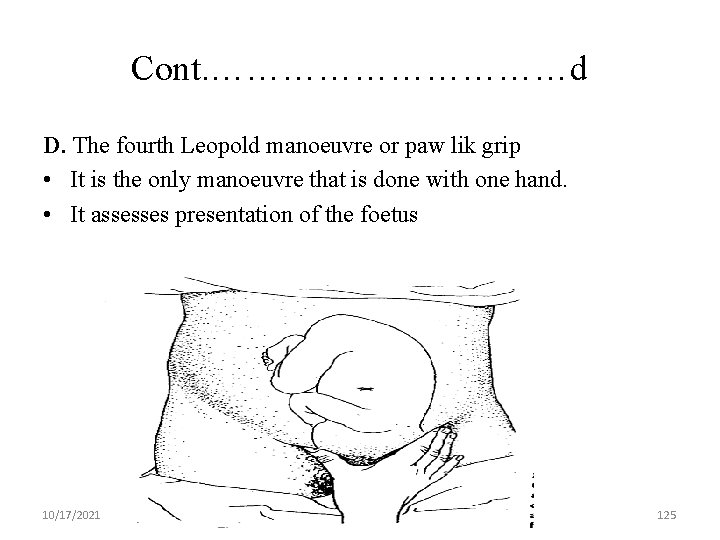
Cont. ……………d D. The fourth Leopold manoeuvre or paw lik grip • It is the only manoeuvre that is done with one hand. • It assesses presentation of the foetus 10/17/2021 125
Cont. …………d 2. 6. 4. Auscultation • Fetal heart beat first heard in the back side at 16 -18 weeks in multipara and 18 -20 weeks in primi gravida • In breech, it is heard above the umbilicus. • In cephalic presentations it is below the umbilicus • In occipito posterior presentation, it is heard in the flanks. • Method – use feto scope • Hand should not touch it while listening. • Ear must be enclose form contact with the feto scope. 10/17/2021 126
Pelvic assessment • By x-ray of the pelvis • Clinical (assessing sign of contracted pelvis) • Head fitting • The head is the best pelvimeter METHOD 1: Head fitting, sitting patient Method : • Let her lie on a couch, place hand on the Symphysis pubes and get the woman to sit up by her own effort. • The effort should force the head in to the pelvis. 10/17/2021 127
Cont. …………d METHOD 2 : Left hand grip method • Grasp the fetal head with left hand push it down wards and backwards • if a sense of give is felt the head has entered and there is no over and no cephalo pelvic disproportion. Genito-Urinary System - Frequency of micturition - Check for abnormal discharge 10/17/2021 128
Cont. …………. . d Circulatory System • Varicosities: - Varicose veins may occur in the legs, anus (hemorrhoids) and vulva. • Vulvar varicosities are rare and very painful. The Vulva - Vulval warts - Purulent irritating discharge The Lower Limbs • Examine for bones alignment and deformities. • Check pitting oedema in the lower limbs by applying fingertip pressure for 10 seconds over the tibial bone 10/17/2021 129
Laboratory test • Urine: - For Protein and glucose • Blood Tests: -V. D. R. L. - Rhesus and blood grouping. - Hemoglobin Points to Be Advised On • The advantages of antenatal check up • The use of tetanus toxoid vaccine. • The danger of lifting heavy loads (exercise). • Rest at least 10 hrs at night and 2 in the afternoon, clothing should be confortable • Breast care • Diet - Rich in Iron and protein 10/17/2021 130
Report the following danger signs • • Vaginal bleeding Reduced fetal movements Frontal or recurring headaches Sudden swelling Rupture of the membrane Premature onset of contractions Maternal anxiety for whatever reason 10/17/2021 131
Frequency and timing of ANC visit 1. Traditional or standard (western) model • Recommends the first visit to take place as early as the first missed period • This allows accurate dating of pregnancy and design appropriate preventive and therapeutic intervention • Subsequent visit are planned every four week until 28 weeks • Every two weeks between 28 -36 weeks • Every week after 36 weeks 10/17/2021 132
Cont. ……………. . d 2. The new WHO model (focused ANC) Is an approach to ANC that emphasizes • Individualized care • Client centered • Fewer but comprehensive visits • Disease detection not risk classification • Care by a skilled provider 10/17/2021 133
Four goals of focused ANC • Early Detection And Treatment Of Problems And Complications • Prevention Of Complications And Disease • Birth Preparedness And Complication Readiness • Health Promotion 10/17/2021 134

The FOCUSED ANC SYSTEM • Privacy/Confidentiality Are Assured • Continuous Care Provided By Same Provider • Promotes Partner/ Support Person Involvement • Adheres To National Protocols • Referral Facilitated • ANC, PNC And Family Planning Services Are Linked And Housed Within The Same Location If Possible 10/17/2021 135
Cont. ……………d • FOUR VISITS – FIRST <16 Weeks – SECOND 24 -28 Wks – THIRD 30 -32 Wks – FOURTH 36 -40 wks • It means good clinical decisions must be made at each visit 10/17/2021 136
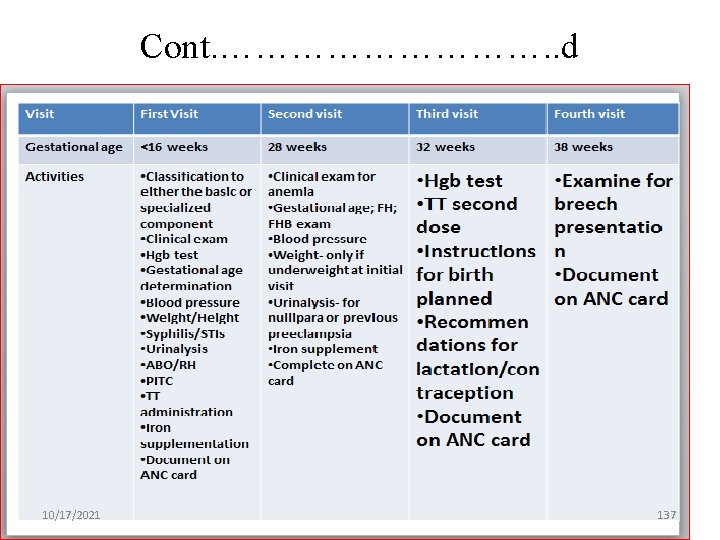
Cont. ……………. . d 10/17/2021 137
Cont. …………. d • In the focused ANC in the initial visit women are grouped into two using the classifying form • Women with out any risk factor are enrolled in the basic component of the new model that needs only three visit until delivery • Women with any identified risk factor need special care that may need frequent visit or even referral to hospital • The classifying form has 18 components that are grouped into three: 10/17/2021 138
Cont. ……………. d 1. Obstetric history: previous still birth/neonatal loss, history of three or more consecutive abortions, birth weight of less than 2500 or more than 4000 gram, admission in the last pregnancy for preeclampsia or hypertension, previous cervical or uterine surgery 2. Current pregnancy: diagnosed or suspected multiple pregnancy, age less than 18 or more than 35 years, RH isoimmunisation, vaginal bleeding, pelvic mass, diastolic blood pressure of more than 90 mm. Hg. 3. General medical condition: insulin dependent diabetes mellitus, renal or cardiac disease, known substance abuse, any other sever medical illness should be assessed. 10/17/2021 139
Subsequent visit • History focuses: on new complaints and problems since the last visit, inter current illness and medication • Quickening time and foetal movement • Danger sign of pregnancy • Any change on the personal history of the women. • physical examination: focuses on the general appearance. • Vital sign mainly the blood pressure, weight • Check for signs of anaemia, fundal height, foetal lie and presentation. 10/17/2021 140
Health promotion (advice and counselling) • Advice the pregnant women about the advantage of balanced diet, Avoidance of drugs, smoking and alcohol • The need of adequate rest, hygiene and safe sex • Discuss about minor complaints of pregnancy and the danger signs of pregnancy • Discuss about whom to contact and where to go if this symptoms develop • Inform the women to record the time of quickening • Education about and preparation for delivery should be done starting from the third visit • The need for clean and safe delivery should be stressed • Breast feeding and family planning after delivery should be discussed 10/17/2021 141
Care provision (care provided) • Individualized delivery plan should be planned starting from the first visit including arrangement for transportation in case of emergency and place of birth • Universal ferrous sulphate prophylaxis for nutritional anaemia should be given starting from the first visit • Tetanus toxoid vaccine should be given • Appropriate prophylaxis and treatment of intestinal parasite and malaria should be offered • Where indicated ART should be given to HIV positive pregnant women • Appropriate management of complaints • Timing and importance of next visit should be discussed 10/17/2021 142
The Birth Preparedness And Complication Readiness Plan • Elements of a birth preparedness and complication readiness plan are – Facility or place of birth – Skilled provider – Transportation – Funds – Support person – Decision maker – Blood donor – Danger signs in labor 10/17/2021 143
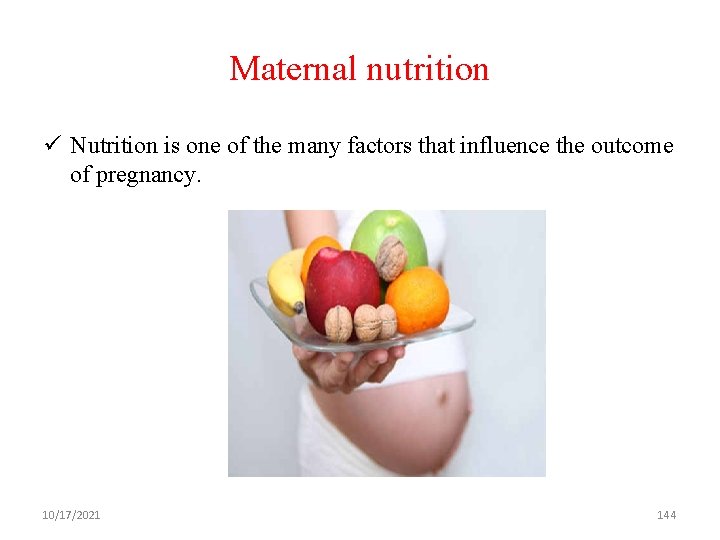
Maternal nutrition ü Nutrition is one of the many factors that influence the outcome of pregnancy. 10/17/2021 144
Cont. ……………d • The nutritional status of a woman before and during pregnancy is related to the birth weight of her child • LBW infants have less chance of survival; when they do survive, they are more prone to disease, growth retardation and impaired mental development. • use of micronutrient- containing prenatal vitamins before and during pregnancy is associated with reductions in the risk of congenital defects, preterm delivery, low infant birth weight, and preeclampsia. 10/17/2021 145
Cont. ……………. . d ü Both maternal under nutrition and over nutrition reduce placental-fetal blood flows and cause stunt fetal growth. ü Promoting optimal nutrition will not only ensure optimal fetal development, but will also reduce the risk of chronic diseases in adults. 10/17/2021 146
Good prenatal care + maternal nutrition ü improved health of woman and baby ü Reduction in maternal and infant mortality ü Achievement of MDG 4 & 5. 10/17/2021 147

The end 10/17/2021 148
- Slides: 148