
NTNU SPEECH AND MACHINE INTELEGENCE LABORATORY Discriminative pronunciation
NTNU SPEECH AND MACHINE INTELEGENCE LABORATORY Discriminative pronunciation modeling using the MPE criterion Meixu SONG, Jielin PAN, Qingwei ZHAO, Yonghong YAN 2015/08/11 Ming-Han Yang 1
NTNU SPEECH AND MACHINE INTELEGENCE LABORATORY Meixu SONG Jielin PAN Qingwei ZHAO Yonghong YAN 2
NTNU SPEECH AND MACHINE INTELEGENCE LABORATORY Outline n Summary n Introduction n Pronunciation Models n Incorporate PMs into MPE training n Experiments and Results n Conclusion and Discussion 3
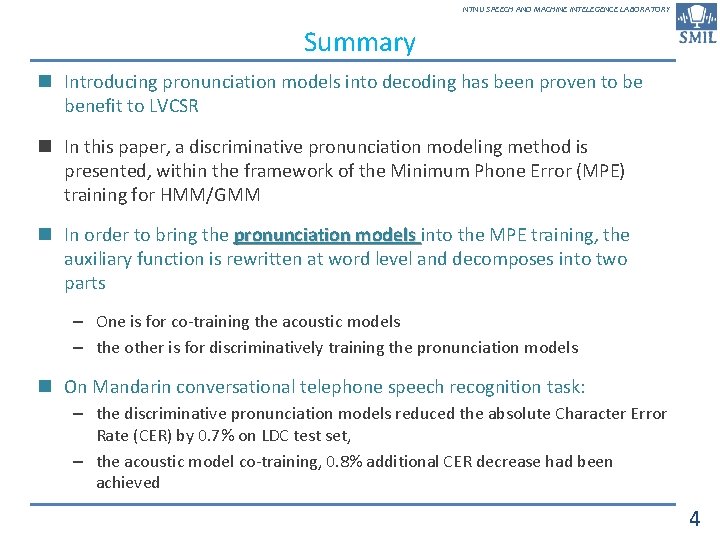
NTNU SPEECH AND MACHINE INTELEGENCE LABORATORY Summary n Introducing pronunciation models into decoding has been proven to be benefit to LVCSR n In this paper, a discriminative pronunciation modeling method is presented, within the framework of the Minimum Phone Error (MPE) training for HMM/GMM n In order to bring the pronunciation models into the MPE training, the auxiliary function is rewritten at word level and decomposes into two parts – One is for co-training the acoustic models – the other is for discriminatively training the pronunciation models n On Mandarin conversational telephone speech recognition task: – the discriminative pronunciation models reduced the absolute Character Error Rate (CER) by 0. 7% on LDC test set, – the acoustic model co-training, 0. 8% additional CER decrease had been achieved 4
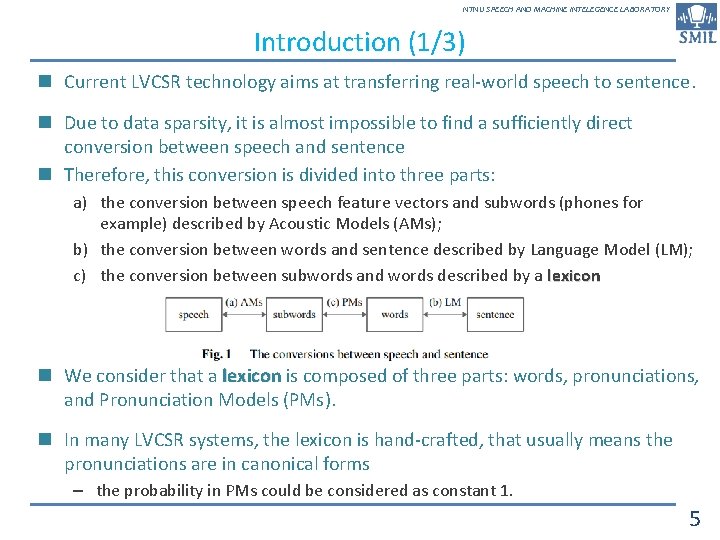
NTNU SPEECH AND MACHINE INTELEGENCE LABORATORY Introduction (1/3) n Current LVCSR technology aims at transferring real-world speech to sentence. n Due to data sparsity, it is almost impossible to find a sufficiently direct conversion between speech and sentence n Therefore, this conversion is divided into three parts: a) the conversion between speech feature vectors and subwords (phones for example) described by Acoustic Models (AMs); b) the conversion between words and sentence described by Language Model (LM); c) the conversion between subwords and words described by a lexicon n We consider that a lexicon is composed of three parts: words, pronunciations, lexicon and Pronunciation Models (PMs). n In many LVCSR systems, the lexicon is hand-crafted, that usually means the pronunciations are in canonical forms – the probability in PMs could be considered as constant 1. 5
NTNU SPEECH AND MACHINE INTELEGENCE LABORATORY Introduction (2/3) ü As to pronunciation learning : [1] O. Vinyals, L. Deng, D. Yu, and A. Acero, “Discriminative pronounciation learning using phonetic decoder and minimum classification-error criterion, ” n [1] presented a discriminative pronunciation learning method using phonetic decoder and minimum classification error criterion [2] I. Badr, I. Mc. Graw, and J. Glass, “Pronunciation learning from continuous speech” [3] I. Mc. Graw, I. Badr, and J. Glass, "Learning lexicons from speech using a pronunciation mixture model“ [4] M. Bisani and H. Ney, "Joint-sequence models for grapheme-to-phoneme conversion" n And previous work [2], [3] made use of a state-of-the-art letter-to-sound (L 2 S) system based on joint-sequence modeling [4] to generate pronunciations [5] X. Lei, W. Wang, and A. Stolcke, "Data-driven lexicon expansion for mandarin broadcast news and conversation speech recognition" n Specifically for Mandarin pronunciation learning, the pronunciation variants of each constituent character in a word were enumerated to construct a pronunciation dictionary in [5] – This method is used to generate pronunciations for words in this paper, and the implementation details will be described. 6
NTNU SPEECH AND MACHINE INTELEGENCE LABORATORY Introduction (3/3) ü As to PM training: n In [2], [3], a pronunciation mixture model (PMM) was presented by treating pronunciations of a particular word as components in a mixture – and the distribution probabilities were learned by maximizing the likelihood of acoustic training data [6] D. Povey, "Discriminative training for large vocabulary speech recognition" n By contrast, in our work we modify the auxiliary function of the standard MPE training [6] to incorporate PMs. – By doing so, a discriminative pronunciation modeling method using minimum phone error criterion is proposed, called MPEPM – In this method, the acoustic models and pronunciation models are co-trained in an co-trained iterative fashion under the MPE training framework. n In the experiment on two Mandarin conversational telephone speech test sets, compared to the baseline using a canonical lexicon, the proposed method has 1. 5% and 1. 1% absolute decrease in CER respectively 7

NTNU SPEECH AND MACHINE INTELEGENCE LABORATORY Pronunciation Models n 8
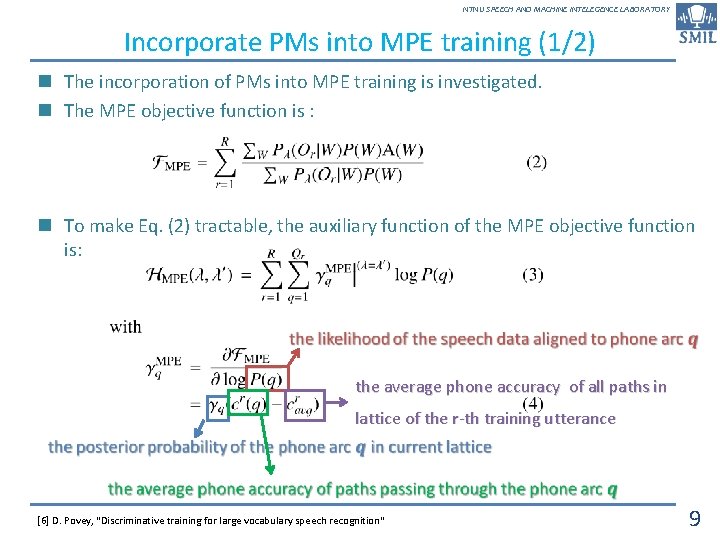
NTNU SPEECH AND MACHINE INTELEGENCE LABORATORY Incorporate PMs into MPE training (1/2) n The incorporation of PMs into MPE training is investigated. n The MPE objective function is : n To make Eq. (2) tractable, the auxiliary function of the MPE objective function is: the average phone accuracy of all paths in lattice of the r-th training utterance [6] D. Povey, "Discriminative training for large vocabulary speech recognition" 9
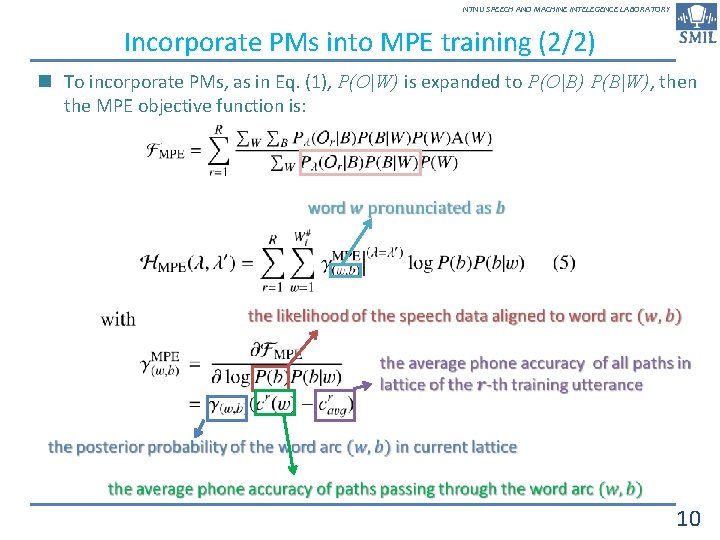
NTNU SPEECH AND MACHINE INTELEGENCE LABORATORY Incorporate PMs into MPE training (2/2) n To incorporate PMs, as in Eq. (1), P(O|W) is expanded to P(O|B) P(B|W), then the MPE objective function is: 10
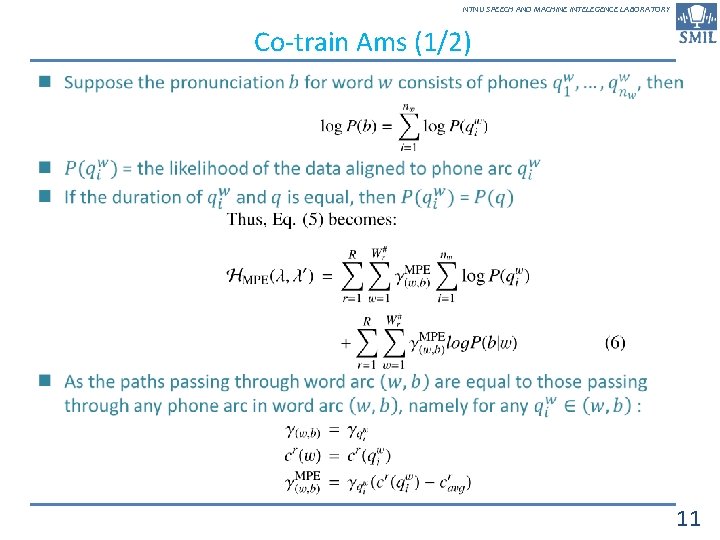
NTNU SPEECH AND MACHINE INTELEGENCE LABORATORY Co-train Ams (1/2) n 11
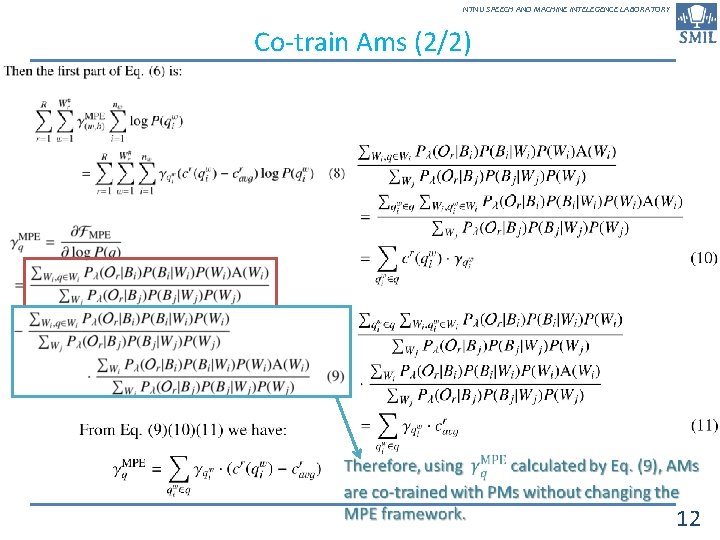
NTNU SPEECH AND MACHINE INTELEGENCE LABORATORY Co-train Ams (2/2) 12
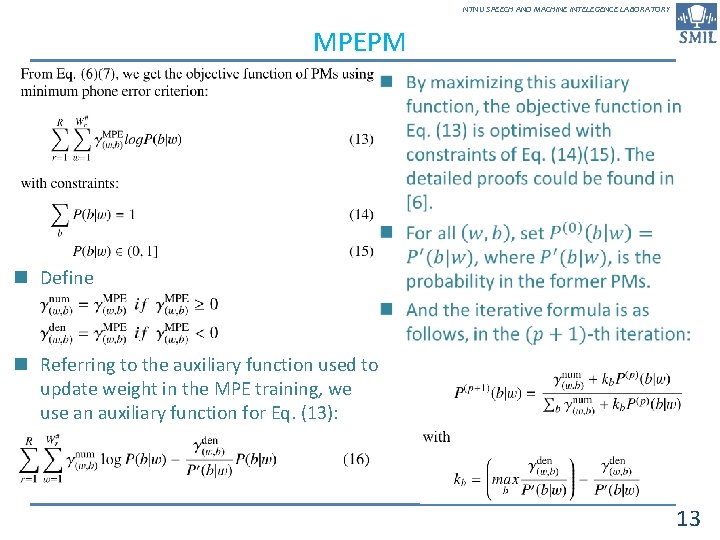
NTNU SPEECH AND MACHINE INTELEGENCE LABORATORY MPEPM n Define n Referring to the auxiliary function used to update weight in the MPE training, we use an auxiliary function for Eq. (13): 13
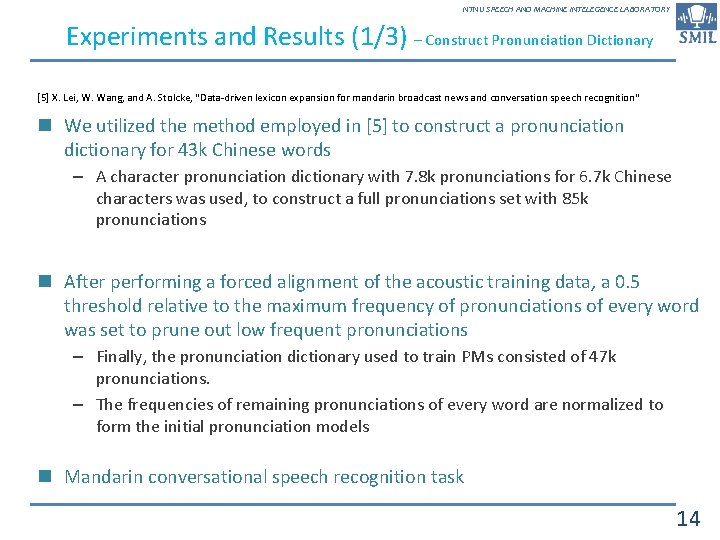
NTNU SPEECH AND MACHINE INTELEGENCE LABORATORY Experiments and Results (1/3) – Construct Pronunciation Dictionary [5] X. Lei, W. Wang, and A. Stolcke, "Data-driven lexicon expansion for mandarin broadcast news and conversation speech recognition" n We utilized the method employed in [5] to construct a pronunciation dictionary for 43 k Chinese words – A character pronunciation dictionary with 7. 8 k pronunciations for 6. 7 k Chinese characters was used, to construct a full pronunciations set with 85 k pronunciations n After performing a forced alignment of the acoustic training data, a 0. 5 threshold relative to the maximum frequency of pronunciations of every word was set to prune out low frequent pronunciations – Finally, the pronunciation dictionary used to train PMs consisted of 47 k pronunciations. – The frequencies of remaining pronunciations of every word are normalized to form the initial pronunciation models n Mandarin conversational speech recognition task 14
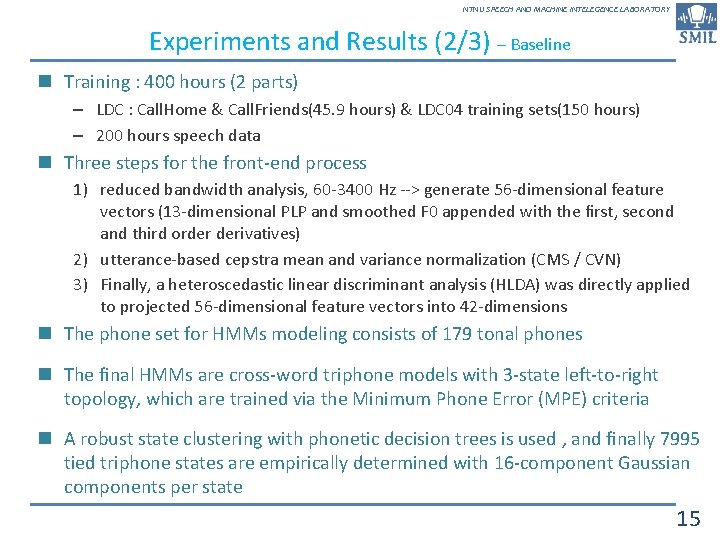
NTNU SPEECH AND MACHINE INTELEGENCE LABORATORY Experiments and Results (2/3) – Baseline n Training : 400 hours (2 parts) – LDC : Call. Home & Call. Friends(45. 9 hours) & LDC 04 training sets(150 hours) – 200 hours speech data n Three steps for the front-end process 1) reduced bandwidth analysis, 60 -3400 Hz --> generate 56 -dimensional feature vectors (13 -dimensional PLP and smoothed F 0 appended with the first, second and third order derivatives) 2) utterance-based cepstra mean and variance normalization (CMS / CVN) 3) Finally, a heteroscedastic linear discriminant analysis (HLDA) was directly applied to projected 56 -dimensional feature vectors into 42 -dimensions n The phone set for HMMs modeling consists of 179 tonal phones n The final HMMs are cross-word triphone models with 3 -state left-to-right topology, which are trained via the Minimum Phone Error (MPE) criteria n A robust state clustering with phonetic decision trees is used , and finally 7995 tied triphone states are empirically determined with 16 -component Gaussian components per state 15
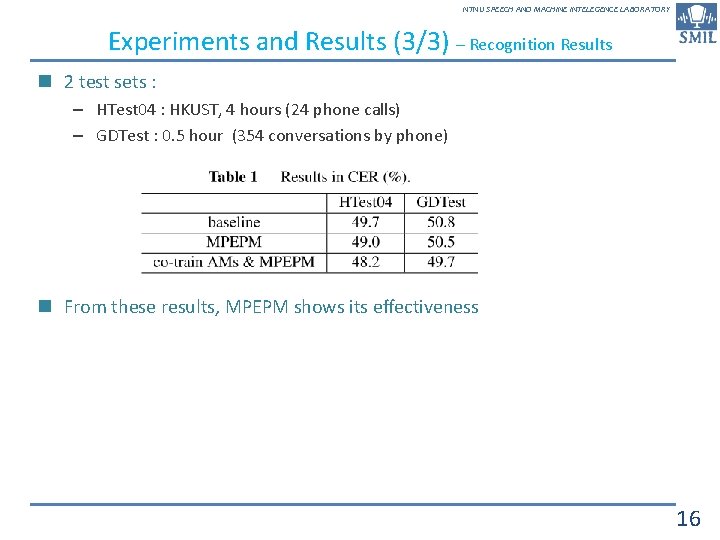
NTNU SPEECH AND MACHINE INTELEGENCE LABORATORY Experiments and Results (3/3) – Recognition Results n 2 test sets : – HTest 04 : HKUST, 4 hours (24 phone calls) – GDTest : 0. 5 hour (354 conversations by phone) n From these results, MPEPM shows its effectiveness 16
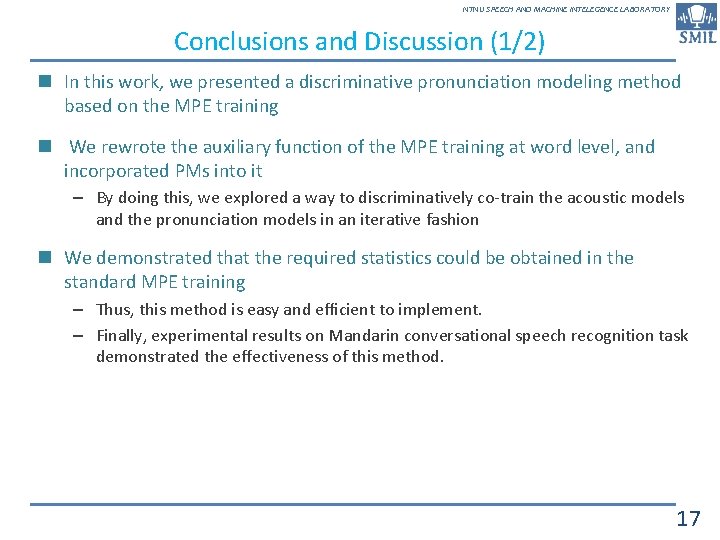
NTNU SPEECH AND MACHINE INTELEGENCE LABORATORY Conclusions and Discussion (1/2) n In this work, we presented a discriminative pronunciation modeling method based on the MPE training n We rewrote the auxiliary function of the MPE training at word level, and incorporated PMs into it – By doing this, we explored a way to discriminatively co-train the acoustic models and the pronunciation models in an iterative fashion n We demonstrated that the required statistics could be obtained in the standard MPE training – Thus, this method is easy and efficient to implement. – Finally, experimental results on Mandarin conversational speech recognition task demonstrated the effectiveness of this method. 17
NTNU SPEECH AND MACHINE INTELEGENCE LABORATORY Conclusions and Discussion (2/2) n Since the current state-of-the-art systems make use of Deep Neural Networks (DNNs), we would like to discuss the possibilities of this MPEPM to be used in DNNs based framework. n Currently, there are two main approaches to incorporate DNNs in acoustic modeling: 1) the TANDEM system • For TANDEM system, DNNs act as feature extractors to derive bottleneck features, which can be used to train traditional HMM / GMM. • Thus, this MPEPM implementation keeps constant 2) the hybrid system • For the hybrid system, DNNs estimate posterior probabilities of states of HMMs. n This MPEPM can be efficiently implemented within the sequencediscriminative training of DNNs, – as they are all based on reference and hypothesis lattices, especially for the one using the state-level minimum Bayes risk (s. MBR) criterion, which is derived from the MPE criterion 18

NTNU SPEECH AND MACHINE INTELEGENCE LABORATORY 19
- Slides: 19