
NTIA Spectrum Monitoring Current Project Status 6 August
- Slides: 17
NTIA Spectrum Monitoring Current Project Status 6 August, 2014 Mike Cotton (NTIA Boulder) for Microsoft Spectrum Observatory Think Tank Meeting (Redmond, WA)
Outline ● Background ● Project Goals, Plan, and Deliverables ● Sensor Design(s) ● Data Transfer Specification ● Measured Spectrum Occupancy Database (MSOD) ● Q&A
Background ● ISART 2010 and 2011 ● Measure of 3. 5 GHz band near San Diego (June 2012) ● Present Data at ISART 2012 Proposed SOW ● NTIA Spectrum Monitoring Initiative with NOI – Did not pass in Dec 2013 Congressional Budget ● NTIA-Funded FY 14/15 Spectrum Monitoring Program (Started March 2014)
Project Goals 1. To determine benefits of automated and continuous spectrum measurements to better analyze actual spectrum usage. 2. To evaluate whether a more comprehensive monitoring program would create additional opportunities for more efficient spectrum access through, for example, increased and more dynamic sharing.
FY 14 Project Plan ●Design and implement a Measured Spectrum Occupancy Database (MSOD) ●Assess RF performance and programmability of available mid-, low-, and ultralow-grade COTS sensors ●Design prototype radar sensor ●Design prototype comm sensor ●Demonstrate end-to-end functionality with data from remote sensors made available to authorized users via MSOD over the internet
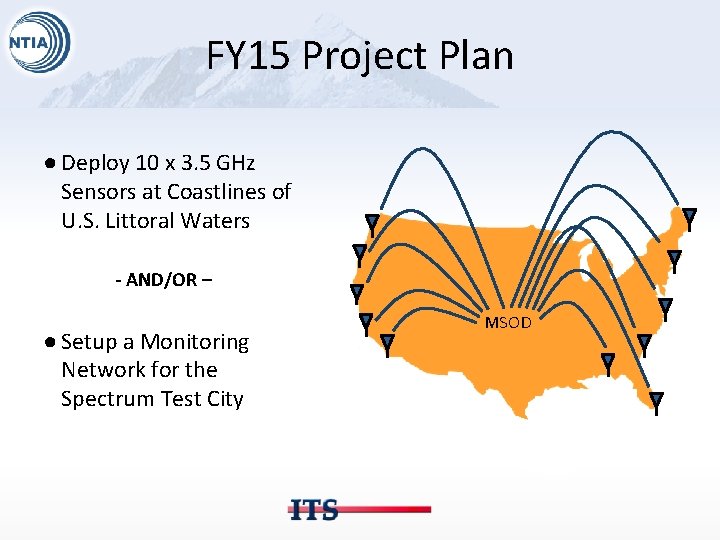
FY 15 Project Plan ● Deploy 10 x 3. 5 GHz Sensors at Coastlines of U. S. Littoral Waters - AND/OR – ● Setup a Monitoring Network for the Spectrum Test City MSOD
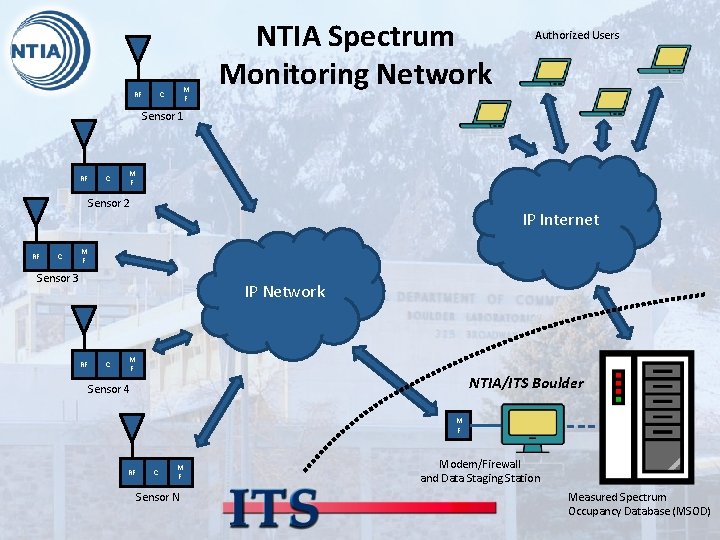
RF M F C NTIA Spectrum Monitoring Network Authorized Users Sensor 1 RF C M F Sensor 2 RF C IP Internet M F Sensor 3 IP Network RF C M F NTIA/ITS Boulder Sensor 4 M F RF C M F Sensor N Modem/Firewall and Data Staging Station Measured Spectrum Occupancy Database (MSOD)
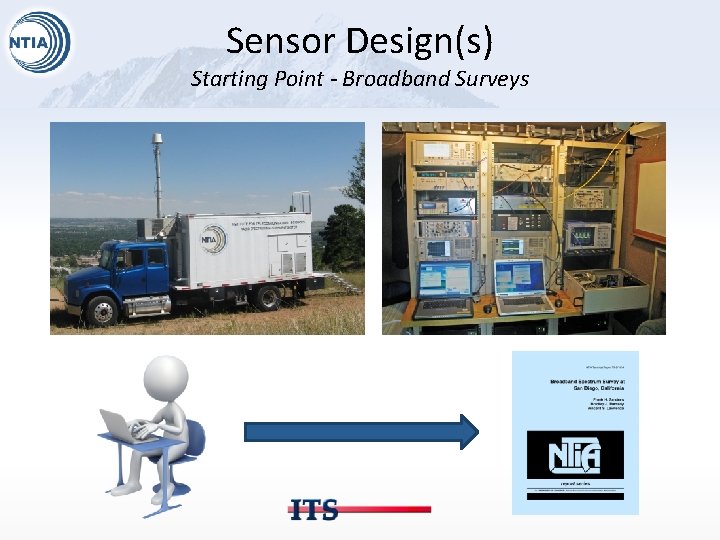
Sensor Design(s) Starting Point - Broadband Surveys
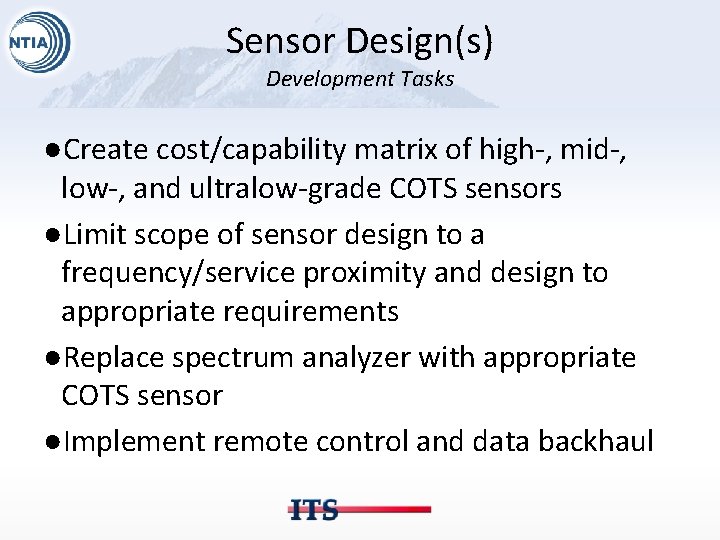
Sensor Design(s) Development Tasks ●Create cost/capability matrix of high-, mid-, low-, and ultralow-grade COTS sensors ●Limit scope of sensor design to a frequency/service proximity and design to appropriate requirements ●Replace spectrum analyzer with appropriate COTS sensor ●Implement remote control and data backhaul
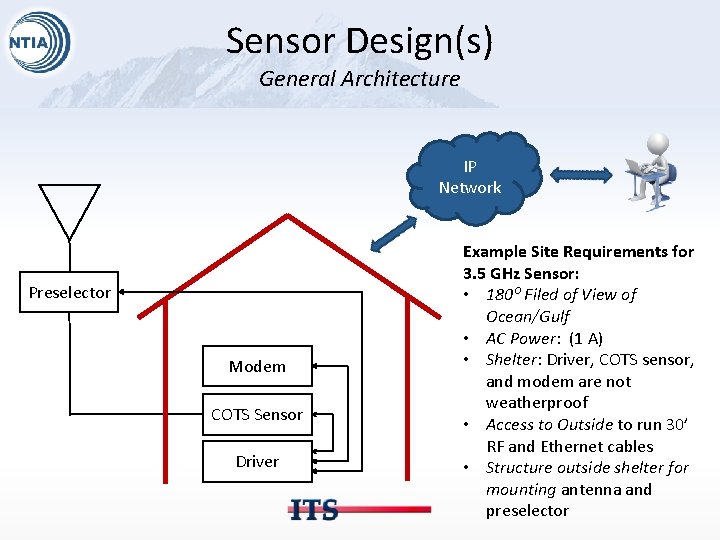
Sensor Design(s) General Architecture IP Network Preselector Modem COTS Sensor Driver Example Site Requirements for 3. 5 GHz Sensor: • 180⁰ Filed of View of Ocean/Gulf • AC Power: (1 A) • Shelter: Driver, COTS sensor, and modem are not weatherproof • Access to Outside to run 30’ RF and Ethernet cables • Structure outside shelter for mounting antenna and preselector
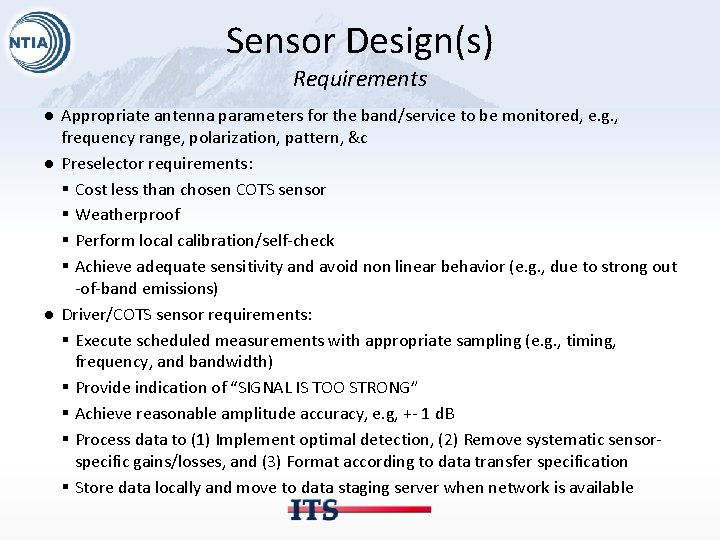
Sensor Design(s) Requirements ● Appropriate antenna parameters for the band/service to be monitored, e. g. , frequency range, polarization, pattern, &c ● Preselector requirements: § Cost less than chosen COTS sensor § Weatherproof § Perform local calibration/self-check § Achieve adequate sensitivity and avoid non linear behavior (e. g. , due to strong out -of-band emissions) ● Driver/COTS sensor requirements: § Execute scheduled measurements with appropriate sampling (e. g. , timing, frequency, and bandwidth) § Provide indication of “SIGNAL IS TOO STRONG” § Achieve reasonable amplitude accuracy, e. g, +- 1 d. B § Process data to (1) Implement optimal detection, (2) Remove systematic sensorspecific gains/losses, and (3) Format according to data transfer specification § Store data locally and move to data staging server when network is available
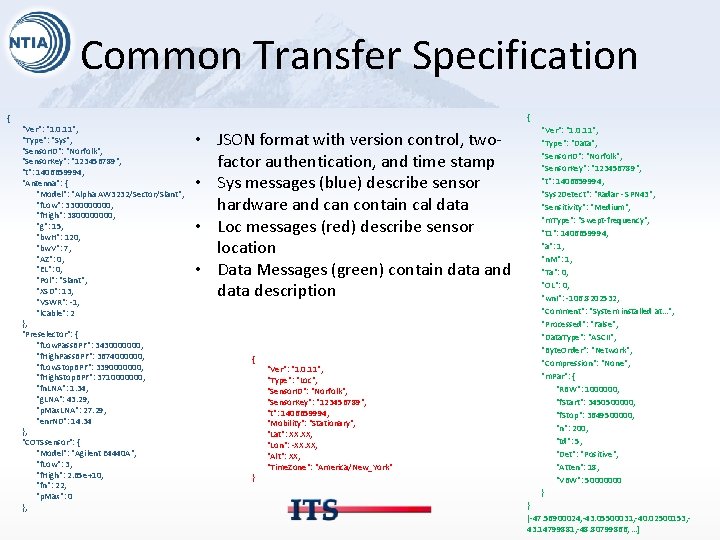
Common Transfer Specification { { "Ver": "1. 0. 11", "Type": "Sys", "Sensor. ID": "Norfolk", "Sensor. Key": "123456789", "t": 1406659994, "Antenna": { "Model": "Alpha AW 3232/Sector/Slant", "f. Low": 330000, "f. High": 380000, "g": 15, "bw. H": 120, "bw. V": 7, "AZ": 0, "EL": 0, "Pol": "Slant", "XSD": 13, "VSWR": -1, "l. Cable": 2 }, "Preselector": { "f. Low. Pass. BPF": 3430000000, "f. High. Pass. BPF": 3674000000, "f. Low. Stop. BPF": 3390000000, "f. High. Stop. BPF": 3710000000, "fn. LNA": 1. 34, "g. LNA": 43. 29, "p. Max. LNA": 27. 29, "enr. ND": 14. 34 }, "COTSsensor": { "Model": "Agilent E 4440 A", "f. Low": 3, "f. High": 2. 65 e+10, "fn": 22, "p. Max": 0 }, • JSON format with version control, twofactor authentication, and time stamp • Sys messages (blue) describe sensor hardware and can contain cal data • Loc messages (red) describe sensor location • Data Messages (green) contain data and data description { } "Ver": "1. 0. 11", "Type": "Loc", "Sensor. ID": "Norfolk", "Sensor. Key": "123456789", "t": 1406659994, "Mobility": "Stationary", "Lat": XX. XX, "Lon": -XX. XX, "Alt": XX, "Time. Zone": "America/New_York" "Ver": "1. 0. 11", "Type": "Data", "Sensor. ID": "Norfolk", "Sensor. Key": "123456789", "t": 1406659994, "Sys 2 Detect": "Radar - SPN 43", "Sensitivity": "Medium", "m. Type": "Swept-frequency", "t 1": 1406659994, "a": 1, "n. M": 1, "Ta": 0, "OL": 0, "wn. I": -106. 8202532, "Comment": "System installed at…", "Processed": "False", "Data. Type": "ASCII", "Byte. Order": "Network", "Compression": "None", "m. Par": { "RBW": 1000000, "f. Start": 3450500000, "f. Stop": 3649500000, "n": 200, "td": 5, "Det": "Positive", "Atten": 18, "VBW": 50000000 } } [-47. 56900024, -43. 05500031, -40. 02500153, 43. 14799881, -48. 80799866, …]
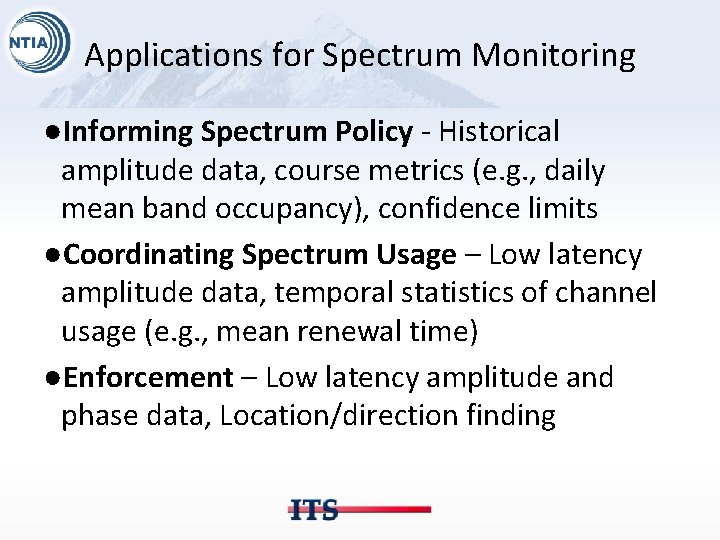
Applications for Spectrum Monitoring ●Informing Spectrum Policy - Historical amplitude data, course metrics (e. g. , daily mean band occupancy), confidence limits ●Coordinating Spectrum Usage – Low latency amplitude data, temporal statistics of channel usage (e. g. , mean renewal time) ●Enforcement – Low latency amplitude and phase data, Location/direction finding
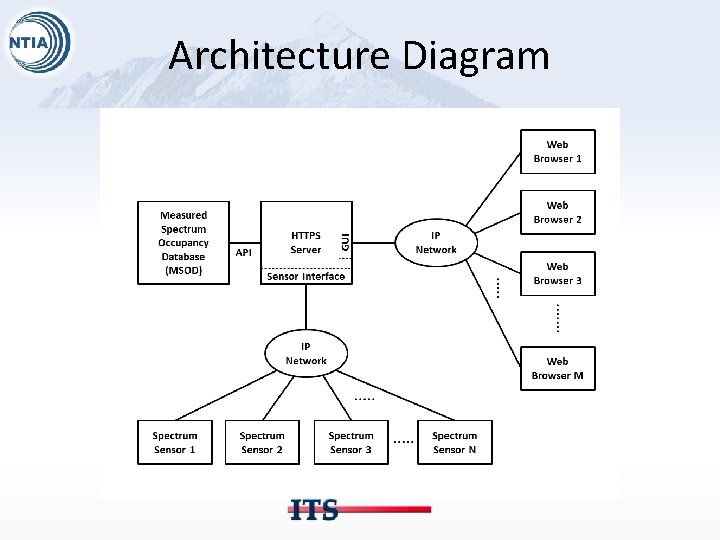
Architecture Diagram
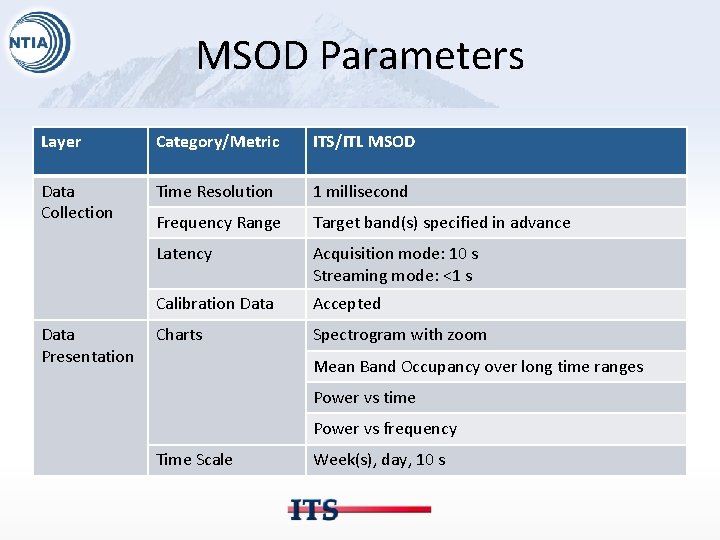
MSOD Parameters Layer Category/Metric ITS/ITL MSOD Data Collection Time Resolution 1 millisecond Frequency Range Target band(s) specified in advance Latency Acquisition mode: 10 s Streaming mode: <1 s Calibration Data Accepted Charts Spectrogram with zoom Data Presentation Mean Band Occupancy over long time ranges Power vs time Power vs frequency Time Scale Week(s), day, 10 s
Contact Information and References Michael Cotton mcotton@its. bldrdoc. gov 303 -497 -7346 1) NOI Comments on NTIA Spectrum Monitoring Pilot Program 2) Cotton and Dalke, “Spectrum Occupancy Measurements of the 3550 -3650 MHz Maritime Radar Band Near San Diego, ” NTIA Report TR-14 -500, Jan 2014. 3) Sanders, Ramsey, and Lawrence, “Broadband Spectrum Survey at San Diego, CA, ” NTIA Report TR-97 -334, Dec 1996.
NOI Collaboration Tasks ● Consult with Federal agencies to determine technical parameters and sensitivity of data. ● Consult with OSM to prioritize frequency bands, sensor locations, coverage criteria, and monitoring requirements. ● Enable private sector and spectrum managers to deploy data collection/dissemination systems. ● Make available criteria, requirements, parameters, designs, interfaces, software, data sets and other information in each phase of the project. ● Make available data for spectrum community to investigate feasibility of new spectrum access schemes. ● Seek recommendations on whether to continue and expand the program.