
NTC v 4 0 Generator Performance Standards Information
- Slides: 24
NTC v 4. 0 / Generator Performance Standards– Information Session 18 February 2019
Welcome Objectives - What do we want out of this session? Stakeholders understand the reasons for change and how the changes may impact on their operations. PWC fully understands the issues and perspectives of all stakeholders to enable any further changes to the final Codes. Session Approach Expect: Context and basis of GPS changes and associated edits to NTC and SCTC will be covered. Discussion to be focussed around issues important to stakeholders to ensure mutual understanding of positions and points of view. Commercial / sensitive information will be respected. Items not dealt with during this session will be duly considered prior to finalisation of Codes and responding to stakeholder formal submissions. Don’t Expect: NTEM existing / design issues – eg bidding, dispatch, scheduling, settlements / price, ancillary services (other than interface with GPS in a technical context) to be addressed. Individual project specific issues to be addressed. That every issue will be agreed / resolved. 2
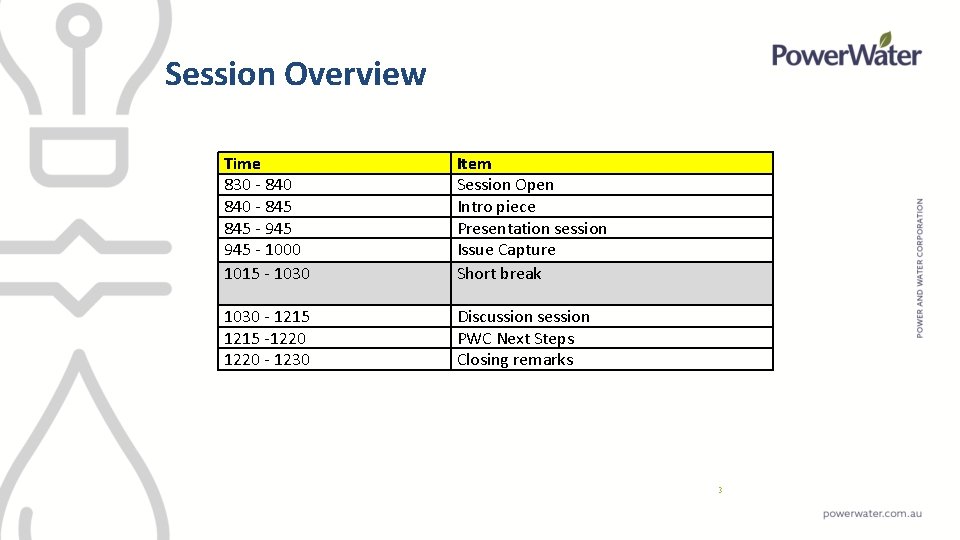
Session Overview Time 830 - 840 - 845 - 945 - 1000 1015 - 1030 Item Session Open Intro piece Presentation session Issue Capture Short break 1030 - 1215 -1220 - 1230 Discussion session PWC Next Steps Closing remarks 3
Presentation Session 4
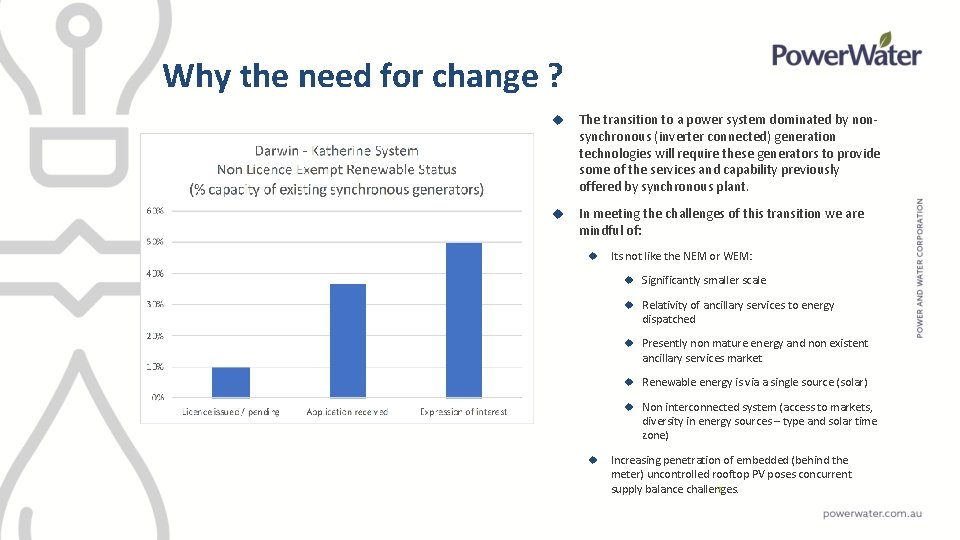
Why the need for change ? The transition to a power system dominated by nonsynchronous (inverter connected) generation technologies will require these generators to provide some of the services and capability previously offered by synchronous plant. In meeting the challenges of this transition we are mindful of: Its not like the NEM or WEM: Significantly smaller scale Relativity of ancillary services to energy dispatched Presently non mature energy and non existent ancillary services market Renewable energy is via a single source (solar) Non interconnected system (access to markets, diversity in energy sources – type and solar time zone) Increasing penetration of embedded (behind the meter) uncontrolled rooftop PV poses concurrent supply balance challenges. 5
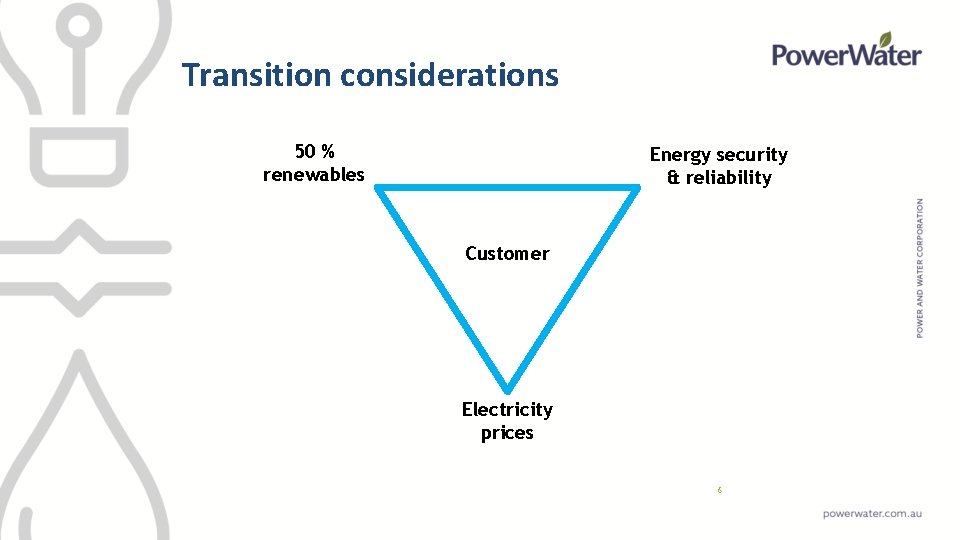
Transition considerations 50 % renewables Energy security & reliability Customer Electricity prices 6
Key Principles in Developing the GPS 1. Maintain power system and energy security 2. Energy source agnostic 3. Technically feasible 4. “do no harm” / “causer pays” 5. Be in the long term interest of customers 6. Automatic access standard with negotiated access provision 7. Leverage extensive work undertaken in the NEM 7
Overview of the new GPS Section 3. 3. 5 of the NTC is predominantly aligned to NER Chapter 5 Schedule 5. 2 “Conditions for Connection of Generators” to fulfil the objective of facilitating connections. General capability requirements under normal power system conditions; and Power system conditions that generators are required to remain in continuous operation; and Response requirements during and following power system contingency events to support the power system. The majority of clauses are neutral to the existing NTC with the exception of the following slides which are additional / changes to the NTC. 8
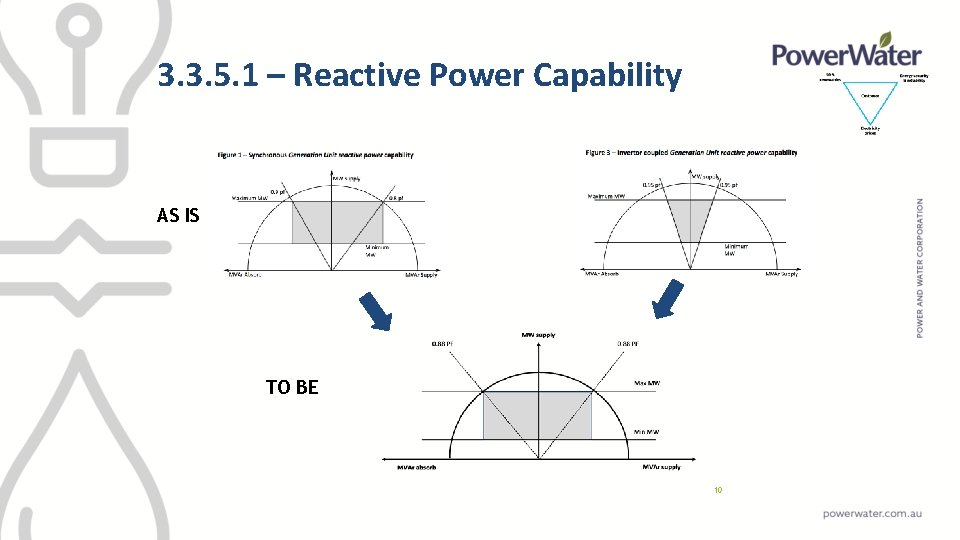
3. 3. 5. 1 – Reactive Power Capability What are we trying to achieve? Maintain the existing balance of system normal reactive power contribution between generators and PWC network. How and why Practically preserve current obligations for synchronous generators but converted to the connection point. Similar to changes made in SA – dropping the “sliding Vee” capability (see next slide). 9
3. 3. 5. 1 – Reactive Power Capability AS IS TO BE 10
3. 3. 5. 4 – Response to Voltage Disturbances What are we trying to achieve? Generators to stay online during and post disturbance and not fall off before the load. How and why Current obligations are not adequate. Consistent with NER S 5. 2. 5. 4 with the additional imported existing NTC requirement of withstanding zero voltage at the connection point for up to 0. 5 seconds. 11
3. 3. 5. 5 – Generating System Response to Disturbances Following Contingency Events What are we trying to achieve? All generators contribute to maintaining resilience of the power system. How and why Require generators to remain connected for a range of credible power system events. Require generators to assist in providing short term reactive power support to the power system during and post event to support voltage levels. Generally consistent with NER S 5. 2. 5. 5. but imports existing NTC longer fault clearing times and higher asynchronous reactive current contribution. 12
3. 3. 5. 11 – Frequency Control What are we trying to achieve? Enable the power system to maintain frequency over a wide range of operating conditions and power system events. How and why Require all generators to have capability to provide all forms of frequency control services. Generally consistent with NER S 5. 2. 5. 11 – but removed the NER clause only requiring generator to operate in frequency response mode when providing market ancillary services (as the AS market doesn’t exist yet). Increased RE opportunity. All generators treated equally. Note – SCTC requires all generators to provide C-FCAS. 13
3. 3. 5. 14 – Active Power Control What are we trying to achieve? Ability to manage regular foreseeable energy supply events without the need to use C-FCAS or load shedding. How and why Applying a scheduled classification to all generators to provide the level of control via obligations of a scheduled generator (capability forecast, following dispatch target). Acknowledge that one subclause has caused confusion around ramp rate “not less (ie slower than) than 5%” – this was incorrectly placed under a dispatch target clause. It will be updated to require generators : To reliably and accurately follow their respective dispatch target smoothly and “quickly”. That are capable of changing their output between minimum and maximum output at a fast but stable rate. Cloud cover for solar is not considered an abnormal event and is therefore not considered a contingency event (BAU). Increased RE opportunity. All generators treated equally. 14
3. 3. 5. 15 – Inertia and Contingency FCAS What are we trying to achieve? To maximise renewable energy capacity by ensuring new entrants provide some of the capabilities of generators they are displacing. How and why Reduce inertia requirements by allowing trade off between C-FCAS and inertia. Increased RE opportunity by minimising constraints and / or existing generators filling available solar capacity. All generators treated equally. Consistent with SA approvals requirements. 15
3. 3. 5. 16 – System Strength What are we trying to achieve? That the connection of a new generator does not adversely affect the ability to maintain a stable power system under any contingency or protected event. How and why PWC will undertake a system strength impact assessment following the AEMO process as part of its connection engineering studies. Do no harm / causer pays in regard to remedy solution. Note the optimum solution maybe either network side or generator side. All generators treated equally. 16
Application of GPS Applies to NEW ENTRANT or MODIFIED existing generators. Grandfathering arrangements for existing generators : Generators connected prior to the approval of NTC v 4. 0 will be deemed to comply but will require their existing performance capability to be agreed with the Network Operator and Power System Controller and documented within an agreed timeframe. As a minimum existing generators will need to meet the existing NTC. The SCTC relates to market operation and power system security and may not be feasible to grandfather certain parts. Specific issues would be worked through with individual generators. Most of the GPS requirements apply to “generating systems” and are measured at the connection point. The NER definition of a generating system (to be incorporated into the final version of NTC): “a system comprising one or more generating units and includes auxiliary or reactive plant that is located on the Generator’s side of the connection point and is necessary for the generating system to meet its performance standards” Ability to negotiate GPS based on principles outlined in NTC 3. 3. 5 17
Discussion Session 18
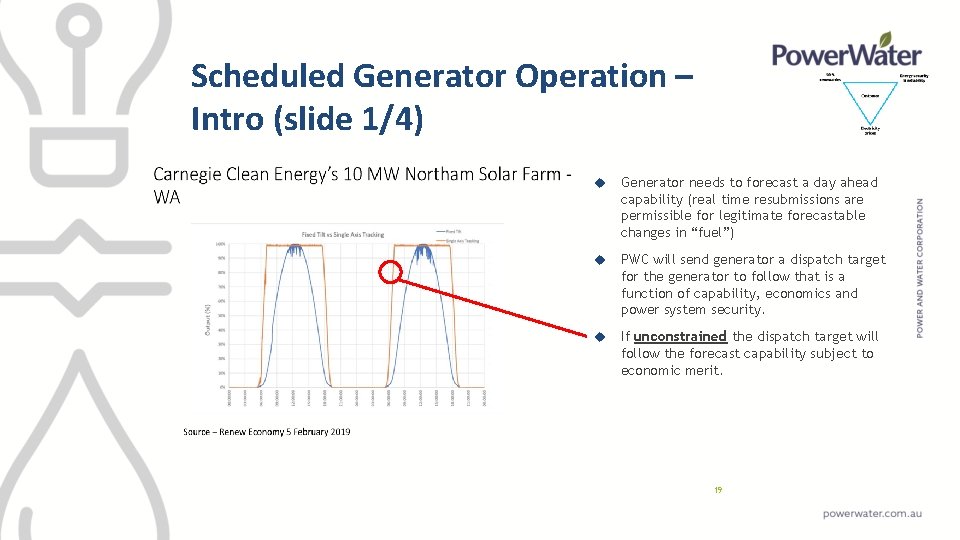
Scheduled Generator Operation – Intro (slide 1/4) Generator needs to forecast a day ahead capability (real time resubmissions are permissible for legitimate forecastable changes in “fuel”) PWC will send generator a dispatch target for the generator to follow that is a function of capability, economics and power system security. If unconstrained the dispatch target will follow the forecast capability subject to economic merit. 19
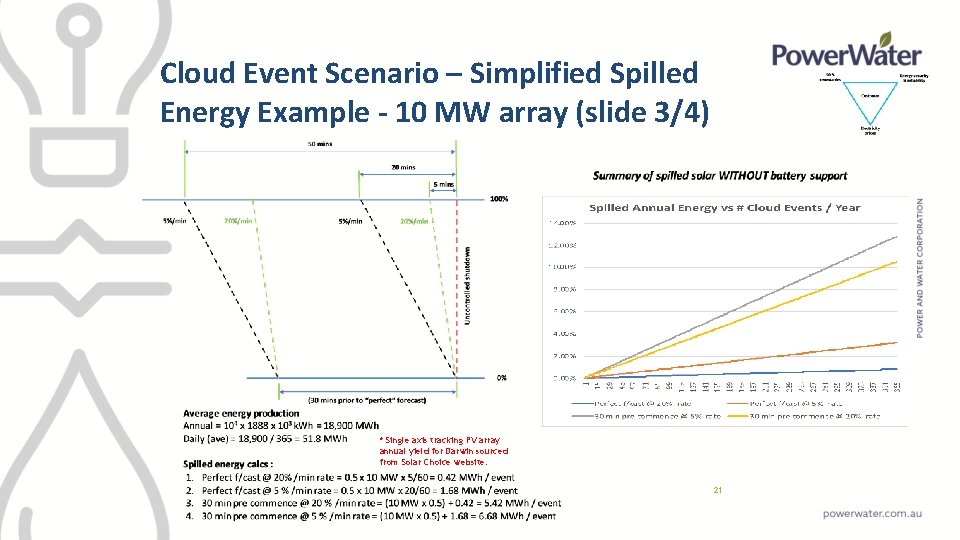
Scheduled Generator Operation – Forecasting (slide 2/4) THESE ARE ANTICIPATED OPERATIONAL REQUIREMENTS (SSG) Closer to real-time forecasts require greater accuracy and updated more frequently 60 minutes ahead, updated at 1 minute intervals: 60 predictions at one minute intervals with accuracy: 95% of times - the forecasts are exceeded, for the other 5% of times – capacity under the forecast by no greater than the lesser of 5% nameplate or 1 MW. 12 hours ahead, updated at 10 minute intervals: Days ahead through market arrangements: 72 predictions at 10 minute intervals, with accuracy: 90% of forecasts are exceeded. 30 minute intervals: 90% of forecasts exceeded Ramping for cloud cover will be done with intent to minimise spilt energy whilst maintaining system security 20
Cloud Event Scenario – Simplified Spilled Energy Example - 10 MW array (slide 3/4) * Single axis tracking PV array annual yield for Darwin sourced from Solar Choice website. 21
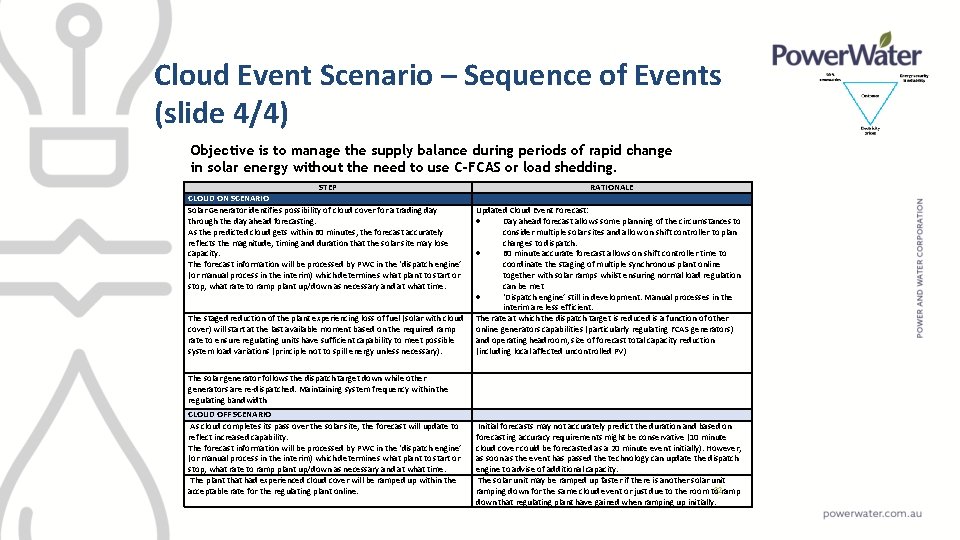
Cloud Event Scenario – Sequence of Events (slide 4/4) Objective is to manage the supply balance during periods of rapid change in solar energy without the need to use C-FCAS or load shedding. STEP CLOUD ON SCENARIO Solar Generator identifies possibility of cloud cover for a trading day through the day ahead forecasting. As the predicted cloud gets within 60 minutes, the forecast accurately reflects the magnitude, timing and duration that the solar site may lose capacity. The forecast information will be processed by PWC in the ‘dispatch engine’ (or manual process in the interim) which determines what plant to start or stop, what rate to ramp plant up/down as necessary and at what time. The staged reduction of the plant experiencing loss of fuel (solar with cloud cover) will start at the last available moment based on the required ramp rate to ensure regulating units have sufficient capability to meet possible system load variations (principle not to spill energy unless necessary). RATIONALE Updated Cloud Event Forecast: Day ahead forecast allows some planning of the circumstances to consider multiple solar sites and allow on shift controller to plan changes to dispatch. 60 minute accurate forecast allows on shift controller time to coordinate the staging of multiple synchronous plant online together with solar ramps whilst ensuring normal load regulation can be met ‘Dispatch engine’ still in development. Manual processes in the interim are less efficient. The rate at which the dispatch target is reduced is a function of other online generators capabilities (particularly regulating FCAS generators) and operating headroom, size of forecast total capacity reduction (including local affected uncontrolled PV) The solar generator follows the dispatch target down while other generators are re-dispatched. Maintaining system frequency within the regulating bandwidth CLOUD OFF SCENARIO As cloud completes its pass over the solar site, the forecast will update to reflect increased capability. The forecast information will be processed by PWC in the ‘dispatch engine’ (or manual process in the interim) which determines what plant to start or stop, what rate to ramp plant up/down as necessary and at what time. The plant that had experienced cloud cover will be ramped up within the acceptable rate for the regulating plant online. Initial forecasts may not accurately predict the duration and based on forecasting accuracy requirements might be conservative (10 minute cloud cover could be forecasted as a 20 minute event initially). However, as soon as the event has passed the technology can update the dispatch engine to advise of additional capacity. The solar unit may be ramped up faster if there is another solar unit 22 ramping down for the same cloud event or just due to the room to down that regulating plant have gained when ramping up initially.
Next Steps and Close 23
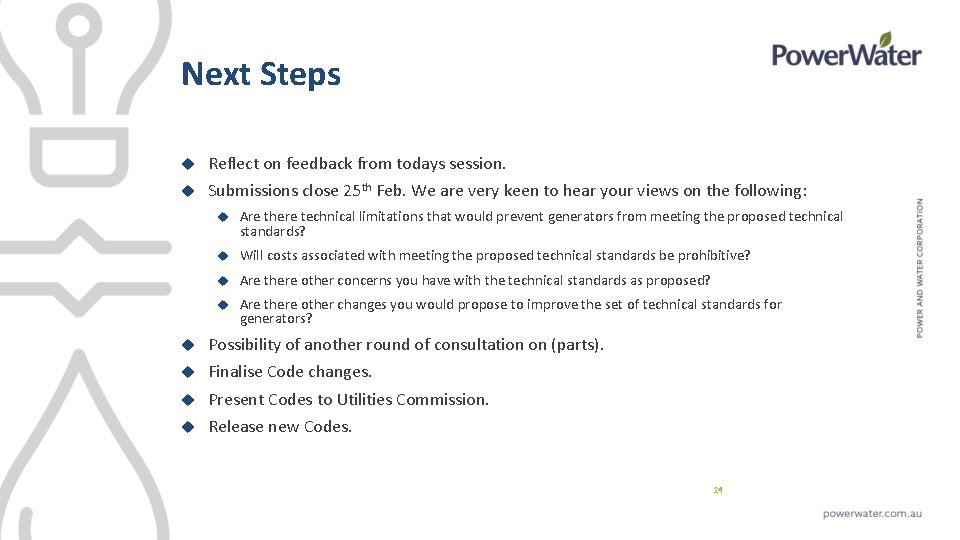
Next Steps Reflect on feedback from todays session. Submissions close 25 th Feb. We are very keen to hear your views on the following: Are there technical limitations that would prevent generators from meeting the proposed technical standards? Will costs associated with meeting the proposed technical standards be prohibitive? Are there other concerns you have with the technical standards as proposed? Are there other changes you would propose to improve the set of technical standards for generators? Possibility of another round of consultation on (parts). Finalise Code changes. Present Codes to Utilities Commission. Release new Codes. 24