
NST 110 Advanced Toxicology Lecture 1 Principles of




- Slides: 16
NST 110: Advanced Toxicology Lecture 1: Principles of Toxicology
Principles of Toxicity 1. Defining toxicology 2. History of toxicology 3. Dose response 4. Evaluating safety
Toxicology is the study of adverse effects of chemicals on living systems, including: • Mechanisms of action and exposure to chemicals as a cause of acute and chronic illness. • Understanding physiology and pharmacology by using toxic agents as chemical probes. • Recognition, identification, quantification of hazards from occupational exposure to chemicals. • Discovery of new drugs and pesticides. • Development of standards and regulations to protect humans and the environment from adverse effects of chemicals.
Branches of Toxicology 1. Mechanistic—cellular, biochemical and molecular mechanisms by which chemicals cause toxic responses 2. Forensic—cause of death, legal aspects 3. Clinical—treatments for poisonings and injuries caused by xenobiotics 4. Environmental—environmental pollutants, effects on flora and fauna 5. Food—adverse effects of processed or natural food components 6. Regulatory—assigns risk to substances of commercial importance.
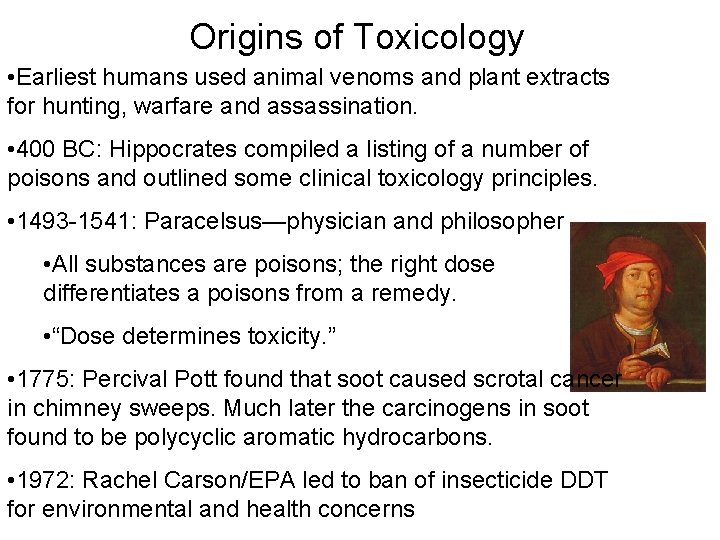
Origins of Toxicology • Earliest humans used animal venoms and plant extracts for hunting, warfare and assassination. • 400 BC: Hippocrates compiled a listing of a number of poisons and outlined some clinical toxicology principles. • 1493 -1541: Paracelsus—physician and philosopher • All substances are poisons; the right dose differentiates a poisons from a remedy. • “Dose determines toxicity. ” • 1775: Percival Pott found that soot caused scrotal cancer in chimney sweeps. Much later the carcinogens in soot found to be polycyclic aromatic hydrocarbons. • 1972: Rachel Carson/EPA led to ban of insecticide DDT for environmental and health concerns
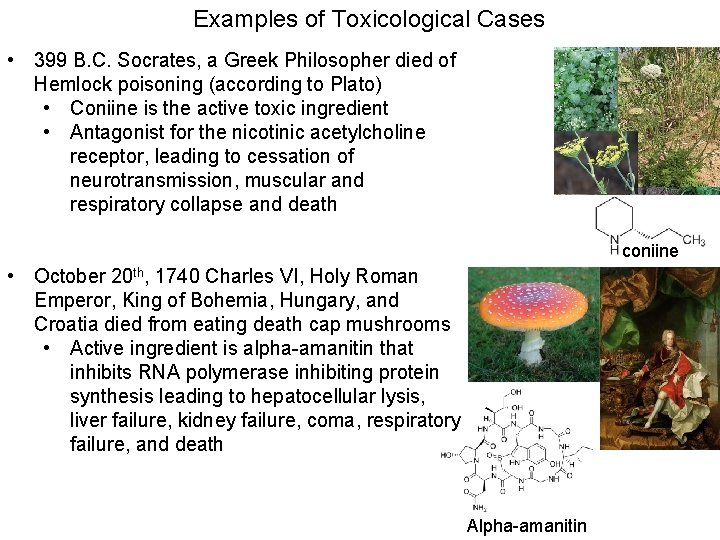
Examples of Toxicological Cases • 399 B. C. Socrates, a Greek Philosopher died of Hemlock poisoning (according to Plato) • Coniine is the active toxic ingredient • Antagonist for the nicotinic acetylcholine receptor, leading to cessation of neurotransmission, muscular and respiratory collapse and death coniine • October 20 th, 1740 Charles VI, Holy Roman Emperor, King of Bohemia, Hungary, and Croatia died from eating death cap mushrooms • Active ingredient is alpha-amanitin that inhibits RNA polymerase inhibiting protein synthesis leading to hepatocellular lysis, liver failure, kidney failure, coma, respiratory failure, and death Alpha-amanitin
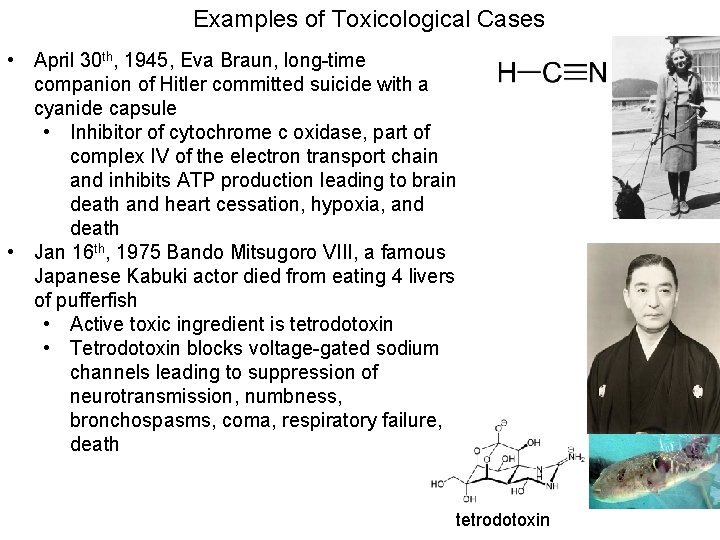
Examples of Toxicological Cases • April 30 th, 1945, Eva Braun, long-time companion of Hitler committed suicide with a cyanide capsule • Inhibitor of cytochrome c oxidase, part of complex IV of the electron transport chain and inhibits ATP production leading to brain death and heart cessation, hypoxia, and death • Jan 16 th, 1975 Bando Mitsugoro VIII, a famous Japanese Kabuki actor died from eating 4 livers of pufferfish • Active toxic ingredient is tetrodotoxin • Tetrodotoxin blocks voltage-gated sodium channels leading to suppression of neurotransmission, numbness, bronchospasms, coma, respiratory failure, death tetrodotoxin
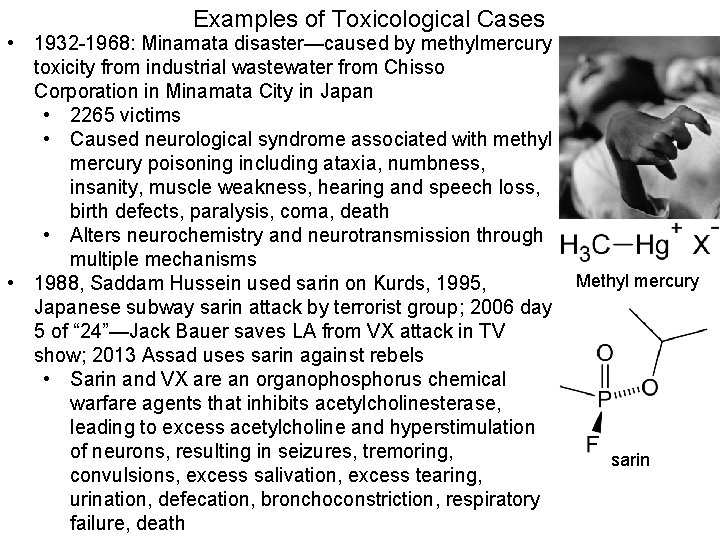
Examples of Toxicological Cases • 1932 -1968: Minamata disaster—caused by methylmercury toxicity from industrial wastewater from Chisso Corporation in Minamata City in Japan • 2265 victims • Caused neurological syndrome associated with methyl mercury poisoning including ataxia, numbness, insanity, muscle weakness, hearing and speech loss, birth defects, paralysis, coma, death • Alters neurochemistry and neurotransmission through multiple mechanisms • 1988, Saddam Hussein used sarin on Kurds, 1995, Japanese subway sarin attack by terrorist group; 2006 day 5 of “ 24”—Jack Bauer saves LA from VX attack in TV show; 2013 Assad uses sarin against rebels • Sarin and VX are an organophosphorus chemical warfare agents that inhibits acetylcholinesterase, leading to excess acetylcholine and hyperstimulation of neurons, resulting in seizures, tremoring, convulsions, excess salivation, excess tearing, urination, defecation, bronchoconstriction, respiratory failure, death Methyl mercury sarin
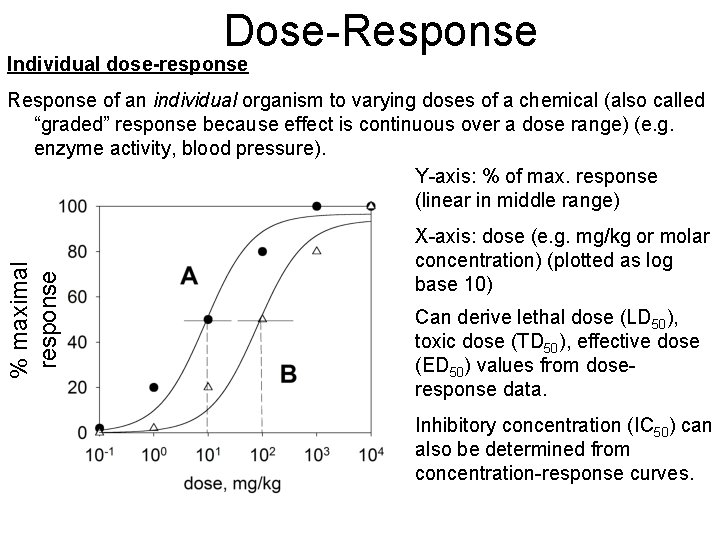
Dose-Response Individual dose-response % maximal response Response of an individual organism to varying doses of a chemical (also called “graded” response because effect is continuous over a dose range) (e. g. enzyme activity, blood pressure). Y-axis: % of max. response (linear in middle range) X-axis: dose (e. g. mg/kg or molar concentration) (plotted as log base 10) Can derive lethal dose (LD 50), toxic dose (TD 50), effective dose (ED 50) values from doseresponse data. Inhibitory concentration (IC 50) can also be determined from concentration-response curves.
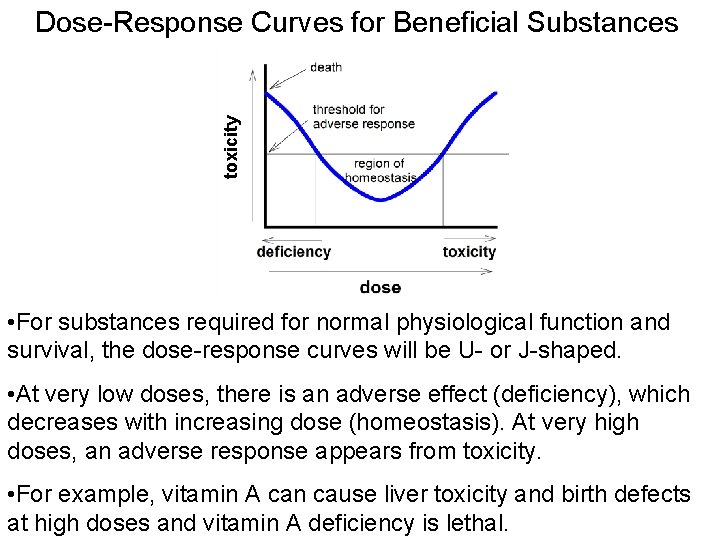
toxicity Dose-Response Curves for Beneficial Substances • For substances required for normal physiological function and survival, the dose-response curves will be U- or J-shaped. • At very low doses, there is an adverse effect (deficiency), which decreases with increasing dose (homeostasis). At very high doses, an adverse response appears from toxicity. • For example, vitamin A can cause liver toxicity and birth defects at high doses and vitamin A deficiency is lethal.
Evaluating Dose-Response Relationships ED: Effective dose % response 100 80 60 40 (therapeutic dose of a drug) 50 % response TD: Toxic dose ED (dose at which toxicity occurs) TD NOAEL LD 20 LD: Lethal dose (dose at which death occurs) NOAEL: no observed adverse effect level LOAEL: lowest observed adverse effect 0 level -2 -1 0 1 2 3 10 10 10 dose (mg/kg) ED 50: dose at which 50% of population therapeutically responds. (In this example, ED 50=1 mg/kg) TD 50: dose at which 50% of population experiences toxicity (TD 50=10 mg/kg). LD 50: dose at which 50% of population dies (LD 50=100 mg/kg).
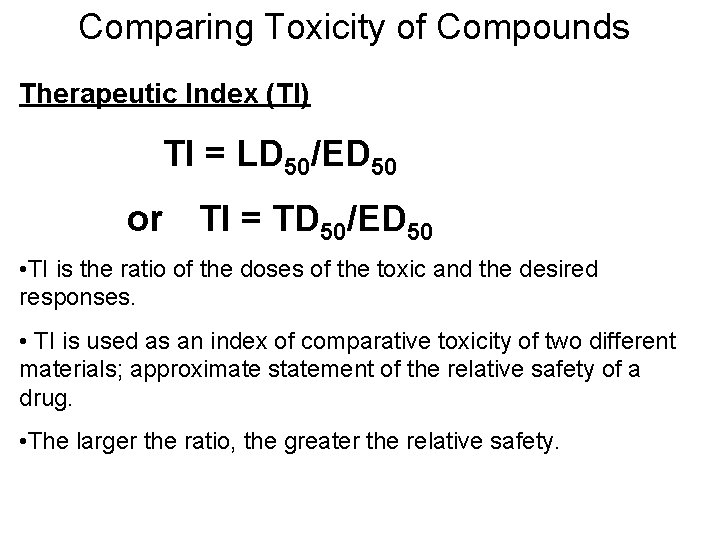
Comparing Toxicity of Compounds Therapeutic Index (TI) TI = LD 50/ED 50 or TI = TD 50/ED 50 • TI is the ratio of the doses of the toxic and the desired responses. • TI is used as an index of comparative toxicity of two different materials; approximate statement of the relative safety of a drug. • The larger the ratio, the greater the relative safety.
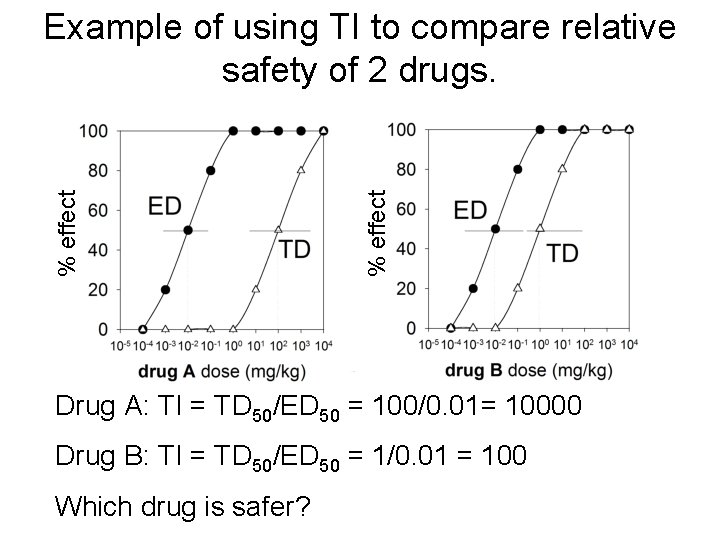
% effect Example of using TI to compare relative safety of 2 drugs. Drug A: TI = TD 50/ED 50 = 100/0. 01= 10000 Drug B: TI = TD 50/ED 50 = 1/0. 01 = 100 Which drug is safer?
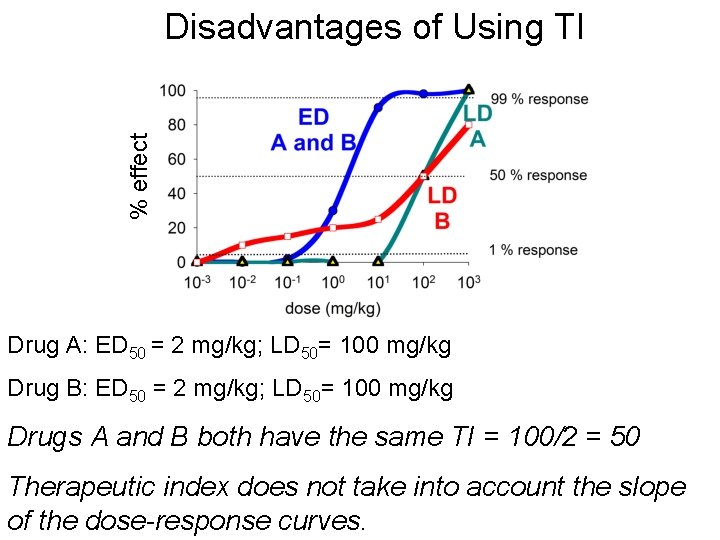
% effect Disadvantages of Using TI Drug A: ED 50 = 2 mg/kg; LD 50= 100 mg/kg Drug B: ED 50 = 2 mg/kg; LD 50= 100 mg/kg Drugs A and B both have the same TI = 100/2 = 50 Therapeutic index does not take into account the slope of the dose-response curves.
% effect Margin of Safety Margin of safety can overcome this deficiency by using ED 99 for the desired effect and LD 1 for the undesired effect. Margin of safety = LD 1/ED 99 Drug A: LD 1/ED 99 = 10 / 10 = 1 Drug B: LD 1/ED 99 = 0. 002 / 10 = 0. 0002 Thus, Drug B is much less safe than Drug A.
Toxic Potency Agent LD 50 (mg/kg) Ethyl alcohol 10, 000 Sodium chloride 4, 000 BHA/BHT (antioxidants) 2, 000 Morphine sulfate 900 Caffeine 200 Nicotine 1 Curare 0. 5 Shellfish toxin 0. 01 sarin 0. 001 Botulinum toxin 0. 00001 slight moderate high Extremely high (<1 mg/kg)