
NSS Project update including budgets bunker moderators and
NSS Project update; including budgets, bunker, moderators and response to the annual review Shane Kennedy NSS Project Leader www. europeanspallationsource. se 22 June 2016
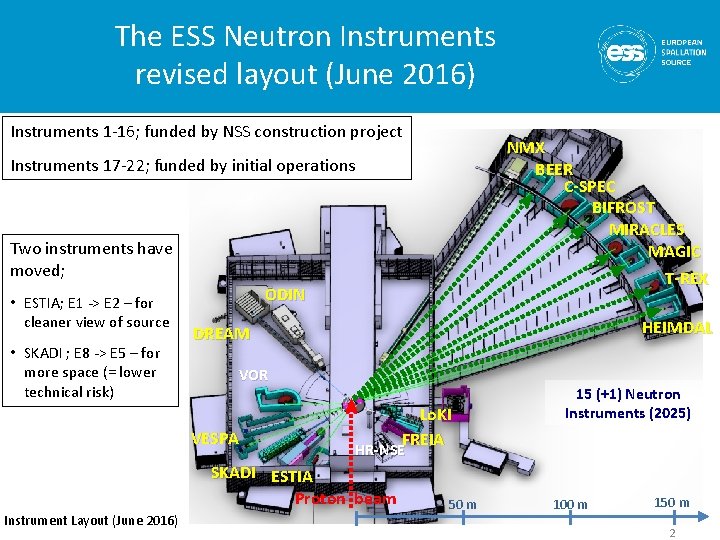
The ESS Neutron Instruments revised layout (June 2016) Instruments 1 -16; funded by NSS construction project NMX BEER C-SPEC BIFROST MIRACLES MAGIC T-REX Instruments 17 -22; funded by initial operations Two instruments have moved; • ESTIA; E 1 -> E 2 – for cleaner view of source • SKADI ; E 8 -> E 5 – for more space (= lower technical risk) ODIN HEIMDAL DREAM VOR VESPA HR-NSE SKADI ESTIA Proton beam Instrument Layout (June 2016) Lo. KI FREIA 15 (+1) Neutron Instruments (2025) 50 m 100 m 150 m 2
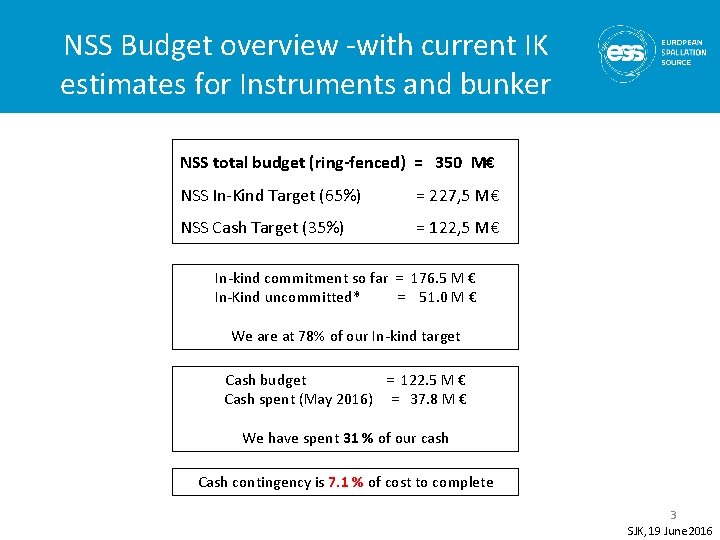
NSS Budget overview -with current IK estimates for Instruments and bunker NSS total budget (ring-fenced) = 350 M€ NSS In-Kind Target (65%) = 227, 5 M€ NSS Cash Target (35%) = 122, 5 M€ In-kind commitment so far = 176. 5 M € In-Kind uncommitted* = 51. 0 M € We are at 78% of our In-kind target Cash budget = 122. 5 M € Cash spent (May 2016) = 37. 8 M € We have spent 31 % of our cash Cash contingency is 7. 1 % of cost to complete 3 SJK, 19 June 2016
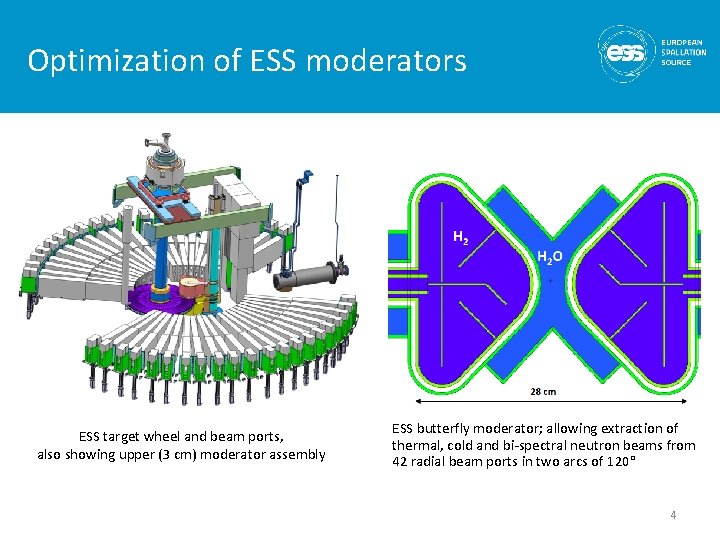
Optimization of ESS moderators ESS target wheel and beam ports, also showing upper (3 cm) moderator assembly ESS butterfly moderator; allowing extraction of thermal, cold and bi-spectral neutron beams from 42 radial beam ports in two arcs of 120° 4
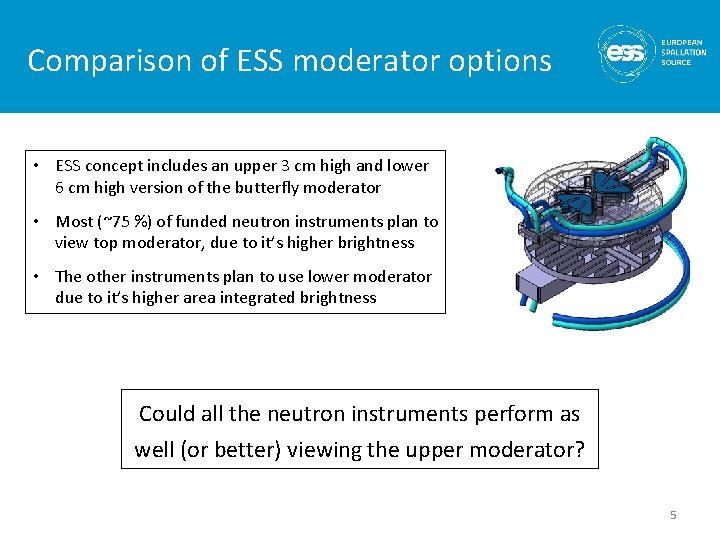
Comparison of ESS moderator options • ESS concept includes an upper 3 cm high and lower 6 cm high version of the butterfly moderator • Most (~75 %) of funded neutron instruments plan to view top moderator, due to it’s higher brightness • The other instruments plan to use lower moderator due to it’s higher area integrated brightness Could all the neutron instruments perform as well (or better) viewing the upper moderator? 5
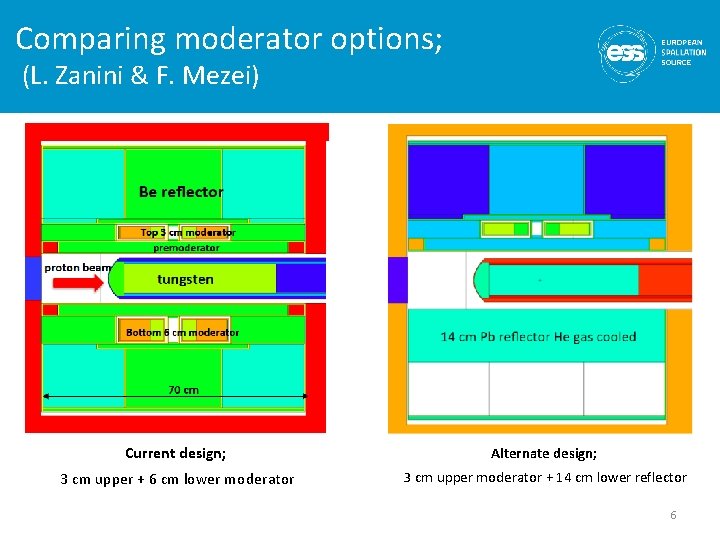
Comparing moderator options; (L. Zanini & F. Mezei) Current design; Alternate design; 3 cm upper + 6 cm lower moderator 3 cm upper moderator + 14 cm lower reflector 6
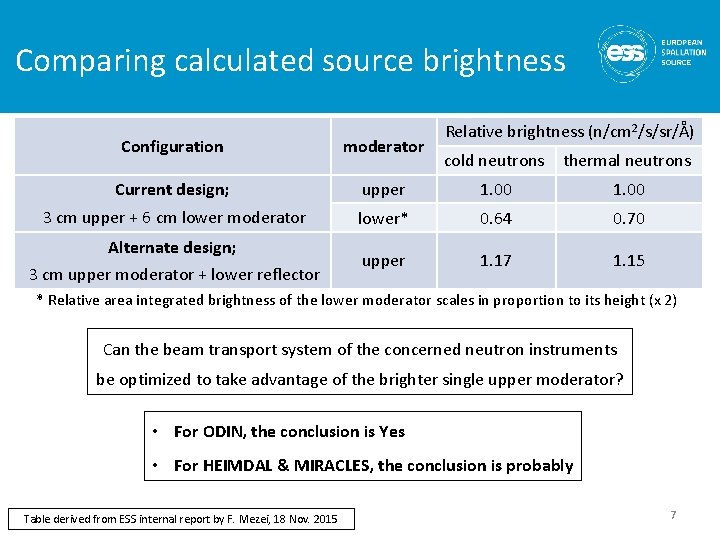
Comparing calculated source brightness Configuration moderator Current design; 3 cm upper + 6 cm lower moderator Alternate design; 3 cm upper moderator + lower reflector Relative brightness (n/cm 2/s/sr/Å) cold neutrons thermal neutrons upper 1. 00 lower* 0. 64 0. 70 upper 1. 17 1. 15 * Relative area integrated brightness of the lower moderator scales in proportion to its height (x 2) Can the beam transport system of the concerned neutron instruments be optimized to take advantage of the brighter single upper moderator? • For ODIN, the conclusion is Yes • For HEIMDAL & MIRACLES, the conclusion is probably Table derived from ESS internal report by F. Mezei, 18 Nov. 2015 7
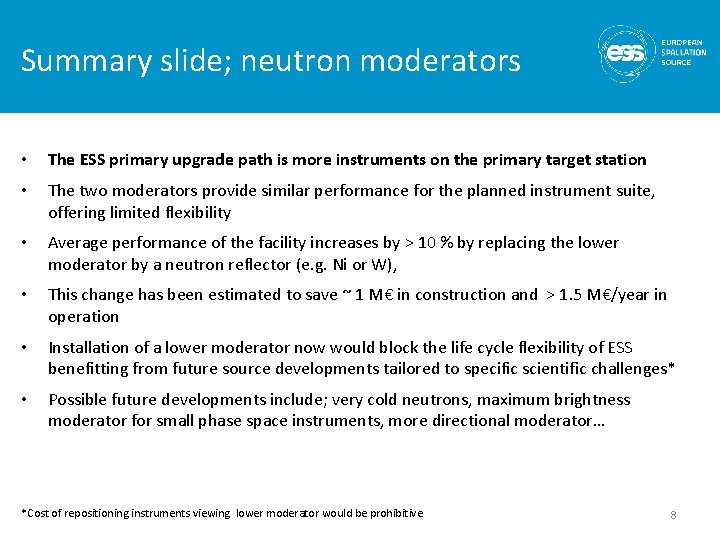
Summary slide; neutron moderators • The ESS primary upgrade path is more instruments on the primary target station • The two moderators provide similar performance for the planned instrument suite, offering limited flexibility • Average performance of the facility increases by > 10 % by replacing the lower moderator by a neutron reflector (e. g. Ni or W), • This change has been estimated to save ~ 1 M€ in construction and > 1. 5 M€/year in operation • Installation of a lower moderator now would block the life cycle flexibility of ESS benefitting from future source developments tailored to specific scientific challenges* • Possible future developments include; very cold neutrons, maximum brightness moderator for small phase space instruments, more directional moderator… *Cost of repositioning instruments viewing lower moderator would be prohibitive 8
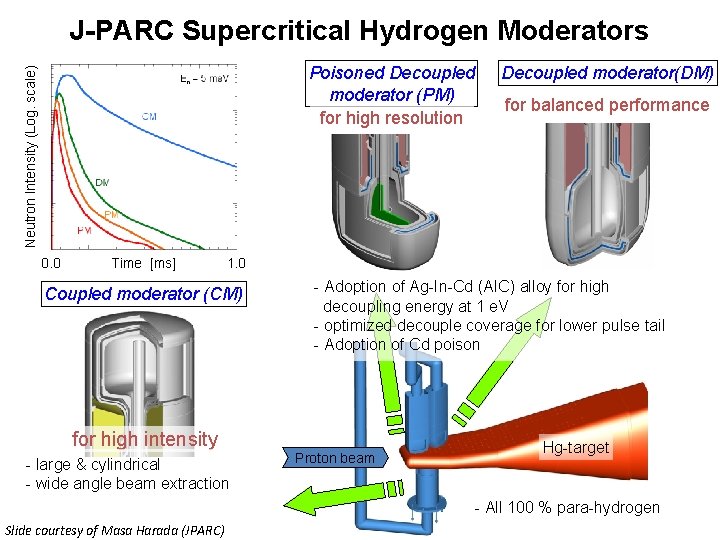
J-PARC Supercritical Hydrogen Moderators Neutron Intensity (Log. scale) Poisoned Decoupled moderator (PM) for high resolution 0. 0 Time [ms] Decoupled moderator(DM) for balanced performance 1. 0 Coupled moderator (CM) for high intensity - large & cylindrical - wide angle beam extraction - Adoption of Ag-In-Cd (AIC) alloy for high decoupling energy at 1 e. V - optimized decouple coverage for lower pulse tail - Adoption of Cd poison Proton beam Hg-target - All 100 % para-hydrogen Slide courtesy of Masa Harada (JPARC)
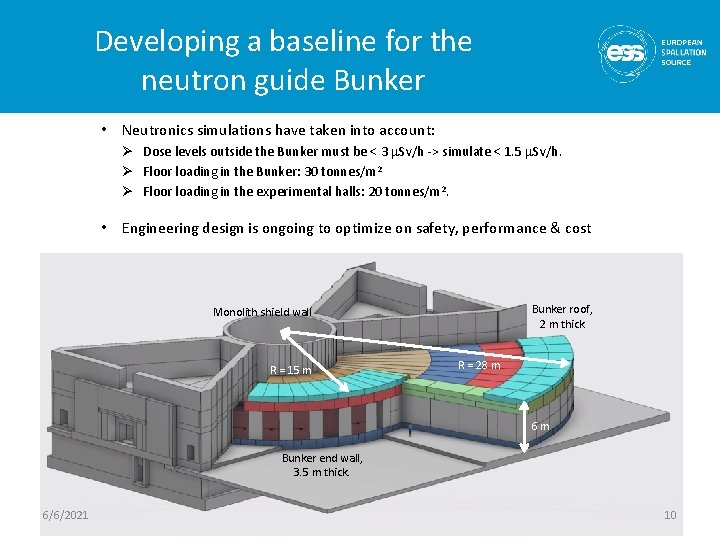
Developing a baseline for the neutron guide Bunker • Neutronics simulations have taken into account: Ø Dose levels outside the Bunker must be < 3 m. Sv/h -> simulate < 1. 5 m. Sv/h. Ø Floor loading in the Bunker: 30 tonnes/m 2 Ø Floor loading in the experimental halls: 20 tonnes/m 2. • Engineering design is ongoing to optimize on safety, performance & cost Bunker roof, 2 m thick Monolith shield wall R = 15 m R = 28 m 6 m Bunker end wall, 3. 5 m thick. 6/6/2021 10
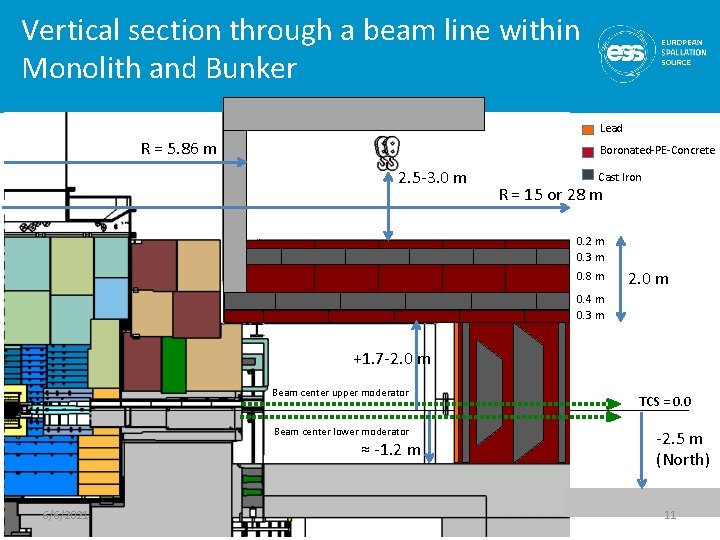
Vertical section through a beam line within Monolith and Bunker Lead R = 5. 86 m Boronated-PE-Concrete 2. 5 -3. 0 m Cast Iron R = 15 or 28 m 0. 2 m 0. 3 m 0. 8 m 2. 0 m 0. 4 m 0. 3 m +1. 7 -2. 0 m Beam center upper moderator Beam center lower moderator ≈ -1. 2 m 6/6/2021 TCS = 0. 0 -2. 5 m (North) 11
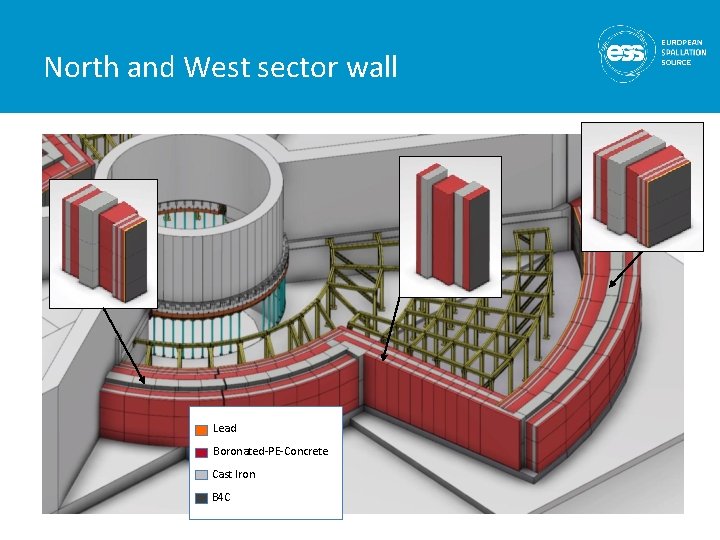
North and West sector wall Lead Boronated-PE-Concrete Cast Iron B 4 C
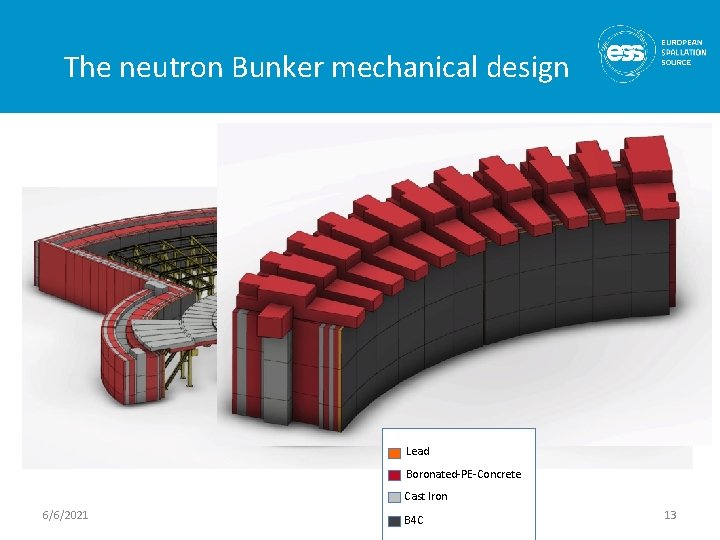
The neutron Bunker mechanical design Lead Boronated-PE-Concrete Cast Iron 6/6/2021 B 4 C 13
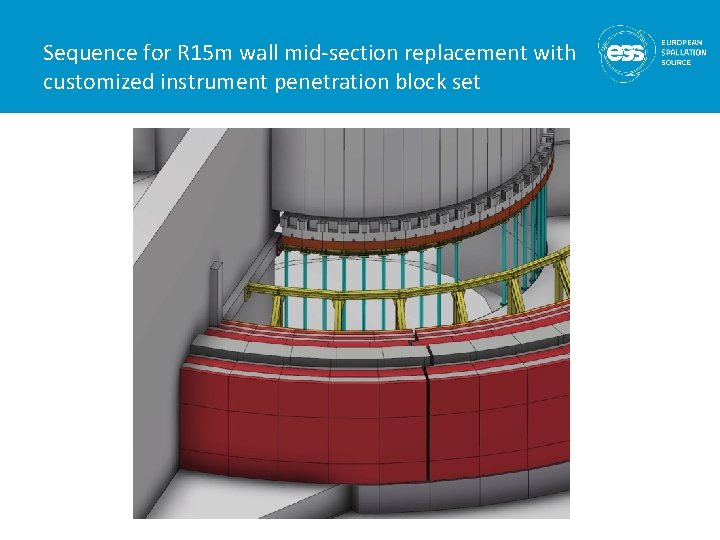
Sequence for R 15 m wall mid-section replacement with customized instrument penetration block set
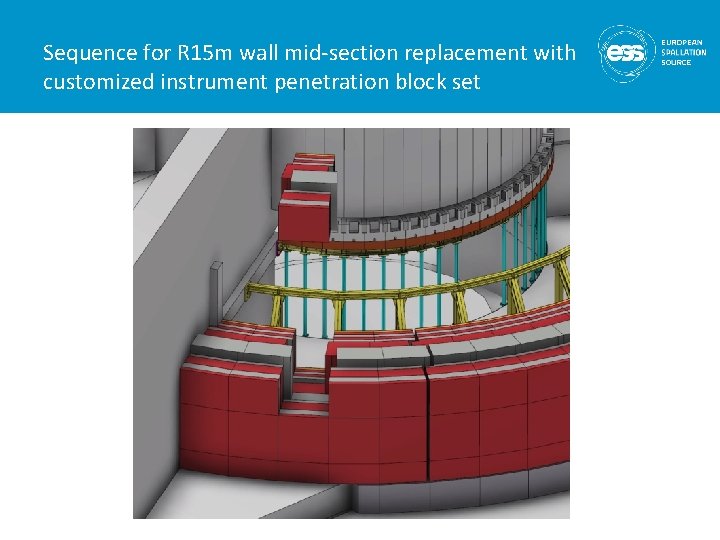
Sequence for R 15 m wall mid-section replacement with customized instrument penetration block set
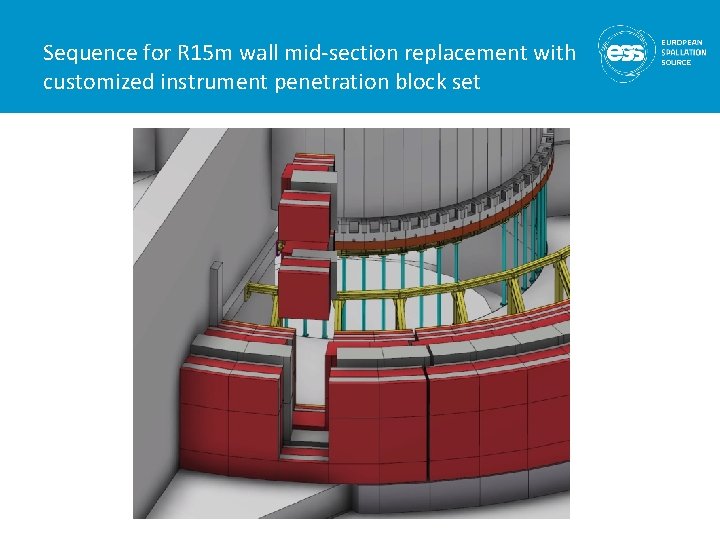
Sequence for R 15 m wall mid-section replacement with customized instrument penetration block set
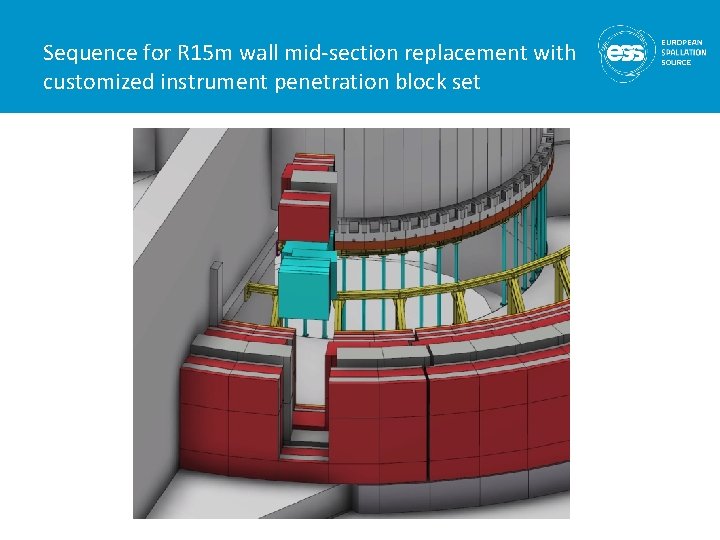
Sequence for R 15 m wall mid-section replacement with customized instrument penetration block set
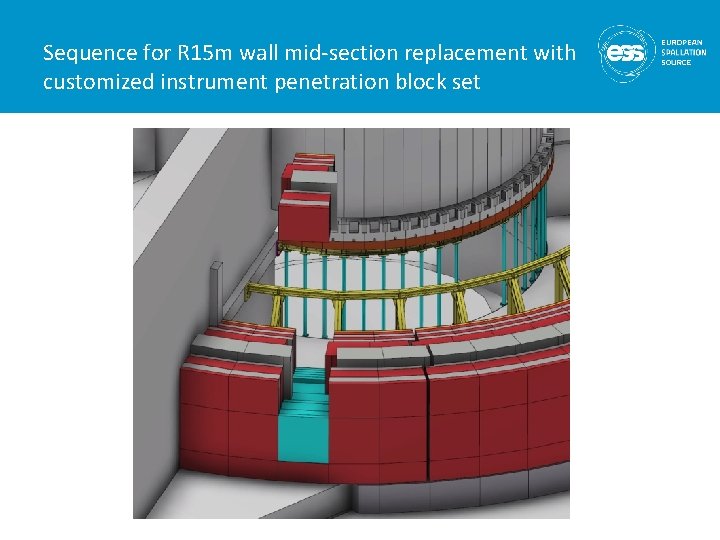
Sequence for R 15 m wall mid-section replacement with customized instrument penetration block set
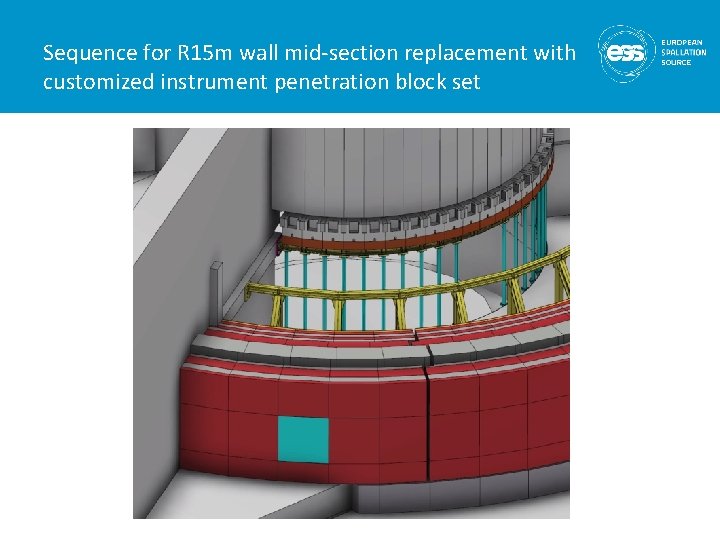
Sequence for R 15 m wall mid-section replacement with customized instrument penetration block set
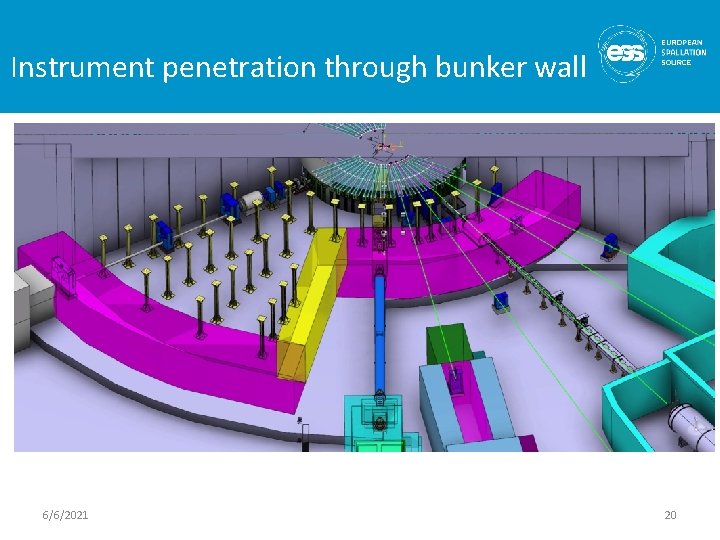
Instrument penetration through bunker wall 6/6/2021 20
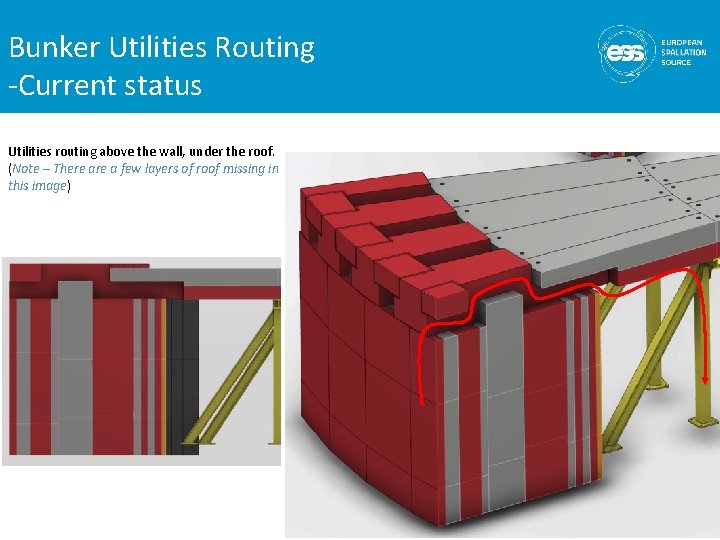
Bunker Utilities Routing -Current status Utilities routing above the wall, under the roof. (Note – There a few layers of roof missing in this image) 21
Neutron Bunker delivery options (1/2) NSS has pursued three different options for Bunker delivery over the past year: 1. One country delivers the Bunker including detailed design, procurement, manufacturing, delivery and installation on site. 2. The Bunker is divided into WPs, e. g. detailed design, steel work, concrete, manufacturing of blocks, etc, which are allocated to different partners. In this case one partner could take responsibility for co-ordination of partners, or if necessary NSS could take responsibility. 3. Levy a fund with all countries involved in NSS, by which each country contributes with a share corresponding to their share in the instruments budget. Regardless which option we take, NSS will maintain leadership in neutronics and in ensuring delivery meets requirements (safety, performance and engineering requirements of the instruments). • Hence, NSS will retain performance risk for the bunker project. • NSS expects our delivery partners will take responsibility for manufacturing risk. 22
Neutron Bunker delivery options (2/2) A. FZJ management is willing to manage detailed design and manufacturing of the bunker, as part of the German In-Kind contribution. NSS and ZEA (FZJ Engineering) are evaluating the feasibility of such a partnership. B. Competent engineering companies in CZ and FR are willing to partner with NSS in the bunker project. C. Potential partnerships have been identified in NO and SE and are being pursued. Option A is our preferred option at this time Options B & C are being pursued as back-up plans The deadline for these ‘partnered’ options is 31 August 2016, Beyond that NSS will manage the full delivery 23
The ESS 3 rd Annual Review held over 3 ½ days from 20 – 23 April 2016 Subcommittee 4: Neutron Scattering systems Panel members: Dan Neumann (Chair) Ken Herwig Mark Johnson Toshi Kanaya Thomas Proffen 6/6/2021 ESS 2016 annual review 24
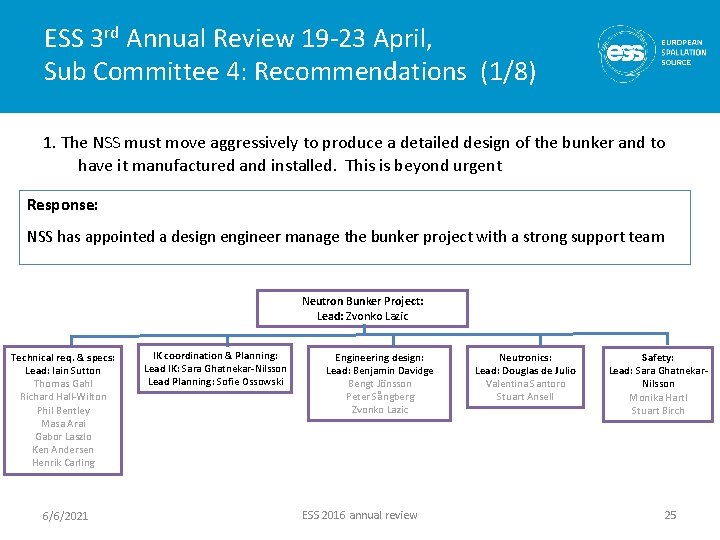
ESS 3 rd Annual Review 19 -23 April, Sub Committee 4: Recommendations (1/8) 1. The NSS must move aggressively to produce a detailed design of the bunker and to have it manufactured and installed. This is beyond urgent Response: NSS has appointed a design engineer manage the bunker project with a strong support team Neutron Bunker Project: Lead: Zvonko Lazic Technical req. & specs: Lead: Iain Sutton Thomas Gahl Richard Hall-Wilton Phil Bentley Masa Arai Gabor Laszlo Ken Andersen Henrik Carling 6/6/2021 IK coordination & Planning: Lead IK: Sara Ghatnekar-Nilsson Lead Planning: Sofie Ossowski Engineering design: Lead: Benjamin Davidge Bengt Jönsson Peter Sångberg Zvonko Lazic ESS 2016 annual review Neutronics: Lead: Douglas de Julio Valentina Santoro Stuart Ansell Safety: Lead: Sara Ghatnekar. Nilsson Monika Hartl Stuart Birch 25
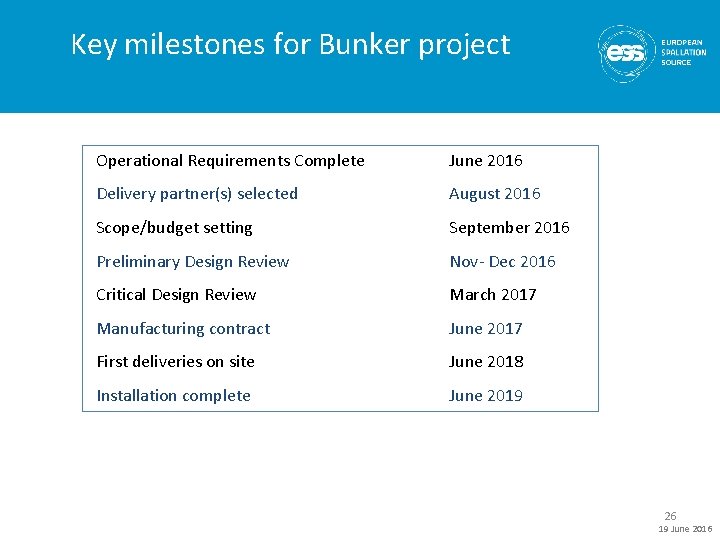
Key milestones for Bunker project Operational Requirements Complete June 2016 Delivery partner(s) selected August 2016 Scope/budget setting September 2016 Preliminary Design Review Nov- Dec 2016 Critical Design Review March 2017 Manufacturing contract June 2017 First deliveries on site June 2018 Installation complete June 2019 16 Neutron Instruments 26 19 June 2016
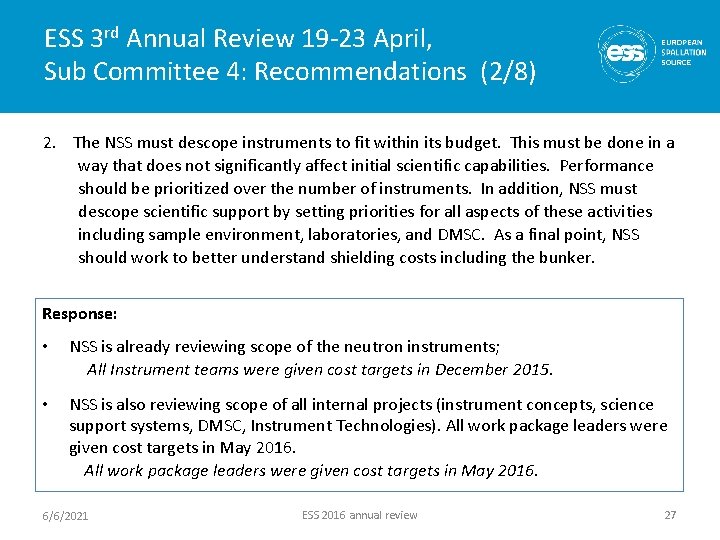
ESS 3 rd Annual Review 19 -23 April, Sub Committee 4: Recommendations (2/8) 2. The NSS must descope instruments to fit within its budget. This must be done in a way that does not significantly affect initial scientific capabilities. Performance should be prioritized over the number of instruments. In addition, NSS must descope scientific support by setting priorities for all aspects of these activities including sample environment, laboratories, and DMSC. As a final point, NSS should work to better understand shielding costs including the bunker. Response: • NSS is already reviewing scope of the neutron instruments; All Instrument teams were given cost targets in December 2015. • NSS is also reviewing scope of all internal projects (instrument concepts, science support systems, DMSC, Instrument Technologies). All work package leaders were given cost targets in May 2016. 6/6/2021 ESS 2016 annual review 27
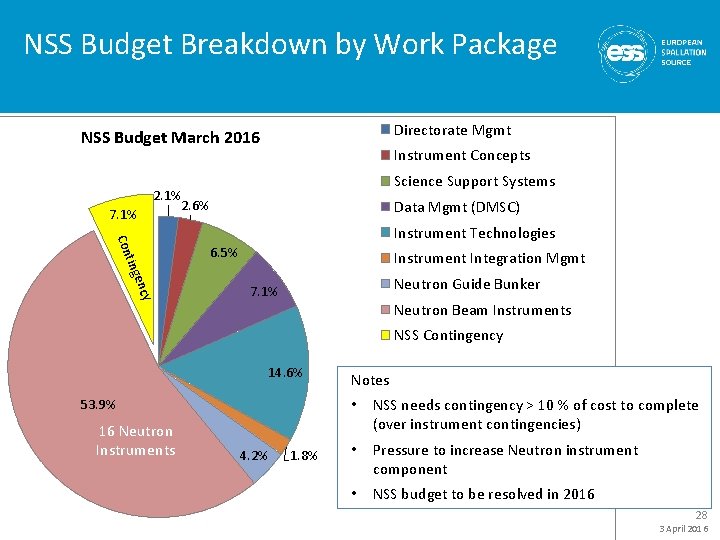
NSS Budget Breakdown by Work Package Directorate Mgmt NSS Budget March 2016 2. 1% 7. 1% Instrument Concepts Science Support Systems Data Mgmt (DMSC) 2. 6% y enc ting Con Instrument Technologies 6. 5% Instrument Integration Mgmt Neutron Guide Bunker 7. 1% Neutron Beam Instruments NSS Contingency 14. 6% • NSS needs contingency > 10 % of cost to complete (over instrument contingencies) 53. 9% 16 Neutron Instruments Notes 4. 2% 1. 8% • Pressure to increase Neutron instrument component • NSS budget to be resolved in 2016 28 3 April 2016
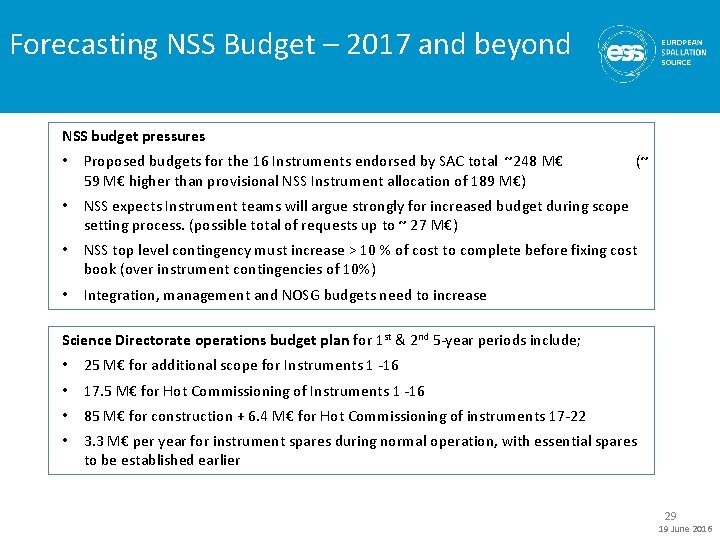
Forecasting NSS Budget – 2017 and beyond NSS budget pressures • Proposed budgets for the 16 Instruments endorsed by SAC total ~248 M€ 59 M€ higher than provisional NSS Instrument allocation of 189 M€) (~ • NSS expects Instrument teams will argue strongly for increased budget during scope setting process. (possible total of requests up to ~ 27 M€) • NSS top level contingency must increase > 10 % of cost to complete before fixing cost book (over instrument contingencies of 10%) • Integration, management and NOSG budgets need to increase Science Directorate operations budget plan for 1 st & 2 nd 5 -year periods include; • 25 M€ for additional scope for Instruments 1 -16 • 17. 5 M€ for Hot Commissioning of Instruments 1 -16 • 85 M€ for construction + 6. 4 M€ for Hot Commissioning of instruments 17 -22 16 Neutron • 3. 3 M€ per year for instrument spares during normal operation, with essential spares Instruments to be established earlier 29 19 June 2016
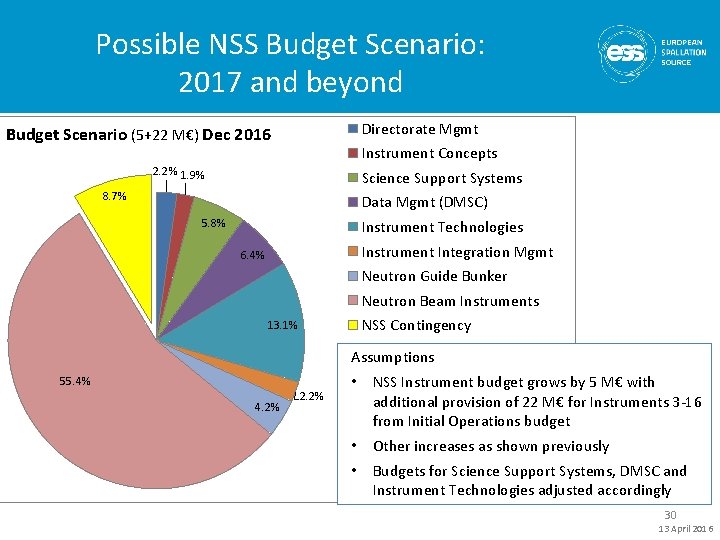
Possible NSS Budget Scenario: 2017 and beyond Directorate Mgmt Budget Scenario (5+22 M€) Dec 2016 Instrument Concepts 2. 2% 1. 9% Science Support Systems 8. 7% Data Mgmt (DMSC) 5. 8% Instrument Technologies Instrument Integration Mgmt 6. 4% Neutron Guide Bunker Neutron Beam Instruments NSS Contingency 13. 1% Assumptions 55. 4% 4. 2% 16 Neutron Instruments 2. 2% • NSS Instrument budget grows by 5 M€ with additional provision of 22 M€ for Instruments 3 -16 from Initial Operations budget • Other increases as shown previously • Budgets for Science Support Systems, DMSC and Instrument Technologies adjusted accordingly 30 13 April 2016
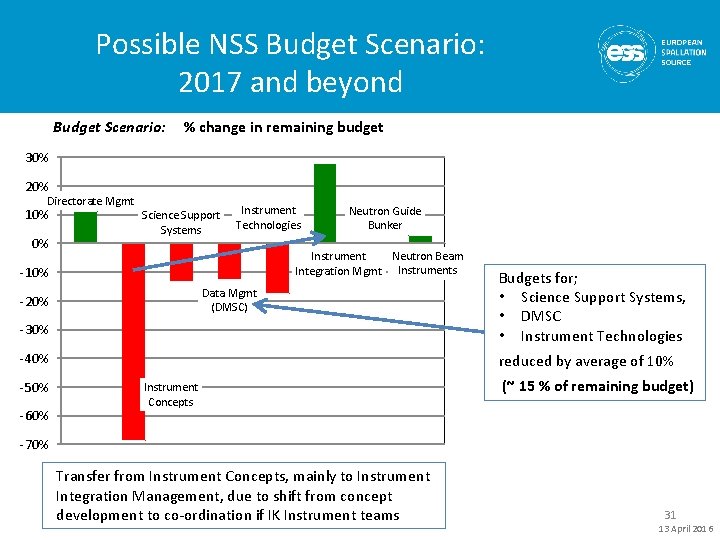
Possible NSS Budget Scenario: 2017 and beyond Budget Scenario: % change in remaining budget 30% 20% Directorate Mgmt 10% 0% Science Support Systems Instrument Technologies Directorate Mgmt Neutron Guide Bunker Neutron Beam Instrument Integration Mgmt Instruments -10% -30% Budgets for; • Science Support Systems, • DMSC • Instrument Technologies -40% reduced by average of 10% Data Mgmt (DMSC) -20% -50% -60% -70% Instrument Concepts (~ 15 % of remaining budget) 16 Neutron Instruments Transfer from Instrument Concepts, mainly to Instrument Integration Management, due to shift from concept development to co-ordination if IK Instrument teams 31 13 April 2016
ESS 3 rd Annual Review 19 -23 April, Sub Committee 4: Recommendations (3 & 4/8) 3. The NSS must continue to clarify scope ownership and the interfaces between NSS and other organizations within the ESS and between NSS and its external partners. This includes formal agreements, standards documents, etc. 4. The NSS must maintain robust communications between NSS and other organizations within the ESS and between NSS and its external partners. Response: • NSS has formed a strong support team for the neutron instrument construction • NSS is has formed a strong core engineering team to address engineering integration issues and initiate installation planning 6/6/2021 ESS 2016 annual review 32
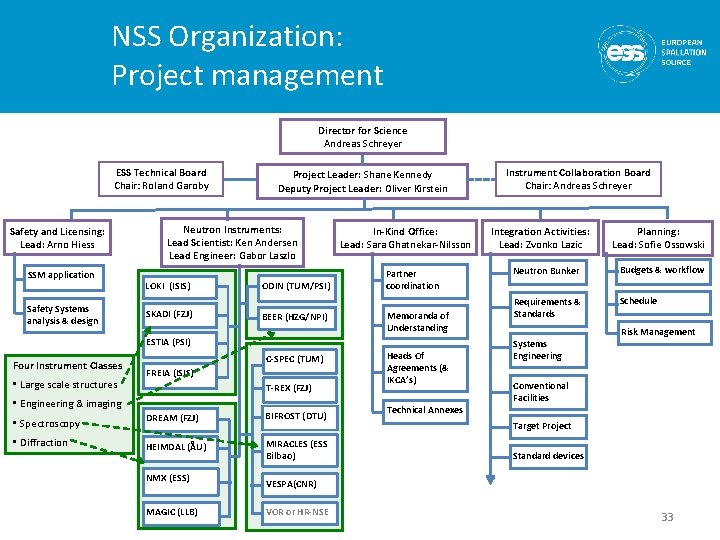
NSS Organization: Project management Director for Science Andreas Schreyer ESS Technical Board Chair: Roland Garoby Safety and Licensing: Lead: Arno Hiess SSM application Safety Systems analysis & design Project Leader: Shane Kennedy Deputy Project Leader: Oliver Kirstein Neutron Instruments: Lead Scientist: Ken Andersen Lead Engineer: Gabor Laszlo LOKI (ISIS) SKADI (FZJ) ODIN (TUM/PSI) BEER (HZG/NPI) In-Kind Office: Lead: Sara Ghatnekar-Nilsson Partner coordination Memoranda of Understanding ESTIA (PSI) Four Instrument Classes • Large scale structures C-SPEC (TUM) FREIA (ISIS) T-REX (FZJ) • Engineering & imaging • Spectroscopy DREAM (FZJ) BIFROST (DTU) • Diffraction HEIMDAL (ÅU) MIRACLES (ESS Bilbao) NMX (ESS) MAGIC (LLB) Heads Of Agreements (& IKCA’s) Instrument Collaboration Board Chair: Andreas Schreyer Integration Activities: Lead: Zvonko Lazic Planning: Lead: Sofie Ossowski Neutron Bunker Budgets & workflow Requirements & Standards Schedule Risk Management Systems Engineering Conventional Facilities Technical Annexes Target Project Standard devices VESPA(CNR) VOR or HR-NSE 33
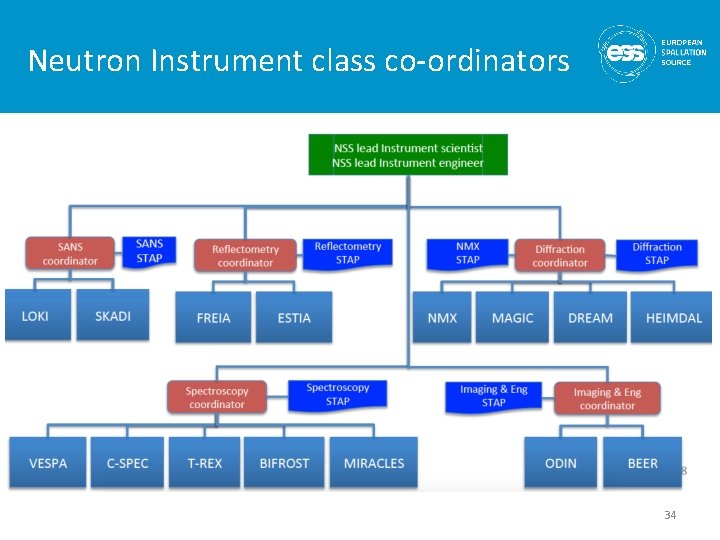
Neutron Instrument class co-ordinators • . . 34
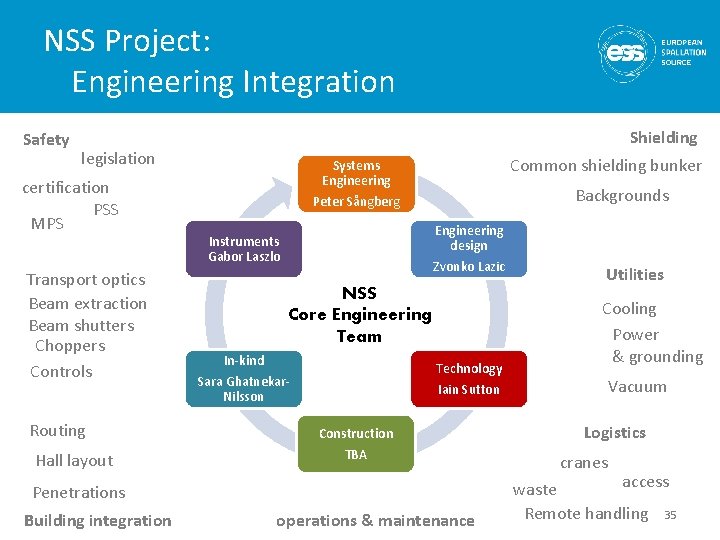
NSS Project: Engineering Integration Safety Shielding legislation certification PSS MPS Transport optics Beam extraction Beam shutters Choppers Controls Routing Hall layout Common shielding bunker Systems Engineering Backgrounds Peter Sångberg Engineering design Instruments Gabor Laszlo Zvonko Lazic NSS Core Engineering Team In-kind Iain Sutton Technology Iain Sutton Sara Ghatnekar. Nilsson Construction TBA Penetrations Building integration Utilities operations & maintenance Cooling Power & grounding Vacuum Logistics cranes access waste Remote handling 35
ESS 3 rd Annual Review 19 -23 April, Sub Committee 4: Recommendations (5/8) 5. The NSS must develop a detailed plan for multiple simultaneous installations and maintenance activities in the bunker and have it reviewed by an external committee. Response: NSS is recruiting a construction engineer to lead in installation planning 6/6/2021 ESS 2016 annual review 36
ESS 3 rd Annual Review 19 -23 April, Sub Committee 4: Actions (6 & 7/8) 6. The NSS should continue to refine its operational plan to efficiently and effectively deliver science at the beginning of user operations. A crucial element will be to ensure that sufficient staff, with the right skills, are identified in advance of this date. 7. The NSS operational plan should include funds to fully exploit the initial suite of instruments, including completion of the scope, procurement of an expanded set of sample environments, and to complete the promised complement of instruments. It should also provide resources for advancing the state-of-the-art in neutron instrumentation including instrument upgrades, neutron devices, and sample environments. These points have been covered in the responses above 6/6/2021 ESS 2016 annual review 37
ESS 3 rd Annual Review 19 -23 April, Sub Committee 4: Recommendations (8/8) 8. The development of the neutron test station must not divert resources from NSS or its attention from its primary activities as the relationship of the test station to delivering world-class neutron instrumentation at the beginning of ESS user operations is unclear. Response: NSS Planning for the test station is on hold until more is known about the schedule of neutron instrument construction 6/6/2021 ESS 2016 annual review 38
- Slides: 38