
NSLS 2 Ground Motion and Vibration Studies Nick
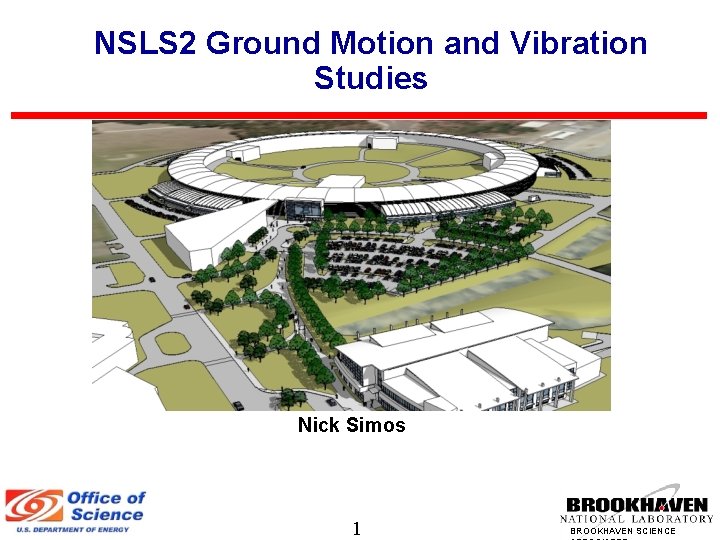
NSLS 2 Ground Motion and Vibration Studies Nick Simos 1 BROOKHAVEN SCIENCE
OBJECTIVE Based on experience data (including measurements at operating facilities) integrated with large-scale, state-of-the-art computational models: • make the best possible estimate as to what the vibration levels will be once the NSLS II structure is placed on the “green-field” • assist in the optimization of the design of a “quiet” facility (treatment of in-house sources, disruption of vibration paths, structural interfaces, mat thicknesses, etc. ) 2 BROOKHAVEN SCIENCE
BASIC APPROACH • QUANTIFY the vibration criteria which key elements of the NSLS 2 (ring and experimental lines) MUST meet • Establish the “green-field” conditions at the NSLS 2 site • Make the link between the “green-field” and the NSLS 2 infrastructure using – “experience” data – state-of-the-art computational methods (the only available tool) and as a result • estimate vibration levels on the ring and experimental floor 3 BROOKHAVEN SCIENCE
NSLS 2 Vibration Environment & Source Identification 4 BROOKHAVEN SCIENCE
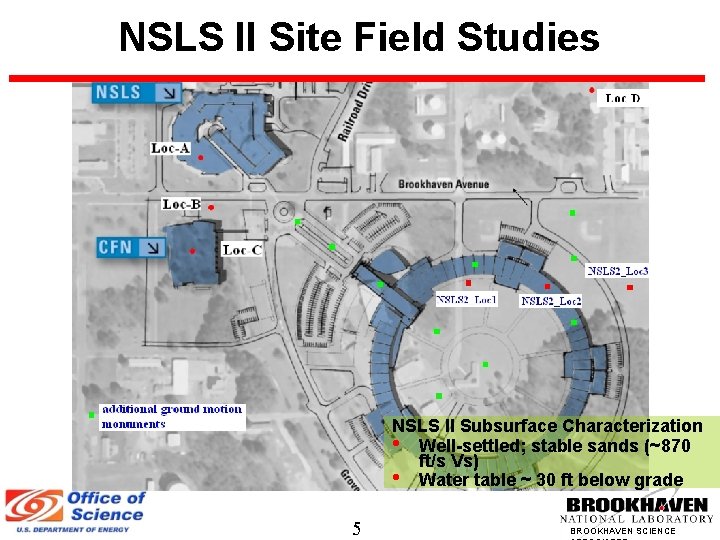
NSLS II Site Field Studies NSLS II Subsurface Characterization • Well-settled; stable sands (~870 ft/s Vs) • Water table ~ 30 ft below grade 5 BROOKHAVEN SCIENCE
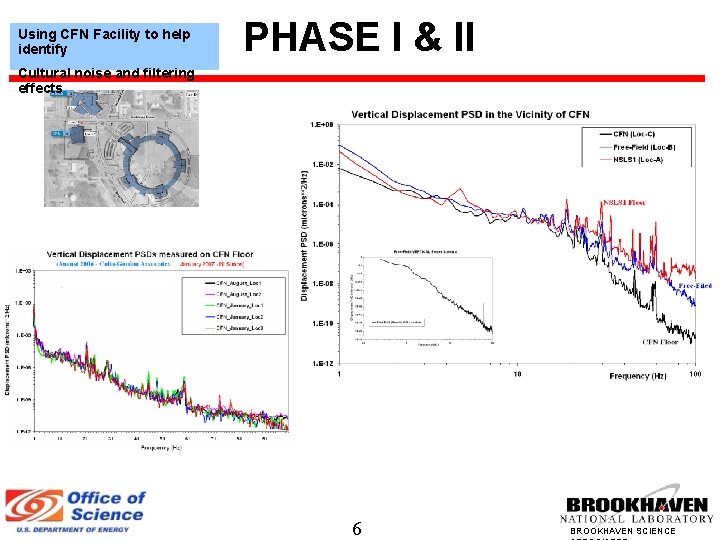
Using CFN Facility to help identify PHASE I & II Cultural noise and filtering effects 6 BROOKHAVEN SCIENCE
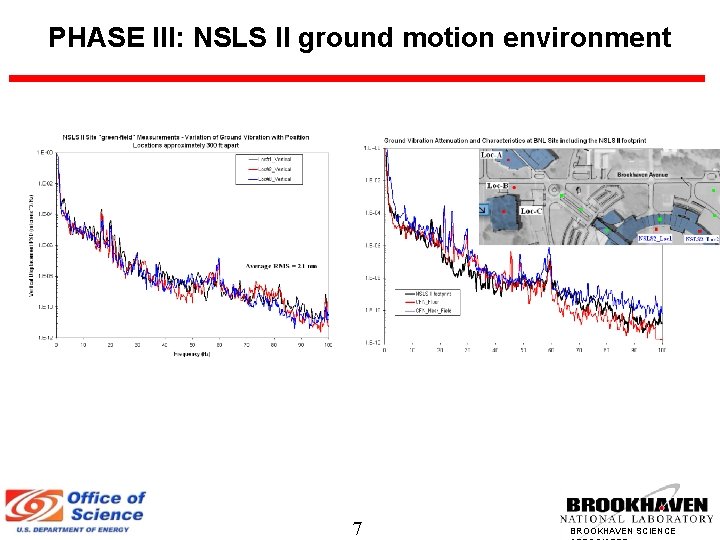
PHASE III: NSLS II ground motion environment 7 BROOKHAVEN SCIENCE
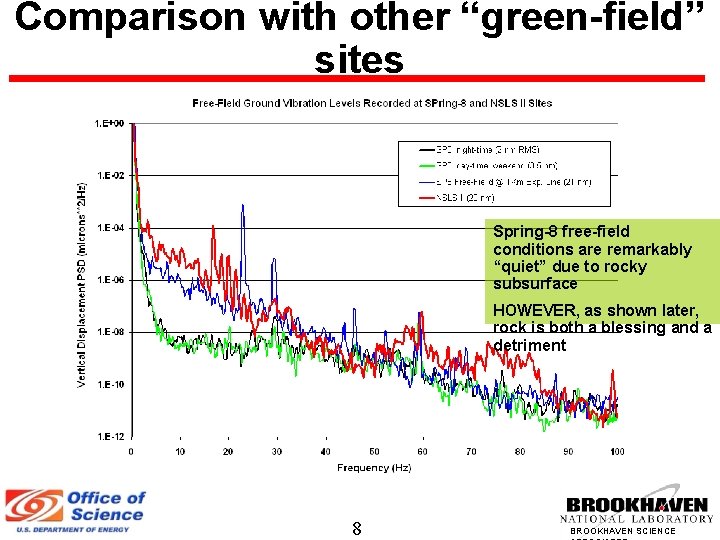
Comparison with other “green-field” sites Spring-8 free-field conditions are remarkably “quiet” due to rocky subsurface HOWEVER, as shown later, rock is both a blessing and a detriment 8 BROOKHAVEN SCIENCE
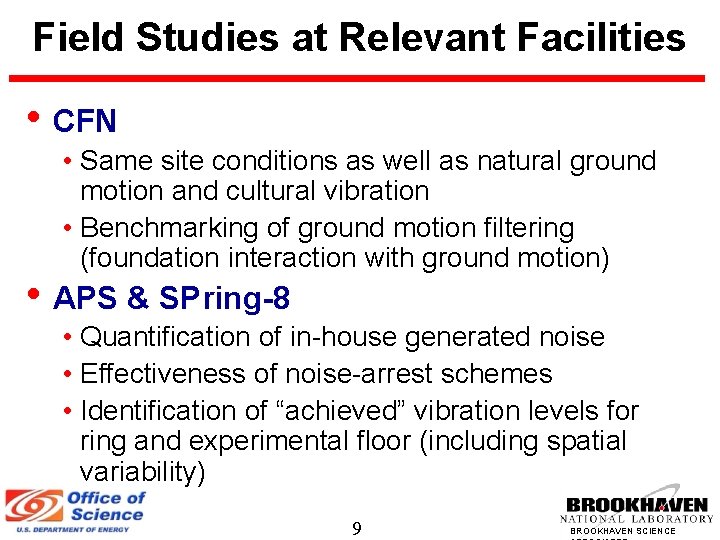
Field Studies at Relevant Facilities • CFN • Same site conditions as well as natural ground motion and cultural vibration • Benchmarking of ground motion filtering (foundation interaction with ground motion) • APS & SPring-8 • Quantification of in-house generated noise • Effectiveness of noise-arrest schemes • Identification of “achieved” vibration levels for ring and experimental floor (including spatial variability) 9 BROOKHAVEN SCIENCE
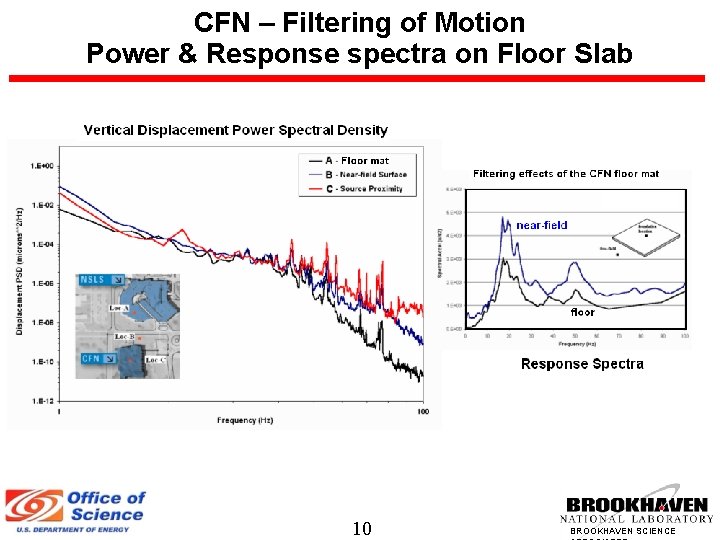
CFN – Filtering of Motion Power & Response spectra on Floor Slab 10 BROOKHAVEN SCIENCE
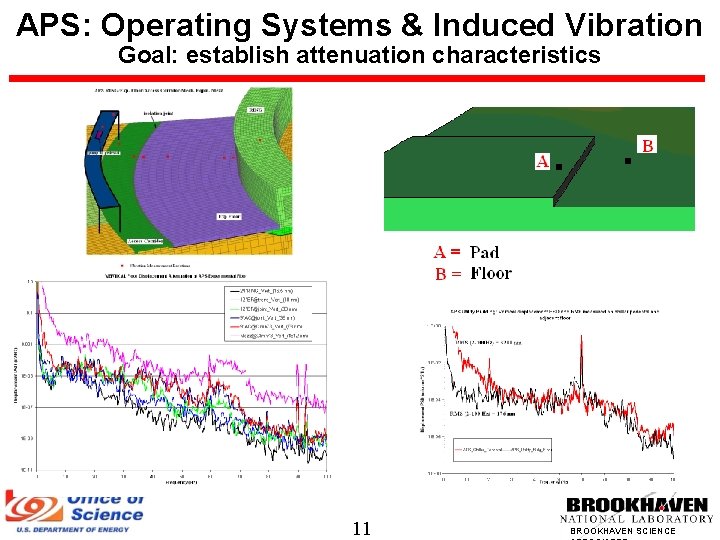
APS: Operating Systems & Induced Vibration Goal: establish attenuation characteristics 11 BROOKHAVEN SCIENCE
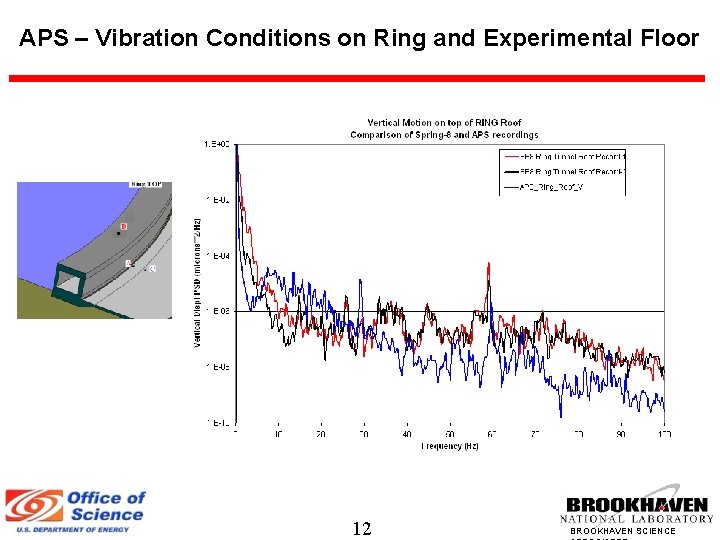
APS – Vibration Conditions on Ring and Experimental Floor 12 BROOKHAVEN SCIENCE
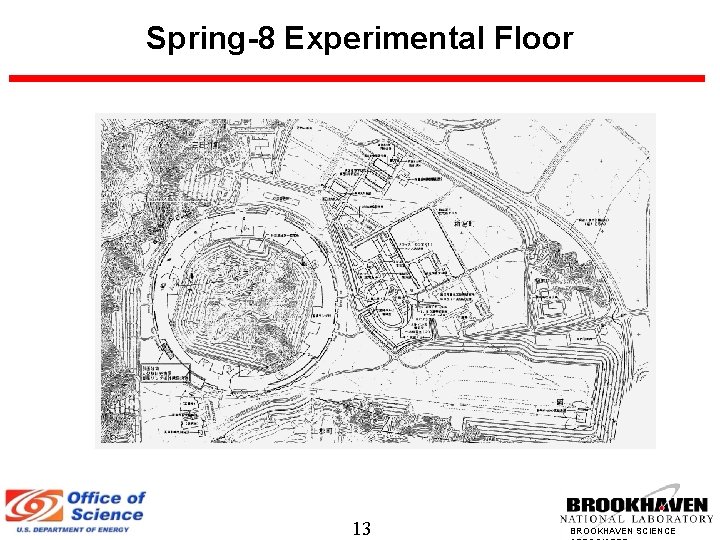
Spring-8 Experimental Floor 13 BROOKHAVEN SCIENCE
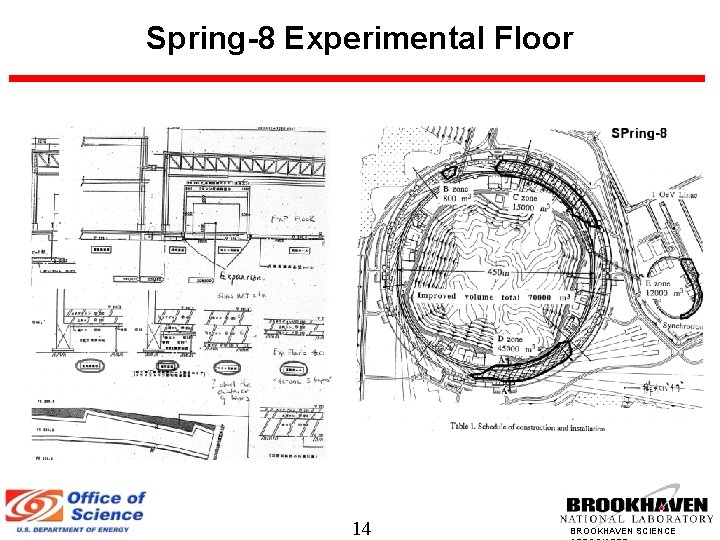
Spring-8 Experimental Floor 14 BROOKHAVEN SCIENCE
Spring-8 Experimental Floor 15 BROOKHAVEN SCIENCE
Spring-8 Experimental Floor 16 BROOKHAVEN SCIENCE
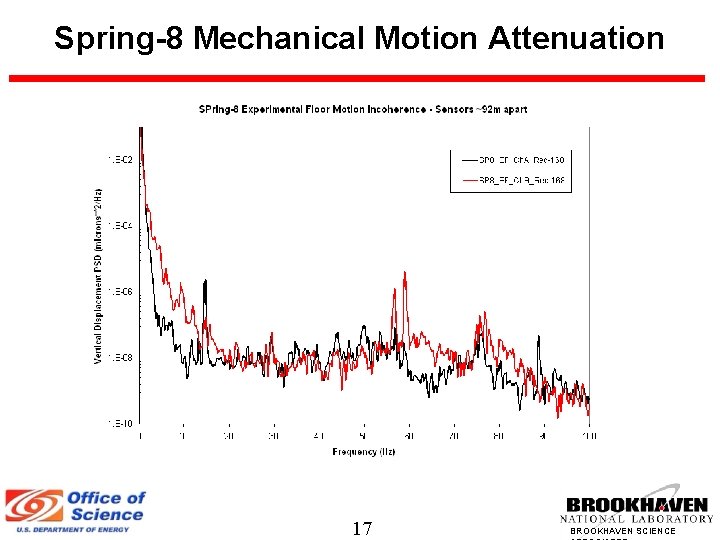
Spring-8 Mechanical Motion Attenuation 17 BROOKHAVEN SCIENCE
NSLS II Vibration Analysis Field data Modeling 18 BROOKHAVEN SCIENCE
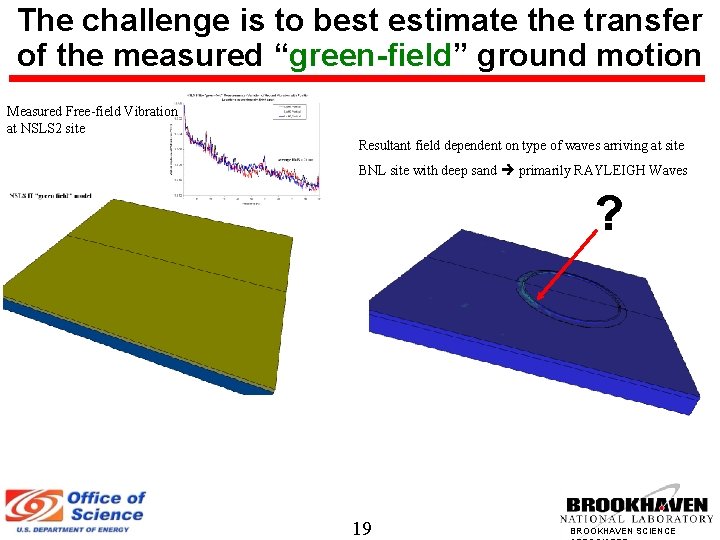
The challenge is to best estimate the transfer of the measured “green-field” ground motion Measured Free-field Vibration at NSLS 2 site Resultant field dependent on type of waves arriving at site BNL site with deep sand primarily RAYLEIGH Waves ? 19 BROOKHAVEN SCIENCE
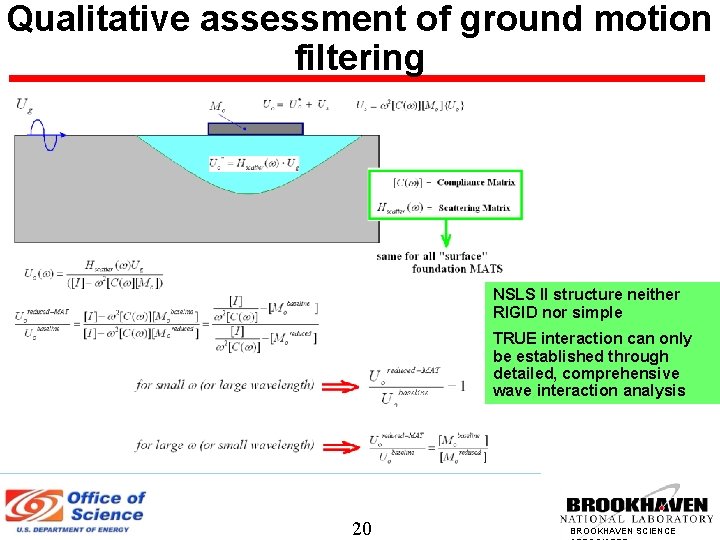
Qualitative assessment of ground motion filtering NSLS II structure neither RIGID nor simple TRUE interaction can only be established through detailed, comprehensive wave interaction analysis 20 BROOKHAVEN SCIENCE
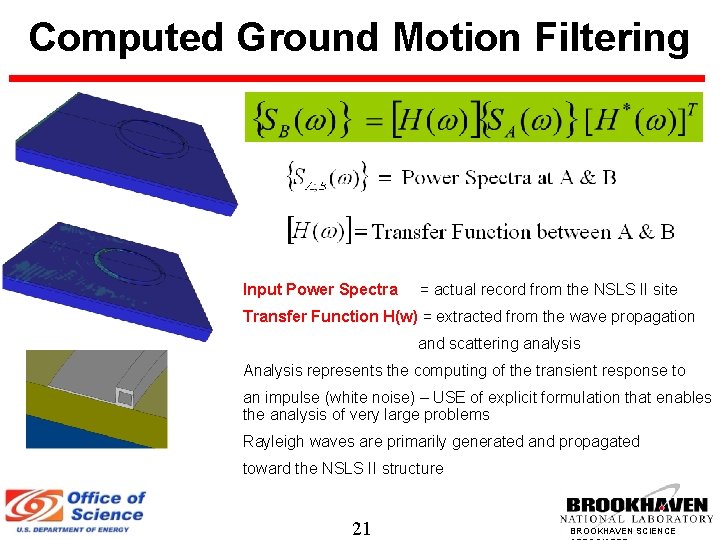
Computed Ground Motion Filtering Input Power Spectra = actual record from the NSLS II site Transfer Function H(w) = extracted from the wave propagation and scattering analysis Analysis represents the computing of the transient response to an impulse (white noise) – USE of explicit formulation that enables the analysis of very large problems Rayleigh waves are primarily generated and propagated toward the NSLS II structure 21 BROOKHAVEN SCIENCE
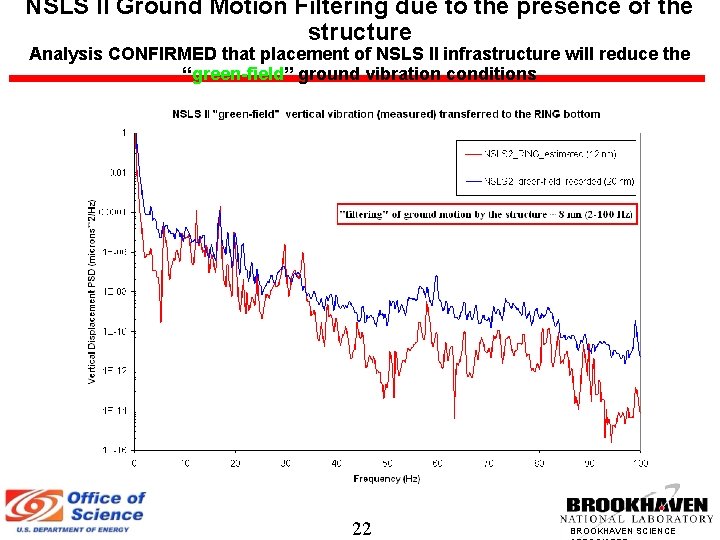
NSLS II Ground Motion Filtering due to the presence of the structure Analysis CONFIRMED that placement of NSLS II infrastructure will reduce the “green-field” ground vibration conditions 22 BROOKHAVEN SCIENCE
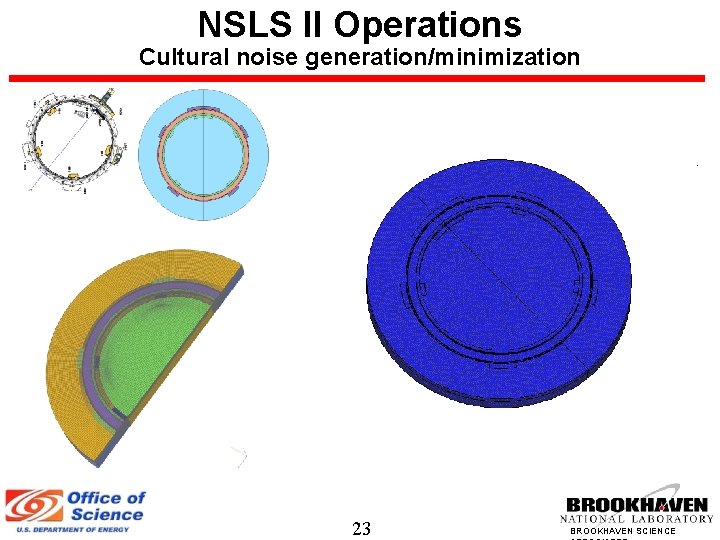
NSLS II Operations Cultural noise generation/minimization 23 BROOKHAVEN SCIENCE
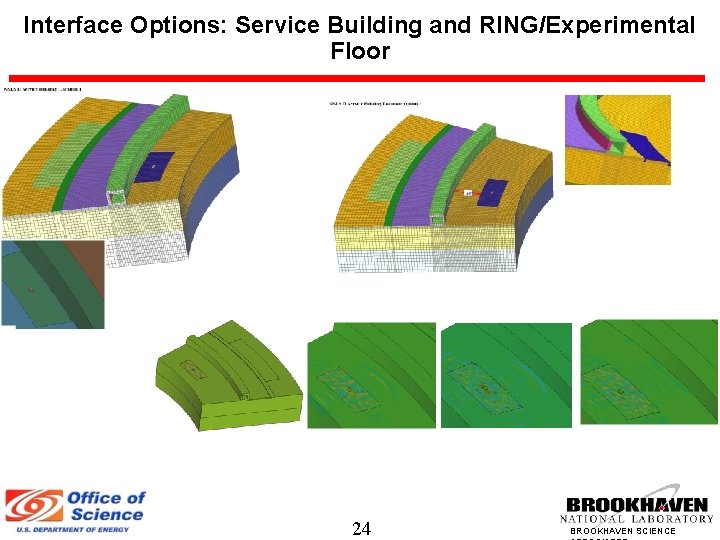
Interface Options: Service Building and RING/Experimental Floor 24 BROOKHAVEN SCIENCE
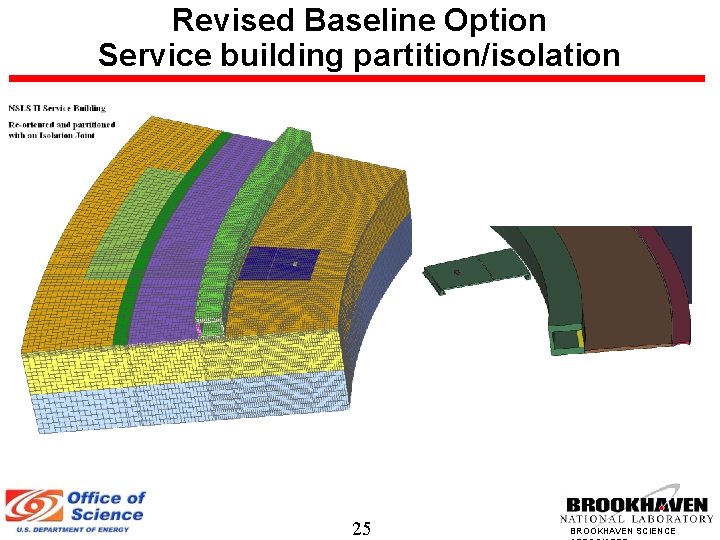
Revised Baseline Option Service building partition/isolation 25 BROOKHAVEN SCIENCE
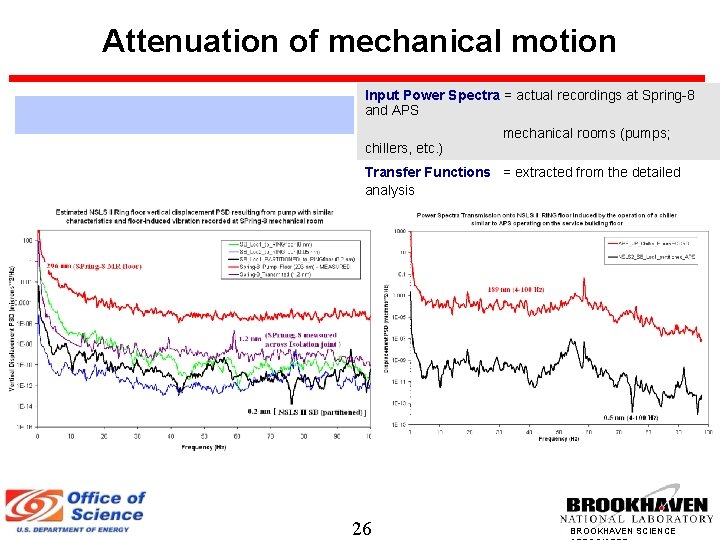
Attenuation of mechanical motion Input Power Spectra = actual recordings at Spring-8 and APS chillers, etc. ) mechanical rooms (pumps; Transfer Functions = extracted from the detailed analysis 26 BROOKHAVEN SCIENCE
How do we ensure that the computational models are leadings us to correct estimates? 27 BROOKHAVEN SCIENCE
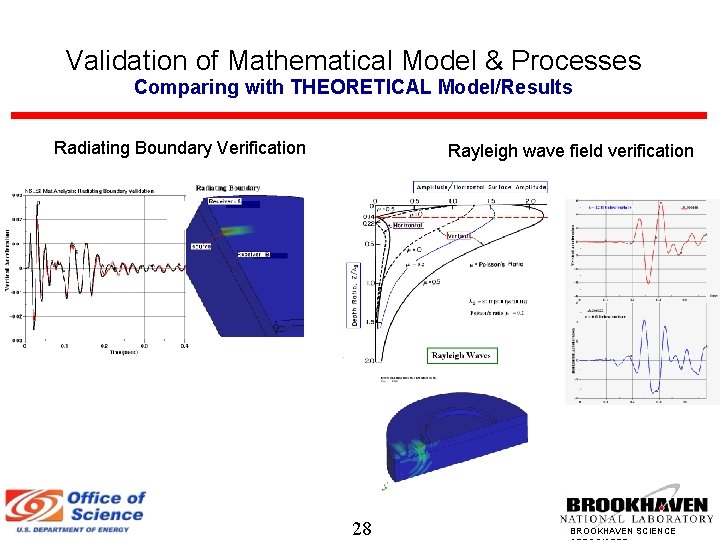
Validation of Mathematical Model & Processes Comparing with THEORETICAL Model/Results Radiating Boundary Verification Rayleigh wave field verification 28 BROOKHAVEN SCIENCE
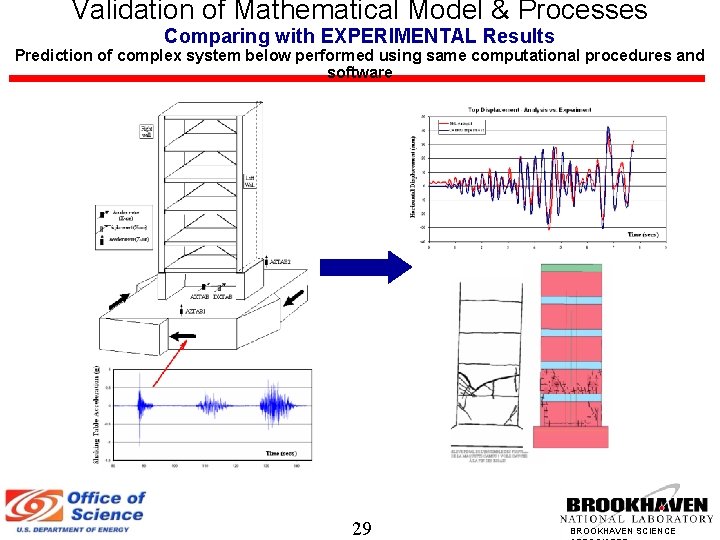
Validation of Mathematical Model & Processes Comparing with EXPERIMENTAL Results Prediction of complex system below performed using same computational procedures and software 29 BROOKHAVEN SCIENCE
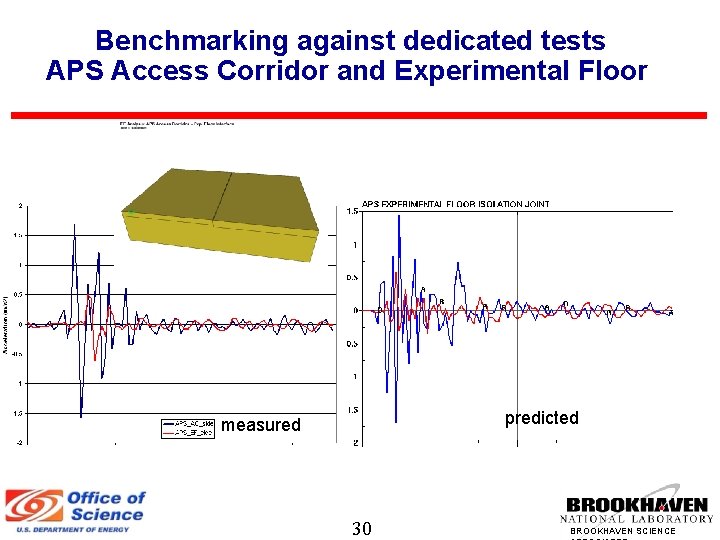
Benchmarking against dedicated tests APS Access Corridor and Experimental Floor predicted measured 30 BROOKHAVEN SCIENCE
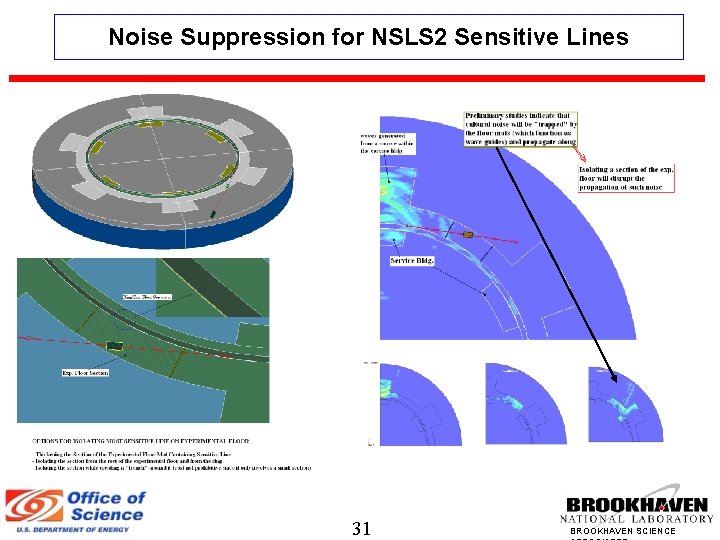
Noise Suppression for NSLS 2 Sensitive Lines 31 BROOKHAVEN SCIENCE
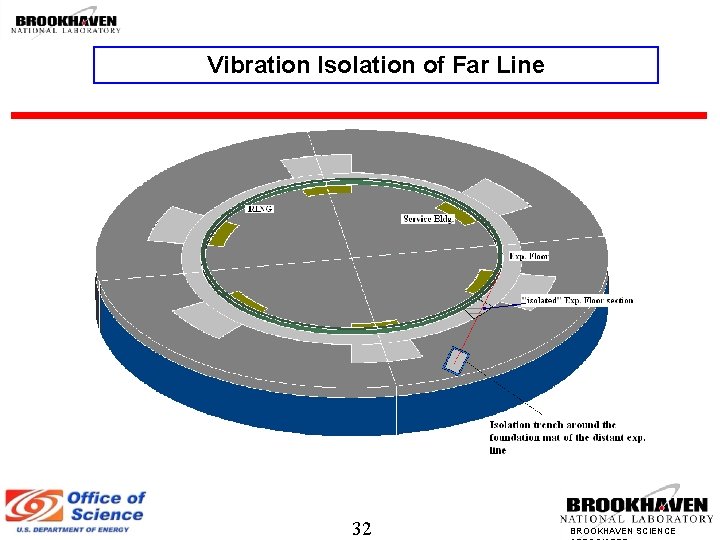
Vibration Isolation of Far Line 32 BROOKHAVEN SCIENCE
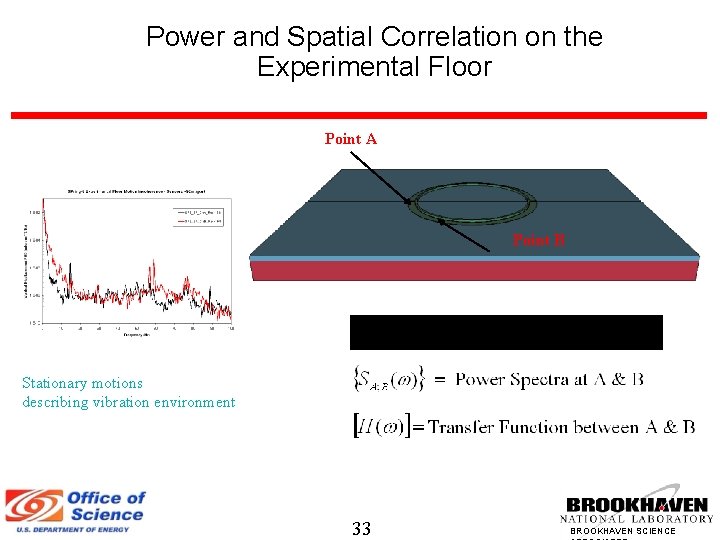
Power and Spatial Correlation on the Experimental Floor Point A Point B Stationary motions describing vibration environment 33 BROOKHAVEN SCIENCE
SUMMARY • • • Field vibration studies confirmed that the stability limits set for NSLS II (<25 nm; 4 -50 Hz) are satisfied by the selected site Field studies at operating facilities have provided realistic levels of in-house generated vibration as well as motion attenuation characteristics Studies at other facilities also provided a good understanding of what measures for noise suppression work and can be implemented into the design of NSLS II The use of benchmarked, large-scale dynamic analysis models combined with data recorded at other facilities have provided a powerful tool for assessing the anticipated motion at the NSLS II experimental and ring floors The combined computational model/actual noise data also provide the means to optimize • The in-house noise suppression • The ring and/or experimental floor thicknesses 34 BROOKHAVEN SCIENCE
PATH FORWARD • Utilize the newly installed network of ground motion measuring stations to monitor both the long-term vibration stability of the site as well as its spatial variation • Expand the site vibration study to include slow ground motions (low frequency end of the spectrum) and assess their space and time coherence for the NSLS II site • Continue to fine-tune the large-scale vibration analysis models based on specific and NSLS II-related field tests as well as on data generated at similar but operating • Complete the optimization of the NSLS II ring and experimental floor thicknesses (especially parts of exp. floor with extra-sensitive beam lines) • Assess the effectiveness of noise suppression features for implementation and integration into the final NSLS II design 35 BROOKHAVEN SCIENCE
- Slides: 35